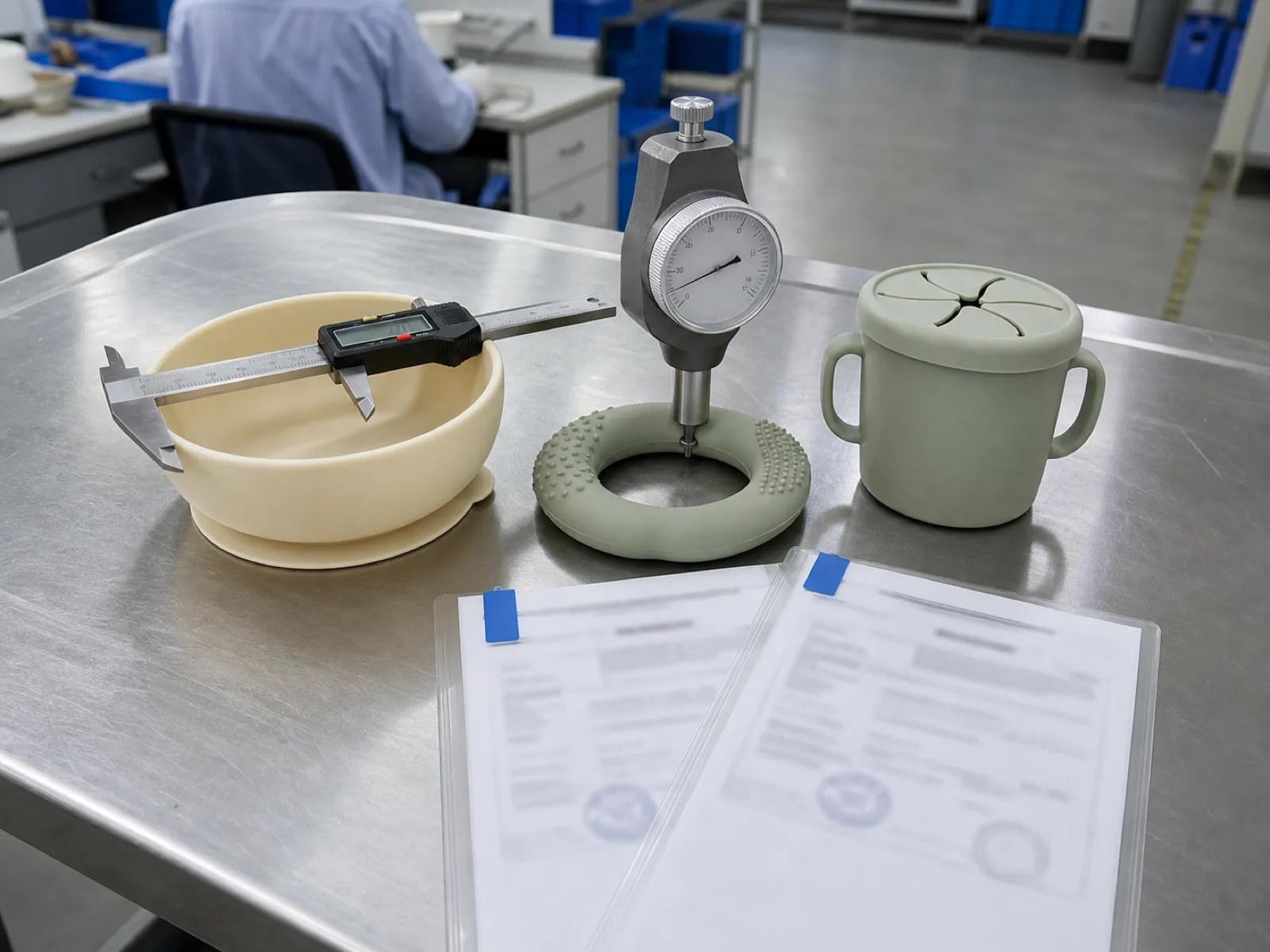
A China silicone baby products manufacturer worth working with molds only platinum-cured food-grade silicone and holds per-batch documentation against FDA 21 CFR 177.2600, LFGB §30/§31 (BfR Recommendation XV), and — for mouth-contact teethers and pacifiers — USP Class VI and ISO 10993 biocompatibility. The market you sell into decides the test stack: the US layers CPSIA lead and phthalate limits plus ASTM F963 for toy-classified items on top of FDA; the EU layers EN 14350 drinking-equipment and EN 71-3 element-migration testing on top of LFGB. Custom programs start at MOQ 500 pcs per SKU with 7–25 day first samples out of Dongguan, and the deciding question is never "is it food-grade" but "show me the migration report against this exact compound lot."
Buyers searching "china silicone baby products manufacturer" split into two groups. Established baby brands and retailers arrive with a spec and a compliance department, and they need a molder who can produce FDA, LFGB, EN 14350, and CPSIA paperwork against a documented compound without hand-holding. Newer brands and private-label buyers arrive earlier, unsure which of the alphabet-soup standards actually apply to a teether versus a bib versus a bottle spout. This guide serves both — written from inside a Dongguan liquid-silicone-rubber (LSR) injection floor and benchmarked against the primary regulations themselves[^fda-177-2600][^eu-1935-2004], not against a marketplace listing. One framing note up front: for feeding and toy items Wetop molds the finished silicone product; for anything that crosses into a medical claim we supply the silicone **component** and cite USP Class VI / ISO 10993, and your team owns any device submission.
A defensible manufacturer holds food-contact compliance to FDA 21 CFR 177.2600 (US) and LFGB §30/§31 via BfR Recommendation XV (EU), and for mouth-contact chew items adds USP Class VI and ISO 10993 biocompatibility. Toy-classified and drinking items then layer on ASTM F963, EN 71-3, EN 14350, and CPSIA lead and phthalate limits — proven per batch, not asserted once.
There is no single "baby-safe" certificate. The correct stack is assembled from three overlapping questions: is the silicone safe for **food contact**, is it safe for **prolonged mouth contact**, and does the finished article pass **mechanical toy/drinking-equipment safety**? Each has its own governing clause: | Standard / clause | Governs | Applies to | |---|---|---| | FDA 21 CFR 177.2600[^fda-177-2600] | US food-contact extractables (water + fatty simulants) | All US feeding items | | LFGB §30/§31 · BfR Recommendation XV[^bfr-fcm] | EU food-contact migration + volatile release for silicones | All EU feeding items | | EU Reg. (EC) 1935/2004[^eu-1935-2004] | EU framework: GMP + no health endangerment | All EU food-contact articles | | USP <88> Class VI[^usp-88] | In-vivo biological reactivity of the compound | Teethers, pacifier nipples (mouth contact) | | ISO 10993-1/-5/-10[^iso-10993-1] | Cytotoxicity, irritation, sensitization | Prolonged mouth/skin contact chew items | | EN 14350 | Mechanical + migration safety of drinking equipment | Bottles, teats, sippy spouts, valves, cups | | EN 71-3 | Migration of 19 elements from toy materials | Bath toys, sensory toys, teether-as-toy | | ASTM F963[^astm-f963] | US toy safety (small parts, mechanical, chemical) | Any teether/toy sold as a toy in the US | | CPSIA lead + phthalates[^cpsia-phthalates] | ≤100 ppm total lead; restricted phthalates <0.1% | All US children's products | The engineering point buyers miss: **food-grade is the floor, not the ceiling.** A silicone that clears FDA 21 CFR 177.2600 has proven only that its extractable fraction is within food-contact limits. It has said nothing about whether the finished teether has detachable small parts (ASTM F963), whether the pigment leaches lead (EN 71-3 / CPSIA), or whether a bottle spout survives the EN 14350 pull test. A manufacturer that answers "yes, it's food-grade silicone" to every one of those distinct questions is either uninformed or hoping you are. For the deeper split between the two food-contact schemes, see the [FDA vs LFGB silicone guide](/guide/fda-vs-lfgb-silicone/). ## Why is platinum-cured silicone the baby-safe default over peroxide-cured?Platinum-cured (addition-cure) silicone crosslinks through a platinum catalyst and produces zero reaction by-products, so a finished baby part has nothing to migrate. Peroxide-cured silicone leaves residual organic-peroxide by-products that must be baked out and can migrate if post-cure is skipped — a failure mode platinum-cure eliminates entirely, which is why it is non-negotiable for feeding and chew items.
Silicone comes in two cure chemistries, and for baby products the choice is not a preference — it is a safety gate. **Platinum-cured (addition-cure)** silicone uses a platinum-complex catalyst to add the polymer chains together. The reaction is clean: the only outputs are the crosslinked network itself. There is no acid, no organic residue, and — after a proper post-cure — no meaningful volatile fraction. This is the chemistry used for pacifier nipples, teethers, and premium feeding lines worldwide. **Peroxide-cured** silicone uses organic peroxides (commonly 2,4-dichlorobenzoyl peroxide) as the crosslinker. Those peroxides decompose during cure and leave acidic by-products in the part. Those by-products are what create the classic "new silicone" odor and taste, and they are exactly what you do not want a baby ingesting. They can be driven off — but only by an aggressive post-cure, and only if the factory actually runs it for the full time and temperature. | Attribute | Platinum-cured (addition) | Peroxide-cured | |---|---|---| | Cure by-products | None | Acidic organic residues | | Odor / taste | Neutral after post-cure | Detectable unless fully baked out | | Migration risk (baby) | Minimal | Real if post-cure is short | | Typical use | Teethers, nipples, feeding | Industrial extrusion, low-cost parts | | Cost | Higher | Lower | | Verdict for baby items | Default | Avoid | The trap in low-cost sourcing is a factory quoting a "food-grade silicone" price that is quietly peroxide-cured with a token post-cure, because the compound and the process are cheaper. It may even pass a fresh migration test — and then off-gas taste and residue weeks later. Specifying platinum-cure in the contract, and confirming it against the base-polymer supplier's CoA, removes the ambiguity. The full trade-off is in the [platinum-cured vs peroxide-cured silicone guide](/guide/platinum-cured-vs-peroxide-cured-silicone/). ## How do post-cure and migration testing actually prove food-contact safety?Post-cure is a 4–6 hour bake at roughly 200 °C that drives residual volatiles out of the molded part; migration testing then measures what still transfers into food simulants. Overall migration caps total non-volatile transfer (EU limit 10 mg/dm²), and specific migration checks named substances — together they convert "should be safe" into a measured mg/dm² result on the actual compound.
This is the section most sourcing guides skip, and it is the one that separates a real program from a paper one. "Food-grade silicone" describes a compound. Safety of the *finished part* depends on two process-and-test steps the compound alone cannot deliver. **Step 1 — the post-cure bake-out.** Freshly molded silicone still contains a small fraction of low-molecular-weight siloxanes and, in peroxide systems, cure residues. A secondary post-cure — typically **4–6 hours at ~200 °C** in a batch oven — volatilizes and removes them. Skipping or shortening this step is the single most common corner cut in cheap baby-product silicone, because oven time is capacity that could be molding the next order. A factory that cannot state its post-cure time and temperature, and log it per batch, has not earned a baby program. **Step 2 — migration testing on the post-cured part.** Migration testing measures what actually leaves the finished part into food: - **Overall migration (OML)** — the total mass of all substances that transfer into standard food simulants (water, 3% acetic acid, ethanol, and a fatty simulant). The EU limit under the framework regulation[^eu-1935-2004] is **10 mg/dm²** (or 60 mg/kg). This is the headline number an LFGB report reports. - **Specific migration (SML)** — the transfer of individually named substances of concern, each with its own limit. - **Volatile / VOC content** — LFGB testing for silicones (BfR Recommendation XV[^bfr-fcm]) includes a volatile-matter check, typically requiring the post-cured part to lose less than a set percentage on further heating — a direct proxy for whether the post-cure was done properly. The report you want to see states the simulants used, the contact time and temperature, and the OML result in mg/dm². A number below the limit on the exact master-batch lot in your parts is proof. "Food-grade" with no number is a claim. The difference between a food-grade and a stricter medical-grade compound — which some premium teether brands specify — is covered in the [food-grade vs medical-grade silicone guide](/guide/food-grade-vs-medical-grade-silicone/). ## Which baby product categories should a full-line factory cover?A full-line silicone baby manufacturer should mold four categories from one audited platinum-cured compound: feeding sets (suction bowls, plates, bibs, spoons), teethers and pacifiers, bath toys, and sensory toys. Mouth-contact items — teethers, nipples, spoon tips — carry the strictest biocompatibility burden and set the compound and post-cure discipline for the whole line.
The advantage of consolidating a baby line with one molder is a single audited compound and one test packet serving many SKUs. The categories, and what each demands: - **Feeding sets — suction bowls, plates, bibs, spoons, snack cups, placemats.** The volume core of most baby lines. Suction bowls need a molded suction base that actually holds (a geometry and durometer problem), bibs need a soft food-catch pocket, and spoon tips are mouth-contact. Shore A typically **40–60**: soft enough to be gentle, firm enough that a bowl holds shape and a suction base grips. - **Teethers and pacifiers.** The strictest category. These live in the mouth for hours, so they carry the full biocompatibility burden — USP Class VI[^usp-88] and ISO 10993[^iso-10993-1] on top of food-contact — plus mechanical safety (no detachable small parts, pull-strength on any ring or clip). Durometer skews **soft, Shore A 20–40**, to be gentle on gums. Molded-in relief textures and multi-durometer two-shot builds are common. - **Bath toys.** Solid or closed-cell silicone is preferred over hollow squeeze toys because the classic hollow bath toy traps water and grows mold. If a squeeze toy is required, a sealed one-piece silicone design with no pinhole is the defensible route. These are toys: EN 71-3[^cpsia-phthalates] element migration and ASTM F963[^astm-f963] apply. - **Sensory toys.** Textured teething rings, stacking rings, soft blocks, and grip toys — feeding-safe silicone chosen for chew-safety and tactile variety. Same toy-safety stack as bath toys, plus mouth-contact biocompatibility because babies mouth everything. One durometer and one color library rarely span all four, but **one platinum-cured base compound and one biocompatibility packet can** — which is the real reason to consolidate rather than split a line across a feeding factory and a toy factory with two different compounds and two different post-cure disciplines.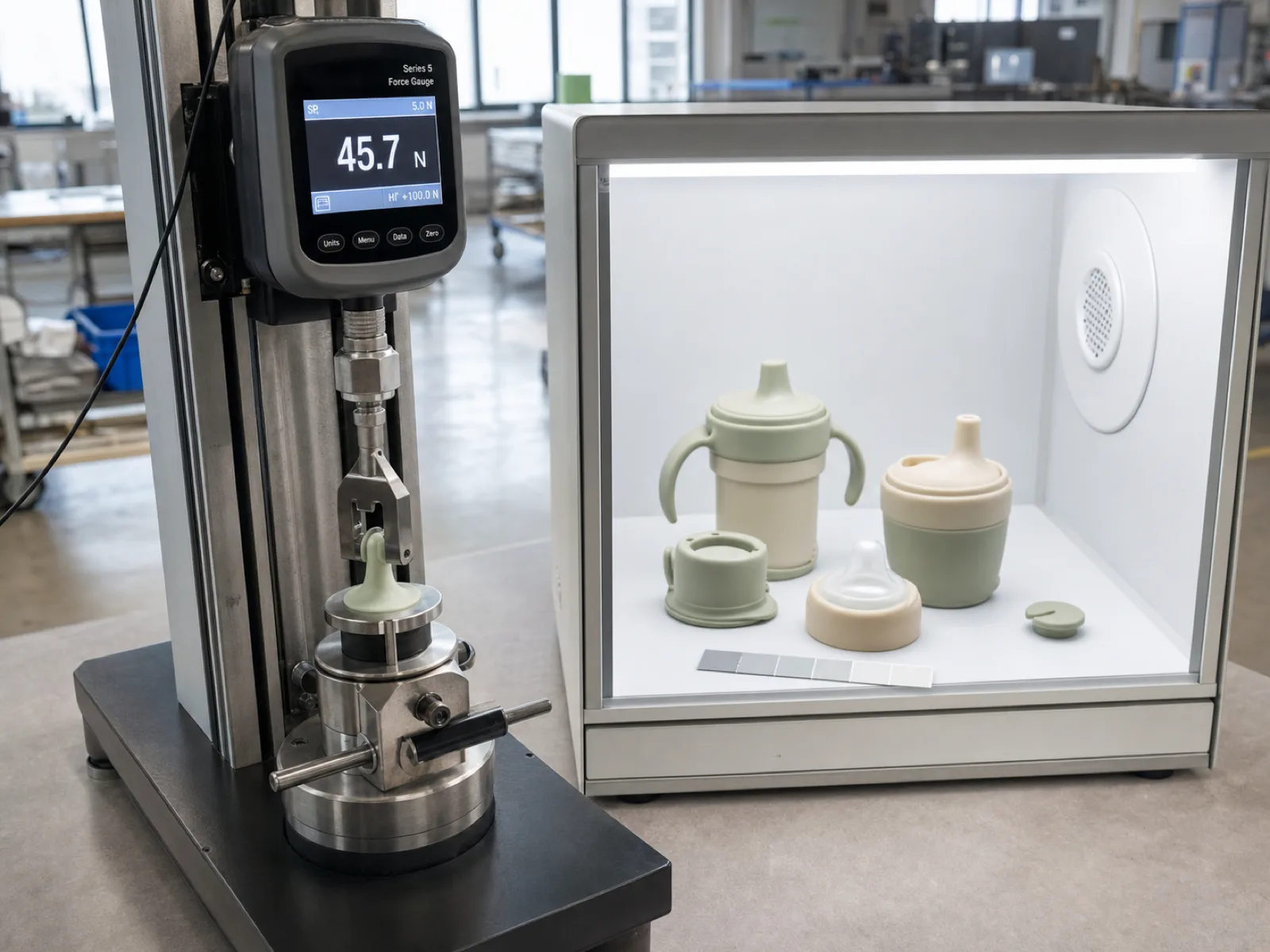
The two markets need different report sets. US: FDA 21 CFR 177.2600 for food contact, CPSIA lead (≤100 ppm total) and phthalate (<0.1%) limits, and ASTM F963 for toy-classified items. EU: LFGB via BfR Recommendation XV for food contact, EN 14350 for drinking equipment, and EN 71-3 element migration for toys. A dual-market factory holds both against one molded compound.
This is the mapping that decides which tests a factory must run before your product can legally sell: | Requirement | United States | European Union / UK | |---|---|---| | Food-contact material | FDA 21 CFR 177.2600[^fda-177-2600] | LFGB §30/§31 · BfR Rec. XV[^bfr-fcm] · Reg. 1935/2004[^eu-1935-2004] | | Drinking equipment (bottle/spout/cup) | FDA + ASTM F963 (if toy) | EN 14350 (mandatory) | | Toy-classified item (teether/bath toy) | ASTM F963[^astm-f963] + CPSIA | EN 71-1/-2/-3[^cpsia-phthalates] | | Heavy metals / lead | CPSIA ≤100 ppm total lead | EN 71-3 element migration + REACH[^echa-reach] | | Phthalates | CPSIA restricted set <0.1% | REACH restriction + EN 71 | | Chemical registration | TSCA (material level) | REACH[^echa-reach] | Two practical consequences. First, a teether sold in the EU as a toy needs both LFGB (it goes in the mouth with food-contact expectations) **and** EN 71-3 (it is a toy) — one report does not cover the other. Second, EN 14350 is frequently missed on the US side of a dual launch because there is no direct US equivalent, and then missed on the EU side because the brand assumed LFGB was enough; a silicone spout, teat, or valve into the EU/UK needs EN 14350 regardless of its food-contact status. A factory that has run both stacks before will flag these gaps at quotation, not after the first customs hold. ## What OEM and ODM customization is available for silicone baby products?Customization spans material, color, form, and branding: durometer selection (Shore A 20–60), Pantone color-matching to ΔE ≤ 1.5 with food-contact master-batch, single-shot or two-shot/co-injection molding, molded-in debossing or food-safe printing outside mouth zones, and full retail packaging. OEM works from your finished design; ODM starts from a factory reference design you re-skin and re-brand.
The customization levers on a silicone baby program, and where each is set: - **Durometer.** Shore A per ASTM D2240[^astm-d2240], typically 20–40 for chew items and 40–60 for structural feeding parts. Set at compound selection. - **Color.** A food-contact silicone master-batch pigment matched to a Pantone reference, held to **ΔE ≤ 1.5 under D65** and verified in a light box against a signed physical swatch — never a screen. Muted, pastel palettes are standard for baby lines and match silicone's natural translucency better than saturated colors. - **Form / construction.** Single-shot for one material; **two-shot (2K) or co-injection** to combine a soft chew zone with a firmer grip, or two colors in one part, in a single tool cycle. This is how multi-texture teethers and soft-tip-on-firm-handle spoons are built. - **Branding.** Molded-in **debossing or embossing** is preferred on baby products because there is no ink or coating to abrade near the mouth. Where printing is needed, food-safe pad or screen printing is kept strictly outside mouth-contact zones. Logo customization detail — deboss, print, laser — is set at the tooling stage. - **Packaging.** Retail cartons, blister/clamshell, header bags, and barcode/compliance labeling — the last mile most factories treat as an afterthought and a baby brand cannot. The OEM/ODM distinction matters at MOQ and IP. **OEM** means you bring the finished design and own the tool and the IP outright. **ODM** means you start from a factory reference design and re-skin it — faster and cheaper to launch, but the base geometry may be shared, so confirm exclusivity in writing if the silhouette matters to your brand. ## What are the MOQ, tooling cost, and lead times?Custom silicone baby product MOQ starts at 500 pcs per SKU. A new LSR injection tool runs roughly $3,000–9,000 by cavity count and geometry, first-article samples take 7–25 days, and mass production is 20–35 days for 20,000–200,000 pcs. At low volume the tooling amortization, not per-unit silicone, dominates landed cost — so multiple colors of one design beat multiple molds.
The numbers a baby brand plans a launch around: | Program parameter | Typical value | |---|---| | MOQ | 500 pcs per SKU (one design × one color × one durometer) | | Tooling — single-cavity teether | ~$3,000–5,000 | | Tooling — multi-cavity feeding item | ~$5,000–9,000 | | First-article sample lead | 7–25 days (existing → new tool) | | Mass-production lead | 20–35 days for 20k–200k pcs | | Color-match setup | 3–7 days (with signed swatch) | | Documentation packet | FDA / LFGB / EN / CPSIA references per shipment | The cost structure is the part buyers most often misread. A silicone baby product's landed cost is roughly: **material** (compound grade × part weight), **cure system premium** (platinum > peroxide; LFGB-tested compounds cost more than FDA-only), **labor and machine time** (cycle time, de-flash, assembly), and **tooling amortized over the run**. At 500–2,000 units, tooling amortization is the single largest line — a $6,000 mold spread over 1,000 units adds $6 per part before any silicone is bought. Which is why the cheapest way to widen a range is more colors on one tool (near-zero tooling delta), and the most expensive is more molds. The full breakdown lives in the [MOQ and lead time guide](/guide/moq-and-lead-time-silicone-oem/). ## How do you vet and audit a Chinese silicone baby products supplier?Vet the factory, not the listing: verify every test report names the accredited lab and the specific master-batch lot, confirm the ISO 9001 certificate scope says "manufacturing of silicone products" not "trading," ask to video-walk the LSR injection cell and post-cure oven, and confirm the base-polymer supplier's CoA. These four checks separate a real Dongguan molder from a re-labeling trading company.
Baby products carry recall and liability risk that makes supplier due diligence non-optional. The audit checklist: 1. **Test-report authenticity.** Every FDA, LFGB, EN, and CPSIA report should name the **accredited lab** (SGS, Intertek, TÜV, Bureau Veritas), reference the **specific compound lot**, be **dated within 1–3 years**, and state the actual measured result (migration in mg/dm², lead in ppm) — not just "pass." Cross-check the report number on the lab's own verification portal; recycled and edited PDFs are the most common fraud. 2. **ISO 9001 scope.** Ask whose legal entity holds the certificate and read the **scope line**. "Manufacturing of silicone rubber products" is a molder; "trade of silicone products" is an intermediary. A trading company can hold ISO 9001 for its office and never touch a mold. 3. **See the process.** A real molder will do a live video walk of the **LSR injection cell** and, critically, the **post-cure oven** — the step cheap suppliers skip. A trader deflects, reschedules, or sends stock footage. This one request filters most re-labelers. 4. **Base-polymer traceability.** Ask for the CoA from the **base-LSR supplier** — Dow, Wacker, Momentive, or Shin-Etsu are the defensible sources for baby-grade platinum-cure. A molder has it on file; a trader usually cannot produce it. 5. **Engineering conversation.** Ask a specific question — post-cure time and temperature, durometer tolerance, or how they hold suction-base flatness. A molder answers in numbers and process steps; a trader answers in adjectives. **On the Dongguan cluster:** the Pearl River Delta around Dongguan concentrates silicone base-polymer distribution, master-batch and pigment houses, LSR tooling shops, and accredited testing labs within a short radius. That density is a genuine supply-chain advantage — tooling iterations and lab turnarounds are faster, and a molder can source medical- and food-grade base compounds and food-contact pigments without long inland freight. It is also why the region hosts both serious founder-led molders and a long tail of trading offices; the checklist above is how you tell them apart. Wetop is a founder-led Dongguan molder — the injection cell and post-cure oven are ours, not a partner's. ## Frequently asked questions The FAQ block above the References list is rendered from the guide frontmatter and mirrors the FAQPage schema verbatim — Gemini and other AI answer engines use it for claim verification. ## Sourcing custom silicone baby products — what happens next Wetop molds custom silicone baby products at MOQ 500 pcs per SKU on platinum-cured food-grade silicone, with a documented 4–6 hour / ~200 °C post-cure and per-batch FDA 21 CFR 177.2600, LFGB §30/§31, EN 14350, EN 71-3, and CPSIA test-report references delivered against every shipment. Founder-led engineering desk in Dongguan; no trading intermediary. For mouth-contact items we back the compound with USP Class VI and ISO 10993 references — we supply the biocompatible silicone; your team owns any device-level claim. To move from RFQ to first-article sample in 7–25 days, [talk to the engineering desk](/contact/) with your product category, target markets (US / EU / UK), durometer and color targets, and required documentation list. Sample turnaround is quoted against a defined platinum-cured master-batch lot with the FDA and LFGB report references attached — not a stock claim. [^fda-177-2600]: FDA / eCFR — [21 CFR 177.2600, Rubber articles intended for repeated use](https://www.ecfr.gov/current/title-21/chapter-I/subchapter-B/part-177/subpart-C/section-177.2600). [^eu-1935-2004]: EUR-Lex — [Regulation (EC) No 1935/2004 on food contact materials](https://eur-lex.europa.eu/legal-content/EN/TXT/?uri=CELEX:32004R1935). [^bfr-fcm]: BfR — [Recommendations on food contact materials (Recommendation XV — Silicones)](https://www.bfr.bund.de/en/home.html). [^usp-88]: USP — [<88> Biological Reactivity Tests, In Vivo (Class I–VI)](https://www.usp.org/harmonization-standards/pdg/excipients/biological-reactivity-tests). [^iso-10993-1]: ISO — [ISO 10993-1:2018 Biological evaluation of medical devices — Part 1](https://www.iso.org/standard/68936.html). [^astm-f963]: CPSC / eCFR — [16 CFR Part 1250, Safety Standard Mandating ASTM F963 for Toys](https://www.ecfr.gov/current/title-16/chapter-II/subchapter-C/part-1250). [^cpsia-phthalates]: CPSC / eCFR — [16 CFR Part 1307, Phthalates in Children's Toys and Child Care Articles](https://www.ecfr.gov/current/title-16/chapter-II/subchapter-C/part-1307). [^echa-reach]: ECHA — [Understanding REACH](https://echa.europa.eu/regulations/reach/understanding-reach). [^astm-d2240]: ASTM — [D2240-15(2021) Durometer Hardness](https://www.astm.org/d2240-15r21.html).