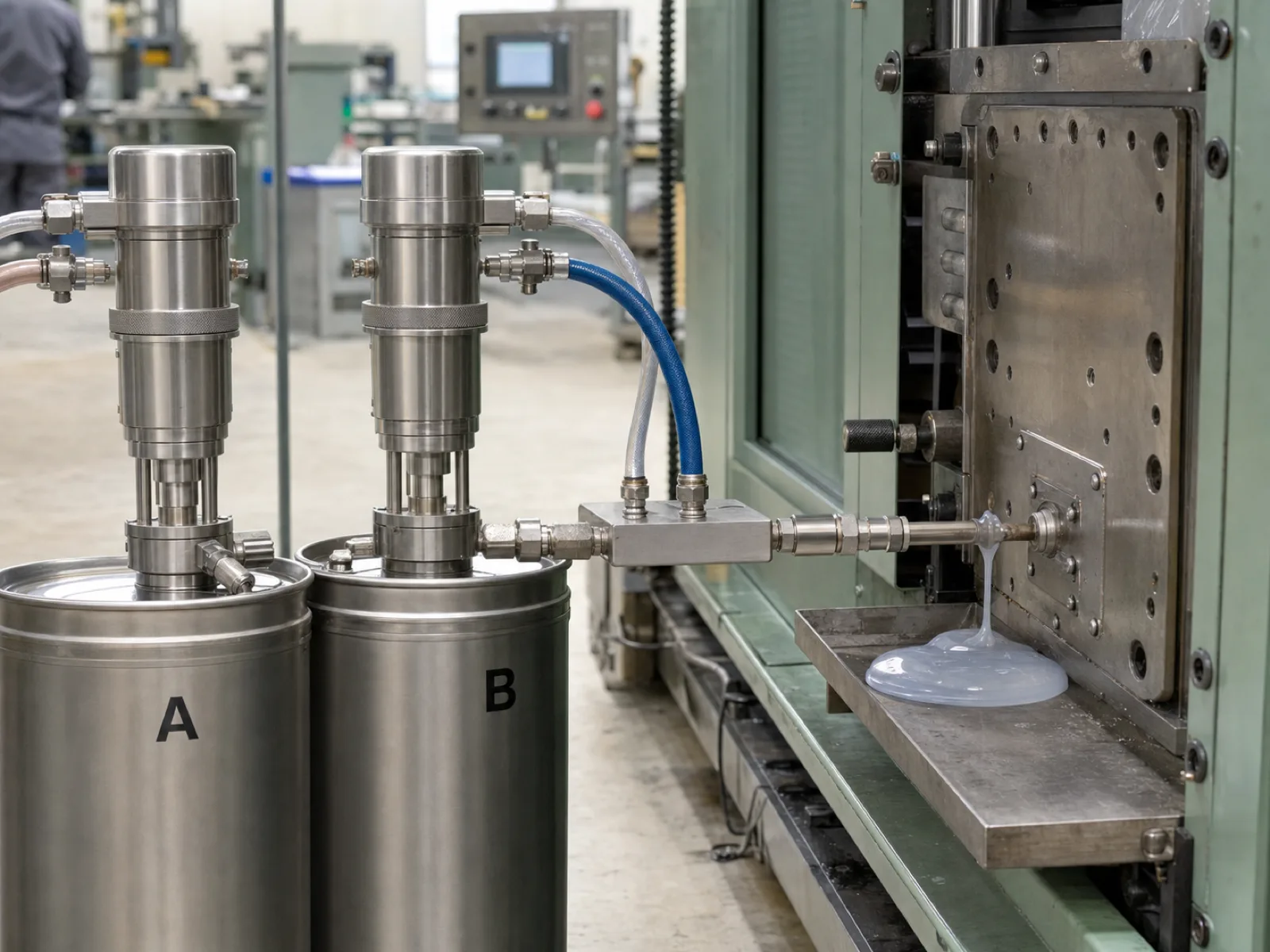
Custom silicone sex toys are body-contact intimate wellness SKUs manufactured from platinum-cured medical-grade silicone under a documented ISO 9001 quality system. The material must clear ISO 10993-5 cytotoxicity and ISO 10993-10 skin sensitisation, in addition to FDA 21 CFR 177.2600 food-contact conformity. A realistic OEM program runs 12-18 weeks from CAD to first shipment at 500-5,000 unit MOQ, depending on whether the SKU is compression-molded or LSR-injected.
This is a manufacturing-engineering guide written for adult-wellness brand founders, product-development leads, and category buyers who need to specify, tool, and audit a custom silicone intimate product program. It skips consumer marketing and focuses on the four decisions that actually change unit cost, safety documentation, and retailer acceptance: cure chemistry, biocompatibility scope, tooling class, and compliance packet. ## What makes silicone the correct material for intimate products?Platinum-cured medical-grade silicone is the correct material for intimate products because it is non-porous, thermally stable from -40 °C to 230 °C, chemically inert, and — when properly post-cured — leaves no leachable residues that migrate into skin or mucosal tissue. No competing elastomer (TPE, PVC, latex, jelly rubber) clears the same biocompatibility slate.
Every other candidate elastomer fails on one of three axes. Thermoplastic elastomers (TPE / TPR) are porous at the micron scale — they harbour biofilm and cannot be sterilised without dimensional creep. PVC requires phthalate plasticisers to hit the required softness range; phthalates are on the REACH SVHC list[^reach-svhc] and disqualified under California Proposition 65[^prop-65]. Latex is an allergen. Jelly rubber contains uncontrolled additive packages and no serious retailer will accept it. Platinum-cured silicone, by contrast, cures by a hydrosilylation addition reaction — the platinum catalyst adds a Si-H bond across a vinyl group, with no by-products. That reaction chemistry is what unlocks USP Class VI classification[^usp-class-vi] and clean ISO 10993-5 cytotoxicity results[^iso-10993-5]. Peroxide-cured silicone, in contrast, releases residues such as 2,4-dichlorobenzoic acid from the peroxide catalyst — extraction studies show these residues migrating at the ppm scale even after post-cure. For any product with mucosal or prolonged skin contact, platinum-cure is the only defensible choice. The full cure-chemistry decision matrix is documented in our /guide/platinum-cured-vs-peroxide-cured-silicone/ deep dive.
ISO 10993-5 (cytotoxicity) and ISO 10993-10 (skin sensitisation and irritation) are the baseline for body-contact intimate products. ISO 10993-23:2021 adds in-vitro irritation for mucosal contact. FDA 21 CFR 177.2600 covers the base rubber compound. Test cost runs USD 1,500-4,000 per compound per report — amortised across every SKU sharing that stock.
The standards stack like this. FDA 21 CFR 177.2600[^fda-177-2600] classifies the rubber compound itself as safe for repeated food contact — that is the entry ticket for the raw silicone gum. ISO 10993-5 tests whether a fabricated part extract kills cultured cells (cytotoxicity). ISO 10993-10 tests whether it triggers skin sensitisation or acute irritation. ISO 10993-23[^iso-10993-23] adds the in-vitro reconstructed-epidermis irritation model that many mucosal-contact device applications now require. | Standard | Scope | Sample cost | Typical turnaround | |---|---|---|---| | FDA 21 CFR 177.2600 | Base silicone compound conformity | USD 400-900 per compound | 2-3 weeks | | ISO 10993-5 (cytotoxicity) | Finished part extract, in-vitro | USD 900-1,500 | 3-4 weeks | | ISO 10993-10 (skin sensitisation) | Finished part, guinea pig or in-vitro | USD 1,500-3,500 | 5-8 weeks | | ISO 10993-23 (irritation, in-vitro) | Finished part, mucosal-contact SKUs | USD 1,200-2,500 | 4-6 weeks | | USP Class VI | Base compound classification | USD 2,000-3,500 | 6-8 weeks | USP Class VI[^usp-class-vi] is an American Pharmacopoeia classification — some premium LSR datasheets carry it as a shorthand for "already cleared for implantable-adjacent medical devices," which reassures buyers who don't want to re-test every compound change. A compound with pre-existing Class VI documentation removes the ISO 10993-5 test burden from most SKU launches. ## How does OEM vs ODM change the tooling and IP structure?OEM means the buyer owns the CAD, the mold, and the design IP — the factory sells production hours. ODM means the factory owns those assets — the buyer pays per unit at a lower entry cost but cannot move the SKU. For intimate wellness brands with a defensible design, OEM is the only structure that preserves category defensibility.
The OEM structure looks like this: the brand delivers CAD (STEP or Parasolid), a materials specification, and a dimensional report template. Wetop delivers SLA masters for concept validation, a CNC aluminum mold, T1 samples with a First-Article Inspection (FAI) report, and production units against a Purchase Order. The mold is engraved with the brand's tool number and stored in a controlled tool room — William reviews every intimate-product tool release personally because the failure mode of a mis-configured overmold cell is delamination against a mucosal surface, which is a recall-grade event. The ODM structure moves the CAD and tooling ownership to Wetop. That is faster and cheaper to launch — the brand pays a per-unit price against an existing tool — but the same mold cannot be exclusive to one buyer without contractual carve-outs, and the design cannot be manufactured elsewhere. The math on which is right for a given brand is walked through in our /guide/moq-and-lead-time-silicone-oem/ guide. ## What MOQ, tooling cost, and lead time should a brand plan for?Compression-molded intimate SKUs run 500-1,000 unit MOQ with aluminum tooling at USD 1,800-4,500 and a 12-week end-to-end lead time. LSR-injected SKUs require 3,000-5,000 unit MOQ with steel tooling at USD 8,000-25,000 and a 16-20 week lead time. LSR only pencils out above ~10,000 units per year on a single SKU.
| Parameter | Compression molding | LSR injection molding | |---|---|---| | Tooling material | Aluminum (7075 or P20) | Hardened steel (S136 or NAK80) | | Tooling cost | USD 1,800-4,500 | USD 8,000-25,000 | | Tooling lifetime | 50,000-80,000 shots | 500,000-1,000,000 shots | | Cycle time | 3-6 min per shot | 30-90 seconds per shot | | Realistic MOQ | 500-1,000 units | 3,000-5,000 units | | Dimensional tolerance | ± 0.15 mm | ± 0.05 mm | | Colour changeover | 2-3 hours | 4-6 hours | | End-to-end lead time | 12-14 weeks | 16-20 weeks | | Break-even volume | Ships from unit 1 | ~10,000 units/year | The end-to-end lead time breaks down as: 1-2 weeks of CAD review and DFM feedback, 1 week for SLA masters and concept sign-off, 4-6 weeks for CNC tooling (aluminum) or 8-12 weeks (steel), 2 weeks for T1 samples and dimensional report, 2 weeks for biocompatibility and IPX7 validation, and 2-4 weeks for the production run itself. The 500-unit MOQ math is walked through numerically in our /guide/real-factory-moq-the-math/ guide. ## How does dual-durometer overmolding work in practice?Dual-durometer overmolding combines a Shore A 5-10 skin-feel outer layer with a Shore A 40-60 structural core in one part. It is executed either in a two-shot LSR cell — where Component B injects into a repositioned mold cavity around Component A — or via a sequential bond-cure process on compression tooling. Both layers must be platinum-cured for chemical adhesion.
Two-shot LSR is the automated route: the first shot forms the core in cavity position 1, the mold rotates or slides, and the second shot injects the softer skin around it. Adhesion is achieved through a co-vulcanisation reaction at the interface — the second-shot vinyl groups cross-link into the first-shot Si-H network. This is why cure-chemistry mismatch is a hard failure: a platinum-cure skin will not chemically bond to a peroxide-cure core, and the two layers delaminate under body-temperature cyclic flex. Sequential bond-cure on compression tooling is the small-volume route: the core is molded, surface-primed with a silicone bonding agent, and returned to a second cavity where the skin is molded and cured over it. The bond strength is 60-80 % of a two-shot LSR joint — adequate for many SKU geometries, and it lets brands validate the dual-durometer design at compression-tooling economics before committing to LSR steel. Hardness measurement across the finished part uses a Shore A durometer per ASTM D2240[^astm-d2240]. QC pulls one part per lot and takes durometer readings at three defined locations — skin, transition, and core — logged into the batch report. Any reading outside the ± 3 Shore A tolerance band triggers a batch hold. ## What does the compliance packet look like for major retailers?A ship-ready compliance packet for major adult-wellness retailers contains ISO 10993-5 and -10 reports on the finished part, an FDA 21 CFR 177.2600 declaration on the compound, a REACH SVHC statement ≤ 0.1 %, a California Prop 65 declaration, a phthalate-free statement, a CE / RoHS 3 file if the SKU is powered, and an IPX7 waterproof test report per IEC 60529 for submersible units.
The retailer vetting sequence is predictable. Lovehoney and Babeland both request the biocompatibility reports up front — before purchase-order confirmation — because a returned recall is a category-wide reputation event. EU chains additionally verify the REACH SVHC statement[^reach-svhc] against the current candidate list, which is refreshed by ECHA on a rolling basis. Products sold into California require the Prop 65[^prop-65] declaration whether the retailer requests it or not — the enforcement mechanism is private-party litigation, and a compliant declaration is the operative defence. Waterproof validation follows IEC 60529[^iec-60529]. IPX7 requires a 1 m submersion for 30 minutes with no water ingress into the electronics housing. That is a per-batch validation on a sample of 5-10 units, logged with the seal-material lot number and the assembly torque. Our /guide/is-silicone-body-safe-guide/ walks the material-side compliance question from first principles. ## How is body-safety documented at the batch level?Every production lot ships with a Certificate of Conformity that references the compound lot number, the ISO 10993 test report ID, the post-cure temperature and time log, and a per-batch extractables screen against the target migration limit. Each unit carries a laser-marked or inkjet-coded lot number for downstream recall traceability.
The traceability chain runs from raw compound to shipped carton. Raw platinum-cured silicone arrives with a certificate of analysis (CoA) from the compound supplier — Wetop's incoming QC records the CoA number, the compound lot, the durometer, and the visual inspection into a batch-record system. During molding, cure temperature and time are logged on a per-shot basis. Post-cure — typically 4 hours at 200 °C for intimate products — is logged with oven identifier and thermocouple trace. Extractables screening is run on 3-5 units per production lot: solvent extraction against a defined migration limit, gas chromatography readback, and a pass/fail against the compound's baseline profile. The laser-marked lot number ties every unit to that batch record. If a downstream recall is triggered — by a retailer complaint, a REACH candidate-list update, or an internal QC deviation — the affected lot is isolated from a database query, not from a physical inventory sweep. That is the discipline that separates audited OEM factories from Alibaba-tier vendors: the ability to answer "which units are affected" in minutes, not weeks. ## Frequently Asked Questions *See the Questions & Answers section rendered by the guide template — 10 KW-specific FAQs sourced from the frontmatter above.* ## Where to go next If your brand is comparing cure chemistry, tooling class, or the compliance packet for an intimate wellness OEM program, the fastest path forward is a scoped conversation with the engineering desk. Send the CAD, the target retailer list, and the annual volume forecast to [inquiry@wetopsilicone.com](/contact/) — we will return a DFM feedback pack, a tooling-class recommendation, and a compliance-packet checklist within five business days. For programs still at concept stage, our SLA prototype process closes the geometry-validation loop for USD 250-600 before any tooling commitment. [^iso-10993-5]: ISO 10993-5:2009 — Biological evaluation of medical devices — Part 5. [^iso-10993-10]: ISO 10993-10:2010 — Biological evaluation of medical devices — Part 10. [^iso-10993-23]: ISO 10993-23:2021 — Biological evaluation of medical devices — Part 23. [^fda-177-2600]: 21 CFR 177.2600 — Rubber articles intended for repeated use. [^usp-class-vi]: USP <88> — Biological Reactivity Tests, In Vivo (Class VI classification). [^astm-d2240]: ASTM D2240 — Standard Test Method for Rubber Durometer Hardness. [^reach-svhc]: REACH — Substances of Very High Concern (SVHC) Candidate List, ECHA. [^iec-60529]: IEC 60529 — Degrees of protection provided by enclosures (IP Code). [^prop-65]: California Proposition 65 — Safe Drinking Water and Toxic Enforcement Act.