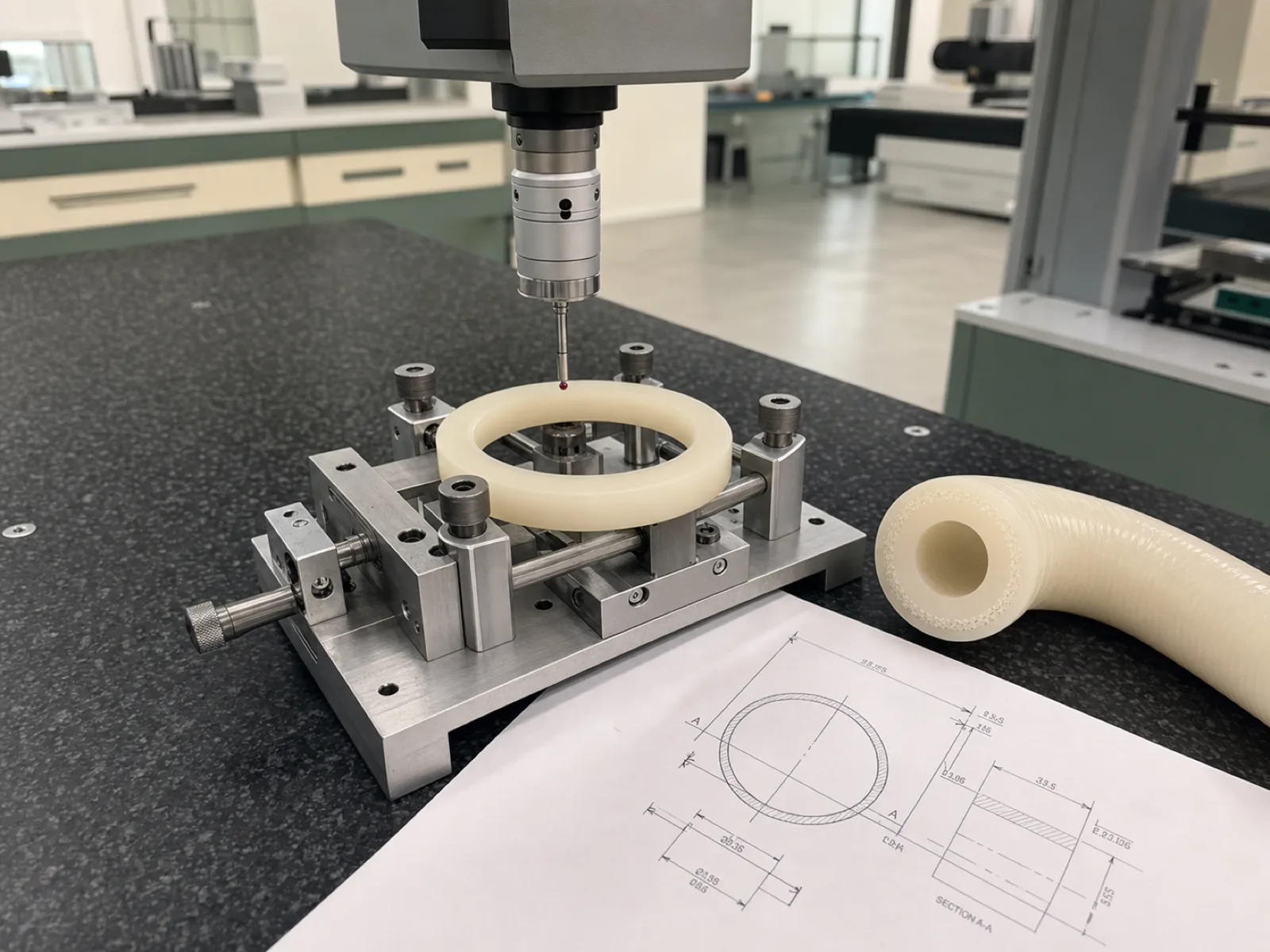
A custom silicone parts manufacturer is a factory that molds silicone components to your drawing — gaskets, seals, grommets, keypads, tubing, and overmolded assemblies — instead of selling catalog parts. Choosing one means verifying in-house molding capacity, an ISO 9001 quality system, and part-level FDA, LFGB, or USP Class VI certification, then confirming they own the tooling and presses rather than brokering your order to a third party. Wetop molds custom silicone parts at MOQ 500 from a 7,500 m² ISO 9001 factory in Dongguan, quoting compression, LSR injection, extrusion, and die-cutting under one roof.
Sourcing custom silicone parts is a supplier-selection problem before it is an engineering problem. The wrong factory quotes a process it cannot run, the wrong trading company subcontracts your tool to a molder you never see, and the wrong certification claim surfaces at customs instead of at the RFQ. This guide is the engineering-desk playbook for evaluating a custom silicone parts manufacturer — the OEM and ODM services to expect, the four processes a full-service factory should offer, material and property specs that belong in your drawing, the certifications that actually matter by clause number, the factory-versus-trading-company tests that expose brokers, and the MOQ, tooling, and lead-time math most supplier pages never publish. ## What is a custom silicone parts manufacturer and what do they do?A custom silicone parts manufacturer is a factory that engineers and molds silicone components to a customer's drawing rather than selling standard catalog parts. Its core functions are tooling design, compound selection and mixing, molding, secondary operations, and per-lot quality certification — all controlled in-house so one party is accountable for the part from drawing lock to shipped carton.
The defining trait of a real manufacturer is that it converts a drawing into a tool and a tool into parts on equipment it owns. That vertical chain — DFM review, mold cutting, silicone compounding, press molding, deflashing, inspection — is what a buyer is actually paying for, and it is exactly what a trading company cannot provide because it owns none of those stages. The distinction is not pedantic: when a tolerance drifts or a lot fails a migration test, only a factory that controls the process can root-cause it, and only a factory that keeps the batch record can prove which lot shipped where. Custom silicone work also differs from custom plastics or metals in one way that shapes how you evaluate a supplier. Silicone properties are compounded, not just selected — a manufacturer with an in-house mixing line can tune durometer, tear strength, and cure speed for your part, while a factory that buys pre-mixed compound is limited to what a distributor stocks. When you evaluate a custom silicone parts manufacturer, the presence of a compound-mixing operation and a materials lab is a stronger capability signal than the number of presses on the floor. ## What OEM and ODM services do custom silicone parts manufacturers provide?OEM service molds to your finished drawing — you own the design and IP, the manufacturer owns the process. ODM service adds design-for-manufacturing input, material engineering, and sometimes original geometry, so you arrive with a functional requirement and leave with a producible, tooled part. Full-service factories offer both, plus tooling, secondary operations, certification testing, and First Article Inspection.
The OEM-versus-ODM line is about who owns the drawing, and it changes what you should expect from the engagement. In an OEM relationship you send a locked 2D drawing or 3D STEP file and the manufacturer's job is to reproduce it faithfully within ISO 3302-1 tolerances. In an ODM relationship you send a functional brief — "a food-safe seal that holds 2 bar at 150°C and demolds without a post-trim" — and the manufacturer's engineering desk selects the compound, designs the geometry, and owns the DFM. Most silicone programs sit somewhere between the two, which is why a factory's willingness to give real DFM feedback on your drawing is the truest test of whether it is engineering-led or order-taking. A full-service manufacturer bundles the stages a buyer would otherwise coordinate across three vendors. The value is a single accountable party, but the trade-off is that not every "full-service" claim is real — some factories subcontract tooling or printing and lose the accountability the label implies. Our [sourcing a silicone factory checklist](/guide/sourcing-silicone-factory-checklist/) walks the exact questions that confirm which stages a supplier actually runs in-house. ### Service scope — what a full-service silicone parts manufacturer should own | Service stage | What it covers | Why in-house matters | |---|---|---| | DFM review | Wall thickness, draft, parting line, undercut analysis | Catches tooling problems before the tool is cut | | Tooling design + build | Aluminum or hardened-steel mold, cavity layout | Controls tolerance, lead time, and re-cut cost | | Compound selection + mixing | Durometer, cure system, color master-batch | Tunes properties to the part, not to a stock grade | | Molding | LSR injection, compression, transfer, extrusion | The core process — never subcontract this | | Secondary operations | Overmolding, printing, die-cutting, assembly | Keeps one QC chain across the whole part | | Certification + FAI | FDA/LFGB/USP testing, dimensioned inspection report | Proves the part meets spec before volume | ## Which manufacturing processes should your silicone parts supplier run?A full-service silicone parts manufacturer should run four processes: LSR injection (precision, high-volume, ±0.05 mm), compression molding (custom profiles, thick sections, MOQ 500), extrusion (continuous tubing, cord, and profiles), and die-cutting (flat gaskets and washers from cured sheet). Matching the part to the right process is the manufacturer's first job — a supplier that only owns one process will force your part into it.
Process capability is the fastest way to separate a specialist from a generalist. A factory that runs only compression will steer every enquiry toward compression, even when your 100,000-piece keypad clearly wants LSR; a factory that runs only extrusion cannot make your molded valve at all. The manufacturers worth shortlisting are those that can honestly recommend against their own busiest cell when the geometry and volume point elsewhere. For the mechanical cure-chemistry differences behind each process, our [silicone molding process explainer](/guide/silicone-molding-process-explained/) covers the heat, pressure, and timing of each cell step by step. ### Process selection map for custom silicone parts | Process | Best-fit part | Tolerance (ISO 3302-1) | Tooling cost | Break-even volume | |---|---|---|---|---| | LSR injection | Precision molded parts, keypads, overmold | M1 (±0.05 mm) | $12,000-45,000 | 20,000+ units | | Compression molding | Custom-profile seals, thick gaskets | M2 (±0.10 mm) | $2,500-6,000 | 500-20,000 units | | Transfer molding | Thin-wall, insert-bonded parts | M2 (±0.10 mm) | $5,000-15,000 | 2,000-30,000 units | | Extrusion | Tubing, cord stock, continuous profiles | Cross-section ±0.15 mm | $500-3,000 (die) | Per-meter, low setup | | Die-cutting | Flat gaskets, washers, seals from sheet | ±0.20 mm | $300-2,000 (steel rule) | 100+ units | The engineering-desk rule: default to compression for custom molded parts under 20,000 annual units, escalate to LSR only when the drawing demands ±0.05 mm, flash-free automation, or an overmolded insert, and use extrusion or die-cutting when the geometry is a continuous profile or a flat cut part rather than a three-dimensional molding. A manufacturer that can articulate this logic unprompted is thinking about your total cost, not its own machine utilization. ## What silicone material grades should a manufacturer offer?A capable manufacturer offers platinum-cured and peroxide-cured VMQ as the base, plus food-grade, medical-grade, high-temp, and fluorosilicone (FVMQ) variants. Platinum-cured is mandatory for food and medical parts because it leaves no cure by-products; peroxide-cured is cheaper for industrial parts that tolerate a post-cure bake. Fluorosilicone adds fuel and oil resistance the standard grades lack.
Material breadth is a capability signal because compounding is where a silicone manufacturer adds engineering value. A supplier that can only offer one general-purpose grade is really a molder, not a manufacturer — it cannot solve a low-compression-set sealing problem or a -100°C cold-service requirement. The grades below all mold on the same presses, so a factory offering the full range is telling you it controls its own compound formulation. Our [platinum-cured vs peroxide-cured comparison](/guide/platinum-cured-vs-peroxide-cured-silicone/) details why the cure system, not the color or hardness, is the property that governs food and medical eligibility. ### Silicone material grades a manufacturer should stock or compound | Grade | Cure system | Key property | Typical parts | |---|---|---|---| | General-purpose VMQ | Peroxide or platinum | Balanced cost/performance | Industrial seals, grommets | | Food-grade VMQ | Platinum | FDA 177.2600 / LFGB clearable | Food gaskets, housewares | | Medical-grade VMQ | Platinum | USP Class VI / ISO 10993 | Valves, tubing, septa | | High-temp VMQ | Platinum | Continuous to +230°C | Appliance and oven seals | | Fluorosilicone (FVMQ) | Platinum | Fuel/oil resistance, +260°C | Fuel-system and sensor seals | | Phenyl silicone (PVMQ) | Platinum | Low-temp to -100°C | Cryogenic and aerospace seals | The material decision is where under-specification costs the most. A standard VMQ seal placed in fuel or hydraulic-oil contact swells 30-50% and fails — a mistake that only surfaces in the field, months after a cheaper factory quoted the wrong grade because the buyer wrote "silicone" without naming the medium. A manufacturer that asks what fluid the part contacts before quoting is protecting you from exactly this failure. ## What physical properties and tolerances should you specify?Specify Shore A hardness (20-80, with 40-70 covering most parts), tensile strength (7-11 MPa per ASTM D412), tear strength (15-40 kN/m), compression set (≤ 25% at 175°C/22 hr per ASTM D395 for seals), service temperature (-60°C to +230°C standard), and ISO 3302-1 tolerance class. A manufacturer holds ±0.05 mm on LSR and ±0.10 mm on compression, scaled to feature size.
Properties are the language a manufacturer quotes against, and a vague drawing forces the factory to guess or to over-build. Shore A is the most-abused field: buyers copy "Shore A 70" from a template because it reads as durable, then wonder why a conformance seal weeps. Durometer is a selection matched to duty — soft parts conform and cushion, hard parts resist extrusion and hold shape under load. A manufacturer that pushes back on an unmatched durometer is doing the engineering; one that silently molds whatever number you wrote is not.
At the factory level, ISO 9001 for the quality system and IATF 16949 for automotive programs. At the part level, FDA 21 CFR 177.2600 and LFGB for food contact, USP Class VI and ISO 10993 for medical, and RoHS/REACH for regulated markets. A serious manufacturer supplies per-lot certificates traceable to the batch record — not a generic logo sheet that proves nothing about your specific parts.
Certification separates into two layers that buyers routinely conflate. Factory-level certification — ISO 9001[^iso-9001] — certifies that a documented quality system exists and is audited, which is a prerequisite but says nothing about your part. Part-level certification proves a specific compound, post-cured on a specific schedule, clears a specific regulatory threshold. A manufacturer that answers "are you food-safe?" with an ISO 9001 certificate is answering the wrong question; the right evidence is an FDA 21 CFR 177.2600[^fda-177-2600] or LFGB migration report on the exact compound your part uses. The requirements stack on one platinum-cured base compound, which is why a capable manufacturer can serve food, medical, and industrial buyers without changing polymer. A food part clears FDA 177.2600 and LFGB after a 4-hour post-cure at 200°C; a medical part adds USP Class VI[^usp-class-vi] and ISO 10993-1[^iso-10993] biological evaluation on the same base; a part bound for the EU market adds RoHS restricted-substance and REACH[^reach-echa] SVHC screening. The depth of the test panel changes, not the silicone. For the clause-by-clause difference between the two food standards, our [FDA vs LFGB silicone comparison](/guide/fda-vs-lfgb-silicone/) breaks down what each one actually tests. ### Certification map — factory level vs part level | Certification | Level | Governs | When required | |---|---|---|---| | ISO 9001 | Factory | Quality management system | Always — baseline vetting | | IATF 16949 | Factory | Automotive quality system | Automotive OEM programs | | FDA 21 CFR 177.2600 | Part | Food-contact extractables | Food and housewares | | LFGB §30/31 | Part | EU food-contact migration | European food market | | USP Class VI / ISO 10993 | Part | Biocompatibility | Medical devices | | RoHS / REACH | Part | Restricted substances | EU regulated markets | The verifiable test: a manufacturer with real certification depth hands you a per-lot certificate that ties the test data to the batch that produced your parts. A trading company or a weak factory hands you a certificate for a compound it once tested, with no traceability to your lot — a distinction that matters the day a customs officer or a customer's compliance auditor asks for proof. ## How do you vet a custom silicone parts manufacturer — factory or trading company?Vet a manufacturer by verifying in-house molding capacity, a documented ISO 9001 quality system, a materials lab, and per-lot traceability — then run three factory-versus-trading-company tests: verify the ISO 9001 certificate number, demand a T0 sample off their own tool, and take a live video walk of the molding floor. Trading companies deflect on all three because they own neither tools nor presses.
The factory-versus-trading-company distinction is the single highest-stakes call in silicone sourcing, because a broker inserts an invisible party between you and the process. When quality drifts, the broker cannot root-cause it; when a lot fails, the broker cannot prove which molder produced it; when you need a tool re-cut, the broker controls neither the schedule nor the cost. The three tests below are hard for a trading company to fake and cheap for a real factory to pass.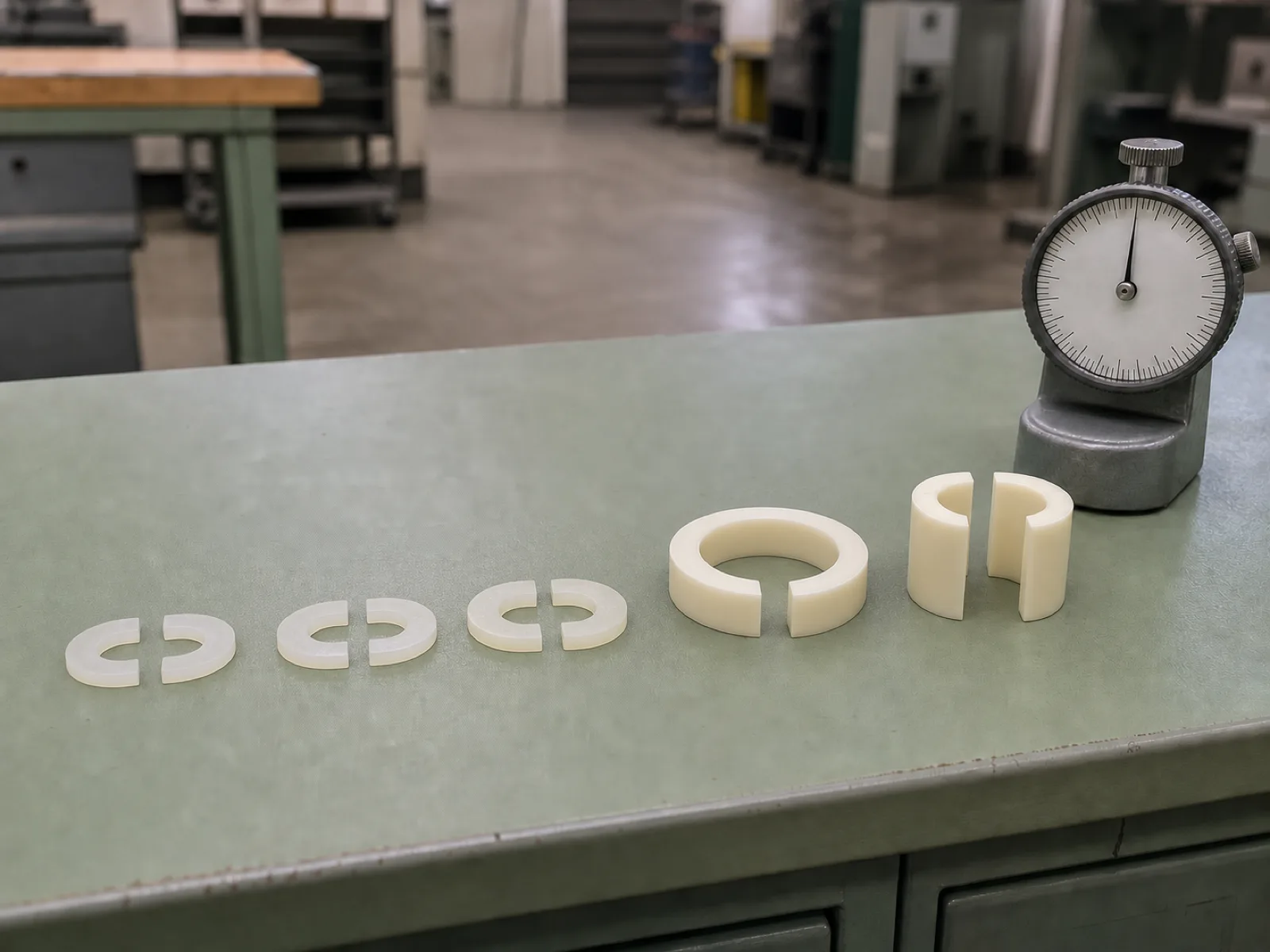
Cost is driven by material grade, cavitation, cycle time, secondary operations, and post-cure. MOQ is typically 500 pieces on compression (where aluminum tooling amortizes on a ~60-day payback) and 20,000 on LSR (to spread hardened steel tooling). Lead time runs 35-55 days on compression and 45-70 days on LSR from drawing lock to First Article Inspection, then 15-25 days on re-orders.
The MOQ and lead-time numbers are exactly what most manufacturer pages omit, and the omission is deliberate — publishing them invites price comparison. From the engineering desk, the numbers are not secret; they fall out of tooling amortization math. Below MOQ 500, tooling cost dominates the unit price on compression and no rational factory quotes LSR at all. Above it, tooling folds into the first production run and the landed cost turns competitive with off-the-shelf parts while delivering a proper molded profile and per-lot certification. Our [MOQ and lead-time guide](/guide/moq-and-lead-time-silicone-oem/) walks the 60-day payback logic and how tiered volume pricing lowers per-piece cost as the tool amortizes. ### Cost drivers and program timeline by process | Factor | Compression | LSR injection | What moves it | |---|---|---|---| | MOQ (per SKU) | 500 units | 20,000 units | Tooling amortization | | Tooling cost | $2,500-6,000 | $12,000-45,000 | Cavity count, complexity | | Lead time (to FAI) | 35-55 days | 45-70 days | Tool build + T0 sampling | | Re-order lead time | 15-25 days | 15-25 days | Existing tool | | Per-piece variable | $0.30-2.50 | $0.15-1.20 | Cycle time, cavitation | | Post-cure | +4 hr at 200°C | Optional | Food/medical requirement | Two cost drivers surprise buyers more than material price. **Cavitation** trades tooling cost against per-piece cost: an 8-cavity tool costs more upfront but slashes cycle cost, so it only pays back across high volume — which is why a manufacturer should size cavity count to your realistic annual forecast, not the maximum. **Secondary operations** — overmolding, printing, die-cutting, assembly — each add a handling step and a QC gate, and a manufacturer that quotes them line-by-line is being transparent, while one that buries them in a single unit price is hiding where the money goes. Send annual volume with your RFQ and a good manufacturer sizes the tool and quotes the tiers correctly on the first pass. ## References [^iso-9001]: ISO 9001:2015 — Quality Management Systems — Requirements, International Organization for Standardization, https://www.iso.org/standard/62085.html [^iso-3302-1]: ISO 3302-1:2014 — Rubber — Tolerances for Products — Dimensional Tolerances, International Organization for Standardization, https://www.iso.org/standard/61812.html [^fda-177-2600]: 21 CFR 177.2600 — Rubber Articles Intended for Repeated Use, US Food and Drug Administration, https://www.ecfr.gov/current/title-21/chapter-I/subchapter-B/part-177/subpart-C/section-177.2600 [^astm-d2240]: ASTM D2240 — Standard Test Method for Rubber Property — Durometer Hardness, ASTM International, https://www.astm.org/d2240-15r21.html [^astm-d412]: ASTM D412 — Standard Test Methods for Vulcanized Rubber and Thermoplastic Elastomers — Tension, ASTM International, https://www.astm.org/d0412-16r21.html [^astm-d395]: ASTM D395 — Standard Test Methods for Rubber Property — Compression Set, ASTM International, https://www.astm.org/d0395-18.html [^usp-class-vi]: USP <88> Biological Reactivity Tests, In Vivo — Class VI Plastics, United States Pharmacopeia, https://www.usp.org/harmonization-standards/pdg/excipients/plastic-materials [^iso-10993]: ISO 10993-1 — Biological Evaluation of Medical Devices — Part 1, International Organization for Standardization, https://www.iso.org/standard/68936.html [^reach-echa]: Understanding REACH — Registration, Evaluation, Authorisation of Chemicals, European Chemicals Agency, https://echa.europa.eu/regulations/reach/understanding-reach ## Talk to the engineering desk about your custom silicone parts program Send a drawing plus your annual volume, target Shore A, service temperature and sealed medium, and required certifications, and we come back inside 48 hours with a process recommendation, cavity-count concept, tooling estimate, and unit-price bracket at MOQ 500 / 5,000 / 20,000. First Article Inspection sample lands 35-55 days after drawing lock on compression, 45-70 days on LSR. [Start an RFQ with the engineering desk](/contact/) or download our [mutual NDA](/nda/) if drawings need coverage before we begin.