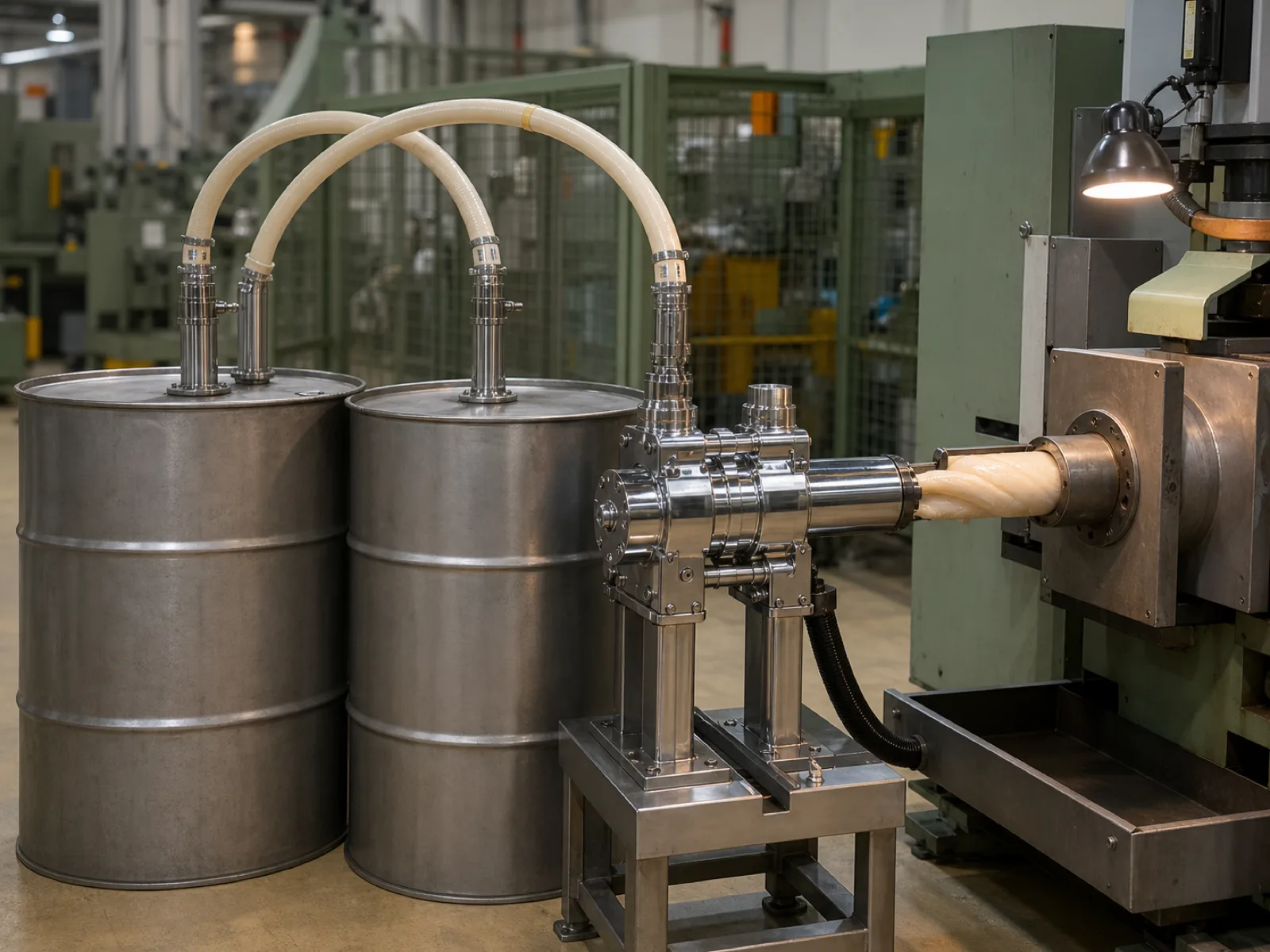
A silicone bib food grade claim is defensible only when the compound clears FDA 21 CFR 177.2600 and LFGB §30/§31 with per-lot migration reports on file. Platinum-cured LSR at Shore A 40-60, post-cured four hours at 200 °C, is the material spec that survives a Target or BBB vendor audit — peroxide-cured HCR does not. Wetop runs this SKU at MOQ 500 per colorway on a two- to eight-cavity tool with cavity-ID engraving mandatory for batch traceability.
"Food-grade silicone bib" is one of the most abused phrases on infant-feeding SERPs. Consumer product pages use it as a slogan; regulators use it as a compound classification with clause numbers, migration limits, and test methods. This guide is written for private-label buyers, brand owners, and sourcing engineers who need the regulator-grade version — the actual specifications, the third-party test matrix, and the manufacturing controls that separate a defensible OEM program from a repackaged stock part. ## What does "food-grade silicone" actually mean on a bib?"Food-grade silicone" is a marketing shorthand with no standalone regulatory definition. The enforceable spec is a compound cleared under FDA 21 CFR 177.2600[^fda-177-2600] for repeated food-contact use and LFGB §30/§31 with per-lot migration testing tied to BfR Recommendation XV[^lfgb-bfr-xv]. Without those two documents, the phrase carries no legal weight.
FDA 21 CFR 177.2600 governs "rubber articles intended for repeated use" and permits specific starting substances, cure systems, and additives. A silicone bib compound has to clear two extractables tests: **non-volatile extractables in distilled water at reflux for seven hours** (limit 20 mg/in² total after one extraction, 1 mg/in² after successive extractions), and the same in n-hexane simulating fatty-food contact. LFGB §30/§31 is the German food-contact code that references BfR XV's positive list of permitted silicone starting materials plus a migration ceiling of 10 mg/dm² across three consecutive extractions into three simulants (3% acetic acid, 20% ethanol, olive oil), all held at 40 °C for 10 days. The practical implication for a buyer: ask the factory for the compound Technical Data Sheet (TDS), the 177.2600 extractables report, and the LFGB migration test PDF signed by an accredited lab (SGS, Intertek, TÜV, Eurofins). "Food-grade" on the packaging without those three attached documents is not defensible under Prop 65 discovery or an EU market-surveillance inspection.
For infant-contact silicone bibs, the defensible answer is platinum-cured LSR (liquid silicone rubber). Platinum cure leaves no peroxide residue, stays optically stable across 500+ steam-sterilizer cycles, and clears USP Class VI biocompatibility[^usp-class-vi] on standard formulations. Peroxide-cured HCR is cheaper but yellows under repeat sterilization and requires a longer post-cure to drive off cure by-products.
The material choice sits at the top of the bill of materials because it drives everything downstream — cure time, tooling type, post-cure schedule, sterilization envelope, and shelf-life. Platinum-cured LSR uses a two-part addition-cure chemistry (vinyl-terminated siloxane + hydride crosslinker + platinum catalyst) that produces no volatile by-products. Peroxide-cured HCR (high-consistency rubber) uses 2,4-dichlorobenzoyl peroxide as an initiator; the cure by-product, 2,4-dichlorobenzoic acid, has to be baked out during post-cure or it migrates into food. | Attribute | Platinum-cured LSR | Peroxide-cured HCR | |---|---|---| | Shore A range for bibs | 40-60 | 40-70 | | Cure by-product | None | 2,4-dichlorobenzoic acid | | Post-cure required | 4 h @ 200 °C (best practice) | 4-8 h @ 200 °C (mandatory) | | Steam-sterilizer cycles before yellowing | 500+ | 150-200 | | Biocompatibility | USP Class VI on standard formulations | Formulation-dependent | | Cost index | 1.00 | 0.80-0.85 | | Cavity-to-cavity dimensional tolerance | ±0.05 mm | ±0.10 mm | | Preferred tooling | Steel injection mold | Aluminum or steel compression mold | The 15-20% material cost saving on peroxide cure disappears the first time a retail customer returns a case of yellowed bibs after home sterilization. For any SKU that will see boiling water or steam sterilizer, platinum-cured LSR is the only cure system Wetop will quote. ## What durometer, tensile, and tear specs does an OEM silicone bib need?A food grade silicone bib runs Shore A 40-60, tensile strength 8-10 MPa, elongation at break 400-600 %, and tear strength 15-25 kN/m. The neck strap and pocket rim usually sit at 50-55A while the main body sits at 45-50A. Every 250-piece batch is verified on a Rex 1600 durometer at three points and written into the batch traveler.
Getting the mechanicals right is what makes the bib feel like the reference product on a retail shelf, not a knockoff. Too soft (below 40A) and the pocket collapses when the child leans forward. Too hard (above 60A) and the neck strap chafes. The tear strength number matters more than most buyers realize — the crumb-catcher pocket concentrates stress at the fold; below 15 kN/m and the pocket rim tears after 20-30 dishwasher cycles. Wetop's process sheet for this SKU calls for: - **Compound:** Dow XIAMETER RBL-9200-40 or Wacker ELASTOSIL LR 3003/40 (platinum-cured LSR, Shore A 40 base) blended with a Shore A 60 masterbatch to the target durometer per SKU. - **Injection:** LSR injection cell, 220 °C mold temperature, 30-45 second cure inside a 4-cavity steel tool. - **Post-cure:** 4 hours at 200 °C in a forced-convection oven to drive off residual cyclic siloxanes D4/D5/D6 — a REACH-restricted family[^echa-siloxanes] you do not want in a finished bib. - **QC gates:** Rex 1600 durometer at three points, tensile bar pulled on an Instron 3345 to verify 8 MPa minimum, tear specimen pulled to verify 15 kN/m minimum, dimensional check on cavity ID 001-004 to catch mold wear early.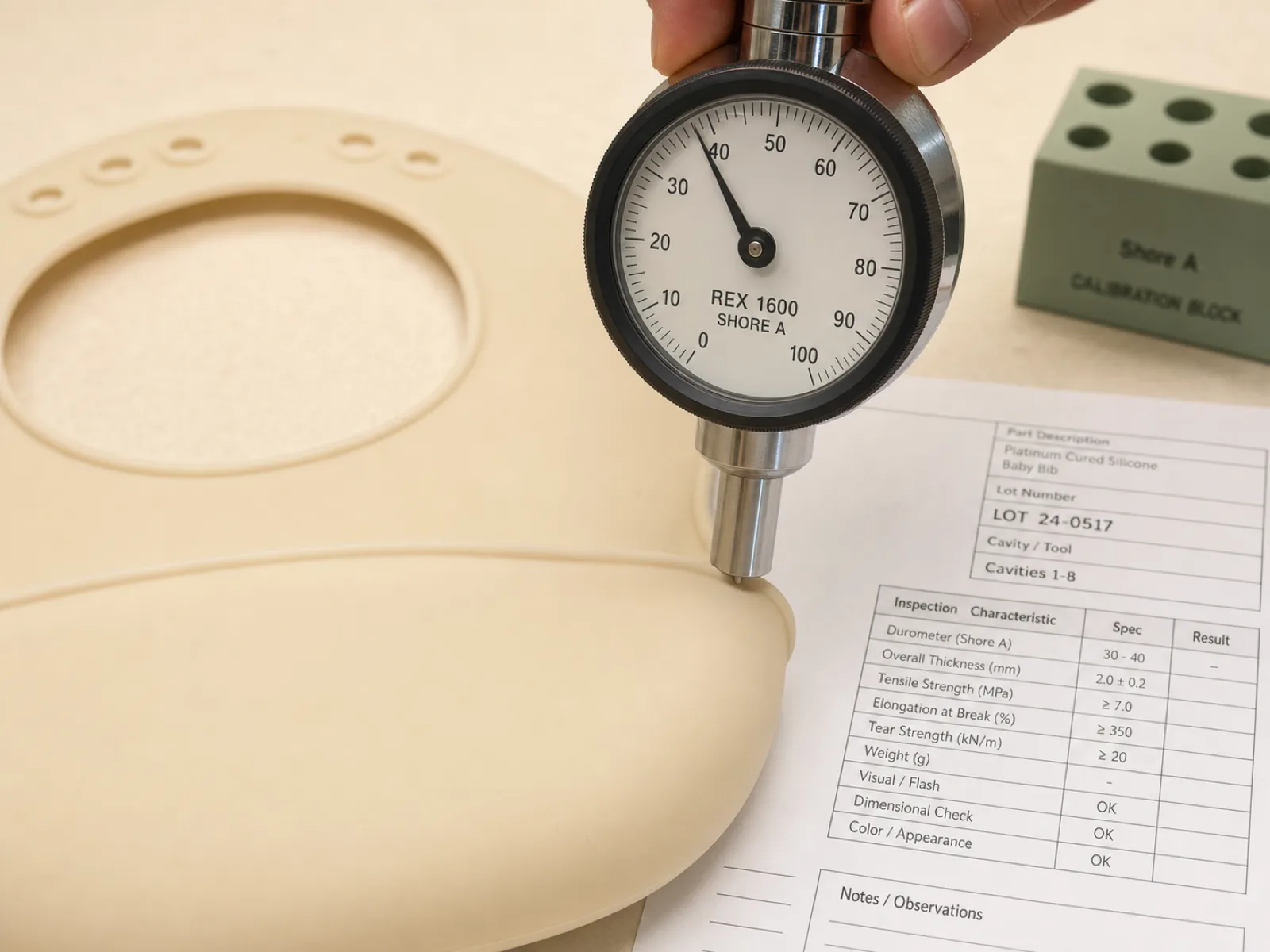
An infant-contact bib must exclude BPA, BPS, PVC, phthalates (DEHP, DBP, BBP, DINP, DIDP, DNOP), PFAS/PFOA, lead, cadmium, latex, and cyclic siloxanes D4/D5/D6. Test methods pair to substance class: ICP-MS for heavy metals, GC-MS for phthalates and siloxanes, LC-MS/MS for PFAS. The compliance packet ships with the report per production lot.
The evergreen retail-buyer question is "is this bib safe" — the useful answer is the substance-exclusion matrix. Every serious buyer spec sheet lists these ten substance groups with the test method, reporting limit, and lab. Below is the working matrix Wetop's compliance packet ships against: | Substance | Limit | Test method | Lab | |---|---|---|---| | Total lead | ≤ 90 ppm (CPSIA[^cpsc-cpsia]) | CPSC-CH-E1002-08.3 | SGS / Intertek | | Phthalates (six restricted) | ≤ 1,000 ppm each | CPSC-CH-C1001-09.4 | SGS / Intertek | | BPA / BPS | Not detected (LOD 0.5 mg/kg) | GC-MS | Eurofins | | PFAS (total organic fluorine) | ≤ 50 ppm | LC-MS/MS + TOF-CIC | Eurofins | | Cadmium | ≤ 75 ppm | ICP-MS | SGS | | PVC / chlorine | Not detected | XRF screen + IC | SGS | | Cyclic siloxanes D4/D5/D6 | ≤ 1,000 ppm each | GC-MS | Eurofins | | Latex proteins | Not detected | ELISA | Eurofins | | Overall migration | ≤ 10 mg/dm² | LFGB §30/§31 into three simulants | TÜV | | Non-volatile extractables | ≤ 20 mg/in² | FDA 21 CFR 177.2600 | SGS | The list looks long because retail-tier programs actually enforce it. Wetop pulls a retention sample from every 5,000-piece lot and archives it for 24 months so re-testing can be run against the exact production lot if a buyer's downstream customer raises a complaint. ## What third-party test matrix does a US or EU retail vendor onboarding require?A US retail-tier vendor onboarding requires a stacked test packet: CPSIA (lead + phthalates), ASTM F963-17[^astm-f963] toy safety, California Prop 65, plus a General Certificate of Conformity (GCC) and a Children's Product Certificate (CPC). EU market entry adds LFGB §30/§31 overall migration and EN 14372[^en-14372] mechanical safety. The full packet is 8-12 PDFs per SKU.
Retailers have consolidated on a standard vendor-onboarding checklist. For a food grade silicone bib SKU shipping into a Tier 2 US home improvement chain or a national baby-goods retailer, the onboarding folder looks like this: - **CPSIA General Certificate of Conformity (GCC)** — signed by the importer, references the CPSC-CH test reports on lead and phthalates. - **Children's Product Certificate (CPC)** — signed per SKU, references the ASTM F963-17 report from an accredited third-party lab. - **California Prop 65 statement** — declares Prop 65 status; if a warning is required, the label design must be pre-approved by the retailer's compliance team. - **FDA 21 CFR 177.2600 extractables report** — from SGS, Intertek, or Eurofins, tied to the compound lot number. - **LFGB §30/§31 overall migration report** — required for EU market, useful even for US retail because it is stricter than FDA and signals process maturity. - **EN 14372 mechanical safety report** — cord and small-parts checks for EU child-use articles. - **ISO 9001[^iso-9001] factory audit certificate** — issued by TÜV, DNV, or Bureau Veritas, valid within the last 12 months. - **Social compliance affidavit** — SEDEX, SMETA, or BSCI depending on retailer. Wetop's compliance packet is pre-staged so that when a buyer signs the NDA and issues the PO, the folder is complete on day one — not something the buyer has to chase for six weeks while the freight-forwarder waits.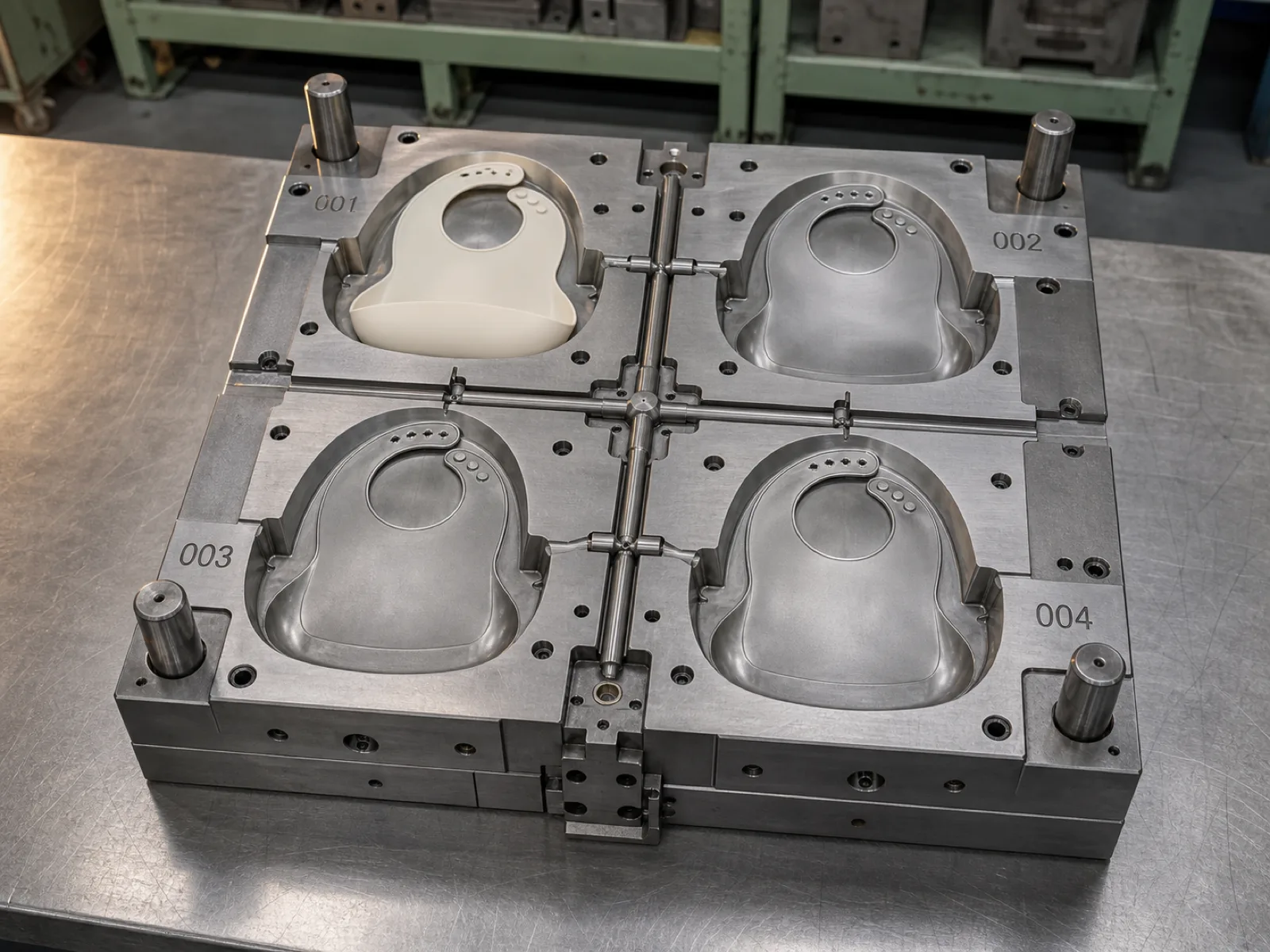
A food grade silicone bib runs through five gated stages: (1) compound mixing and metering, (2) LSR injection at 220 °C mold temperature, (3) flash trim and deflash, (4) four-hour post-cure at 200 °C, (5) durometer + dimensional QC and retail-ready packaging. Cavity ID engraving is baked into stage 2 at mold-build — it is not a running change.
The cavity-to-carton flow is where the compliance paperwork either becomes real or falls apart. Wetop's process sheet for this SKU: 1. **Compound metering** — Dow / Wacker / Momentive / Shin-Etsu A/B drums, 1:1 volumetric metering pump, colorant masterbatch dosed at 1-3% by weight to match Pantone. 2. **Injection** — 4-cavity or 8-cavity steel tool, 220 °C mold temperature, 30-45 second cure, 20-ton clamp. Cavity ID (001, 002, 003, 004) is engraved into the tool at build so every part carries its cavity source. 3. **Deflash** — LSR injection at this Shore A range produces near-zero flash at the parting line; touch-up is manual on the neck-strap opening only. 4. **Post-cure** — 4 hours at 200 °C in a forced-convection oven. This is the step that drives cyclic siloxanes D4/D5/D6 below the ECHA[^echa-siloxanes] reporting threshold. Skipping post-cure is the single biggest quality gap on offshore bib programs. 5. **QC gates** — Rex 1600 durometer three-point, dimensional check against tool drawing on cavity samples, visual defect check under D65 lighting, retention sample pulled per 5,000 pieces. 6. **Packaging** — retail-ready blister card or poly-bag with barcode, hangtag, and CPC insert per retailer spec. Cartons are labeled with lot number, cavity code range, and manufacture date.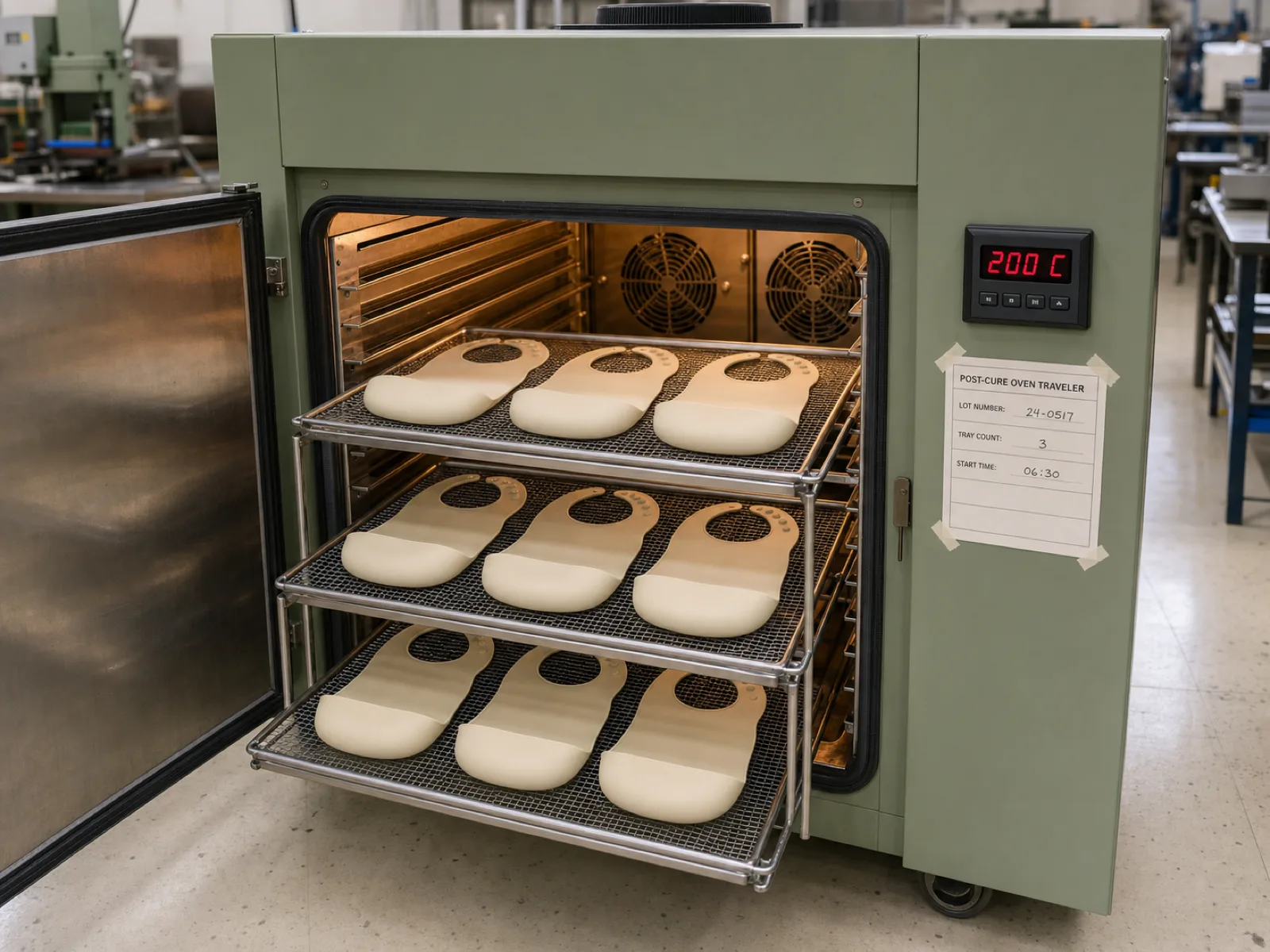
Wetop's MOQ is 500 pieces per SKU per colorway. Mold cost runs $800-2,500 per cavity, so a 4-cavity aluminum tool lands at about $6,500. Sample lead time is 7-15 days from tool sign-off. Mass production runs 25-35 days FOB Yantian once compound, colorway, and packaging spec are locked. Retail-audit-ready compliance packet ships with the first bulk shipment.
The commercial envelope is where most private-label conversations either land or stall. The table below is the working quote structure for a food grade silicone bib program at Wetop: | Program parameter | Value | |---|---| | MOQ | 500 pieces per SKU per colorway | | Sample lead time | 7-15 days from tool sign-off | | Mold cost (2-cavity aluminum) | $1,600-3,000 | | Mold cost (4-cavity aluminum) | $5,000-7,000 | | Mold cost (8-cavity steel) | $10,000-16,000 | | Cavity ID engraving | included at mold-build | | Debossed logo on tool | included at mold-build | | Pad-printed logo | $0.04-0.09 per unit | | Compound (platinum-cured LSR) | $6-10 per kg landed | | Unit weight (typical bib) | 45-70 g | | Unit price (500 pcs, 4-cavity) | $0.90-1.60 FOB (varies with colorway complexity) | | Mass production | 25-35 days FOB Yantian | | Compliance packet | shipped with first bulk | Notes on the math: an 8-cavity steel tool amortized over 100,000 pieces adds about $0.13-0.16 to the unit cost — cheaper per piece than a 4-cavity aluminum tool at 20,000 pieces. If the buyer expects to run this SKU for two years or more, steel pays back inside the first program. ## What are the red flags on a "food grade silicone bib" quote?Six red flags to walk away from: (1) "food-grade" claimed without a cert PDF on request; (2) sample has no cavity ID engraved; (3) factory won't name the compound supplier; (4) no post-cure schedule in the process sheet; (5) no traceable lot number on packaging; (6) MOQ under 100 pieces with no tooling cost. That combination signals unqualified stock compound repackaged as OEM.
The trade platform ecosystem is full of listings that use "food-grade silicone" as a keyword rather than a spec. The six diagnostic questions that separate a defensible OEM factory from a broker are: 1. **Can you send the FDA 21 CFR 177.2600 extractables report and the LFGB overall migration PDF tied to the compound lot you plan to use?** Legitimate factories have these on the shared drive within an hour. Brokers stall for a week and send a report on a different compound. 2. **Is cavity ID 001-004 (or 001-008) engraved on the parting-line flat of the sample?** No cavity ID means no traceability, which means no way to isolate a defect batch, which means retail-audit exposure the buyer will inherit. 3. **Who supplies the base compound — Dow, Wacker, Momentive, Shin-Etsu, or someone else?** "Local platinum-cured LSR" is a euphemism for a compound with a TDS that will not survive discovery. 4. **What is the post-cure schedule — hours and temperature?** The correct answer is "4 hours at 200 °C in a forced-convection oven with a temperature-logging chart per lot." Anything vaguer is a process gap. 5. **Is the batch lot number printed on the carton and traceable to the compound lot and cavity range?** Yes for defensible programs, "we can do it if you want" for the rest. 6. **Is MOQ under 100 pieces with no tooling cost?** That combination almost always means stock compound in a shared cavity, sold as OEM. Real tooling costs money; real MOQ is 500+. If two or more of those six answers come back wrong, the buyer is not talking to a factory that can defend the program to a Target vendor auditor. Walk away. ## Ready to source your food grade silicone bib program? Wetop runs OEM/ODM programs for infant-feeding silicone SKUs under a 500-piece per colorway MOQ, with a full FDA + LFGB + CPSIA + Prop 65 compliance packet pre-staged for retail-tier onboarding. Samples ship in 7-15 days on new tooling; mass production runs 25-35 days FOB Yantian. Send the target Shore A, Pantone, logo artwork, and target retail channel to the [Wetop engineering desk](/contact/) and we will return a full quote with mold options, unit price by cavity count, and the compliance-packet index inside two business days.