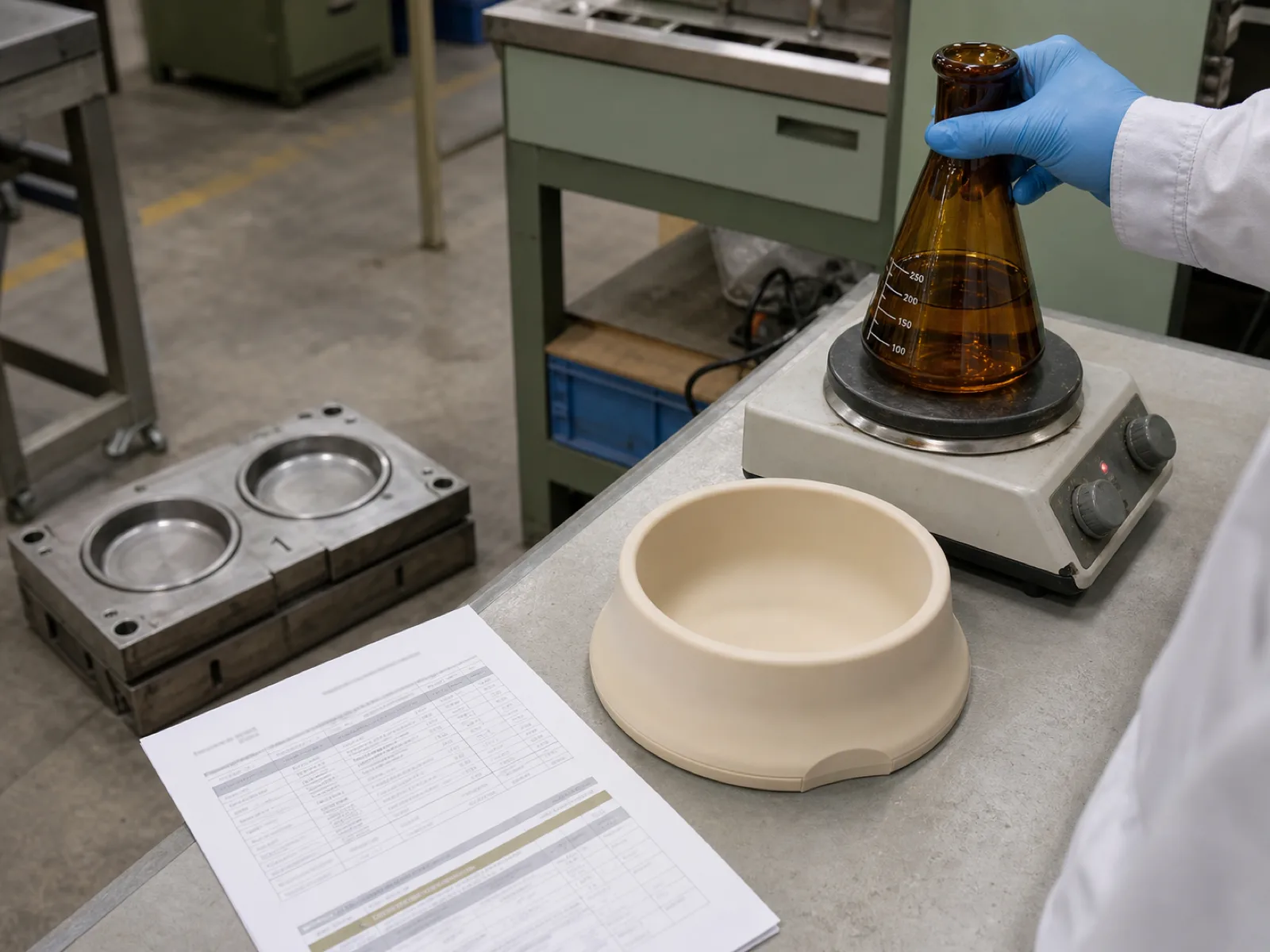
A food grade silicone pet bowl is a feeding or water bowl molded from platinum-cured silicone whose base polymer, cure system, and colorants are all food-contact compliant and whose finished form has passed migration testing — most commonly FDA 21 CFR 177.2600 in the US and LFGB in the EU. "Food grade" is a testable chemistry-and-documentation status, not a marketing label or a certificate FDA hands out, so the claim is only as good as the finished-good test report behind it. The specifications that decide whether a bowl is genuinely food-grade and durable, rather than a returns problem, are the cure system, the migration and extractables reports, the Shore A hardness and wall geometry, and the temperature range, and every one of them is verifiable before a purchase order is signed.
To a pet-brand or distributor buyer, "food grade silicone" reads like a solved problem — the material is famously safe, so any silicone bowl must be fine. It is not that simple. Two bowls can be visually identical while one is molded from platinum-cured, migration-tested compound and the other from a peroxide-cured industrial grade with unscreened filler and colorant, and the difference only surfaces as a rubber odor the dog refuses, a customs hold, or a failed retailer audit. This guide is written from the engineering desk at Wetop's Dongguan floor for buyers, distributors, and private-label brands who want to understand exactly what standards govern a food grade silicone pet bowl, which test reports prove the claim, and which specs make the bowl survive a chewer and a dishwasher. ## What does "food grade" actually mean for a silicone pet bowl?Food grade means every ingredient in the silicone — base polymer, cure system, and colorant — is food-contact compliant, and the finished bowl has passed migration testing for repeated food contact. It is a testable chemistry-and-documentation status, not a look or a feel. Generic industrial silicone can share the same appearance while carrying unscreened extender fillers, process oils, and pigments never evaluated for ingestion.
The phrase collapses three separate decisions that a low-cost quote treats as one. The first is the **base polymer and its purity**: food grade silicone is polydimethylsiloxane compounded without the cheap extending fillers and process oils that stretch an industrial batch. The second is the **cure system** — food grade for oral contact means platinum (addition) cure, which crosslinks cleanly with no volatile byproducts, rather than peroxide cure whose residues can migrate and off-gas. The third, and the one buyers most often forget, is the **colorant**: a pigment or masterbatch must itself be food-contact approved and screened against REACH and Prop 65, because a non-compliant dye in an otherwise clean bowl fails the whole part. The fillers and softeners are the hidden variable. A general-purpose silicone batch is often extended with fumed-silica reinforcement beyond food-contact grades or cut with a non-approved process oil to soften it and speed the mold — both cheapen the compound and both can raise the extractable load a migration test measures. A genuinely food-grade compound uses only reinforcement and additives cleared for food contact, which is part of why it costs more per kilogram and why a suspiciously cheap "food grade" quote deserves a finished-good report before an order, not after. Because none of those variables are visible, "food grade" is proven by a migration report on the finished bowl, not by touching it or trusting the color. That is the throughline of this guide: the grade lives in the documentation. The material-safety case a skeptical category buyer or an anxious pet owner will demand is laid out in the [is silicone safe for pets materials guide](/guide/is-silicone-safe-for-pets-materials-guide/). | Attribute | Food grade silicone | Generic / industrial silicone | |---|---|---| | Base polymer | PDMS, no extender filler | May carry cheap extending filler | | Cure system | Platinum (addition) | Often peroxide (free-radical) | | Colorant | Food-contact approved, REACH/Prop 65 screened | May be unscreened pigment | | Cure byproducts | None | Benzoic-acid volatiles possible | | Proof of grade | Finished-good migration report | Usually none, or compound COA only | | Suitable for a pet feeding bowl | Yes | No | ## What does FDA 21 CFR 177.2600 cover — and what does it not certify?21 CFR 177.2600 is the US regulation for rubber articles intended for repeated food contact, and silicone pet bowls are graded under it. It caps extractives on the cured material — total extractives ≤ 20 mg/in² in n-hexane plus a chloroform-soluble follow-up extraction. It does not "certify" a finished bowl: FDA issues no approval number, so compliance is a claim you back with an accredited-lab test report.
The rule works on **extractives**, the idea that whatever the cured silicone gives up into a solvent is what could migrate into food over repeated use. The procedure extracts the cured rubber in n-hexane and then in a chloroform-soluble follow-up under specified time and temperature, and both fractions must fall under the 20 mg/in² ceiling[^fda-177-2600]. A bowl molded from clean platinum-cured compound and properly post-cured clears this comfortably; a bowl full of extending oil or under-cured residue does not. The critical nuance for a buyer is what 177.2600 is **not**. FDA does not test, approve, or certify individual pet bowls, and it issues no certificate or registration number for one[^fda-food-packaging]. Compliance with 177.2600 is a self-supported position, so the honest label is "compliant with 21 CFR 177.2600, verified by a finished-good migration report" — not "FDA approved." When a listing claims the latter, it is loose language covering a supplier COA at best. What a US customs review or a retailer's compliance desk actually asks for is the accredited-lab report showing the *finished bowl* passed the extractive limits, which is why the verification step later in this guide matters more than the marketing word. | 21 CFR 177.2600 element | What it means for a pet bowl | |---|---| | Scope | Rubber articles for repeated food contact — includes silicone bowls | | n-hexane extractives limit | ≤ 20 mg/in² on the cured, finished material | | Chloroform-soluble extractives | Follow-up extraction, ≤ 20 mg/in² | | Test article | The finished cured bowl, not the raw compound | | What FDA issues | No certificate, number, or approval — compliance is self-supported | | Proof buyers should demand | Accredited third-party migration report on the bowl | ## Why is LFGB stricter than baseline FDA for a pet bowl?LFGB, Germany's food and feed code, adds an overall-migration limit and a volatile-matter (peroxide-residue) test on top of the extractables logic FDA uses. Its silicone basis is BfR Recommendation XV, and the EU framework sets a total-migration ceiling of 10 mg/dm² of contact surface. That volatile-matter screen is exactly what a cheap, under-post-cured peroxide bowl fails, so LFGB catches odor and residue that pure extractables testing can miss.
FDA 177.2600 asks how much the material gives up to aggressive solvents. LFGB asks that **plus** two more questions. First, **overall migration**: how much total non-volatile substance transfers into food simulants under real contact conditions, capped in the EU plastics framework at 10 mg/dm² of contact area[^eu-10-2011]. Second, **volatile matter**: how much residual byproduct the silicone off-gasses when baked, a value BfR Recommendation XV holds to a strict limit for repeated-contact silicone[^bfr-xv]. That volatile-matter test is the one a peroxide-cured, throughput-rushed bowl fails — the same benzoic-acid residues that register as migrating volatiles are the ones an animal smells and refuses. This is why treating FDA and LFGB as interchangeable is a mistake. A bowl can pass 177.2600 extractives and still carry an odor an LFGB volatile-matter test would flag, so a defensible pet-bowl program carries **both** reports rather than one standing in for the other. The clause-level differences between the two regimes, and which markets require which, are broken down in the [FDA vs LFGB silicone guide](/guide/fda-vs-lfgb-silicone/). | Test dimension | FDA 21 CFR 177.2600 | LFGB (§30/31, BfR XV basis) | |---|---|---| | Extractables limit | ≤ 20 mg/in² (n-hexane + chloroform) | Included via extractable checks | | Overall migration into simulant | Not a separate limit | ≤ 10 mg/dm² (EU 10/2011 framework) | | Volatile-matter / peroxide residue | Not tested | Tested and capped (BfR XV) | | Odor / taste screen effect | Indirect | Directly catches rubber odor | | Net strictness for a pet bowl | Baseline | Stricter — recommended alongside FDA | ## Platinum-cured or peroxide-cured — which cure system belongs in a pet feeding bowl?A pet feeding bowl must be platinum-cured, not peroxide-cured. Platinum (addition) cure is a clean reaction that leaves no volatile byproducts, so the bowl carries no rubber odor an animal will refuse and clears biocompatibility screens like USP Class VI and ISO 10993 cytotoxicity. Peroxide cure leaves benzoic-acid residues that a shortened post-cure fails to drive off, registering as odor and migrating volatiles.
There are two crossroads in the cure decision, and cheap quoting skips both. The first is **chemistry**. Platinum cure crosslinks vinyl- and hydride-functional silicone with a platinum catalyst in a stoichiometrically clean reaction that generates no volatiles, which is why platinum-cured silicone is the grade that ships into infant-feeding and medical use with minimal residue[^nih-silicone-review]. Peroxide cure uses a free-radical initiator whose reaction leaves benzoic acid and related volatiles that a full 4-hour, 200 °C post-cure is meant to bake off — but a factory protecting cycle time often shortens that bake, and the residual volatiles stay in the part. On a bowl an animal eats from daily, those volatiles read as a rubber taste, and a dog's or cat's nose is a far more sensitive inspector than any human on the line. The full breakdown is in the [platinum-cured vs peroxide-cured silicone guide](/guide/platinum-cured-vs-peroxide-cured-silicone/). The second crossroad is **biocompatibility headroom**. A food bowl is legally a food-contact article, not a medical device, so USP Class VI and ISO 10993 are not required. But platinum-cured medical-grade compounds routinely clear USP Class VI's systemic, intracutaneous, and implantation screens and ISO 10993 cytotoxicity[^usp-class-vi] — and no peroxide-cured industrial grade does. Citing that biocompatibility documentation at the raw-material level is an above-minimum assurance a premium pet-feeding brand can offer without ever claiming the finished bowl is a cleared medical device. For any bowl positioned above entry level, Wetop quotes only platinum-cured compound, because the taste-refusal failure mode that comes with peroxide is exactly the one that produces a one-star review showing a dog turning away from the bowl.
A feeding bowl targets Shore A 50–70 with a 2.5–4 mm wall — firm enough to hold shape and resist casual chewing, soft enough to stay flexible or collapsible. It should be one continuous molded piece with no glued-on parts a chewer can pry off. Platinum-cured silicone holds −40 °C to 230 °C continuous service, covering dishwasher, boiling, and steam sterilization without deforming or leaching.
"Soft," "medium," and "firm" are not a spec — they are how two people end up arguing over a rejected lot. Durometer, measured on the Shore A scale per ASTM D2240[^astm-standards], is the number that ends the argument. A pet feeding bowl lands at **Shore A 50–70**: below about 45 the rim deforms and the bowl tips or folds under a paw; above about 75 it loses the flexibility that makes silicone worth choosing over rigid plastic. A collapsible travel bowl sits at the softer end of that band so it folds flat; a heavy-feeder or slow-feeder bowl sits firmer to hold its geometry. Chew resistance is geometry and construction as much as durometer. The tensile and tear behavior that governs how a bite propagates is characterized by ASTM D412[^astm-standards], and the practical rules are: mold the bowl as one continuous piece with **no glued-on non-slip ring, base, or feet** a determined chewer can pry loose and swallow, and use a thicker **rolled rim** because tearing starts at a thin edge. The temperature story is where silicone separates from its rivals: a continuous service range of about **−40 °C to 230 °C** covers a dishwasher's hot cycle, boiling-water sanitizing, and steam sterilization with no deformation or leaching — letting a brand make freeze, boil, and dishwasher claims it can defend. The one caveat: on a collapsible bowl with a bonded plastic clip or base, the assembly carries that component's lower rating, not the silicone's. If your team wants the full durometer scale mapped to tactile feel, the [Shore A hardness silicone chart](/guide/shore-a-hardness-silicone-chart/) is the reference. There is also an in-use safety dimension a brand should put in its owner instructions rather than leave to chance. A food grade silicone bowl is inert and safe to lick and eat from, but it is not indestructible under a dedicated chewer — a tooth can start a nick at a thin edge, and a nick can propagate into a tear or a torn-off fragment that becomes an ingestion or choking hazard. The honest guidance is to inspect the bowl periodically for microcracks, nicks, or torn edges, and to replace it once the surface is compromised rather than keep feeding from a damaged bowl. Designing the rim thick and the part one-piece pushes that replacement cadence out, but no soft material lasts forever against a determined chewer, and saying so plainly protects both the animal and the brand's review score. | Spec | Target for a pet feeding bowl | Method / basis | Verified at lot release | |---|---|---|---| | Licking/feeding surface hardness | Shore A 50–70 (±5) | ASTM D2240 | Durometer reading | | Wall thickness | 2.5–4 mm | Design + caliper | Caliper | | Tensile / tear (chew resistance) | Per compound datasheet | ASTM D412 | Compound COA + spot test | | Continuous service temperature | −40 °C to 230 °C | Platinum silicone rating | Compound datasheet | | Construction | One-piece, no glued parts | Design rule | Visual + pull test | | Rim | Rolled / thickened edge | Design rule | CMM / profile | ## How do you verify a food-grade silicone claim — test reports vs self-declaration?Verify the claim with four documents, read for scope. Demand a finished-good FDA 21 CFR 177.2600 migration report from an accredited lab naming the actual bowl, an LFGB §30/31 report for EU sale, REACH SVHC and California Prop 65 screening on every pigment, and an ISO 9001 certificate. A self-declared "food grade" label, or the raw-compound producer's COA passed off as a finished-good result, is not evidence.
The documentation trap that catches first-time pet buyers is the **finished-good versus compound** substitution. A "food grade" or "FDA certified" claim on a listing almost always means the base silicone carries a supplier certificate — not that the finished bowl was lot-tested by an accredited third-party lab. Because the bowl is a repeated-use food-contact surface an animal eats from directly, the migration test on the *actual part* is what a US customs FDA review and a pet-retailer supplier audit will demand. The minimum packet: 1. **Finished-good FDA 21 CFR 177.2600[^fda-177-2600] migration report** from an accredited lab (SGS, Intertek, or Eurofins), naming the bowl, per lot or per quarter. 2. **LFGB §30/31 report** for EU markets, with BfR Recommendation XV[^bfr-xv] as the technical basis. 3. **REACH SVHC screening and California Prop 65 statement** on every pigment, masterbatch, and additive — colorants are where non-compliant chemistry hides, and Prop 65 is the screen most US retail listings require. 4. **ISO 9001[^iso-9001] certificate** — Wetop is certified since 2008, evidencing the documented quality system behind lot-to-lot consistency. A note on **claims to avoid**: an "antibacterial" bowl built on a silver-ion additive turns that additive into a regulated biocide under US EPA and the EU Biocidal Products Regulation — a registration liability you inherit if you copy a competitor's copy. The defensible, science-backed position is the inherent property: platinum-cured silicone is non-porous, so it gives biofilm far less to colonize than a scratched plastic bowl, and it dishwashes clean. On the sourcing side, the same rigor applies to commercial terms — Wetop molds food grade silicone pet bowls at **MOQ 500 pcs/color** on existing tooling and **USD 2,500–7,000** for a new compression mold, with a first sample in **7–25 days**, and a transparent quote breaks tooling, unit price, and packaging into separate lines rather than one bundled number.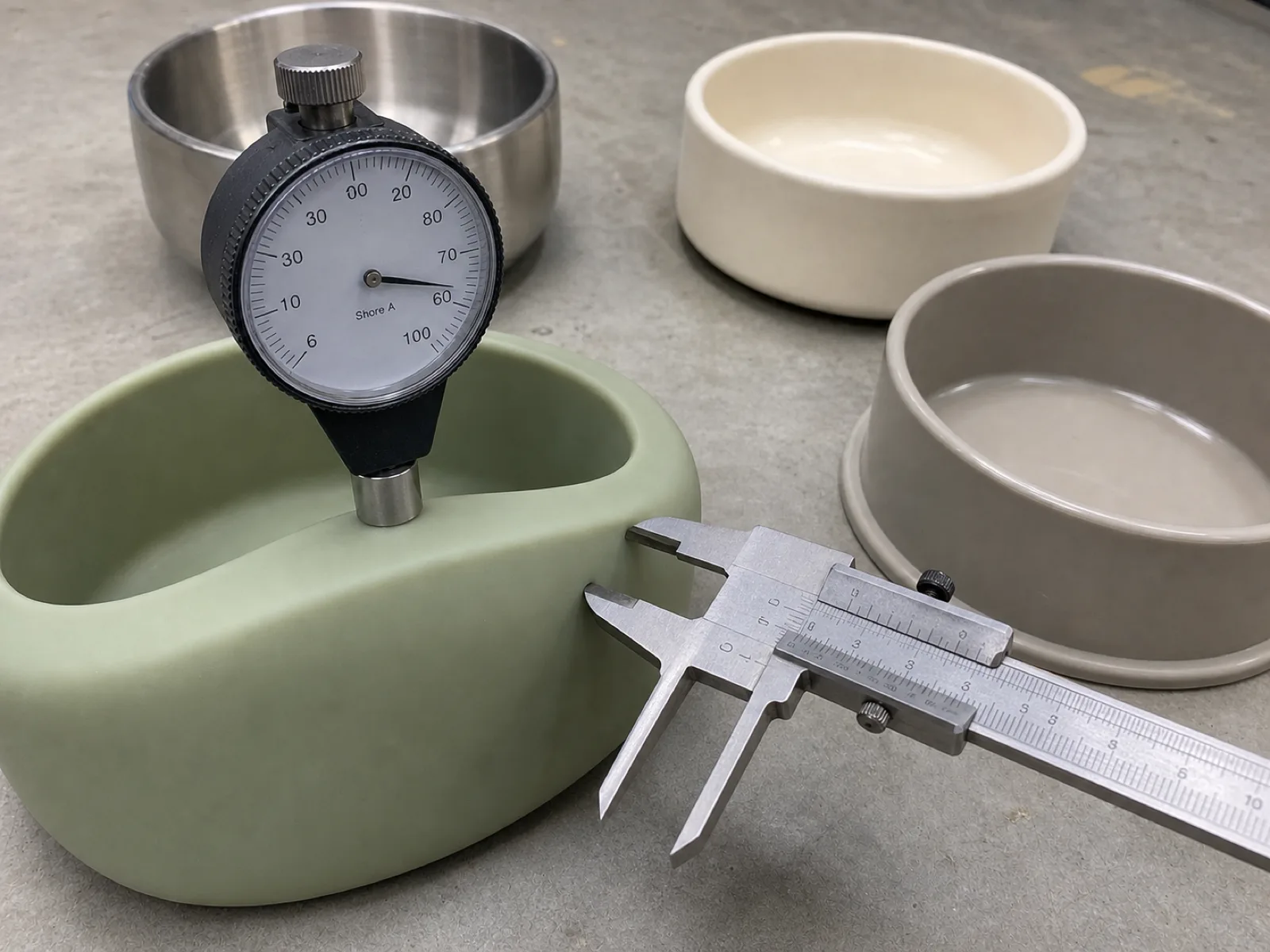
Each material trades off differently. Grade-304 stainless is the hygienic benchmark but rigid, noisy, and non-collapsible. Ceramic is stable but chips, and cheap glaze can leach lead. Rigid plastic scratches and harbors biofilm linked to feline chin acne. Glass is inert but breakable. Food-grade platinum-cured silicone is inert, non-porous, collapsible, quiet, and safe across −40 °C to 230 °C — ideal for feeding, water, and travel.
The material choice decides where a bowl sits on the shelf and how defensible its paperwork is. **Stainless steel (304)** is durable, non-porous, and the reference hygienic bowl, but it is rigid, clanks, dents, and cannot fold for travel; the head-to-head is in the [silicone vs stainless steel dog bowl comparison](/guide/silicone-vs-stainless-steel-dog-bowl-comparison/). **Ceramic** is heavy and tip-stable but chips, and a cracked glaze harbors bacteria or, on low-cost imports, can leach lead. **Rigid plastic** is cheapest but scratches, and those micro-scratches hold the biofilm associated with feline chin acne, while some plastics raise BPA or phthalate concerns. **Glass** is chemically inert but breakable and heavy. **Food-grade platinum-cured silicone's** advantages line up with what a pet bowl needs: chemical inertness with no plasticizer to migrate, a non-porous surface that resists biofilm, flexibility and collapsibility for travel, quiet feeding, and a −40 °C to 230 °C range that makes dishwasher, boiling, and freeze-fill claims defensible. The honest trade-off is that any soft material can be damaged by a truly determined chewer, so silicone is the right call for feeding, water, and travel bowls rather than as a chew toy — and for a buyer, the material choice is also a compliance choice, because the food-contact paperwork is easier to defend on inert silicone than on phthalate-risk plastic. | Property | Silicone (platinum) | Stainless 304 | Ceramic | Rigid plastic | Glass | |---|---|---|---|---|---| | Food-contact inertness | High | High | High (glaze-dependent) | Additive-dependent | High | | Biofilm resistance | High (non-porous) | High | Moderate (chip risk) | Low (scratches) | High | | Collapsible / travel | Yes | No | No | No | No | | Service temperature | −40 °C to 230 °C | Very wide | High | Narrow | High | | Breakage / dent risk | Low | Dents | Chips / cracks | Cracks | Breaks | | Documentation ease | Easiest to defend | Easy | Moderate | Hardest | Easy | ## Sourcing a food grade silicone pet bowl program? Wetop runs one compression cell and one LSR injection cell on a 7,500 m² floor in Dongguan, molding platinum-cured, food-grade silicone against FDA 21 CFR 177.2600, LFGB §30/31, and ISO 9001 — with a finished-good migration report on the actual bowl, not a raw-compound COA passed off in its place. Bring the bowl size, target Shore A, collapsible or flat design, and certification markets (US / EU / both), and the engineering desk will quote tooling, unit price, and a 7–25 day first sample against a documented spec. [Talk to the engineering desk](/contact/) to start a food grade silicone pet bowl RFQ.