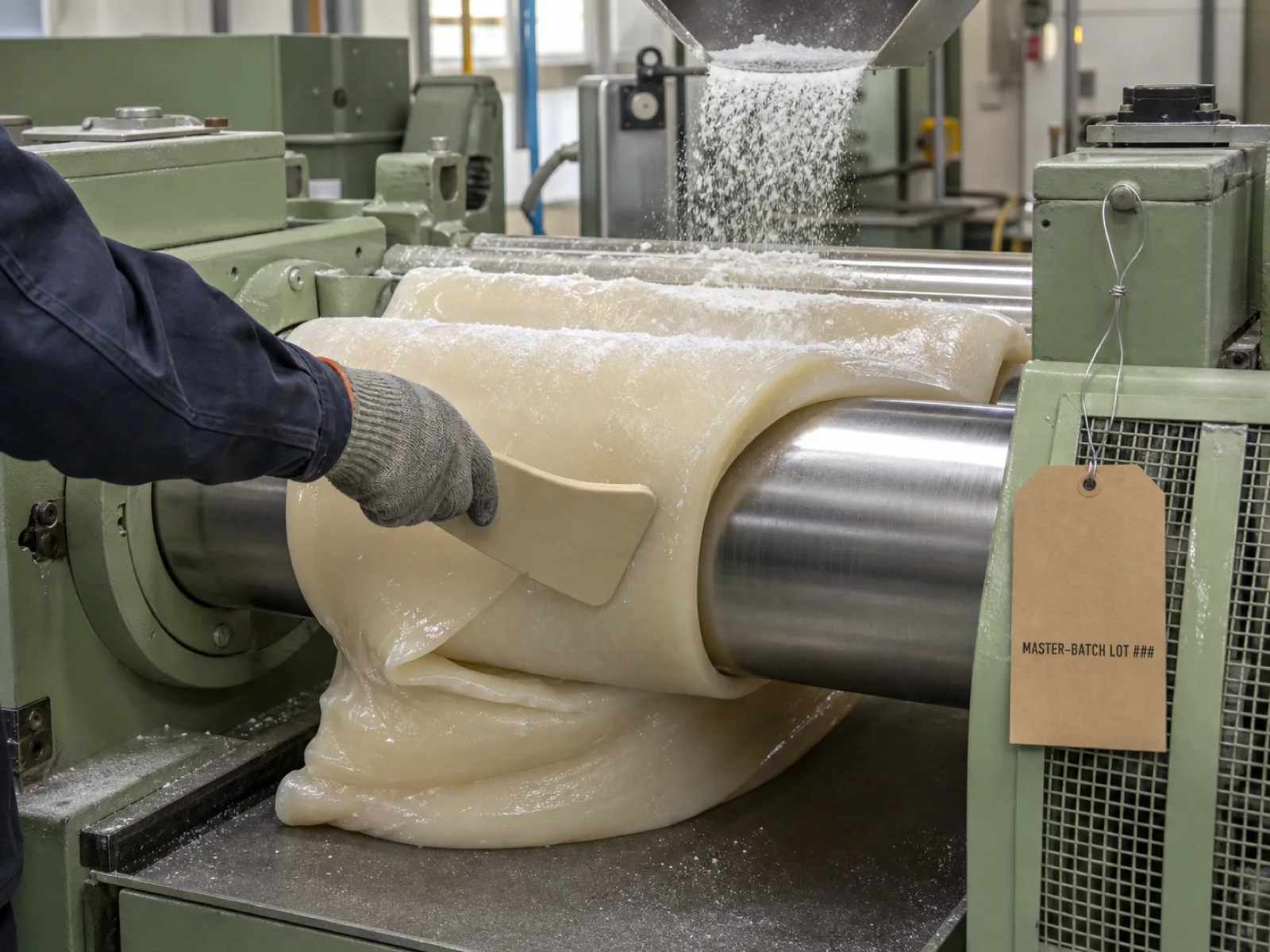
Food-grade silicone is a polydimethylsiloxane (PDMS) polymer that is safe for food contact from -40°C to 230°C continuous, verified by FDA 21 CFR 177.2600 extraction testing and LFGB §30/31 three-simulant migration testing. The polymer itself contains no BPA, phthalates, or PFAS by chemistry — the real safety variables are cure system (platinum-cure vs peroxide-cure), post-cure discipline (4-6 hours at 200°C), raw-material provenance (Dow / Wacker / Momentive / Shin-Etsu base gums vs unbranded), and finished-part additives like pigments and inks. 'Is silicone safe' is not a yes/no question — it is a per-batch verification packet.
## What is food-grade silicone at the polymer level, and why is it different from plastic?Food-grade silicone is polydimethylsiloxane (PDMS), a siloxane polymer with a Si–O backbone. This is chemically distinct from thermoplastics like PP, PE, PET, or PVC, which have carbon–carbon backbones. The Si–O bond has higher bond energy (452 kJ/mol vs 348 kJ/mol for C–C), which is why silicone tolerates -40°C to 230°C continuously without softening, melting, or leaching plasticizers. It contains no BPA, phthalates, or PFAS by chemistry.
The confusion around "is silicone safe" comes largely from lumping silicone with plastic. Chemically they are unrelated. Thermoplastics (PP, PE, PET, PVC, PC) rely on carbon backbones and often require plasticizers (phthalates in PVC), stabilizers (BPA-derivatives in polycarbonate), or fluorinated processing aids (PFAS in fluoropolymers) to reach their target properties. Silicone rubber does none of this. The base gum is PDMS with side-chain methyl groups; the compound adds fumed silica reinforcement (chemically inert SiO2), a cure catalyst, and — for pigmented parts — colorant master-batches.
FDA 21 CFR 177.2600 governs rubber articles intended for repeated use in food contact. It sets composition limits on allowed constituent compounds and defines an extraction test using n-hexane and distilled water. The finished silicone part is extracted at 49°C for 7 hours in n-hexane and 24 hours in water; the extract residue must fall below 175 mg per square inch after the first extraction cycle and lower ceilings for subsequent cycles[^fda-177-2600].
The specificity matters because most competitor content says "FDA-approved silicone" without citing the actual clause. There is no such thing as "FDA-approved silicone" as a blanket label. There is silicone that has been tested against the extraction procedure defined in 21 CFR 177.2600 and cleared the ceilings — that is what "FDA-compliant" means at the regulatory level. The regulation is finished-part testing, not raw-material approval; the base gum can be labeled "food-grade" by the compound house, but the finished part still has to clear extraction. ### 21 CFR 177.2600 test conditions | Parameter | Value | |---|---| | Solvent 1 | n-hexane, food-simulant for fatty foods | | Solvent 2 | Distilled water, food-simulant for aqueous foods | | Extraction temperature | 49°C (both solvents) | | Extraction duration | 7 hours in n-hexane; 24 hours in water | | First-extraction ceiling | 175 mg per square inch of exposed article surface | | Successive-extraction ceiling | 4 mg per square inch | | Report retention | Per master-batch lot, kept for the shelf-life of the QMS (typically 3+ years under ISO 9001[^iso-9001]) | The successive-extraction ceiling (4 mg/in²) is the discipline check — it validates that the silicone doesn't leach continuously under repeated hot-liquid contact. A part that passes the first cycle but fails the successive cycle is under-cured or over-filled with non-food-grade fillers. ## What does LFGB §30/31 add, and why is it the stricter benchmark?LFGB §30/31 requires three separate migration tests — aqueous, acidic, and fatty simulants — under conditions that mirror actual food contact. For silicone specifically, LFGB draws on BfR Recommendation XV[^bfr-lfgb-xv]: distilled water, 3% acetic acid, and 95% ethanol simulants, tested at 4 hours at 100°C or 24 hours at 40°C depending on use case. The measured total non-volatile residue must stay below approximately 10 mg/dm² across all three simulants.
The reason LFGB is the stricter benchmark for EU buyers is that it catches process failures FDA doesn't. FDA's n-hexane extraction models fatty-food contact well and its water extraction models aqueous contact — but neither simulates acidic foods (tomato, citrus, vinegar). A peroxide-cured silicone that skips post-cure passes FDA because the acetophenone and dicumyl-peroxide byproducts don't extract significantly into n-hexane or water. Those same byproducts extract into the 3% acetic acid simulant under LFGB conditions and fail the test every time. LFGB is Germany's national implementation of Regulation (EC) 1935/2004[^ec-1935-2004], the pan-EU framework establishing that food-contact materials "shall not transfer their constituents in quantities that endanger human health, alter food composition, or cause organoleptic deterioration." Most other EU member states accept LFGB test data as equivalent for import — making LFGB the de facto EU-wide reference for "is silicone safe" at the compliance level. ## What is the safe operating temperature window for food-grade silicone?Continuous use: -40°C to 230°C. Short excursion: up to 250°C. Below -40°C the elastomer starts to lose rebound; above 230°C continuous exposure drives volatile cyclic siloxanes (D4, D5, D6) out of the polymer at measurable rates. Above 250°C the rate of siloxane volatilization accelerates and — in the presence of oxygen — the PDMS backbone begins slow oxidative degradation. This is why silicone baking mats are spec'd 230°C, not 300°C[^bfr-lfgb-xv].
The "silicone releases toxins when heated" claim on consumer wellness blogs almost always traces to studies of under-post-cured peroxide-cure silicone stressed at 250°C+ for hours — conditions that don't occur in normal oven, freezer, microwave, or dishwasher use. The temperature-window numbers below are the ones Wetop's engineering desk signs on spec sheets and the ones an OEM buyer should reference in the finished-part datasheet. ### Safe temperature window (continuous food-contact use) | Use case | Operating temperature | Rated ceiling | Failure mode past ceiling | |---|---|---|---| | Freezer storage | -40°C to -18°C | -40°C | Elastomer stiffens, rebound drops | | Refrigerator storage | 2°C to 8°C | -40°C floor | None | | Room-temperature contact | 20°C to 25°C | — | None | | Dishwasher cycle | 65°C to 75°C | 230°C | None | | Microwave food heating | 80°C to 120°C | 230°C | None | | Oven baking (conventional) | 150°C to 200°C | 230°C | None | | Oven baking (high heat) | 200°C to 230°C | 230°C | Approaching D4/D5 volatilization threshold | | Broiler / dry oven | 240°C to 260°C | 250°C excursion only | D4/D5 evolve at measurable rates | | Direct flame / stovetop element | 300°C+ | Not rated | PDMS backbone oxidative degradation | Any product that will see broiler-adjacent heat should be spec'd against the 250°C excursion ceiling and stress-tested at that condition on the pilot run. Wetop's QC bench runs a 250°C oven-hold test on any SKU spec'd for broiler-adjacent use before signing off the pilot batch. ## What are cyclic siloxanes and how does post-cure eliminate them?Cyclic siloxanes D4 (octamethylcyclotetrasiloxane), D5, and D6 are low-molecular-weight ring oligomers left over from PDMS polymerization. They are volatile and, in un-post-cured silicone, migrate slowly from the finished part under heat. Post-curing at 180-200°C for 4-6 hours drives them off through the oven exhaust — the same cycle that eliminates peroxide-cure byproducts and unlocks LFGB compliance[^bfr-lfgb-xv][^pubmed-siloxane-migration].
The engineering context: PDMS polymerization is never 100% linear-chain conversion; a small fraction of ring oligomers always remains in the base gum. In the compounded and molded part these residual cyclics are physically trapped in the elastomer matrix. Under heat they diffuse to the surface and volatilize. The rate of volatilization drops by ~2 orders of magnitude after a proper post-cure — the diffusion pathway effectively closes as the crosslink density completes.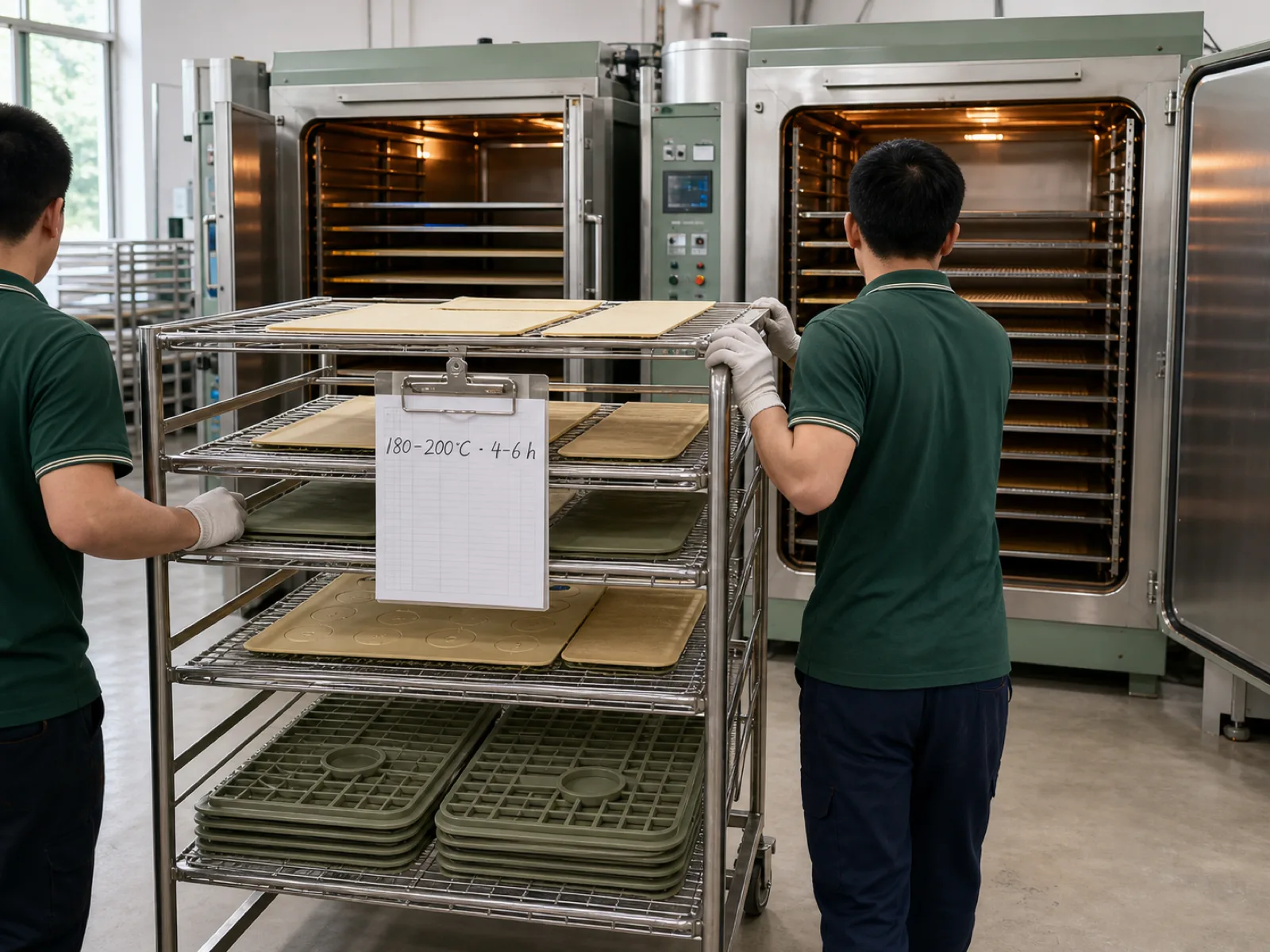
Platinum-cure silicone is the safer default because the failure mode is eliminated at the chemistry level. Platinum-cure (addition-cure) crosslinks via a platinum-catalyzed hydrosilylation reaction that produces no byproducts. Peroxide-cure crosslinks via dicumyl peroxide (DCP) decomposition, which leaves acetophenone and DCP fragments in the elastomer. Both can pass FDA extraction, but peroxide-cure fails LFGB unless the 4-6 hour post-cure at 200°C is run to full spec.
The distinction is not a nice-to-have — it is the single biggest real-world safety variable at the factory floor. On a cost-optimized floor, peroxide-cure base gum is 15-25% cheaper and the compression cycle is 20-40% shorter. If the post-cure oven is bottlenecked, the temptation to truncate the 4-hour cycle to 90 minutes is significant. The finished parts look and feel identical. The failure only surfaces on the LFGB acetic acid simulant. For any premium food-contact program — Whole Foods / Sprouts / Erewhon-caliber US retail, all EU retail, or any baby / infant product — spec platinum-cure explicitly in the RFQ. Do not accept "peroxide-cure equivalent" language. The [platinum-cure vs peroxide-cure guide](/guide/platinum-cured-vs-peroxide-cured-silicone/) covers the chemistry and process comparison in engineering detail. ### Cure system comparison — safety-relevant | Property | Platinum-cure (addition-cure) | Peroxide-cure (DCP) | |---|---|---| | Catalyst | Karstedt's / Speier's Pt catalyst | Dicumyl peroxide (DCP) | | Cure byproducts | None (byproduct-free reaction) | Acetophenone, DCP fragments | | Post-cure required for LFGB? | Optional (belt-and-braces) | Mandatory (4-6h @ 200°C) | | FDA 21 CFR 177.2600 pass rate | Consistent | Consistent with post-cure | | LFGB §30/31 pass rate | Consistent | Passes with disciplined post-cure; fails without | | USP <88> Class VI feasibility | Yes | Not typically | | Base-gum cost premium | +15% to +25% vs peroxide | Baseline | | Typical compression cycle time | 3-5 min at 180°C | 2-3 min at 165°C | | Recommended for baby / medical | Yes | No | | Recommended for premium food-contact | Yes | Only with process discipline | ## Do BPA, phthalates, and PFAS show up in silicone products?The PDMS polymer contains none of them by chemistry. But "silicone product" safety extends beyond the base polymer. Non-food-grade colorant master-batches, talc or CaCO3 fillers cut into cheap compound, printing inks used for logos, and mold-release agents on finished parts can reintroduce restricted substances at the finished-part level. On premium programs, spec a full restricted-substance-list (RSL) test bundle from the same accredited lab, referencing one master-batch lot[^echa-reach][^echa-pfas-proposal].
The most common way "is silicone safe" fails at the finished-part level despite a compliant base gum: pigment substitution. A cost-optimized factory switches from a food-grade organic pigment (rated per BfR / FDA) to a cheaper industrial pigment that carries heavy metals or PAHs. The base gum COA is unchanged; the finished part now fails RSL testing. This is why a per-SKU RSL bundle — not just FDA + LFGB — is standard practice on premium programs. ### Finished-part safety failure modes (base polymer is fine — additives fail) | Failure mode | Where it enters | Detection test | Countermeasure | |---|---|---|---| | Non-food-grade pigment | Colorant master-batch | RSL heavy-metal panel | Spec food-grade pigment supplier by name in RFQ | | Talc / CaCO3 filler substitution | Compound-house filler-cutting | Ash content, RSL | Require raw-material COA per lot | | Printing ink migration | Logo printing on food-contact surface | LFGB overall migration | Move logo to non-food-contact zone or deboss instead | | Mold-release agent residue | Mold prep between shots | Extraction test | Spec silicone-based release agent or no release agent | | PFAS-contaminated processing aid | Legacy fluorosurfactant use | PFAS non-detect certificate | Require PFAS non-detect per master-batch lot | | Regrind incorporation | Compound-house economics | Physical property drift, extraction | Prohibit regrind in food-contact spec | ## Raw-material provenance — why the base gum brand mattersNamed base-gum brands (Dow XIAMETER, Wacker ELASTOSIL, Momentive Silopren, Shin-Etsu KE-series) ship with per-lot Certificates of Analysis backed by ISO 9001 quality systems. Unbranded Chinese base gum from tier-3 compound houses often lacks per-lot COAs, mixes food-grade and industrial-grade streams, and is the upstream flag for downstream 'is silicone safe' failure. On any premium program, spec the base-gum brand by name in the RFQ[^iso-9001].
The four global majors — Dow (formerly Dow Corning), Wacker Chemie, Momentive Performance Materials, Shin-Etsu Chemical — collectively supply the majority of food-grade PDMS base gum used in disciplined OEM manufacturing. Their food-grade product families (Dow XIAMETER RBB, Wacker ELASTOSIL R and Q, Momentive Silopren, Shin-Etsu KE-951 / KE-961) ship with per-lot COAs specifying viscosity, volatile content, catalyst residue, and heavy-metal content. This is the traceability chain that lets a Wetop batch report at the finished-part level reference back to a specific base-gum lot.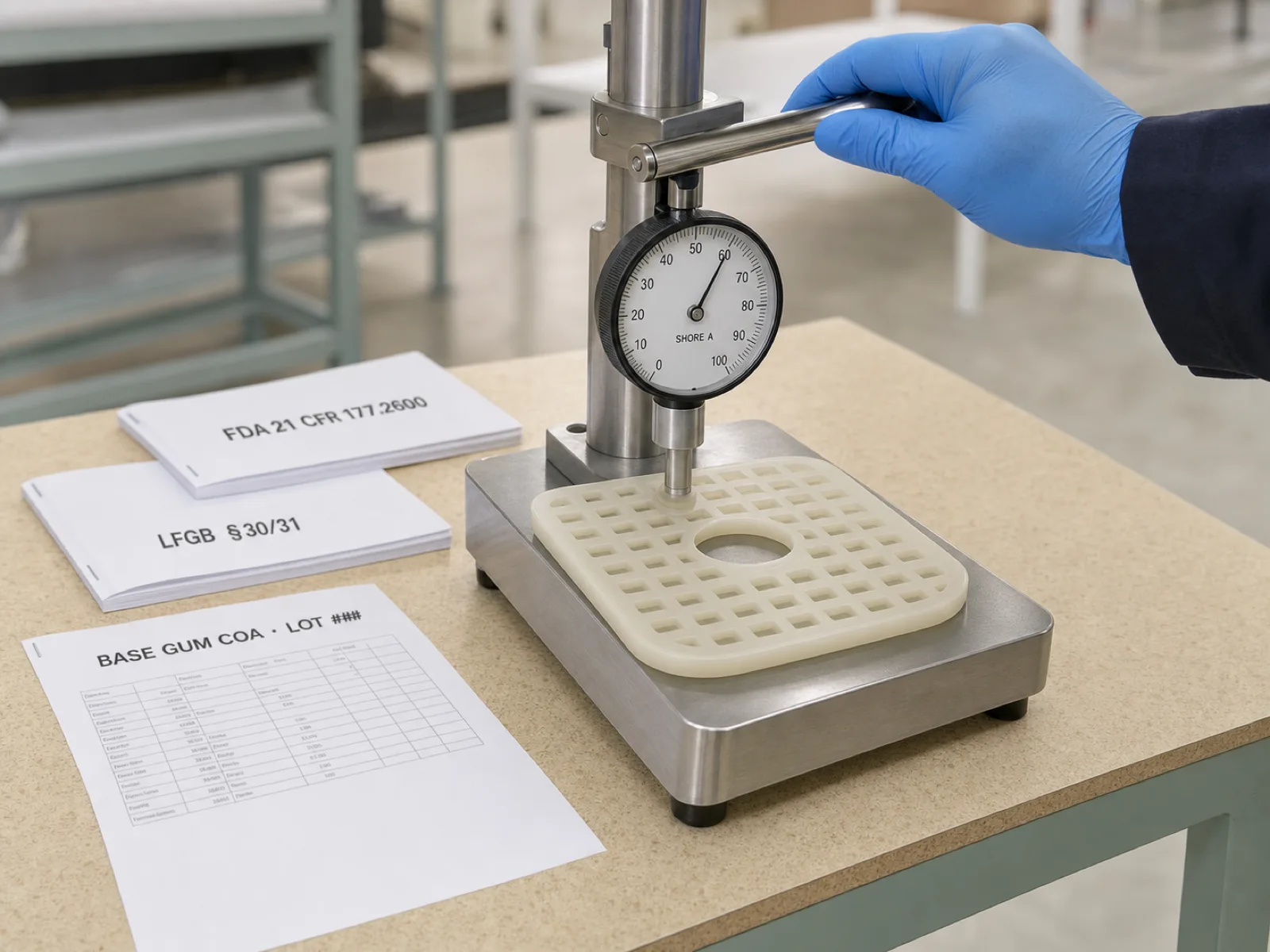
For B2B buyers, "is silicone safe" is not verified until six documents are on file per SKU, per production run. (1) Raw-material COA from a named base-gum brand; (2) master-batch lot number that will feed the production run; (3) post-cure oven log for that lot; (4) FDA 21 CFR 177.2600 test report from an accredited lab, referencing the same lot; (5) LFGB §30/31 test report, same lot; (6) PFAS non-detect certificate. Anything less is claim, not proof[^fda-177-2600][^bfr-lfgb-xv][^echa-pfas-proposal].
This is the packet Wetop ships with every OEM production run. It is also the packet a buyer should demand from any silicone factory before releasing a PO. The [sourcing checklist](/guide/sourcing-silicone-factory-checklist/) covers the full pre-PO factory audit; the six documents below are the specific safety-verification subset. ### Pre-PO safety verification checklist | # | Document | What it proves | Common failure | |---|---|---|---| | 1 | Raw-material COA (base-gum brand) | Named food-grade PDMS supplier, per-lot | "COA available" but not per-lot | | 2 | Master-batch lot number | Traceability anchor tying finished part to base gum | Lot number missing or "representative" | | 3 | Post-cure oven log | 4-6 h at 180-200°C actually ran on this lot | Truncated cycle (90 min) or no log | | 4 | FDA 21 CFR 177.2600 test report | n-hexane and water extraction within ceilings | Report is >90 days old / different lot | | 5 | LFGB §30/31 test report | Three-simulant migration within TNVR ceiling | FDA-only supplied; LFGB "on request" | | 6 | PFAS non-detect certificate | No PFAS-contaminated processing aids | Not offered; only "PFAS-free by declaration" | The 90-day rule on #4 and #5 is the operational anchor. Reports older than 90 days often do not tie to the current master-batch lot because the base-gum inventory has cycled. Wetop refuses to ship reports older than the batch they document — every production run gets its own paired FDA + LFGB report from SGS, Intertek, TÜV, or Bureau Veritas. ## What do peer-reviewed migration studies actually measure?Peer-reviewed migration studies index on PubMed consistently measure D4/D5/D6 release from post-cured platinum-cure silicone at levels one to two orders of magnitude below the tolerable daily intake (TDI) reference doses established by EFSA and BfR[^pubmed-siloxane-migration]. Studies of under-post-cured peroxide-cure silicone stressed at 250°C show measurably higher release rates — which is the process signature the LFGB acetic acid simulant test is designed to catch.
The migration literature converges on three findings that matter to a B2B buyer signing an "is silicone safe" verification. First, the cure system determines the migration baseline: platinum-cure silicone with 4-hour post-cure at 200°C releases D4/D5/D6 into food simulants at rates 10-100x lower than peroxide-cure silicone with truncated post-cure. Second, the migration rate is temperature-dependent — the release doubles roughly per 10°C, which is why the 230°C continuous ceiling exists as a safety margin below the 250°C threshold where measurable acceleration begins. Third, the migration rate drops sharply after the first exposure cycle: the surface-adjacent siloxane pool depletes and diffusion becomes the rate-limiting step. This is why FDA 21 CFR 177.2600's successive-extraction ceiling (4 mg/in²) is materially lower than the first-extraction ceiling (175 mg/in²). The engineering implication for a factory floor: the post-cure step is the largest single lever on the migration rate a buyer will encounter downstream. A factory that runs the full 4-6 hour cycle at 200°C reliably ships product with migration well below LFGB TNVR ceilings. A factory that truncates the cycle to 90 minutes ships product that may pass FDA but will fail LFGB. This is one of the reasons Wetop declines RFQs that spec peroxide-cure with an aggressive lead time — the post-cure oven cannot be shortcut without shifting the failure downstream to the buyer's retail-tier compliance audit. ## What are NIAS and why do they show up in "is silicone safe" audits?NIAS (Non-Intentionally Added Substances) are compounds present in a food-contact material that were not deliberately added — cure byproducts, impurities in raw materials, degradation products, and reaction products of intended additives. EU Regulation (EC) 1935/2004[^ec-1935-2004] captures NIAS under its general safety principle: they must not migrate at levels endangering human health. For silicone, the practical NIAS are peroxide-cure byproducts and residual cyclic siloxanes.
NIAS is the framework compliance officers use to answer "what else is in the finished part?" beyond the declared ingredients. For silicone specifically, the NIAS profile is well-characterized: acetophenone and dicumyl-peroxide fragments in peroxide-cure product, D4/D5/D6 in all silicone products at some level, and trace platinum catalyst residue in platinum-cure product. All three are captured under LFGB §30/31 TNVR extraction — which is why LFGB is the more rigorous safety benchmark than FDA for silicone. The buyer question this shapes: on premium programs where NIAS coverage matters (baby / infant, medical-adjacent, USP <88> Class VI), spec both FDA + LFGB + a NIAS-specific screening panel from an accredited lab. The screening panel typically runs GC-MS analysis on the LFGB extraction residue to identify individual migrating species rather than just reporting aggregate TNVR. Wetop can spec this on request for programs where it is required. ## The consumer-blog claims — a quick engineering rebuttalMost "silicone is not safe" claims on consumer blogs conflate un-post-cured peroxide-cure silicone tested at extreme temperatures with properly manufactured platinum-cure food-grade silicone in normal use. The peer-reviewed food-contact migration literature — indexed on PubMed and cited by BfR in Recommendation XV — consistently confirms properly manufactured silicone releases D4/D5/D6 at levels well below toxicological reference doses[^pubmed-siloxane-migration][^bfr-lfgb-xv].
The three most-repeated consumer-blog claims and the engineering counter: **Claim: "Silicone leaches chemicals when heated."** — Under-post-cured peroxide-cure silicone stressed above 230°C does release measurable D4/D5 siloxanes. Properly post-cured platinum-cure silicone tested at LFGB conditions (100°C, 4 hours, acidic and fatty simulants) releases residues well below the 10 mg/dm² TNVR ceiling. The engineering fix is post-cure, not silicone avoidance. **Claim: "Silicone contains BPA."** — Silicone is PDMS with a Si–O backbone; BPA is bisphenol-A, a carbon-based compound used in polycarbonate. The two are chemically unrelated. Silicone can neither contain BPA nor leach it because BPA is not a component or byproduct of PDMS chemistry. **Claim: "Silicone is basically plastic."** — Chemically, no. Silicone is an inorganic-organic polymer with a siloxane backbone. Plastic (in the food-contact sense) refers to carbon-backbone thermoplastics. The distinction matters because the failure modes (plasticizer migration, PFAS leaching, PC bisphenol release) that drive plastic safety concerns simply do not apply to silicone. ## Next step — release the OEM PO on evidence, not marketing The engineering answer to "is silicone safe" is: yes, when the finished part is platinum-cure food-grade silicone with the six-document verification packet on file per SKU per batch. That is a manufacturable, auditable, defensible position — and the one Wetop's engineering desk operates by default on every OEM program. If you are sourcing a food-contact silicone SKU and need the pre-PO verification packet reviewed against your retail channel's compliance stack, the [Wetop engineering desk](/contact/) will walk your spec sheet against FDA / LFGB / PFAS / USP scope, name the base-gum brands acceptable for your program, and — for programs at Top-5 US sink brand caliber or the Kraus / Ruvati / Kohler-caliber retail tier — set up an accredited-lab per-batch reporting cadence tied to your master-batch lot number.