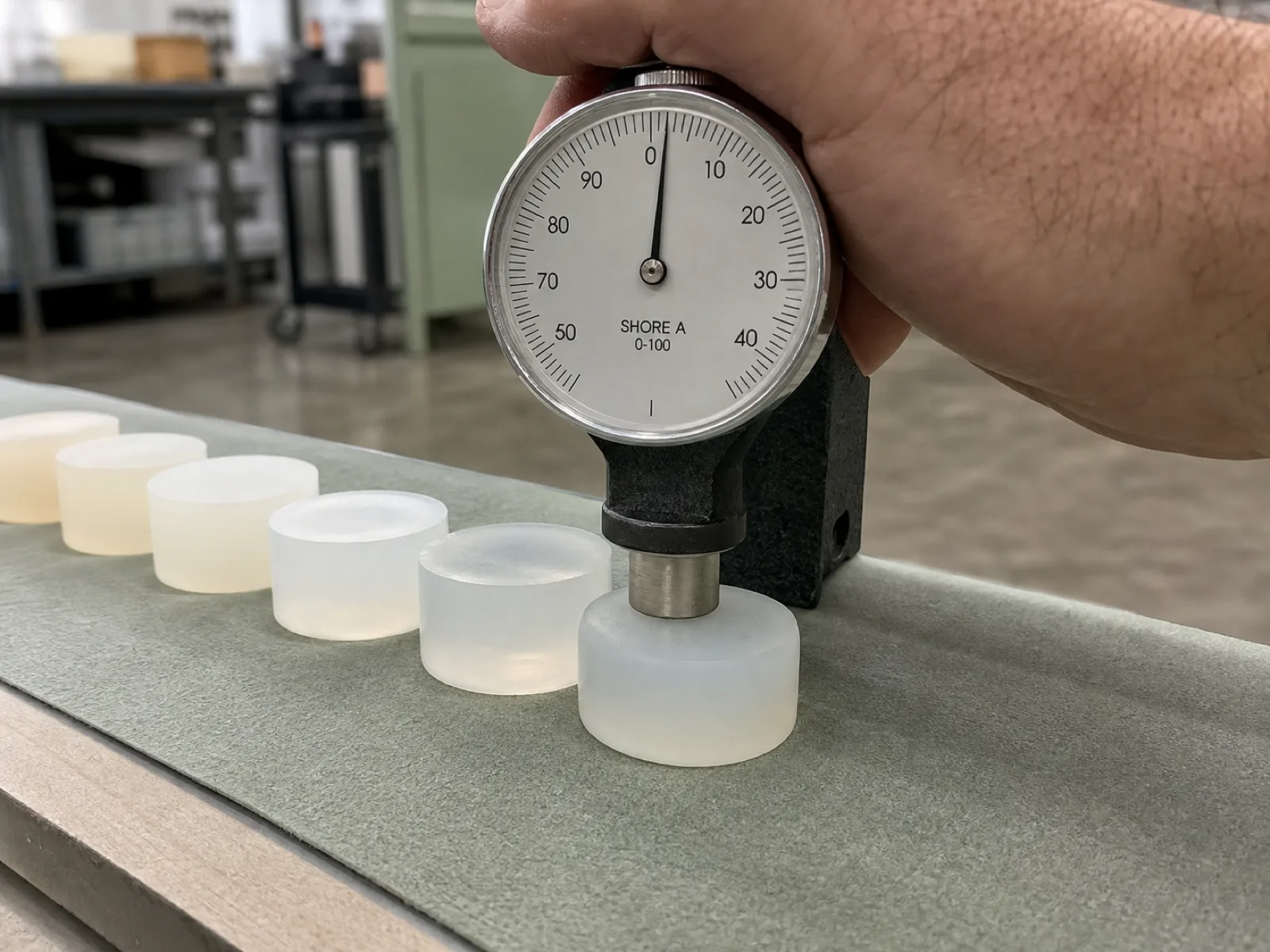
LSR (liquid silicone rubber) is a pumpable two-part liquid at 50,000-100,000 g/mol that injection-molds and platinum-cures in seconds, holding ±0.05-0.10 mm tolerance. HCR (high-consistency rubber) is a stiff gum block above 400,000 g/mol that is compression- or transfer-molded, usually peroxide-cured, and holds ±0.20-0.30 mm. LSR wins on tight tolerance, overmolding, and automated high volume; HCR wins on large flat parts, low-to-mid volumes, and lower tooling spend.
Both materials are polydimethylsiloxane — the same silicone chemistry that clears FDA and LFGB food-contact regulation when correctly post-cured. The decision between them is not about safety. It is about how the part is shaped, how tight the drawing is, how many you are buying, and how much tooling budget the program can carry. Below, each dimension is broken out with the numbers a sourcing engineer actually needs to spec the right material on an RFQ. ## What is the difference between LSR and HCR silicone?LSR and HCR share the same silicone polymer but differ in physical form and molecular weight. LSR (liquid silicone rubber) is a low-viscosity, two-part liquid around 50,000-100,000 g/mol that pumps and injects. HCR (high-consistency rubber, also called gum stock) is a stiff, dough-like solid above 400,000 g/mol that must be milled and compression-molded. Every processing difference flows from that gap.
Both materials start as polydimethylsiloxane (PDMS) — linear siloxane chains (Si-O-Si) with methyl side groups. What separates them is chain length. LSR uses shorter polymer chains, so it stays liquid and flowable at room temperature and ships in two pumpable parts (an "A" side carrying the platinum catalyst and a "B" side carrying the crosslinker). HCR uses very long chains, so at room temperature it behaves like a stiff, tacky gum — closer to bread dough than to a liquid — and has to be worked on a two-roll mill before it can be shaped. That single difference in molecular weight cascades into everything downstream: how the material is metered, which molding process applies, what cure chemistry is practical, what tolerance is achievable, and where the cost curve sits versus volume. Understanding the polymer physics first makes the rest of the comparison read as consequences rather than a list of disconnected facts. If you want the ground-level primer on the liquid side before going further, the [liquid silicone rubber explainer](/guide/what-is-liquid-silicone-rubber-lsr-explained/) covers LSR chemistry and handling in depth. ## How do molecular weight and viscosity differ between LSR and HCR?Molecular weight is the root variable. LSR polymer chains run roughly 50,000-100,000 g/mol, keeping viscosity low enough to pump and inject at low pressure. HCR chains run 400,000-800,000 g/mol and higher, producing a gum so viscous it cannot flow — it must be milled, calendered, or compression-forced into a cavity. Viscosity, not chemistry, dictates the molding method.
Think of it like the difference between honey and chewing gum made from the same sugar. The chemistry is identical; the chain length changes the behavior completely. LSR's shorter chains let it flow into fine cavity detail and around inserts at injection pressures, which is why it can fill thin walls and complex micro-geometry an operator could never press by hand. HCR's long chains give it green strength — it holds its shape as an uncured blank — but they also make it impossible to inject through a runner system without extreme pressure. | Property | LSR (liquid silicone rubber) | HCR (high-consistency rubber) | |---|---|---| | Physical form | Pumpable two-part liquid | Stiff gum block / dough | | Molecular weight (typical) | 50,000-100,000 g/mol | 400,000-800,000+ g/mol | | Viscosity | Low (pours / pumps) | Very high (must be milled) | | Supplied as | Part A + Part B pails/drums | Catalyzed or un-catalyzed gum | | Room-temp handling | Metered by pump | Two-roll mill, then blanked | | Filler loading | Lower, pre-dispersed | Higher, mill-dispersed | The higher filler loading HCR can carry on the mill is part of why HCR often reaches higher tensile and tear numbers — more reinforcing silica is worked into the longer-chain matrix. That trade-off surfaces again in the mechanical-property section below. Viscosity also governs how each material is stored, dosed, and wasted. LSR arrives in sealed pails or drums and is pumped straight from container to mixer, so scrap is low and lot-to-lot consistency is high — the metering system doses the same ratio every shot. HCR arrives as catalyzed or un-catalyzed gum that a compounder mills to disperse filler and pigment, a step that adds a manual variable but also lets a supplier tune hardness, color, and reinforcement on the floor without a new base compound. For a buyer, that means LSR favors programs where repeatability and automation matter most, while HCR favors programs that need formulation flexibility or frequent color and durometer changes across a family of parts. ## How do the cure systems differ — platinum vs peroxide?LSR is platinum addition-cured; HCR is most often peroxide-cured. LSR's platinum-catalyzed hydrosilylation produces no byproducts and cures in seconds inside a heated mold, which is what makes fast automated injection possible. HCR's peroxide cure leaves trace organic volatiles that a mandatory 4-6 hour post-cure at 180-200°C drives off before the part clears LFGB testing.
The cure system is downstream of the physical form, not an independent choice. LSR must use a fast, clean catalyst because it injection-cures on a short cycle — a platinum complex (Karstedt's catalyst) drives a byproduct-free addition reaction that sets the part in 15-90 seconds. That clean chemistry is also why platinum-cured LSR is inherently PFAS-free and meets USP Class VI[^usp-class-vi] and ISO 10993 biocompatibility[^iso-10993] on standard formulation, making it the default for medical and infant-feeding programs. HCR is most commonly peroxide-cured. Organic peroxide (typically dicumyl peroxide) generates radicals that crosslink the long chains, but it leaves decomposition byproducts — acetophenone and related volatiles — that must be baked out. Skipping that post-cure is the real quality failure mode, not the peroxide itself: without it, parts fail LFGB §30/31 organic-volatile testing (a BfR Recommendation XV requirement[^bfr-lfgb]) and carry a first-heat odor. Platinum-cured HCR grades do exist for low-odor and medical work, so the "LSR = platinum, HCR = peroxide" shorthand is a default, not a law. For the full chemistry, cost delta, and documentation contrast, see the dedicated [platinum-cured vs peroxide-cured guide](/guide/platinum-cured-vs-peroxide-cured-silicone/).
LSR runs liquid injection molding; HCR runs compression or transfer molding. LSR is metered by pump, injected into a closed heated tool, and cured in seconds on a fully automated cell — ideal for high-cavitation, high-volume, tight-tolerance parts. HCR is milled, blanked into pre-forms, and pressed in a heated compression or transfer mold, a lower-capital process better suited to large or simple geometry at moderate volume.
The process gap is where the abstract material difference becomes a real cost and quality decision. LSR liquid injection molding (LIM) is a closed-loop automated cell: metering pumps dose Part A and Part B, a static mixer combines them, and the shot injects into a multi-cavity tool that cures and ejects with minimal operator touch. It excels at small-to-medium parts, thin walls, tight registration, and — critically — two-shot and insert overmolding, because low-viscosity liquid flows around an insert at low pressure. HCR compression molding is closer to a craft process automated at the press. Milled gum is weighed into blanks, an operator lays them into open cavities, and a heated hydraulic press closes to cure the parts under pressure. Transfer molding adds a pot-and-plunger to force gum into a closed cavity for better registration. Both carry lower tooling cost than a multi-cavity LSR tool, and both scale well for large flat parts — sink grids, drying mats, gaskets, and drying racks — where injection would be impractical or wasteful. The trade is more manual labor per part and looser achievable tolerance. Our own [silicone molding process guide](/guide/silicone-molding-process-explained/) walks each process step by step with cycle-time and tooling detail. | Process trait | LSR — liquid injection | HCR — compression / transfer | |---|---|---| | Automation level | Fully automated cell | Semi-automated at press | | Best part size | Small to medium | Medium to large / flat | | Cavitation | High (8-32+ common) | Low to moderate | | Cycle time | 15-90 sec | 3-8 min per press cycle | | Overmolding / 2-shot | Native strength | Difficult, higher scrap | | Labor per part | Low | Higher (manual blank placement) | | Tooling cost | High (precision multi-cavity) | Lower (simpler press tool) | ## How do the mechanical and dimensional properties compare?HCR edges out on tensile and tear; LSR wins decisively on tolerance. HCR reaches roughly 9-11 MPa tensile because its long chains form a denser network, while LSR lands around 6-10 MPa. But LSR holds ±0.05-0.10 mm on molded features versus HCR's ±0.20-0.30 mm. Both cover Shore A 30-80 and the same broad temperature band.
The mechanical numbers below are typical ranges across general-purpose food-grade grades measured under ASTM tension and tear methods[^astm-standards]; specific formulations shift them. The pattern that matters: HCR's molecular weight buys durability, LSR's process buys precision. Choose on which one your drawing actually demands. | Property | LSR | HCR | Test basis | |---|---|---|---| | Shore A hardness range | 30-80 | 30-80 | ASTM D2240[^astm-d2240] | | Tensile strength | 6-10 MPa | 9-11 MPa | ASTM D412[^astm-standards] | | Tear strength | 20-45 kN/m | 30-55 kN/m | ASTM D624[^astm-standards] | | Elongation at break | 400-700% | 400-800% | ASTM D412[^astm-standards] | | Dimensional tolerance | ±0.05-0.10 mm | ±0.20-0.30 mm | ISO 3302-1[^iso-standards] | | Compression set | Low | Low-moderate | — | | Service temperature | -60°C to 230°C | -60°C to 250°C | — | Hardness is the one axis that does not separate the materials — both are compounded across the full Shore A 30-80 band, so a "we need Shore A 60" requirement tells you nothing about LSR vs HCR. For how durometer maps to feel and function, the [Shore A hardness chart](/guide/shore-a-hardness-silicone-chart/) breaks down each band. The tolerance line is the one that most often forces the decision: a sealing face, snap fit, or precision mating interface calls for LSR injection, while a flat mat or grid tolerates HCR's looser process window without any functional penalty.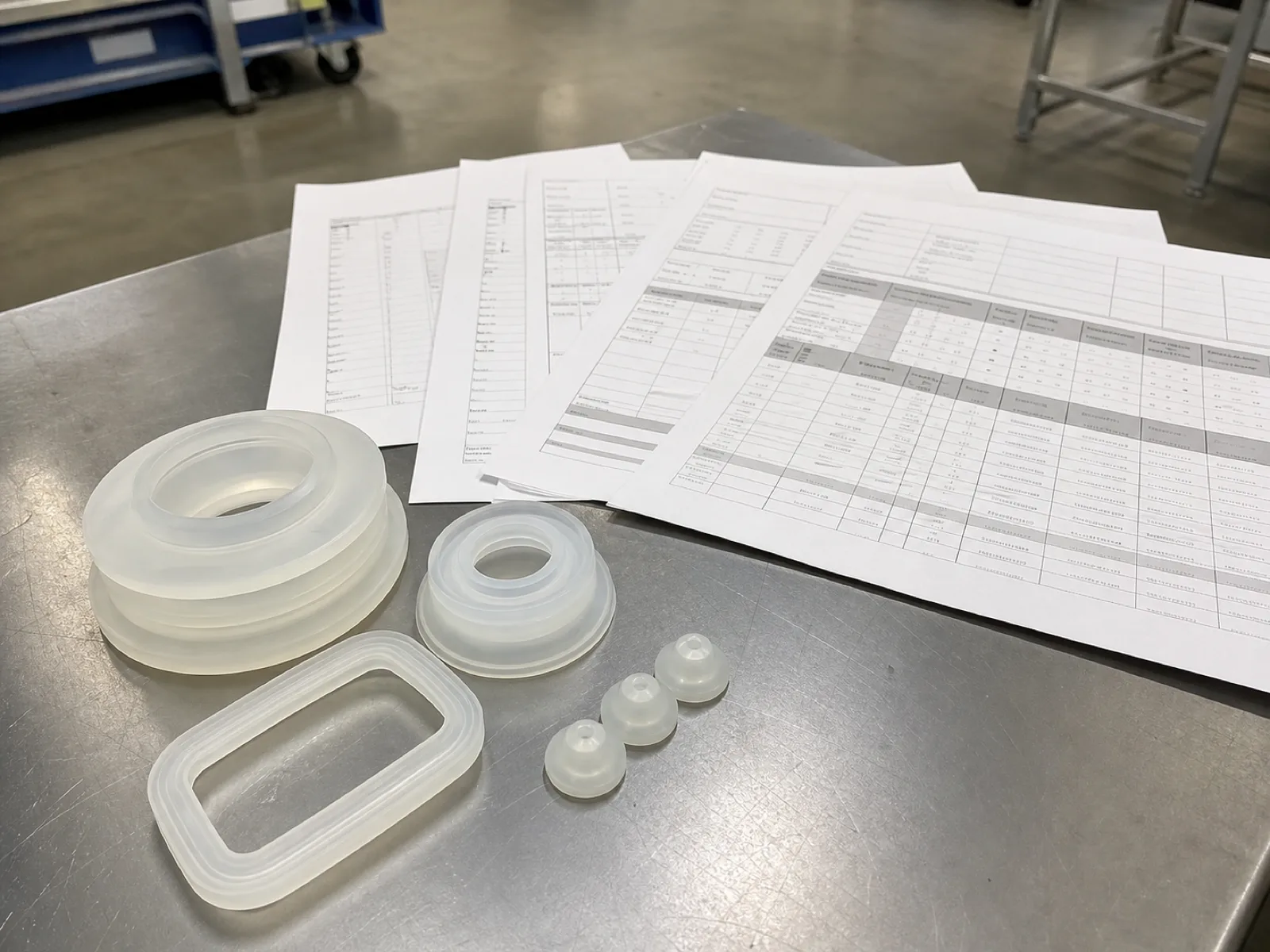
Tooling cost versus volume decides it. HCR compression tooling is a fraction of a multi-cavity LSR injection tool, so HCR wins below roughly 10,000-25,000 pieces per year. Above that, LSR's fast automated cycle and low per-part labor overtake HCR's manual compression cost. Part size, cavitation, and geometry shift the exact crossover, so model each program.
The economics are a classic fixed-versus-variable trade. LSR carries high fixed cost (a precision multi-cavity injection tool plus the metering cell) but very low variable cost per part (seconds of automated cycle, minimal labor). HCR carries low fixed cost (a simpler press tool) but higher variable cost (minutes per press cycle, manual blank placement). Plot both against annual volume and the lines cross. | Factor | Favors HCR | Favors LSR | |---|---|---| | Annual volume | Low to mid (< ~10-25k) | High, repeat production | | Tooling budget | Constrained | Amortizable across volume | | Part geometry | Large, flat, simple | Small, complex, thin-wall | | Tolerance requirement | ±0.2 mm acceptable | ±0.05-0.10 mm required | | Overmolding / 2-shot | Not needed | Required | | Medical / USP Class VI | Secondary | Baseline requirement | | Time-to-first-article | Faster (cheaper tool) | Slower (precision tool) | For a real OEM decision you also have to weigh MOQ and tooling lead time, not just unit price — a cheaper LSR unit cost is meaningless if the program volume never amortizes the tool. Our [MOQ and lead-time guide](/guide/moq-and-lead-time-silicone-oem/) puts the tooling-amortization math against realistic order quantities. The short version: don't pay for an automated LSR cell to make 5,000 flat mats a year, and don't try to compression-mold a tight-tolerance two-shot valve in HCR. ## Which material does Wetop use for kitchenware and sink programs?HCR compression molding is Wetop's default for kitchenware, sink grids, and drying racks. These are large, mostly flat parts at Shore A 40-70, ordered at MOQ 500-50,000 — exactly where HCR tooling economics, high filler loading, and disciplined post-cure win. Wetop reserves LSR injection for small, tight-tolerance, or overmolded components where the automated cell and ±0.05 mm precision are genuinely required.
Wetop runs both a compression cell and an LSR injection cell on the 7,500 m² Dongguan floor, so the recommendation on any RFQ is engineering-led, not capacity-led. For the core lines — silicone drying racks, drying mats, and sink grids — the parts are large-format and flat, the volumes sit in the range where a compression tool amortizes fast, and the tolerance windows are comfortably inside what compression holds. HCR, post-cured 4-6 hours at 200°C, clears FDA 21 CFR 177.2600[^fda-177-2600] and LFGB per batch and delivers the tensile and tear needed for a part that gets flexed, stacked, and dishwasher-cycled for years. This is not a limitation of the LSR cell — it is a match between part and process. A roll-up drying rack is a large flat lattice; forcing it through an injection tool would demand an enormous, expensive multi-cavity mold and gain nothing on a part whose tolerance window is millimeters, not microns. Compression molding lays a milled blank into an open cavity, presses, cures, and post-cures — a workflow that scales cleanly from a 500-piece pilot to a 50,000-piece production run without re-tooling into a different process. That range is exactly why HCR compression is the backbone of the core kitchenware lines. Where a brief calls for a small precision component — a sealing grommet, a two-shot overmold onto a plastic frame, a medical-adjacent part needing USP Class VI[^usp-class-vi] — the recommendation flips to platinum-cured LSR injection, because that is the process built for tolerance and overmolding. The discipline that matters more than the material choice is the same in both cases: cure system declared on the master-batch certificate, per-batch post-cure records under an ISO 9001[^iso-9001] system, and independent food-contact test reports on the compliance packet. Any supplier who can't produce those, in either material, fails the audit downstream regardless of whether they quoted LSR or HCR. ## Frequently asked questions **What is the main difference between LSR and HCR silicone?** Physical form and molecular weight. LSR (liquid silicone rubber) is a two-part, low-viscosity liquid around 50,000-100,000 g/mol that pumps and injects like a thermoset. HCR (high-consistency rubber) is a stiff, gum-like solid above 400,000 g/mol that must be milled and compression- or transfer-molded. Everything else — cure chemistry, tooling, tolerance, and cost curve — follows from that molecular-weight difference. **Is LSR or HCR silicone stronger?** HCR generally reaches higher tensile strength (up to ~10-11 MPa) and tear resistance because its long polymer chains form a denser entangled network, which is why HCR dominates high-durability seals and cable insulation. LSR tensile lands around 6-10 MPa depending on grade. For most consumer and food-contact parts the difference is not decision-driving; geometry, tolerance, and volume matter more than raw tensile. **When should I choose LSR over HCR for an OEM part?** Choose LSR when the part is small-to-medium, high-volume, needs tight tolerance (±0.05-0.10 mm), requires two-shot overmolding onto plastic or metal, or targets medical/infant-feeding positioning where platinum-cure and USP Class VI are baseline. LSR's automated injection cell amortizes its higher tooling cost only across large, repeat production runs. **When is HCR the better choice than LSR?** HCR wins on large flat or extruded parts, low-to-mid volumes (below ~10,000-25,000 pieces), simpler geometry, and programs sensitive to tooling spend. Compression and transfer tooling costs a fraction of a multi-cavity LSR injection tool, so the per-program economics favor HCR whenever the annual volume can't amortize an automated LSR cell. **Does LSR or HCR hold a tighter dimensional tolerance?** LSR. Automated injection molding with precise metering holds ±0.05-0.10 mm on molded features, versus ±0.20-0.30 mm typical of HCR compression molding, where flash and gum placement introduce more variation. If your drawing calls out a sealing face, snap fit, or mating interface with tight GD&T, LSR injection is the safer process choice. **Can HCR silicone be overmolded onto plastic or metal like LSR?** It is far harder. Two-shot and insert overmolding are native strengths of LSR injection molding because the low-viscosity liquid flows around an insert at low pressure and bonds via primer or self-bonding grades. HCR compression molding can bond to inserts but with more manual placement, higher scrap, and looser registration. For high-mix overmold assemblies, LSR is the standard answer. **Is LSR always platinum-cured and HCR always peroxide-cured?** Mostly, but not absolutely. LSR is platinum addition-cured by definition — that clean, byproduct-free reaction is what lets it injection-cure in seconds. HCR is most often peroxide-cured, but platinum-cured HCR grades exist for medical and low-odor applications. If cure chemistry matters to your compliance packet, specify it on the master-batch certificate rather than inferring it from the material class. **At what volume does LSR become cheaper than HCR?** There is no universal number, but the crossover for a typical small-to-medium part sits around 10,000-25,000 pieces per year. Below that, HCR's low tooling cost wins; above it, LSR's fast automated cycle and low per-part labor overtake HCR's manual compression labor. Part size, cavitation, and geometry shift the exact breakpoint, so model it per program. ## Spec the right material with the engineering desk LSR versus HCR is not a quality ranking — it is a fit decision between molecular weight, molding process, tolerance, and volume. Bring the drawing, the target volume, and the compliance requirement, and Wetop's engineering desk will recommend the material and process that make the program cost-right, not capacity-right. [Talk to the engineering desk](/contact/) to get an LSR-vs-HCR recommendation and a quote against your actual part. ## References The claims and specifications in this guide reference the following Tier-1 authoritative sources.