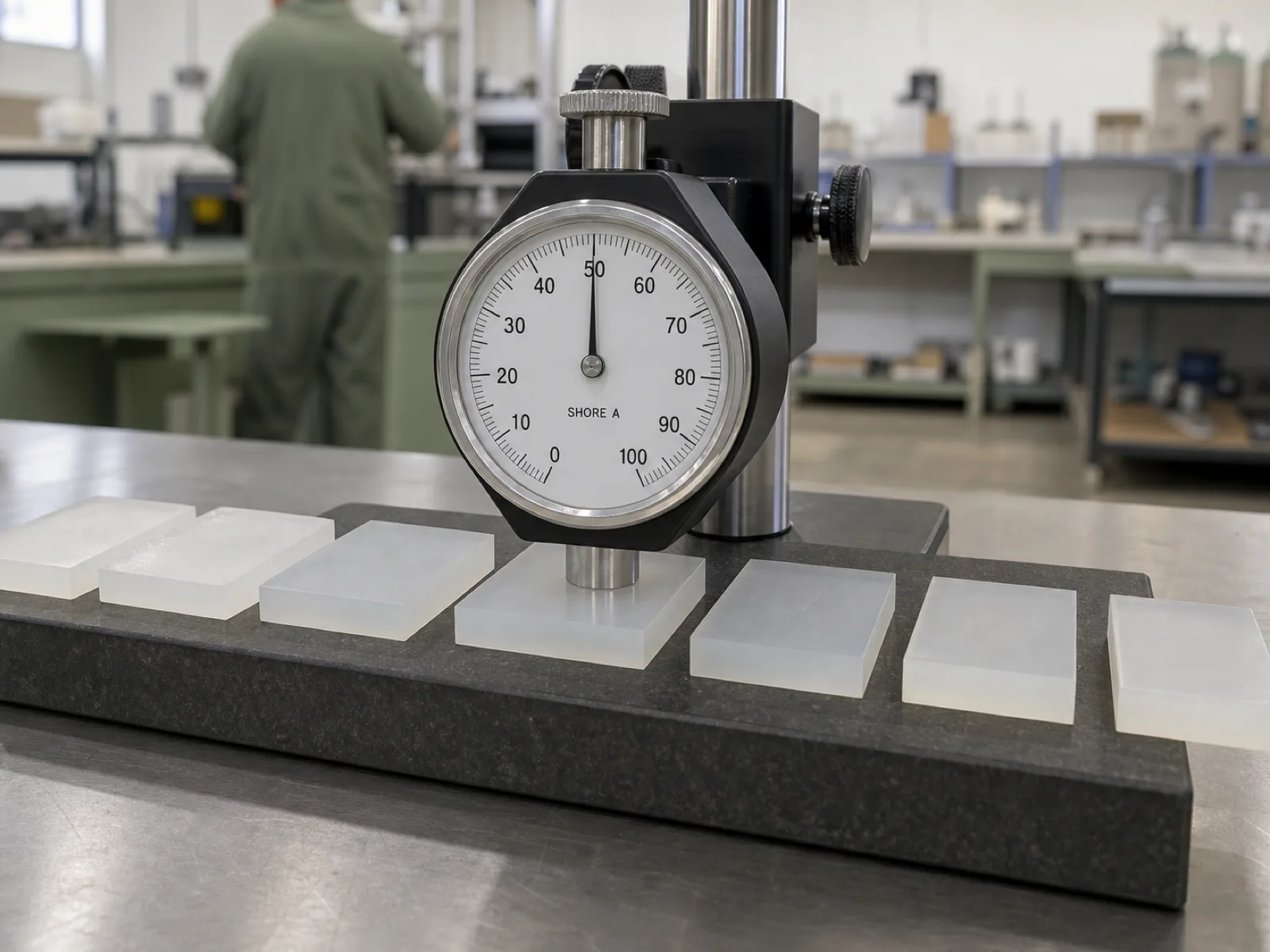
Silicone is phthalate-free by design because phthalates are plasticizers added to soften rigid plastics like PVC, whereas silicone's siloxane backbone is already flexible and needs no plasticizer — so there is nothing of that class to leach out. The regulated phthalates such as DEHP, DBP, and BBP are endocrine-active plasticizers restricted under CPSIA and EU REACH, and none of them are ingredients in silicone chemistry. The verifiable claim, however, comes from testing: FDA 21 CFR 177.2600, EU Regulation 10/2011 migration limits, and a per-batch third-party report turn "phthalate-free" from a marketing word into documented compliance.
## Is silicone phthalate-free?Yes — silicone is inherently phthalate-free. Phthalates are plasticizers added to soften rigid polymers like PVC. Silicone's -Si-O-Si- siloxane backbone is flexible on its own and never requires a plasticizer, so no phthalate is present to migrate. The remaining task is not removing phthalates but documenting purity: verifying the specific compound with food- or medical-grade test reports.
The reason the answer is "yes by chemistry" and not "yes by testing alone" matters for how you write a specification. In a plasticized plastic — flexible PVC being the textbook case — a rigid polymer chain is softened by dispersing 20–40% by weight of a phthalate ester between the chains. Those ester molecules are not chemically bonded; they are physically trapped, which is exactly why they migrate into food, skin oils, and air over time.[^niehs-phthalates] Silicone works on an entirely different principle. Its flexibility comes from the siloxane backbone itself — alternating silicon and oxygen atoms with a bond geometry that rotates freely at room temperature. The rubber is soft because of what the polymer *is*, not because of something added to it. There is no plasticizer role to fill, so a phthalate never enters the formulation. This is the single fact most consumer blogs get right but never explain: the phthalate-free property is structural, not a feature the manufacturer opted into. That is also why "phthalate-free silicone" as a product category is, strictly, a redundancy — like "gluten-free water." The commercially useful version of the claim is narrower: *this compound is a verified, tested, food- or medical-grade silicone with documentation you can hand to a compliance auditor.* The rest of this guide is about earning that second sentence. ## What are phthalates, and why are they regulated?Phthalates are esters of phthalic acid used as plasticizers to soften rigid plastics. The regulated set — DEHP, DBP, BBP, DINP, DIDP, and DnOP — is classified as endocrine-disrupting because several members interfere with hormone signaling. They are restricted by name under CPSIA, EU REACH, and EU food-contact rules, specifically because they leach from the flexible plastics that contain them.
Phthalates are a family of chemicals built on the same phthalic-acid core with different alcohol side chains. The side chain determines the behavior, but the ones that draw regulatory attention share a role: they make hard plastics bendable. The most-restricted members and their typical restriction basis: | Phthalate | Abbrev. | Primary regulatory status | |---|---|---| | Di(2-ethylhexyl) phthalate | DEHP | CPSIA banned in children's articles; REACH Annex XIV SVHC | | Dibutyl phthalate | DBP | CPSIA banned; REACH SVHC | | Benzyl butyl phthalate | BBP | CPSIA banned; REACH SVHC | | Diisononyl phthalate | DINP | CPSIA restricted in children's articles | | Diisodecyl phthalate | DIDP | CPSIA restricted (interim) | | Di-n-octyl phthalate | DnOP | CPSIA restricted (interim) | The health concern is endocrine disruption — the ability of certain phthalates to mimic or interfere with hormones, which is why the US NIEHS studies them as a public-health topic[^niehs-phthalates] and why the US CPSC permanently restricted the primary set for children's toys and childcare articles under the Consumer Product Safety Improvement Act.[^cpsc-phthalates] In the EU, DEHP, DBP, BBP, and DIBP are on the REACH candidate list of Substances of Very High Concern.[^echa-reach] The through-line for a silicone buyer: every one of these restrictions targets a *plasticizer in a flexible plastic*. The regulators wrote the rules around the leaching mechanism. Since silicone has no plasticizer, it sits outside the mechanism entirely — but the paperwork that proves your part is silicone, and not a plasticized look-alike, is what closes the loop. ## Why does silicone need no plasticizer?Because the siloxane backbone is already flexible. Silicone is built from repeating silicon-oxygen (-Si-O-Si-) units whose bond angles rotate freely, giving the polymer rubber-like elasticity from -60 °C to well above 200 °C without any softening additive. A plasticizer exists only to loosen rigid chains; silicone chains are never rigid, so the additive — and its leaching risk — is designed out.
No. "Silicone" names a polymer, not a purity grade. The base chemistry is phthalate-free, but cheap compounds can carry non-food-grade fillers, non-compliant pigments, and slip or processing additives that introduce other contaminants. Only a tested food-grade or medical-grade compound — with a report tied to a lot number — is a verifiable claim. "It's silicone, so it's safe" is not defensible.
This is the gap that consumer pages skip and that a B2B buyer cannot afford to. A finished silicone part is the base polymer *plus* everything the compounder and molder added: reinforcing filler, color master-batch, catalyst, and often a mold-release or slip additive. Each is a place where a low-cost supply chain can substitute a non-compliant grade to shave cost. The realistic contamination risks in adulterated "silicone" — none of which are phthalates, which is itself instructive — include: - **Non-food-grade filler extenders** — excess precipitated silica or calcium-carbonate extenders loaded past the food-grade formulation to cut polymer cost. - **Non-compliant pigments** — colorants outside the FDA/EU permitted list, occasionally carrying heavy-metal contaminants that fail a migration or total-lead screen. - **Mold-release residue** — spray release agents that transfer to the part surface; some legacy chemistries carry fluorinated compounds (a separate concern covered in our [PFAS-free silicone guide](/guide/silicone-pfas-free-sustainability/)). So the phthalate question and the purity question are actually two questions. Silicone answers the first by chemistry. Only testing answers the second. A supplier who responds to "is this phthalate-free?" with "yes, it's silicone" has answered the easy half and dodged the half that matters — whether *this batch* of *this compound* passes migration and extractables limits. ## How does cure system affect residual byproducts?Cure system changes the residual profile, not the phthalate status. Platinum-cured (addition) silicone produces no cure byproducts, leaving the cleanest extractable profile. Peroxide-cured silicone generates acidic decomposition byproducts that a 4–6 hour post-cure at ~200 °C drives off. Neither system involves phthalates, but the cure route and post-cure belong on the compound documentation because they govern what migration testing actually measures.
Two crosslinking chemistries dominate industrial silicone, and they leave different fingerprints on an extractables report: | Attribute | Platinum-cured (addition) | Peroxide-cured (free-radical) | |---|---|---| | Cure byproduct | None (hydrosilylation) | Acidic peroxide decomposition residues | | Post-cure requirement | Optional / short | 4–6 h at ~200 °C typically required | | Residual extractables | Lowest | Low after full post-cure | | Typical use | Medical, baby, premium food-contact | General food-contact, industrial | | Phthalate content | None | None | The takeaway is that "phthalate-free" is table stakes for both routes — the differentiator is the *overall* extractables and volatiles profile, which is what a premium or medical-adjacent buyer is really specifying when they ask about purity. Platinum-cure is the default for medical and infant programs precisely because it leaves nothing behind to extract. Peroxide-cure reaches a comparably clean state, but only with a verified post-cure, which is why the post-cure step is a documentation item, not an optional finishing touch. For the full decision framework, see our [platinum-cured vs peroxide-cured silicone comparison](/guide/platinum-cured-vs-peroxide-cured-silicone/). ## Which standards verify a phthalate-free claim?Five standards carry the weight: FDA 21 CFR 177.2600, EU Regulation 10/2011, USP Class VI, ISO 10993, and LFGB. The first two govern food contact and set migration limits — including phthalate-specific SMLs in EU 10/2011. The USP and ISO tiers govern medical biocompatibility. Cite them by clause on the Certificate of Compliance; a claim without a clause reference is not verifiable.
This is where an authoritative supplier separates from a marketplace listing: naming the standard by number rather than waving a generic "food-safe" flag. The map of which standard proves what: | Standard | Jurisdiction / scope | What it verifies | |---|---|---| | FDA 21 CFR 177.2600[^fda-177-2600] | US food-contact, repeated-use rubber | Total extractives within reflux limits | | EU Regulation 10/2011[^eu-10-2011] | EU food-contact plastics | Overall + specific migration limits, incl. phthalate SMLs | | LFGB §30/31 | Germany / EU food-contact | Sensory + migration compliance per batch | | USP Class VI[^usp-class-vi] | US medical-grade materials | In-vivo biological reactivity | | ISO 10993 series[^iso-10993] | Medical device biocompatibility | Chemical characterization, extractables/leachables | EU Regulation 10/2011 is the sharpest tool for this specific topic, and it is the one every competitor page omits. Because it regulates *plastics*, it explicitly lists the phthalates permitted as plasticizers and assigns each a specific migration limit (SML). For example, the regulation sets SMLs for the plasticizer phthalates it authorizes and prohibits others outright in food-contact plastics.[^eu-10-2011] A silicone part tested against 10/2011 is measured on the same ruler as the plasticized plastics the rule was written for — and returns non-detect on the phthalate line, which is exactly the evidence a premium EU program wants on file. The broader US framework these food-contact substance rules sit inside is FDA's food-packaging program.[^fda-food-packaging] Which standards you demand depends on the program tier — a distinction we break down fully in the [FDA vs LFGB decoder](/guide/fda-vs-lfgb-silicone/). For food-contact housewares, FDA 177.2600 plus LFGB and EU 10/2011 is the core. For anything medical-adjacent, USP Class VI and ISO 10993 stack on top. ## How does migration and extractables testing prove it?Migration testing is the lab evidence behind the claim. FDA 21 CFR 177.2600 uses reflux extraction in food simulants to cap total extractives; EU 10/2011 sets overall migration and phthalate-specific SMLs measured against simulants; GC-MS screens for the phthalate panel directly. A phthalate-free claim is only as good as the accredited-lab report — tied to your master-batch lot — that documents these results.
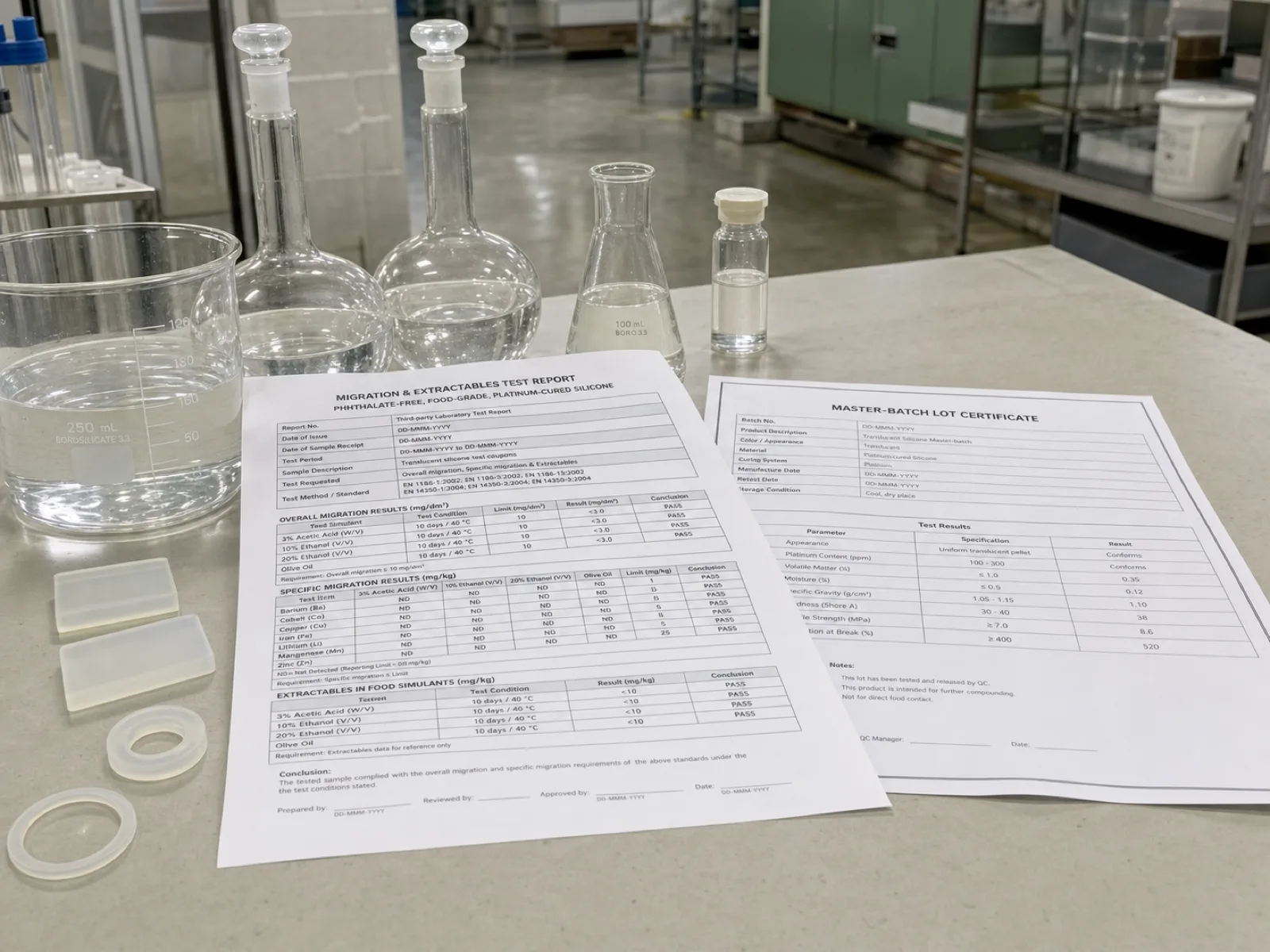
The three grades differ by documentation depth, not by phthalate content — all silicone is phthalate-free. Industrial-grade meets mechanical specs with minimal food/medical testing. Food-grade adds FDA 21 CFR 177.2600 and LFGB migration compliance. Medical-grade adds USP Class VI and ISO 10993 biocompatibility. You pay for the level of verified evidence the application requires, not for a different base chemistry.
| Grade | Core standards | Phthalate status | Typical documentation | |---|---|---|---| | Industrial | Mechanical/thermal spec only | Phthalate-free | Material datasheet, RoHS/REACH statement | | Food-grade | FDA 21 CFR 177.2600, LFGB, EU 10/2011 | Phthalate-free | Migration/extractables report per lot | | Medical-grade | USP Class VI, ISO 10993 series | Phthalate-free | Biocompatibility + extractables/leachables | The insight buyers should internalize: moving up the grade ladder does not buy you a "more phthalate-free" material — the base silicone is phthalate-free at every tier. What you buy is a deeper stack of *verification*, and correspondingly higher material and testing cost. Over-speccing medical-grade for a food-contact drying mat wastes money; under-speccing industrial-grade for an infant-feeding component fails an audit. We map this trade-off in detail in the [food-grade vs medical-grade silicone guide](/guide/food-grade-vs-medical-grade-silicone/), and note that for medical work Wetop supplies silicone **components** (tubing, cushions, ear tips) characterized to USP Class VI and ISO 10993 — not finished, cleared devices. ## How should a B2B buyer request phthalate-free documentation?Ask for documents tied to a lot number, not adjectives. A defensible phthalate-free package is: a Certificate of Compliance citing FDA 21 CFR 177.2600 and/or EU 10/2011 by clause; a third-party migration/extractables report from an accredited lab referencing your master-batch lot; a REACH/SVHC and California Prop 65 statement; and RoHS if required. No report tied to a lot is marketing, not compliance.
Turn the claim into a procurement checklist your supplier either meets or does not: - **Certificate of Compliance / Conformity (CoC)** — names the specific standard and clause the compound is certified against, not a generic "food-safe." - **Certificate of Analysis (CoA)** — the batch-level record with the material identity and test summary for the production lot you are buying. - **Third-party migration/extractables report** — from SGS, Intertek, TÜV, Bureau Veritas, or Eurofins, referencing your master-batch lot number, not a "representative sample." - **Phthalate-specific GC-MS screen** — when the retail buyer's spec demands a named-panel report. - **REACH SVHC + California Prop 65 statement** — the two declarations retail compliance teams request by default. - **RoHS declaration** — for any part with an electronic or hardware pairing. The tell of a serious supplier is speed and specificity: the documents come back referencing a lot number within days, and every certificate names a clause. Wetop ships this stack per production batch on food-contact and medical-component programs — MOQ 500 per SKU, first samples in 7–25 days from our Dongguan floor — with the migration report bundled at no per-unit surcharge on premium programs. ## What Wetop delivers on phthalate-free complianceWetop treats phthalate-free as a documented default, not a talking point. Every food-contact and medical-component program ships a food- or medical-grade compound with migration and extractables testing per FDA 21 CFR 177.2600 and EU Regulation 10/2011, plus a per-batch packet referencing the master-batch lot. MOQ is 500 per SKU, first samples run 7–25 days from Dongguan.
The chemistry gives you the phthalate-free property for free; the discipline is in proving it the same way every batch. On a food-contact drying-mat or sink-grid program, that means a food-grade compound cleared to FDA 21 CFR 177.2600[^fda-177-2600] and LFGB, migration-tested against EU Regulation 10/2011[^eu-10-2011] simulants, with the third-party report referencing the specific master-batch lot rather than a one-time reference sample. Named-phthalate GC-MS screens, REACH SVHC statements, RoHS, and California Prop 65 declarations are produced on request within days, not weeks. For medical-adjacent work, Wetop supplies silicone **components** — tubing, cushions, ear tips, cushioning pads — characterized to USP Class VI[^usp-class-vi] and the ISO 10993[^iso-10993] series. We do not sell finished, FDA-cleared devices; we supply the biocompatible silicone that your device passes into your own regulatory pathway. That distinction keeps the compliance claims defensible: we document the material, you document the device. The founder-led engineering desk in Dongguan runs one compression cell and one LSR injection cell on a 7,500 m² floor, and the compliance packet is engineered into the program from the first sample — not bolted on when a retail buyer's auditor finally asks for it. If your specification lists "phthalate-free" as a line item, the honest first question back is *"against which standard, and do you want the migration report per batch?"* — because that is the version of the claim that survives an audit. [^fda-177-2600]: US Food and Drug Administration / eCFR. *21 CFR 177.2600 — Rubber articles intended for repeated use.* https://www.ecfr.gov/current/title-21/chapter-I/subchapter-B/part-177/subpart-C/section-177.2600 [^eu-10-2011]: European Commission / EUR-Lex. *Commission Regulation (EU) No 10/2011 on plastic materials and articles intended to come into contact with food.* https://eur-lex.europa.eu/legal-content/EN/TXT/?uri=CELEX%3A32011R0010 [^fda-food-packaging]: US Food and Drug Administration. *Food Ingredients & Packaging — Food Contact Substances.* https://www.fda.gov/food/food-ingredients-packaging [^usp-class-vi]: United States Pharmacopeia. *USP <88> Biological Reactivity Tests, In Vivo (Class I–VI Plastics).* https://www.usp.org/ [^iso-10993]: International Organization for Standardization. *ISO 10993 — Biological evaluation of medical devices.* https://www.iso.org/standards.html [^niehs-phthalates]: US National Institute of Environmental Health Sciences. *Endocrine Disruptors — Environmental Health Topics.* https://www.niehs.nih.gov/health/topics/agents/endocrine [^cpsc-phthalates]: US Consumer Product Safety Commission. *Consumer Product Safety Improvement Act — Phthalates.* https://www.cpsc.gov/ [^echa-reach]: European Chemicals Agency. *Substances restricted under REACH (Annex XVII) and the SVHC Candidate List.* https://echa.europa.eu/ --- **Ready to source?** Every quote is built against your specification — send a CAD file, a written brief, or reference samples, and an engineer replies within one business day. [Request a quote →](/contact/)