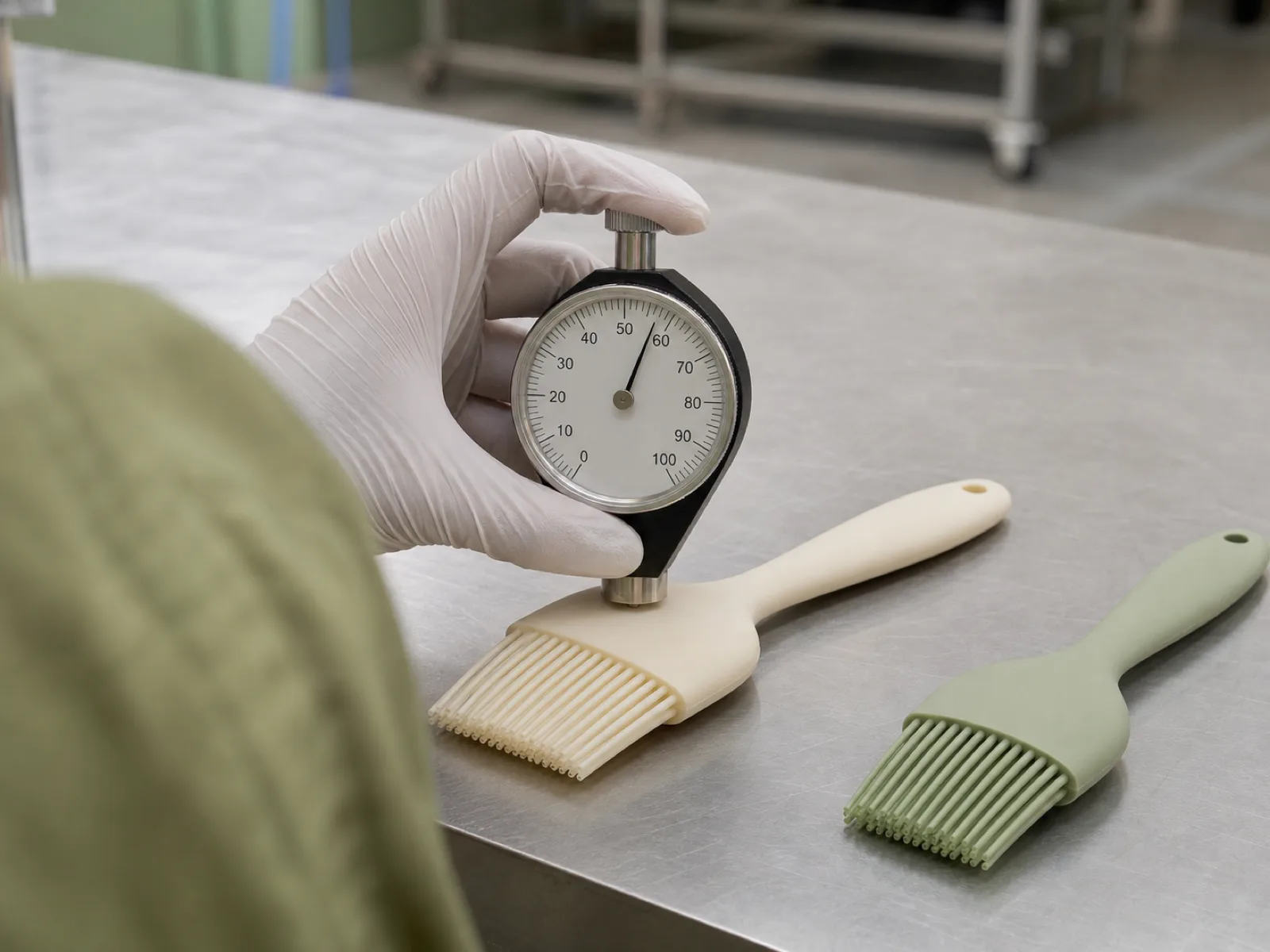
A retail-grade silicone basting brush is a platinum-cured, FDA 21 CFR 177.2600 and LFGB §30/§31 compliant food-contact tool with Shore A 50-60 bristles pull-tested to ≥ 15 N and a handle rated -40 °C to 230 °C. OEM programs start at 500 MOQ per SKU with tooling from USD 3,200 and a 30-40 day PPAP path. Wetop runs basting-brush programs for Tier-2 US home-goods chains at 40,000 units per quarter.
Silicone basting brushes look like a commodity — a handle, some bristles, a hangtag. In practice, three engineering decisions separate a retail-return-magnet from a Home Depot endcap SKU: bristle pull-force, handle-neck construction, and cure chemistry. This guide is for kitchenware brand managers, sourcing engineers, and OEM/ODM buyers specifying silicone brushes for the US and EU retail channels. It documents the specs, the tooling economics, the compliance packet, and the failure modes cheap suppliers ignore — the engineering desk view, not the catalog view. ## What makes a silicone brush "food-grade" — FDA vs LFGB vs generic?A food-grade silicone brush clears FDA 21 CFR 177.2600[^fda-177-2600] for US retail and LFGB §30/§31[^lfgb-30][^lfgb-31] for EU retail via per-lot migration testing under BfR Recommendation XV[^bfr-xv]. Both regulations govern substance transfer from brush to food under water, ethanol, and fatty-food simulants. "Food-grade" without a per-lot report attached is a marketing word.
The regulatory distinction matters because US and EU buyers ask different questions. Amazon and Walmart accept a general FDA 21 CFR 177.2600 compliance letter as sufficient for a listing. German drugstore chains (dm, Rossmann), UK grocers, and French hypermarkets ask for per-batch LFGB §30 and §31 test reports issued against BfR XV protocols — including the 200 °C, 4-hour post-cure step that scrubs residual peroxide byproducts and low-molecular-weight siloxanes out of the polymer. Wetop's compliance packet on every OEM basting-brush program includes: | Document | Regulation | Frequency | Issued by | |---|---|---|---| | 21 CFR 177.2600 compliance letter | US FDA | Per SKU | Wetop QA + material supplier COA | | LFGB §30 general safety letter | EU (Germany-anchored) | Per SKU | Wetop QA + SGS or Intertek report | | LFGB §31 migration test | EU | Per lot | Third-party lab (SGS / Intertek / TÜV) | | BfR XV silicone-specific migration | EU | Per lot | Third-party lab | | Prop 65 exemption or warning | California | Per SKU | Wetop QA + third-party lab confirmation | | ISO 9001 process certificate | Global | Annual | TÜV (or equivalent notified body)[^iso-9001] | The FDA vs LFGB choice is not either/or for retail-tier OEM programs — most Tier-2 chain buyers request both in the same PPAP packet so a single SKU can flex between US and dual-listed EU channels. Full clause-by-clause comparison is in our [FDA vs LFGB silicone guide](/guide/fda-vs-lfgb-silicone/).
Wetop's retail-grade bristle pull-force spec is ≥ 15 N per bristle at ambient and ≥ 12 N after a 4-hour, 200 °C oven soak, verified on an Instron tensile tester per ASTM D412 methodology[^astm-d412]. Sub-10 N bristles are the root cause of shed complaints. The failure mode is thermal aging of an under-cured bristle root — not a bristle defect, but a mold-flow defect.
Bristle shed is the #1 return driver on private-label silicone brushes on Amazon US. The complaint reads "bristles fell into the pancakes." The mechanical reality: bristle roots are the thinnest cross-section in the entire molding, they sit at the flow front of the compression cycle, and if the mold heat profile drops below 165 °C at that root during cure, the crosslink density there is under-developed. The bristle looks fine coming out of the mold, holds a 5-10 N pull-test on QC day, then softens after 20-30 dishwasher cycles or one 450 °F oven soak and pulls out under normal use. The three engineering fixes: 1. **Post-cure at 200 °C for 4 hours** on every lot — bakes residual peroxide byproducts out and pushes crosslink density to spec. BfR Recommendation XV mandates this for EU markets; Wetop runs it on every lot regardless of destination market. 2. **Bristle root cross-section ≥ 1.8 mm** on the mold cavity — undersized bristle roots (< 1.5 mm) are the reason budget-tier brushes shed. This is a mold-design decision, not a material decision. 3. **AQL 1.5 pull test on a 3.2 sample size per lot** — pull 5 bristles per brush, 32 brushes per lot, log to Instron trace. Attach trace to PPAP packet. Shore A hardness sits on top of pull-force as the second-order spec. Basting brushes target Shore A 50-60 — stiff enough to load teriyaki or egg-wash without floppy drip, soft enough to hug a lattice pie top. Pastry brushes drop to Shore A 40-45 for gentler glaze application. BBQ mop brushes climb to Shore A 65-70 for thicker sauces and grill-side abuse. All three verified per ASTM D2240[^astm-d2240] on a Type A durometer at 23 °C ± 2 °C. ## What handle construction options survive real kitchen use?Four production-viable handle constructions: solid platinum-cured silicone (soft grip, snaps at ~35 N torque); stainless-steel core with overmolded silicone (retail default, survives 230 °C oven-dip); beech or bamboo wood core (premium tier, FSC-certified for EU sustainability scorecards); glass-filled PP core (budget tier, cracks below -20 °C in frozen-storage returns).
Handle failure is the #2 return driver behind bristle shed and the more expensive one to warranty, because a snapped handle usually means a broken brush plus a bruised knuckle. The failure mode depends on construction, and each construction has a different tooling and unit-cost footprint. | Construction | Torque failure | Temp range | Tooling | Unit cost adder | Best for | |---|---|---|---|---|---| | Solid platinum silicone | ~35 N at neck | -40 to 230 °C | Compression mold only | Baseline | Pastry brushes, kids' brushes | | Stainless (SUS304) core + overmold | ~180 N at handle | -40 to 260 °C | Compression + insert loading fixture | +USD 0.35-0.60 | Retail-grade basting, BBQ mop | | Beech / bamboo wood core | ~120 N at wood | -40 to 200 °C (dry) | Compression + wood prep line + FSC docs | +USD 0.55-0.90 | Premium EU retail, artisan bakery | | Glass-filled PP core | ~90 N at ambient, cracks < -20 °C | -20 to 100 °C | Compression + PP injection cell | +USD 0.10-0.20 | Club-store bulk, budget tier | The retail-grade default for a US kitchenware brand launching a basting brush is the stainless-core construction — it survives the "left the brush in the oven" scenario that generates warranty tickets, and the tooling adder is minor. Wood-core is the premium tier, but wood-core brushes require an FSC certification chain for EU sustainability scorecards. Glass-filled PP is banned from the Wetop line for retail programs shipping into cold-chain distribution (frozen 3PL warehouses) because the PP cracks below -20 °C — the warehouse temperature spec Target and Walmart run. For anonymized reference: a Top-5 US kitchen-sink brand routes their private-label basting brush SKU through Wetop with stainless-core construction, Shore A 55 platinum-cured silicone, and a pad-printed brand mark. That SKU has run for two program cycles at 20,000-30,000 units per cycle with 0.08 % defective PPM. ## What does the OEM sampling workflow look like — RFQ to PPAP?Wetop's silicone-brush OEM path runs six steps over 30-40 days from RFQ to PPAP-ready first article: RFQ + spec review (3 days), 3D-printed handle mockup (5 days), material COA + Pantone match (7 days parallel), T1 soft-tool sample (15 days), pull-force + migration test packet (5 days parallel), and PPAP first article (30-40 days total). Production tooling adds 15-25 days on top for mass-run.
The sampling workflow is where cheap OEM suppliers cut corners and premium retail programs survive. Skipping the T1 soft-tool sample stage — jumping straight from 3D print to production tool — is the reason so many Alibaba-sourced basting brushes fail their first PPAP submission. Soft tooling (aluminum, single cavity) costs USD 800-1,400 and lets the buyer approve bristle stiffness, handle grip, and Pantone match before the USD 3,200-6,800 P20-steel production tool is cut. That check pays for itself the first time it catches a Shore A miss. Wetop's step-by-step: 1. **RFQ + spec review (day 0-3)** — buyer submits brush geometry (STEP or STL), target Shore A, Pantone reference, handle construction choice, annual volume forecast, target retail channels. 2. **3D-printed handle mockup (day 3-8)** — SLA-printed hand-fit sample in the buyer's grip. Confirms ergonomics before mold-cut. 3. **Material COA + Pantone match (day 3-10, parallel)** — Wetop's material supplier issues COA on the platinum-cured LSR or HCR grade. Masterbatch colorist runs D65 light-box match against buyer's Pantone reference. ΔE ≤ 2.0 target. 4. **T1 soft-tool sample (day 8-23)** — single-cavity aluminum tool cut. 20-30 samples molded, post-cured at 200 °C for 4 hours, pull-tested to ≥ 15 N. 5. **Compliance + pull-force packet (day 18-25, parallel)** — third-party lab runs LFGB §31 migration and BfR XV protocols. Wetop QA runs Instron pull traces and Type A durometer readings on lot. 6. **PPAP first article (day 25-40)** — Wetop delivers first-article inspection report, capability study (Cpk on bristle diameter + handle diameter), and full compliance packet. Wetop tools all four handle constructions above under the same 30-40 day PPAP path — but stainless-core adds a day for insert-loading fixture qualification and wood-core adds 3-5 days for FSC chain-of-custody paperwork. Detailed lead-time breakdown is in our [MOQ and lead time guide](/guide/moq-and-lead-time-silicone-oem/). ## How much does OEM tooling cost — and when does it amortize?Compression-mold tooling for a silicone basting brush runs USD 3,200-6,800 for a 4-cavity P20-steel mold, USD 5,800-9,500 for 8-cavity S136-steel, and USD 7,000-14,000 for LSR injection tooling. Wetop amortizes tooling over the first 15,000 units at a per-unit surcharge disclosed on quote. Breakeven for LSR vs compression is around 30,000 units/year annual volume.
Tooling economics is where basting-brush OEM programs get real. The temptation for a brand launching a new SKU is to run pilot volumes on a generic existing cavity and pad-print the logo — that path works for 500-1,000 unit test batches and can ship in 20 days, but it caps you at generic geometry and non-embossed branding. The next tier is a dedicated 4-cavity P20 tool at USD 3,200-6,800, which unlocks logo debossing, unique bristle patterns, and handle-shape differentiation. At 15,000 units it fully amortizes. | Tooling type | Cost (USD) | Cavities | Cycle time | Amortization volume | Steel life | |---|---|---|---|---|---| | Generic cavity, pad-print logo | 0 (uses stock tool) | Existing | 90-120 s | N/A (pilot only) | N/A | | 4-cavity P20 compression | 3,200-6,800 | 4 | 180-240 s | 15,000 units | ~300,000 shots | | 8-cavity S136 compression | 5,800-9,500 | 8 | 200-260 s | 40,000 units | ~500,000 shots | | LSR injection tooling | 7,000-14,000 | 8-16 | 45-90 s | 30,000 units / yr | ~1,000,000 shots | The LSR breakeven at 30,000 units/year is a hard-number filter for a program manager choosing between compression and LSR. Below 30,000 units/year, compression wins on tooling amortization even with slower cycle time. Above 50,000 units/year, LSR wins on per-unit cost even with the higher tooling investment. The Wetop cost model shares the full amortization math on quote — the [OEM pricing structure guide](/guide/silicone-oem-pricing-structure/) walks through the calculation. ## What does retail-grade construction look like vs OXO / Di Oro / GIR?The three US retail benchmarks — OXO Good Grips, Di Oro Seamless Series, GIR Ultimate Basting Brush — all run stainless-steel core handles with platinum-cured silicone heads at Shore A 55-60, bristle pull-force ≥ 15 N, FDA 21 CFR 177.2600 compliance, and dishwasher-safe / oven-safe ratings to 232 °C. Wetop's retail-tier spec matches all four dimensions and adds per-lot LFGB §30/§31 test reports for EU dual-listing.
The retail-grade quality bar for a US kitchenware brand launching a silicone basting brush is defined by the three SKUs above. Every US buyer's spec sheet references one of them as a "match this quality" line. Here is what "matching" actually means in engineering terms: | Dimension | OXO Good Grips | Di Oro Seamless | GIR Ultimate | Wetop retail-grade spec | |---|---|---|---|---| | Bristle Shore A | 55-60 | 55-60 | 50-55 | 50-60 (buyer choice) | | Handle construction | Stainless core + silicone overmold | Stainless core + seamless silicone head | Solid platinum silicone | All four tooled | | Temperature rating | -40 to 232 °C | -40 to 232 °C | -40 to 232 °C | -40 to 230 °C standard | | Bristle pull-force | Not published | Not published | Not published | ≥ 15 N per lot, Instron trace | | FDA 21 CFR 177.2600 | Yes | Yes | Yes | Yes, per-SKU letter | | LFGB §30/§31 | Not applicable (US only) | Not applicable | Not applicable | Yes, per-lot for EU dual-listing | | Dishwasher rating | Top rack | Top rack | Top rack | Full cycle to 75 °C | | Prop 65 warning | Exempt (silicone body) | Exempt | Exempt | Exempt, lab-confirmed | The Wetop retail-tier program matches the four public specs (Shore A, construction, temperature, FDA) and improves on the bristle pull-force dimension by publishing the ≥ 15 N spec on every lot report. The EU-dual-listing capability (per-lot LFGB §30/§31 with BfR XV migration) is the extra Wetop advantage for brands that want a single SKU in both channels — a spec OXO / Di Oro / GIR do not carry because they do not sell into EU retail at scale.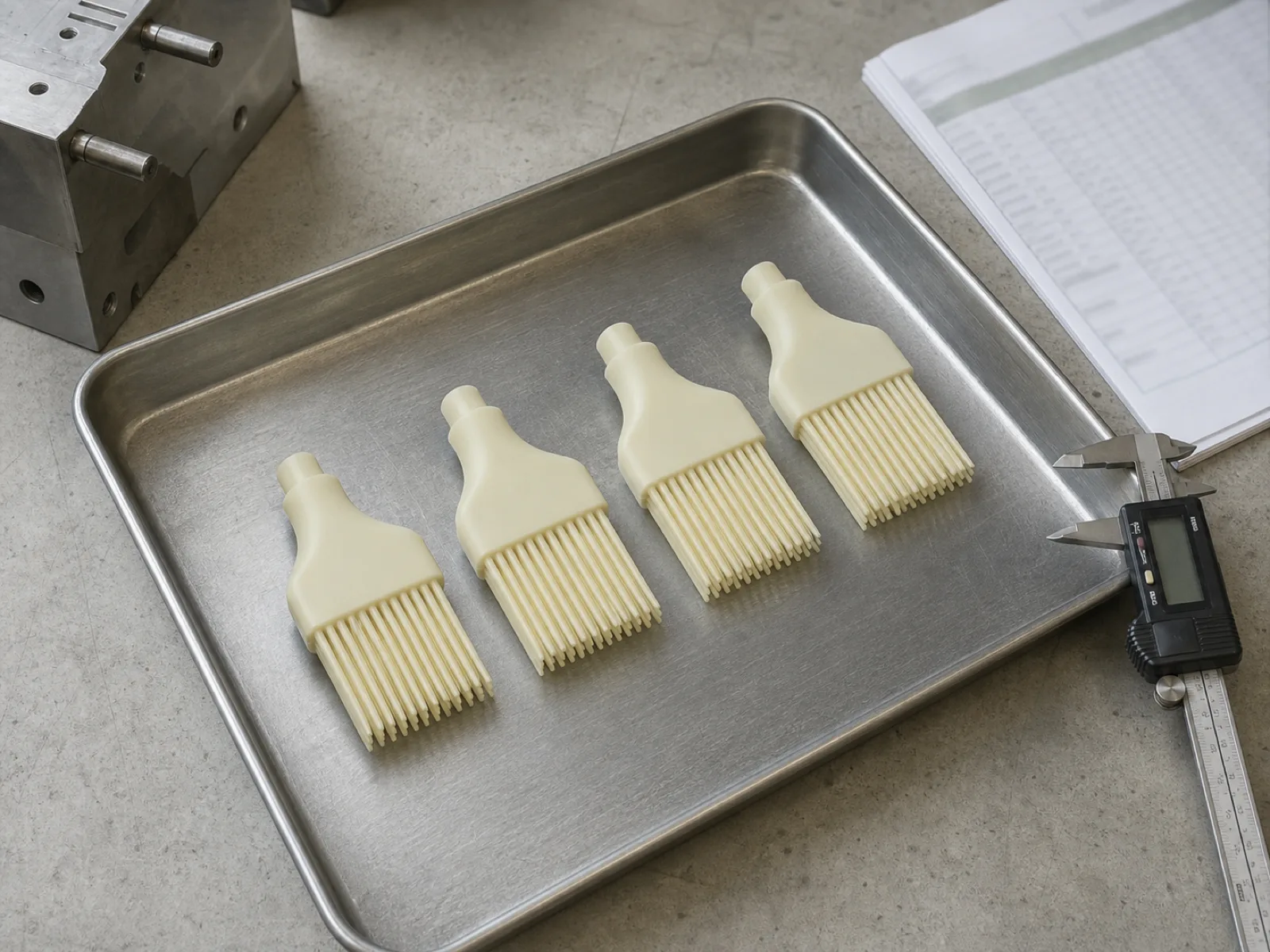
Three retail packaging formats Wetop tools regularly for silicone basting brushes: blister card with printed insert for endcap displays, kraft sleeve with die-cut window for premium tiers, and hangtag-only for club-store bulk. All three support UPC/EAN barcode placement, California Prop 65 warning printing[^prop-65], and FSC-certified paper for retailer sustainability scorecards. Retail-ready packaging adds USD 0.15-0.60 per unit depending on format.
Packaging is the last engineering decision on the sourcing path and the one most likely to derail a launch when the retail buyer requests changes at PO stage. Home Depot, Target, and Costco each have distinct packaging preferences: Home Depot favors blister cards with front-facing endcap display, Target wants kraft sleeves that scan sustainability-forward, and Costco's Kirkland-tier private label runs hangtag-only for club-store bulk. Wetop's packaging cell handles all three in-house. The three formats: - **Blister card + printed insert** — USD 0.35-0.60 per unit, 6-cavity display box for endcap, supports Prop 65 warning + UPC + brand card. Best for Home Depot, Lowes, Bed Bath & Beyond. - **Kraft sleeve + die-cut window** — USD 0.25-0.45 per unit, FSC-certified 100% recycled kraft, supports EAN barcode + brand deboss. Best for Target, Whole Foods, EU premium retail. - **Hangtag only** — USD 0.15-0.25 per unit, printed hangtag with UPC + care instructions. Best for Costco, Sam's Club, Amazon FBA. All three formats can carry buyer-supplied brand art at 300 dpi minimum, and Wetop's masterbatch color match extends to the packaging print — a Pantone-matched brush and a Pantone-matched blister card ship as one system. Prop 65 warning language is either printed on-pack (default) or exempted via a lab-confirmed test report attached to the compliance packet. ## Closing — where a silicone-brush OEM program starts A silicone basting brush is a small SKU that carries the same engineering discipline as a sink grid or a drying mat: cure system, mold flow, post-cure bake, pull-force verification, per-lot compliance packet. The suppliers who ship reliable brushes into Home Depot and dm run all six steps; the suppliers who cannot are the reason bristle shed and handle snap complaints define the category on Amazon reviews. Wetop's engineering desk runs OEM basting-brush programs from 500-unit pilots on generic tooling to 40,000-unit-per-quarter retail SKUs on dedicated 8-cavity P20 tools, with the compliance packet, sampling cadence, and Pantone-match discipline documented above. If you are sourcing a silicone brush SKU for a US kitchenware brand, an EU dual-listed program, or a private-label club-store launch, [talk to the engineering desk](/contact/) — send your STEP file, target Shore A, Pantone reference, and annual volume forecast. RFQ turnaround is 3 business days with tooling quote, unit cost tiers, and compliance-packet contents documented in the response. ## References [^fda-177-2600]: See references block. [^lfgb-30]: See references block. [^lfgb-31]: See references block. [^astm-d2240]: See references block. [^astm-d412]: See references block. [^iso-9001]: See references block. [^bfr-xv]: See references block. [^prop-65]: See references block.