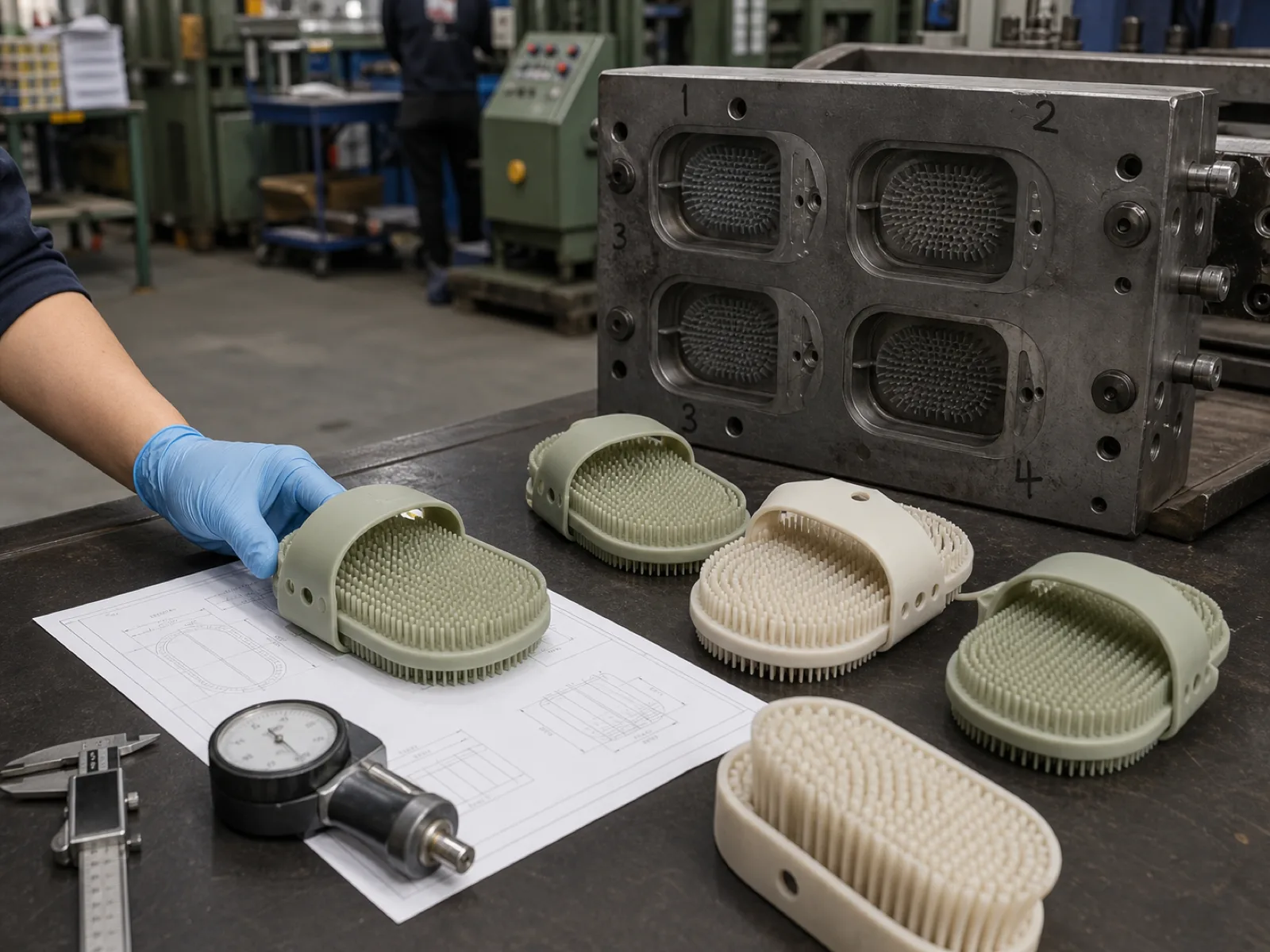
A silicone body scrubber manufacturer is a factory that molds skin-safe silicone into soft-bristle bathing and exfoliation tools, and the right one for a retail program is a platinum-cured, ISO 9001 factory that can prove FDA 21 CFR 177.2600 and LFGB clearance on the finished good — not just the raw compound. The decisions that separate a durable, odor-free scrubber from a returns problem are cure system, bristle Shore A firmness, molding process, and the certification packet, and they are all made before the first sample is cut. This guide is the engineering-desk brief for beauty and housewares buyers running a silicone body scrubber program at 3,000 to 500,000 pcs, covering how to vet a supplier, the material and firmness spec, the OEM-versus-ODM path, MOQ and tooling math, private-label branding, and the compliance documents that keep a shipment out of customs jail.
To a beauty buyer, a silicone body scrubber looks like a commodity — a soft brush that costs a few dollars and sells for fifteen. Then the first container comes back with a faint rubber smell on the second production lot, a batch of bristles too stiff for the "gentle daily exfoliation" claim on the pack, and a marketplace listing pulled for an unsubstantiated "antimicrobial" line. None of those failures are bad luck. Each maps to a specific decision a factory made — or skipped — during cure-system selection, durometer targeting, and claim substantiation. This guide is written from the engineering desk at Wetop's Dongguan floor for brand owners and private-label buyers who want the manufacturing math, not marketing copy. ## What does a silicone body scrubber manufacturer actually do, and how do I vet one?A silicone body scrubber manufacturer tools, molds, finishes, and certifies soft-bristle silicone bathing tools to a buyer's design. Vet one on four axes: certifications (ISO 9001 plus a finished-good FDA 21 CFR 177.2600 and LFGB report, not a raw-compound COA), cure system (platinum, not peroxide), tooling-ownership terms in writing, and verifiable capability — floor area, staff count, and a durometer reading on a reference sample.
The category spans several product architectures under one manufacturing logic: a facial cleansing scrubber, an everyday body scrubber with a hand strap, a long-handle or two-handed back brush, an infant bath brush, and combination tools with a silicone-bristle side and a smooth massage side. All of them are molded from the same family of skin-safe silicone; what changes is bristle firmness, geometry, and the strap or handle. A manufacturer worth a purchase order can move across all of them on shared tooling philosophy and prove the material every time. Vetting is where first-time buyers lose money, so run it as a checklist, not a vibe. The single most important document distinction: a **finished-good migration report** tests the actual scrubber you will sell, while a **base-compound COA** only certifies the raw silicone the factory bought. US Customs FDA import review does not accept the compound COA in place of a finished-good report, and a beauty retailer's supplier audit will reject it too. The [is silicone body safe guide](/guide/is-silicone-body-safe-guide/) covers the underlying material-safety case you will need to defend to a skeptical category buyer or a concerned end consumer. A workable manufacturer scorecard before you release tooling money: | Screen | Pass signal | Fail signal | |---|---|---| | Quality system | ISO 9001 certificate, current, verifiable number | "We follow ISO standards" with no certificate | | Material proof | Finished-good FDA 177.2600 + LFGB §30/31 report | Only a base-compound supplier COA | | Cure system | Platinum-cured confirmed in writing | Vague "food-grade silicone," cure system unstated | | Firmness proof | Durometer reading on a reference sample | "Soft/medium/hard" with no Shore A number | | Tooling ownership | Mold title transfers to buyer, in writing | Mold held as leverage, terms unstated | | Capability | Floor area, staff, line-walk or virtual tour | Trading-company front, no factory access | ## Which silicone material grade belongs in a skin-contact body scrubber?A body scrubber should be molded from platinum-cured silicone that clears FDA 21 CFR 177.2600 extractables and BfR Recommendation XV, in a medical- or food-grade compound. Platinum cure is a clean addition reaction with no odor-causing byproducts; peroxide cure leaves benzoic-acid residues that off-gas a rubber smell on a bathing product. Grade the compound to skin contact, not just food contact.
There are two crossroads in the material decision, and both are frequently skipped in low-cost quoting. The first is **cure chemistry**. Platinum (addition) cure crosslinks vinyl- and hydride-functional silicone with a platinum catalyst in a stoichiometrically clean reaction that generates no volatile byproducts, which is exactly why platinum-cured silicone ships into infant-feeding and medical applications with minimal post-cure[^nih-silicone-review]. Peroxide cure uses a free-radical initiator whose reaction leaves benzoic acid, acetophenone, and related volatiles that a proper 4-hour, 200 °C post-cure is supposed to drive off — but factories protecting throughput often skip it, and 40–60 % of the volatile load stays in the part, off-gassing a rubber odor in the shower. On a product a customer holds to wet skin, that odor is a fast one-star review. The full breakdown lives in the [platinum-cured vs peroxide-cured silicone guide](/guide/platinum-cured-vs-peroxide-cured-silicone/). The second crossroad is **material form** — high-consistency rubber (HCR) versus liquid silicone rubber (LSR). Both can be platinum-cured and both can be skin-safe; the difference is process economics, covered in the molding section below. What matters for the material spec is that the compound is graded and documented for repeated skin contact, BPA- and phthalate-free (silicone contains neither by chemistry, but the declaration is what a retail buyer files), and free of any non-compliant pigment or filler. | Attribute | Peroxide-cured HCR | Platinum-cured HCR | Platinum-cured LSR | |---|---|---|---| | Odor / off-gas risk on a wet product | High without full post-cure | Very low | Very low | | Byproducts of cure reaction | Benzoic acid, acetophenone | None | None | | Typical skin/medical clearance path | Difficult | Standard | Standard | | Best fit for body scrubbers | Avoid | Compression-molded scrubbers | Ultra-high-volume only | | Relative raw-material cost | Lowest | Mid | Higher | For any body scrubber sold above an entry-level shelf price, Wetop only quotes platinum-cured compound. The odor and skin-safety failure modes that come with peroxide are precisely the ones a beauty category buyer notices first.
Bristle firmness is set by the silicone's Shore A hardness plus bristle diameter and length — the spec buyers most often leave blank. Target Shore A 20–35 for a gentle facial or infant scrubber, 35–50 for an everyday body scrubber, and 50–65 with thicker, shorter bristles for a deep-exfoliation back brush. Write the Shore A target and a ±3 tolerance so the factory can prove it on an ASTM D2240 durometer at lot release.
"Soft," "medium," and "firm" are not a spec — they are how two people end up arguing over a rejected lot. The physical drivers of perceived firmness are three: the durometer of the cured silicone (measured on the Shore A scale per ASTM D2240[^astm-standards]), the **bristle diameter** at the base, and the **bristle free length**. A tall, thin bristle in a Shore A 30 compound feels gentle and floppy; a short, fat bristle in the same compound feels firm because it resists bending. This is why the firmness spec must name all three, not just a hardness number. The firmness map Wetop uses to translate a marketing claim into a moldable spec: | Scrubber class | Shore A target | Bristle base Ø | Free length | Marketing claim it supports | |---|---|---|---|---| | Facial / infant | 20–35 | 0.8–1.2 mm | 6–10 mm | "Gentle daily cleanse," "baby-safe" | | Everyday body | 35–50 | 1.2–1.8 mm | 8–14 mm | "Soft exfoliation," "sensitive skin" | | Deep-exfoliation back brush | 50–65 | 1.8–2.5 mm | 6–10 mm | "Deep clean," "invigorating scrub" | | Massage / dual-side | 45–60 nub | 3–6 mm nub | 4–8 mm | "Circulation massage" | The verification step is non-negotiable at lot release: a calibrated Shore A durometer reading on the molded bristle field, recorded against the spec ± 3 tolerance. A reading outside the band means a compound-batch drift or an incomplete cure — both predict a firmness complaint or an odor problem downstream. If your engineering team wants to reason about the whole scale, the [Shore A hardness silicone chart](/guide/shore-a-hardness-silicone-chart/) maps durometer values to the tactile feel across product categories. The mistake to avoid: approving a hand-feel sample without recording its Shore A, then having no objective way to hold the production lot to the same firmness. ## Compression molding or LSR injection — how is a body scrubber actually made?Silicone body scrubbers are almost always compression-molded from high-consistency rubber (HCR). A pigmented silicone slug is cured inside a heated, bristle-engraved cavity under press tonnage in a few minutes, then deflashed and post-cured. LSR injection molding is reserved for very high volumes or ultra-fine geometry, because its higher tooling cost only pays back above roughly 200,000 pcs/year.
The process choice is an economic decision disguised as a technical one. **Compression molding** places a pre-weighed slug of pigmented HCR into an open, heated cavity; the press closes under tonnage, the material flows to fill the bristle field, and it cures in place. It is the right method for body scrubbers because the tooling is comparatively cheap, color changes are fast, and the soft-bristle geometry molds cleanly without the flow-length problems that fine features can create in injection. The trade-off is a slightly longer cycle time and a manual deflash step, both absorbed easily at scrubber volumes. **LSR injection molding** pumps two-part liquid silicone into a closed, heated mold where it cures in 15–90 seconds, fully automated, holding tight tolerance. It shines on ultra-high volumes and very fine or thin-wall geometry, but the tooling is multiples more expensive and color changes are slower. For a typical scrubber program under roughly 200,000 pcs/year, LSR's automation savings never catch up to its tooling premium. The full process explainer is in the [silicone molding process explained guide](/guide/silicone-molding-process-explained/). | Factor | Compression molding (HCR) | LSR injection molding | |---|---|---| | Tooling cost (single scrubber) | USD 2,500 – 6,000 | USD 12,000 – 40,000+ | | Cycle time per part | 2 – 5 min | 15 – 90 s | | Color changeover | Fast (slug swap) | Slower (purge cycle) | | Best volume band | up to ~200,000 pcs/yr | 200,000 pcs/yr and up | | Fine-feature capability | Good | Excellent | | Right call for body scrubbers | Yes (default) | Only at very high volume | After the part is cured and demolded, the make-or-break step is the **post-cure**: a 4-hour bake at 200 °C that drives off residual volatiles. On a bathing product this is what stands between a clean, odor-free scrubber and a rubber smell in the shower, so a factory that skips it to protect throughput is disqualifying itself for a beauty program. ## What certifications and claims does a silicone body scrubber program need?A US/EU beauty program needs FDA 21 CFR 177.2600 extractables clearance on the finished good, LFGB §30/31 batch reports for EU markets (BfR XV as the basis), BPA/phthalate-free declarations, REACH SVHC screening on all additives, and an ISO 9001 supplier certificate. Antimicrobial and "mildew-resistant" claims are regulated — an added biocide triggers EPA or EU BPR obligations, so lead with silicone's inherent non-porous, fast-drying property instead.
Two documentation traps catch first-time buyers. The first is the **finished-good versus compound** distinction covered earlier — a listing that says "FDA certified" almost always means the base silicone has 177.2600[^fda-177-2600] clearance from its supplier, not that the finished scrubber was lot-tested by an accredited third-party lab. Insist on the finished-good report. The minimum documentation packet: 1. **Finished-good FDA 21 CFR 177.2600[^fda-177-2600] migration report** from an accredited lab (Intertek, SGS, or Eurofins), per lot or per quarter 2. **LFGB §30/31 batch report** for EU markets, with BfR Recommendation XV[^bfr-xv] as the technical basis 3. **BPA-free and phthalate-free declarations** (silicone contains neither by chemistry; the declaration is what the retailer files) 4. **REACH SVHC screening[^echa-reach]** on every pigment, masterbatch, and additive against the current candidate list 5. **ISO 9001[^iso-9001] certificate** — Wetop is certified since 2008 6. **California Prop 65 statement** covering the compound and any colorant The second trap is the **antimicrobial claim**. A silver-ion or other biocidal additive is a regulated substance — under the US EPA and, in Europe, the Biocidal Products Regulation (EU) 528/2012[^eu-bpr] — so an unqualified "antimicrobial" or "kills bacteria" line can trigger registration duties and marketplace takedowns. Competitor listings that claim silver-ion or "mildew-resistant" performance rarely publish the substantiating data or the registration path, which is a liability you inherit if you copy the claim. The defensible, science-backed position for most brands is to sell the **inherent property**: silicone is non-porous and dries quickly, so it does not harbor microbes the way a porous loofah or mesh pouf does. Back it with a drainage-friendly bristle layout and a hang hole, and you have a hygiene story that survives legal review without a biocide on the label. ## Silicone vs loofah, mesh, and nylon — the comparison that captures the saleA silicone body scrubber is non-porous and dries fast, so it resists the mold and bacterial buildup that colonize damp natural loofahs and nylon mesh poufs — a hygiene edge dermatology guidance regularly flags. Silicone also lasts far longer (measured in years versus weeks or months) and rinses clean under running water. Loofah and mesh win only on the softest lather-generating feel at the lowest unit cost.
The buyer's real question is not "is silicone good" but "why should a shopper trade up from the 2-dollar mesh pouf they already own." The answer is a hygiene-and-longevity story that competitors in this category consistently fail to document with any authority. A natural loofah and a nylon mesh pouf share the same failure mode: they are porous, they stay damp between uses in a humid bathroom, and that is exactly the condition bacteria and mold need to establish. A silicone scrubber's non-porous surface gives microbes far less to colonize and dries in a fraction of the time. | Attribute | Silicone body scrubber | Natural loofah | Nylon mesh pouf | Nylon-bristle brush | |---|---|---|---|---| | Porosity / drying speed | Non-porous, dries fast | Porous, stays damp | Porous, stays damp | Semi-porous | | Hygiene / microbe resistance | High | Low | Low | Medium | | Typical usable lifespan | 1–3 years | 3–4 weeks | 1–3 months | 6–12 months | | Rinses fully clean | Yes | No | Partial | Partial | | Exfoliation control (firmness tunable) | Yes (Shore A) | Fixed | Low | Fixed | | Typical retail price | USD 8 – 18 | USD 3 – 8 | USD 2 – 6 | USD 5 – 12 | The longevity math also underwrites a sustainability angle: one silicone scrubber that lasts two to three years displaces roughly two to three dozen mesh poufs over the same period. For a brand building a hygiene- or eco-forward story, that replacement-rate difference is a substantiated claim, not a vibe — and it is the single most citation-worthy line to put on the pack. ## OEM vs ODM, MOQ tiers, tooling cost, and lead timeOEM means the factory builds to your finished design and dedicated tooling; ODM means you customize the factory's existing scrubber platform to skip new-mold cost and lead time. Wetop's MOQ starts at 500 pcs/color on existing tooling and 3,000 pcs on a new compression mold at USD 2,500–6,000 tooling cost. Samples land in 7–15 days on existing tools, 25–35 days on new tools; bulk runs 15–25 days after approval.
Most first-time beauty buyers should start **ODM** — pick a proven scrubber platform, then customize color, bristle firmness, strap, and branding on top. It reaches market months faster and avoids sinking tooling money before the SKU has proven itself. Once annual volume justifies the investment, move to a dedicated **OEM** mold for a distinctive shape you own outright. The private-label branding options that ride on top of either path are detailed in the [customize silicone logo deboss, print, and laser guide](/guide/customize-silicone-logo-deboss-print-laser/). **MOQ and tooling tier structure at Wetop (2026 pricing):** | Program tier | MOQ per color | Tooling cost | Unit price band (FOB) | Best for | |---|---|---|---|---| | Stock platform, Wetop packaging | 500 pcs | USD 0 | USD 0.85 – 2.20 | Sample orders, small brands | | Stock platform, custom Pantone + logo deboss | 1,000 pcs | USD 150 – 350 (logo insert) | USD 0.80 – 2.00 | Private-label test runs | | Custom bristle/handle, new compression mold | 3,000 pcs | USD 2,500 – 6,000 | USD 0.75 – 1.80 | Brands wanting a distinct shape | | Full private-label — mold + color + card + carton | 5,000 – 10,000 pcs | USD 3,500 – 8,000 all-in | USD 0.95 – 2.20 all-in | Beauty-retail PL programs | **Sample timeline (existing tooling):** color-matched pre-production sample in 7–10 days; retail-ready first-article with strap and card in 12–15 days. **Sample timeline (new tooling):** T1 sample off the new mold in 25–30 days; T2 corrections in 5–7 days; production release after T2 approval. **Bulk production:** 15–25 days for a standard container order, driven by color-match sign-off, packaging artwork, and any secondary assembly. **Mold ownership** is the buyer's asset upon full payment of tooling — Wetop transfers title after the first production run ships and does not hold molds as end-of-program leverage. For the broader logic on how MOQ and lead time interact across silicone OEM programs, the [MOQ and lead time silicone OEM guide](/guide/moq-and-lead-time-silicone-oem/) lays out the sample-to-mass-production sequence.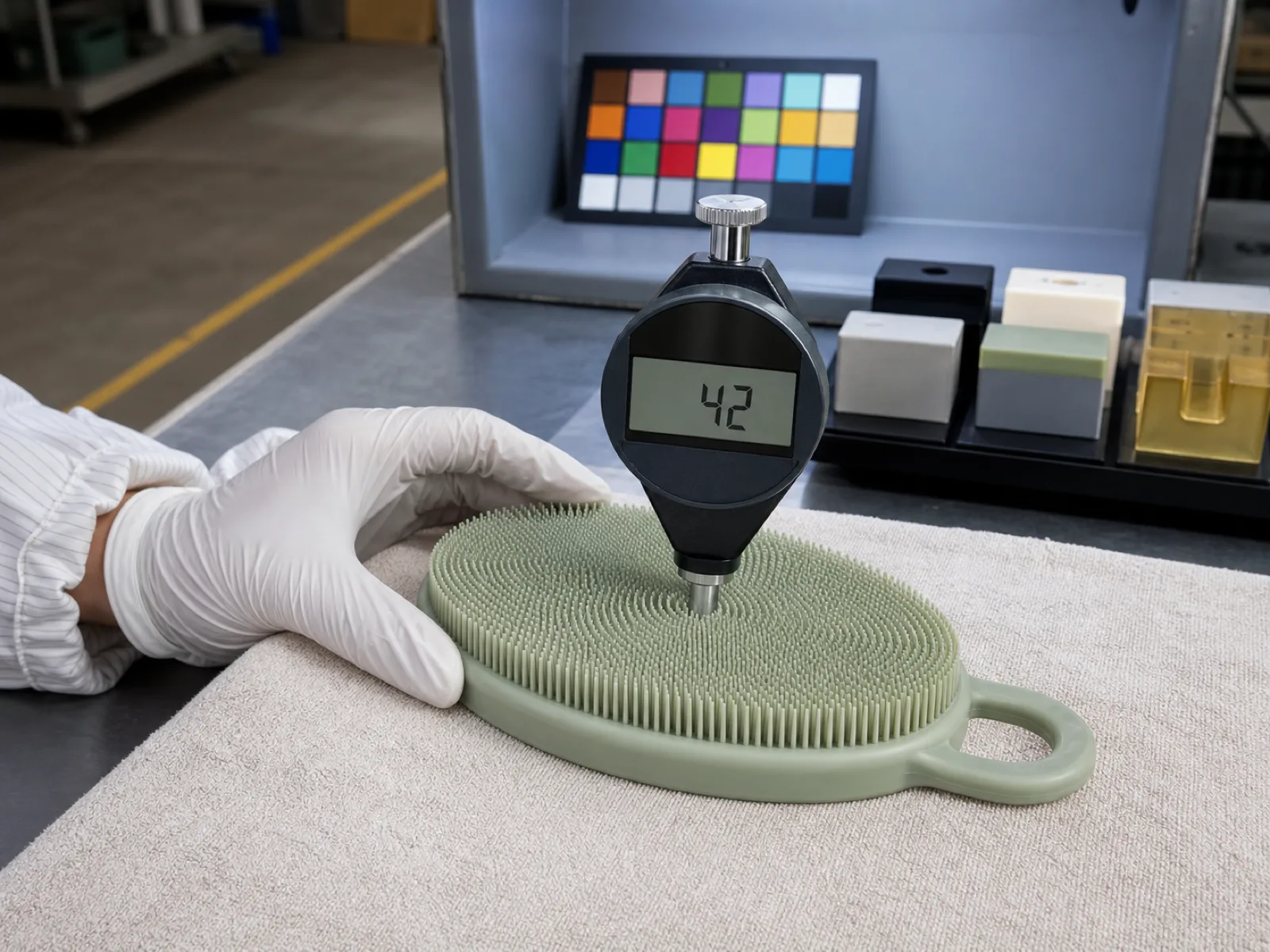
Branding options are debossed or embossed mold-cavity logos (USD 150–350 per insert, zero unit-cost adder, unlimited wash durability), full-color heat transfer for multi-color art, and Pantone color-matched within ΔE ≤ 1.5 on a D65 light box. QC runs five bench checks: durometer, bristle pull test, dimensional check, a scent panel after a 48-hour 60 °C soak, and pre-shipment inspection at AQL 1.5.
Because a body scrubber is molded as one soft part, the cleanest, most durable branding is a **debossed logo engraved into the mold cavity** — it becomes a physical feature of the part, survives unlimited wash cycles, and adds nothing to unit cost beyond the one-time insert. Full-color heat transfer is available for multi-color artwork but wears faster in a wet-use product. Silicone masterbatch pigments are inorganic for stability, so muted spa tones — sage, cream, blush, charcoal — hit ΔE ≤ 1.5 cleanly; deep saturated neons are harder to hold within retail tolerance and are quoted with wider bands. Packaging spans four beauty-retail tiers: bulk polybag (USD 0.03–0.06/unit), kraft hang card (USD 0.15–0.35, e-commerce and rack ready), printed sleeve (USD 0.25–0.55), and full-color retail box with FSC board (USD 0.70–1.60, premium or gift set). A hang card with a hang hole is the highest-value default for a scrubber because it doubles as the drainage-and-dry hygiene story on the shelf. The QC regime that keeps a program out of the return pile: 1. **Shore A durometer** — verifies cure completeness and firmness against spec ± 3 2. **Bristle pull / root-bond test** — confirms bristles will not shear off in use, the failure mode that generates safety complaints on infant and body scrubbers 3. **Dimensional check** — bristle length, field diameter, and strap fit against the drawing 4. **Scent panel** — five blind noses after a 48-hour 60 °C soak; any rubber off-note fails the lot (the peroxide-cure tell) 5. **Pre-shipment inspection at AQL 1.5** — third-party or in-house, sampling the full carton for cosmetic and functional defects A full first-article test package runs USD 600–1,500 in accredited-lab fees, which Wetop folds into tooling amortization or FOB unit price depending on program size. Skipping it saves that money once and loses it many times over on the first customs hold or the first beauty-buyer complaint escalation. ## What should I bring to the first RFQ, and what will a good factory return?Bring five documents to get a firm quote: a spec sheet (scrubber class, bristle Shore A target, dimensions), a Pantone color target with ΔE tolerance, a vector logo file with placement, a packaging spec, and an annual volume forecast. A capable factory returns a firm quote in about 48 hours, and will teardown-benchmark a competitor sample to report its cure system, bristle Shore A, and bond method before quoting.
The difference between a firm quote and a range that shifts on every call is the completeness of your RFQ package. The five documents that let the engineering desk quote firm: 1. **Product spec sheet:** scrubber class, bristle Shore A target and tolerance, bristle diameter and length, overall dimensions, strap or handle type, wash rating 2. **Color spec:** Pantone solid-coated reference, acceptable ΔE tolerance, D65 light-box viewing standard 3. **Logo spec:** vector file, placement drawing, method preference (deboss / emboss / heat transfer) 4. **Packaging spec:** retail readiness level (bulk / e-commerce / rack / premium), material preference, sustainability requirements (FSC / recycled) 5. **Volume forecast:** annual volume, launch quantity, target FOB date, replenishment cadence, sales channel The last engineering-desk suggestion: send the factory a **competitor sample** of the scrubber you want to beat. Wetop's response is a teardown report identifying the incumbent's cure system, bristle Shore A reading, root-bond method, and a spec-improvement recommendation — before quoting a single unit. That teardown is the fastest way to turn a vague "make it better than this one" brief into a defensible, moldable specification. ## Ready to source a silicone body scrubber program? Wetop is a founder-led, ISO 9001 silicone factory in Dongguan running platinum-cured compression cells. We manufacture silicone body scrubber, facial scrubber, and bath-brush programs for US and EU beauty and housewares brands at 500-pc to 500,000-pc annual scale, with the skin-contact material spec, firmness engineering, compliance packet, and QC regime built in. If you have a spec sheet, an RFQ, or a competitor sample you want teardown-benchmarked, [talk to the engineering desk](/contact/). We will return a first-pass spec review, tooling estimate, and MOQ / lead-time / FOB unit-price band inside two business days.