---
title: "Coated Stainless vs Pure Silicone Roll-Up Racks — OEM Choice"
description: "Coated 304 stainless gives 18 kg load and premium retail feel; full silicone folds smaller and lighter. Which construction wins each retail tier."
primaryKeyword: "silicone coated stainless vs full silicone rack"
secondaryKeywords:
- "roll up dish drying rack construction"
- "silicone coated 304 stainless rack"
- "full silicone drying rack OEM"
- "drying rack load capacity"
searchIntent: "commercial"
category: "Comparison"
author:
name: "Wetop Silicone Engineering Team"
credential: "ISO 9001 certified silicone OEM, founder-led since 2008"
datePublished: 2026-05-16
dateModified: 2026-05-16
heroImage: "/images/guides/silicone-coated-stainless-vs-pure-silicone-racks-hero.webp"
heroImageAlt: "Silicone-coated 304 stainless and full-silicone roll-up drying racks side-by-side, both partially rolled up"
keyTakeaways:
- "Silicone-coated 304 stainless rod = ~70% of our shipped programs. Premium structural feel, 18 kg static load, $18-32 retail band, the dominant US over-sink format."
- "Full silicone (no metal core) = ~30% of programs. Lighter, foldable, 8-10 kg load, $12-22 retail, better for travel/RV/compact-kitchen positioning."
- "Corrosion concerns on coated stainless are not real for 304 grade fully encapsulated in silicone — no exposed metal touches water. Coastal-climate sales channels still sometimes prefer full silicone."
- "Retail price-point is the strongest predictor. Programs above $18 retail almost always run coated stainless; programs below $18 mostly run full silicone."
faqs:
- question: "Which construction is the higher-volume retail choice?"
answer: "Silicone-coated 304 stainless dominates the US over-sink drying rack market — roughly 70% of programs we ship. It gives the structural premium feel that lands at $18-32 retail and survives 18 kg static load tests. Full silicone is the right choice for travel-focused, RV / compact-kitchen, or eco-positioned SKUs at $12-22 retail. The decision usually maps cleanly to your target retail price-point."
- question: "Are there real corrosion concerns with the coated stainless version?"
answer: "Not when manufactured correctly. We use 304 grade stainless fully encapsulated in silicone — no exposed metal touches water. The silicone coating is a continuous skin, not a paint layer, and it survives 500+ dishwasher cycles tested. Some coastal / saline-environment retailers still prefer full silicone for the de-risking, but the actual corrosion risk on a properly encapsulated 304 rack is near zero."
- question: "What's the load capacity difference and does it matter at retail?"
answer: "Coated stainless: 18 kg static tested, 12-15 kg working load is the typical retail spec (30% headroom). Full silicone: 8-10 kg static, 5-8 kg working load. For most kitchens this doesn't matter — a typical dish-drying load is under 5 kg. It becomes relevant for hospitality, commercial prep stations, and family-kitchen positioning that emphasizes cookware drying."
- question: "Can the same SKU pre-tool both constructions?"
answer: "No. The mold geometry differs — coated stainless racks need cavities for the rod insertion and silicone-overmold operation; full silicone is a single-shot mold without rod inserts. We typically tool each construction as a separate mold series within a brand program if both are required. For programs that run both as SKU variants, we tool both molds in parallel to keep the launch on a single schedule."
- question: "What's the right one for an Amazon FBA private-label launch?"
answer: "Depends on your target retail price. Above $18 — coated stainless (premium structural feel converts at higher unit price). Below $18 — full silicone (the foldability is a strong shipping-economics story for FBA). Both are FBA-compatible from us with barcoded retail color box, suffocation warnings, and Amazon TI/HI pallet specs."
recommended: true
---
This is the single most-common spec decision on roll-up drying rack OEM programs — and the answer almost always maps to your target retail price-point, not to engineering preference. Here is what each construction actually buys you, and where each wins commercially.
Silicone-coated 304 stainless racks dominate the US over-sink retail market at ~70% of our program volume, with 18 kg load capacity and a $18-32 retail band. Full silicone racks (no metal core) cover the remaining ~30% — lighter, foldable, $12-22 retail, well-suited to travel and compact-kitchen positioning. The choice is retail-tier-driven.
## Which construction dominates the US retail market?
Silicone-coated 304 stainless steel rod construction is the dominant US over-sink drying rack format — roughly 70% of the programs we ship are this construction. It gives the structural feel a retail buyer expects at the $18-32 USD price-point.
Full silicone racks (a single silicone molded part with no metal core) cover the remaining ~30% — they're foldable, lighter, ship smaller, and fit better in retail box dimensions for $12-22 retail SKUs.
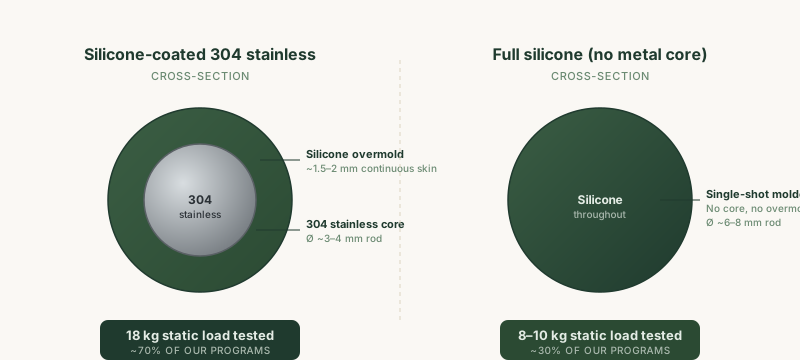
The construction difference is visible the moment you cut the rod open:
Two cross-section views of the rod that actually does the structural work in a roll-up rack. The coated version's 304 stainless core is what carries the 18 kg load capacity; the silicone overmold is the food-contact and corrosion barrier.
## Full feature comparison
| Property | Coated 304 Stainless | Full Silicone |
|---|---|---|
| Load capacity (static tested) | 18 kg | 8-10 kg |
| Working load (retail spec) | 12-15 kg | 5-8 kg |
| Unit weight | ~750-1,150 g | ~280-450 g |
| Storage form | Rolls compactly, rigid axis | Folds smaller, more flexible |
| Retail price band | $18-32 USD | $12-22 USD |
| Mold construction | Multi-step (rod inserts + silicone overmold) | Single-shot mold |
| Color options | Pantone-matched silicone coating | Pantone-matched throughout |
| Coastal corrosion concern | Negligible if 304 fully encapsulated | None by construction |
| % of programs shipped | ~70% | ~30% |
| Best retail tier | Premium DTC, Tier 2 retail chain, sink-brand coordinated | Travel, RV, compact-kitchen, eco/DTC |
## When coated stainless is the right choice
- **$18+ retail price band** — the premium structural feel converts at this tier.
- **Sink-brand coordinated accessory programs** — where the rack pairs with a $200+ sink and the structural premium feel matters.
- **Premium DTC housewares** — Williams Sonoma / Sur La Table / KitchenAid-tier branded programs.
- **Tier 2 retail chain accessory aisles** — Home Depot / Lowe's / Wayfair / Bed Bath caliber chain accessory programs.
- **Commercial / hospitality** — where the 18 kg load capacity matters.
## When full silicone is the right choice
- **Sub-$18 retail price band** — single-shot molding economics favor this format.
- **Travel / RV / compact-kitchen positioning** — the foldability is the marketing.
- **Eco / sustainability positioning** — single-material construction simplifies the EOL story.
- **Subscription gift boxes** — compact-folded shipping dimensions matter.
- **Coastal / saline retail channels** — removes the corrosion question entirely (even though the question is largely theoretical for properly encapsulated 304).
## Are corrosion concerns on coated stainless real?
Not for 304 grade fully encapsulated. We use 304 stainless rod and overmold with silicone in a continuous skin — no exposed metal touches water. The construction has survived 500+ dishwasher cycle testing without any visible corrosion or silicone-to-metal delamination.
Some coastal-region retailers (Hawaii, Florida coastal, some EU coastal) still prefer full silicone for the de-risking story. We treat that as a positioning preference rather than an engineering necessity.
## Cookware load test methodology
Coated stainless racks at our standard spec test to 18 kg static load on a 17×13 in span using a calibrated load distribution against 4-point support (mimics typical sink-bridge installation). Working load spec at retail is 12-15 kg, which gives 30% headroom for shock loading (a dropped cast-iron Dutch oven).
Full silicone at the same span tests to 8-10 kg static. Working load at retail is 5-8 kg, comfortable for typical dish-drying but not for heavy cookware.
If your retail program emphasizes cookware drying as part of the marketing (family-kitchen positioning, hospitality), coated stainless is the only spec that holds the working-load claim under audit.
## What we OEM
Wetop runs both constructions on dedicated mold series. MOQ 500 per SKU per construction. Pantone-matched silicone in either case (±0.5 ΔE master-batch). FDA + LFGB per-batch testing. Lead time 30-45 days production after sample approval. We've shipped both formats for sink-brand coordinated programs and Tier 2 retail chain accessory aisles, plus housewares-brand DTC private label.
For programs running both formats as SKU variants in the same range, we tool both molds in parallel to keep first-article and launch on a single schedule.
Sourcing? Email [inquiry@wetopsilicone.com](mailto:inquiry@wetopsilicone.com) with target retail price-band and program volume — we'll come back with mold cost, per-unit pricing for each construction, and sample timeline.