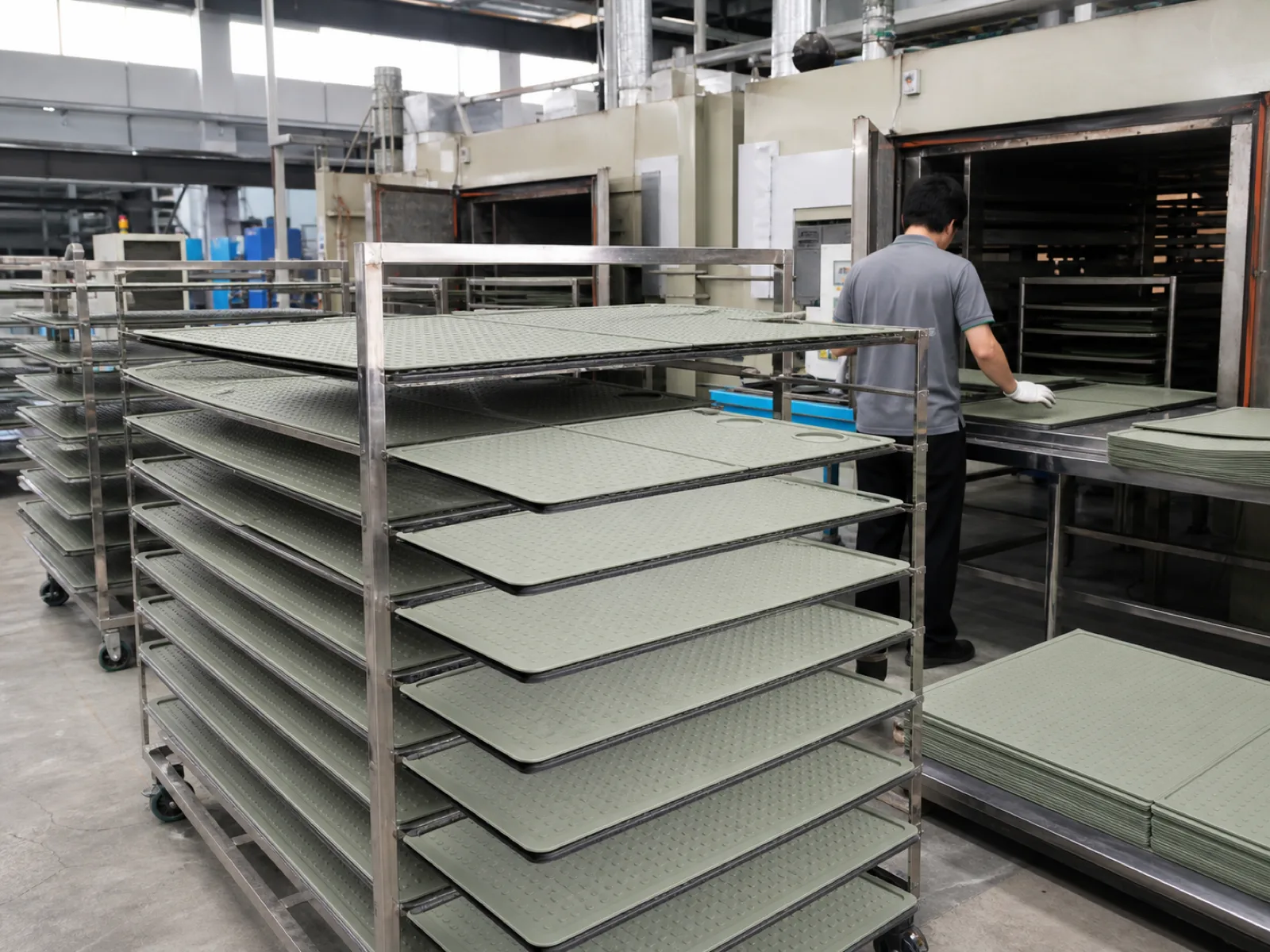
A B2B silicone collapsible bowl OEM program at 500-50,000 MOQ turns on four decisions: cure system (platinum-cured for premium and medical-adjacent, peroxide-cured with disciplined post-cure for mid-tier retail), Shore A hardness (50-60 for a 400-800 ml bowl per ASTM D2240), tooling tier (aluminum single-cavity at $2,800-$4,500 for MOQ 500, P20 steel multi-cavity at $9,000-$14,000 for MOQ 5,000+), and compliance stack (FDA 21 CFR 177.2600 plus LFGB §30/31 plus Prop 65 plus REACH SVHC, with CPSIA added if children appear on-pack). Real lead time is 7-15 days for a T1 sample and 30-45 days for mass production. Anything shorter is a red flag.
## What does a real B2B sourcing workflow for a custom silicone collapsible bowl look like?Six gates: RFQ, DFM feedback, tooling, T1 sample, PPAP-style sign-off, mass production. Total elapsed time is 90-130 days from RFQ to first landed shipment at a US or EU warehouse. Skipping the DFM feedback gate is the single most common cause of a failed first-run tolerance, and skipping the PPAP-style sign-off is the most common cause of a mid-program dispute over what "the sample" actually specified.
The B2B workflow is not the consumer-facing "click a supplier, get a sample, place an order" flow that Alibaba-style marketplaces train buyers into. It is a documented procurement chain with a paperwork gate at each step. The gates exist to catch problems at the cheapest possible stage — a tolerance disagreement resolved in DFM feedback costs $0; the same disagreement caught after tooling is cut costs $4,000-$14,000.
The full stack is FDA 21 CFR 177.2600 plus LFGB §30/31 plus Prop 65 plus REACH SVHC, with CPSIA added when children appear on-pack and USP Class VI added when the program is medical-adjacent. Every certification maps to a specific per-batch test report from an accredited lab (SGS, Intertek, TÜV, Bureau Veritas). Certificates without lot references or older than 12 months are not accepted at Tier 2 retail audit.
Compliance is not a single certificate — it is a stack, and each layer answers a specific regulator's question. Buyers who treat "food-grade" as a single yes/no field on the RFQ walk into a retail audit failure downstream. The [FDA vs LFGB decoder](/guide/fda-vs-lfgb-silicone/) unpacks the two food-contact layers in detail; the summary here is the full multi-layer stack a collapsible bowl program needs to clear. ### The full compliance stack | Layer | Regulation | Test artifact per batch | Applies to | |---|---|---|---| | US food contact | FDA 21 CFR 177.2600[^fda-177-2600] | Migration test report, master-batch lot referenced | Every collapsible bowl sold in the US | | EU food contact | LFGB §30/31 per BfR Recommendation XV[^bfr-lfgb-xv]; framework Regulation (EC) 1935/2004[^ec-1935-2004] | Total organic volatiles report in mg/dm², mandatory post-cure gates this | Every collapsible bowl sold in the EU | | California | Prop 65 | No-warning-required certificate | Any bowl sold or shipped into California | | EU chemical | REACH SVHC | Declaration at 0.1% w/w threshold across the current SVHC candidate list | Every bowl entering EU customs | | PFAS restriction | ECHA universal restriction proposal[^echa-pfas-proposal] | PFAS non-detect report at ppb detection | EU premium retail, US West Coast retail, any PFAS-free marketing claim | | Children on-pack | CPSIA[^cpsia-silicone] | Total lead and phthalate test | Any bowl marketed for or referencing children | | Medical-adjacent | USP <88>[^usp-class-vi] | Biological reactivity in-vivo report | Baby feeding, pet dental, personal care, wound-contact | | Medical device | ISO 10993-1[^iso-10993] | Biological evaluation assessment | Only where a device classification applies | | Factory quality | ISO 9001:2015[^iso-9001] | Current certificate plus internal audit record | Required by every Tier 2 retail chain | ### What "table stakes" looks like on a Tier 2 chain audit Tier 2 US and EU retail chains — Home Depot / Wayfair / Bed Bath & Beyond / Tesco / Carrefour caliber — audit against roughly the same package: - ISO 9001 valid within 12 months - Sedex SMETA 4-pillar social audit within 24 months - Per-batch FDA + LFGB reports referencing the master-batch lot number - PFAS non-detect at 25 ppb or better - REACH SVHC declaration signed by an authorized officer - Prop 65 no-warning-required certificate Wetop maintains this package as a standing deliverable — every quote already assumes the buyer needs it. The [PFAS-free sustainability explainer](/guide/silicone-pfas-free-sustainability/) walks the PFAS layer specifically. ## Platinum-cured vs peroxide-cured — which cure system fits a collapsible bowl program?Platinum-cure for premium retail, EU launch, medical-adjacent, and any program with an on-pack PFAS-free claim. Peroxide-cure with mandatory 4-6 h post-cure at 180-200 °C for mid-tier retail programs where the shelf-price is $10-25 and the 15-25% platinum premium does not recover in positioning. Both are food-safe when the supplier holds the process discipline; the choice is documentation depth, not toxicological risk.
The full cure-system decision is walked in the [platinum vs peroxide guide](/guide/platinum-cured-vs-peroxide-cured-silicone/). For a collapsible bowl specifically, four program characteristics push the decision: - **On-pack PFAS-free claim.** Platinum-cure is inherently PFAS-free by chemistry (Karstedt hydrosilylation uses no PFAS process aids). Peroxide-cure is PFAS-free only if the supplier switched to modern process aids (standard at reputable compound houses since ~2020) and produces a per-batch non-detect report at ppb detection. The ECHA restriction proposal[^echa-pfas-proposal] makes this a hardening spec year over year. - **Baby-to-mouth or pet dental positioning.** Both applications sit close enough to the medical-adjacent line that USP Class VI documentation[^usp-class-vi] becomes prudent. Platinum-cure hits Class VI on standard formulation; peroxide-cure rarely does — the residual peroxide byproducts fail the cytotoxicity screen. - **First-heat odor.** A peroxide-cured bowl that skipped post-cure develops a faint acidic first-heat odor in dishwasher cycles. In an outdoor / travel / pet application the buyer never notices this. In a premium kitchen application the retail returns hit 3-8% and the program tanks. Platinum-cure removes the failure mode entirely. - **Multi-year program horizon.** On a program running 100,000+ units per year over 3+ years, the 15-25% platinum premium is a small regulatory-drift insurance policy against future PFAS action in downstream markets. ### Post-cure is the hidden variable — and the actual failure point Peroxide-cure requires a 4-6 hour oven cycle at 180-200 °C after molding to drive off residual volatiles and clear LFGB §30/31[^bfr-lfgb-xv]. Suppliers who skip or shortcut this step save 4-6 hours of oven time and 20-30% of energy cost per batch — and ship product that fails EU premium retail audit downstream. On any collapsible bowl RFQ, three post-cure verification questions belong in the sourcing dossier: 1. What is the standard post-cure cycle — temperature × time × oven type? 2. Send the post-cure log for a recent production batch, referencing the master-batch lot number. 3. Do the per-batch LFGB §30/31 reports show total-extractables in mg/dm² or just pass/fail? Correct answers: 180-200 °C for 4-6 hours in a batch or continuous oven; yes, on request, from the last 36 months of records; quantitative values in mg/dm² measurable against BfR Recommendation XV limits. Any evasion is a red flag for the whole program. ## What Shore A hardness should you specify?Shore A 50-60 for a 400-800 ml bowl, measured on a fully post-cured finished part per ASTM D2240. Wetop's default is 55 ± 3. Softer than 50 A: sidewalls collapse under their own weight and the rim loses seal integrity against a lid. Harder than 65 A: the collapse rib creases rather than folds and initiates a stress-concentration tear within 2,000-3,000 fold-unfold cycles.
Shore A hardness controls the rim rigidity, the collapse-rib flex behavior, and the seal geometry against any lid or cover. Getting it wrong at the RFQ stage means either a bowl that collapses when full of soup or a bowl that tears at the second-most-used part of its geometry. The measurement standard is ASTM D2240[^astm-d2240] — insist on a Shore A value measured on the finished, post-cured part, not on the raw gum or the master-batch data sheet. ### Hardness selection by application | Application | Recommended Shore A | Why | |---|---|---| | Compact travel bowl, 200-400 ml | 55-65 A | Higher rim rigidity holds shape when clipped to a bag | | Standard kitchen collapsible bowl, 400-800 ml | 50-60 A | Balanced rim rigidity and rib flex | | Large family serving bowl, 1,000-1,600 ml | 60-70 A | Higher hardness needed to support fill weight without sag | | Pet food and water bowl, 400-800 ml | 55-65 A | Chew and paw abrasion resistance | | Baby feeding bowl, 200-400 ml | 45-55 A | Softer for infant handling and to prevent hard-edge injury | | Medical / clinical bowl | 55-65 A + platinum-cure | Class VI compatibility plus dimensional stability | The collapse rib itself — the accordion pleat that lets the bowl fold flat — is a stress concentration by design. A 5,000-cycle fold-unfold endurance test on the T1 sample is standard on any Wetop collapsible bowl program before the tool is released to mass production. Failure below 5,000 cycles triggers either a hardness re-spec or a rib-geometry revision in DFM. ## What do tooling costs really look like at 500, 1,000, 5,000, and 20,000 MOQ?Tooling scales in four tiers. Aluminum single-cavity at $2,800-$4,500 for MOQ 500-1,000. P20 hardened steel two-cavity at $6,000-$9,000 for MOQ 1,000-5,000. P20 four-cavity at $9,000-$14,000 for MOQ 5,000-20,000. S136 stainless four-cavity for premium platinum-LSR programs at $15,000-$22,000 for MOQ 20,000+. Amortization per piece falls from $6.00-$9.00 at MOQ 500 to below $0.08 at MOQ 20,000.
Tooling economics is the single most-misunderstood variable in silicone OEM sourcing. Consumer roundups don't touch it. Trading offices misrepresent it. The math is straightforward once the tiers are laid out explicitly. The [real-factory MOQ math](/guide/real-factory-moq-the-math/) walks the underlying unit economics; this table adapts the framework specifically to a collapsible bowl geometry. ### Tooling cost and amortization table | Tool tier | Material | Cavities | Cost (USD) | Rated life (shots) | Cycle time | Fits MOQ | Amortization at MOQ | |---|---|---|---|---|---|---|---| | Prototype | Soft aluminum | 1 | $2,800-$3,500 | 5,000-10,000 | 4-5 min | 500-1,000 | $3.50-$7.00/pc at 500 | | Aluminum production | Hard aluminum | 1-2 | $3,500-$4,500 | 30,000-50,000 | 3-4 min | 1,000-3,000 | $1.50-$4.50/pc at 1,000 | | Steel production | P20 hardened steel | 2 | $6,000-$9,000 | 200,000+ | 2-3 min | 3,000-10,000 | $0.60-$1.80/pc at 5,000 | | High-volume steel | P20 hardened steel | 4 | $9,000-$14,000 | 300,000+ | 2-3 min | 10,000-50,000 | $0.20-$0.70/pc at 20,000 | | Premium LSR | S136 stainless | 4-8 | $15,000-$22,000 | 500,000+ | 60-90 s | 20,000-100,000 | $0.15-$0.35/pc at 50,000 | ### Amortization worked example A brand orders 5,000 pieces of a collapsible bowl in Year 1 and forecasts 20,000 pieces in Year 2: - Cutting a P20 four-cavity tool at $12,000. Amortized over the Year 1 order alone: $2.40/pc. - Amortized over the Year 1 + Year 2 combined 25,000 pieces: $0.48/pc. - Amortized over the tool's rated 300,000-shot life if the program lasts: $0.04/pc. The cheaper aluminum tool at $4,000 would amortize at $0.80/pc over Year 1 alone — visibly cheaper in Year 1 accounting. But it caps at 50,000 shots and its cycle time is 40% longer, so the piece-price on the second-year 20,000-piece order rises by $0.15-$0.25/pc versus the steel four-cavity, and the tool needs re-cutting inside Year 3. Steel wins on any program with a two-year horizon at MOQ 5,000+. The [OEM pricing structure explainer](/guide/silicone-oem-pricing-structure/) walks the full quote decomposition — tooling amortization is one line; material, labor, cure, post-cure, QC, and packaging are the others. ## What retail-tier readiness gates apply to a Tier 2 chain program?Six gates: valid ISO 9001, Sedex SMETA social audit, per-batch FDA + LFGB test reports, PFAS non-detect at ppb detection, REACH SVHC declaration, and Prop 65 no-warning certificate. Plus retail-specific gates: GS1 UPC/EAN barcode on the retail carton, country-of-origin marking, PDCA cycle documentation, and a 2-year finished-good warranty backed in writing by the manufacturer.
Tier 2 retail chain readiness — the Home Depot / Wayfair / Bed Bath & Beyond / Tesco / Carrefour caliber — is where consumer-sourcing suppliers wash out most visibly. The audit package is a fixed shape and the paperwork has to exist before the first purchase order lands. ### The retail-readiness checklist | Gate | Requirement | Typical audit frequency | |---|---|---| | Quality management | ISO 9001:2015 valid[^iso-9001] | Annual recertification | | Social compliance | Sedex SMETA 4-pillar | Every 24 months | | Food contact US | Per-batch FDA 21 CFR 177.2600[^fda-177-2600] | Every production lot | | Food contact EU | Per-batch LFGB §30/31[^bfr-lfgb-xv] | Every production lot | | PFAS | Non-detect at 25 ppb or better | Every production lot | | REACH SVHC | Declaration signed by authorized officer | Annual update against current SVHC list | | California | Prop 65 no-warning certificate | Annual | | CPSIA (if children) | Total lead and phthalate report[^cpsia-silicone] | Every production lot | | Barcode | GS1 UPC / EAN registered in retailer's system | One-time per SKU | | Country of origin | Compliant marking on retail carton and product | One-time per SKU | | Sampling | AQL 1.5 major / 2.5 minor per ISO 2859-1[^iso-2859-1] | Every production lot | | Warranty | Manufacturer-backed 2-year finished-good warranty | Program lifetime | Wetop maintains all twelve gates as a standing deliverable. Programs specifically launching into US premium retail (Whole Foods orbit, Target Good & Gather tier) or EU premium retail additionally require the PFAS non-detect at ppb detection; NSF/ANSI 51[^nsf-ansi-51] documentation applies to food-equipment channel launches. ## What are the common failure modes on a silicone collapsible bowl program?Four failure modes account for over 90% of quality escalations: surface bloom, tear at the collapse rib, dishwasher fade of pigments, and odor retention. All four are specifiable against at the RFQ stage — none are unknowable manufacturing mysteries. Suppliers who cannot articulate a spec-level defense against each of the four are the ones whose programs fail Tier 2 audit downstream.
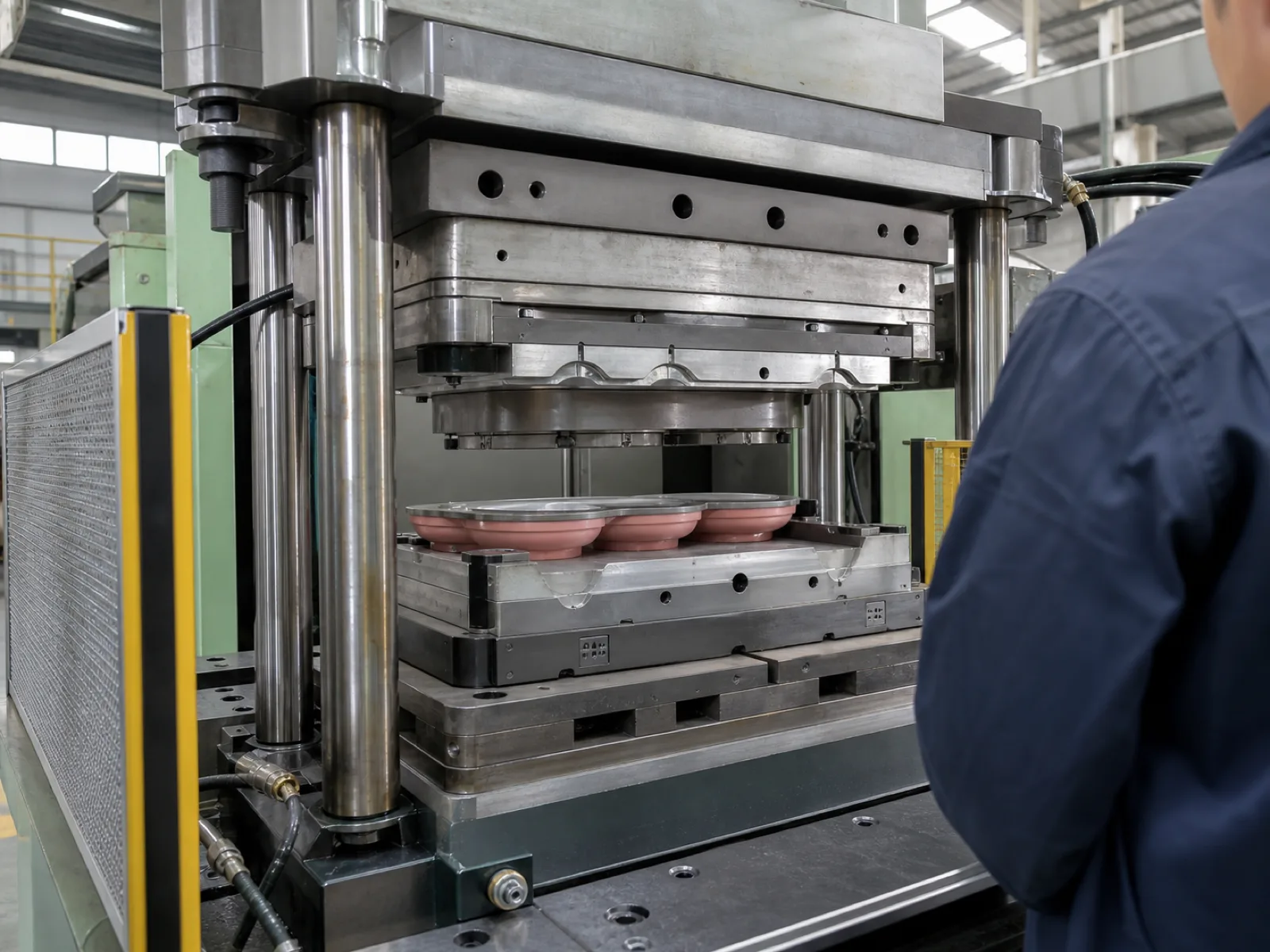
Five sourcing signals separate a real factory from a trading office reselling other factories' output. Cure-chemistry answered on the master-batch lot certificate, per-batch third-party test reports, a compound-house-of-record traceability chain, a same-day video walk-through of the mixing / molding / post-cure / QC lines, and a founding-engineer contact who signs the DFM report. Trading offices deflect on all five and pivot to price and lead time.
The [sourcing checklist](/guide/sourcing-silicone-factory-checklist/) walks the full 14-point vetting protocol. The five load-bearing signals specifically: 1. **Cure chemistry is specified in writing.** A real factory answers "platinum-cured LSR from [compound house], master-batch lot [number]" within 48 hours. A trading office answers "food-grade silicone" and cannot escalate the answer without contacting a subcontractor. 2. **Per-batch test reports are per-batch.** A real factory produces test reports referencing the master-batch lot number of the production batch. A trading office produces a single 12-24 month-old certificate that predates your production batch by six months or more. 3. **Compound-house-of-record traceability.** A real factory names its silicone gum supplier (Wacker, Momentive, Dow, Shin-Etsu, KCC, or a named Chinese compound house) and provides lot-level traceability. A trading office deflects. 4. **Live video walk-through.** A real factory sends a video walk-through of the mixing, molding, post-cure oven, and QC lines within 48 hours, with today's date stated audibly. A trading office sends stock photos or a 12-month-old video. 5. **A founding engineer signs the DFM report.** A real factory routes the DFM feedback through a named engineer who signs the report. A trading office routes it through a sales manager who forwards a subcontractor's PDF. Wetop is founder-led. William Zhuo (engineering lead, 12 years silicone) signs the DFM report on every incoming RFQ personally. If the answer to your first-round questions is not signed by an engineer, you are sourcing from a trading office. ## What is the realistic lead time for a first order?7-15 days for a T1 sample; 30-45 days for mass production at 5,000-20,000 pcs; 15-25 days ocean freight to US or EU ports; 90-130 days end-to-end from RFQ to first landed shipment. A PPAP-style sign-off gate adds 10-14 days. Suppliers quoting a 20-day end-to-end lead time on a custom-tooled program are quoting on a shelf item, not the program you specified.
The lead-time breakdown by stage: - RFQ and DFM feedback: 3-5 days - Tooling (aluminum single-cavity): 15-20 days - Tooling (P20 four-cavity): 25-35 days - T1 sample after tool completion: 7-15 days - T1 iteration if changes required: 5-10 days per round (budget one round) - PPAP-style sign-off (optional): 10-14 days - Mass production 5,000-20,000 pcs: 30-45 days - Post-cure and outgoing QC: included in mass production window - FOB Shenzhen or Yantian ocean freight: 15-25 days to US or EU ports The [MOQ and lead time explainer](/guide/moq-and-lead-time-silicone-oem/) walks the schedule at higher fidelity. The Wetop factory sits 90 minutes from Yantian Port and 2 hours from Hong Kong International Airport — a logistics fact that trims 3-5 days off the total on any air-freighted sample or first-order shipment. ## Engineer's Note — a rejected first-run tolerance and the peroxide-free lineFounder-led decision: Wetop's collapsible bowl line runs peroxide-free by default. The line was reconfigured in 2022 after a first-run T1 sample on a Tier 2 US retail program came back with a 3.2 mg/dm² total-extractables reading — cleared FDA 21 CFR 177.2600 but sat above the LFGB §30/31 comfort threshold for a program that was heading into EU launch six months later. Wetop rejected the batch and rebuilt the line rather than shipping.
The 2022 program was for a Tier 2 US housewares brand — 40,000 pcs first order, 400 ml collapsible bowl in three colors, peroxide-cured HCR from a mid-tier Chinese compound house at $0.08/pc lower material cost than the platinum-cured LSR alternative. The T1 sample cleared FDA and cleared LFGB pass/fail. But the mg/dm² total-extractables reading — 3.2 mg/dm² against a Wetop internal comfort threshold of 2.0 mg/dm² — sat just under the LFGB compliance ceiling. The buyer's EU launch was six months out. Shipping the batch would have technically cleared regulatory but risked a downstream failure in EU premium retail audit when volumes scaled. William Zhuo's call: reject the batch, refund the deposit against the sample tooling, and reconfigure the compression molding line for peroxide-free operation going forward. The line has run peroxide-free with platinum-LSR as the default cure since. Mid-tier peroxide-cure programs are still accepted on a separate line with mandatory 4-6 h post-cure at 180-200 °C and per-batch mg/dm² reporting. The default flipped because the failure mode was too close to the compliance line for a program with any EU exposure. The industry lesson: pass/fail LFGB reports hide the actual margin against the limit. Insist on the mg/dm² value on every batch, and reject any supplier who cannot produce the quantitative reading. ## What Wetop OEMs on collapsible bowlsWetop runs custom silicone collapsible bowl programs from MOQ 500 to 100,000+ pieces per SKU — housewares, outdoor, pet, baby, and medical-adjacent brands. Full private-label with custom pantone-matched pigments, custom retail packaging, per-batch FDA + LFGB + PFAS documentation, and per-program tooling stored in the mold vault under the brand's account. Founder-led engineering on every DFM report; ISO 9001, FDA 21 CFR 177.2600, LFGB §30/31 as standing deliverables.
Wetop's collapsible bowl book: - **MOQ tiers.** 500 pcs on aluminum single-cavity, 1,000-5,000 pcs on P20 hardened steel two-cavity, 5,000-50,000 pcs on P20 four-cavity, 50,000+ on S136 stainless multi-cavity LSR. - **Cure systems.** Platinum-cure LSR as the default line. Post-cured peroxide-cure HCR on a separate line for mid-tier retail programs, with mandatory 4-6 h at 180-200 °C and per-batch mg/dm² reporting. - **Hardness range.** Shore A 40-70 measured on the finished post-cured part per ASTM D2240[^astm-d2240]; default 55 ± 3 for a 400-800 ml collapsible bowl. - **Compliance stack.** FDA 21 CFR 177.2600[^fda-177-2600], LFGB §30/31 per BfR Recommendation XV[^bfr-lfgb-xv], Regulation (EC) 1935/2004[^ec-1935-2004], Prop 65, REACH SVHC, PFAS non-detect at 25 ppb, CPSIA for children-on-pack, USP <88>[^usp-class-vi] for medical-adjacent, ISO 10993-1[^iso-10993] where a device classification applies. - **Retail-tier readiness.** ISO 9001[^iso-9001], Sedex SMETA, ISO 2859-1 AQL 1.5 major / 2.5 minor outgoing QC[^iso-2859-1], NSF/ANSI 51[^nsf-ansi-51] for food-equipment channel launches, PPAP-adjacent sign-off available for programs requesting it under IATF 16949 methodology[^iatf-16949]. - **Custom branding.** Deboss, pad print, laser mark, custom pantone-matched pigments — see the [logo customization guide](/guide/customize-silicone-logo-deboss-print-laser/) for method trade-offs. - **Private-label programs.** Full white-label with mutual NDA on file — see [nda](/nda/) and the [private-label kitchen products guide](/guide/private-label-silicone-kitchen-products/). Sourcing a custom silicone collapsible bowl program? Email inquiry@wetopsilicone.com with your target dimensions, MOQ tier, target retail tier, and target regulatory scope. Wetop returns a DFM report signed by the engineering lead, a tooling recommendation with cavity count and cost bracket, and unit-price brackets at MOQ 500 / 1,000 / 5,000 / 20,000 within 48 hours. Full manufacturing detail on the [capabilities page](/capabilities/); anonymized program archetypes on [case studies](/case-studies/); founder-led engineering commentary and factory contact via the [contact page](/contact/). [^fda-177-2600]: US Food and Drug Administration. *21 CFR 177.2600 — Rubber articles intended for repeated use.* https://www.ecfr.gov/current/title-21/chapter-I/subchapter-B/part-177/subpart-C/section-177.2600 — the primary US regulation Wetop tests every collapsible bowl batch against. [^bfr-lfgb-xv]: German Federal Institute for Risk Assessment (BfR). *Recommendation XV — Silicones.* https://www.bfr.bund.de/cm/349/xv-silicones.pdf — the technical standard behind LFGB §30/31 for food-contact silicone, defining the organic volatile extraction test mandatory post-cure clears. [^iso-9001]: International Organization for Standardization. *ISO 9001:2015 — Quality Management Systems — Requirements.* https://www.iso.org/standard/62085.html — the quality management standard Wetop is certified against. [^iso-2859-1]: International Organization for Standardization. *ISO 2859-1:1999 — Sampling procedures for inspection by attributes.* https://www.iso.org/standard/1141.html — the AQL sampling standard used on every Wetop outgoing QC pass. [^astm-d2240]: ASTM International. *ASTM D2240-15 — Standard Test Method for Rubber Property — Durometer Hardness.* https://www.astm.org/d2240-15r21.html — the measurement standard for Shore A hardness on finished collapsible bowl parts. [^usp-class-vi]: United States Pharmacopeia. *USP <88> — Biological Reactivity Tests, In Vivo.* https://www.usp.org/harmonization-standards/pdg/excipients/plastic-materials — defines USP Class VI biological reactivity classification for medical-adjacent silicone. [^echa-pfas-proposal]: European Chemicals Agency. *PFAS Universal Restriction Proposal.* https://echa.europa.eu/hot-topics/perfluoroalkyl-chemicals-pfas — the regulatory action driving PFAS-free specification adoption in EU premium retail. [^ec-1935-2004]: European Parliament and Council. *Regulation (EC) No 1935/2004 — Materials and articles intended to come into contact with food.* https://eur-lex.europa.eu/legal-content/EN/TXT/?uri=CELEX%3A02004R1935-20090807 — the overarching EU framework regulation under which LFGB §30/31 sits. [^cpsia-silicone]: US Consumer Product Safety Commission. *Consumer Product Safety Improvement Act (CPSIA).* https://www.cpsc.gov/Regulations-Laws--Standards/Statutes/The-Consumer-Product-Safety-Improvement-Act — governs total lead and phthalate limits on collapsible bowls marketed for children. [^iatf-16949]: International Automotive Task Force. *IATF 16949:2016 — Quality management systems for automotive production.* https://www.iatfglobaloversight.org/iatf-169492016/ — underlies the PPAP methodology adopted for industrial and premium-retail production sign-off. [^iso-10993]: International Organization for Standardization. *ISO 10993-1:2018 — Biological evaluation of medical devices — Part 1.* https://www.iso.org/standard/68936.html — the biocompatibility standard applied when a collapsible bowl program crosses the medical-adjacent threshold. [^nsf-ansi-51]: NSF/ANSI. *NSF/ANSI 51 — Food Equipment Materials.* https://www.nsf.org/consumer-resources/what-is-nsf-certification/food-safety-certification — applies to food-equipment channel launches. [^cie-color]: International Commission on Illumination. *CIE Colorimetry, 4th Edition.* https://cie.co.at/publications/colorimetry-4th-edition — the standard behind delta-E colorimetric measurement for dishwasher-endurance pigment testing.