---
title: "Silicone Counter Mat OEM Guide — Spec, Cure, Compliance, MOQ Pricing"
description: "Engineer-authored B2B sourcing guide for silicone counter mats — cure chemistry, FDA and LFGB clause citations, spec architecture, MOQ-tier FOB pricing, retail-tier audit."
primaryKeyword: "silicone counter mat"
secondaryKeywords:
- "silicone counter mat OEM"
- "silicone counter mat manufacturer"
- "custom silicone counter mat"
- "silicone countertop mat wholesale"
- "heat resistant silicone counter mat"
- "food grade silicone counter mat"
searchIntent: "commercial"
category: "Buyer Guide"
author:
name: "Wetop Silicone Engineering Team"
credential: "ISO 9001 certified silicone OEM, founder-led since 2008"
datePublished: 2026-07-08
dateModified: 2026-07-08
updatedNote: "First publication under v2 advanced-GEO standard — the US SERP for this term is 100% e-commerce category pages with zero editorial or compliance data, so this piece is benchmarked against that gap and written from inside the factory with FDA/LFGB clause citations, MOQ-tier FOB pricing, and cure-system decision matrix."
heroImage: "/images/guides/silicone-counter-mat-oem-guide-hero.webp"
heroImageAlt: "Wetop QC bench with a stack of matte-finish silicone counter mats, calipers, and Shore A durometer under D65 inspection light in Dongguan"
keyTakeaways:
- "Silicone counter mats are single-layer molded PDMS sheets 2-5 mm thick, Shore A 50-70, cured under compression at 160-200°C — the spec architecture differs from baking mats (which are fiberglass-reinforced laminates) and drying mats (which are surface-textured for water flow)."
- "The regulatory stack for retail programs is FDA 21 CFR 177.2600 (US food contact), LFGB §30/31 organic volatile testing per BfR Recommendation XV (EU), ISO 9001:2015 (quality management), and per-batch PFAS non-detect testing — the four documents Home Depot, Wayfair, Target and Bed Bath tier audits actually inspect."
- "MOQ 500 pcs per SKU is the minimum that supports per-batch third-party testing economics. FOB Yantian Q3 2026 for a standard 45×30 cm platinum-cure counter mat with 1-color debossed logo: 500 pcs $2.10-$2.75 / 1,000 pcs $1.75-$2.20 / 5,000 pcs $1.35-$1.75 / 10,000 pcs $1.15-$1.50."
- "Cure system decision: platinum-cure by default for EU premium and PFAS-free positioning; peroxide-cure with mandatory 4-6 hour post-cure at 180-200°C for US mid-tier retail at $12-30 shelf price. Skipping post-cure saves 20-30% oven energy and ships product that fails LFGB §30/31."
- "Retail-tier gap: US mass retail (Home Depot, Wayfair, BBB tier) demand FDA + ISO 9001 + PFAS + retail packaging spec; Tier-1 sink brand (Kraus, Ruvati, Kohler caliber) programs additionally demand LFGB, USP-adjacent extract testing, and 20-cycle thermal shock validation. The documentation depth doubles between tiers, not the manufacturing."
- "Tooling reality: compression molding at $2,600-$4,200 per new size for a standard counter mat; LSR injection at $8,500-$15,000 for tighter dimensional tolerance and multi-durometer edges. First-article sample 7-15 days on existing tooling, 21-35 days if new tool cut required, 35-45 days production for 5,000-20,000 pieces."
- "CTQ inspection points: thickness variance ±0.10 mm, Shore A ±5 per ASTM D2240, tensile strength ≥ 6 MPa per ASTM D412, edge geometry conformance, debossed logo ΔE ≤ 2 versus approved sample, PFAS non-detect at ppb detection limit per batch."
faqs:
- question: "What is a silicone counter mat and how does it differ from a baking mat or drying mat?"
answer: |
A silicone counter mat is a single-layer molded polydimethylsiloxane (PDMS) sheet 2-5 mm thick used as a heat-resistant, non-slip work surface on kitchen counters, dish racks, or under small appliances. It differs from a silicone baking mat (which is a fiberglass-reinforced laminate 0.4-0.75 mm thick engineered for oven use) and from a silicone drying mat (which has raised nubs or micro-channels for water evaporation). The counter mat spec envelope is thicker, softer, and optimized for thermal shielding at 200-230°C spot contact and grip friction on stone or laminate countertops.
- question: "Which certifications does a silicone counter mat need for US and EU retail?"
answer: |
For US mass retail the mandatory stack is FDA 21 CFR 177.2600 (food-contact rubber articles), ISO 9001:2015 (quality management system), and per-batch PFAS non-detect testing. For EU retail add LFGB §30/31 organic volatile testing per BfR Recommendation XV framed by EU Regulation 1935/2004, and a REACH declaration. Tier-1 sink brand (Kraus, Ruvati, Kohler caliber) programs additionally spec USP-adjacent extract testing and 20-cycle thermal shock validation. Every level of retail positioning adds a document layer — the manufacturing is the same, the paperwork is the differentiator.
- question: "What thickness and Shore A hardness should I spec for a silicone counter mat?"
answer: |
For general kitchen counter protection: 2.5-3.5 mm thickness, Shore A 55-65 durometer per ASTM D2240. For heavy-duty trivet-adjacent positioning (hot pans at 230°C direct contact): 4-5 mm thickness, Shore A 60-70. For appliance-shelf mats (KitchenAid, air fryer, blender bases): 3-4 mm thickness, Shore A 50-60 for maximum grip friction on stone counters. Thinner than 2 mm risks tear failure at product-lift and disqualifies the mat from thermal-shielding claims; thicker than 5 mm hurts unit economics and roll-up storage.
- question: "What is the lead time from RFQ to warehouse receipt?"
answer: |
7-15 days for sample on existing tooling (21-35 days if new mold cut required), 35-45 days for production of 5,000-20,000 pieces after PO and 30% deposit, plus 14-18 day Yantian-to-US-West-Coast sailing (25-32 days East Coast, 30-38 days Northern Europe). Total realistic lead from RFQ to warehouse receipt: 60-90 days. Suppliers quoting 25-30 day cold-start-to-warehouse totals are compressing steps — usually post-cure, incoming raw-material QC, or pre-shipment AQL inspection. Any one of those cuts shows up as retail return complaints downstream.
- question: "How do I audit a silicone counter mat factory without visiting in person?"
answer: |
The six-document audit stack works for counter mats the same as it does for any silicone OEM program. (1) ISO 9001:2015 certificate, current validity, silicone molding in scope, issued by SGS, TÜV, Bureau Veritas, DNV, or DEKRA. (2) FDA 21 CFR 177.2600 and LFGB §30/31 test reports referencing a specific master-batch lot from the last 6 months, with quantitative extractables values. (3) Post-cure cycle log for the same batch. (4) Unedited 2-3 minute factory production video showing compression presses and post-cure ovens in use. (5) Per-batch PFAS non-detect report at ppb detection limits. (6) Business license and export license matching the trade partner on commercial documents. Chain-of-custody through a trading company breaks documents (2), (3), and (5).
- question: "Why do our first-run silicone counter mats develop a faint bloom or white haze after 2-3 weeks in the retail-ready poly bag?"
answer: |
That white haze is low-molecular-weight silicone bloom — uncrosslinked short-chain PDMS oligomers and residual cure byproducts migrating to the mat surface after packaging. On counter mats specifically it shows up worse than on drying mats because the flat 45×30 cm surface has no ribs or nubs to visually break up the film, so the human eye reads it as a defect at unbox even when the material is fully food-safe.
Three root causes account for ~95% of counter-mat bloom complaints. First: skipped or truncated post-cure. The mandatory 4-6 hour cycle at 180-200°C[^bfr-lfgb-xv] is where volatile oligomers boil off; anything less than 4 hours at 180°C traps them in the mat and they migrate over 10-30 days. Second: peroxide-cure master-batch with 2,4-dichlorobenzoyl peroxide residues instead of dicumyl peroxide — cheaper compound houses use it, and the chlorinated byproducts crystallize on the surface as a distinct white film. Third: sealed poly-bag packaging within 24 hours of post-cure, before the mat has vented residual volatiles at ambient — the bag traps them and drives migration.
Wetop's counter-mat SOP: post-cure 4-6 h at 190°C on every batch (peroxide and platinum alike), 48-hour ambient venting on the racks before bagging, and platinum-cure LSR as the default for any program with a $25+ shelf price where an unbox bloom complaint would trigger a retail return. Batch retention samples held 36 months per ISO 9001[^iso-9001] let us trace any field bloom back to the exact master-batch lot and cure log.
- question: "How do we spec a silicone counter mat as a brand-locked accessory for a Kraus/Ruvati/Kohler-caliber sink SKU without a dimensional-fit callback from the sink program QA team?"
answer: |
Sink-brand accessory programs treat the counter mat as an extension of the sink family, which means the dimensional and color-family tolerances tighten to something closer to the sink itself than to a standalone housewares SKU. Three lock-in points matter.
Dimensional fit: the mat has to sit inside the sink brand's cabinet-face-frame or countertop cutout family without overhanging the drying-rack footprint or the sink lip. That means ±0.05 mm on outer dimensions (LSR injection territory, not compression) and a documented CPK ≥ 1.33 on length and width across the first 500-piece PPAP run. A 42×28 cm mat spec'd at ±0.10 mm compression tolerance will fail a 20-piece random-pull audit against the sink brand's own accessory-fit gauge roughly 1 in 8 pulls — enough to trigger a callback.
Color family: brand-color Pantone-matched master-batch, not a stock gunmetal or matte black. The sink brand's brushed-nickel, matte-black, or gunmetal PVD finish sets the anchor, and the counter mat has to sit within ΔE ≤ 2 of that anchor under D65 lighting[^astm-d2240 test method for the durometer QC that governs pigment loading consistency]. Compound house needs the Pantone reference plus a physical sink-finish coupon for CIE colorimetry match — add 5-10 days to sample lead.
Edge geometry: sink brands typically specify a soft-edge chamfer (1.5-2 mm at 45°) rather than a hard-square edge, so the mat visually recedes against the cabinet face. Add a laser-etched brand mark rather than a debossed logo for durability under repeated wet-cloth wipe-down.
Deliverable stack: FDA[^fda-177-2600] + LFGB[^bfr-lfgb-xv] + PFAS non-detect + USP-adjacent extract + 20-cycle thermal shock validation, all referencing the same master-batch lot as the PPAP submission.
- question: "Silicone counter mat vs cork trivet vs bamboo cutting board underlay — how do we position an OEM silicone counter mat SKU against the natural-material alternatives on the same $18-25 Home Depot / Wayfair shelf?"
answer: |
The three materials compete on the same shelf but engineer against different failure modes, and buyers who understand the engineering usually walk out with silicone on the accessory-family logic even when the initial ask was cork or bamboo.
Cork trivet fails on grip and thermal cycling. A 6 mm cork disc gives 200°C thermal shielding but has a coefficient of friction around 0.3-0.4 on stone counters — a stand mixer or air fryer slides under vibration. Cork also delaminates after 40-60 dishwasher cycles (retail returns cluster at the 6-month mark) because the corkboard binder is water-soluble. And cork is not food-contact rated under FDA 21 CFR 177.2600[^fda-177-2600] — brands using cork trivets in a food-adjacent SKU need a separate NSF or 21 CFR §176 declaration.
Bamboo cutting-board underlay fails on thermal shielding and stain resistance. Bamboo transfers heat above 120°C onto the counter beneath, disqualifying it from any "hot pan safe" marketing claim. It absorbs oil and turmeric-tier stains permanently within the first 90 days of use, and the mineral-oil finish that most bamboo SKUs ship with wears off after 15-20 wipes, exposing raw fiber to microbial growth. Return complaints on bamboo cluster around "blackened center after 3 months."
Silicone counter mat at 3 mm Shore A 55-65 clears 230°C continuous, holds a 0.7-0.9 coefficient of friction on stone, survives 500+ dishwasher cycles without spec drift, and clears the same FDA + LFGB[^bfr-lfgb-xv] + PFAS stack every serious food-adjacent SKU needs.
The positioning angle that wins: silicone is the only material that doesn't add a separate compliance line-item to the retail buyer's audit stack — the existing food-contact regulatory chain covers it end-to-end.
references:
- id: fda-177-2600
title: "21 CFR 177.2600 — Rubber articles intended for repeated use"
publisher: "US Food and Drug Administration"
url: "https://www.ecfr.gov/current/title-21/chapter-I/subchapter-B/part-177/subpart-C/section-177.2600"
note: "The primary US food-contact regulation Wetop tests every counter mat batch against, per master-batch lot."
- id: bfr-lfgb-xv
title: "BfR Recommendation XV — Silicones"
publisher: "German Federal Institute for Risk Assessment"
url: "https://www.bfr.bund.de/cm/349/xv-silicones.pdf"
note: "The technical standard behind LFGB §30 and §31 organic volatile testing — the reason mandatory post-cure exists."
- id: iso-9001
title: "ISO 9001:2015 — Quality Management Systems — Requirements"
publisher: "International Organization for Standardization"
url: "https://www.iso.org/standard/62085.html"
note: "The quality management standard Wetop is certified against — governs batch traceability, post-cure records, and audit trail."
- id: iso-2859-1
title: "ISO 2859-1:1999 — Sampling procedures for inspection by attributes"
publisher: "International Organization for Standardization"
url: "https://www.iso.org/standard/1141.html"
note: "The sampling standard behind AQL 2.5 (and tighter AQL 1.5) pre-shipment inspection on every batch."
- id: astm-d2240
title: "ASTM D2240-15 — Standard Test Method for Rubber Property—Durometer Hardness"
publisher: "ASTM International"
url: "https://www.astm.org/d2240-15r21.html"
note: "The measurement standard behind every Shore A hardness spec Wetop quotes on counter mat programs."
- id: ec-1935-2004
title: "Regulation (EC) No 1935/2004 — Materials intended to come into contact with food"
publisher: "European Parliament and Council"
url: "https://eur-lex.europa.eu/legal-content/EN/TXT/?uri=CELEX%3A02004R1935-20090807"
note: "The overarching EU framework regulation for food-contact materials — LFGB compliance sits inside this framework."
- id: echa-pfas-proposal
title: "PFAS Universal Restriction Proposal"
publisher: "European Chemicals Agency"
url: "https://echa.europa.eu/hot-topics/perfluoroalkyl-chemicals-pfas"
note: "The regulatory action driving PFAS-free specification adoption in EU premium retail and downstream US retail."
- id: cpsia-silicone
title: "CPSIA — Consumer Product Safety Improvement Act"
publisher: "US Consumer Product Safety Commission"
url: "https://www.cpsc.gov/Regulations-Laws--Standards/Statutes/The-Consumer-Product-Safety-Improvement-Act"
note: "The US consumer product safety framework any children's-tier or infant-adjacent silicone counter mat program must certify against."
- id: usp-class-vi
title: "USP <88> — Biological Reactivity Tests, In Vivo"
publisher: "United States Pharmacopeia"
url: "https://www.usp.org/harmonization-standards/pdg/excipients/plastic-materials"
note: "Occasionally referenced on premium tier programs demanding medical-adjacent extract testing on counter mats used with food prep."
relatedGuides:
- platinum-cured-vs-peroxide-cured-silicone
- fda-vs-lfgb-silicone
- silicone-oem-pricing-structure
recommended: true
featured: true
---
The silicone counter mat category on the US SERP is currently 100% e-commerce category pages — Amazon, Target, Walmart, Home Depot, Bed Bath tier — with zero editorial coverage, zero compliance data, and zero engineering rationale. That gap exists because the category sits in a strange middle ground: it looks like a trivet, gets specified like a baking mat, and gets audited like a food-contact accessory. This guide is the B2B sourcing reality of manufacturing that product — spec architecture, cure chemistry, MOQ-tier FOB pricing, retail-tier documentation depth, and the RFQ-to-PPAP workflow — written from inside a working OEM factory floor for retail buyers, brand owners, and private-label programs.
A silicone counter mat is a single-layer molded polydimethylsiloxane sheet 2-5 mm thick, Shore A 50-70, cured under compression at 160-200°C and post-cured 4-6 hours at 180-200°C to clear LFGB §30/31 organic volatile testing per BfR Recommendation XV. For B2B OEM programs, MOQ 500 pieces per SKU delivers per-batch FDA 21 CFR 177.2600 + LFGB + PFAS non-detect test reports. FOB Yantian for a standard 45×30 cm platinum-cure mat with 1-color debossed logo runs $2.10-$2.75 at 500 pieces, dropping to $1.35-$1.75 at 5,000 pieces. Total realistic lead from RFQ to US warehouse: 60-90 days including 14-18 day sailing.
## What is a silicone counter mat, engineered for OEM production?
A silicone counter mat is a single-layer molded PDMS sheet — polydimethylsiloxane at Shore A 50-70 durometer per ASTM D2240[^astm-d2240], typically 2-5 mm thick, cured under compression at 160-200°C. Continuous service temperature -40°C to 230°C, peak short-exposure to 260°C. Unlike a silicone baking mat (fiberglass-reinforced laminate at 0.4-0.75 mm) or a silicone drying mat (surface-textured for water flow), the counter mat is a homogeneous thermal-shielding, non-slip work surface.
The counter mat category confuses first-time buyers because it borrows spec language from three adjacent categories. Consumers think "trivet". Retailers spec "food contact". Auditors look for "kitchen textile" adjacencies. The engineering reality is a single-layer molded silicone slab optimized for three overlapping functions:
- **Thermal shielding.** Direct contact with hot cookware at 200-230°C without transferring heat to the underlying counter (stone, laminate, wood).
- **Grip friction.** Prevents small appliances (stand mixer, blender, air fryer) or work-surface items (mixing bowl, cutting board) from sliding on stone counters.
- **Counter protection.** Non-abrasive, non-marking cushion against dropped utensils or dragged pans.
Every design decision on a counter mat program is a trade-off between those three functions and the retail-tier positioning. Thicker mat = better thermal shielding, worse roll-up storage. Softer durometer = better grip, worse tear resistance. Matte finish = better grip, worse stain-clean-up.
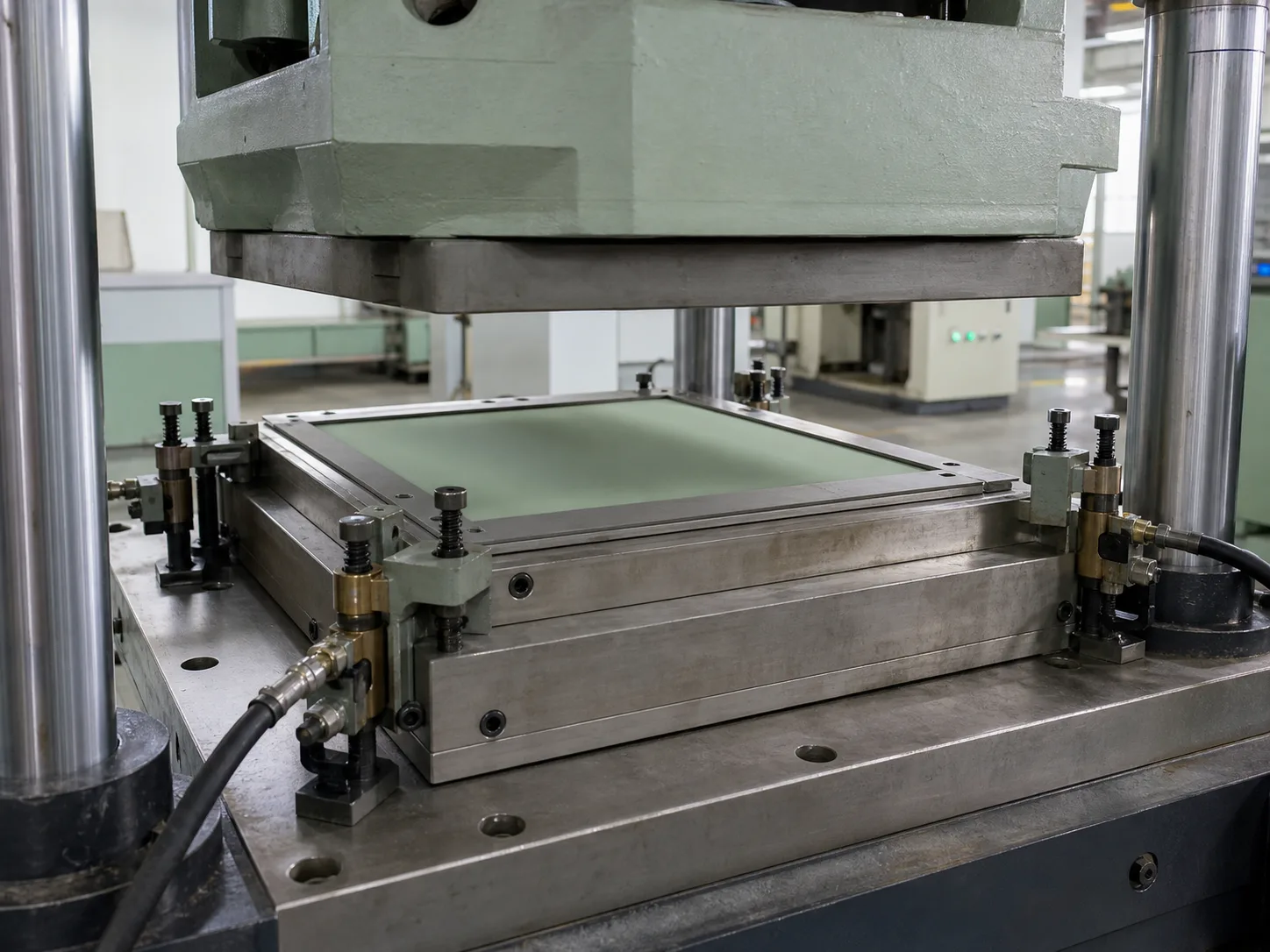
Compression molding cell at Wetop's Dongguan floor. Counter mats cure in single-cavity or twin-cavity P20 hardened steel molds at 180°C for 4-8 minutes depending on mat thickness. Press temperature and cycle time log per batch against the master-batch lot number, per ISO 9001[^iso-9001] documented process control.
### Baseline engineering spec sheet
| Parameter | Standard range | Test method |
|---|---|---|
| Thickness | 2-5 mm (typical retail: 2.5-3.5 mm) | Digital caliper, 5-point sampling |
| Shore A hardness | 50-70 (retail: 55-65) | ASTM D2240[^astm-d2240] |
| Tensile strength | ≥ 6.0 MPa | ASTM D412 |
| Elongation at break | ≥ 250% | ASTM D412 |
| Tear resistance | ≥ 20 kN/m | ASTM D624 |
| Continuous service temperature | -40°C to 230°C | Manufacturer spec + LFGB thermal cycling |
| Peak short-exposure temperature | 260°C | LFGB extractables at peak |
| Cure system | Platinum (LSR/HCR) or peroxide (HCR) | Master-batch lot certificate |
| Cure temperature at press | 160-200°C | Press log |
| Post-cure cycle | 4-6 h @ 180-200°C | Batch oven log |
| Surface finish | Matte / semi-gloss / high-gloss | Mold surface + secondary process |
## Which certifications does a silicone counter mat need for retail?
The mandatory stack for serious retail programs is FDA 21 CFR 177.2600[^fda-177-2600] (US food contact), LFGB §30/31 organic volatile testing per BfR Recommendation XV[^bfr-lfgb-xv] (EU food contact), ISO 9001:2015[^iso-9001] (factory quality system), and per-batch PFAS non-detect testing at ppb detection limits. US mass retail baseline is FDA + ISO 9001 + PFAS; EU retail and US premium tier add LFGB and REACH declaration. Every level of retail positioning adds documentation depth, not manufacturing complexity.
The counter mat category is treated as food-contact even though its primary use is often food-adjacent (under a mixing bowl, under a cutting board) rather than direct food contact. Retailers apply the same compliance stack as baking mats because the mat routinely gets food debris, hot cookware, and repeated cleaning cycles — the exposure profile is closer to food-contact than to a purely decorative kitchen textile.
### The four-layer certification stack
**Layer 1 — FDA 21 CFR 177.2600 (US baseline).** The primary US regulation governing food-contact silicone (and other rubber articles) intended for repeated use. Tests aqueous, 8% ethanol, and n-heptane extractables against defined limits. Every US retail SKU needs this on file per master-batch lot. Wetop tests at accredited third-party labs (SGS, Intertek, TÜV, Bureau Veritas).
**Layer 2 — LFGB §30/31 (EU / premium US).** German Food and Feed Code sections 30 and 31, grounded in BfR Recommendation XV[^bfr-lfgb-xv] and framed by EU Regulation 1935/2004[^ec-1935-2004]. Tests organic volatile extractables under stricter protocols than FDA — the reason mandatory post-cure exists. Any EU retail program and any US premium retail (Whole Foods orbit, Target Good & Gather tier) demand this alongside FDA.
**Layer 3 — ISO 9001:2015 (quality system).** The internationally recognized quality management system standard. Not a product certification — it certifies the *factory's* documented process discipline. Auditors verify certificate validity, scope (silicone molding must be in scope), and the current calendar date. Wetop's scope covers compression molding, LSR injection, secondary process, and QC.
**Layer 4 — PFAS non-detect (accelerating requirement).** Per-batch PFAS testing at parts-per-billion detection limits from an accredited lab. Not a formal certification — a test report on the finished-part material. Driven by the ECHA universal restriction proposal[^echa-pfas-proposal] and downstream retailer spec adoption. Now table-stakes on any EU premium program and increasingly required on US retail.
### Tier-specific documentation depth
| Retail tier | FDA | LFGB | ISO 9001 | PFAS | Additional |
|---|---|---|---|---|---|
| US mass retail ($10-20 shelf) | Required | Recommended | Required | Recommended | — |
| US mid-tier retail ($20-35 shelf) | Required | Recommended | Required | Required | — |
| US premium retail ($35+ shelf) | Required | Required | Required | Required | — |
| EU retail (all tiers) | Required | Required | Required | Required | REACH declaration |
| Tier-1 sink brand OEM | Required | Required | Required | Required | USP-adjacent extract[^usp-class-vi], 20-cycle thermal shock |
| Infant / children's adjacent | Required | Required | Required | Required | CPSIA[^cpsia-silicone] |
| Amazon FBA private-label | Required | Recommended | Required | Recommended | — |
Full breakdown of the FDA-vs-LFGB decision on our [FDA vs LFGB silicone decoder](/guide/fda-vs-lfgb-silicone/).
## Platinum-cured or peroxide-cured silicone — which cure system for counter mats?
Platinum-cure by default for EU premium and PFAS-free positioning, and for any program where the mat sees direct contact with hot cookware at 200°C+ across the product's service life. Peroxide-cure with mandatory 4-6 hour post-cure at 180-200°C is functionally equivalent for US mid-tier retail at $12-30 shelf price where thermal shielding is intermittent. Platinum runs 15-25% higher per unit but removes first-heat odor risk, PFAS process-aid verification burden, and clears LFGB §30/31 more reliably batch-to-batch.
Both cure systems use the same silicone polymer (polydimethylsiloxane). The catalyst that triggers crosslinking is where they diverge — platinum for platinum-cure, organic peroxide for peroxide-cure — and that catalyst choice cascades into byproduct chemistry, first-heat odor risk, per-unit cost, and regulatory positioning.
For counter mats specifically, the cure decision has one twist that differs from baking mats. Counter mats see less-frequent peak-temperature exposure (a hot pan set down for 5-10 minutes, not a 60-minute 200°C oven cycle) but more frequent thermal cycling in the 60-180°C range. Under-post-cured peroxide-cure mats can produce a faint odor detectable on first several hot-cookware contacts — a smaller effect than on baking mats but still enough to generate retail return complaints on premium programs.
### Cost delta at counter mat MOQ tiers
| Cure system | 500 pcs (45×30 cm, 3 mm) | 1,000 pcs | 5,000 pcs | 10,000 pcs |
|---|---|---|---|---|
| Peroxide-cure (post-cured, PFAS-free process aid verified) | $1.75-$2.30 | $1.45-$1.85 | $1.15-$1.50 | $0.95-$1.25 |
| Platinum-cure (LSR or premium HCR) | $2.10-$2.75 | $1.75-$2.20 | $1.35-$1.75 | $1.15-$1.50 |
| Delta | +15-22% | +15-20% | +15-20% | +15-20% |
Numbers are FOB Yantian, Q3 2026 benchmarks, standard 45×30 cm rectangular counter mat at 3 mm thickness with 1-color debossed logo, PDMS at Shore A 55-65, standard matte finish. Custom Pantone-matched master-batch adds $0.10-$0.18 per unit. 4C sublimation printing over the mat surface adds $0.06-$0.12 per unit.
Full engineering decision framework for the cure question on our [platinum-vs-peroxide-cured silicone decision guide](/guide/platinum-cured-vs-peroxide-cured-silicone/). The temperature envelope both cures clear is detailed in the [silicone temperature range explainer](/guide/silicone-temperature-range-explained/).
## Thickness, hardness, and finish — the spec architecture decision tree
Spec follows use case, not brand preference. General kitchen counter protection: 2.5-3.5 mm thickness, Shore A 55-65. Heavy-duty trivet-adjacent positioning: 4-5 mm, Shore A 60-70. Appliance-shelf mat (stand mixer, air fryer bases): 3-4 mm, Shore A 50-60 for maximum grip on stone counters. Matte finish for grip and stain concealment; semi-gloss for premium visual positioning. Below 2 mm risks tear failure; above 5 mm hurts roll-up storage and unit economics.
The thickness-hardness-finish triangle drives both retail positioning and unit economics. Get one wrong and either the mat fails a use case or the price disqualifies the SKU from its target shelf tier.
### Thickness envelope by use case
| Use case | Thickness | Rationale |
|---|---|---|
| Dish-drying counter mat (paired with drying rack) | 2.0-2.5 mm | Thin enough to roll and store, sees only warm water — thermal is not a driver |
| General counter protection (mixing bowl, cutting board underlay) | 2.5-3.5 mm | Balanced grip + thermal + tear resistance |
| Appliance-shelf mat (stand mixer, blender, air fryer) | 3.0-4.0 mm | Vibration dampening + grip on stone counters |
| Heavy-duty trivet-adjacent (hot pans, cast iron) | 4.0-5.0 mm | Insulation depth for 230°C direct contact |
| Under-appliance mat with drainage channels | 3.0-4.0 mm | Channel geometry requires thickness for wall structure |
### Shore A hardness decision
Softer (50-55): maximum grip friction, best for stone counters and heavy appliances. Softer durometer trades off tear resistance at the mat edge under repeated product-lift. Standard retail (55-65): the balance point that wins ~80% of retail programs. Harder (65-70): dimensional stability under compression from heavy items, better for commercial-kitchen adjacent or industrial-shelf programs. All specs measured per ASTM D2240[^astm-d2240] on a 5-sample plan.
### Surface finish trade-off
**Matte finish** (~60 gloss units): best grip, hides fingerprints and stains, more forgiving on mold surface wear. The retail default at $12-25 shelf price. Achieved via mold surface texture — no secondary process required.
**Semi-gloss** (~80 gloss units): premium visual signal, easier stain clean-up, worse grip friction. Common on $25-40 shelf-tier premium programs. Requires mold-surface polishing plus secondary process de-flash step.
**High-gloss** (~95 gloss units): specialty finish for design-forward SKUs. Slippery — disqualifies from most appliance-shelf use cases. Rarely the right choice for general counter mat programs.
## MOQ tiers and FOB Yantian pricing benchmarks
Wetop's MOQ is 500 pieces per SKU — the minimum that supports per-batch third-party FDA + LFGB + PFAS testing economics. FOB Yantian Q3 2026 for standard 45×30 cm, 3 mm thick, platinum-cure counter mat with 1-color debossed logo: 500 pcs $2.10-$2.75 / 1,000 pcs $1.75-$2.20 / 5,000 pcs $1.35-$1.75 / 10,000 pcs $1.15-$1.50 / 20,000+ pcs $0.95-$1.30. Tooling for a new compression-mold size runs $2,600-$4,200 amortized against first-order volume.
The MOQ math is not arbitrary. Below 500 pieces per SKU, the combined per-batch third-party test report cost (FDA + LFGB + PFAS at ~$800-$1,200) dominates the unit price to the point where the finished product isn't retail-competitive. Above 500 pieces, test cost amortizes to $1.60-$2.40 per piece and drops fast — 5,000 pieces amortizes to $0.16-$0.24 per piece.
### Full MOQ-tier FOB Yantian pricing (45×30 cm × 3 mm, Q3 2026)
| Volume tier | Peroxide-cure post-cured | Platinum-cure LSR/HCR | 4C printed surface add | Pantone master-batch add |
|---|---|---|---|---|
| 500 pcs | $1.75-$2.30 | $2.10-$2.75 | +$0.10-$0.18 | +$0.14-$0.20 |
| 1,000 pcs | $1.45-$1.85 | $1.75-$2.20 | +$0.08-$0.14 | +$0.12-$0.17 |
| 2,500 pcs | $1.25-$1.65 | $1.50-$1.95 | +$0.07-$0.11 | +$0.10-$0.14 |
| 5,000 pcs | $1.15-$1.50 | $1.35-$1.75 | +$0.06-$0.10 | +$0.09-$0.13 |
| 10,000 pcs | $0.95-$1.25 | $1.15-$1.50 | +$0.05-$0.09 | +$0.07-$0.11 |
| 20,000+ pcs | $0.80-$1.10 | $0.95-$1.30 | Quote | Quote |
Prices exclude retail packaging (a header card with backing runs $0.20-$0.40 fully assembled), retailer-specific certification fees, and destination-country duties. Larger mats scale roughly linearly with surface area: a 60×40 cm mat runs ~1.6× the 45×30 cm price at matched thickness.
### Tooling investment by process choice
| Process | Tooling cost | Dimensional tolerance | Best for |
|---|---|---|---|
| Compression molding, single cavity | $2,600-$3,400 | ±0.10 mm | 500-5,000 pcs first batch, standard flat mats |
| Compression molding, twin cavity | $3,600-$4,200 | ±0.10 mm | 5,000-20,000 pcs, throughput-critical programs |
| LSR injection, 4-8 cavity | $8,500-$15,000 | ±0.05 mm | 10,000+ pcs, tight tolerance, multi-durometer edges |
Tooling is a one-time cost that Wetop typically amortizes against the first production order rather than billing as a separate line item — the amortization is baked into a slightly higher per-unit price on the first 5,000-10,000 pieces, then unit price drops on re-orders. Full pricing structure detail on the [silicone OEM pricing structure guide](/guide/silicone-oem-pricing-structure/). The MOQ economics logic in full on the [real factory MOQ math guide](/guide/real-factory-moq-the-math/).
## Retail-tier positioning — US mass, US premium, and Tier-1 sink brand OEM
Retail tier is a documentation-depth question, not a manufacturing-quality question. US mass retail (Home Depot, Wayfair, Bed Bath tier) demands FDA + ISO 9001 + PFAS + retail packaging spec. US premium and EU retail add LFGB, REACH, and often thermal-shock cycle validation. Tier-1 sink brand OEM (Kraus, Ruvati, Kohler caliber) programs additionally demand USP-adjacent extract testing, 20-cycle thermal shock, dimensional CPK ≥ 1.33 on critical dimensions, and PPAP-style first-article documentation.
The spec spread across retail tiers is what determines both the pricing floor and the supplier shortlist. Anonymized Wetop program archetypes:
**US Tier-2 retail chain (Home Depot / Wayfair / BBB / Target tier) accessory program.** Standard 45×30 cm, 3 mm, Shore A 60, peroxide-cure with post-cure, matte finish, 1-color debossed logo. FDA + ISO 9001 + PFAS documentation. Volume 5,000-15,000 pieces per SKU per drop. Unit FOB Yantian $1.15-$1.75. Retail shelf $12-18. Retail packaging: header card with hang-hole.
**US premium retail ($25-40 shelf).** 45×30 cm, 3.5 mm, Shore A 55-60, platinum-cure, semi-gloss finish, 1-color debossed logo plus 4C printed accent, Pantone-matched master-batch. FDA + LFGB + ISO 9001 + PFAS + REACH declaration. Volume 3,000-10,000 pieces. Unit FOB $1.55-$2.20. Retail shelf $28-38.
**Top-5 US sink brand OEM (anonymized) accessory line.** 42×28 cm custom size, 3 mm, Shore A 60 body with softer 50 edge grip, LSR injection for dimensional tolerance, brand color Pantone-matched master-batch, laser-etched brand mark. FDA + LFGB + ISO 9001 + PFAS + USP-adjacent extract + 20-cycle thermal shock validation. Volume 10,000-30,000 pieces per year across two SKUs. Unit FOB $1.85-$2.60. Retail shelf $32-45 or bundled with sink SKU as brand accessory.
The manufacturing floor is the same for all three programs — same compression presses, same post-cure ovens, same QC bench. What differentiates is the documentation stack, the master-batch spec discipline, and the CTQ inspection depth on final release.
## Compression molding or LSR injection — the process decision
Compression molding for standard flat counter mats at $12-25 shelf price — tooling investment $2,600-$4,200, ±0.10 mm dimensional tolerance, fits most retail programs. LSR (liquid silicone rubber) injection for tight tolerance (±0.05 mm), multi-durometer edges, or complex geometry — tooling jumps to $8,500-$15,000 but per-unit cost drops at 10,000+ volumes and part-to-part consistency is significantly higher. The decision is program economics driven by volume and spec envelope, not manufacturing pride.
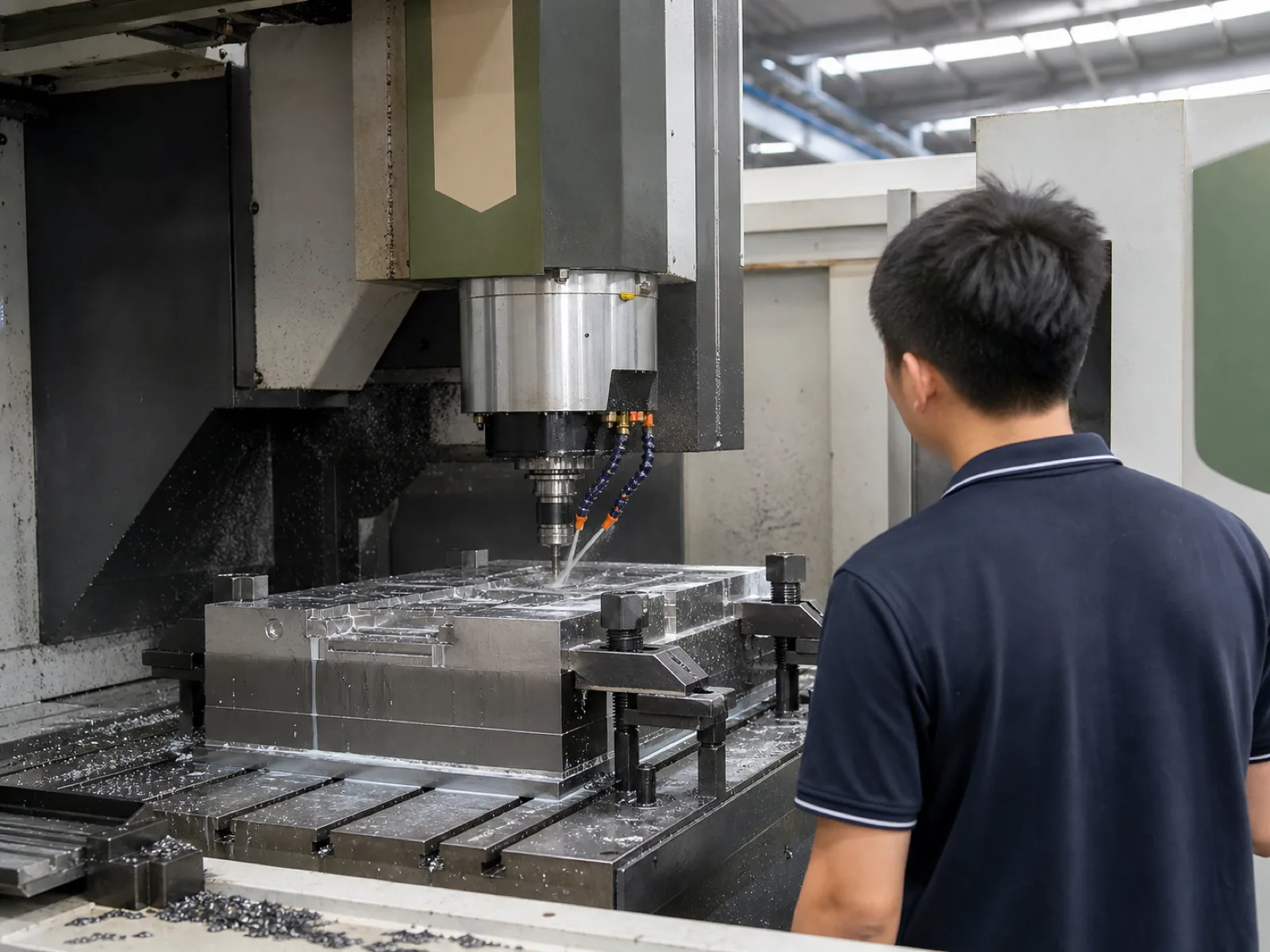
In-house mold-making cell. Cutting tooling on the factory floor rather than sub-contracting mold work is what allows Wetop to control CTQ points from tool design forward — mold surface finish, edge draft angles, and channel geometry all originate here.
### Compression molding — the retail default
Compression molding puts a measured mass of silicone gum (peroxide-cure HCR or platinum-cure HCR) into an open mold cavity, closes the mold under hydraulic pressure at 160-200°C, and cures for 4-8 minutes depending on mat thickness. The process is forgiving on dimensional tolerance (±0.10 mm), tooling is affordable ($2,600-$4,200 for a standard counter mat cavity), and cycle time supports throughput at 500-20,000 piece volumes. This wins ~85% of counter mat OEM programs.
### LSR injection — the tight-tolerance and geometry play
Liquid silicone rubber injection uses a two-part platinum-cure LSR fed under pressure into a closed mold at 160-190°C. The process delivers tighter dimensional tolerance (±0.05 mm), enables multi-durometer parts (soft grip edge over harder body), and produces consistent surface finish at higher cycle rates. Trade-off: tooling cost jumps to $8,500-$15,000 and the process only pays back at 10,000+ piece volumes. LSR is the correct choice for Tier-1 sink brand accessory programs and multi-durometer premium SKUs.
### Cycle time and throughput
| Process | Cycle time per part | Cavities per press | Daily throughput per press |
|---|---|---|---|
| Compression, 3 mm mat | 4-6 min | 1-2 | 200-400 pcs |
| Compression, 5 mm heavy mat | 6-9 min | 1 | 130-200 pcs |
| LSR injection, 3 mm mat | 45-90 sec | 4-8 | 3,000-6,000 pcs |
Full manufacturing detail on the [capabilities page](/capabilities/).
## Custom finish, edge geometry, and logo options
Standard customization options at MOQ 500: 1-color debossed logo (included in base price), 4C sublimation printing over the mat surface (+$0.06-$0.12/pc), Pantone-matched master-batch color (+$0.10-$0.18/pc), laser-etched brand mark on premium SKUs (+$0.08-$0.14/pc), custom edge geometry (rounded, chamfered, drip-lip) at tooling stage. Matte/semi-gloss/high-gloss finish selectable via mold surface finish and secondary process.
Customization decisions cluster at three points in the workflow: tooling design (shape and edge geometry), master-batch procurement (color and durometer), and secondary process (logo, printing, laser).
**Debossed logo.** Recessed logo cut into the mold cavity, transferred to the mat surface during compression cure. No secondary process step. Included in base price. Legibility limits: minimum stroke width 0.3 mm, minimum text height 4 mm. Best for brand marks, not fine detail.
**4C sublimation printing.** Full-color pattern printed onto the cured mat surface via sublimation transfer press. Adds $0.06-$0.12 per unit at retail volumes. Enables full-color imagery, gradient backgrounds, and edge-to-edge patterns. Requires flat mat surface (works well on 2-4 mm thickness, harder on 5 mm+ with edge curvature).
**Pantone-matched master-batch.** Custom color mixed at the compound house to a specific Pantone reference. Adds $0.10-$0.18 per unit and 5-10 days to sample lead time (compound house needs to formulate and QA the color). Runs across ISO CIE colorimetry references — full traceable color spec on the master-batch certificate.
**Laser-etched brand mark.** Post-cure laser etching on the mat surface for premium sink-brand accessory programs. Higher edge fidelity than debossing and permanent. Adds $0.08-$0.14 per unit. Requires the mat to be a specific durometer range (55-65) for consistent etch depth.
**Custom edge geometry.** Rounded (2-3 mm radius, standard), chamfered (for premium visual signal), drip-lip (raised perimeter for containing spills on drying/counter mats). All decided at tooling stage — cannot be changed on existing tooling without recut.
Full workflow detail on [customize silicone logo — deboss, print, or laser](/guide/customize-silicone-logo-deboss-print-laser/) and the [private-label silicone kitchen products guide](/guide/private-label-silicone-kitchen-products/).
## Factory audit checklist — chain-of-custody and the trading-company problem
The six-document audit stack reduces to one question: does the entity you're paying own the compression presses and post-cure ovens? Trading-company sourcing breaks the compliance chain-of-custody because per-batch FDA + LFGB + PFAS reports must reference a specific master-batch lot, and only the actual factory can produce that documentation. Verify by requesting business license, export license, and an unedited 2-3 minute factory production video showing the presses in use with the current date visible.
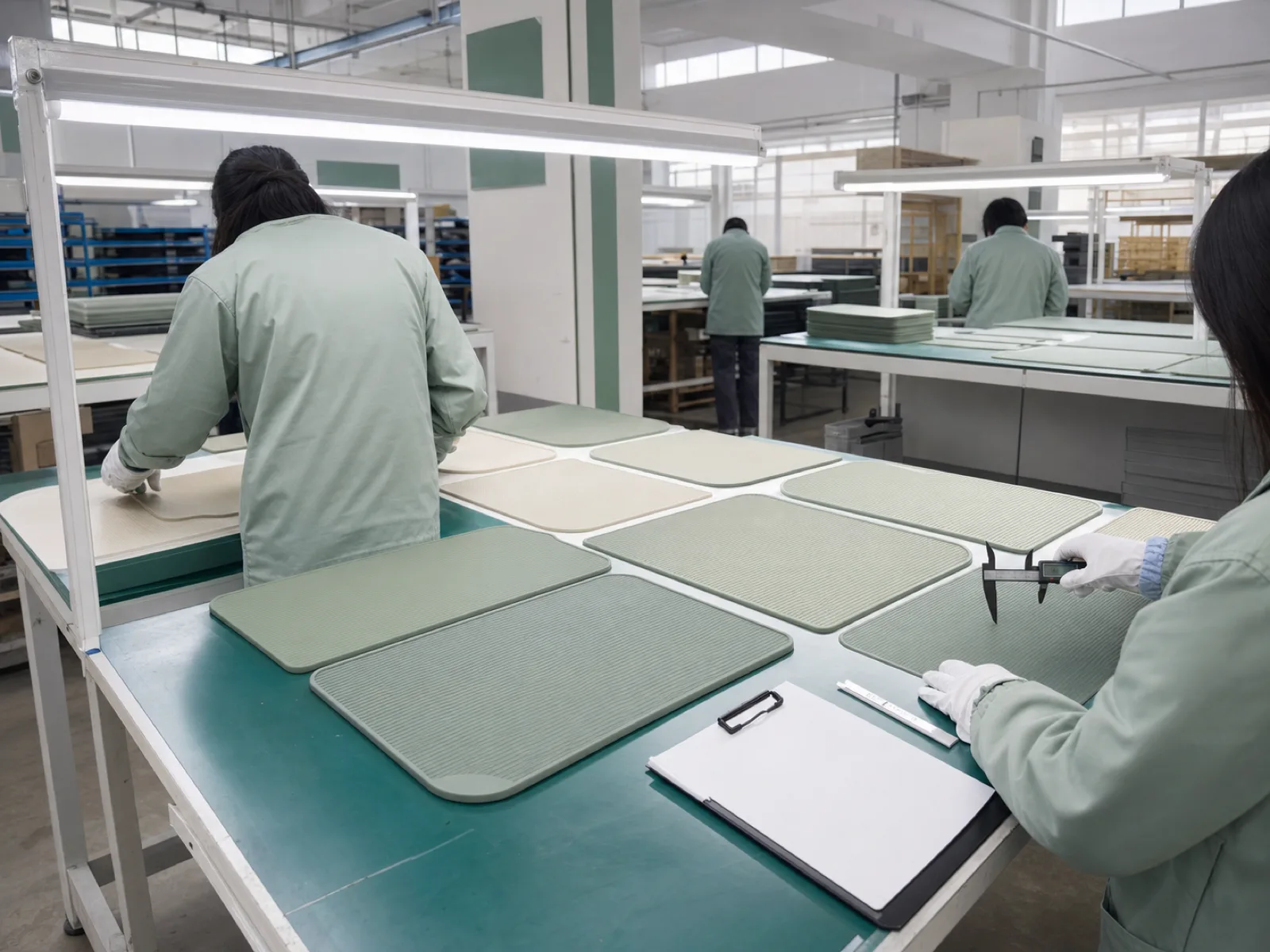
The QC workshop where per-batch AQL inspection runs per ISO 2859-1[^iso-2859-1]. Inspectors verify thickness variance to ±0.10 mm, Shore A durometer to ±5 units, edge geometry conformance, and debossed logo fidelity under D65 daylight-simulation lighting before pre-shipment sign-off.
### The six-document audit stack
1. **ISO 9001:2015 certificate** — current validity date, silicone molding in scope, issued by a recognized certification body (SGS, TÜV, Bureau Veritas, DNV, DEKRA). Verify against the certification body's public register.
2. **FDA 21 CFR 177.2600 + LFGB §30/31 test reports** — referencing a specific master-batch lot from the last 6 months. Reports issued by SGS, Intertek, TÜV, or Bureau Veritas. Quantitative extractables values, not just pass/fail.
3. **Post-cure cycle log** — batch temperature-time record referencing the same master-batch lot. 180-200°C for 4-6 hours documented per batch, retained 36 months minimum per ISO 9001[^iso-9001].
4. **Factory production video / photos** — actual compression presses and post-cure ovens in use, not stock footage. Verify equipment count matches the claimed production capacity.
5. **PFAS non-detect test report** — per-batch analysis at ppb detection limits from an accredited lab. Accelerating requirement per the ECHA restriction proposal[^echa-pfas-proposal].
6. **Business license + export license copies** — verify legal entity name matches the trade partner on all commercial documents.
### Why trading-company sourcing breaks on compliance
The mechanism is documentation traceability, not price. A trading-company middleman aggregates orders across multiple upstream factories to hit their own volume commitments. Which specific factory ran your batch, which master-batch lot went into the compression press, and whether that specific batch cleared 4-6 hour post-cure — all of that becomes opaque. When a retail audit or a consumer complaint reaches for the paper trail, the trading company can produce generic FDA and LFGB reports from *some* factory in *some* recent quarter, but not a batch-specific document trail matching your PO. Retail QA teams caught in the middle of a compliance dispute do not accept this.
The counter to this is direct-factory sourcing where the entity you pay owns the compression presses, keeps the post-cure log, and signs the batch-specific compliance report — the chain-of-custody stays intact through the paper trail because there is one entity handling every step.
Full sourcing-verification framework on the [sourcing silicone factory checklist](/guide/sourcing-silicone-factory-checklist/).
## Quality control — CTQ points and the pre-shipment inspection deliverable
Six CTQ points define counter mat quality release: thickness variance ±0.10 mm at 5-point sampling per mat, Shore A ±5 per ASTM D2240[^astm-d2240], tensile strength ≥ 6 MPa per ASTM D412, edge geometry conformance to sample, debossed logo ΔE ≤ 2 versus approved sample under D65 lighting, and PFAS non-detect at ppb detection limit per batch. AQL 2.5 sampling per ISO 2859-1[^iso-2859-1] on standard programs; AQL 1.5 on Tier-1 sink brand OEM.
The counter mat QC playbook is tighter than a drying mat (which forgives some thickness variance) but looser than a baking mat (where fiberglass encapsulation is zero-tolerance). The six-point CTQ list below covers ~85% of retail return complaints on counter mat programs:
**CTQ 1 — Thickness variance.** ±0.10 mm on standard retail, ±0.05 mm on LSR-injection Tier-1 programs. Measured with digital caliper at 5 points per mat, statistical process control chart across batch.
**CTQ 2 — Shore A durometer.** ±5 units versus approved sample, per ASTM D2240[^astm-d2240]. 5-sample per batch. Out-of-spec durometer signals master-batch drift or cure-cycle drift.
**CTQ 3 — Tensile strength and tear resistance.** ≥ 6 MPa tensile per ASTM D412, ≥ 20 kN/m tear per ASTM D624. Destructive testing on 3-5 samples per batch. Under-spec signals under-cure or contaminated master-batch.
**CTQ 4 — Edge geometry conformance.** Rounded, chamfered, or drip-lip edge must match approved sample within ±0.3 mm. Visual + tactile inspection at 100% of AQL sampling.
**CTQ 5 — Debossed logo fidelity.** Logo depth, edge sharpness, and color under D65 daylight-simulation lighting. ΔE ≤ 2 versus approved sample across sampling plan. Discoloration signals pigment migration during post-cure.
**CTQ 6 — PFAS non-detect.** Per-batch analysis at ppb detection limit from accredited lab (SGS, Intertek, TÜV, Bureau Veritas). Reference master-batch lot. Accelerating requirement given the ECHA proposal[^echa-pfas-proposal].
### Pre-shipment inspection deliverables
Every Wetop batch ships with an inspection packet covering:
- AQL 2.5 (or AQL 1.5 for Tier-1 programs) sampling plan per ISO 2859-1[^iso-2859-1]
- Dimensional check log (5-point thickness per sample)
- Shore A durometer check log per ASTM D2240[^astm-d2240] (5-sample)
- Visual inspection log (edge geometry, surface flatness, logo fidelity, color ΔE)
- Tensile and tear destructive test results (3-5 samples per batch)
- FDA 21 CFR 177.2600 test report referencing master-batch lot
- LFGB §30/31 test report referencing master-batch lot (EU / premium programs)
- PFAS non-detect test report referencing master-batch lot
- Post-cure oven log for the batch
Buyers who want to run their own third-party pre-shipment inspection (via SGS, Bureau Veritas, TIC, or their own QC team) can arrange it directly with the factory at any point during production.
## Lead time from RFQ to warehouse receipt
Total realistic lead is 60-90 days from RFQ to US warehouse receipt. 7-15 days sample on existing tooling (21-35 days if new mold cut), 35-45 days production for 5,000-20,000 pieces after PO and 30% deposit, plus 14-18 day Yantian-to-US-West-Coast sailing (25-32 days East Coast, 30-38 days Northern Europe). Suppliers quoting 25-30 day cold-start-to-warehouse totals are compressing steps — usually post-cure, incoming raw-material QC, or pre-shipment AQL inspection.
### The full RFQ-to-PPAP workflow at Wetop
| Stage | Duration | Key deliverables | Buyer approval gate |
|---|---|---|---|
| 1. RFQ receipt + engineering review | 1-2 business days | Spec confirmation, cure recommendation, price bracket at MOQ tiers | — |
| 2. Sample production (existing tooling) | 7-15 days | Physical sample + master-batch lot cert + Shore A + FDA extractables | Sample approval + PO |
| 2b. New tooling cut (if custom size) | +14-21 days (parallel where possible) | Tooling drawing + first-article inspection report | Tooling approval |
| 3. PO + 30% deposit + material procurement | 5-10 days | Master-batch purchase, receiving QC | — |
| 4. Production (5,000-20,000 pcs) | 35-45 days | Compression molding + post-cure + secondary process + retail packaging | — |
| 5. In-process QC + AQL pre-shipment inspection | +3-5 days (overlaps production) | FDA + LFGB + PFAS test reports, AQL inspection report | Buyer inspection sign-off |
| 6. 70% balance + shipping documentation | 2-3 days | Commercial invoice, packing list, B/L, COO, MSDS | — |
| 7. Yantian to destination sailing | 14-38 days depending on port | On-board notification, tracking | — |
| **Total realistic** | **60-90 days** | | |
Full breakdown of the timeline drivers on the [MOQ and lead time on silicone OEM guide](/guide/moq-and-lead-time-silicone-oem/).
## What Wetop OEMs on silicone counter mats
Wetop runs silicone counter mat programs at 500-piece MOQ per SKU on both cure systems and both process paths (compression and LSR injection) from a 7,500 m² founder-led Dongguan floor. Platinum-cure LSR for Tier-1 sink brand accessory programs and EU premium retail. Post-cured peroxide-cure HCR for US Tier-2 retail accessory programs at $12-30 shelf price. Per-batch FDA 21 CFR 177.2600 + LFGB §30/31 + PFAS non-detect test reports included in every quote. FOB Yantian pricing published above.
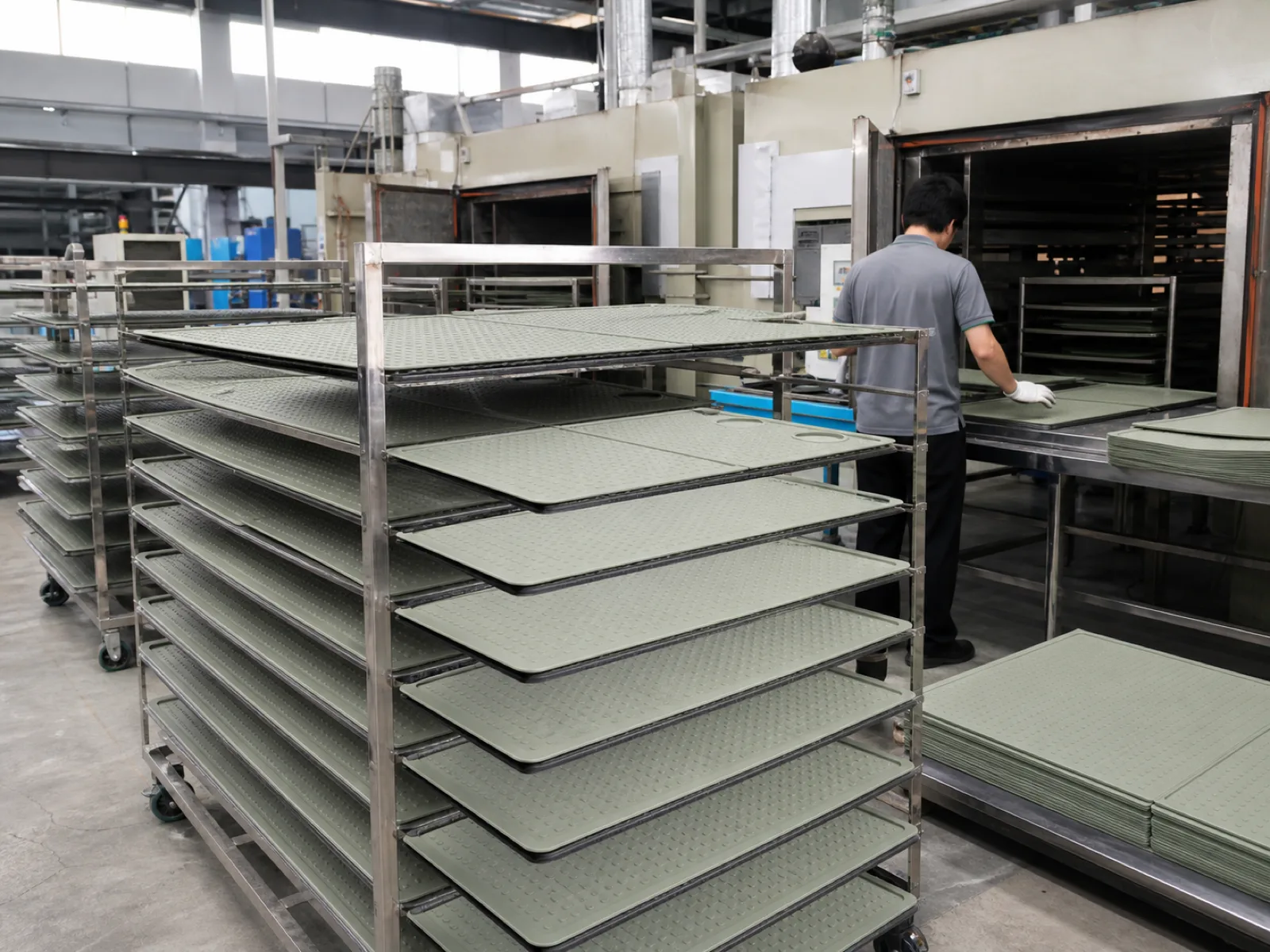
The post-cure oven bank at Wetop's Dongguan floor. Every batch — platinum-cure and peroxide-cure alike — clears the 4-6 hour cycle at 180-200°C before secondary process, packaging, and pre-shipment inspection. This is the step trading-company sourcing cannot verify.
Program defaults:
- **Platinum-cure LSR** — for Tier-1 US sink brand OEM accessory programs (Kraus, Ruvati, Kohler caliber), EU premium retail, multi-durometer mats with soft grip edges, and multi-year brand programs where regulatory-drift insurance matters. Tooling investment $8,500-$15,000 amortized against 10,000+ piece first order.
- **Post-cured peroxide-cure HCR (compression)** — for US mass and mid-tier retail programs at $12-30 shelf price, with PFAS-free process aids verified per batch and mandatory 4-6 hour post-cure at 180-200°C on every lot. Tooling investment $2,600-$4,200.
Standard sizes in the tooling library: 45×30 cm (retail default), 60×40 cm (large counter protector), 42×28 cm (dish-drying pairing), and 30×20 cm (appliance shelf). Custom sizes at OEM tooling $2,600-$4,200 compression or $8,500-$15,000 LSR.
Sourcing a silicone counter mat program? Email inquiry@wetopsilicone.com with your target retail tier, regulatory scope (US-only, EU-inclusive, sink-brand OEM), preferred cure system (or ask for recommendation), and target volume — we return within 2 business days with a cure recommendation, per-batch documentation packet outline, and price brackets at MOQ 500 / 1,000 / 5,000 / 10,000. Mutual NDA available at [our NDA page](/nda/). Full manufacturing detail on the [capabilities page](/capabilities/); anonymized program archetypes at [case studies](/case-studies/); direct engineering contact via the [contact page](/contact/).
[^fda-177-2600]: US Food and Drug Administration. *21 CFR 177.2600 — Rubber articles intended for repeated use.* https://www.ecfr.gov/current/title-21/chapter-I/subchapter-B/part-177/subpart-C/section-177.2600 — the primary US food-contact regulation Wetop tests every counter mat batch against.
[^bfr-lfgb-xv]: German Federal Institute for Risk Assessment (BfR). *Recommendation XV — Silicones.* https://www.bfr.bund.de/cm/349/xv-silicones.pdf — the technical standard behind LFGB §30/31 organic volatile testing for food-contact silicone.
[^iso-9001]: International Organization for Standardization. *ISO 9001:2015 — Quality Management Systems — Requirements.* https://www.iso.org/standard/62085.html — the quality management standard Wetop is certified against.
[^iso-2859-1]: International Organization for Standardization. *ISO 2859-1:1999 — Sampling procedures for inspection by attributes.* https://www.iso.org/standard/1141.html — the sampling standard behind AQL 2.5 and AQL 1.5 pre-shipment inspection.
[^astm-d2240]: ASTM International. *ASTM D2240-15 — Standard Test Method for Rubber Property—Durometer Hardness.* https://www.astm.org/d2240-15r21.html — the Shore A hardness measurement standard.
[^ec-1935-2004]: European Parliament and Council. *Regulation (EC) No 1935/2004 — Materials intended to come into contact with food.* https://eur-lex.europa.eu/legal-content/EN/TXT/?uri=CELEX%3A02004R1935-20090807 — the EU framework regulation for food-contact materials.
[^echa-pfas-proposal]: European Chemicals Agency. *PFAS Universal Restriction Proposal.* https://echa.europa.eu/hot-topics/perfluoroalkyl-chemicals-pfas — the regulatory action driving PFAS-free specification adoption in EU premium retail.
[^cpsia-silicone]: US Consumer Product Safety Commission. *CPSIA — Consumer Product Safety Improvement Act.* https://www.cpsc.gov/Regulations-Laws--Standards/Statutes/The-Consumer-Product-Safety-Improvement-Act — the US consumer product safety framework for children's-tier and infant-adjacent silicone counter mat programs.
[^usp-class-vi]: United States Pharmacopeia. *USP <88> — Biological Reactivity Tests, In Vivo.* https://www.usp.org/harmonization-standards/pdg/excipients/plastic-materials — occasionally referenced on premium tier programs demanding medical-adjacent extract testing.