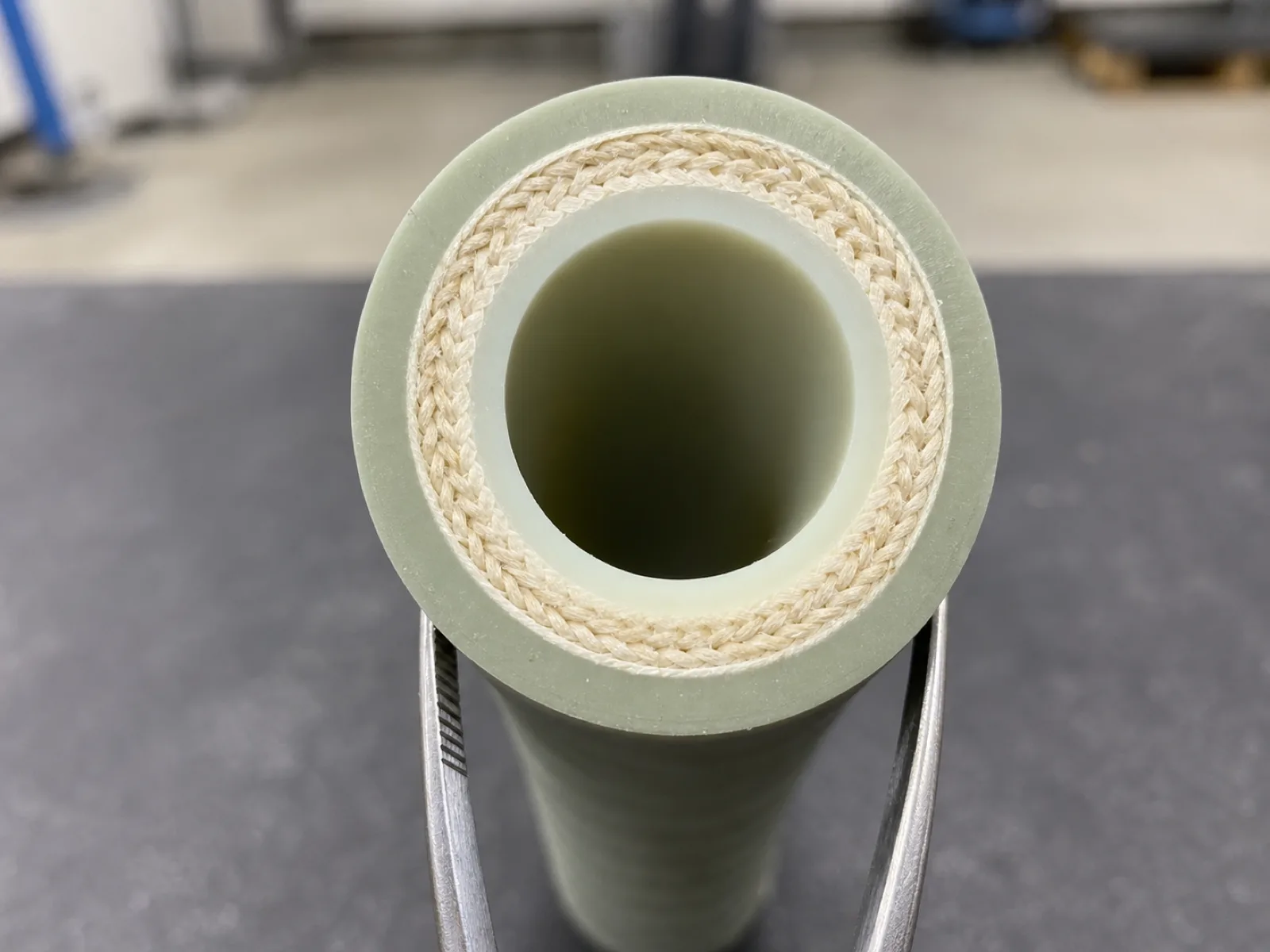
A silicone hose manufacturer builds reinforced silicone hose — straight extruded lengths and compression-molded elbows, reducers, and humps — for automotive coolant, turbo charge-air, industrial transfer, food, and medical fluid paths. What separates a real manufacturer from a trading company is in-house reinforcement: the polyester, aramid, fiberglass, or wire-braid ply that sets the temperature and pressure ceiling. Wetop runs both an extrusion cell and a mandrel-based molding cell in Dongguan at 500-unit OEM MOQ, with per-lot durometer, burst, and ply-adhesion data on every shipment.
Sourcing silicone hose is a different task from sourcing silicone tubing, and the two are often confused at RFQ time. Tubing is a single-wall bore for low-pressure transfer. Hose carries reinforcement, survives clamping and pressure pulses, and is specified by construction as much as by compound. This guide is written for OEM buyers specifying hose for engine cooling systems, turbochargers, charge-air ducting, industrial chemical transfer, food and beverage lines, and medical equipment. It covers how reinforcement sets the operating envelope, the temperature and pressure ratings by construction, the extrusion-versus-molding decision, when fluorosilicone is mandatory, the certification map, MOQ economics, and how to tell a manufacturer from a broker. ## What does a silicone hose manufacturer actually make?A silicone hose manufacturer produces reinforced silicone hose in two forms: straight hose extruded continuously with a textile or wire ply, and formed hose — elbows, reducers, and humps — compression-molded over a mandrel. The reinforcement ply is what defines the manufacturer. A supplier that only extrudes bore without reinforcement is a tubing maker, not a hose maker.
The word "hose" carries a specific engineering meaning that "tubing" does not. A hose is a multi-layer construction: an inner silicone liner that contacts the fluid, one or more reinforcement plies that carry the pressure load, and an outer silicone cover that protects the reinforcement from abrasion, heat, and ozone. That layered build is what lets a hose survive a hose clamp crushing it, a bend radius tighter than the tubing would tolerate, and pressure pulses that would balloon a single-wall bore. A genuine silicone hose manufacturer therefore runs two production cells: - **Extrusion cell** — for straight hose. Silicone is extruded around a braiding line that lays the reinforcement ply, then a second silicone pass covers it, then the assembly is vulcanized and post-cured. Output is continuous straight hose cut to length. - **Compression-molding cell with mandrel tooling** — for formed hose. The reinforced silicone is built up on a steel or aluminum mandrel shaped like the finished elbow or reducer, then cured under heat and pressure so the hose holds its bent shape permanently. A trading company will have neither cell, or one cell and a subcontractor for the other. That matters because the ply-to-silicone interface is where hoses fail, and a subcontracted forming step breaks the traceability that lets you diagnose a delamination. When you vet a [silicone hose manufacturer versus a trading company](/guide/moq-and-lead-time-silicone-oem/), the presence of both cells under one roof is the single clearest signal. ## Silicone hose vs silicone tubing vs standard rubber hoseSilicone tubing is single-wall, low-pressure, and specified by ID and OD. Silicone hose adds reinforcement plies for 10-15 bar service. Standard rubber hose (EPDM, NBR) is cheaper but caps near 150 °C and hardens with age. Silicone hose wins on temperature range, ozone and UV resistance, and service life; it loses on upfront unit cost.
The three products solve different problems and cost different amounts. Getting the category right on the drawing prevents a mis-quote: | Attribute | Silicone tubing | Silicone hose | Standard rubber hose (EPDM/NBR) | |---|---|---|---| | Construction | Single-wall bore | Liner + reinforcement + cover | Reinforced rubber | | Working pressure | Under ~1.7 bar (25 psi) | 3-15 bar by ply | 5-20 bar by ply | | Temperature range | -60 to 230 °C | -60 to 230 °C | -40 to 150 °C (EPDM) | | Ozone / UV resistance | Excellent | Excellent | Moderate (EPDM), poor (NBR) | | Ages by | Minimal change | Minimal change | Hardening, cracking, set | | Oil / fuel resistance | Poor (VMQ) | Poor unless FVMQ liner | Good (NBR) | | Relative unit cost | Low | High | Low-moderate | Silicone's advantage over EPDM is not pressure — a well-built EPDM hose holds pressure fine. The advantage is that silicone does not harden, crack, or take a permanent compression set after years of hot-cold cycling, and it holds a far wider temperature band. That is why premium and heavy-duty coolant systems migrated to silicone hose despite the higher unit cost: the hose outlives the vehicle instead of being a scheduled replacement item. Where the fluid is oil or fuel, though, standard silicone (VMQ) is the wrong choice — that is a fluorosilicone or NBR job, covered below. ## How is silicone hose reinforced?Silicone hose is reinforced with a textile or wire ply embedded between silicone layers: polyester braid for automotive coolant to ~180 °C, aramid (para-aramid) for turbo and hot-side ducting to ~220 °C, fiberglass for 260 °C+ continuous service, and stainless-steel wire braid or helix for high burst pressure or vacuum resistance. Ply choice sets the temperature and pressure ceiling.
Reinforcement is the heart of hose engineering. The silicone compound gives the hose its temperature range, chemical resistance, and flexibility, but the reinforcement ply is what carries pressure and holds the wall against clamping and bending. The four common systems, and where each earns its place: | Reinforcement | Continuous temp ceiling | Typical working pressure | Best-fit application | |---|---|---|---| | Polyester braid (1-4 ply) | ~180 °C | 6-12 bar | Automotive coolant, low-side charge-air, general purpose | | Aramid / para-aramid (Nomex-class) | ~220 °C | 10-15 bar | Turbo charge-air hot side, boost ducting | | Fiberglass | 260 °C+ | 8-12 bar | Exhaust-adjacent hot-air, industrial ducting | | Stainless-steel wire braid / helix | Compound-limited (230 °C) | 15+ bar or full vacuum | High-pressure transfer, vacuum lines, collapse resistance | Two engineering points buyers routinely miss. First, ply count and ply material are separate levers — adding polyester plies raises burst pressure but does nothing for the temperature ceiling; you move to aramid or fiberglass for heat, not for pressure. Second, wire reinforcement is about pressure and collapse resistance, not temperature: a wire-braid hose does not run hotter than its silicone compound allows, because the silicone still limits the continuous temperature to roughly 230 °C. Specify wire when you need burst pressure above 15 bar or when the hose must resist collapsing under vacuum, not when you simply need "more heat."
Silicone hose runs -60 °C to 230 °C continuous on the compound side, but the usable pressure ceiling is set by reinforcement and drops with temperature. A polyester-reinforced hose rated 12 bar at 25 °C may hold only 5-6 bar at 180 °C. Always specify working pressure at the operating temperature, with a 3-4x burst safety factor, not the ambient rating.
Temperature and pressure interact, and the most common specification error is quoting a pressure rating at room temperature and assuming it holds hot. It does not. As silicone warms, the reinforcement textile relaxes and the compound softens, so the burst pressure falls. A responsible manufacturer publishes a temperature-derated pressure curve, not a single headline number. The working envelope by construction, at ambient and at 180 °C: | Construction | Continuous temp | Working pressure @ 25 °C | Working pressure @ 180 °C | Burst safety factor | |---|---|---|---|---| | Single-ply low-pressure | 230 °C | 3-4 bar | 1.5-2 bar | 3x | | 2-ply polyester | 180 °C | 8-10 bar | 4-5 bar | 3-4x | | 3-4 ply polyester/aramid | 220 °C | 12-15 bar | 6-8 bar | 3-4x | | Wire-braid reinforced | 230 °C | 15-25 bar | 8-12 bar | 4x | Peak versus continuous is the other trap. Silicone will survive a short excursion to 260 °C or even 300 °C for seconds during a heat-soak event, but that is a peak rating, not a continuous one. Continuous 260 °C service needs fiberglass reinforcement and a heat-stabilized compound. When a drawing says "260 °C," push the buyer to clarify whether that is a five-second heat-soak peak or an eight-hour continuous duty — they are different hoses. For the underlying compound behavior across the range, the [silicone temperature range guide](/guide/silicone-temperature-range-explained/) breaks down continuous, intermittent, and peak ratings and how post-cure shifts the ceiling. ## Extrusion vs molding: straight hose vs formed shapesStraight silicone hose is extruded continuously and cut to length — low tooling cost, fast, ideal for long runs. Formed hose (elbows, reducers, humps, T-pieces) is compression-molded over a mandrel so it holds a permanent bend. Formed hose needs a dedicated mandrel tool per shape and carries a higher MOQ, but it is the only way to make a tight-radius bend that will not kink.
The routing geometry decides the process. A hose that runs in a straight or gently curved path is extruded; a hose that must turn a sharp corner, step between two diameters, or absorb engine movement with a bellows hump is molded on a mandrel. - **Extruded straight hose** — the continuous process. The reinforcement is braided inline between silicone passes, cured, and cut. Tooling is a die and tip, cheap to make, and one die serves any length. This is the right choice for straight coolant runs, air lines, and any hose the customer will cut to length themselves. - **Compression-molded formed hose** — the reinforced silicone is laid onto a shaped mandrel and cured under heat and pressure so it permanently holds the elbow, reducer, or hump geometry. Each shape needs its own mandrel tool. A 90° elbow, a 45° elbow, and a 76-to-63 mm reducer are three separate tools and three separate SKUs. The engineering reason formed hose exists: an extruded straight hose bent into a tight radius will kink and collapse the bore, choking flow. A molded elbow holds the bore open around the bend because it was cured in that shape with the reinforcement supporting the arch. For turbo and intercooler plumbing, where every bend is tight and space is constrained, formed hose is not optional. A silicone hose manufacturer that only extrudes cannot serve automotive charge-air work — it can only sell straight lengths and let the customer struggle with the bends. Wetop runs the mandrel-molding cell precisely so formed and straight hose ship from the same quality system, with the same [silicone molding process](/guide/silicone-molding-process-explained/) discipline applied to both. ## When is fluorosilicone (FVMQ) mandatory?Fluorosilicone (FVMQ) is mandatory whenever a silicone hose contacts oil, fuel, or diesel-blend coolant — most often on the turbocharger pressure side and on charge-air ducting exposed to blow-by oil mist. A fluorosilicone inner liner over a silicone body resists hydrocarbon swelling while keeping silicone's temperature range. Standard VMQ silicone swells and delaminates on oil contact within months.
Standard silicone (VMQ) has one significant weakness: it is not oil- or fuel-resistant. Immerse a VMQ hose in oil and it swells, softens, and loses mechanical strength; the reinforcement ply separates from the softened liner and the hose fails. This is the single most common cause of premature silicone hose failure in engine bays — a VMQ hose specified for a location that sees oil. Fluorosilicone (FVMQ) solves this. It is a silicone with fluorinated side groups that resist hydrocarbon absorption, and it keeps most of silicone's temperature range (-55 °C to about 200 °C). Because FVMQ is expensive, it is used as a thin inner liner only — the layer that actually contacts the oil — bonded to a standard silicone body and textile reinforcement. The result is oil resistance where it matters at a fraction of the cost of an all-fluorosilicone hose. Where FVMQ liners are required versus where they are wasted cost: - **Requires FVMQ liner:** turbocharger pressure-side hose, charge-air ducting downstream of the turbo (blow-by oil mist), oil-cooler hose, and any diesel application where the coolant carries fuel or oil traces. - **Standard VMQ is correct:** plain water-glycol coolant hose with no oil contact, coolant-side (cold) charge-air, radiator hose, and heater hose. Specifying FVMQ here is paying a premium for resistance the hose will never need. The decision is binary and easy once you know it: does the hose touch oil or fuel? If yes, FVMQ liner. If no, VMQ. A manufacturer that reflexively quotes FVMQ everywhere is padding the price; one that never offers it does not understand automotive service. ## Which certifications matter, and for what?Certifications map to application. ISO 9001 is the quality-system baseline for any program. SAE J20 governs automotive coolant hose. FDA 21 CFR 177.2600 plus LFGB cover food and beverage hose. USP Class VI and ISO 10993 cover medical fluid-path hose. IATF 16949 is the automotive-tier quality system for direct OE supply. Ask for the certificate scoped to hose, dated within 12 months.
Certification is where marketing PDFs proliferate, so tie every claim to a clause and an application. The map that matters for silicone hose: | Standard | Application | What it verifies | |---|---|---| | ISO 9001[^iso-9001] | Every program (baseline) | Documented quality management system | | SAE J20[^sae-j20] | Automotive coolant hose | Burst, aging, adhesion, temperature class (R1-R4) | | IATF 16949 | Direct automotive OE supply | Automotive-sector quality system on top of ISO 9001 | | FDA 21 CFR 177.2600[^fda-177-2600] | Food & beverage hose | Extractable limits after water/hexane immersion | | LFGB §30/31 | EU food & beverage hose | Migration + sensory testing (BfR guideline) | | EU 1935/2004[^eu-1935-2004] | EU food-contact hose | Umbrella food-contact-material regulation | | USP Class VI[^usp-class-vi] | Medical / pharma hose | Biocompatibility (in-vivo reactivity) | | ISO 10993-5[^iso-10993-5] | Medical device hose | In-vitro cytotoxicity | | REACH SVHC[^echa-reach] | Any EU-bound hose | Substance-of-very-high-concern screening | Two practical notes. First, SAE J20 is the standard almost every automotive coolant program will reference — a silicone hose manufacturer serving automotive should be able to test to J20 burst and adhesion criteria and issue a per-lot report, and the buyer's drawing will typically name a J20 class. Second, IATF 16949 is a bigger commitment than ISO 9001 and is genuinely required only for direct OE (original-equipment) supply into a carmaker's production line; aftermarket and Tier-2 programs usually run on ISO 9001 plus SAE J20 testing. Do not pay for an IATF-certified supplier if your program is aftermarket — you are buying a certification your application does not consume. For food and medical hose, the compliance stack mirrors the [FDA vs LFGB frame](/guide/fda-vs-lfgb-silicone/) buyers already know from tubing work.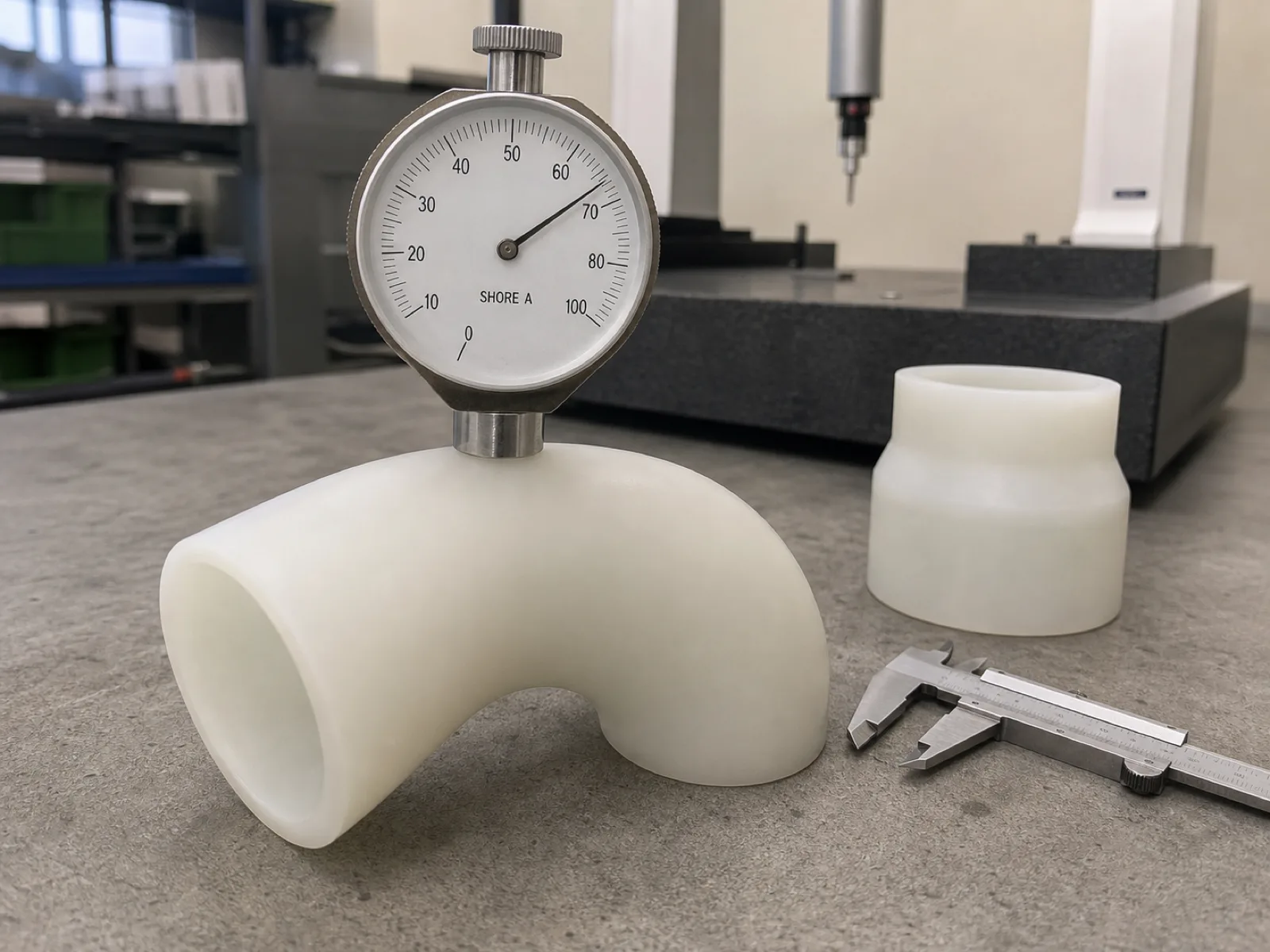
Silicone hose serves five main sectors: automotive cooling and turbo (coolant, charge-air, boost), industrial chemical and hot-air transfer, food and beverage (CIP-capable transfer), medical and pharmaceutical fluid paths, and marine or aerospace ducting. Each sector sets a different reinforcement, compound, and certification combination, so the RFQ must name the sector, not just "silicone hose."
The same hose category spans very different specifications by sector. Naming the application on the RFQ lets the manufacturer pick the right compound, liner, reinforcement, and certification bundle: - **Automotive cooling & turbo** — coolant hose (VMQ, polyester, SAE J20), turbo charge-air hot side (aramid, FVMQ liner), intercooler and boost hose (aramid). Highest-volume silicone hose sector. - **Industrial transfer** — hot-air ducting, chemical transfer (compound chosen by chemistry), and high-temperature process lines. Fiberglass reinforcement dominates the hot-air work. - **Food & beverage** — CIP-capable transfer hose, brewery and dairy lines, coffee equipment. Platinum-cured VMQ, FDA 177.2600 + LFGB, polyester or wire reinforcement for pressure. - **Medical & pharmaceutical** — peristaltic and fluid-path hose, USP Class VI and ISO 10993. Platinum-cured only, tight extractables control. - **Marine & aerospace** — exhaust-adjacent ducting, coolant, and air lines where fire and heat resistance matter. Fiberglass reinforcement, heat-stabilized compound. The sector also drives the cure system. Food and medical hose must be platinum-cured to avoid peroxide by-products and pass biocompatibility; automotive and industrial hose can be peroxide-cured for cost where taste and biocompatibility are irrelevant. The [platinum-cured vs peroxide-cured guide](/guide/platinum-cured-vs-peroxide-cured-silicone/) covers why the cure system, not just the compound, determines which sectors a hose can serve. ## Material grades and Shore A hardness for silicone hoseSilicone hose bodies run 60-70 Shore A in most applications. Below 55 Shore A the wall is too soft to resist clamp cut-through and pressure ballooning; above 75 Shore A the hose is stiff to route and cracks at tight bends. Automotive coolant and turbo hose typically specify 65-70 Shore A, with the reinforcement carrying the pressure load and the compound tuned for temperature and fluid resistance.
Durometer selection for hose is a balance between clamp resistance and routing flexibility. The reinforcement carries the pressure, so the compound hardness is chosen mainly for how the hose behaves under a clamp and around a bend: | Application | Shore A body | Reason | |---|---|---| | Low-pressure air / vacuum hose | 50-60 | Flexibility over pressure resistance | | General-purpose coolant hose | 60-65 | Balanced clamp resistance and routing | | Automotive turbo / charge-air | 65-70 | Clamp cut-through resistance under boost | | High-pressure industrial | 70-75 | Wall stiffness against ballooning | The compound grade layers on top of durometer: a standard VMQ for water-glycol, a heat-stabilized VMQ for continuous high-temperature service, an FVMQ liner for oil contact, and a platinum-cured food or medical grade where biocompatibility is required. When you write the drawing, specify both the durometer (with a ±5 tolerance) and the compound family, because "65 Shore A silicone" and "65 Shore A fluorosilicone-lined heat-stabilized silicone" are very different hoses at very different prices. Durometer is verified per lot with a Shore A gauge under ASTM D2240.[^astm-d2240] ## OEM/ODM workflow, MOQ, and lead timeWetop's OEM MOQ is 500 units per formed-hose SKU or 500 meters per straight-hose die. Mandrel tooling for a formed shape runs $400-1,200 and amortizes across the first two POs. First-article lead time is 20-30 days on formed hose including mandrel tooling and 15-20 days on straight extruded hose using an existing die. Send a drawing with ID, wall, reinforcement, and bend geometry to quote.
The OEM workflow runs drawing → tooling → first article → production. What differs from tubing is the tooling: formed hose needs a mandrel per shape, so each elbow or reducer is its own MOQ event, while straight hose shares one extrusion die across lengths. | Item | Straight extruded hose | Formed molded hose | |---|---|---| | MOQ per SKU | 500 meters | 500 units | | Tooling | Die + tip, $300-800 | Mandrel tool, $400-1,200 per shape | | First-article lead time | 15-20 days | 20-30 days | | Production lead time | 20-25 days | 25-35 days | | Pantone color matching | +$0.15-0.30 / m | +$0.20-0.40 / unit | | FVMQ liner | +30-50 % on base | +30-50 % on base | The drawing-to-tooling step is where a real manufacturer earns its keep. A complete hose drawing carries: inner diameter with tolerance, wall thickness, reinforcement type and ply count, bend geometry (angles, leg lengths, centerline radius for formed hose), Shore A durometer, compound family (VMQ / FVMQ / food grade), color, and the certification frame (SAE J20 class, FDA, USP). A drawing missing reinforcement or bend geometry cannot be quoted as a hose — it will be quoted as tubing or bounced back for clarification. For the full economics of MOQ, tooling amortization, and lead time across silicone OEM programs, the [MOQ and lead time guide](/guide/moq-and-lead-time-silicone-oem/) breaks down how tooling cost spreads across the first two production orders. ## Failure modes and how to prevent themThe five common silicone hose failure modes are ply delamination, over-clamping cut-through, chemical incompatibility (oil on VMQ), pressure ballooning from under-reinforcement, and heat-soak degradation above the continuous rating. Every one is a specification-time or process-time fix, not a field fix. The highest-leverage prevention is a peel-adhesion test on the first article of every run.
Hose failures trace back to construction and specification, not to the end user. The five modes and their fixes: - **Ply delamination** — separation between reinforcement and silicone. Cause: contaminated ply, under-cure, or an adhesion system not tuned to the compound. Fix: clean ply handling, controlled build sequence, full post-cure, and a peel-adhesion test on the first article. This is the failure that most distinguishes a real manufacturer from a broker. - **Over-clamping cut-through** — the clamp bites through a too-soft wall. Cause: durometer under 55 Shore A or a wall too thin for the clamp load. Fix: 65-70 Shore A body and a wall specified for the clamp type. - **Chemical incompatibility** — VMQ silicone swelling on oil or fuel contact. Cause: specifying standard silicone where FVMQ is required. Fix: fluorosilicone inner liner on any oil- or fuel-contact hose. - **Pressure ballooning / burst** — the hose expands and ruptures under pressure. Cause: too few reinforcement plies for the working pressure, or a rating quoted at ambient instead of operating temperature. Fix: size ply count to working pressure at temperature with a 3-4x burst factor. - **Heat-soak degradation** — the compound hardens or cracks after continuous service above its rating. Cause: running a polyester-reinforced hose above 180 °C continuous. Fix: aramid or fiberglass reinforcement and a heat-stabilized compound for the actual continuous temperature. Each fix costs a few percent at specification time and prevents a field failure that costs a full hose replacement plus warranty exposure. The peel-adhesion test in particular is cheap insurance: a manufacturer that runs it on every first article is telling you they take the ply interface seriously. ## How to vet a silicone hose manufacturer before you POVet a silicone hose manufacturer against six checkpoints: in-house extrusion and mandrel-molding cells, ISO 9001 scope naming silicone hose, reinforcement ply data with peel-adhesion test results, SAE J20 or application-specific test capability, fluorosilicone liner capability, and an open attitude to a plant audit. A supplier that hesitates on any of these is brokering hose, not building it.
The vetting checklist for a first-time hose supplier: 1. **Confirm both production cells exist in-house.** Ask to see the extrusion line and the mandrel-molding cell. A trader will have one or neither and will subcontract the rest — which is where delamination hides. 2. **Read the ISO 9001 certificate scope.** It must name silicone hose extrusion and molding, not a generic "silicone products." A generic scope is a red flag. 3. **Ask for reinforcement ply data and peel-adhesion results.** A real manufacturer runs a peel-adhesion test on first articles and can show you the numbers. If they cannot explain their ply system, they are buying formed hose from someone who can. 4. **Confirm application-specific test capability.** For automotive, that means SAE J20 burst and adhesion testing. For food, FDA 177.2600 and LFGB reports. For medical, USP Class VI and ISO 10993. 5. **Ask whether they run fluorosilicone liners.** A manufacturer that cannot offer an FVMQ liner cannot serve turbo or oil-contact applications — a real limitation to know before you design the hose in. 6. **Ask if they welcome a plant audit.** A supplier that resists a factory visit is usually hiding a rented facility or a subcontracted forming step. An open audit invitation is the strongest signal of a genuine manufacturer. Run this checklist before the first PO, not after the first failure. The cost of a plant audit and a document review is trivial against the cost of a delamination recall on a shipped program. ## FAQ For frequently asked technical questions on reinforcement selection, temperature and pressure ratings, fluorosilicone, SAE J20, MOQ, and delamination prevention, see the FAQ list in the frontmatter block — the same questions render on the deployed page and feed the FAQ schema. ## Sourcing custom silicone hose — next step Wetop manufactures reinforced silicone hose — straight extruded lengths and compression-molded elbows, reducers, and humps — from a 7,500 m² factory in Dongguan, 90 minutes from Yantian Port. Both the extrusion cell and the mandrel-molding cell run under one ISO 9001 quality system, with polyester, aramid, fiberglass, and wire reinforcement, fluorosilicone liner capability, and per-lot durometer, burst, and ply-adhesion data on every shipment. For an RFQ with a drawing carrying ID, wall, reinforcement, bend geometry, and target volume, [talk to the engineering desk](/contact/). [^sae-j20]: SAE J20 — Coolant System Hoses. SAE International. See references. [^fda-177-2600]: 21 CFR 177.2600 — Rubber articles intended for repeated use. US FDA. See references. [^astm-d2240]: ASTM D2240 durometer hardness standard. ASTM International. See references. [^iso-9001]: ISO 9001:2015 Quality Management Systems. See references. [^iso-10993-5]: ISO 10993-5:2009 in-vitro cytotoxicity. See references. [^usp-class-vi]: USP <88> Biological Reactivity Tests — Class VI. See references. [^eu-1935-2004]: Regulation (EC) No 1935/2004 on food-contact materials. EUR-Lex. See references. [^echa-reach]: REACH Regulation (EC) No 1907/2006 — SVHC. ECHA / EUR-Lex. See references.