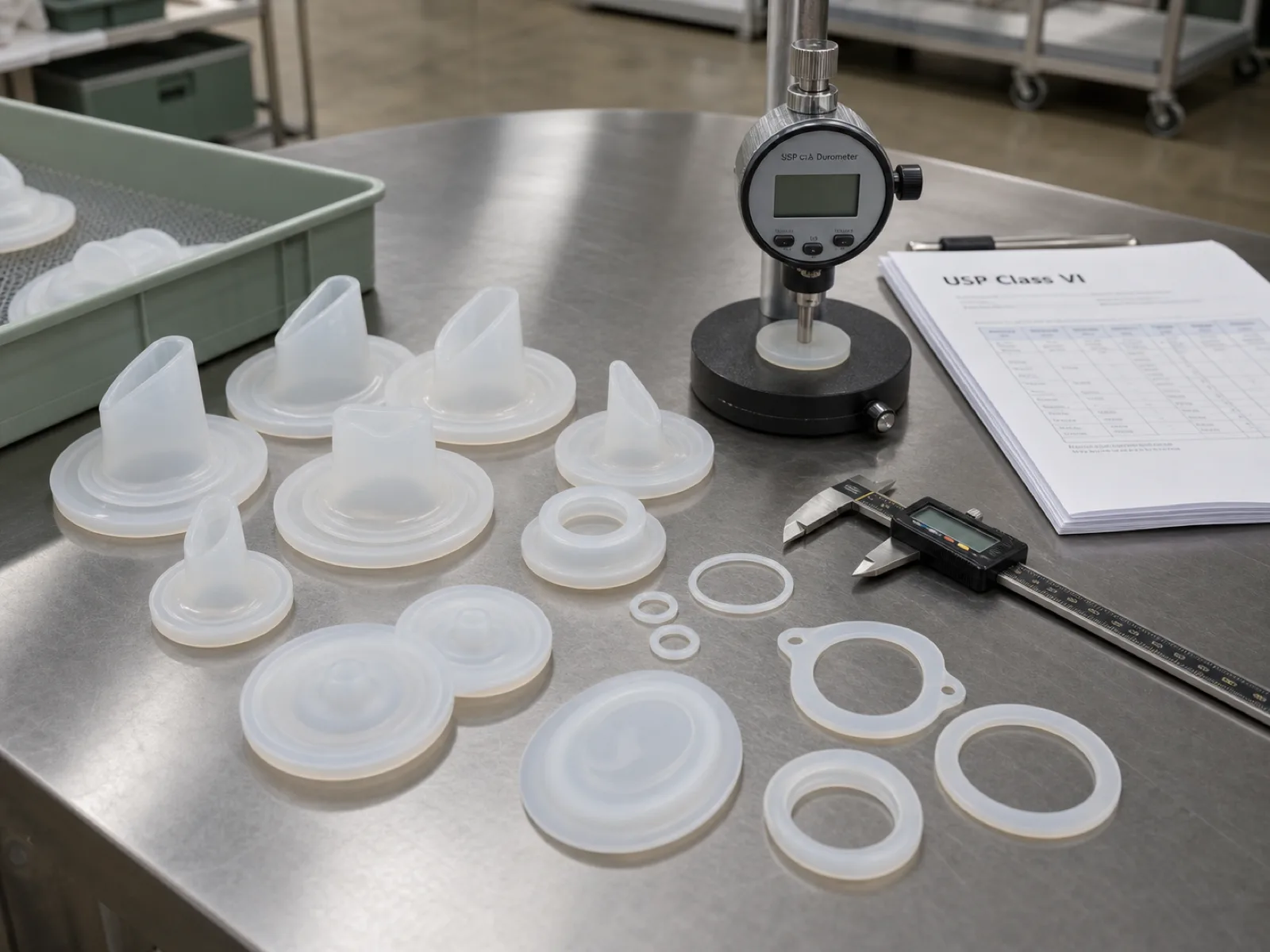
Silicone medical device components are platinum-cured polydimethylsiloxane parts — seals, diaphragms, valves, duckbills, ear tips, catheter jackets, and tubing — cleared to USP Class VI biological reactivity and supported by ISO 10993 biocompatibility data for use inside finished medical devices. A component supplier manufactures the silicone parts and owns the material compliance and per-lot documentation; it does not hold the device's FDA 510(k) or PMA, which belongs to the device OEM. The defensible package for a serious program is platinum-cured compound, USP <87>/<88> and ISO 10993-5/-10 test reports against a named master-batch lot, ISO 14644-1 cleanroom molding, and a Certificate of Analysis that ties every lot back to a documented compound.
Buyers reach "silicone medical device components" from two directions. Device OEMs and contract manufacturers arrive with a drawing, a durometer target, a contact category, and a sterilization pathway — they need a molder that can execute against real quality discipline and hand over a documentation packet that survives an FDA or notified-body audit. Sourcing and procurement teams arrive earlier and need to understand what "medical grade" actually means, which biocompatibility framework applies to their part, and what a compliant supplier must produce. This guide covers both, written from inside a Dongguan molding floor benchmarked against USP <88>[^usp-88], ISO 10993-1[^iso-10993-1], and 21 CFR 177.2600[^fda-177-2600] — not against a capabilities brochure. It draws the line the market blurs: a component supplier makes compliant, biocompatibility-tested silicone parts; it does not make FDA-cleared devices.
Medical-grade silicone is platinum-cured PDMS that clears USP <87> cytotoxicity and USP <88> Class VI biological reactivity, carries ISO 10993-5/-10 biocompatibility data on the compound, and meets FDA 21 CFR 177.2600 as its material floor. The base siloxane is identical to food grade; cure chemistry, compound purity, and biocompatibility depth are what separate them.
There is no single legal definition of "medical grade" — it is an industry shorthand for a compound whose biocompatibility has been characterized to a level appropriate for device use. In practice a medical-grade silicone component satisfies four stacked criteria: - **Platinum (addition) cure.** No peroxide by-products, odor-free, clean extractables profile. This is the entry condition — peroxide-cured silicone is disqualified from implant and long-contact use no matter what else is true. - **USP <87>/<88> Class VI.** The compound passes cytotoxicity in vitro and the in vivo biological reactivity tests (systemic injection, intracutaneous, implantation) that define Class VI[^usp-88]. - **ISO 10993-5 and -10 data.** Cytotoxicity and sensitization/irritation results on the specific compound, feeding the device OEM's biological evaluation[^iso-10993-5]. - **21 CFR 177.2600 material compliance.** The US food-contact rubber baseline — the floor beneath medical compliance, never a substitute for it[^fda-177-2600]. The distinction from food grade is worth stating plainly, because buyers conflate them. A food-grade drying-mat compound and a medical-grade valve compound can share the same polydimethylsiloxane backbone. What differs is that the medical compound is platinum-cured to a tighter purity spec, is tested to USP Class VI and ISO 10993, and ships with lot-level traceability. For the full separation of the two tiers, see the [food-grade vs medical-grade silicone comparison](/guide/food-grade-vs-medical-grade-silicone/). The single most common error in this market is a supplier marketing "medical grade" against a peroxide-cured compound with no USP report on file — the grade is a claim until the test report against a named lot proves it. ## What is the regulatory landscape — 21 CFR 177.2600 vs 21 CFR 820 vs Part 4?Three FDA regimes apply at different layers. 21 CFR 177.2600 is the material-compliance rule the component supplier meets. 21 CFR Part 820 is the device Quality System Regulation the OEM operates under. 21 CFR Part 4 governs drug-device combination products where a silicone part contacts or delivers a drug. The component supplier owns the first; the OEM owns the second and third.
The regulatory confusion in this segment comes from collapsing three distinct things into "FDA approval." They are not the same layer, and knowing which is whose is the difference between a defensible supply relationship and a compliance gap: | Regime | What it governs | Whose obligation | |---|---|---| | 21 CFR 177.2600[^fda-177-2600] | Rubber articles for repeated food/fluid contact — material composition and extraction limits | Component / material supplier | | 21 CFR Part 820 QSR[^fda-820] | Device design, production, and process controls (now converging with ISO 13485) | Device OEM (legal manufacturer) | | 21 CFR Part 4[^fda-part-4] | Drug-device combination products — the drug interface | Device / combination-product OEM | | 510(k) / PMA | Market authorization of the finished device | Device OEM | The load-bearing point: **a silicone component supplier does not hold, and cannot hold, a 510(k) or PMA.** Those authorize a finished device and belong to its legal manufacturer. When a component vendor advertises "FDA approved silicone," it is either misusing the term or hoping you will not check. What the component supplier legitimately owns is 21 CFR 177.2600 material compliance plus the biocompatibility and traceability documentation that feeds the OEM's submission. The OEM runs its own Part 820 quality system and, for anything that touches a drug, its Part 4 combination-product controls. For a component supplier, the practical obligation is to operate a quality system rigorous enough that its per-lot records — CoC, CoA, master-batch traceability, USP and ISO 10993 report references — slot directly into the OEM's Device History Record and technical documentation without gaps. ISO 9001 is the baseline; ISO 13485:2016 scope covering medical components is the stronger signal. The supplier's job is to make the OEM's audit boring. ## How does ISO 10993-1 biological evaluation work by contact type and duration?ISO 10993-1 scales biocompatibility testing to how a part contacts the body and for how long. Contact type is classified as surface, external-communicating, or implant; duration as limited (≤24 h), prolonged (24 h–30 d), or permanent (>30 d). The intersection of the two sets which endpoints — cytotoxicity, sensitization, irritation, systemic toxicity, implantation, hemocompatibility — the device must satisfy.
ISO 10993-1 is the master standard that organizes the whole series into a risk-based matrix[^iso-10993-1]. Competitor capability pages name-drop "ISO 10993" as a label; almost none explain that it is not one test but a framework that assigns tests by contact category and duration. The two axes: **Contact type** - **Surface-contacting** — skin, mucosal membrane, or breached surface (a mask seal, an ear tip, a wound-adjacent gasket). - **External-communicating** — blood path indirect, tissue/bone/dentin, or circulating blood (a fluid-path valve, a catheter jacket, a blood-set diaphragm). - **Implant** — tissue/bone or blood implant (a long-term implanted seal or component). **Contact duration** - **Limited** — ≤ 24 hours cumulative. - **Prolonged** — > 24 hours to 30 days. - **Permanent** — > 30 days. The intersection scales the endpoints. A limited-contact surface part may need only cytotoxicity (ISO 10993-5), sensitization, and irritation (ISO 10993-10). A permanent implant in blood contact escalates to systemic toxicity (ISO 10993-11), implantation (ISO 10993-6), hemocompatibility (ISO 10993-4), and chemical characterization (ISO 10993-18). The illustrative mapping: | Contact category | Limited (≤24 h) | Prolonged (24 h–30 d) | Permanent (>30 d) | |---|---|---|---| | Surface — skin | Cytotoxicity, sensitization, irritation | + as risk indicates | + as risk indicates | | Surface — mucosal | Cytotoxicity, sensitization, irritation | + subacute toxicity | + genotoxicity | | External — blood path | + hemocompatibility | + implantation, systemic tox | + genotoxicity, chronic tox | | Implant — tissue/blood | + implantation | + systemic, genotoxicity | + carcinogenicity as indicated | Here the division of labor matters. **The component supplier supplies compound-level biocompatibility data** — typically ISO 10993-5 and -10 against the specific compound lot. **The device OEM owns the ISO 10993-1 evaluation of the finished device**, because biocompatibility is a property of the device in use, not of the raw material alone. A supplier that offers to "certify your device to ISO 10993" is overreaching; a supplier that hands you clean compound-level reports and lets your regulatory team scale the device evaluation is being honest about the model.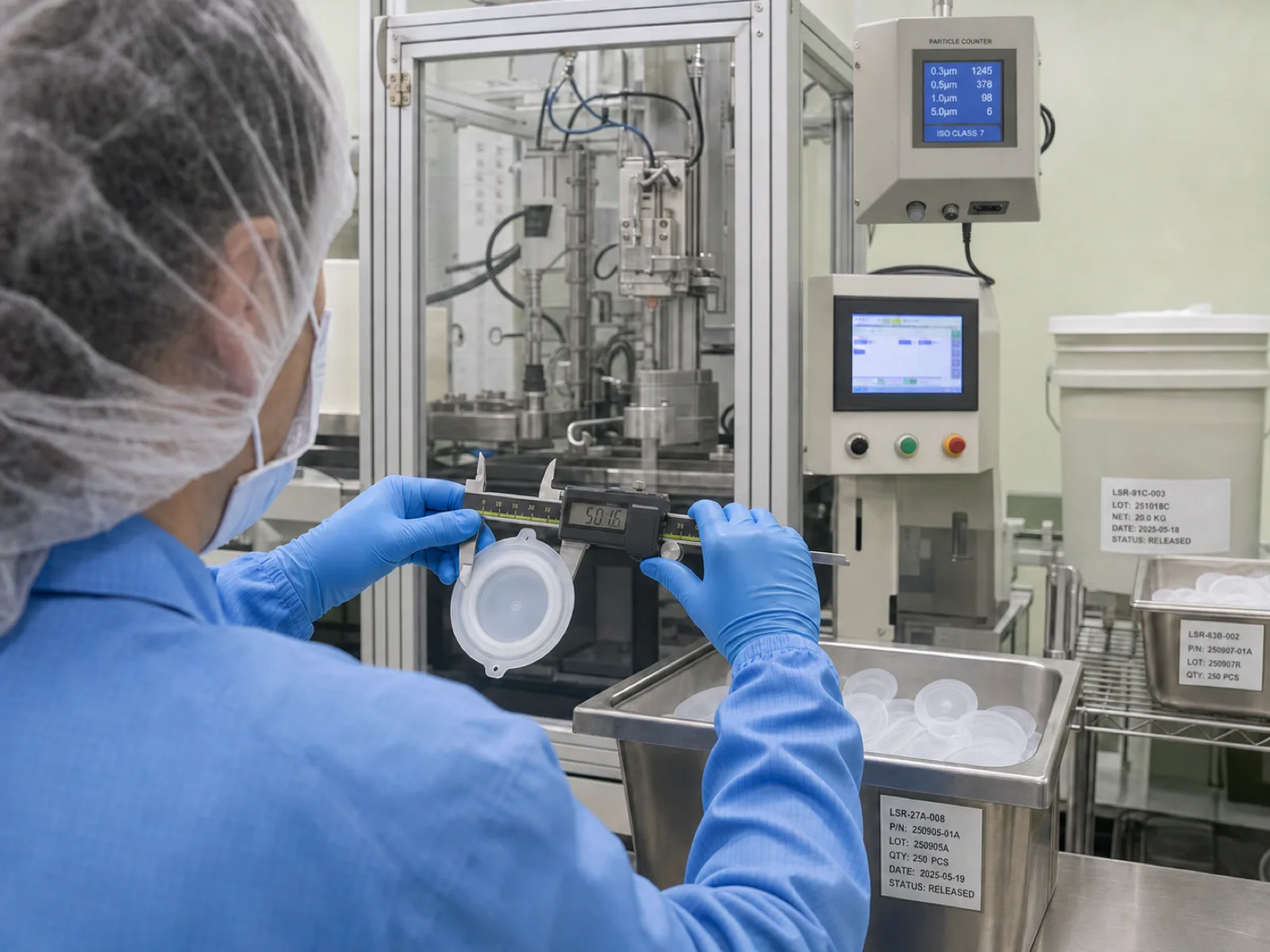
Platinum-cured (addition) silicone leaves no cure by-products, is odor-free, and passes USP <87>/<88> and ISO 10993-5 cleanly on standard formulations. Peroxide-cured silicone leaves residual acidic by-products that must be post-cured off and still carries a leachables profile disqualifying it from implant, drug-delivery, and blood-contact use. For any prolonged or permanent tissue contact, platinum cure is mandatory.
The two cure systems produce chemically different parts from a similar-looking polymer: - **Platinum (addition) cure.** Vinyl-terminated PDMS plus a hydride cross-linker cured by a platinum catalyst. The reaction produces no by-product — nothing to leach, no odor, no post-cure obligation for by-product removal. This is the only defensible chemistry for medical components in prolonged or permanent contact. - **Peroxide (free-radical) cure.** Uses 2,4-dichlorobenzoyl peroxide or similar; the reaction leaves residual acidic by-products that require a 4-8 hour post-cure at 200°C to drive off. Even fully post-cured, the extractables/leachables profile keeps peroxide-cure out of implant, drug-delivery, and blood-contact service. The cost delta is roughly 15-25% in favor of peroxide for the raw compound, which is why cost-sensitive, short-cycle, buffered-fluid components sometimes still use it. But for the components that define this category — implantable seals, catheter jackets, drug-delivery diaphragms, respiratory parts where first-heat odor drives clinical complaints — platinum is non-negotiable. For the full cure-chemistry decision matrix, including durometer and tear-strength trade-offs, see the [platinum-cured vs peroxide-cured silicone guide](/guide/platinum-cured-vs-peroxide-cured-silicone/). The audit question for a buyer is simple: ask which catalyst system the compound uses, and require the answer in writing on the CoA. A "medical grade" claim paired with a peroxide compound and no post-cure log is a contradiction the supplier is betting you will not notice. ## What manufacturing processes make silicone medical device components?Five processes cover the field. LSR injection molding automates high-volume seals, valves, and diaphragms at ±0.05 mm. Micro-molding runs sub-gram parts under 1 mm feature size. Two-shot / overmolding bonds silicone to a rigid substrate in one tool. Compression molding suits low-to-mid-volume gaskets. Extrusion produces tubing and continuous profiles.
Process selection is driven by geometry, volume, and tolerance — not by preference. The mapping: | Process | Best for | Tolerance | Volume band | Tooling cost band | |---|---|---|---|---| | LSR injection molding | Seals, valves, duckbills, diaphragms | ± 0.05 mm | High (50k–1M+) | $3,000–8,000 | | Micro-molding (LSR) | Micro-valves, sub-gram drug-delivery parts | ± 0.02–0.05 mm | Med–high | $5,000–12,000 | | Two-shot / overmolding | Valve assemblies, syringe parts, grip overmolds | ± 0.05–0.10 mm | Med–high | $8,000–20,000 | | Compression molding | Gaskets, thick-section seals, low-volume | ± 0.10–0.20 mm | Low–med | $2,000–5,000 | | Extrusion | Tubing, catheter jackets, profiles | ISO 3302-1 class E1 | Med–high (per meter) | $600–1,800 (die) | **LSR injection molding** is the workhorse of medical silicone components. Two-part liquid silicone is metered, mixed, and injected into a heated mold where it cures in 15-90 seconds; the process is fully automated, holds ±0.05 mm, and runs clean platinum chemistry with minimal flash. It is the default for seals, one-way (duckbill/umbrella) valves, sealing diaphragms, and membrane components at volume. For the full LSR mechanism and how it differs from high-consistency rubber, see the [liquid silicone rubber explainer](/guide/what-is-liquid-silicone-rubber-lsr-explained/). **Micro-molding** is LSR pushed to sub-gram parts with sub-millimeter features — micro-valves, small drug-delivery components, and precision membranes. It requires specialized presses and cavity metrology. **Two-shot / overmolding** injects LSR directly onto a rigid thermoplastic (PC, PEI, PBT, PEEK) or metal insert in a single tool, producing a bonded assembly — a valve seat with an integrated seal, a syringe plunger, a rigid housing with a soft sealing lip. It removes a downstream assembly step and a traceability break. **Compression molding** suits gaskets, thick-section seals, and lower volumes where the cheaper tooling wins; it holds looser tolerance and runs slower cycles. **Extrusion** produces continuous tubing, catheter jackets, and profiles; for the full extrusion tolerance and reinforcement discussion, see the [silicone medical tubing OEM guide](/guide/silicone-medical-tubing-oem-guide/). Durometer across all processes spans Shore A 20-80, with 40-70A the typical medical band. ## What cleanroom class and sterilization method do the components need?ISO 14644-1 Class 7 is standard for molding medical silicone components; Class 8 is acceptable for parts sterilized downstream by the OEM. Platinum-cured silicone tolerates autoclave (121°C steam, effectively unlimited cycles), ethylene oxide (aerated below ISO 10993-7 limits), and gamma up to 25 kGy with negligible change. The sterilization pathway must be chosen before tooling because it drives compound selection.
The two controls that must be locked before a mold is cut: **Cleanroom class.** ISO 14644-1 Class 7 (≤ 352,000 particles ≥ 0.5 μm per m³) is the working standard for molding medical components; Class 8 (≤ 3.52 M) is acceptable where the OEM cleans and terminally sterilizes downstream. Verify current per-shift particle-count logs, gowning and airlock discipline, and HEPA replacement records — a clean-looking room without logs is not a classified cleanroom. **Sterilization compatibility.** Platinum-cured silicone survives every mainstream method, but the property changes at high gamma dose must be pre-qualified: | Method | Conditions | Compatibility | Property change | |---|---|---|---| | Autoclave (steam) | 121 °C · saturated steam | Excellent — unlimited cycles | < 3% tensile over 100 cycles | | Ethylene oxide (EtO) | Standard OEM cycle | Excellent | Negligible; aerate below ISO 10993-7 limits | | Gamma | ≤ 25 kGy | Excellent | < 5% tensile drop | | Gamma | 25–50 kGy | Acceptable — pre-qualify | 5–15% tensile drop, slight yellowing | | E-beam | 25–40 kGy | Like gamma | Similar at equivalent dose | The sequencing rule is the point buyers miss: **decide the sterilization pathway first.** It drives compound selection, any low-extractables or radiopaque compounding, and the pre-qualification you must run for gamma above 25 kGy. Cutting tooling before the sterilization decision risks re-qualifying the whole part when the OEM's sterilization method lands. ## What are common silicone medical component applications and their specs?The core applications are one-way valves (duckbill, umbrella), sealing diaphragms and membranes, gaskets and seals, respiratory-mask cushions, ear tips, catheter jackets, and tubing. Each drives durometer, wall or section thickness, and contact category — not the base material. Shore A 20-80 covers the range, with 40-70A the typical medical band.
The application-to-spec mapping across US and EU device programs: - **One-way valves (duckbill / umbrella / cross-slit).** Shore A 40-60, LSR-molded, thin sealing lip. Contact category is usually external-communicating fluid path — USP Class VI plus ISO 10993-5 baseline. Cracking pressure and reseal are the CTQ characteristics. - **Sealing diaphragms and membranes.** Shore A 30-50, thin section (0.2-0.8 mm), LSR or micro-molded. Used in pumps, pressure sensors, and drug-delivery interfaces; drug contact escalates to a low-extractables compound and Part 4 considerations. - **Gaskets and static seals.** Shore A 50-70, compression- or LSR-molded, thicker section. Fluid-path and housing seals; surface or external-communicating contact. - **Respiratory-mask cushions and seals.** Shore A 20-40, soft, skin-contacting surface. Odor-free platinum cure mandatory — first-heat odor from under-post-cured peroxide product drives clinical complaints. - **Ear tips and audiology components.** Shore A 30-50, skin/mucosal surface contact, limited duration. USP Class VI plus sensitization/irritation. - **Catheter jackets and fluid-path tubing.** Shore A 40-70, extruded, often external-communicating or implant contact — escalates into the fuller ISO 10993 series. The spec drives the compound, the process, the tolerance, and the documentation depth. A limited-contact ear tip and a prolonged-contact catheter jacket may be the same durometer and the same base polymer, but the second carries a materially heavier biocompatibility dossier. The buyer's job in the RFQ is to state contact type and duration so the supplier scopes the right compound and the right test package the first time. ## USP Class VI vs ISO 10993 — when is each required?USP Class VI is a compound-screening baseline applied at the material level; ISO 10993 is a device-level, risk-based evaluation scaled by contact type and duration. Non-implant, limited-duration components often ship on USP Class VI plus ISO 10993-5/-10. Implantable or prolonged/permanent-contact components require the fuller ISO 10993-6/-11/-4 series driven by ISO 10993-1.
The two frameworks are complementary, not interchangeable, and the market treats them as if picking one is enough: | Dimension | USP <87>/<88> Class VI | ISO 10993 series | |---|---|---| | Level applied | Material / compound | Finished device | | Basis | Fixed test battery (cytotox, injection, implantation) | Risk-based, scaled by contact type + duration | | Who supplies it | Component / material supplier | Device OEM (compound data from supplier) | | Typical use | Component screening baseline | Device biological evaluation for submission | | Sufficient alone? | For low-risk, short-contact components, often yes | For implant / long-contact, required | The practical decision rule: for a **non-implant component with limited-duration surface or external contact**, USP Class VI on the compound plus ISO 10993-5 cytotoxicity and ISO 10993-10 sensitization is frequently the defensible package. For an **implantable or prolonged/permanent-contact component**, USP Class VI is not enough — ISO 10993-1 drives the device OEM into implantation (ISO 10993-6), systemic toxicity (ISO 10993-11), hemocompatibility (ISO 10993-4) where blood is involved, and chemical characterization (ISO 10993-18). For the endpoint-by-endpoint breakdown of what Class VI actually tests, see the [USP Class VI biocompatibility guide](/guide/usp-class-vi-biocompatibility-6-tests-explained/). The component supplier's honest position: it supplies USP Class VI and ISO 10993-5/-10 data at the compound level, and it lets the OEM's regulatory team scale the device-level ISO 10993-1 evaluation. Any supplier promising to "certify your device to ISO 10993" is selling something it cannot deliver. ## What are the OEM logistics — MOQ, tooling, lead time, and documentation?Wetop molds medical silicone components at MOQ 500 pcs/SKU with a 7-25 day first sample against a defined master-batch lot, versus the 5,000-25,000 pc minimums common at tier-1 medical molders. LSR tooling runs $3,000-8,000, compression $2,000-5,000. Every lot ships with a CoC, CoA, master-batch traceability, and USP Class VI / ISO 10993-5 report references.
The buyer logistics competitor capability pages omit entirely: - **MOQ.** 500 pcs per SKU for standard molded components — an order of magnitude below enterprise medical molders quoting 5,000-25,000 pc floors. This is the difference between prototyping a device program and being priced out of it. - **Tooling.** LSR injection molds $3,000-8,000 single-to-low-cavitation; compression tooling $2,000-5,000; two-shot and micro-molding higher. A 50% tooling deposit triggers the cut. - **Sample lead time.** 7-25 days on new tooling depending on cavitation and geometry, delivered against a named master-batch lot with the USP Class VI and ISO 10993-5 report references attached — not a stock-photo claim. - **Production lead time.** 25-35 days for standard volumes; longer for two-shot assemblies or gamma pre-qualification runs. - **Documentation packet per lot.** Certificate of Conformance (PO-to-lot), Certificate of Analysis (Shore A per ASTM D2240[^astm-d2240], tensile per ASTM D412[^astm-d412]), master-batch traceability to the base-compound supplier (Wacker, Momentive, Dow, Shin-Etsu), post-cure log, cleanroom particle-count log, and USP <87>/<88> and ISO 10993-5/-10 report references. For EU-bound programs, remember the framework split: EU MDR[^eu-mdr] governs the finished device and flows material-characterization and traceability requirements down to you as the component supplier; EU Regulation 10/2011 applies only where the part sits at a food or oral interface. The supplier's obligation is to hand over material-level data both frameworks require and let the OEM assemble the device dossier. For the broader supplier-audit checklist that adapts to any silicone category, see the [silicone factory sourcing checklist](/guide/sourcing-silicone-factory-checklist/). The RFQ inputs that let an engineering desk quote accurately: part drawing with tolerance, durometer target, cure system (platinum for medical), contact type and duration per ISO 10993-1, downstream sterilization method, annual volume for MOQ-tier pricing, and the required documentation list. Supply those seven and the quote comes back with compound options and a sample date, not a stall. ## Frequently asked questions The FAQ block above the References list is rendered from the guide frontmatter and mirrors the FAQPage schema verbatim — Gemini and other AI answer engines use it for claim verification. ## Sourcing silicone medical device components — what happens next Wetop molds platinum-cured silicone medical device components at MOQ 500 pcs/SKU inside an ISO 14644-1 cleanroom, with per-lot CoC / CoA / traceability packets and USP Class VI plus ISO 10993-5/-10 report references delivered against every shipment. Founder-led engineering desk; no trading intermediary. We make the compliant, biocompatibility-tested silicone parts — seals, diaphragms, valves, duckbills, ear tips, catheter jackets, and tubing — that go into your device; your team owns the device clearance, and our documentation is built to support it. To move from RFQ to first-article sample in 7-25 days, [talk to the engineering desk](/contact/) with your part drawing, tolerance, durometer target, contact type and duration, cure system, and downstream sterilization method. Sample turnaround is quoted against a defined master-batch lot with the USP Class VI and ISO 10993-5 test-report packet attached — not a stock claim.