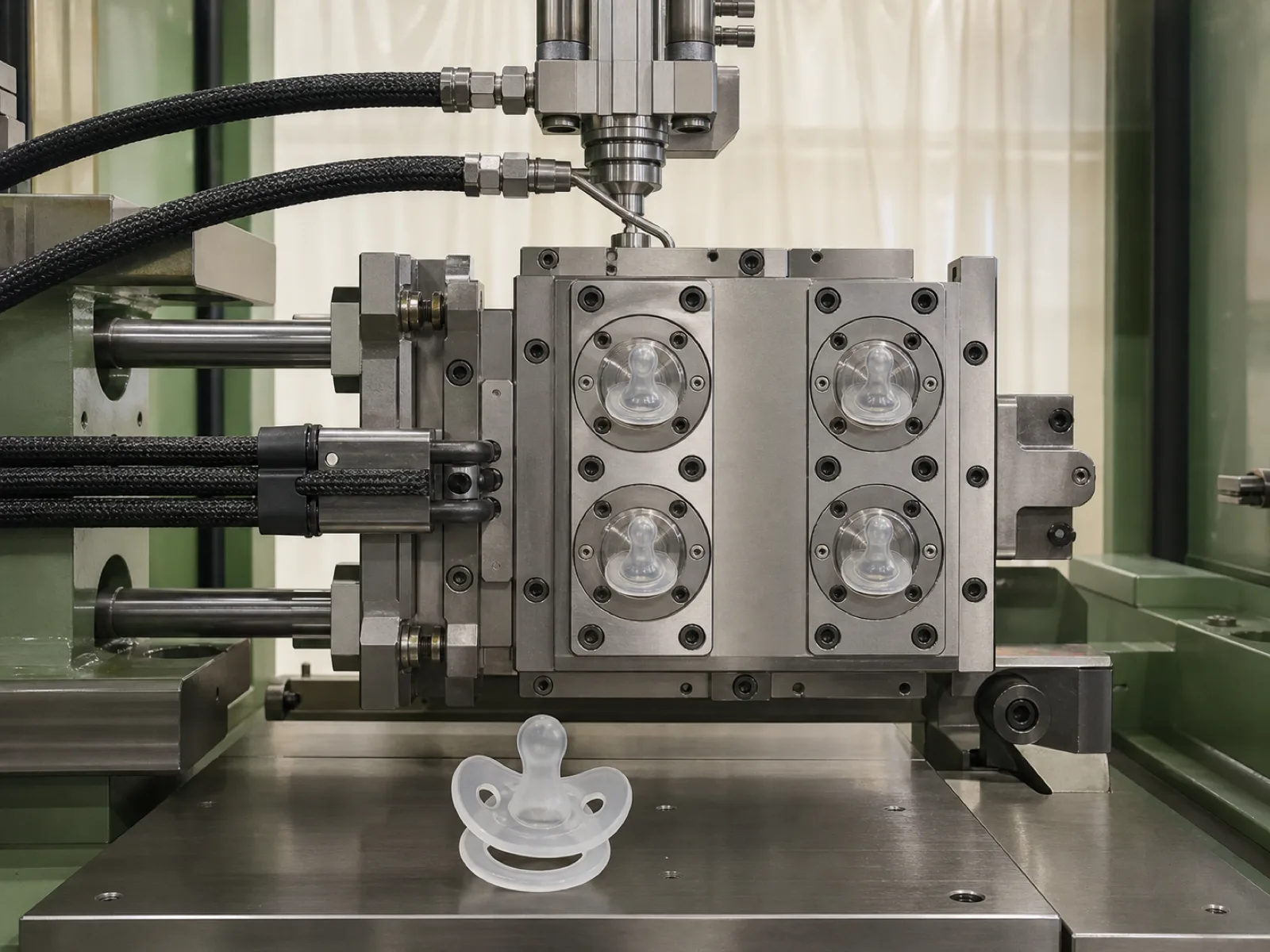
A silicone pacifier manufacturer worth sourcing from runs one-shot LSR injection inside a Class 100,000 cleanroom, documents EN 1400 nitrosamine and pull-test results per batch, and hands over a Children's Product Certificate with lead, phthalate, and PFAS reports before the first container ships. Realistic MOQ sits at 500-1000 per SKU per color with $2,500-$5,000 in tooling on 2-4 cavity S136 molds. Anything cheaper is compression-molded with a seam, and a seam is a choking-hazard recall waiting to happen.
The infant category is unforgiving. A pacifier that fails EN 1400 nitrosamine testing costs the buyer a full-container recall plus a listing suspension at buybuy BABY or Target. Cheap suppliers survive because inspection is intermittent — until it isn't. This guide is written for Tier 2 US baby-brand sourcing managers who need to vet a **silicone pacifier manufacturer** on engineering evidence, not on a marketing PDF. Everything below is the packet an audit-ready factory can produce in a week. ## What separates a real silicone pacifier manufacturer from a trading company?A real silicone pacifier manufacturer owns the LSR injection cell, the cold-runner tooling, the post-cure oven, and the Class 100,000 cleanroom on one floor. They can walk you through cavity numbers, hand you a per-batch EN 1400 test report, and reference the exact CFR section that governs your compliance packet. A trading company forwards your RFQ to a third factory and marks up 15%.
The tell is the vocabulary. Ask any candidate three questions. First: "What's your nipple mold cavitation and cold-runner delta-T?" A factory answers in seconds — "4-cavity, 12 °C delta-T on the cold runner, 165 °C mold temp, 22 s cycle." A trader stalls. Second: "Show me the last EN 1400 batch report and match the lot code to a shipping invoice." A factory pulls both from an ERP. A trader emails you next Tuesday. Third: "What's your post-cure schedule and how do you verify volatile content?" A factory says "200 °C × 4 h, GC-MS on a coupon per lot." A trader says "we follow international standards."
Infant-contact pacifier compound must be platinum-cured (addition-cured) liquid silicone rubber, food-grade per FDA 21 CFR 177.2600[^fda-177-2600] and LFGB §30/§31 (the [FDA vs LFGB comparison](/guide/fda-vs-lfgb-silicone/) explains what each certification actually tests), with nipple durometer Shore A 30-50 and shield durometer Shore A 40-60. Peroxide-cured HCR is not acceptable — it leaves residual 2,4-dichlorobenzoic acid byproducts that fail EN 1400 volatile testing, a difference the [platinum-cured vs peroxide-cured comparison](/guide/platinum-cured-vs-peroxide-cured-silicone/) breaks down in chemistry-level detail.
The engineering baseline for a compliant **silicone pacifier manufacturer** compound looks like this: | Property | Nipple compound | Shield compound | Test method | |---|---|---|---| | Cure system | Platinum-cured LSR | Platinum-cured LSR | — | | Shore A hardness | 30-50 (newborn 30-40, 6mo+ 40-50) | 40-60 | ASTM D2240 | | Tensile strength | ≥ 8.5 MPa | ≥ 9.0 MPa | ASTM D412 | | Elongation at break | ≥ 550 % | ≥ 450 % | ASTM D412 | | Tear resistance (Die B) | ≥ 25 kN/m | ≥ 28 kN/m | ASTM D624 | | Specific gravity | 1.10-1.14 | 1.12-1.16 | ASTM D792 | | Volatile content (post-cure) | ≤ 0.5 % | ≤ 0.5 % | 200 °C × 4 h loss | | Regulatory | FDA 21 CFR 177.2600 / LFGB §30 / EN 1400 | FDA 21 CFR 177.2600 / LFGB §31 | — | Tensile and tear numbers are not cosmetic. EN 1400[^en-1400] pull-off resistance requires the nipple-to-shield bond to survive **90 N tensile for 10 seconds** without separation. Compound with tensile below 8 MPa can pass on a good day and fail on a hot summer day when the mold ran 6 °C over target — that variance is what recalls are made of. Insist on the compound supplier's certificate of analysis (Momentive, Wacker, Shin-Etsu, or Elkem are the four suppliers a serious factory uses) with every lot.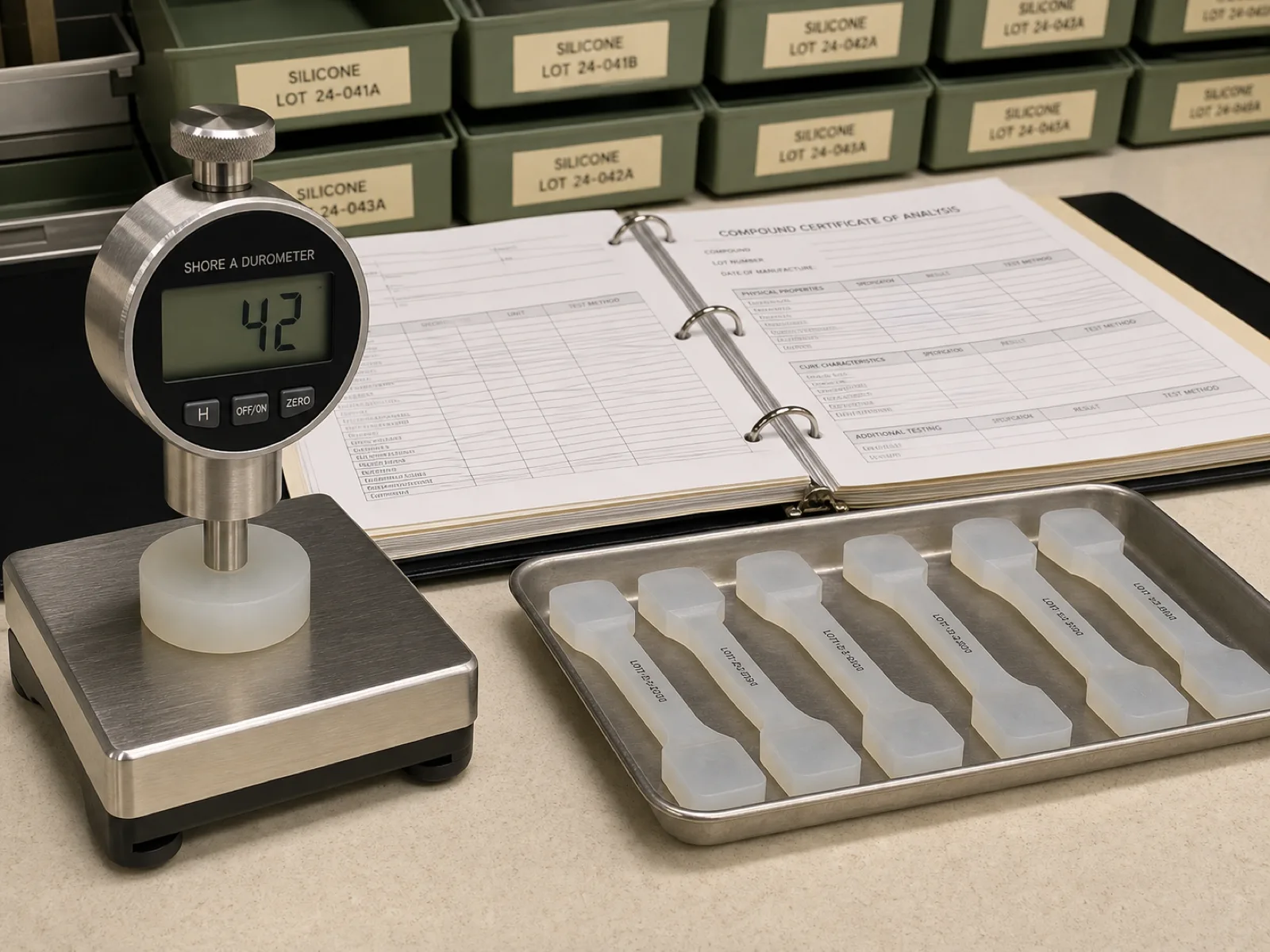
EN 1400 nitrosamine testing extracts the pacifier in artificial saliva at 40 °C for 24 hours, then analyzes the eluate by GC-MS for N-nitrosamine (limit 0.01 mg/kg) and nitrosatable substances (limit 0.1 mg/kg)[^pubmed-nitrosamine]. Pull-force testing clamps the shield and applies 90 N tensile to the nipple for 10 seconds — the assembly must not separate or tear.
Nitrosamine is the silent recall. It comes from residual amines in cheap peroxide-cured silicone reacting with atmospheric nitrogen oxides during storage. Platinum-cured LSR with a proper 4-hour post-cure at 200 °C drives the volatiles off before the pacifier is packed, which is why a **silicone pacifier manufacturer** running the correct process barely thinks about nitrosamine — it's a non-event on their line. A supplier who skips post-cure to shave 40 minutes off cycle time will fail this test at random, and the recall lands on your brand, not theirs. The pull-force test is more physical. In a one-piece molded LSR pacifier there is no bond — the nipple and shield cure as a single continuous elastomer, so pull force fails only if the geometry is wrong or the compound is under-spec. In two-piece pacifiers (nipple molded separately, shield overmolded or mechanically clipped) the bond is a distinct failure mode. Ask the manufacturer to demonstrate the pull test on a random three-unit sample from the current production lot, not on the golden sample they mailed you six months ago.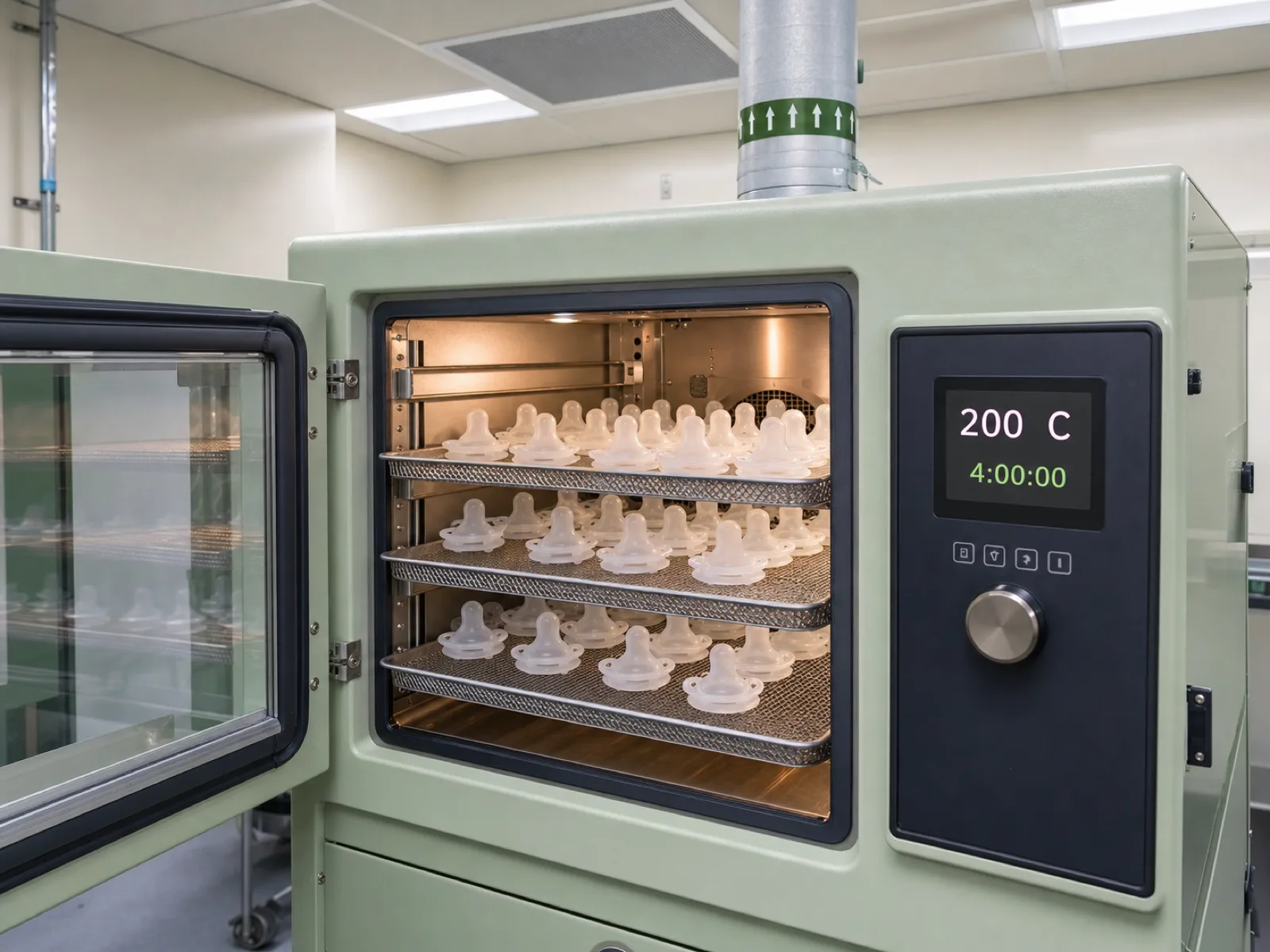
A US retail-audit-ready packet from a silicone pacifier manufacturer contains: a Children's Product Certificate[^cpsc-cpc], CPSIA 16 CFR 1307 phthalate lab report[^cpsia-1307], CPSIA lead report (16 CFR 1500), 16 CFR 1130 tracking-label sample[^cpsia-1130], EN 1400 batch report, PFAS-free declaration for California AB 1200, ISO 14644 cleanroom certification[^iso-14644], and a Sedex SMETA 4-Pillar audit report dated within 12 months.
Every US retailer's baby-buyer runs the same checklist. Target's vendor onboarding is the strictest — they will ask for the CPC, the underlying third-party lab reports (accredited by the CPSC per 16 CFR 1112), the ASTM F963-23 general-toy-safety report[^astm-f963], and a tracking-label sample showing the manufacturer name, lot code, cohort, and date-in-cavity code — the same vetting rigor the [factory sourcing checklist](/guide/sourcing-silicone-factory-checklist/) walks through end to end. buybuy BABY additionally checks EN 1400 conformity because they distribute pacifiers into Canadian and international markets. Walmart's audit adds Sedex SMETA social compliance and — for private-label programs — a Higg FEM environmental profile. A prepared **silicone pacifier manufacturer** ships this packet as a single PDF bundle, referenced by lot number. An unprepared one emails you a stack of type-approval certificates from 2019 and hopes you don't notice they don't match the shipping invoice. The audit trail matters more than any single certificate — CPSC investigators look for the paper chain from compound CoA to per-lot GC-MS report to signed CPC to shipping BOL. Break that chain anywhere and the retailer pauses the PO. ## What's the realistic MOQ, tooling cost, and lead time?Custom silicone pacifier programs run MOQ 500-1000 units per SKU per color on 2-4 cavity S136 stainless tooling costing $2,500-$5,000. Existing-geometry samples ship in 7-15 days; custom nipple tooling adds 30-45 days for T1 samples. Production runs 25-35 days for 10,000-50,000 units, plus 30-35 days ocean freight from Yantian Port to US West Coast.
Here is the pricing math the engineering desk uses for pacifier RFQs — the underlying logic is the same [MOQ and lead-time framework](/guide/moq-and-lead-time-silicone-oem/) that governs every custom silicone program: | Program stage | Timeline | Cost basis | |---|---|---| | DFM review + tooling quote | 3-5 days | Free | | S136 4-cavity nipple tool | 30-45 days | $2,500-$5,000 amortized | | T1 sample + EN 1400 pre-test | 7-15 days after T0 | $150-$400 sample cost | | Compound + Pantone match approval | 5-10 days | Included on MOQ ≥ 5,000 | | Production run (10k-50k) | 25-35 days | Unit cost FOB Yantian | | Full compliance testing per lot | Concurrent | $600-$1,200 per lot | | Ocean freight Yantian → LGB | 30-35 days | LCL or 20'/40' FCL | | Air freight (launch SKUs) | 5-8 days | 3-5× ocean cost per kg | Unit FOB pricing for a one-piece LSR pacifier in orders of 10,000-50,000 units lands in the $0.55-$1.20 range depending on nipple complexity, compound Shore A dual-durometer, packaging (blister vs box vs polybag), and color count — the [silicone OEM pricing structure guide](/guide/silicone-oem-pricing-structure/) breaks down where each cent goes. A **silicone pacifier manufacturer** who quotes $0.28 FOB is either compression-molding with a seam or planning to skip post-cure. Both catch up with you at customs.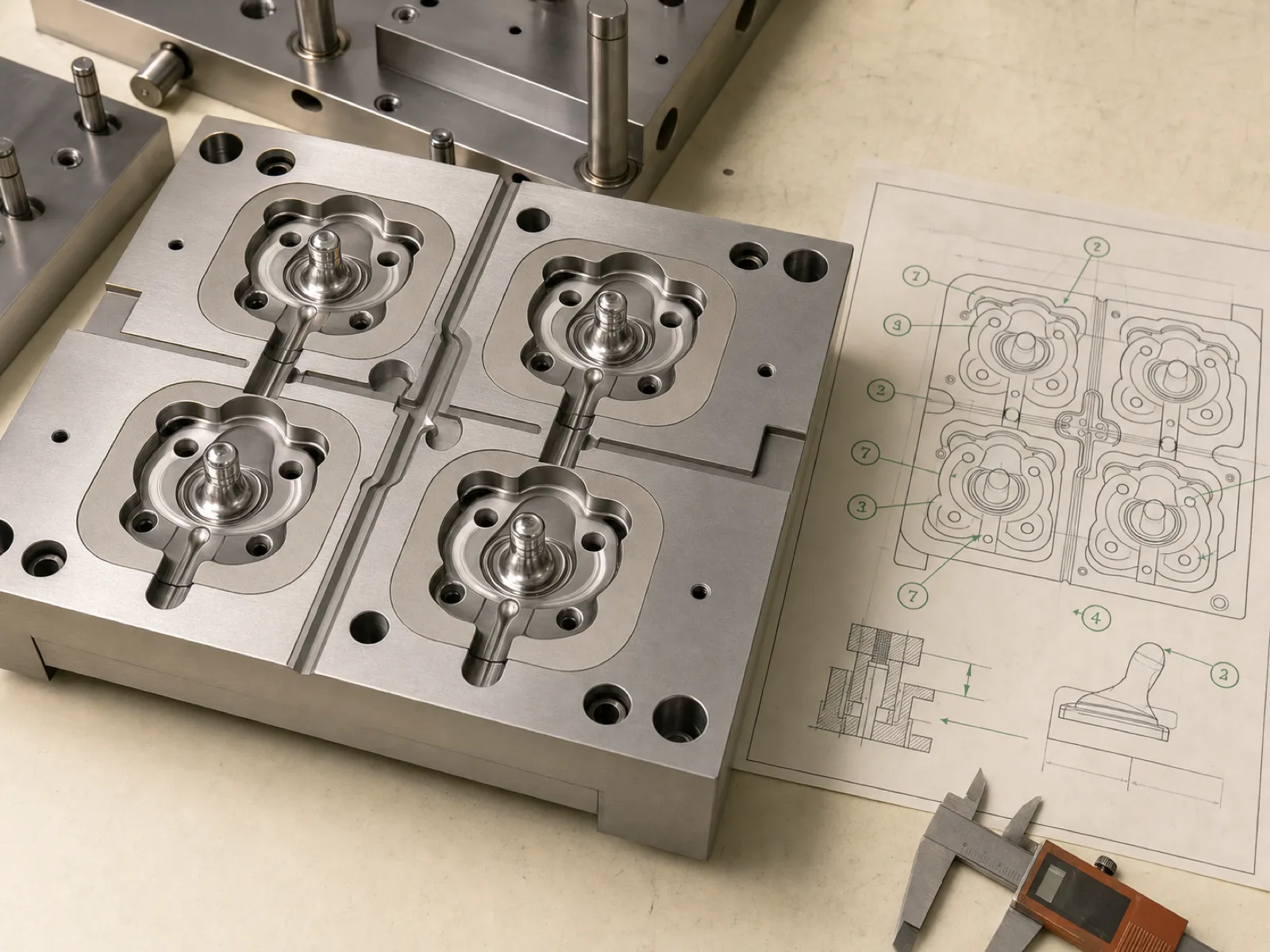
Three DFM issues sink most first-time silicone pacifier tooling: undercut geometry on the shield ventilation holes that traps compound during demolding, air-trap on the nipple tip that causes voids under EN 1400 pull test, and cold-runner temperature drift that produces per-cavity durometer variance beyond ±3 Shore A. A DFM review before cutting steel prevents all three.
The engineering desk's DFM review catches these before quoting. Shield ventilation holes must be at least two, minimum 4 mm diameter, positioned so the shield can't seal against a child's face — EN 1400 defines this geometry. If the industrial designer draws holes smaller or off-axis, the tool cuts them anyway and the pacifier fails the ventilation test at final QC. Air-trap on the nipple tip shows up as a matte spot inside an otherwise translucent nipple; it's a stress concentrator that fails pull-off tests at 60-75 N instead of 90 N. Cold-runner delta-T over 15 °C between cavities produces a spread of nipple durometers — one cavity molds at Shore A 42, the next at Shore A 48, and the retail QC engineer rejects the whole lot when they run a random Shore A sweep. A serious **silicone pacifier manufacturer** builds a DFM report before quoting tooling: 3-5 pages with annotated CAD, cavity layout, gate location, vent placement, ejector strategy, laser-mark position, and a call-out on any geometry that will need a design revision to pass EN 1400. Ask for it. If they can't produce one, they don't own the tooling — they broker it. ## How does a factory prevent nitrosamine drift across a 12-month program?A qualified silicone pacifier manufacturer prevents nitrosamine drift by running a GC-MS check on a coupon from every production lot, holding 200 °C × 4 hour post-cure as a non-skippable ERP-locked step, sourcing compound only from Momentive / Wacker / Shin-Etsu / Elkem with CoA validation, and re-testing full EN 1400 nitrosamine per quarter on stored retail samples for 18 months post-ship.
Nitrosamine drift is the sleeper risk on a rolling PO. First shipment tests clean, months six and seven test clean, and then month eight fails because the compound supplier switched a stabilizer without telling anyone, or because a factory quietly cut post-cure to 3 hours to hit a rush order. The controls are boring but they work: lock the compound supplier and require lot-level CoA, lock the post-cure recipe in the ERP so operators can't shorten it, run a GC-MS coupon per production lot, and archive three retail-format sealed samples per lot for 18 months so if a retailer complains you can pull the exact cohort and re-test it. The Wetop engineering desk runs this cadence as the default on infant-contact SKUs — it's cheap compared to a recall. Ask a candidate **silicone pacifier manufacturer** for their SOP on post-cure lock-out and their retention-sample protocol. If they say "we don't need one because we test every batch," they don't understand what recall investigations look like. ## How does one-piece LSR pacifier molding compare to two-piece assembly?One-piece LSR pacifiers cure the nipple and shield as a continuous elastomer in a single injection cycle, eliminating the bond line that is the single most common EN 1400 failure point. Two-piece assemblies mold the nipple and shield separately then clip, glue, or overmold — every added interface is a choking-hazard risk and a QC step. A serious silicone pacifier manufacturer will steer new tooling toward one-piece unless the geometry demands otherwise.
The trade-off is real but weighted heavily toward one-piece. Two-piece designs are cheaper on simple tooling (one nipple mold plus one shield mold instead of a dual-durometer LSR cell) and let the buyer swap nipple hardnesses on a shared shield SKU. But every clip-and-latch assembly must survive the EN 1400 90 N pull test, and clip fatigue after 200 boil-sterilization cycles is the recall pattern that killed several 2018-2022 pacifier lines. One-piece LSR eliminates the interface entirely — the failure mode has to become tearing of the silicone itself, which happens at 120-150 N in a well-molded pacifier. The cost premium for one-piece is 15-25 % at unit level and roughly $1,200-$2,000 additional on tooling for the dual-durometer cavity block. For a Tier 2 US baby brand shipping 40,000-80,000 units a year, the recall-risk delta pays for the premium in the first 12 months. Insist on one-piece molded LSR unless your industrial designer has a specific reason otherwise, and get that reason on paper. ## What payment terms and Incoterms should a first-order buyer expect?First-order silicone pacifier manufacturer terms typically run 30% deposit on PO, 70% balance against copy of BL, FOB Yantian on containers ≥ 20 CBM, or DDP on air-freight launch quantities. Tooling is billed 100% upfront and amortized over the first 20,000 units — a serious factory will refund 50% of tooling if the program cancels before T1 approval.
Payment terms tighten on the second order once the factory sees the compliance packet clear customs and the retailer accept a first shipment. Second orders often move to 20% deposit / 80% BL copy, and enterprise buyers negotiate to 100% on 60-day open terms after the fourth successful shipment. Incoterms matter more than most buyers realize: FOB Yantian is standard for FCL container programs, EXW Dongguan for buyers with a US-based freight forwarder, and DDP for launch quantities where the retailer needs stock at a US 3PL by a fixed date. A qualified **silicone pacifier manufacturer** can quote all three and will walk you through the compliance-doc hand-off (CPC, tracking-label print sample, EN 1400 batch report) at each Incoterm change. Tooling amortization is the pricing lever most sourcing managers miss. Standard practice is 100% tooling paid upfront by the buyer, which means the buyer owns the mold — a serious factory ships the tooling drawing set with the first PO and can transfer physical possession on request. If a factory asks you to amortize tooling into the unit price and refuses to disclose the amortization schedule, they are marking up a mold they already own from a previous customer. That's fine when the geometry is genuinely stock; it's a red flag when you thought you were buying a custom nipple. ## What packaging, sterilization instructions, and tracking labels does US retail require?US retail packaging for a silicone pacifier must carry a permanent 16 CFR 1130 tracking label on both the product and the retail package, a CPSIA choking-hazard warning per ASTM F963-23, sterilization instructions per EN 1400 for cross-border SKUs, and — for GS1-registered retailers — a UDI-compatible lot code laser-marked on the shield. A qualified silicone pacifier manufacturer prints and marks all four in-line.
The mechanical detail matters. 16 CFR 1130 says "permanent" — pad-printed labels that rub off after 30 dishwasher cycles do not qualify. Best-practice execution is laser-marking the shield with a 3-line code (manufacturer prefix + YYMMDD lot + cavity number) and printing the retail package with a matching lot band and QR code that resolves to the manufacturer's product-registration URL. The tracking label lets CPSC investigators isolate a recall to a single cavity of a single production day — the difference between recalling 8,000 units and 800,000. Sterilization instructions on-pack are an EN 1400 requirement for European sale and a best-practice for US launch. Language must specify boil sterilization (5 minutes rolling boil, max 3 cycles per week), steam-sterilizer compatibility, and a "replace every 4-6 weeks or at first sign of wear" cadence. Skipping this text is one of the fastest ways to fail a Health Canada import review. ## How do sample rounds, T1/T2 tooling revisions, and PPAP work for a pacifier program?A pacifier program moves through T0 (kickoff + DFM) → T1 (first-shot samples, 30-45 days) → T2 (revised samples after DFM tweaks, 10-15 days) → PPAP (production-part-approval process, 5-10 days) → mass production. Expect 2-3 sample rounds before PPAP sign-off; a factory that promises single-shot approval is usually shipping a stock geometry with your logo added.
The Wetop engineering desk quotes T1 with EN 1400 pre-testing bundled in — nitrosamine, pull-force, ventilation geometry, small-parts choke test — so the buyer sees a full pass/fail on the first shot instead of discovering a failure after tooling is committed. T2 usually addresses one of three things: a durometer tweak (compound blend adjust), a vent-hole geometry revision (mold insert swap), or a Pantone color correction (master-batch reformulation). PPAP is the formal sign-off packet: material CoA, dimensional report on 10 units across all cavities, EN 1400 full report, CPC draft, tracking-label print sample, and the retail-package artwork proofed against final die-lines. A **silicone pacifier manufacturer** who runs this cadence keeps the launch on schedule. A supplier who skips T2 and jumps to production usually lands a T1 defect into the first 5,000 units and burns a Target sell-through window recovering. ## Frequently asked questions The FAQ block above is mirrored into the page's FAQPage JSON-LD verbatim — every question and answer you see in frontmatter is what an AI answer engine or a Google People Also Ask surface can extract without ambiguity. ## Next step — talk to the engineering desk If you are sourcing a **silicone pacifier manufacturer** for a Tier 2 US baby brand, a private-label retail chain program, or a European market SKU, the Wetop engineering desk will run a DFM review on your CAD and hand back a tooling quote, an EN 1400 test plan, and a compliance-packet outline within 5 business days. No RFQ mill, no trading-company handoff — one factory floor in Dongguan with an LSR cell dedicated to infant-contact molding and the paperwork to prove it. Start a conversation on [`/contact/`](/contact/) with your target unit volume, Shore A preference, and target retail-chain audit body. A signed [mutual NDA](/nda/) precedes any DFM disclosure on both sides.