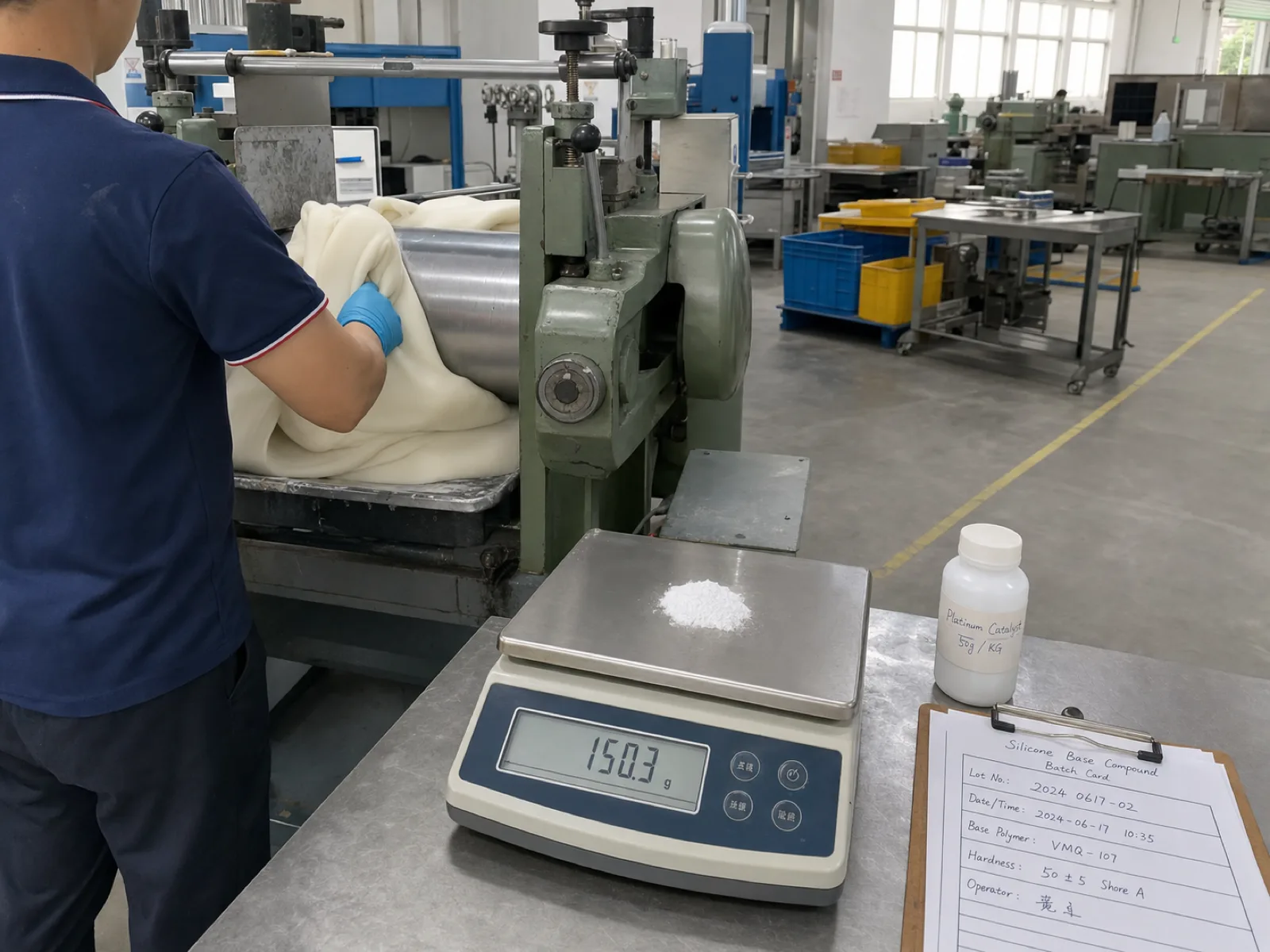
A silicone rubber gasket is a molded or die-cut VMQ elastomer seal that holds pressure between -60 °C and 230 °C continuous. It sits in the middle of the elastomer cost curve — three to five times a nitrile gasket, one-third the price of Viton — and buys you the widest thermal window and the cleanest food and medical compliance available under 3 USD/kg. Get the durometer, cure system, and process match right and it's the most forgiving seal on the RFQ; get any of those three wrong and it leaks, extrudes, or fails compliance at PPAP.
This guide is written for OEM sourcing engineers and program managers speccing silicone rubber gaskets for kitchen, medical, LED, EV-battery, or industrial-enclosure programs. It replaces the vague "premium quality silicone gasket" datasheets with the numbers you actually need at RFQ — Shore A ranges, compression-set targets, cure-system compliance mapping, die-cut vs molded break-even, and the documentation stack we ship with every production lot.
Match the grade to the failure mode. General-purpose (GP) VMQ covers most sealing jobs. Step to high-strength when tear or elongation dominates, to FDA / USP-VI for food or medical contact, to fluorosilicone (FVMQ) for fuel and oil, to conductive for EMI shielding, and to flame-retardant when the enclosure carries a UL yellow card.
Silicone rubber gasket compounds split into seven functional grades. Each grade adds cost — sometimes by 2×, sometimes by 5× — so spec'ing above your actual failure mode is where OEM programs quietly lose 20-30 % of margin. The right grade is the cheapest one that clears the compliance and physical-property envelope, not the highest one on the datasheet. | Grade | Typical use | Cost index (GP = 1.0) | Key spec | | --- | --- | --- | --- | | Commercial GP VMQ | Enclosure gaskets, low-pressure lids | 1.0 | Shore A 40-70, tensile ≥ 6 MPa | | High-strength VMQ | Repeat-open lids, wearing seals | 1.4 | Tensile ≥ 9 MPa, tear ≥ 30 kN/m | | FDA 21 CFR 177.2600 platinum | Food-contact, potable water | 1.6 | Extractables clear per fda.gov[^fda-177-2600] | | USP Class VI | Medical device, single-use bioprocess | 2.2 | Biocompatibility per USP <88>[^usp-class-vi] | | Fluorosilicone (FVMQ) | Fuel, oil, aromatic-solvent contact | 3.5-4.0 | Volume swell < 20 % per ASTM D471[^astm-d471] | | Conductive (Ni/Ag-filled) | EMI/RFI shielding gaskets | 4.5-6.0 | Volume resistivity < 0.05 Ω·cm | | Flame-retardant UL 94 V-0 | UL-listed lighting / EV / enclosure | 2.0-2.6 | UL 94 V-0 yellow card[^ul-94] | The two most common mis-specs we see at RFQ: a food-contact program written against generic "FDA silicone" (meaningless — cite the CFR section; the [FDA vs LFGB compliance breakdown](/guide/fda-vs-lfgb-silicone/) walks through which clause belongs on which market's drawing) and an EV-battery pack gasket written against Shore A 70 GP compound when the sealing surface is a stamped-sheet flange with 6.3 μm Ra (needs Shore A 40-50 to conform). ## What Shore A hardness should I specify?Shore A 30-40 seals rough or low-torque surfaces at low pressure. Shore A 50-60 is the workhorse range for machined flanges under 5 bar. Shore A 65-70 holds line pressure but needs a mating surface finished to Ra ≤ 3.2 μm and higher bolt torque. Above 70 A a silicone gasket behaves like hard rubber and won't recover from a single thermal cycle.
Durometer selection is a three-way trade between conformance (soft wins), extrusion resistance (hard wins), and compression set at temperature (mid-range wins). The mistake most first-time OEM buyers make is treating Shore A as a quality signal — it isn't. It's a sealing-behavior parameter tied directly to the flange finish, bolt torque, and pressure spec. | Shore A | Sealing pressure | Flange finish needed | Typical application | | --- | --- | --- | --- | | 30-40 | ≤ 0.5 bar | Ra ≤ 12.5 μm (rough) | Enclosure lid, dust seal, weather strip | | 40-50 | 0.5-2 bar | Ra ≤ 6.3 μm | Kitchen appliance, food-contact lid | | 50-60 | 2-5 bar | Ra ≤ 3.2 μm | Autoclave lid, LED weather seal | | 60-70 | 5-10 bar | Ra ≤ 1.6 μm | Fluid manifold, medical device housing | | 70-80 | Line pressure > 10 bar | Ra ≤ 0.8 μm (ground) | Extrusion-resistant backup | Tolerance on durometer is typically ±5 Shore A. Anyone quoting ±2 either has closed-loop compounding data or is bluffing — ask for the last 90 days' Shore A SPC chart before believing it. ## What temperature range does silicone actually hold?Standard VMQ silicone runs -60 °C to 230 °C continuous and 300 °C intermittent (< 30 minutes). Compression set roughly doubles every 25 °C above 175 °C, so a gasket rated "230 °C" on the datasheet is often specified against 8-hour service, not 12-month. For continuous 200 °C+ sealing, require ASTM D395 data at your actual service temperature and consider a heat-stabilized compound.
Silicone's temperature envelope is its single strongest selling point over nitrile, EPDM, and neoprene — but only if you separate continuous rating from intermittent excursion. The [silicone temperature range explainer](/guide/silicone-temperature-range-explained/) unpacks why the "-60 °C to 230 °C" number on datasheets means different things in continuous, cyclic, and intermittent service. Datasheet numbers assume static load in air; real gasket service adds thermal cycling, compression, and often chemical exposure that pull the effective ceiling 20-40 °C lower. | Metric | Standard VMQ | Heat-stabilized VMQ | Fluorosilicone (FVMQ) | | --- | --- | --- | --- | | Continuous service | -60 to 230 °C | -60 to 250 °C | -60 to 200 °C | | Intermittent peak | 300 °C, < 30 min | 315 °C, < 30 min | 230 °C | | Compression set @ 175 °C, 70 h | 15-25 % | 10-18 % | 20-30 % | | Compression set @ 200 °C, 70 h | 25-40 % | 15-25 % | 35-50 % | | Brittle point | -60 to -65 °C | -70 °C | -60 °C | We reject any batch where compression set at the customer's rated service temperature exceeds 30 % — the failure signature (leak after first thermal cycle) is unambiguous and hits the field 3-9 months later when the seal cannot recover. ## Which compliance certifications matter for a silicone rubber gasket?For food contact, cite FDA 21 CFR 177.2600 and (in the EU) LFGB §30/31. For medical, cite USP Class VI biocompatibility and ISO 10993 for extended contact. For potable water, cite NSF-51 or NSF-61. For enclosures shipping into North America, cite UL 94 flame class. For EU shipment of any grade, screen against REACH SVHC and RoHS.
Compliance is where silicone rubber gasket programs die at PPAP. The compound must clear the standard, the process must be documented (post-cure time, cure system, batch traceability), and the paperwork must reference the specific clause — not a generic "food safe" or "medical grade" claim. The [platinum-cured vs peroxide-cured cure system comparison](/guide/platinum-cured-vs-peroxide-cured-silicone/) explains why cure chemistry — not the base polymer — is the variable that decides whether extractables clear on the first submission. | Certification | Clause / test | When to require | | --- | --- | --- | | FDA 21 CFR 177.2600[^fda-177-2600] | Extractables in water, hexane, ethanol | Any food or potable-water contact | | USP Class VI[^usp-class-vi] | In-vivo biological reactivity per USP <88> | Medical device, single-use bioprocess | | ISO 10993 | Cytotoxicity, sensitization, irritation | Extended-contact medical device | | LFGB §30/31 | Overall migration + sensory test | EU food-contact shipment | | NSF-51 / NSF-61 | Food equipment / drinking water | Potable water, foodservice equipment | | UL 94 V-0 or V-1[^ul-94] | Vertical burn test | Lighting, EV, UL-listed enclosure | | REACH SVHC[^echa-reach] | Candidate-list screening | Any EU shipment | | RoHS | 10 restricted substances | Electronics enclosure | For every compliance claim we ship a Certificate of Compliance (COC) that cites the specific clause number and references the raw-compound COA — not the finished-part inspection alone. A compliance packet that only says "FDA compliant" without the clause number does not survive a serious PPAP audit. ## Die-cut vs molded vs extruded silicone gasket — how do I pick a process?Die-cut from calendered sheet wins under 5,000-8,000 pcs on simple 2D profiles. Compression molding wins on volume, 3D features, and compression-set performance. Injection (LSR) molding wins on cavity count and dimensional repeatability above 50,000 pcs/year. Extrusion wins on continuous profiles (weather strip, tubing gasket) cut to length.
Process choice drives tooling cost, unit cost, tolerance, and cycle time — often the four biggest lines on the RFQ. Get this wrong at spec-in and the program either over-invests in tooling for a low-volume part or die-cuts a 200,000-pc/year part that should have been molded. | Process | Tooling cost | Unit cost @ 10k | Tolerance | Best fit | | --- | --- | --- | --- | --- | | Die-cut sheet | 300-800 USD (steel-rule die) | 0.15-0.60 USD | ±0.20 mm | Flat 2D gaskets, low volume, thin profiles | | Waterjet | 0 (CNC) | 1.50-4.00 USD | ±0.10 mm | Prototypes, thick sheet, no tooling | | Compression molding | 1,500-6,000 USD | 0.08-0.35 USD | ±0.10 mm | 3D features, mid-volume, best compression set | | Injection (LSR) molding | 8,000-40,000 USD | 0.05-0.25 USD | ±0.05 mm | High-volume O-rings, precision seals | | Extrusion + cut | 800-2,500 USD (die) | 0.20-1.50 USD/m | ±0.15 mm | Continuous profiles, weather strip | For a first-time OEM program with unclear volume, we typically quote die-cut samples for the first 500-2,000 pcs then transfer to compression tooling once the buyer's forecast clears 8,000 pcs/year — the tooling amortization break-even lands there for most 2D-plus-boss geometries. The [OEM pricing structure breakdown](/guide/silicone-oem-pricing-structure/) walks through how tooling amortization actually shows up on the quote line by line.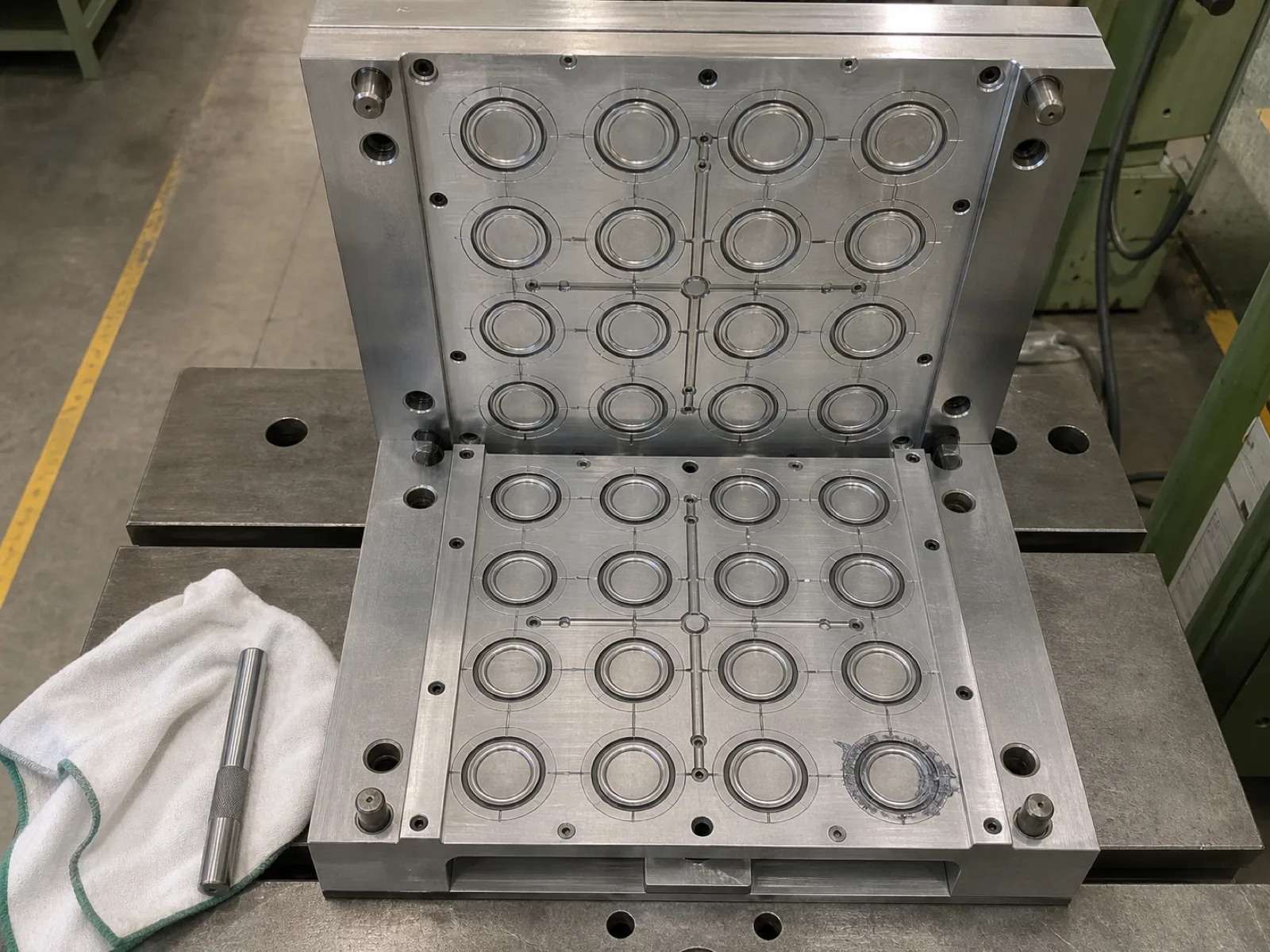
Solid silicone seals pressure and holds tolerance. Sponge (open-cell) conforms to rough surfaces at ultra-low load but leaks under pressure. Closed-cell foam splits the difference — 40-60 % compression at 0.1-0.5 bar with a moisture-tight seal. Sponge-with-skin adds a molded outer layer for cleanability. Choose based on load, pressure, and cleanability requirements.
Cross-section geometry is the second-order decision after material. Solid silicone is the default; foam / sponge / skinned variants exist because there are sealing jobs (LED enclosures, low-torque lids, weather stripping) where a solid gasket needs bolt torque no one wants to spec. - **Solid VMQ** — the default. Best for pressure sealing, high-cycle applications, and any spec requiring compression set data. - **Open-cell sponge** — 60-80 % void, absorbs water, no pressure seal. Only appropriate for dust seals and thermal barriers. - **Closed-cell foam** — 30-50 % void, moisture-tight, seals at 10-20 % of solid gasket torque. Common in LED weather seals and battery-pack enclosures. - **Sponge with molded skin** — closed-cell core + solid outer skin, cleanable, meets some food-contact clauses. Higher tooling cost. ## What sealing performance data should I put on the drawing?The five non-negotiable numbers on any silicone rubber gasket drawing are: Shore A ± 5, tensile strength per ASTM D412, tear resistance per ASTM D624, compression set per ASTM D395 at the actual service temperature, and dielectric strength (kV/mm) if the gasket sees any voltage. Every number cites its ASTM method and test conditions — not a marketing datasheet range.
A drawing that specifies "silicone, food-grade, Shore A 60" without ASTM references is unenforceable. The supplier can ship a compound that reads Shore A 60 out of the mold but degrades to Shore A 75 after 30 days at 175 °C. Attaching ASTM methods to the spec is how you make quality a contractual number. | Property | Method | Typical spec | Failure signature if under-spec'd | | --- | --- | --- | --- | | Shore A hardness | ASTM D2240 | 55 ± 5 | Leak or extrusion depending on direction | | Tensile strength | ASTM D412[^astm-d412] | ≥ 7 MPa | Tears during assembly | | Elongation at break | ASTM D412 | ≥ 300 % | Cracks on installation | | Tear resistance | ASTM D624[^astm-d624] | ≥ 20 kN/m | Fails on repeat open/close | | Compression set | ASTM D395[^astm-d395] | ≤ 25 % @ 175 °C, 70 h | Slow leak after thermal cycling | | Volume change in service fluid | ASTM D471[^astm-d471] | ≤ 20 % | Swelling, dimensional loss | | Dielectric strength | ASTM D149 | ≥ 20 kV/mm | Electrical breakdown | ## What does the OEM sourcing flow look like end to end?Standard silicone rubber gasket sourcing runs: RFQ with 2D drawing + material spec + volume, quote in 3-5 business days, prototype samples in 7-25 days, first-article inspection report + PPAP-level documentation on approval, then 30-45 day production lead time on new tooling. Wetop's MOQ starts at 500 pcs on existing tooling and 2,000-5,000 pcs on new tooling.
The gap between a datasheet-quality gasket and a PPAP-approved gasket is roughly 3-4 weeks of documented process work. See the [MOQ and lead-time reality check](/guide/moq-and-lead-time-silicone-oem/) for how these stages actually compress or stretch against real factory calendars. Buyers who compress that timeline usually end up with a "sample approved / production rejected" mismatch — the sample was made by hand, the production run was made from a hot press with different vent geometry. | Stage | Duration | Deliverables | | --- | --- | --- | | RFQ | Day 0 | Quote with tooling + unit cost + lead time | | Tooling design review | Days 3-7 | 3D tool drawing, gate/vent plan, cavity count | | Aluminum soft tooling | Days 7-20 | First-article samples (T1) | | First-article inspection | Days 20-25 | Dimensional CMM, material property test, COA | | PPAP / IMDS submission | Days 25-30 | Full production-part approval packet | | Production ramp | Days 30-45 | First production lot, AQL 1.5 outgoing inspection | ## What quality-control documentation ships with each production lot?Every production lot ships with a Certificate of Analysis (COA) covering Shore A, specific gravity, and tensile per ASTM D412; a Certificate of Compliance (COC) referencing FDA 21 CFR 177.2600 or the applicable clause; an outgoing AQL 1.5 inspection report; and a traceability record linking finished-goods carton back to compound lot and cure cycle. IMDS and REACH declarations attach for EU-bound shipments.
QC without documentation is unverifiable, and unverifiable QC is the reason "we've been buying silicone gaskets for 10 years and never had a problem" ends the day a food-safety auditor asks for a compliance packet. The [sourcing checklist for a silicone factory](/guide/sourcing-silicone-factory-checklist/) lists the exact documents to demand at supplier qualification so this gap never opens. Wetop's silicone rubber gasket program treats each production lot as a documented event: compound-day traceability, in-process Shore A + dimensional SPC every 30 minutes, and outgoing AQL 1.5 inspection with the report attached to the shipment.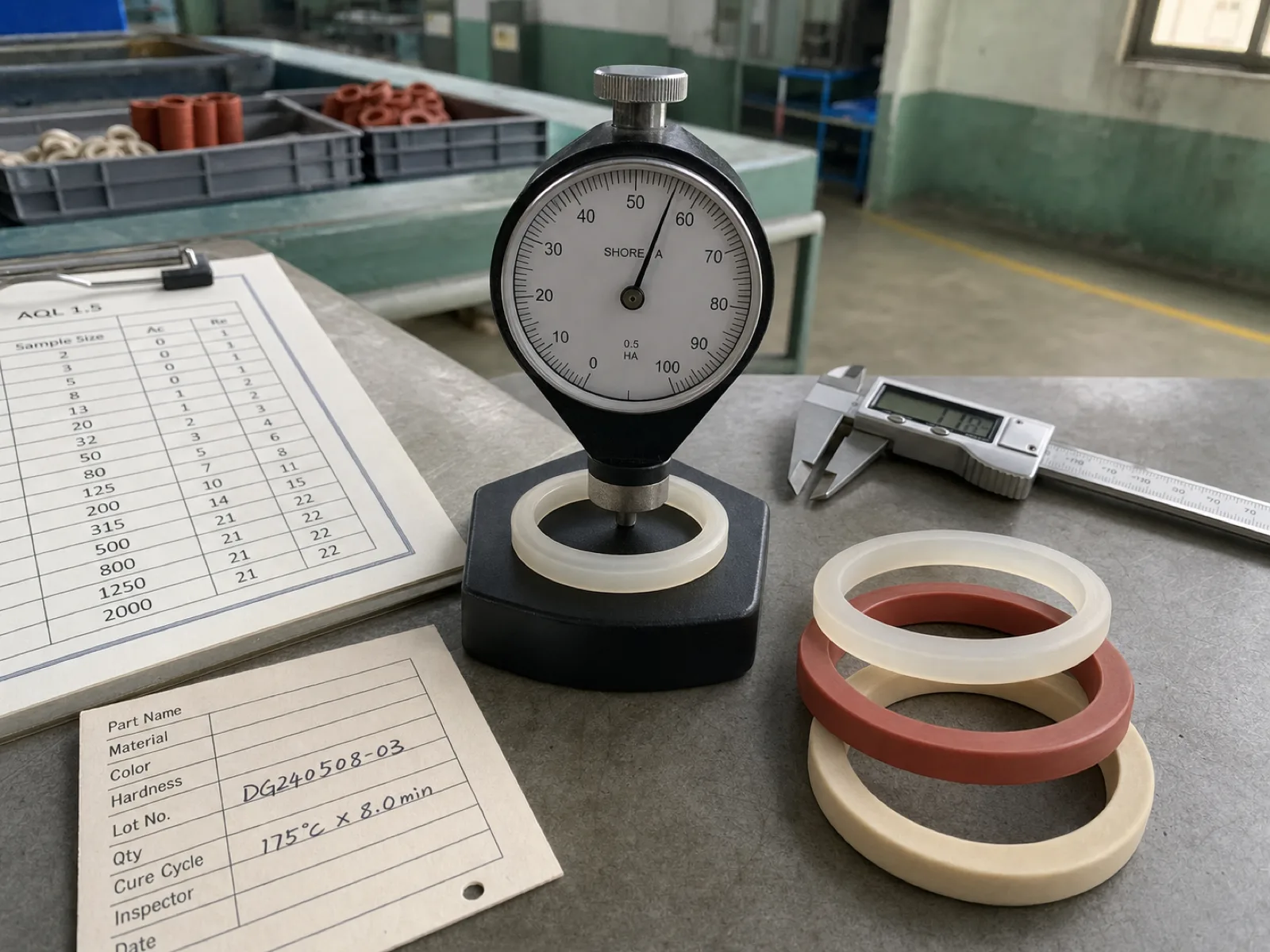
Landed cost breaks into four buckets: material (35-55 % of unit cost, driven by grade and filler load), tooling amortized over 12 months (5-15 %), labor and press time (20-30 %), and freight + duty (10-25 % for US or EU delivery). Platinum-cure compounds add 15-25 % on material cost over peroxide but eliminate the post-cure step's energy and time cost.
TCO discipline matters most when comparing die-cut to molded, or when the sourcing engineer is being asked to justify a 30-40 % unit-cost step up to switch from a commodity compound to a compliant one. The most common mis-analysis: comparing per-piece FOB pricing without amortizing tooling, or forgetting that a peroxide-cure compound needs a 4-6 hour post-cure at 200 °C that a platinum-cure compound doesn't. | Cost bucket | Share of landed cost | Levers | | --- | --- | --- | | Raw compound | 35-55 % | Grade selection, filler load, cure system | | Tooling amortization | 5-15 % | Cavity count, tool material (aluminum vs P20) | | Press labor + energy | 20-30 % | Cycle time, cavity count, post-cure requirement | | Post-processing | 5-10 % | Flash trim, secondary printing, packaging | | Freight + duty | 10-25 % | Sea vs air, HTS code, port of entry | ## Closing — how to move a silicone rubber gasket program forward If you're specifying a silicone rubber gasket program and want the RFQ to come back with numbers instead of adjectives, send a drawing with the five ASTM references above, the compliance clause you need (not "food safe"), and a 12-month volume forecast. We'll return a quote in 3-5 business days that separates tooling from unit cost, cites the specific compound and cure system, and lists the documentation stack we ship with each lot. The engineering desk answers RFQs directly — [talk to the engineering desk](/contact/) or download the [mutual NDA](/nda/) before sharing your drawing.