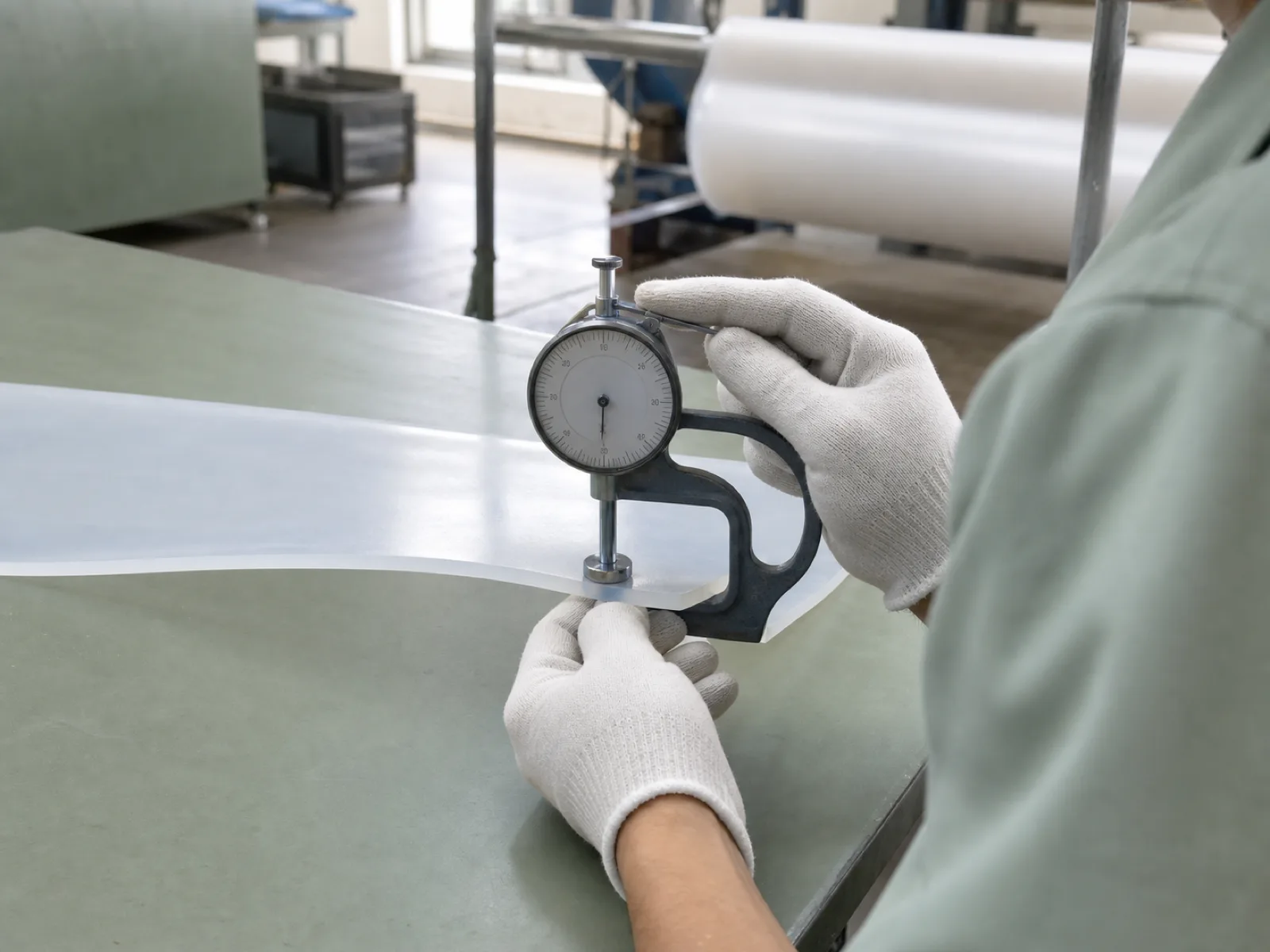
A silicone rubber sheet manufacturer produces flat VMQ silicone stock — in rolls or cut panels — that buyers fabricate into gaskets, pads, seals, membranes, and insulation. The core specification is four numbers: Shore A durometer from 10 to 90, thickness from 0.005 in (0.13 mm) to 0.500 in (12.7 mm) and beyond, tensile strength of 700-1,400 psi, and a -60°C to +230°C continuous service window. Wetop compounds and calenders custom silicone rubber sheet at MOQ 500 per SKU with a 7-25 day first sample, from a 7,500 m² ISO 9001 factory in Dongguan holding FDA 21 CFR 177.2600 and LFGB clearance.
This guide is the engineering-desk reference for buyers sourcing custom silicone rubber sheet — how to read the four core specs, how the grade taxonomy maps to your application, what thickness and tolerance a real factory can hold, how calendering differs from molding and extrusion, which fabrication and adhesive-backing options convert sheet into finished parts, and the MOQ, tooling, and lead-time math most competitor pages leave out. Every recommendation carries a number, a cert clause, or a process step. Read it before your next RFQ and you will spec a sheet that ships on time and performs across the temperature and sealing duty you actually run. ## What specs define a silicone rubber sheet?Four numbers define any silicone rubber sheet: Shore A durometer (10-90 hardness), thickness (0.005 in / 0.13 mm to 0.500 in / 12.7 mm), tensile strength (700-1,400 psi per ASTM D412), and continuous service temperature (-60°C to +230°C for standard VMQ). Grade, color, and certification stack sit on top of these four, but the four numbers gate every quote a silicone rubber sheet manufacturer will give you.
Most RFQs we receive under-specify the sheet by leaving one of the four blank. A drawing that says "food-grade silicone sheet, 1/8 inch" tells us the thickness and hints at the grade, but says nothing about durometer or the temperature the part will see — so we cannot grade the compound or price it. The four-number discipline forces a complete brief. The table below is the working baseline a silicone rubber sheet manufacturer holds for general-purpose stock. Every value shifts with grade, but this is the anchor a buyer should carry into the first conversation. | Property | Test method | General-purpose VMQ range | Ship-gate we hold | |---|---|---|---| | Hardness | ASTM D2240 (Shore A) | 10-90 | ±5 Shore A | | Thickness | Caliper / gauge | 0.005-0.500 in (0.13-12.7 mm) | ±10% or ±0.003 in | | Tensile strength | ASTM D412 | 700-1,400 psi | ≥ 800 psi standard grade | | Elongation at break | ASTM D412 | 200-600% | ≥ 300% standard grade | | Tear strength | ASTM D624 | 20-45 kN/m | grade-dependent | | Continuous temp | ASTM D573 aging | -60°C to +230°C | +230°C standard VMQ | | Compression set | ASTM D395 | 15-35% @ 175°C/22 hr | ≤ 25% post-cured | Silicone is deliberately not a high-tensile elastomer. Where natural rubber or nitrile out-pull it on the tensile line, silicone wins on the properties that actually matter for a sheet-derived seal: temperature range, UV and ozone aging resistance, low compression set across heat cycles, and chemical inertness against food and biological media. If your application demands 3,000 psi tensile, you are choosing the wrong polymer — silicone's value proposition lives in the thermal and inertness columns, not the strength column. ## How do I choose durometer for a silicone rubber sheet?Match durometer to closure force and surface roughness: Shore A 40-50 for soft gaskets and vibration pads that must conform to rough or waved faces at low bolt torque; Shore A 60-70 for general bolted-flange gaskets; Shore A 70-90 for thin die-cut parts, wear pads, and abrasion-facing surfaces. Softer conforms and seals at low force; harder resists extrusion and tearing but leaks on uneven surfaces.
Durometer is the single most miscalled parameter on sheet drawings, exactly as it is on molded gaskets. Buyers copy "70 durometer" from an old print without asking whether the new sealing geometry justifies it. The right approach maps hardness to the mechanical duty the sheet performs. The rule of thumb the engineering desk applies: - **Shore A 30-40** — anti-vibration pads, sound-damping membranes, and cushioning where conformity to an irregular surface matters more than sealing pressure. Very soft; tears easily in thin sections. - **Shore A 40-50** — soft gaskets against cast or rough-machined flanges with surface waviness, low-torque enclosure seals, and skin-contact cushions. - **Shore A 50-65** — the workhorse band for general gasketing, oven and appliance door seals, and food-contact sheet duty. Balances conformity and extrusion resistance. - **Shore A 65-80** — precision bolted flanges, higher-torque joints, and thin die-cut parts that need dimensional stability during cutting. - **Shore A 80-90** — wear pads, abrasion-facing surfaces, and roller stock. Firm, dimensionally stable, low conformity. Durometer is measured per ASTM D2240 with a Type A durometer against a stacked 6 mm sample, read at a fixed dwell time[^astm-d2240]. On any custom sheet program we run, the hardness target ships as a ±5 Shore A tolerance band — tighter than that is not repeatable across production calendering. For a full hardness-to-application map, see our [Shore A hardness chart for silicone](/guide/shore-a-hardness-silicone-chart/). ## What grades of silicone rubber sheet can a manufacturer supply?The grade taxonomy runs general-purpose, FDA food-grade (21 CFR 177.2600), USP Class VI / ISO 10993 medical, high-temperature phenyl (PVMQ, to +300°C intermittent), flame-retardant (UL 94 V-0), and electrically conductive or thermally conductive specialty compounds. Grade is chosen before durometer, because grade dictates the base polymer and cure system — and therefore which certifications and temperature ceilings are even reachable.
Grade is the first decision, not the last. It fixes the base polymer, the cure chemistry, and the compliance ceiling; durometer and thickness are then tuned within the grade. Choosing durometer before grade is how buyers end up with a hard, cheap general-purpose sheet that can never pass the food-contact test the program actually needs. | Grade | Base / cure | Key spec | Typical use | Cert stack | |---|---|---|---|---| | General-purpose | VMQ, peroxide or platinum | 700-900 psi, -60/+230°C | Industrial gaskets, pads | ASTM D2000 callout | | FDA food-grade | VMQ, platinum-cured | Extractables < limit | Food-processing seals, ovenware | FDA 21 CFR 177.2600, LFGB, EU 10/2011 | | Medical grade | VMQ, platinum-cured | Biocompatible | Device cushions, membranes, tubing sheet | USP Class VI, ISO 10993 | | High-temp phenyl | PVMQ | -117°C to +300°C | Aerospace, cryogenic seals | MIL-spec, ASTM D2000 | | Flame-retardant | VMQ + FR package | UL 94 V-0 | Rail, mass-transit, electronics | UL 94, EN 45545 adjacent | | Conductive | VMQ + carbon/metal fill | Volume resistivity target | EMI shielding, grounding pads | Application-specific | Two grade boundaries cause the most confusion. First, **FDA food-grade versus medical grade**: FDA 21 CFR 177.2600 governs extractable residues under repeated food contact[^fda-177-2600], while medical grade adds biological-reactivity testing under USP Class VI[^usp-class-vi] and the risk-based ISO 10993 framework[^iso-10993]. Every medical-grade sheet is food-safe; not every food-grade sheet has cleared biocompatibility. For the full clause-by-clause comparison, read our [FDA vs LFGB silicone](/guide/fda-vs-lfgb-silicone/) guide. Second, on medical work: **we supply silicone components and sheet stock, not finished FDA-cleared devices** — the device clearance belongs to the OEM who assembles and registers the finished product. ## What thickness, width, and tolerances are available?Calendered silicone sheet runs 0.005 in (0.13 mm) to about 0.125 in (3.2 mm) per pass, laminated in plies up to 0.500 in (12.7 mm) and beyond. Standard widths are 36 in and 48 in; roll lengths run 10-50 ft. Thickness tolerance is roughly ±10% or ±0.003 in on thin calendered stock, tightening on molded plate. Width and length are cut to order.
Thickness is where the manufacturing method shows through. A calender — the multi-roll mill that lays silicone into a continuous web — holds thin gauges beautifully but cannot build arbitrary thickness in one pass. Above roughly 0.125 in, a sheet is built by laminating (plying) calendered layers, or switched to compression molding for solid thick plate. Each approach carries a different tolerance and a different cost curve. | Build method | Thickness range | Thickness tolerance | Best for | |---|---|---|---| | Single-pass calendered | 0.005-0.125 in (0.13-3.2 mm) | ±10% or ±0.003 in | Thin gaskets, membranes, die-cut parts | | Plied / laminated | 0.125-0.500 in (3.2-12.7 mm) | ±0.010 in | Thick pads, cushions, insulation | | Compression molded plate | 0.060-1.000 in (1.5-25 mm) | ±0.005 in | High-durometer, reinforced, specialty | Two options widen the envelope. **Fiberglass-mesh reinforcement** laminated into the sheet raises effective tensile and dimensional stability for large gaskets — the same reinforcement principle behind a baking mat's internal mesh. And **width beyond 48 in** is possible on wide calender lines but should be flagged early in the RFQ, because it changes tooling and can move lead time. Always state your thickness *and its tolerance* on the drawing; a thickness with no tolerance forces the factory to guess, and the guess is rarely the one that fits your closure-force budget.
Calendering laminates uncured silicone through heated rollers into a continuous, uniform web — the default for thin, wide sheet (0.005-0.125 in). Compression molding presses stock into a heated platen mold for thick, high-durometer, or reinforced plate. Extrusion pushes silicone through a die for continuous profile or thick strip. Calendered sheet holds ±0.003 in thickness; molded plate holds tighter dimensional control on thick sections.
The three processes are not interchangeable — each owns a region of the thickness-and-format map, and choosing the wrong one shows up as either blown tolerance or blown cost. - **Calendering** is the volume process for flat sheet. Uncured silicone gum passes through a stack of temperature-controlled rolls that progressively thin and consolidate it into a web, which then vulcanizes in a continuous oven. It is fast, uniform across width, and the cheapest route to square footage. Its limit is thickness: thin excels, thick requires plying. - **Compression molding** presses a measured charge of silicone into a heated, flat cavity under hydraulic pressure. It is the route for thick plate, durometers above 70, embedded reinforcement, and specialty compounds that do not calender well. It costs more per square foot but hits tighter thickness control on thick sections and enables features a calender cannot. - **Extrusion** forces silicone through a shaped die into continuous stock — the process behind cord, tube, and profile, and occasionally thick strip. It is not the primary sheet process but matters when your part is closer to a profile than a flat sheet. The buyer takeaway: specify the *sheet*, not the *process*. Give the factory the four core numbers plus grade, and let the manufacturer pick calendering, plying, or molding to hit them at lowest landed cost. A manufacturer that runs all three in-house — as we do on our Dongguan floor — chooses the process that fits your tolerance and volume rather than forcing your part onto the one machine they own. The [silicone rubber gasket manufacturing guide](/guide/silicone-rubber-gasket-manufacturing-guide/) walks the molded-part side of this decision in depth. ## How is silicone sheet fabricated into finished gaskets and pads?Sheet becomes finished parts through die-cutting (steel-rule or matched-metal dies), waterjet cutting for thick or complex profiles, flash and laser cutting for fine detail, and lamination for adhesive backing. These fabrication routes convert stock sheet into gaskets, pads, and membranes without new molds — which is why sheet stock beats compression molding on landed cost below roughly 3,000 units.
Fabrication is where sheet stock earns its economic advantage. A molded gasket needs a dedicated cavity tool; a die-cut gasket needs only a cutting die, which is an order of magnitude cheaper and faster to build. For low-to-mid volume, or for a family of parts that share one thickness and grade, cutting from calendered sheet is the correct route. | Method | Best for | Tooling cost | Edge quality | |---|---|---|---| | Steel-rule die-cut | High-volume flat gaskets, pads | Low | Good | | Matched-metal die-cut | Tight-tolerance flat parts | Medium | Excellent | | Waterjet | Thick sheet, complex outlines, no tooling | None (CAD-driven) | Excellent | | Flash / laser cut | Fine detail, prototypes, low volume | None | Very good (watch heat-affected edge) | | Lamination | PSA backing, multi-ply builds | Low | N/A | The highest-leverage fabrication add-on is **pressure-sensitive adhesive (PSA) backing**. A 3M-class or Adchem-class acrylic or silicone PSA is laminated to one face with a release liner, turning a plain sheet into a peel-and-stick gasket blank. Acrylic PSA holds to roughly 120°C — right for ambient gasketing; silicone PSA holds past 200°C for high-temperature pads. Specify PSA type by service temperature, not by habit, or the adhesive fails before the silicone does. Provide cut geometry as a DXF or DWG and the factory returns a die-cut, adhesive-backed, peel-ready part.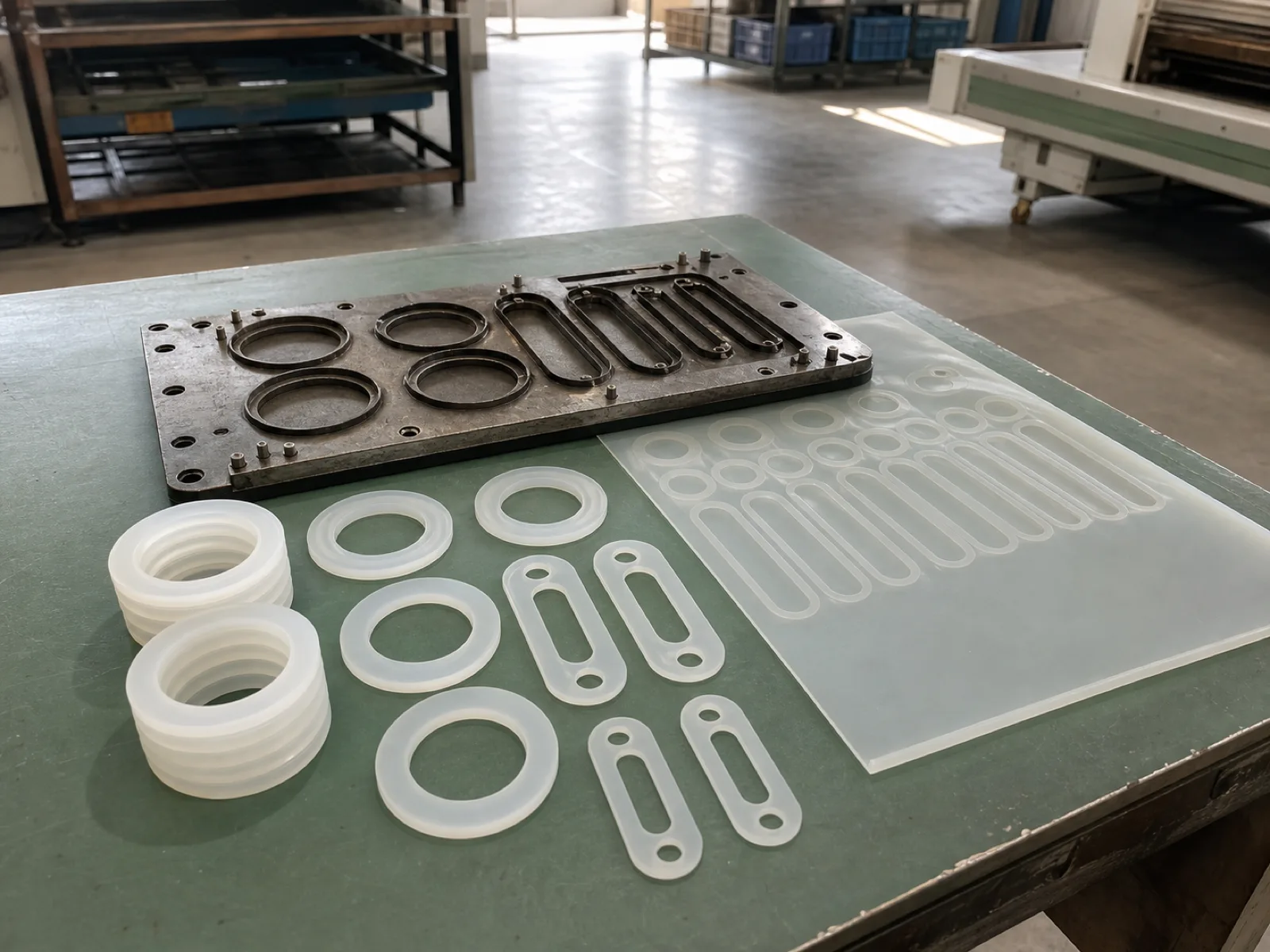
Solid silicone sheet is dense, non-porous, and seals fluid and pressure — the choice for gaskets and food-contact surfaces. Closed-cell sponge sheet has sealed gas cells that seal dust, air, and weather at low closure force. Open-cell foam sheet has interconnected pores that cushion and insulate but do not seal. Pick solid for pressure, closed-cell sponge for low-force weather sealing, foam for cushioning only.
These three are distinct materials, not grades of one — and buyers routinely conflate them. The wrong choice fails in service: an open-cell foam will never seal a fluid, and a solid sheet demands far more closure force than a sponge to seal a light enclosure. | Type | Structure | Seals fluid/pressure? | Closure force | Typical use | |---|---|---|---|---| | Solid | Dense, non-porous | Yes | Higher | Gaskets, food-contact, membranes | | Closed-cell sponge | Sealed gas cells | Air/dust/weather | Low | Enclosure seals, environmental gaskets | | Open-cell foam | Interconnected pores | No | Very low | Cushioning, acoustic, thermal insulation | The decision rule: if the part must hold a liquid or gas *pressure*, use solid. If it seals a light enclosure against dust and weather where the mating surfaces cannot apply much force, use closed-cell sponge. If it only cushions, damps, or insulates, use open-cell foam and do not pay for sealing performance you will not use. State the type explicitly on the RFQ — "silicone sheet" alone is ambiguous across three very different materials. ## Which industries use custom silicone rubber sheet, and why?Silicone rubber sheet serves food processing (FDA-grade gaskets and belts), aerospace (phenyl PVMQ seals to -117°C), electronics (thermal pads, EMI-shielding conductive sheet, keypad membranes), energy and appliances (oven and door seals), and medical (biocompatible cushions and membrane stock). Each industry buys the same base polymer for a different column of its property profile — temperature, inertness, aging, or conductivity.
The reason silicone sheet spans such different industries is that no single competing elastomer matches its combination of temperature range, aging resistance, and certifiability. Buyers in each vertical are effectively paying for a different silicone strength while accepting the same modest tensile. | Industry | What they buy sheet for | Grade driver | Governing spec | |---|---|---|---| | Food processing | Gaskets, seals, conveyor facing | FDA extractables, cleanability | FDA 21 CFR 177.2600, LFGB, EU 10/2011 | | Aerospace / defense | Cryogenic and high-temp seals | -117°C to +300°C window | PVMQ, ASTM D2000, MIL-spec | | Electronics | Thermal pads, EMI shielding, membranes | Conductivity, dielectric strength | Application-specific, UL 94 | | Energy / appliances | Oven, door, and enclosure seals | +230°C continuous, low set | ASTM D573, D395 | | Medical devices | Biocompatible cushions, membranes | USP Class VI, ISO 10993 | USP <88>, ISO 10993-1 | | Rail / mass transit | Flame-retardant gaskets, pads | UL 94 V-0, low smoke | UL 94, EN 45545 adjacent | Two industry notes matter for sourcing. In **electronics**, "silicone sheet" often means a functional material — a thermally conductive gap pad or a carbon-loaded EMI-shielding sheet — where the spec that governs is volume resistivity or thermal conductivity, not durometer; state the functional target first. In **medical**, the sheet is component stock for cushions, membranes, and tubing-adjacent parts qualified to USP Class VI and ISO 10993 — we supply the biocompatible silicone component, and the finished-device clearance and registration stay with the OEM. Aerospace and cryogenic programs are the reason to reach for phenyl-modified PVMQ: the phenyl group depresses the glass-transition temperature far enough to keep the sheet flexible near -117°C, a range standard VMQ cannot survive without cracking. ## What are the MOQ, tooling, and lead times for custom silicone sheet?Wetop runs custom compounded or colored silicone rubber sheet at MOQ 500 per SKU, with a 7-25 day first sample depending on color match, cert package, and whether a cutting die is involved. Die-cutting needs a low-cost die (days to a week); molding needs a cavity tool (2-4 weeks). Plain sheet from stocked compound carries no tooling. Production runs 20-35 days after sample approval.
Tooling and lead-time transparency is the single biggest gap across competitor pages — most name-drop "custom manufacturing" without stating a minimum or a timeline. Here is the actual math. | Program type | Tooling | MOQ | First sample | Production | |---|---|---|---|---| | Plain sheet, stocked compound | None | 500 | 7-10 days | 15-25 days | | Custom color / durometer sheet | None | 500 | 10-18 days | 20-30 days | | Die-cut gasket from sheet | Cutting die (low cost) | 500 | 12-20 days | 20-30 days | | Molded plate / reinforced sheet | Cavity tool | 500 | 18-25 days | 25-35 days | | Full custom grade + FDA/USP docs | Compound + tool | 500 | 20-25 days | 25-35 days | The OEM/ODM workflow is a fixed sequence: (1) RFQ with the four core specs plus grade, color, and cert requirements; (2) same-day feasibility and DFM feedback; (3) quote with tooling and unit pricing across volume tiers; (4) sample build and dimensional first-article inspection; (5) customer approval; (6) production run with per-lot certificates of compliance. Sheet stock's advantage is that steps involving tooling are cheap or absent — a die-cut program skips the multi-week cavity tool a molded part demands, which is precisely why sheet-derived gaskets win below roughly 3,000 units. For the full minimum-order economics, see how we frame [MOQ and lead time on silicone OEM](/guide/moq-and-lead-time-silicone-oem/) programs. ## Talk to the engineering desk You have the spec framework: four core numbers, the grade taxonomy, thickness and tolerance limits, the calendering-versus-molding decision, fabrication and PSA options, the solid-sponge-foam distinction, and the MOQ and lead-time math. The next step is a real quote against your actual application. Send us your durometer, thickness and tolerance, grade, sheet or gasket geometry, and annual volume, and the engineering desk returns feasibility and a tiered quote — typically same day. As an ISO 9001 factory in Dongguan holding FDA 21 CFR 177.2600 and LFGB clearance, we compound, calender, mold, and fabricate custom silicone rubber sheet at MOQ 500 per SKU with a 7-25 day first sample. [Talk to the engineering desk](/contact/) and we will spec a sheet that ships on time and performs across the duty you run. ## References The specifications and test methods in this guide trace to the following primary sources. [^astm-d2000]: ASTM International — [ASTM D2000, Classification System for Rubber Products in Automotive Applications](https://www.astm.org/d2000-18.html). [^astm-d2240]: ASTM International — [ASTM D2240, Durometer Hardness](https://www.astm.org/d2240-15r21.html). [^astm-d412]: ASTM International — [ASTM D412, Tension Test Methods for Vulcanized Rubber](https://www.astm.org/d0412-16r21.html). [^astm-d624]: ASTM International — [ASTM D624, Tear Strength of Conventional Vulcanized Rubber](https://www.astm.org/d0624-00r20.html). [^fda-177-2600]: US Food and Drug Administration — [21 CFR 177.2600, Rubber Articles Intended for Repeated Use](https://www.ecfr.gov/current/title-21/chapter-I/subchapter-B/part-177/subpart-C/section-177.2600). [^usp-class-vi]: United States Pharmacopeia — [USP Class VI / Biological Reactivity Tests](https://www.usp.org/harmonization-standards/pdg/excipients/plastic-materials). [^iso-10993]: International Organization for Standardization — [ISO 10993-1:2018, Biological Evaluation of Medical Devices](https://www.iso.org/standard/68936.html).