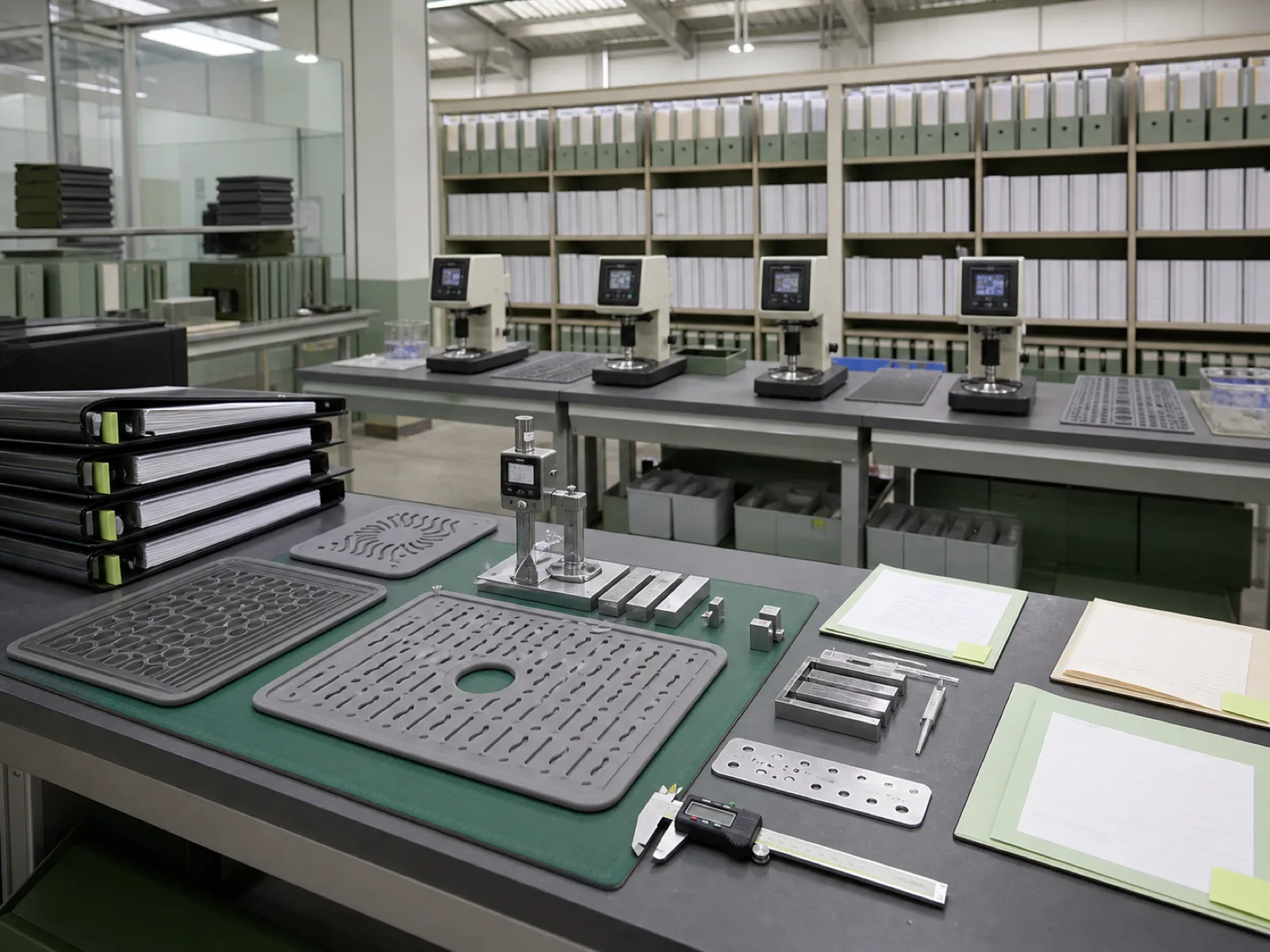
A silicone sink mat OEM program runs on a compliance stack of FDA 21 CFR 177.2600, LFGB §30/§31, and ISO 9001 batch traceability; MOQ 500 units per SKU on real tooling; Shore A 55-70 durometer at 4-8 mm thickness; and cure-system choice between platinum-cure (premium, EU, PFAS-free positioning) and post-cured peroxide-cure (Tier 2 chain private-label economics). A 40 HQ container ships 8,000-14,000 finished units at 35-45 day FOB Yantian lead time from PO.
## What is a silicone sink mat and why does the service envelope matter for material choice?A silicone sink mat is an elastomeric protective liner that sits inside a stainless steel or fireclay sink basin to buffer dropped cookware, protect the basin finish from abrasion, and provide drainage lanes. The service envelope — food-adjacent contact, dropped-glassware impact, near-boiling water contact at 95-100°C, dishwasher thermal cycles up to 90°C, and residual acid or alkali exposure — eliminates PVC, TPE, EVA, and TPU on either safety or durability grounds and leaves food-grade silicone as the working answer.
The material screen runs quickly. PVC fails on plasticizer migration and phthalate content flagged under EU REACH and US CPSIA scrutiny. TPE and TPU deform permanently at repeated 90°C dishwasher exposure. EVA yellows and hardens under UV plus thermal cycles. Natural rubber grows and cracks under the citric acid and dish detergent exposure that lives around a sink drain corridor. Food-grade silicone — polydimethylsiloxane elastomer with the appropriate compliance package — clears the temperature envelope of -40°C to 230°C[^astm-d5296], is inherently plasticizer-free, resists dishwasher chemistry, and holds its Shore A durometer through multi-year service. The [silicone temperature range explainer](/guide/silicone-temperature-range-explained/) covers the underlying test methods. The engineering distinction matters for spec-writing. The service envelope drives cure-system choice, thickness and durometer selection, and the compliance stack — not the other way around. A buyer who spec's "silicone sink mat, FDA compliant, 500 pieces" has skipped the four-variable decision that determines whether the finished product survives a two-year retail rotation. ## Which compliance certifications are required for the OEM program?Three baseline layers are required for any silicone sink mat program crossing into US or EU retail. FDA 21 CFR 177.2600[^fda-177-2600] covers US food-contact rubber articles intended for repeated use. LFGB §30/§31 (technically grounded in BfR Recommendation XV[^bfr-lfgb-xv]) covers EU food-contact organic volatile extraction. ISO 9001:2015[^iso-9001] covers the documented batch traceability, cure records, and QC logs that make the first two auditable per production lot.
The three layers work together. FDA 177.2600 is a materials-composition regulation — it constrains which polymers, curing agents, and additives can appear in the finished part. LFGB §30/§31 is an extraction test — the finished product is exposed to food simulants (3% acetic acid, olive oil, distilled water, ethanol) at defined time-temperature conditions and the extracted material is measured against BfR limits. ISO 9001 is the process management standard that guarantees the results from batch #17 match the results from batch #217 because the same documented process ran both. Premium sink brand programs and EU-launched SKUs increasingly layer on top of the baseline: - **Per-batch PFAS non-detect analysis** at parts-per-billion detection limits. Not a legal requirement yet in most jurisdictions but table-stakes on premium retail RFQs given the ECHA universal restriction proposal[^echa-pfas-proposal] trajectory. - **EC Regulation 1935/2004[^ec-1935-2004]** — the EU framework food-contact regulation. LFGB is Germany's national implementation; a program launching multi-country in Europe references the framework regulation as the master. - **USP <88> biological reactivity documentation[^usp-class-vi]** when the sink mat program extends into infant-feeding accessory territory or a skin-adjacent use case. The [FDA vs LFGB decoder](/guide/fda-vs-lfgb-silicone/) walks the practical differences and per-batch test-report interpretation. On the sourcing side, the question that separates serious OEMs from repackagers is whether they can produce a per-batch third-party report referencing the master-batch lot number — not a two-year-old material certificate from the compound house.
Platinum-cure is the right default for premium sink brand programs, EU-launched SKUs, and any program carrying PFAS-free marketing positioning. Post-cured peroxide-cure with disciplined 4-6 hour 180-200°C post-cure fits Tier 2 chain private-label economics at mid-tier shelf price points. Both cure systems clear FDA 21 CFR 177.2600 and LFGB §30/§31 when properly cured. The premium is 15-25% per unit and recovers when retail tier or regulatory scope requires the documentation.
Platinum-cure uses a platinum-complex catalyst (Karstedt's catalyst) to drive a hydrosilylation reaction that produces no cure byproducts. The finished elastomer has no residual acetophenone or α-methylstyrene, no first-heat odor, and clears the extractables profile for USP Class VI and medical-adjacent applications on standard formulation. It is inherently PFAS-free — the chemistry does not use PFAS process aids. Peroxide-cure uses an organic peroxide (typically dicumyl peroxide) that decomposes during cure and leaves trace organic volatiles behind. Those volatiles must be driven off during a 4-6 hour post-cure at 180-200°C. Correctly post-cured peroxide-cure silicone clears LFGB §30/§31 organic volatile testing and matches platinum-cure on food-safety measured performance. Incorrectly post-cured peroxide-cure ships product with a slight first-heat odor and fails EU premium audit — the failure mode is process discipline, not chemistry. The four-variable decision for sink mat programs: | Program dimension | Suggests platinum-cure | Suggests peroxide-cure | |---|---|---| | Retail tier | Premium sink brand / EU premium / DTC | Tier 2 chain private label / mass-retail | | Regulatory scope | LFGB + PFAS non-detect + EC 1935/2004 | FDA 21 CFR 177.2600 baseline + post-cured LFGB | | PFAS-free marketing claim | Yes — inherent to the chemistry | Possible, requires per-batch verification | | Unit-cost sensitivity | Not the primary constraint | Primary constraint | The full decision matrix, including cost delta modeling and regulatory drift insurance, lives in the [platinum vs peroxide cured silicone OEM guide](/guide/platinum-cured-vs-peroxide-cured-silicone/). ## What MOQ, tooling, and pricing tiers should a sink mat OEM quote?MOQ 500 units per SKU is the honest floor on real custom tooling. Unit price drops roughly 18-28% moving from 500 to 5,000 units as tooling amortizes, secondary process cycles consolidate, and post-cure oven runs fill efficiently. Below 500, per-batch third-party compliance testing cost dominates unit economics and no reputable OEM can quote sustainably without hiding tooling amortization inside the per-unit line.
Tooling for a silicone sink mat program runs in two stages: - **Pilot tooling** — buyer-owned aluminum mold, 300-500 shots per cavity, priced $800-2,500 depending on cavity count and geometry complexity. Used for first-article samples, retail-shelf mock-ups, and the first 100-500 unit production run to validate geometry against basin fit. - **Volume tooling** — buyer-owned P20 hardened steel mold, 500,000+ shots per cavity, priced $4,000-15,000. Used for ongoing production once the SKU is retail-approved and the geometry is frozen. P20 amortizes across multi-year programs and holds tolerance through five to seven-figure unit volumes. Tooling ownership terms belong in the PO in writing. Standard Wetop terms: buyer owns the tool on final tooling payment; tool dimensional records archived per ISO 9001[^iso-9001]; mold-transfer clause allows the buyer to relocate the tool to a dual-source or successor supplier at any time. Suppliers who refuse buyer-owned tooling are locking the program into single-source pricing leverage — the [real factory MOQ math guide](/guide/real-factory-moq-the-math/) walks the economics. Indicative pricing bands for a standard 300 × 400 × 6 mm silicone sink mat, post-cured peroxide-cure, Shore A 60, FDA + LFGB per-batch reports: | MOQ tier | Unit price band (FOB Yantian) | Lead time from PO | Notes | |---|---|---|---| | 500 units | 100% baseline | 35-45 days | Pilot tooling amortized into first PO or paid separately | | 1,000 units | -8% to -12% | 35-45 days | Same tooling as 500; savings from oven-fill and secondary process consolidation | | 2,500 units | -14% to -20% | 40-50 days | Same tooling; further oven-fill and packing consolidation | | 5,000+ units | -18% to -28% | 45-55 days | P20 volume tooling investment justifiable; savings compound | Platinum-cure runs 15-25% above these bands at every tier. The [silicone OEM pricing structure guide](/guide/silicone-oem-pricing-structure/) breaks down the line items behind each band. ## What are the mechanical spec ranges for a silicone sink mat?Shore A 55-70 durometer, thickness 4-6 mm at drain corridor and 6-8 mm at load-bearing footprint, tensile strength ≥ 7 MPa, tear strength ≥ 25 kN/m, and dimensional tolerance ±0.15 mm on outer envelope. Softer than Shore A 50 deforms under sustained cookware load; harder than Shore A 75 doesn't grip the basin surface and transmits impact noise. Measurement runs per ASTM D2240[^astm-d2240] on durometer and per D412 / D624 on tensile and tear respectively.
The mechanical envelope is not aesthetic — it's derived from the actual service loads a sink mat sees over a two-year retail rotation. | Property | Target range | Test method | Why the range matters | |---|---|---|---| | Shore A durometer | 55-70 | ASTM D2240[^astm-d2240] | Below 50: permanent set under cast-iron cookware. Above 75: no basin grip, transmits impact. | | Thickness at drain corridor | 4-6 mm | Digital caliper per drawing | Drainage flow rate requires thin section; too thin fails at fold-over impact. | | Thickness at footprint | 6-8 mm | Digital caliper per drawing | Load-bearing zone; too thin telegraphs cookware impact into basin. | | Tensile strength | ≥ 7 MPa | ASTM D412 | Survives fold-and-store retail packaging and stainless corner-abrasion cycles. | | Tear strength | ≥ 25 kN/m | ASTM D624 (die B) | Resists drain-slot tear propagation under repeated wet-dry-fold cycles. | | Compression set | ≤ 20% after 22h @ 100°C | ASTM D395 method B | Recovers shape after sustained cookware load storage. | | Dimensional tolerance | ±0.15 mm on outer envelope | CAD-referenced dimensional inspection | Fits published sink basin dimensions across brand model range. | | Temperature service envelope | -40°C to 230°C | ASTM D5296[^astm-d5296] | Covers freezer-to-boiling-water-to-dishwasher swing. | The [sink grid fit guide](/guide/sink-grid-fit-guide-kraus-ruvati-blanco/) covers the dimensional-tolerance side of specifying a sink mat against basin geometry from Kraus, Ruvati, VIGO, Kohler, Blanco, Elkay, Houzer, and Karran caliber sink brands. The dimensional strategy is not "one size fits all" — it's SKU-per-basin-family with shared tooling geometry. ## What does the QC protocol look like from raw silicone to shipped carton?Four QC gates. Incoming: master-batch lot COA plus per-batch third-party FDA and LFGB reports. In-process: durometer to ASTM D2240 every 500 pieces, dimensional gauge to CAD ±0.15 mm, cure-cycle time and temperature logged per press. Post-cure: 180-200°C for 4-6 hours in calibrated oven with batch log retained 36 months minimum. Final: AQL 2.5 for major defects, AQL 1.0 for critical, per ISO 2859-1[^iso-2859-1] sampling standard.
Each gate produces a document that references the master-batch lot number, and every document is auditable back to the raw silicone gum from the compound house of record.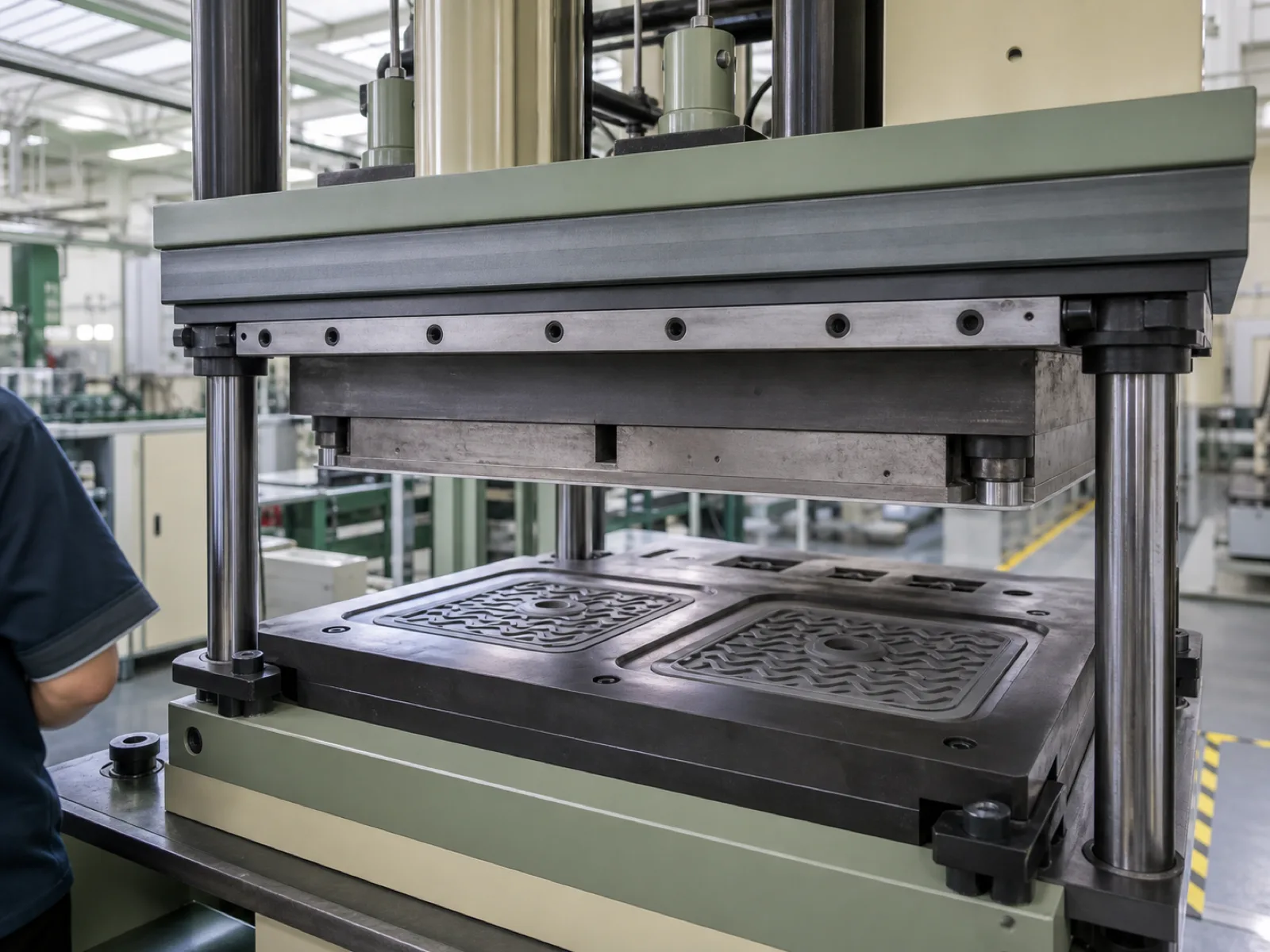
A 40 HQ container ships roughly 8,000-14,000 finished silicone sink mats depending on carton nesting geometry. Typical spec: 300 × 400 × 6 mm sink mat, 24 pieces per master carton (380 × 320 × 250 mm), 20 masters per pallet, 20-22 pallets per 40 HQ. FOB Yantian lead time is 35-45 days from PO for a 5,000-unit run; Wetop's Dongguan floor is 90 minutes from Yantian Port and 2 hours from HKG airport for airfreight of first-article samples.
Packaging structure is written into the PO alongside the mechanical spec: - **Unit packaging** — polybag with retail-ready hang-tag or private-label sleeve on retail-launch SKUs; bulk polybag on wholesale programs. Poly thickness 0.04-0.06 mm depending on retail chain spec. - **Inner box** — 6 or 12 units per inner, printed with SKU and barcode or unbranded for retailer over-packaging downstream. - **Master carton** — 24 pieces per master is the typical density for a 300 × 400 × 6 mm sink mat; 5-ply corrugated at 380 × 320 × 250 mm holds crush strength through container stacking. - **Pallet** — Euro or US standard depending on destination; heat-treated ISPM 15 compliant. - **Container** — 40 HQ loadability 8,000-14,000 units depending on carton nesting and pallet vs floor-load choice. The 35-45 day FOB Yantian lead time breaks down: tooling if new (14-21 days), material lead from the compound house (7 days), production and post-cure (10-14 days), final QC and packing (3-5 days), inland trucking to Yantian and terminal cutoff (2-3 days). On repeat POs with existing tooling, the front 14-21 days collapse and lead time drops to 21-28 days. The [MOQ and lead time on custom silicone kitchenware guide](/guide/moq-and-lead-time-silicone-oem/) covers the scheduling side in depth. ## What retail tier and channel fit does a silicone sink mat OEM target?Two primary channels. First: sink brand OEM programs where the sink brand licenses the mat as an accessory SKU under their master brand — the mat's fit and finish must match the sink line. Second: Tier 2 retail chain private label — home improvement chain private-label, wholesale club private-label, wholesale specialty chain private-label — where the mat carries the retailer's brand and price-tier positioning drives the spec choices.
The two channels diverge on almost every spec decision. **Sink brand OEM programs** live in premium retail. The buyer is a product manager at a sink brand (Kraus, Ruvati, VIGO, Kohler, Blanco, Elkay, Houzer, Karran caliber) launching a first-party accessory line. Spec defaults: platinum-cure or post-cured peroxide-cure with per-batch PFAS non-detect; Shore A 60-65; premium debossed logo integrated into tooling; three to five colorways matched to sink finish family; retail packaging designed to hang alongside the sink or ship as an included accessory in the sink carton. MOQ typically 1,000-2,500 per SKU at launch, scaling to 5,000+ once the SKU proves in retail. **Tier 2 chain private-label programs** live in mid-tier retail. The buyer is a private-brand manager at a home improvement chain, wholesale club, or wholesale specialty chain. Spec defaults: post-cured peroxide-cure to hit the shelf-price point; Shore A 55-70; single or two-color program; simple hang-tag packaging or bulk retail carton. MOQ typically 2,500-10,000 per SKU per PO with quarterly or semi-annual replenishment cadence. The [private-label silicone kitchen products guide](/guide/private-label-silicone-kitchen-products/) covers the branding, tooling ownership, and non-compete clause language specific to Tier 2 chain private-label engagements. The [customize silicone logo guide](/guide/customize-silicone-logo-deboss-print-laser/) covers deboss vs pad-print vs laser marking durability trade-offs for both channels. ## What are the RFQ-ready spec fields any silicone sink mat OEM should ask for?A serviceable RFQ specifies twelve fields before quote: SKU geometry with CAD, target basin fit list, cure system (platinum or post-cured peroxide), Shore A durometer target, thickness at drain corridor and footprint, tensile and tear minimums, dimensional tolerance, compliance stack (FDA / LFGB / PFAS non-detect / USP <88>), colorway and Pantone reference, branding treatment (deboss / laser / pad-print), packaging structure, and MOQ tier for pricing bracket.
A minimal but honest RFQ template Wetop can quote against in one round: 1. SKU geometry — CAD (STEP or IGES) or dimensional drawing with tolerance callouts. 2. Target basin fit list — sink brand and model numbers the mat must fit inside. 3. Cure system — platinum-cure or post-cured peroxide-cure. 4. Shore A durometer target — nominal ±5. 5. Thickness zones — drain corridor and footprint, ±0.15 mm. 6. Tensile and tear minimums — MPa and kN/m respectively. 7. Compliance stack — FDA 21 CFR 177.2600, LFGB §30/§31, PFAS non-detect, USP <88> as applicable. 8. Colorway and Pantone or masterbatch reference — one or multiple. 9. Branding treatment — deboss, laser mark, pad-print, unbranded. 10. Packaging structure — unit poly, inner, master carton, pallet, container mode. 11. MOQ tier — 500 / 1,000 / 2,500 / 5,000+ for pricing bracket. 12. Target FOB or DDP destination — Yantian FOB, Long Beach DDP, Hamburg DDP.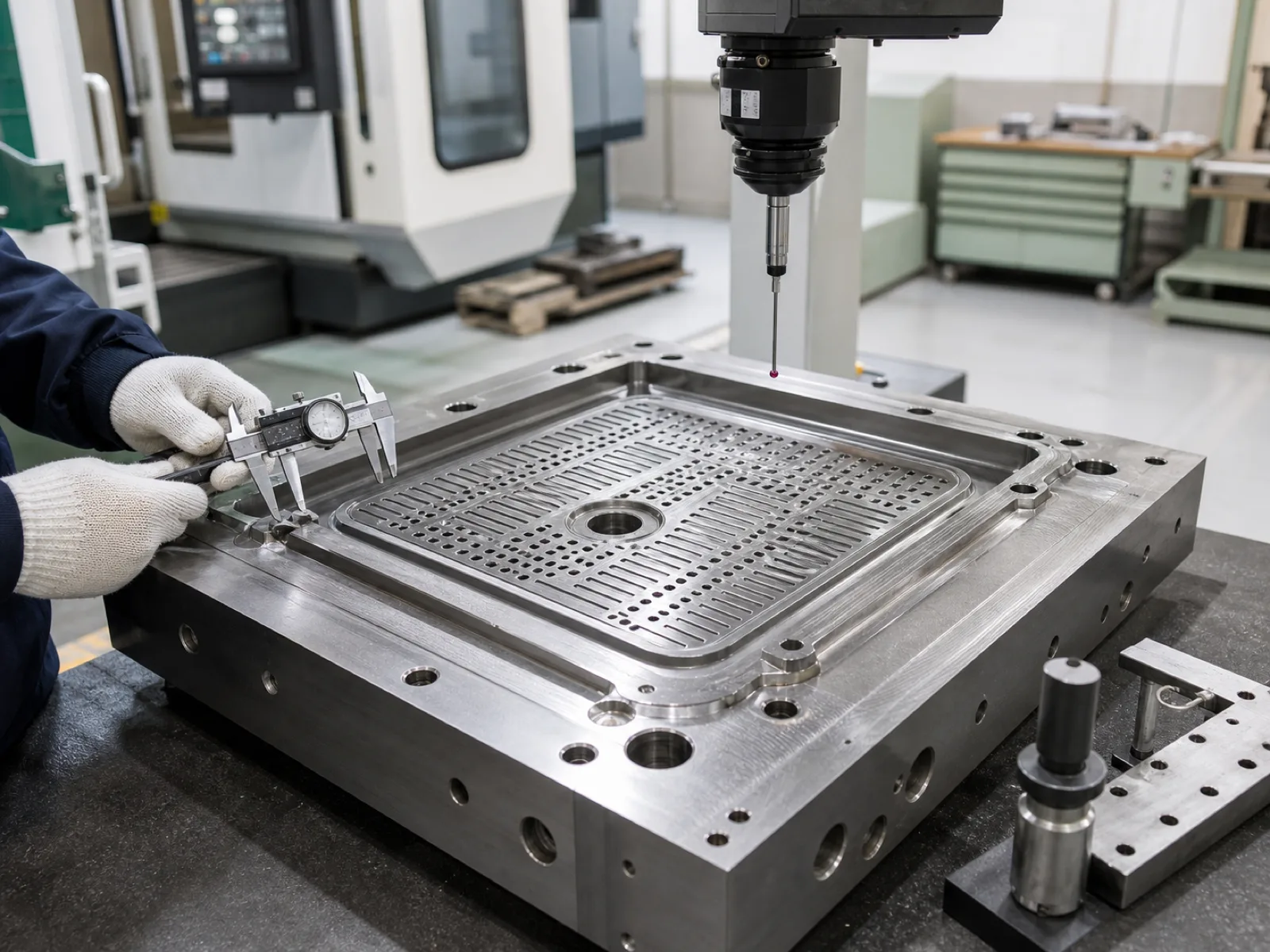
Wetop runs silicone sink mat OEM programs for sink brand accessory lines and Tier 2 chain private-label at MOQ 500 per SKU, platinum-cure or post-cured peroxide-cure, FDA 21 CFR 177.2600 plus LFGB §30/§31 plus per-batch PFAS non-detect testing on request, buyer-owned tooling (aluminum pilot or P20 volume), Shore A 55-70 to spec, 35-45 day FOB Yantian lead time from PO. Founder-led, ISO 9001 certified, Dongguan, since 2008.
Default program shape: - **MOQ 500 per SKU** on either cure system with real (not shared) tooling. - **Platinum-cure** default for premium sink brand / EU / PFAS-free positioning; **post-cured peroxide-cure** default for Tier 2 chain private-label economics. - **Per-batch FDA + LFGB third-party test reports** referencing master-batch lot number, from SGS / Intertek / TÜV / Bureau Veritas. - **Per-batch PFAS non-detect analysis** available on request; USP <88> extract testing available on medical-adjacent programs. - **Buyer-owned tooling** — aluminum pilot (300-500 shots) or P20 hardened steel volume (500,000+ shots), with dimensional records archived per ISO 9001 and mold-transfer clause on request. - **Shore A 55-70** durometer to spec, thickness 4-6 mm drain corridor and 6-8 mm footprint, dimensional tolerance ±0.15 mm. - **35-45 day FOB Yantian lead time** from PO on new-tooling programs; 21-28 days on repeat POs with existing tooling. Sourcing a silicone sink mat program? Email inquiry@wetopsilicone.com with your CAD or dimensional sketch, target sink basin fit list, target retail tier, and compliance scope — we return with a cure recommendation, spec sheet, per-batch documentation packet, and pricing at MOQ 500 / 1,000 / 2,500 / 5,000. Full manufacturing detail on [our capabilities page](/capabilities/); mutual NDA template on the [NDA page](/nda/). [^fda-177-2600]: US Food and Drug Administration. *21 CFR 177.2600 — Rubber articles intended for repeated use.* https://www.ecfr.gov/current/title-21/chapter-I/subchapter-B/part-177/subpart-C/section-177.2600 — the primary US food-contact regulation for silicone sink mats. [^bfr-lfgb-xv]: German Federal Institute for Risk Assessment (BfR). *Recommendation XV — Silicones.* https://www.bfr.bund.de/cm/349/xv-silicones.pdf — the technical standard behind LFGB §30/§31 organic volatile extraction testing. [^iso-9001]: International Organization for Standardization. *ISO 9001:2015 — Quality Management Systems — Requirements.* https://www.iso.org/standard/62085.html — the quality management standard Wetop is certified against. [^iso-2859-1]: International Organization for Standardization. *ISO 2859-1:1999 — Sampling procedures for inspection by attributes.* https://www.iso.org/standard/1141.html — the AQL sampling standard Wetop uses for final-QC acceptance. [^astm-d2240]: ASTM International. *ASTM D2240-15 — Standard Test Method for Rubber Property—Durometer Hardness.* https://www.astm.org/d2240-15r21.html — the Shore A hardness measurement standard. [^usp-class-vi]: United States Pharmacopeia. *USP <88> — Biological Reactivity Tests, In Vivo.* https://www.usp.org/harmonization-standards/pdg/excipients/plastic-materials — the biological reactivity classification standard for medical-grade elastomers. [^echa-pfas-proposal]: European Chemicals Agency. *PFAS Universal Restriction Proposal.* https://echa.europa.eu/hot-topics/perfluoroalkyl-chemicals-pfas — the regulatory action driving PFAS-free spec adoption in EU premium retail. [^ec-1935-2004]: European Parliament and Council. *Regulation (EC) No 1935/2004 — Materials and articles intended to come into contact with food.* https://eur-lex.europa.eu/legal-content/EN/TXT/?uri=CELEX%3A02004R1935-20090807 — the EU framework food-contact regulation. [^astm-d5296]: ASTM International. *ASTM D5296-19 — Standard Test Method (Silicone Elastomers).* https://www.astm.org/d5296-19.html — silicone elastomer characterization test method. --- **Ready to source?** Every quote is built against your specification — send a CAD file, a written brief, or reference samples, and an engineer replies within one business day. [Request a quote →](/contact/)