---
title: "Silicone Straw Wholesale — Buyer's Guide"
description: "A founder-led factory guide to sourcing silicone straws wholesale: MOQ tiers, per-unit pricing bands, platinum vs peroxide cure, FDA and LFGB compliance, baby-safe QC."
primaryKeyword: "silicone straw wholesale"
secondaryKeywords:
- "wholesale silicone straws OEM"
- "custom silicone straw manufacturer"
- "baby silicone straw supplier"
- "food grade silicone straw factory"
- "reusable silicone straw private label"
searchIntent: commercial
category: "Buyer Guide"
author:
name: "Wetop Silicone Engineering Team"
credential: "ISO 9001 certified silicone manufacturer since 2008"
datePublished: 2026-07-09
dateModified: 2026-07-09
heroImage: "/images/guides/silicone-straw-wholesale-buyers-guide/hero.webp"
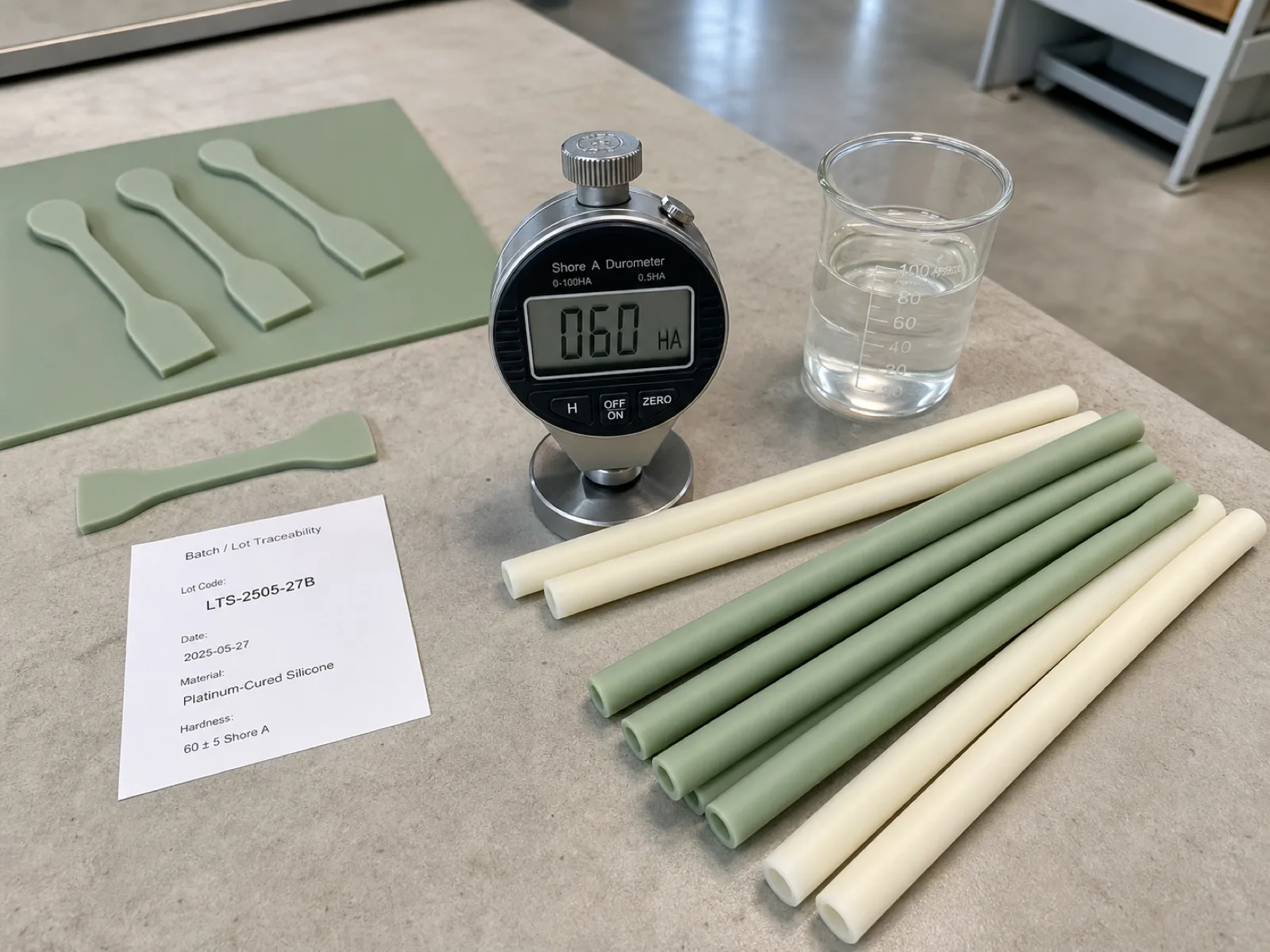
heroImageAlt: "QC bench inspection of platinum-cured silicone straw samples in sage and cream colorway at a Dongguan silicone factory, showing durometer gauge, calipers, and a batch coupon awaiting migration testing for a baby brand OEM order."
keyTakeaways:
- "Wholesale silicone straw MOQs at a real factory start at 500 pcs per SKU per Pantone color; per-unit FOB Shenzhen prices land at 0.28-0.42 USD (500 pcs), 0.19-0.28 USD (1,000 pcs), 0.12-0.18 USD (5,000 pcs), and 0.08-0.13 USD (10,000+ pcs) for a standard 21 cm straight straw."
- "Only platinum-cured (addition-cure) silicone belongs in a baby or toddler straw program — peroxide-cured stock releases 2,4-dichlorobenzoic acid byproducts and is disqualified under EN 14350-1 §5.3 for repeated-use liquid-contact articles for young children."
- "Every US retail SKU needs an FDA 21 CFR 177.2600 test report against the actual production lot; every EU SKU needs an LFGB §30/§31 report plus REACH SVHC declaration — factories that hand you a generic PDF instead of a lot-tied COA are trading companies, not manufacturers."
- "Shore A hardness for infant and toddler straws sits at 40-50 A for a soft, gum-friendly bite; adult reusable straws run 55-70 A for stem rigidity in a drink lid. Above 70 A silicone chips instead of flexing."
- "Tooling for a single-cavity aluminum compression mold runs 600-1,800 USD and 15-25 days; a 6-cavity steel tool for 50,000+ annual units runs 3,000-6,500 USD and 30-45 days. Sampling turns in 7-15 days from art-approval."
- "Ocean LCL from Yantian to Los Angeles runs 0.014-0.022 USD per straw all-in at CBM-density typical of retail-packed straws (approx. 900 pcs per carton, 12 kg, 0.045 CBM); air freight only makes sense for first-order samples or launch-window pallets."
- "HS code for silicone drinking straws is 3924.90.5650 (US) — general MFN duty rate 3.4%, currently subject to a 25% Section 301 surcharge on China-origin as of 2026-07."
faqs:
- question: "What is the real MOQ for a wholesale silicone straw order from a factory?"
answer: "500 pieces per SKU per Pantone-matched color at Wetop. That is per finished configuration — a straight 21 cm straw in sage green is one SKU; the same straw in cream is a second SKU. Trading companies quote 100-piece MOQs by consolidating your order into someone else's production run, which is why lot traceability and color consistency fall apart."
- question: "How much does a silicone straw cost wholesale at different quantities?"
answer: "For a standard 21 cm x 8 mm OD straight straw in platinum-cured food-grade silicone, FOB Shenzhen: 0.28-0.42 USD at 500 pcs, 0.19-0.28 USD at 1,000 pcs, 0.12-0.18 USD at 5,000 pcs, 0.08-0.13 USD at 10,000+ pcs. Collapsible, bent, and reusable-with-brush configurations run 20-60% higher because of extra cavities, assembly, or a bundled cleaning brush."
- question: "Are silicone straws safe for babies and toddlers?"
answer: "Only when they are platinum-cured food-grade silicone, tested against FDA 21 CFR 177.2600 and LFGB §30/§31, with Shore A hardness in the 40-50 A range for the mouthpiece section. EN 14350-1 (child-use articles for liquid) is the specific European standard covering silicone drinking-aid components for young children — insist on a lot-tied test report, not a generic factory PDF."
- question: "What is the difference between platinum-cured and peroxide-cured silicone for straws?"
answer: "Platinum-cured silicone uses a platinum-complex catalyst that leaves no byproducts. Peroxide-cured silicone uses organic peroxides that produce 2,4-dichlorobenzoic acid residues, which is why it needs an aggressive post-cure and is disqualified for repeated liquid-contact baby articles. For any straw touching a mouth daily, specify platinum cure on the RFQ. See our [platinum-cured vs peroxide-cured silicone comparison](/guide/platinum-cured-vs-peroxide-cured-silicone/) for the full failure-mode breakdown."
- question: "How long is the lead time for a private-label silicone straw order?"
answer: "Sampling: 7-15 days from art-approval to physical T1 sample. Production for a first order on a new tool: 25-35 days after sample approval and deposit. Repeat orders on existing tooling: 18-25 days. Custom Pantone masterbatch adds 5-7 days for the first run only. Air-freight samples ship 3-4 days from Shenzhen."
- question: "Can we customize color, length, diameter, and logo on silicone straws?"
answer: "Yes — at Wetop's MOQ of 500 pcs per SKU, Pantone-matched masterbatch, custom length (14-30 cm typical), custom outer diameter (6-12 mm), and in-mold debossed logo are included without a separate setup fee. Screen-printed or pad-printed logos add 0.03-0.06 USD per piece and are not recommended for the mouthpiece area. See our [logo customization methods guide](/guide/customize-silicone-logo-deboss-print-laser/) for the durability tradeoff."
- question: "What certifications should a wholesale silicone straw supplier provide?"
answer: "Non-negotiable: FDA 21 CFR 177.2600 (US), LFGB §30/§31 (EU), REACH SVHC declaration. For baby/toddler SKUs add: EN 14350-1 (EU child liquid-use articles), EN 71-3 migration of certain elements, CPSIA lead and phthalate compliance (US, 16 CFR 1500 and 1501). Every report must reference the actual production lot number, not just the material grade."
- question: "How do I tell a real silicone straw factory from a trading company?"
answer: "Ask for the production floor address, the ISO 9001 certificate scope (must list silicone molding), and a video walk of the compression presses or LSR injection lines. Request a lot-tied FDA test report for a shipment you can verify — a trading company can only forward the mill's certificate, not tie it to your production run. Our [factory sourcing checklist](/guide/sourcing-silicone-factory-checklist/) covers the 12 questions that separate the two."
- question: "What are the most common defects to inspect on a silicone straw shipment?"
answer: "Five failure modes account for most returns: flash at the mouthpiece parting line (must be trimmed and post-buffed), color drift across cavities (Pantone Delta-E > 2.0 rejected), residual mold-release oil surface tack, chemical odor from skipped post-cure, and cross-section pinch or wall-thickness drift on collapsible designs. AQL 2.5 general, AQL 1.0 critical (mouthpiece) is the standard specification for US retail."
- question: "What is the ocean freight cost per silicone straw from China to the US or EU?"
answer: "Ocean LCL Yantian to Los Angeles: approximately 0.014-0.022 USD per straw all-in at retail-packed density (approx. 900 pcs per carton, 12 kg, 0.045 CBM). Yantian to Rotterdam or Hamburg: 0.018-0.028 USD per straw. Air freight runs 8-12x higher and only pencils for launch samples or Amazon replenishment during a stock-out. HS code 3924.90.5650 (US), 3924.9000 (EU)."
references:
- id: fda-177-2600
title: "21 CFR 177.2600 — Rubber articles intended for repeated use"
publisher: "US Food and Drug Administration"
url: "https://www.ecfr.gov/current/title-21/chapter-I/subchapter-B/part-177/subpart-C/section-177.2600"
note: "The federal migration-limits regulation governing repeated-use rubber articles in food contact — the specific citation any US silicone straw importer must have on file per production lot."
- id: en-14350
title: "EN 14350-1:2020 — Child use and care articles — Drinking equipment — Part 1: General and mechanical requirements and tests"
publisher: "European Committee for Standardization (CEN)"
url: "https://standards.iteh.ai/catalog/standards/cen/6bfd6f13-5c15-4b76-9bab-5e77f5e3541f/en-14350-1-2020"
note: "The EU harmonized standard covering silicone straws, spouts, and drinking-aid components intended for young children — the compliance backbone for European baby-brand retail listings."
- id: iso-9001
title: "ISO 9001:2015 — Quality Management Systems — Requirements"
publisher: "International Organization for Standardization"
url: "https://www.iso.org/standard/62085.html"
note: "The documented QMS Wetop's compression and LSR injection lines are certified against, including batch traceability required for lot-tied straw COAs."
- id: astm-d2240
title: "ASTM D2240 — Standard Test Method for Rubber Property — Durometer Hardness"
publisher: "ASTM International"
url: "https://www.astm.org/d2240-15r21.html"
note: "The Shore A hardness test protocol referenced on every silicone straw drawing — the specification distinguishing a soft toddler mouthpiece (40-50 A) from an adult reusable straw (55-70 A)."
- id: cpsia
title: "Consumer Product Safety Improvement Act of 2008 — 15 U.S.C. §§ 2051 et seq."
publisher: "US Consumer Product Safety Commission"
url: "https://www.cpsc.gov/Regulations-Laws--Standards/Statutes/The-Consumer-Product-Safety-Improvement-Act"
note: "The US statute setting lead-content and phthalate limits for children's products under 12 — mandatory for any silicone straw sold in the US kids' or baby category."
- id: echa-reach
title: "REACH — Registration, Evaluation, Authorisation and Restriction of Chemicals (Regulation EC 1907/2006)"
publisher: "European Chemicals Agency (ECHA)"
url: "https://echa.europa.eu/regulations/reach/understanding-reach"
note: "The EU chemicals regulation requiring an SVHC declaration on every silicone straw shipment entering the European market — the compliance layer that sits above LFGB."
- id: bfr-xv
title: "BfR Recommendation XV — Silicones"
publisher: "German Federal Institute for Risk Assessment (BfR)"
url: "https://bfr.ble.de/kse/faces/resources/pdf/360-english.pdf"
note: "The material-composition and migration-testing framework LFGB §30/§31 silicone straw tests are constructed against."
- id: usitc-hts-3924
title: "Harmonized Tariff Schedule of the United States — Heading 3924 (Tableware, kitchenware, other household articles of plastics)"
publisher: "US International Trade Commission"
url: "https://hts.usitc.gov/"
note: "The HTS code (3924.90.5650) applied to silicone drinking straws at US customs, and the source-of-record for the 3.4% MFN duty and China-origin Section 301 surcharge."
relatedGuides:
- platinum-cured-vs-peroxide-cured-silicone
- customize-silicone-logo-deboss-print-laser
- sourcing-silicone-factory-checklist
featured: false
recommended: false
---
Wholesale silicone straws at a real factory start at a 500-piece MOQ per SKU per Pantone color, with FOB Shenzhen pricing landing at 0.28-0.42 USD at 500 pcs and dropping to 0.08-0.13 USD at 10,000+ pcs for a standard 21 cm straight straw. Only platinum-cured food-grade silicone belongs in a baby or toddler straw — peroxide-cured stock is disqualified under EN 14350-1 for repeated liquid-contact articles for young children. Every US retail SKU needs an FDA 21 CFR 177.2600 test report tied to the production lot; every EU SKU needs an LFGB §30/§31 report plus REACH SVHC declaration.
Most silicone straw quotes you receive are not from factories. They are from trading offices that mark up a floor price from a real molding line in Dongguan or Xiamen, consolidate your 500-piece order into someone else's production run, and hand you a generic PDF instead of a lot-tied test report. This guide is a founder-led engineering brief — written by the same people who run the compression presses — on how to specify a silicone straw program that survives baby-brand retail QC, at pricing anchored to real factory economics.
## What does silicone straw wholesale actually cost per unit?
FOB Shenzhen wholesale pricing for a standard 21 cm × 8 mm OD platinum-cured silicone straight straw runs 0.28-0.42 USD at 500 pcs, 0.19-0.28 USD at 1,000 pcs, 0.12-0.18 USD at 5,000 pcs, and 0.08-0.13 USD at 10,000+ pcs. Collapsible, bent, and reusable-with-brush configurations sit 20-60% higher because of extra cavities, tip assembly, or bundled cleaning brushes.
| Quantity band | Straight 21 cm | Bent 24 cm | Collapsible w/ case | Reusable set (2 straws + brush + case) |
|---|---|---|---|---|
| 500 pcs | 0.28-0.42 USD | 0.34-0.52 USD | 0.85-1.30 USD | 1.40-2.10 USD |
| 1,000 pcs | 0.19-0.28 USD | 0.24-0.36 USD | 0.62-0.95 USD | 1.05-1.55 USD |
| 5,000 pcs | 0.12-0.18 USD | 0.15-0.22 USD | 0.42-0.65 USD | 0.75-1.10 USD |
| 10,000+ pcs | 0.08-0.13 USD | 0.11-0.16 USD | 0.32-0.48 USD | 0.58-0.85 USD |
Prices assume: platinum-cured food-grade silicone, Pantone-matched masterbatch, in-mold debossed logo, individual polybag, master carton labeling. Add 0.02-0.04 USD/pc for a hangtag insert, 0.03-0.06 USD/pc for pad-printed logo, 0.05-0.09 USD/pc for a printed retail box. See our [OEM pricing structure teardown](/guide/silicone-oem-pricing-structure/) for the material-labor-QC-overhead split behind these bands.
## What is the actual MOQ for a wholesale silicone straw order?
Wetop's MOQ is 500 pieces per SKU per Pantone color. A three-color capsule (sage / cream / rust) on the same straw geometry is a 1,500-piece minimum aggregate. A three-length lineup (short / standard / long) on the same three colors is 4,500 pieces aggregate. Trading companies quote 100-piece MOQs by piggybacking your order onto someone else's run — which is why color consistency and lot traceability fall apart.
An SKU is a finished configuration: a 21 cm straight straw in sage is one SKU; the same straw in cream is a second SKU; a 24 cm bent straw in sage is a third. Custom Pantone masterbatch, custom length within a 14-30 cm range, custom outer diameter (6-12 mm), and in-mold debossed logo are all included at the 500-per-SKU tier without a separate setup fee — the tooling amortizes over the first ~3,000 units across all colors on the shared cavity.
## Platinum-cured vs peroxide-cured silicone — why it matters for straws
Only platinum-cured (addition-cure) silicone belongs in a baby or toddler straw program. Peroxide-cured silicone releases 2,4-dichlorobenzoic acid byproducts that require aggressive post-cure to drive off; residual byproducts cause chemical odor, yellowing, and are disqualified under EN 14350-1 §5.3 for repeated-use liquid-contact articles for young children. For any straw touching a mouth daily, specify platinum cure on the RFQ and reject any factory that substitutes peroxide stock to hit a target price.
| Property | Platinum-cured (addition-cure) | Peroxide-cured |
|---|---|---|
| Catalyst | Platinum complex (Karstedt's) | Organic peroxides (DCBP, DCP) |
| Byproducts | None | 2,4-dichlorobenzoic acid + water |
| Post-cure required | Optional, 200 °C × 2-4 h for premium spec | Mandatory, 200 °C × 4-8 h to drive off byproducts |
| Odor after 30 days wet use | None | Persistent chemical note if post-cure skipped |
| Yellowing risk | Very low | Moderate to high |
| Baby / toddler straw spec | Compliant with EN 14350-1 §5.3 | Disqualified for repeated liquid-contact under EN 14350-1 |
| Cost premium | +8-15% material | Baseline |
The 8-15% material premium for platinum-cured stock is the single most consequential line item on a silicone straw RFQ. Trading companies routinely substitute peroxide stock to hit an aggressive target price, then hand you a generic material certificate that does not reference the actual production lot. Insist on a **lot-tied FDA 21 CFR 177.2600 test report**[^fda-177-2600] — a trading company physically cannot produce this because they do not own the mold or the compound.
## What certifications and test reports do baby-safe silicone straws need?
Non-negotiable baseline: FDA 21 CFR 177.2600 for the US[^fda-177-2600], LFGB §30/§31 for the EU (backed by BfR Recommendation XV[^bfr-xv]), and a REACH SVHC declaration for European market entry[^echa-reach]. For baby and toddler SKUs, add EN 14350-1[^en-14350] for child liquid-use articles, EN 71-3 migration of certain elements, and CPSIA §101 lead and §108 phthalate compliance in the US[^cpsia]. Every report must reference the actual production lot number.
Every production lot at Wetop generates a batch coupon that follows the shipment as a lot-tied test article — the difference between a factory certificate and a trading-company PDF.
The certification stack ladders up. FDA 177.2600 is the material-safety floor. LFGB §30/§31 is the German food-contact ceiling that most EU retailers accept as sufficient. REACH SVHC is a declaration layer that sits above LFGB and covers the 235-substance candidate list as of 2026. EN 14350-1 is the specific baby-safety overlay that adds mechanical drop, small-parts, and inhalable-fragment tests to the food-contact chemistry base. Miss any layer and your first EU retail listing gets pulled.
## Straw types, dimensions, and Shore A hardness for each use case
Four straw formats cover 90% of retail volume: straight (21 cm × 8 mm), bent (24 cm × 8 mm with a 45° gooseneck), collapsible (15 cm accordion in a carabiner case), and reusable set (two straws + cleaning brush + carry case). Shore A hardness runs 40-50 A for infant and toddler mouthpieces, 50-60 A for kid and everyday reusable, and 60-70 A for adult smoothie or boba straws where stem rigidity matters in a drink lid.
| Straw type | Length range | OD range | Shore A hardness | Primary use case |
|---|---|---|---|---|
| Infant / sippy | 12-16 cm | 6-8 mm | 40-45 A | Weaning cups, EN 14350-1 compliant baby brands |
| Toddler | 16-20 cm | 7-9 mm | 45-50 A | Sippy-to-open-cup transition, kids' brand retail |
| Standard reusable | 20-24 cm | 8-10 mm | 55-60 A | Adult reusable water bottle, cafe replacement straw |
| Boba / smoothie | 22-26 cm | 10-12 mm | 60-70 A | Bubble tea, thick smoothies, drink-lid stability |
| Bent (gooseneck) | 22-26 cm | 8-10 mm | 55-60 A | Adult drink-lid, accessibility SKUs |
| Collapsible | 12-15 cm folded | 8-10 mm | 55-65 A | On-the-go carabiner case, sustainability positioning |
Shore A hardness is measured per ASTM D2240[^astm-d2240] on a durometer gauge with a 15-second dwell. Below 40 A the mouthpiece gets mushy and dogs, toddlers, or an aggressive bite will chew through it in weeks; above 70 A the silicone starts to lose the flex advantage over a plastic or metal straw and chips at the tip when dropped on tile. The 40-70 A window is where silicone actually earns its category.
## What does the tooling and sampling process look like?
Sampling turns in 7-15 days from art-approval to physical T1 sample. Tooling for a single-cavity aluminum compression mold runs 600-1,800 USD and 15-25 days. A 6-cavity steel tool for 50,000+ annual units runs 3,000-6,500 USD and 30-45 days. Tooling amortizes across the first 3,000-5,000 units. See our [MOQ and lead time explainer](/guide/moq-and-lead-time-silicone-oem/) for the full timeline.
The critical decision at RFQ is aluminum-single-cavity versus steel-multi-cavity. Aluminum-single is right for a market test or a niche SKU under 10,000 annual units — low tooling cost, short lead time, but a slower cycle time that means per-piece labor stays high. Steel-multi is right the moment your annual forecast crosses 20,000 units — the higher upfront tooling pays back in 3-4 months of production because a 6-cavity steel tool cuts cycle time per piece by roughly 5×.
## Ocean freight, HS code, and landed cost math
Ocean LCL Yantian to Los Angeles runs approximately 0.014-0.022 USD per straw all-in at retail-packed density (approximately 900 pcs per carton, 12 kg, 0.045 CBM). Yantian to Rotterdam or Hamburg runs 0.018-0.028 USD per straw. Silicone straws clear US customs under HS code 3924.90.5650 at a 3.4% MFN duty rate, plus a 25% Section 301 China-origin surcharge in effect as of 2026-07[^usitc-hts-3924].
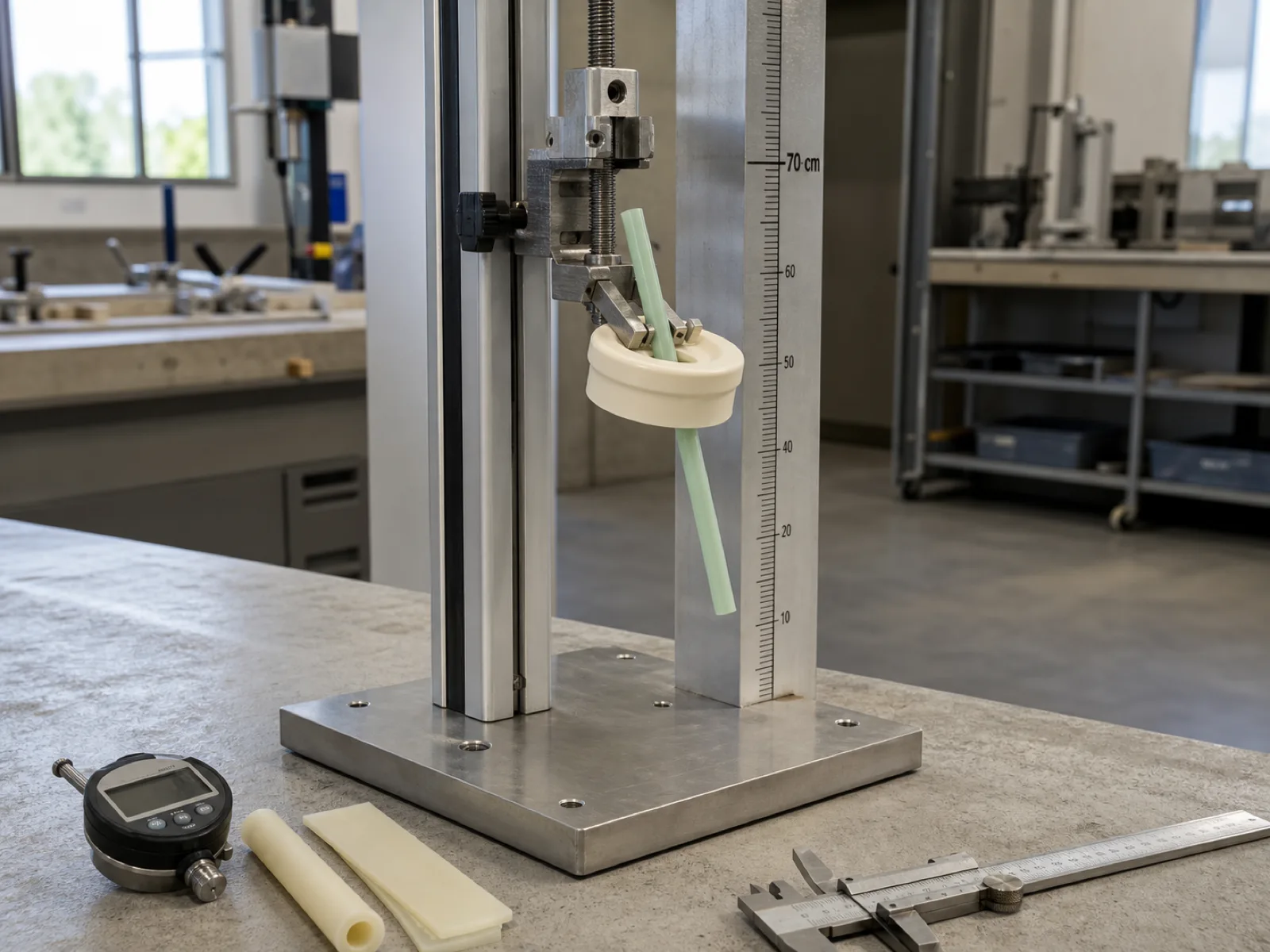
EN 14350-1 requires a 70 cm drop onto a hard surface without producing hazardous fragments — the mechanical test that qualifies a silicone straw for a European toddler brand.
A worked example: 10,000 pcs of a 21 cm straight straw at 0.11 USD FOB Shenzhen, shipped LCL to Los Angeles, lands at approximately 0.150-0.165 USD per piece all-in — factory price (0.11) + ocean LCL (0.018) + US 3.4% MFN duty on landed value (0.005) + Section 301 25% surcharge (0.028) + last-mile trucking to warehouse (0.004). At a 4.99 USD retail price point, this is a defensible 60-65% first-cost gross margin before Amazon fees or retail slotting.
## What are the most common defects and how does QC actually work?
Five failure modes account for most silicone straw returns: flash at the mouthpiece parting line, color drift across cavities (Pantone Delta-E > 2.0 rejected), residual mold-release oil surface tack, chemical odor from a skipped post-cure, and cross-section pinch or wall-thickness drift on collapsible designs. Wetop specifies AQL 2.5 general and AQL 1.0 critical (mouthpiece + food-contact surface) for US retail, verified against a hand-inspected sample from every carton.
Batch coupons — a small section of the same shot flow as the production straws — are cut, labeled with the lot code, and retained for two years. When a retailer questions a shipment three months later, the coupon goes to the same third-party lab that ran the original FDA 177.2600[^fda-177-2600] and LFGB §30/§31[^bfr-xv] tests. This is the difference between defending a claim in a Chewy or Amazon vendor-central dispute and losing the SKU. Full protocol is documented against ISO 9001[^iso-9001] and tensile strength per ASTM D412.
## Private label vs white label vs full custom mold — the decision framework
Three OEM tiers cover the wholesale silicone straw market. White label: existing tool, your color and logo on our stock geometry — MOQ 500 pcs, 18-25 day lead. Private label: existing tool, custom Pantone plus custom packaging plus retail-ready hangtags — MOQ 1,000 pcs, 25-30 day lead. Full custom mold: your geometry, tooling amortized over 5,000+ annual units — MOQ 2,000 pcs on first PO, 45-60 day first-run lead time.
| Tier | Tooling cost to brand | MOQ | Lead time (first PO) | Best fit |
|---|---|---|---|---|
| White label | 0 USD | 500 pcs | 18-25 days | Market test, gift-with-purchase, subscription-box add-on |
| Private label | 0-500 USD (packaging plates) | 1,000 pcs | 25-30 days | Retail launch, brand-first positioning, e-commerce hero SKU |
| Full custom mold | 800-6,500 USD (amortized) | 2,000 pcs | 45-60 days | Category-defining geometry, patentable feature, > 10K annual units |
Most first-time buyers over-index on full custom mold when white label would test the market at a fraction of the risk. The right question at RFQ is: what does the product need to look like that our stock geometry cannot achieve? If the answer is "custom Pantone and our logo," you are a white-label buyer. Our [factory sourcing checklist](/guide/sourcing-silicone-factory-checklist/) covers the six questions that separate a real factory quote from a trading-company markup on any of these tiers.
## Ready to source silicone straws from the factory floor?
Wetop is a 60-person, 7,500 m² silicone factory in Dongguan, ISO 9001 certified since 2008, running six compression presses and two LSR injection lines. We publish real MOQs, real per-unit price bands, and lot-tied FDA and LFGB test reports because that is what defends a baby-brand retail listing in an Amazon dispute or an EU market surveillance audit.
If you have a target retail price, a target annual unit volume, and a target certification stack, we can quote against them within 48 hours — no consolidated trading-company markup, no generic PDFs. **[Request a quote through our contact page](/contact/)** with your tech pack, brand deck, or a competitor SKU link and William Zhuo (founder + engineering lead) will route the RFQ directly to the compression-line manager.
[^fda-177-2600]: See References — FDA 21 CFR 177.2600.
[^en-14350]: See References — EN 14350-1:2020.
[^iso-9001]: See References — ISO 9001:2015.
[^astm-d2240]: See References — ASTM D2240.
[^cpsia]: See References — CPSIA 2008.
[^echa-reach]: See References — REACH (ECHA).
[^bfr-xv]: See References — BfR Recommendation XV.
[^usitc-hts-3924]: See References — USITC HTS Heading 3924.