---
title: "Silicone Temperature Range — Why -40°C to 230°C Is Standard"
description: "The thermal physics behind silicone kitchenware's wide service range, what 230°C means in practice, and how to spec for commercial vs residential use."
primaryKeyword: "silicone temperature range"
secondaryKeywords:
- "silicone kitchenware heat resistance"
- "silicone -40 to 230 explained"
- "high temperature silicone OEM"
- "silicone freezer dishwasher safe"
searchIntent: "informational"
category: "Manufacturing"
author:
name: "Wetop Silicone Engineering Team"
credential: "ISO 9001 certified silicone OEM, founder-led since 2008"
datePublished: 2026-05-16
dateModified: 2026-05-16
heroImage: "/images/guides/silicone-temperature-range-explained-hero.webp"
heroImageAlt: "Silicone product on a thermal test plate at 230°C with a frost-covered chamber at -40°C, engineering materials-testing setup"
keyTakeaways:
- "Standard food-grade silicone service range is -40°C to 230°C continuous, with short excursions to 250-260°C possible without material degradation."
- "The wide range comes from the Si-O backbone chemistry — stronger than C-C bonds in conventional plastics, with rotational freedom that prevents both brittleness at cold and softening at heat."
- "Specialized 'high-temperature' silicone compounds extend the upper end to 260-280°C continuous for sink-grid and cookware-contact applications. We use this compound for commercial / hospitality programs."
- "For freezer-to-oven kitchen accessories the spec is 'continuous service across the range', not peak excursions. Suppliers claiming 350°C+ are usually marketing the short-term limit, not the durability spec."
faqs:
- question: "What does '-40°C to 230°C' actually mean for kitchenware?"
answer: "It means continuous service across that range without measurable change in physical properties. The product can be used in a freezer at -40°C (deep freezer territory), at standard kitchen temperatures, in a dishwasher (typically 60-80°C wash, 70-90°C dry), and in an oven up to 230°C for the spec range. Short excursions to 250-260°C don't degrade the silicone but can cause cosmetic discoloration. For typical sink, counter, and dish-drying applications, the relevant range is closer to 0°C to 90°C."
- question: "Where does the 230°C upper limit come from?"
answer: "It's the conservative threshold where silicone polymer chains begin to show measurable thermal degradation in long-term continuous service. The chemistry can tolerate higher temperatures briefly — silicone can survive 300°C exposure for short durations without catastrophic failure — but at 230°C continuous, you can run the product through thousands of thermal cycles without seeing physical property change. Buyers spec'ing 'oven-safe' for cookware applications typically require 230-260°C continuous, which is at or just above standard food-grade silicone capability."
- question: "Why is the lower end -40°C if most freezers run -18°C?"
answer: "Buyer-side margin and shipping conditions. Standard residential freezers run -18°C, but products spec'd for global distribution need to survive deep-freeze conditions (commercial freezers, ice cream storage, cold-chain shipping in winter). Silicone's glass transition temperature is around -125°C — well below any kitchen application — and the -40°C spec is the rated service limit for routine use without measurable brittleness."
- question: "Are there silicone grades with higher temperature capability?"
answer: "Yes. Specialized high-temperature silicone compounds extend continuous service to 260-280°C, used for sink-bottom grid programs (where heavy cast-iron cookware might come out of a 230°C oven directly onto the grid) and commercial / hospitality applications. The premium is 10-15% over standard food-grade silicone and the compound requires a 500-piece MOQ. Buyers spec'ing 'beyond standard' should specify the working temperature requirement so we can recommend the right compound."
- question: "Does dishwasher use matter for temperature spec?"
answer: "Dishwasher temperatures (60-90°C) are well within standard silicone service range — temperature is not the failure mode in dishwashers. The real failure modes are detergent alkalinity (which can affect surface decoration like silk-screen) and mechanical agitation (which abrades surface coatings). Silicone substrate itself shows no measurable degradation across 500+ tested dishwasher cycles. Our standard formulation is fully top-rack dishwasher safe."
recommended: true
---
The "-40°C to 230°C" service range stamped on every food-grade silicone product is genuinely true, but it's worth understanding why the range is so wide and what it actually means for spec'ing a retail program. Here is the engineering reality behind the most-quoted silicone capability.
Food-grade silicone's standard service range is -40°C to 230°C continuous. The Si-O polymer backbone is stronger and more flexible than the C-C bonds in conventional plastics, giving silicone both cold-temperature toughness and heat resistance. For most kitchenware applications the relevant range is much narrower (0-90°C), but the wide rated range gives durability margin for freezer-to-oven retail positioning.
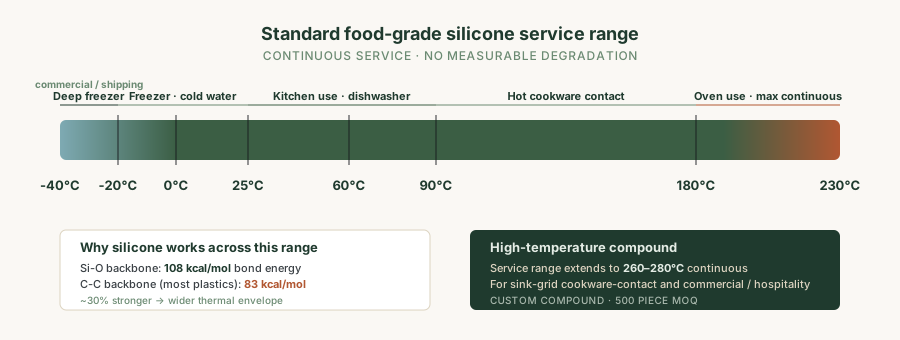
The range visualized against real kitchen-use zones:
Real kitchen use stays well inside the rated range. The margin between dishwasher (~80°C) and oven (~230°C) is the headroom that makes silicone the right material for freezer-to-oven retail positioning.
## Why silicone has such a wide service range
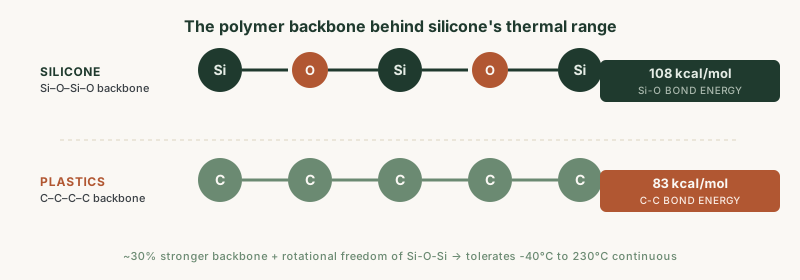
The performance comes from the **Si-O (silicon-oxygen) polymer backbone** chemistry. Compared to conventional plastics built on C-C (carbon-carbon) backbones, the Si-O bond is:
The 30% stronger backbone bond, plus the rotational freedom of the Si-O-Si linkage, is what lets silicone tolerate both -40°C cold-brittleness conditions and 230°C continuous heat.
- **~30% stronger** in bond energy (108 kcal/mol vs 83 kcal/mol for C-C)
- **Less brittle at cold temperatures** — the Si-O-Si rotational freedom prevents the chain freezing that makes most plastics brittle in deep freezers
- **More heat-stable** — the bond energy resists thermal breakdown at temperatures where C-C plastics start oxidizing
In practice this means a silicone part can be:
- Used at -40°C deep-freeze temperatures without becoming brittle
- Used at 230°C oven temperatures without melting or losing elastic properties
- Cycled across that range thousands of times without measurable degradation
For comparison: standard polypropylene service limit is roughly -20°C to 120°C, and even that with reduced mechanical properties at the extremes.
## What the range actually means in kitchen applications
Most kitchenware silicone never sees temperatures near the limits. For typical applications:
| Application | Temperature range in use | Spec margin |
|---|---|---|
| Sink-bottom grid | 0-90°C (cold water to dishwasher) | 140°C+ headroom |
| Counter drying mat | 5-90°C | 140°C+ headroom |
| Roll-up drying rack | 5-90°C | 140°C+ headroom |
| Oven-safe silicone (baking molds, trivets) | -20°C to 230°C cycling | At spec |
| Freezer-to-oven products | -40°C to 230°C cycling | At spec |
| Cookware-contact sink grid (heavy cast iron from oven) | 0°C to 250°C peak | Standard insufficient — needs high-temperature compound |
The wide spec is **durability margin** for retail positioning. A drying mat marketed as "dishwasher-safe and freezer-safe" gives the buyer confidence even though typical kitchen use never approaches those limits.
## When standard silicone isn't enough: high-temperature compounds
For applications where the spec actually pushes the upper end of standard silicone:
- **Sink-bottom grids in households that pull heavy cast-iron cookware directly from a hot oven onto the sink** — the cookware can be at 240-260°C when it lands on the grid.
- **Commercial / hospitality prep sinks** — heavy cookware turnover at higher peak temperatures than residential.
- **Direct-with-hot-food applications** in some specialty cookware.
For these we run a **specialized high-temperature silicone compound** with continuous service to 260-280°C. The compound is engineered for sink-grid and cookware-contact applications. Premium is 10-15% over standard food-grade silicone, and the compound is custom (500-piece MOQ to amortize).
## What the lower end matters for
The -40°C lower limit is rarely a practical kitchen constraint — household freezers run -18°C and you'd have to seek out commercial cold-storage to find -40°C in real use. The reason buyers spec to -40°C anyway:
1. **Cold-chain shipping** — products shipping through winter freight in northern climates can hit -30°C in transit.
2. **Commercial freezer applications** — ice cream storage, frozen food prep.
3. **Marketing margin** — "freezer-safe down to -40°C" reads as professional spec, even for retail SKUs that will only ever see -18°C.
Silicone's glass transition temperature is around -125°C, well below any kitchen application. The -40°C rating is a conservative service limit, not a chemistry limit.
## What the spec doesn't cover
A few important caveats on the "-40 to 230°C" claim:
1. **Surface decoration may have different limits.** Silk-screen ink, IML labels, and post-cure surface coatings have lower thermal limits than the silicone substrate. For oven-rated silicone products, in-mold debossing is the only decoration method that survives the full thermal range.
2. **Mechanical loading at temperature changes.** A silicone part loaded near its working capacity can show different behavior at thermal extremes — load testing should be done at the temperature range of use.
3. **Dwell time matters.** "230°C continuous" means continuous service. Short excursions to 250-260°C don't degrade the silicone but can cause cosmetic discoloration. Sustained exposure above 230°C is what limits service life.
4. **PFAS and process-aid residuals** can have different thermal stability than the silicone itself — another reason to spec platinum-cured for high-temperature applications (no peroxide decomposition byproducts to worry about).
## What we OEM
Wetop's default food-grade silicone formulation is rated -40°C to 230°C continuous service. Our specialized high-temperature compound for sink-grid and commercial / hospitality programs is rated 260-280°C continuous. Both pass FDA 21 CFR 177.2600 and LFGB §30/31 testing. Both are top-rack dishwasher safe.
For programs where temperature spec matters (cookware-contact sink grids, commercial prep sink accessories, freezer-to-oven retail positioning), we recommend specifying the working temperature requirement at RFP so we can pick the right compound from first principles.
Sourcing a temperature-spec-sensitive program? Email [inquiry@wetopsilicone.com](mailto:inquiry@wetopsilicone.com) with your application's working temperature range — we'll come back with a compound recommendation and per-batch FDA + LFGB documentation.