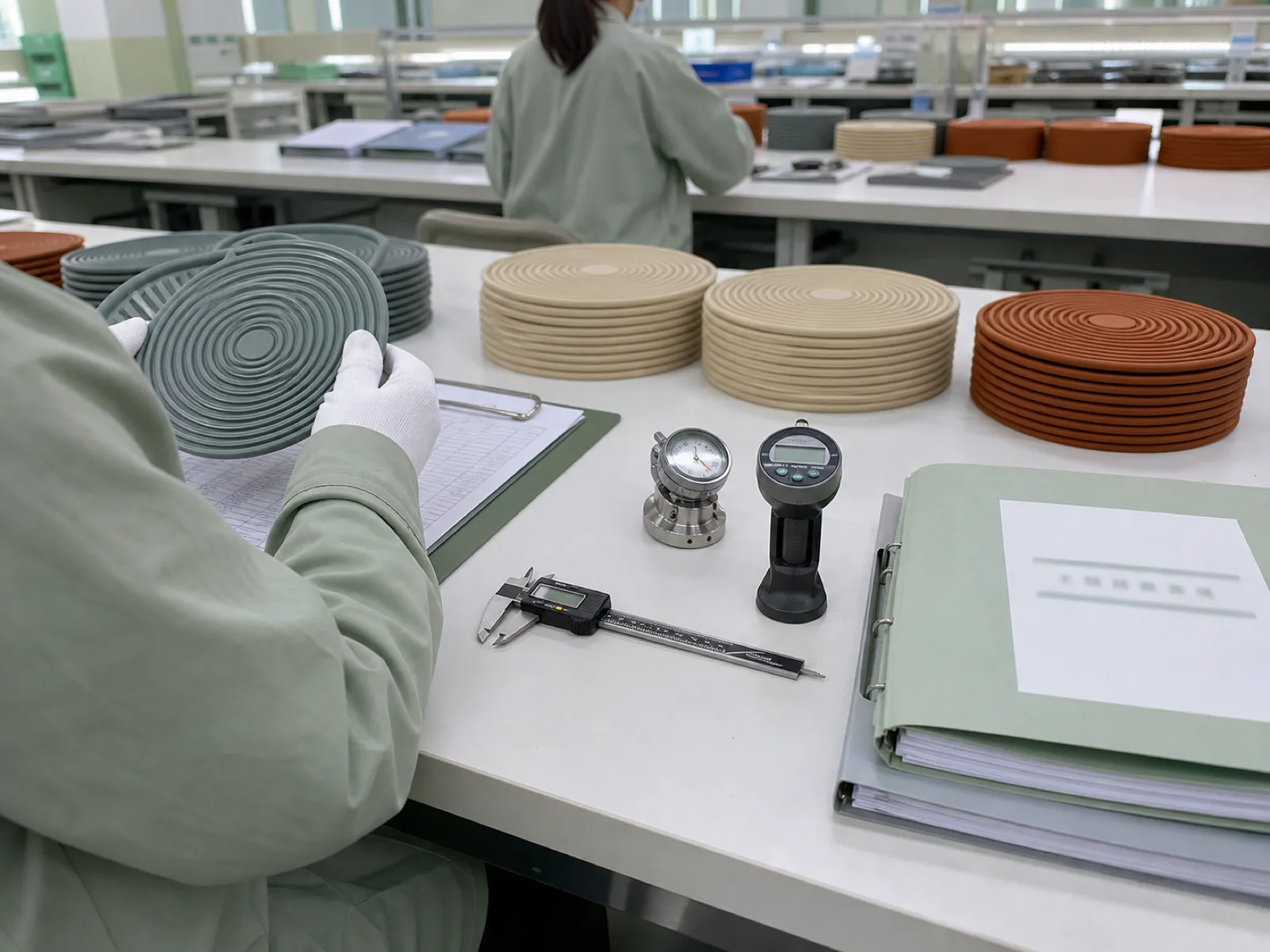
A silicone trivet is a single-piece food-contact silicone (PDMS) part typically molded at Shore A 50-60 hardness, cured with platinum or peroxide catalyst, and post-cured 4-6 hours at 180-200°C to clear LFGB §30/31 volatile extraction testing. MOQ from a real factory is 500 pieces per SKU; unit cost FOB Yantian runs $1.60-$2.80 at 500 pcs, $0.75-$1.20 at 5,000 pcs. Tooling for a 2-4 cavity P20 hardened steel mold is $800-$2,400.
## What is a silicone trivet, in B2B specification terms?A silicone trivet is a single-material molded part consisting only of polydimethylsiloxane (PDMS) crosslinked with either a platinum catalyst or organic peroxide, plus a pigment master-batch for color. It sits on a counter to protect the surface from a hot pan (typically -40°C to +230°C service range), is dishwasher-safe, and molds in a single press cycle with no assembly step.
There's no coating, no textile lamination, no metal core, no glue. That single-material simplicity is why silicone dominates the $5-25 retail trivet market — the bill of materials contains two SKUs (silicone gum + pigment), the process is one molding step plus post-cure, and the finished part clears retail compliance with one round of third-party testing rather than the multi-substrate audit stack a fabric-and-cork or coated-metal design requires. Three physical specs define every trivet program: - **Geometry** — round, square, hexagonal, honeycomb, or brand-signature freeform; wall thickness 6-12 mm; ribbed or waffled underside for thermal air-gap - **Shore A hardness** — 40-70 range, measured to ASTM D2240 [^astm-d2240] - **Cure chemistry** — platinum (LSR) or peroxide (HCR), post-cured to clear FDA 21 CFR 177.2600 [^fda-177-2600] and where applicable LFGB / BfR Recommendation XV [^bfr-lfgb-xv] Everything else — Pantone color match, debossed logo, silk-printed graphic, packaging — is a downstream decoration or secondary process. The engineering decision that drives price, compliance, and shelf position is the combination of those three specs. ## What are the FDA, LFGB, and PFAS compliance requirements for a food-contact silicone trivet?US-bound trivets must clear FDA 21 CFR 177.2600 [^fda-177-2600] for repeated-use rubber food-contact articles. EU-bound trivets must clear LFGB §30/31, grounded in BfR Recommendation XV [^bfr-lfgb-xv] and framed by EC 1935/2004 [^ec-1935-2004]. Both regimes require per-batch third-party test reports from an accredited lab; premium retail programs additionally require per-batch PFAS non-detect analysis given the ECHA universal restriction trajectory [^echa-pfas-proposal].
The compliance stack breaks into three layers: **Layer 1 — Material eligibility.** The silicone gum used in the trivet must come from a compound house whose master-batch has a documented food-contact certification history. Wetop sources from qualified compound houses only, with lot-level traceability retained for a minimum of 36 months per ISO 9001 [^iso-9001] requirements. **Layer 2 — Per-batch third-party testing.** For every production batch, an accredited lab (SGS, Intertek, TÜV, or Bureau Veritas) runs migration and extractables testing against the target regulation. Peroxide-cure material additionally requires demonstrating that residual VOC has been driven off by the 4-6 hour post-cure at 180-200°C. Reports reference the master-batch lot number and the finished-part batch number so a retail audit downstream can trace back. **Layer 3 — PFAS non-detect (premium tier only).** Any trivet program targeting EU premium retail, US natural-food retail (Whole Foods orbit, Sprouts, Erewhon caliber), or a PFAS-free marketing claim requires per-batch PFAS analysis at parts-per-billion detection limits. This is not required by FDA or LFGB directly but is driven by the ECHA universal restriction proposal [^echa-pfas-proposal] and downstream retailer spec. Beyond food-contact, US programs targeting children's product categories additionally clear CPSIA [^cpsia-silicone] for lead and phthalate content; medical-adjacent programs (infant-feeding accessories, wound-contact) require USP <88> Class VI biological reactivity documentation [^usp-class-vi]. A standard kitchen trivet marketed to adults typically does not need CPSIA or USP scoping — but as soon as a program touches the child-safety or medical-adjacent axis, both add to the audit stack. The full FDA-vs-LFGB decoder, including which retail programs typically require which certification stack, is covered in the [FDA vs LFGB silicone guide](/guide/fda-vs-lfgb-silicone/).
Both cure systems produce food-safe trivets when correctly manufactured. Peroxide-cure fits Tier 2 mid-market retail at 15-25% lower unit cost and clears FDA + post-cured LFGB. Platinum-cure fits EU premium, US natural-food retail, and PFAS-free marketing programs — the cleaner extractables profile removes documentation burden but adds unit cost. The choice is retail-tier and positioning-driven, not safety-driven.
Both materials share the same PDMS backbone. The crosslinking catalyst is where the delta lives: - **Platinum-cure** uses a platinum-complex (Karstedt's catalyst) to drive a hydrosilylation reaction. Zero cure byproducts. Naturally PFAS-free by chemistry. Compound cost is ~5x peroxide by weight. - **Peroxide-cure** uses organic peroxide (typically dicumyl peroxide) that decomposes during cure and leaves trace organic volatiles behind. Mandatory 4-6 hour post-cure at 180-200°C drives them off to clear LFGB §30/31. For a $12-18 retail-shelf trivet at Tier 2 chain volume, peroxide-cure with disciplined post-cure and PFAS-free process aids is genuinely equivalent on food safety and passes retail audit. For a $25-40 premium-shelf trivet with EU distribution, PFAS-free marketing, or an infant-feeding parent brand, platinum-cure earns back the 15-25% premium in documentation simplicity and shelf-tier positioning. Full decision matrix in [platinum-cured vs peroxide-cured silicone](/guide/platinum-cured-vs-peroxide-cured-silicone/). The failure mode across both systems is under-post-cure. A supplier trimming the 4-6 hour oven cycle to 30-60 minutes saves oven time and energy cost but ships trivets that (a) fail LFGB volatile extract testing on incoming audit and (b) produce first-heat odor on retail — a category of consumer complaint that generates 3-8% return rates on premium SKUs. ## How do you pick the right Shore A hardness for a trivet?Shore A 50-60 is the retail-program default. It's stiff enough to stay flat under a 3-4 kg hot Dutch oven, soft enough to grip a counter without sliding, and forgiving of the ±2 Shore A batch-to-batch drift that ASTM D2240 [^astm-d2240] tolerates. Firmer hot pads move to 60-70; softer jar-opener/multi-use trivets sit at 40-50.
Shore A durometer is the indentation hardness reading of the cured elastomer. A durometer needle is pressed into the sample under standardized load; the depth of penetration returns a 0-100 number. On a trivet, the reading drives three properties: - **Grip vs slip** — softer material (40-50) grips a smooth counter surface via friction; firmer material (60-70) can slide under load unless a textured underside is molded in. - **Load deformation** — softer material sags under a heavy Dutch oven; firmer material stays flat. - **Tactile perception at retail** — under 40 reads as "gummy" and cheap; over 70 reads as "plastic-like" and cheap. Both ends fail focus-group testing. 50-60 sits in the "premium silicone" perception band. Batch-to-batch drift of ±2 Shore A is normal and per-standard. Tighter tolerance (±1 Shore A) is achievable but adds cost — the compound house has to run a stricter incoming-material QC on the silicone gum. For most retail programs the standard ±2 is fine; specify tighter only if the program has a mechanical spec that depends on it. ### Hardness selection table | Trivet type | Shore A target | Load range | Notes | |---|---|---|---| | Jar-opener / multi-use grip pad | 40-50 | ≤ 2 kg | Higher grip friction, softer feel | | Standard round/square trivet | 50-60 | 3-5 kg | Retail default — best balance | | Heavy Dutch oven trivet | 60-65 | 5-8 kg | Minimal sag, needs textured base to prevent slip | | Hot-pad / potholder (folded) | 60-70 | Variable | Stiffness enables fold-and-hold geometry | | Cast-iron shelf pad (commercial) | 65-70 | 8-12 kg | Firm, dimensionally stable at high load | ## Which ASTM test methods define trivet mechanical performance?Four ASTM methods cover the mechanical spec sheet: D2240 for Shore A hardness [^astm-d2240], D412 for tensile strength and elongation, D624 for tear resistance, and D395 for compression set. On a retail silicone trivet at Shore A 55, expect roughly 8-11 MPa tensile, 400-700% elongation at break, 25-35 kN/m Die-B tear, and 10-20% compression set after 22 hours at 175°C.
The mechanical numbers a serious buyer requires on the material data sheet: | Property | Test method | Typical value at Shore A 55 | Failure mode if missed | |---|---|---|---| | Shore A hardness | ASTM D2240 [^astm-d2240] | 55 ± 2 | Wrong grip, wrong perception at retail | | Tensile strength | ASTM D412 Die C | 8-11 MPa | Tearing on demold or in-use stress | | Elongation at break | ASTM D412 Die C | 400-700 % | Brittle behavior, cracking | | Tear resistance (Die B) | ASTM D624 | 25-35 kN/m | Tear propagation from a gate or nick | | Compression set | ASTM D395 (22 h @ 175°C) | 10-20 % | Permanent flat spots after sustained load | | Specific gravity | ASTM D792 | 1.12-1.20 | Weight target for pack-out and freight | | Rebound resilience | ASTM D2632 | 55-65 % | Bounce-back on impact | Under-post-cured material typically hits 60-80% of these targets. That's the mechanical signature of a supplier skipping post-cure to save oven time. On incoming QC, the tear-resistance value is the most sensitive indicator — a 30-40% shortfall on tear at Die-B testing correlates with post-cure discipline problems. ## What does a silicone trivet actually cost at MOQ 500, 1,000, 5,000, and 10,000 pieces?For a standard 190 mm round Shore A 55 peroxide-cure trivet with debossed logo, FOB Yantian pricing runs roughly $1.60-$2.80 at 500 pcs, $1.10-$1.80 at 1,000 pcs, $0.75-$1.20 at 5,000 pcs, and $0.55-$0.90 at 10,000 pcs. Platinum-cure adds 15-25%. Tooling is a separate one-time $800-$2,400 for a 2-4 cavity mold, buyer-owned on payment.
The cost stack on a molded silicone trivet decomposes into six lines. Understanding each is the difference between accepting a quote and negotiating one: | Cost line | Share at 500 pcs | Share at 10,000 pcs | Notes | |---|---|---|---| | Silicone gum (compound cost) | 25-30% | 40-50% | Scales linearly with weight; ~180 g for a 190 mm trivet | | Molding press + labor (cycle) | 30-35% | 15-20% | Fixed per shot; amortizes at higher volume | | Post-cure oven (energy + capacity) | 8-10% | 5-7% | 4-6 h at 180-200°C; often skipped by cheap vendors | | QC + third-party testing per batch | 12-15% | 5-8% | ISO 2859-1 AQL 2.5 GII [^iso-2859-1] + FDA/LFGB reports | | Decoration (debossing / print / laser) | 5-10% | 5-10% | Included in mold if debossed; adder if silk-print | | Packaging + FOB Yantian handling | 8-12% | 8-12% | Individual polybag + master carton | Three cost multipliers push the base numbers up: - **Platinum-cure**: +15-25% on gum cost line - **Pantone-matched pigment beyond standard palette**: +$0.05-$0.15 per unit + $60-$180 pigment master-batch cost - **Silk-print or pad-print secondary process**: +$0.08-$0.20 per unit, per color pass - **Complex geometry** (thin walls, undercuts, multi-cavity precision): +10-25% The full pricing decomposition is covered in [silicone OEM pricing structure](/guide/silicone-oem-pricing-structure/); the MOQ economics — why 500 is a real floor and why quotes below that number are rarely from an actual factory — are covered in [real factory MOQ: the math](/guide/real-factory-moq-the-math/). ## What does tooling actually cost, and how do you amortize it?A 2-4 cavity P20 hardened steel compression mold for a standard trivet costs $800-$2,400 and is buyer-owned on payment. P20 mold life is 500,000+ shots with routine maintenance. Amortization: on a first-order 5,000-piece run, that's $0.16-$0.48 per piece added to unit cost; by the second production run the tooling cost is fully absorbed and doesn't recur.
Tooling variables that move the number: - **Cavitation** — 2-cavity is the minimum viable for a trivet; 4-cavity halves cycle time per piece. 6-8 cavity is possible for multi-year programs at 20,000+ annual volume, adding $600-$1,200 to mold cost. - **Steel spec** — P20 hardened steel is the retail standard, 500,000-shot life. Aluminum tooling ($400-$900) fits pilot runs under 5,000 total shots but wears out; H13 hardened ($2,500-$4,500) fits multi-million-shot programs. - **Undercuts / side-actions** — a flat trivet with a debossed logo is a simple two-plate mold. Any raised feature that requires a side-action or slide-pull adds $300-$800. - **Debossing** — sunk into the mold cavity at zero incremental cost per piece. This is the reason debossing is the default logo method for silicone. - **Multi-cavity family molds** — sometimes viable when a program has 3-5 related SKUs sharing a base geometry. Not our default offering; each Wetop program runs dedicated tooling. The tooling cost is a one-time capital expense on a first order. It doesn't recur on repeat runs unless the mold is retired (500,000+ shots) or the design changes. On a program running 20,000-50,000 pieces per year across multi-year, the effective tooling cost per piece rounds to zero after the first shipment.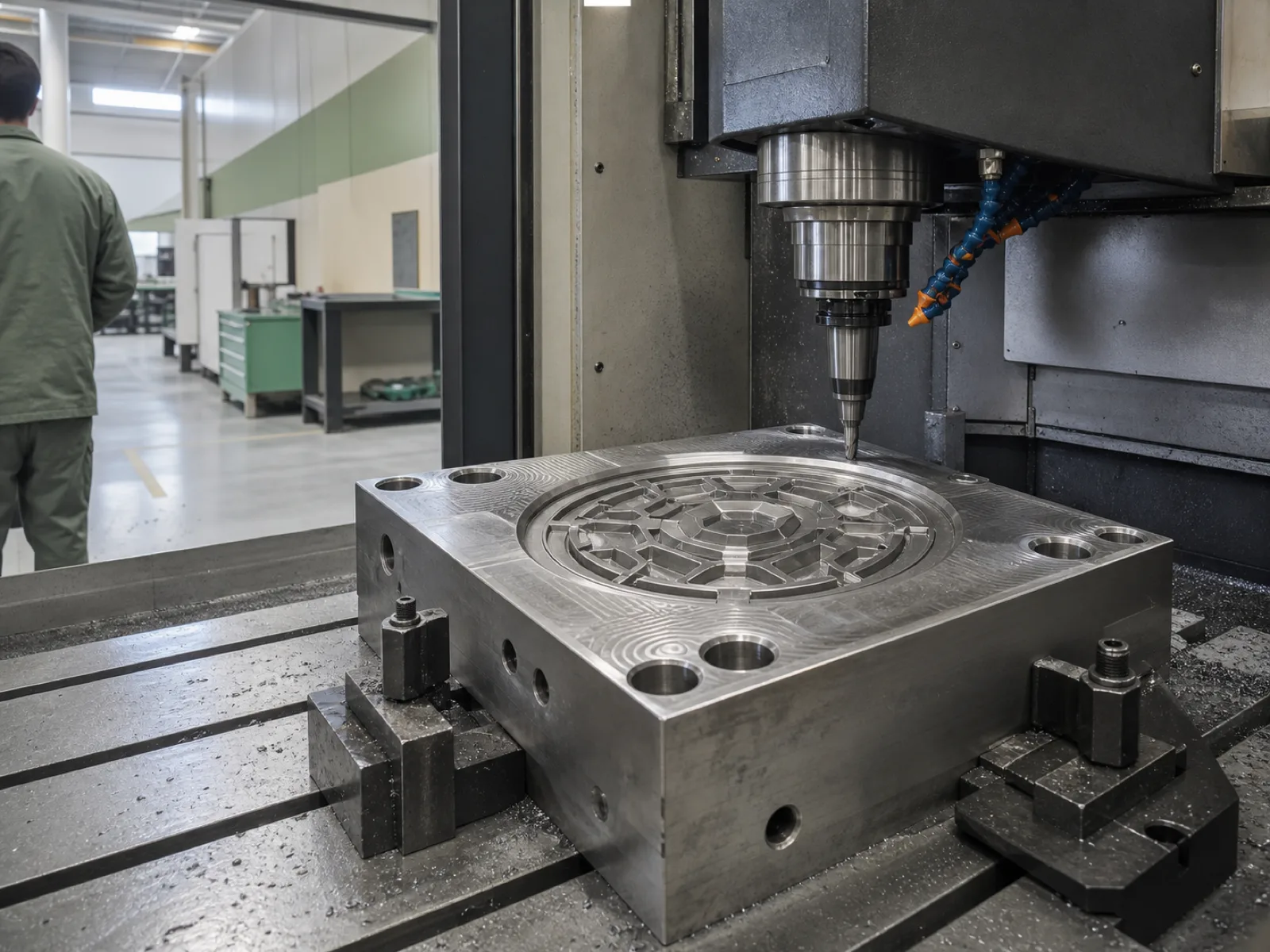
The workflow runs in five phases: tech pack + DFM review (5-7 days), tooling cut (10-18 days), first article + spec sign-off (5-8 days per iteration), mass production (25-35 days), FOB Yantian handoff (90 min drayage). Total PO to on-the-water is typically 30-45 days for a program with tooling in place, 55-70 days with new tooling on the critical path.
Phase-by-phase breakdown of a standard silicone trivet OEM engagement: **Phase 1 — Tech pack + DFM review (5-7 days).** Buyer submits: 3D CAD (STEP preferred, IGES acceptable), 2D drawing with GD&T, material spec (Shore A + cure chemistry + regulatory scope), decoration spec (logo Pantone + placement + method), packaging spec, target quantity per SKU + first-order size. Wetop engineering runs DFM: cavity layout, gating strategy, parting-line optimization, wall-thickness check, shrinkage-compensation on the tool. Output: signed tech pack + tooling drawing. **Phase 2 — Tooling cut (10-18 days).** In-house CNC roughing → EDM detail → polish → gate + vent finishing. In-house machining is the difference between 2-3 weeks and 6-8 weeks — subcontracted mold shops queue behind their own customers. **Phase 3 — First article + spec sign-off (5-8 days per iteration).** T1 shot on the mold. Full dimensional inspection, Shore A durometer per ASTM D2240 [^astm-d2240], color match to Pantone under D65 lighting, debossing readability, post-cure verification, and per-batch FDA + LFGB testing. Photos and 5-10 physical samples shipped to buyer for hand-approval. Iterate T2, T3 if needed — most programs land at T1 or T2 with clean DFM upstream. **Phase 4 — Mass production (25-35 days).** Molding runs on the approved tooling; every batch post-cured 4-6 hours at 180-200°C; QC at ISO 2859-1 AQL 2.5 GII [^iso-2859-1]. Per-batch third-party FDA + LFGB reports pulled and referenced to the master-batch lot. **Phase 5 — FOB Yantian handoff (90 min drayage).** Master cartons palletized, container loaded at our floor, drayage to Yantian Port in 90 minutes. HK airport reachable in 2 hours if air freight is on the plan. Full lead-time detail with the schedule assumptions is in [MOQ and lead time on silicone OEM](/guide/moq-and-lead-time-silicone-oem/); the sourcing-audit playbook — what to check before placing a first order — is in [the sourcing silicone factory checklist](/guide/sourcing-silicone-factory-checklist/). ## What retail-tier fit does a silicone trivet program have to hit?Tier 2 chain retail (Home Depot / Wayfair / Bed Bath / Tesco / Carrefour class) expects a documented ISO 9001 + FDA + LFGB per-batch stack, AQL 2.5 GII inspection per ISO 2859-1 [^iso-2859-1], and PFAS non-detect on premium SKUs. Tier 1 retail (national mass merchants) adds annual factory social/security audits. Below Tier 2 (Amazon FBA private label, boutique DTC) still requires FDA per-batch minimum — cutting corners here is the fastest path to a listing takedown.
The retail-tier positioning drives which quality gates are non-negotiable versus optional: | Retail tier | Certifications required per batch | Audit depth | Trivet SKU price band | |---|---|---|---| | Tier 1 chain (national mass merchant) | ISO 9001 + FDA + LFGB + PFAS + social audit | Annual on-site + per-shipment lab | $15-$35 shelf | | Tier 2 chain (home improvement / department) | ISO 9001 + FDA + LFGB per batch | Per-shipment lab, annual desk audit | $10-$25 shelf | | Specialty premium (natural food / EU premium) | Above + PFAS non-detect + platinum-cure | Per-shipment lab + brand rep | $18-$40 shelf | | DTC / Amazon FBA private label | FDA per batch minimum | Sample-basis, first-order | $8-$20 shelf | Wetop's founder-led floor is calibrated to Tier 2 chain requirements as the baseline. Specialty premium and Tier 1 layer additional documentation on top; DTC / Amazon FBA runs on the same molds and cure discipline with a lighter audit stack. What we do not do: undercut Tier 2 quality to hit a lower price point. The economics of running an ISO 9001 [^iso-9001] certified floor set a hard floor on unit cost — programs shopping for a $0.30 trivet are shopping for a trading house re-labelling stock, not a factory. ## Silicone vs cork, cast iron, and cotton — buyer comparison for private-label programsSilicone dominates the $5-25 retail trivet band because the unit economics work at Tier 2 chain volume: single-material, single-process, MOQ 500, dishwasher-safe, easy Pantone match, and $0.55-$2.80 FOB unit cost. Cork, cast iron, and cotton each solve one buyer's problem better but lose on the four-way retail-audit and unit-cost combination for a mid-market program.
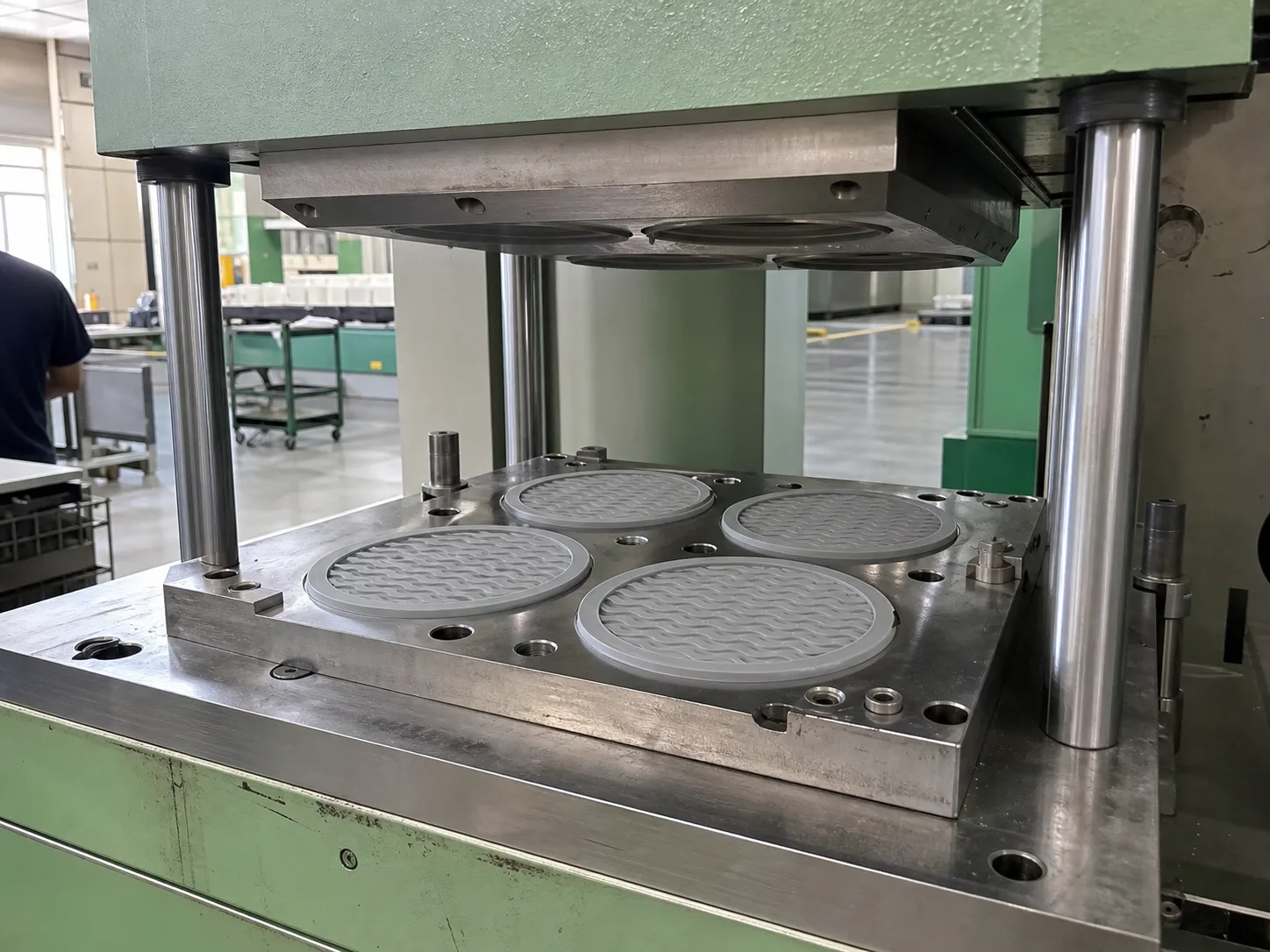
Wetop runs silicone trivets on both cure systems from an ISO 9001 [^iso-9001] certified floor in Dongguan — MOQ 500 per SKU, platinum-cure or post-cured peroxide-cure, Shore A 40-70, custom geometry, debossing / silk-print / pad-print / laser decoration, per-batch FDA 21 CFR 177.2600 [^fda-177-2600] + LFGB §30/31 [^bfr-lfgb-xv] + PFAS non-detect testing, ISO 2859-1 [^iso-2859-1] AQL 2.5 GII inspection, 90 minutes to Yantian Port.
Program defaults: - **Cure**: platinum-cure for premium / EU / PFAS-free / medical-adjacent brands; post-cured peroxide-cure for Tier 2 chain accessory programs - **Hardness**: Shore A 55 default, adjustable 40-70 to program spec, tolerance ±2 per ASTM D2240 [^astm-d2240] - **MOQ**: 500 pcs/SKU entry; unit-cost bands materially better at 1,000 / 5,000 / 10,000 - **Tooling**: $800-$2,400 for 2-4 cavity P20 hardened steel, buyer-owned, 500,000+ shot life - **Lead time**: 30-45 days PO to on-the-water with tooling in place; 55-70 days with new tool cut - **Regulatory package**: per-batch FDA + LFGB + PFAS non-detect, referenced to master-batch lot, retained 36 months - **Retail-tier fit**: baseline calibrated to Tier 2 chain audit; scales up to specialty premium and Tier 1 with documentation layering Sourcing a custom silicone trivet program? Email inquiry@wetopsilicone.com with your target Shore A, target regulatory scope (US / EU / both), target retail tier, annual volume estimate, and any existing sketch or CAD. We return with a cure recommendation, DFM feedback on the geometry, per-batch documentation packet outline, and price brackets at MOQ 500 / 1,000 / 5,000 / 10,000 within 48 hours. Full manufacturing detail on the [capabilities page](/capabilities/); NDA process on the [NDA page](/nda/); anonymized program archetypes on [case studies](/case-studies/); direct sourcing questions via [contact](/contact/). [^fda-177-2600]: US Food and Drug Administration. *21 CFR 177.2600 — Rubber articles intended for repeated use.* https://www.ecfr.gov/current/title-21/chapter-I/subchapter-B/part-177/subpart-C/section-177.2600 — the primary US food-contact regulation Wetop cures every trivet batch against. [^bfr-lfgb-xv]: German Federal Institute for Risk Assessment (BfR). *Recommendation XV — Silicones.* https://www.bfr.bund.de/cm/349/xv-silicones.pdf — the technical standard behind LFGB §30/31 for food-contact silicone. Defines the organic volatile extraction test mandatory post-cure clears. [^astm-d2240]: ASTM International. *ASTM D2240-15 — Standard Test Method for Rubber Property — Durometer Hardness.* https://www.astm.org/d2240-15r21.html — the measurement standard for Shore A hardness across the 40-70 trivet range. [^iso-9001]: International Organization for Standardization. *ISO 9001:2015 — Quality Management Systems — Requirements.* https://www.iso.org/standard/62085.html — the quality management standard Wetop is certified against. [^iso-2859-1]: International Organization for Standardization. *ISO 2859-1:1999 — Sampling procedures for inspection by attributes.* https://www.iso.org/standard/1141.html — defines the AQL 2.5 General Inspection Level II sampling regime Wetop runs on trivet final inspection. [^ec-1935-2004]: European Parliament and Council. *Regulation (EC) No 1935/2004 — Materials and articles intended to come into contact with food.* https://eur-lex.europa.eu/legal-content/EN/TXT/?uri=CELEX%3A02004R1935-20090807 — the EU framework regulation for food-contact materials that LFGB and BfR Recommendation XV operate under. [^echa-pfas-proposal]: European Chemicals Agency. *PFAS Universal Restriction Proposal (2023).* https://echa.europa.eu/hot-topics/perfluoroalkyl-chemicals-pfas — the regulatory action driving PFAS-free spec adoption in EU premium retail and, downstream, in US premium retail. [^usp-class-vi]: United States Pharmacopeia. *USP <88> — Biological Reactivity Tests, In Vivo.* https://www.usp.org/harmonization-standards/pdg/excipients/plastic-materials — defines USP Class VI biological reactivity classification for medical-adjacent trivet programs. [^cpsia-silicone]: US Consumer Product Safety Commission. *CPSIA — Consumer Product Safety Improvement Act.* https://www.cpsc.gov/Regulations-Laws--Standards/Statutes/The-Consumer-Product-Safety-Improvement-Act — US federal law governing lead, phthalates, and general safety compliance for consumer products marketed for children's use.