Silicone tubing sizes are defined by three numbers — inner diameter (ID), outer diameter (OD), and wall thickness — linked by the fixed relationship OD = ID + (2 × wall). Standard extruded silicone runs from roughly 0.5 mm to 25 mm ID (about 1/32" to 1"), and inner diameter is what sets flow rate. This reference gives the full ID/OD/wall chart in millimeters and inches, the peristaltic pump L/S size numbering crosswalk, and the tolerances, conversions, and fitting rules an OEM buyer needs to spec correctly the first time.
Silicone tubing looks like a commodity until a buyer has to put a real number on a drawing. Pick an ID that misses the flow target, a wall that collapses under vacuum, or a size that no factory carries a die for, and the program stalls at sampling. This guide is a working sizes reference from an extrusion floor: the master ID/OD/wall chart in both measurement systems, the peristaltic pump numbering system that trips up first-time buyers, how to measure and convert sizes, the dimensional tolerances a real factory holds, and where standard sizing ends and a custom extrusion die begins. It pairs with our [Shore A hardness chart](/guide/shore-a-hardness-silicone-chart/) for the durometer half of the spec. ## What are the standard silicone tubing sizes?Standard silicone tubing sizes span inner diameters from about 0.5 mm to 25 mm and up, built on fractional-inch IDs of 1/32", 1/16", 1/8", 3/16", 1/4", 3/8", and 1/2" paired with 1/32" (0.8 mm) or 1/16" (1.6 mm) walls. Any ID/OD combination a factory keeps a die for is "standard"; a die cut for your exact dimensions is "custom."
There is no single global standard that mandates silicone tubing sizes the way SAE AS568 fixes o-ring sizes — the market converged on the fractional-inch ladder plus a set of metric sizes for European and medical use. What matters is that every size is fully described by two of the three dimensions, because they are locked together: **OD = ID + (2 × wall)**. Give a factory ID and OD, and the wall is fixed; give ID and wall, and the OD is fixed. A quote that lists all three with an inconsistent arithmetic (say 1/4" ID, 3/8" OD, and "1/8" wall") is a red flag that the supplier does not control their own dimensions. The master chart below is the working ladder our extrusion cell runs. It shows the common fractional-inch sizes with their metric equivalents, a typical wall, and the resulting OD. Because fractional inches rarely land on a round millimeter, both systems are shown — always state both on the drawing so a die is never cut to the wrong system. | ID (inch) | ID (mm) | Typical wall (inch / mm) | OD (inch) | OD (mm) | |---|---|---|---|---| | 1/32" | 0.8 mm | 1/32" / 0.8 mm | 3/32" | 2.4 mm | | 1/16" | 1.6 mm | 1/32" / 0.8 mm | 1/8" | 3.2 mm | | 1/8" | 3.2 mm | 1/16" / 1.6 mm | 1/4" | 6.4 mm | | 3/16" | 4.8 mm | 1/16" / 1.6 mm | 5/16" | 7.9 mm | | 1/4" | 6.4 mm | 1/16" / 1.6 mm | 3/8" | 9.5 mm | | 3/8" | 9.5 mm | 1/16" / 1.6 mm | 1/2" | 12.7 mm | | 1/2" | 12.7 mm | 3/32" / 2.4 mm | 11/16" | 17.5 mm | | 3/4" | 19.1 mm | 1/8" / 3.2 mm | 1" | 25.4 mm | | 1" | 25.4 mm | 1/8" / 3.2 mm | 1-1/4" | 31.8 mm | Below 0.5 mm ID (micro-bore capillary tubing for analytical and drug-delivery work) and above 25 mm ID (large-bore transfer and drainage), sizing moves fully into custom-die territory. Both extremes are extrudable — micro-bore just needs precision pull-through calibration, and large-bore needs a heavier wall or reinforcement to avoid collapse under its own weight.
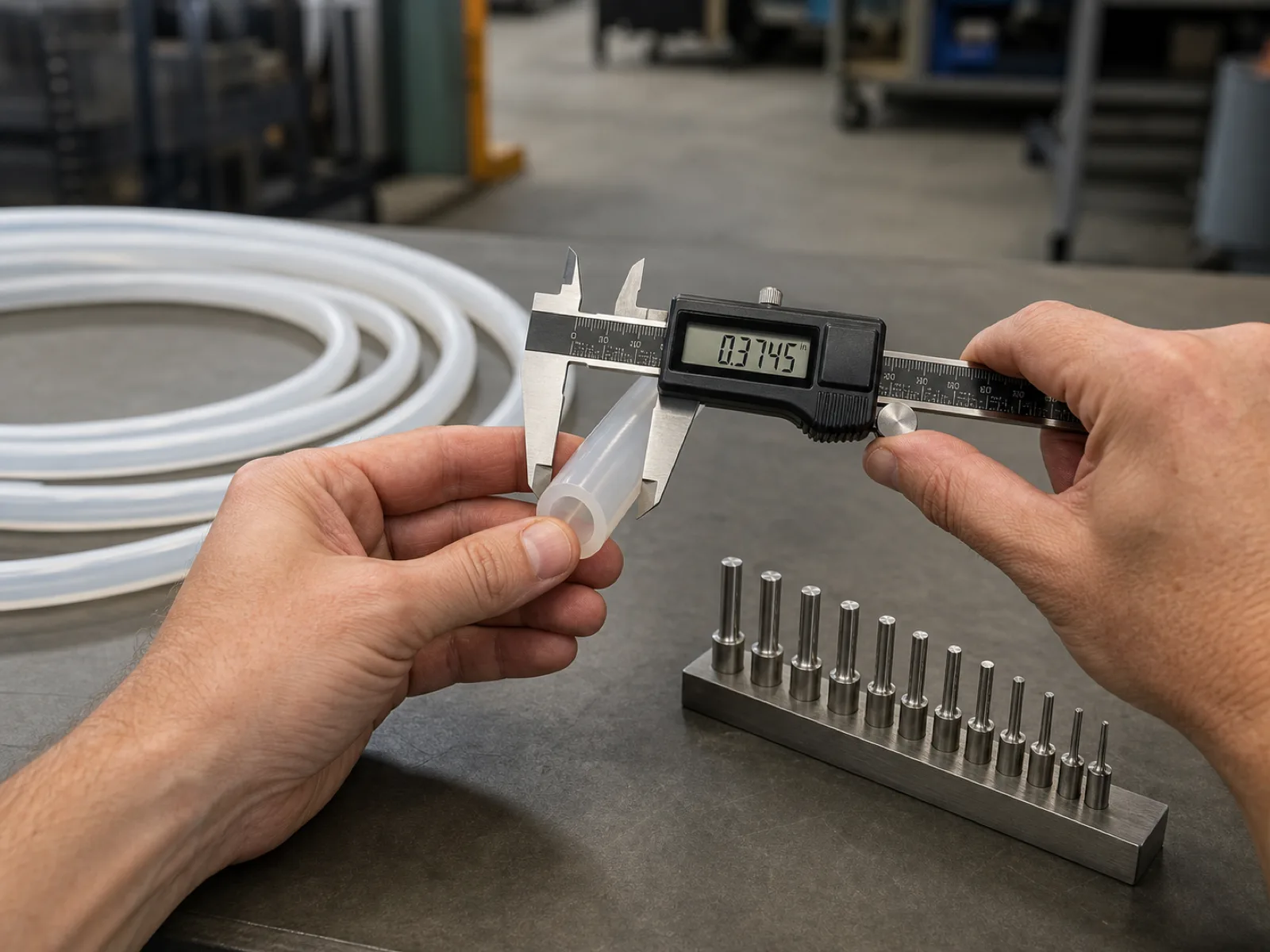
Measure OD with the outside jaws of a digital caliper and ID with the inside jaws or a tapered pin gauge, using a light touch because the soft wall deflects under pressure. Average two perpendicular readings to catch out-of-roundness, then derive wall thickness as (OD − ID) ÷ 2 or confirm it directly by cross-sectioning a sample.
Measuring silicone is different from measuring a rigid part because the material yields. Press a caliper too hard on the OD and you read low; force the inside jaws and you stretch the ID and read high. The factory-floor method is to seat the jaws until they just kiss the surface, take the value, then rotate the tube 90° and take a second reading — the spread between the two is your out-of-roundness, which matters as much as the nominal for sealing and pump seating. For ID specifically, a stepped or tapered pin gauge is more repeatable than caliper inside-jaws on anything under about 4 mm, because the pin self-centers and does not distort the bore. Wall thickness is the number most often gotten wrong: deriving it as (OD − ID) ÷ 2 assumes a perfectly concentric extrusion, so on precision work we confirm it by slicing a clean cross-section and reading it on an optical comparator. Concentricity — how well-centered the bore sits inside the OD — is a separate quality metric from wall thickness itself, and a tube can hit nominal wall on average while running thin on one side. One practical note for buyers doing incoming inspection: measure at room temperature and record it. Silicone's dimensions shift slightly with temperature, and a tube measured warm off a hot-air-vulcanization line will not match the same tube measured after it fully cools and relaxes. ## What is the peristaltic pump tubing size numbering system?Peristaltic pump tubing uses the L/S dimensional numbering system, where a code like 13#, 14#, 16#, 25#, 17#, or 18# fixes a specific inner diameter and wall thickness. Because the numbers are a dimensional standard rather than a brand catalog, tubing and pump heads marked the same number interchange across manufacturers, and the number alone predicts flow range.
First-time buyers get tripped up because a pump spec sheet says "use 16# tubing" with no diameter — the number *is* the size. The L/S system assigns each code a fixed ID and a common wall so the tube seats correctly in the pump's roller occlusion bed. Select the number by the flow you need, then order silicone tubing cut to that ID and wall. The crosswalk below covers the six most common sizes plus the heavy-wall high-performance pair. | Pump size # | ID (mm) | ID (inch) | Wall (mm) | Relative flow | |---|---|---|---|---| | 13# | 0.8 mm | 0.031" | 1.6 mm | Lowest | | 14# | 1.6 mm | 0.063" | 1.6 mm | Low | | 16# | 3.1 mm | 0.125" | 1.6 mm | Medium | | 25# | 4.8 mm | 0.190" | 1.6 mm | Medium-high | | 17# | 6.4 mm | 0.250" | 1.6 mm | High | | 18# | 7.9 mm | 0.312" | 2.4 mm | Highest (std wall) | | 15# | 4.8 mm | 0.190" | 2.4 mm | Medium-high (heavy wall) | | 24# | 6.4 mm | 0.250" | 2.4 mm | High (heavy wall) | | 35# / 36# | 4.8 / 8.0 mm | 0.190 / 0.315" | 2.4 mm | High-performance formulation | Two things buyers should hold onto. First, within a common wall, flow tracks ID exactly as the flow-rate physics predict — 13# through 18# all share the 1.6 mm wall precisely so they seat in the same roller geometry, and only the bore changes. Second, the heavy-wall sizes (15#, 24#) and high-performance sizes (35#, 36#) exist because peristaltic pumping is a fatigue problem: the tube is flexed millions of times, and a thicker wall or a specially reinforced formulation extends service life at the cost of higher flex force. For a food or pharma dosing line, the size number and the cure system both belong in the RFQ — see [platinum-cured vs peroxide-cured silicone](/guide/platinum-cured-vs-peroxide-cured-silicone/) for why the cure system drives which pump tubing clears extraction testing. ## How do wall thickness and Shore A hardness affect tubing performance?Wall thickness and Shore A durometer together set pressure rating, burst pressure, and vacuum-collapse resistance. A thicker wall or a higher durometer resists internal pressure and external collapse, but both raise the flex force a peristaltic pump must overcome and shorten tube life in the rollers. Softer, thinner walls flow and pump better but collapse and balloon sooner.
Wall thickness is the single most under-specified dimension. Buyers fixate on ID because it drives flow, then accept whatever wall the stocked size carries — and that wall determines whether the tube survives the application. For a given ID and material, working and burst pressure both rise with wall thickness, and so does resistance to vacuum collapse (the tube being sucked flat on the suction side of a pump). The trade-off is that a heavier wall is stiffer, so a peristaltic pump works harder to occlude it and the tube fatigues faster. Durometer is the second lever. Standard silicone tubing runs 50-70 Shore A; our [Shore A hardness chart](/guide/shore-a-hardness-silicone-chart/) covers the full ladder. The interaction with wall thickness is what matters here: | Goal | Wall move | Durometer move | Cost | |---|---|---|---| | More working pressure | Thicker wall | Higher Shore A (60-70) | Reinforcement needed above ~4 bar | | Better vacuum-collapse resistance | Thicker wall | Higher Shore A | Stiffer, harder to route | | Longer peristaltic pump life | Thinner wall within spec | Lower-mid Shore A (50-60) | More frequent tube changes if too thin | | Softest sealing over barbs | Standard wall | Lower Shore A (40-50) | Lower pressure ceiling | | Kink resistance on tight bends | Thicker wall or reinforcement | — | Wire-helix or braid adds cost | The honest engineering answer for pressures above roughly 3-4 bar is that thickening an unreinforced wall is inefficient — you add stiffness and material cost faster than you add burst margin. That is the threshold where braid-reinforced silicone hose earns its keep, carrying the pressure in the textile jacket while the silicone handles the sealing and temperature. Below that threshold, wall-plus-durometer tuning on plain tubing is the right and cheaper lever. ## How do you convert silicone tubing sizes between metric and imperial?Convert by dividing millimeters by 25.4 for inches, or multiplying inches by 25.4 for millimeters. The catch is that fractional-inch sizes never land on round millimeters — a nominal 1/4" tube is actually 6.35 mm — so a size stated in one system and re-quoted in the other can drift by a die's worth of tolerance if rounded carelessly.
Most sizing errors on international programs are unit errors, not engineering errors. A US buyer orders "6 mm ID" as a convenient round number; the drawing was actually built around 1/4" (6.35 mm) barbs, and the 0.35 mm gap is enough to loosen the fit. The fix is discipline: state both systems on the drawing and mark which one is the controlling dimension the die is cut to. The conversion table below is the crosswalk our extrusion cell keeps taped to the die rack. | Fractional inch | Decimal inch | Millimeters (exact) | Common nominal | |---|---|---|---| | 1/32" | 0.03125" | 0.79 mm | 0.8 mm | | 1/16" | 0.0625" | 1.59 mm | 1.6 mm | | 3/32" | 0.09375" | 2.38 mm | 2.4 mm | | 1/8" | 0.125" | 3.18 mm | 3.2 mm | | 3/16" | 0.1875" | 4.76 mm | 4.8 mm | | 1/4" | 0.250" | 6.35 mm | 6.4 mm | | 5/16" | 0.3125" | 7.94 mm | 7.9 mm | | 3/8" | 0.375" | 9.53 mm | 9.5 mm | | 1/2" | 0.500" | 12.70 mm | 12.7 mm | | 3/4" | 0.750" | 19.05 mm | 19.1 mm | | 1" | 1.000" | 25.40 mm | 25.4 mm | Notice that the "common nominal" column rounds to one decimal — that rounding is safe only when it stays inside your tolerance band. On precision medical or metering tubing where tolerance is ±0.05 mm, a 0.35 mm rounding error between "6 mm" and 1/4" is seven times the tolerance and will fail incoming inspection. Round for convenience on garden-variety transfer tubing; carry the exact conversion on anything held to class E1. ## How do you size silicone tubing for barb fittings and clamps?Match the barb's nominal size to the tubing ID and let silicone's high elongation form the seal — a 1/4" barb is engineered for 1/4" ID tubing and grips because the elastomer stretches over the barb ridge. When a barb is rated for a range, the smaller ID in that range grips tighter. Add a hose clamp or crimp for pressures above about 2 bar.
Silicone's advantage at a fitting is exactly the property that trips up first-time buyers: it stretches. Per ASTM D412[^astm-d412] tension testing, silicone tubing elongates several hundred percent before breaking, so a tube slipped over a same-nominal barb expands over the ridge and clamps down on it elastically. That is why you do **not** oversize the tubing to "make it fit easier" — an oversized ID rides loose over the barb and leaks. Size the ID to the barb, warm the tube end in hot water if it is a tight push, and let the material do the sealing. For barbs printed with a size range (a barb marked "3/16"-1/4"," common on universal fittings), pick the smaller ID for a tighter, higher-pressure grip and the larger ID only when you need an easier connect on a low-pressure line. The wall thickness at the fitting matters too: a heavier wall provides more radial squeeze on the barb ridge, so a thin-wall tube may need a clamp where a standard wall seals bare. The pressure rule of thumb from our bench: bare silicone-over-barb holds to roughly 2 bar reliably; above that, add a worm-drive hose clamp, an ear clamp, or a crimp ferrule seated behind the last barb ridge. For sanitary food and pharma lines, sanitary tri-clamp fittings with molded silicone ends replace barbs entirely — a different sizing exercise governed by the tri-clamp gasket standard rather than the barb ID. ## What dimensional tolerances should you expect on extruded silicone tubing?Commodity extruded silicone holds ISO 3302-1[^iso-3302-1] class E2, roughly ±0.15-0.40 mm by size. Precision extrusion to class E1 tightens ID and wall to about ±0.05 mm on thin walls, ±0.08 mm mid-range, and ±0.13 mm on heavy walls. Anything tighter than E1 needs in-line laser gauging and pull-through calibration, which raises scrap rate and unit cost.
Tolerance is where a real factory quote diverges from an Alibaba listing that prints a nominal size and nothing else. Silicone is extruded as a soft, hot profile through a die, then vulcanized in a hot-air tunnel — the material relaxes, shrinks, and can drift, so the achievable tolerance is a process outcome, not a promise you can simply demand. ISO 3302-1 is the governing standard, and it defines tolerance classes so buyer and factory can agree on a realistic band. | Nominal wall | Class E2 (standard) | Class E1 (precision) | Method to hit E1 | |---|---|---|---| | < 0.5 mm | ±0.15 mm | ±0.05 mm | Pull-through calibration + laser gauge | | 0.5-1.5 mm | ±0.25 mm | ±0.08 mm | In-line OD laser, tuned line speed | | > 1.5 mm | ±0.40 mm | ±0.13 mm | Vacuum sizing box, closed-loop control | The practical lesson for OEM buyers: write the tolerance class into the RFQ rather than a bare ± number, and understand what it costs. Moving from class E2 to E1 is not just a tighter callout — it changes the tooling (calibration sleeves, laser micrometers) and the yield. On thin-wall precision work, scrap rate can climb from about 5% at E2 to 15-25% at E1, and that scrap is priced into the quote. If your application genuinely needs E1 or tighter, expect it and budget it; if it does not, over-specifying tolerance is pure waste. The [MOQ and lead-time economics](/guide/moq-and-lead-time-silicone-oem/) of a precision run reflect that yield hit directly.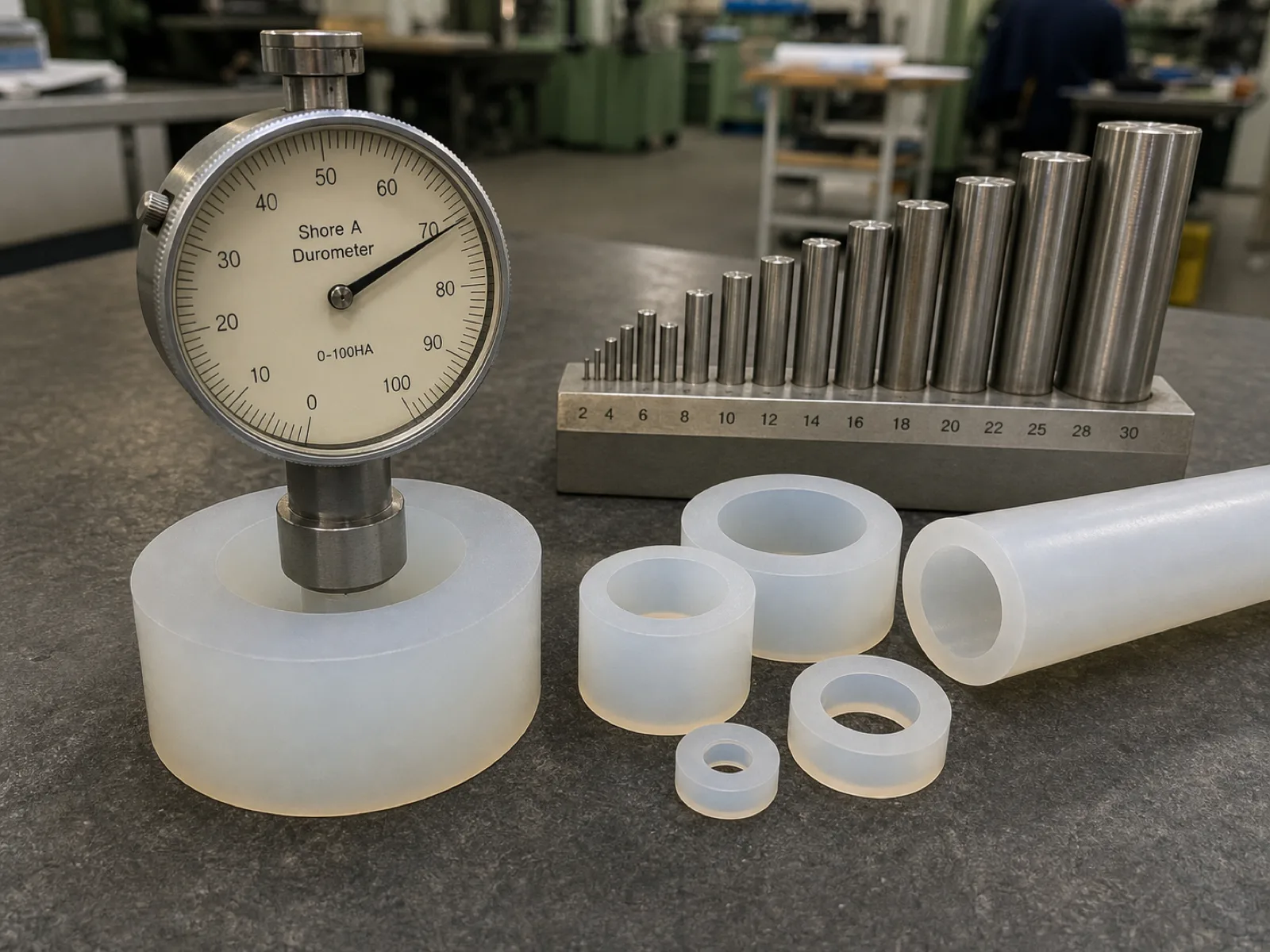
Match ID to the required flow rate, wall to the pressure and collapse demand, and material grade to the regulatory environment. Medical fluid transfer favors small precision IDs in platinum-cured USP Class VI stock; food and beverage uses mid-range IDs in FDA/LFGB grades; automotive and EV cooling needs heavier walls or reinforcement; lab lines prioritize peristaltic pump size numbers.
Sizing is never purely dimensional — the application dictates all three axes at once. The map below is how our engineering desk translates a use case into a starting spec, which the buyer then refines against their exact flow and pressure numbers. | Application | Typical ID range | Wall / grade emphasis | Certification | |---|---|---|---| | Medical fluid transfer, drug delivery | 0.3-6 mm | Precision E1 wall, platinum-cured | USP Class VI[^usp-class-vi], ISO 10993-5[^iso-10993-5] | | Food & beverage dispensing | 3-12 mm | Standard wall, FDA/LFGB grade | FDA 21 CFR 177.2600[^fda-177-2600], LFGB | | Peristaltic pump / lab metering | Per L/S size # | Wall set by pump size code | USP or FDA per fluid | | Automotive & EV cooling / vacuum | 4-25 mm | Heavy wall or braid, high Shore A | ASTM D2000[^astm-d2000] line callout | | General air, water, low-pressure transfer | 3-19 mm | Standard wall, 50-60 Shore A | FDA optional | A few application-specific notes worth carrying into the RFQ. Medical and analytical lines live or die on tolerance and biocompatibility, so the small ID is paired with class E1 and a platinum-cured base per ASTM D1418[^astm-d1418] VMQ nomenclature. Automotive and EV thermal-management lines see pressure and vacuum cycling, so they are specified by an ASTM D2000 line callout that bundles hardness, heat aging, and fluid resistance rather than a bare size. And any peristaltic application should be specified by its L/S size number first — the number locks ID and wall to the pump, and you choose only the material grade and length on top of it. ## Standard vs custom sizing — MOQ and custom extrusion dies for OEMA stocked ID/OD in standard 50-70 Shore A silicone ships at 500 m MOQ or less. A custom ID/OD/wall needs a new extrusion die at 500-3,000 m MOQ with 2-4 week tooling lead time. Silicone dies are inexpensive versus injection molds, so custom sizing is routine — a real factory quotes it readily rather than forcing you onto stocked sizes only.
The dividing line between standard and custom is simply whether the factory already owns a die for your dimensions. Because a silicone extrusion die is a comparatively cheap piece of tooling — orders of magnitude below an injection or compression mold — cutting a custom die to hit an exact ID, OD, and wall is a normal request, not an exotic one. This is the differentiator to probe when qualifying a supplier: a genuine extrusion factory will quote a custom die and a modest MOQ; a trading company will push you onto whatever stocked sizes it can source and call your exact spec "not available." What drives the custom MOQ up is not the die cost but the line setup and calibration time. Threading a new die, dialing in line speed, and tuning the calibration to bring the profile into tolerance consumes hours of a heated extrusion line and generates startup scrap before the first good meter runs. That setup is amortized across the run, so a 500 m order carries more setup-per-meter than a 3,000 m order — which is why custom sizing prices better at volume. For the full breakdown of how tooling, setup, and volume interact, see our [MOQ and lead-time guide](/guide/moq-and-lead-time-silicone-oem/). For an OEM program the sequence is: fix the ID from flow, fix the wall from pressure and collapse, confirm the OD that results, choose the durometer and cure system for the environment, then decide standard-versus-custom on whether those dimensions match a stocked die. State both metric and imperial, name the ISO 3302-1 tolerance class, and the quote comes back clean. ## Frequently asked questions The FAQ section mirrors the structured data on this page and answers the buyer-language questions that surface most often on silicone tubing sizing. ## Spec your silicone tubing size with the engineering desk You have the charts — ID/OD/wall in both systems, the peristaltic pump crosswalk, the tolerance classes, and the fitting rules. The last step is turning them into a manufacturable spec. Send us your target flow rate, working pressure, temperature range, and regulatory environment, and our engineering desk will return a full ID/OD/wall callout, a Shore A recommendation, the right ISO 3302-1 tolerance class, and a standard-vs-custom-die verdict with MOQ and lead time. [Talk to the engineering desk](/contact/) to get a sized, quotable spec back — not a stock list.