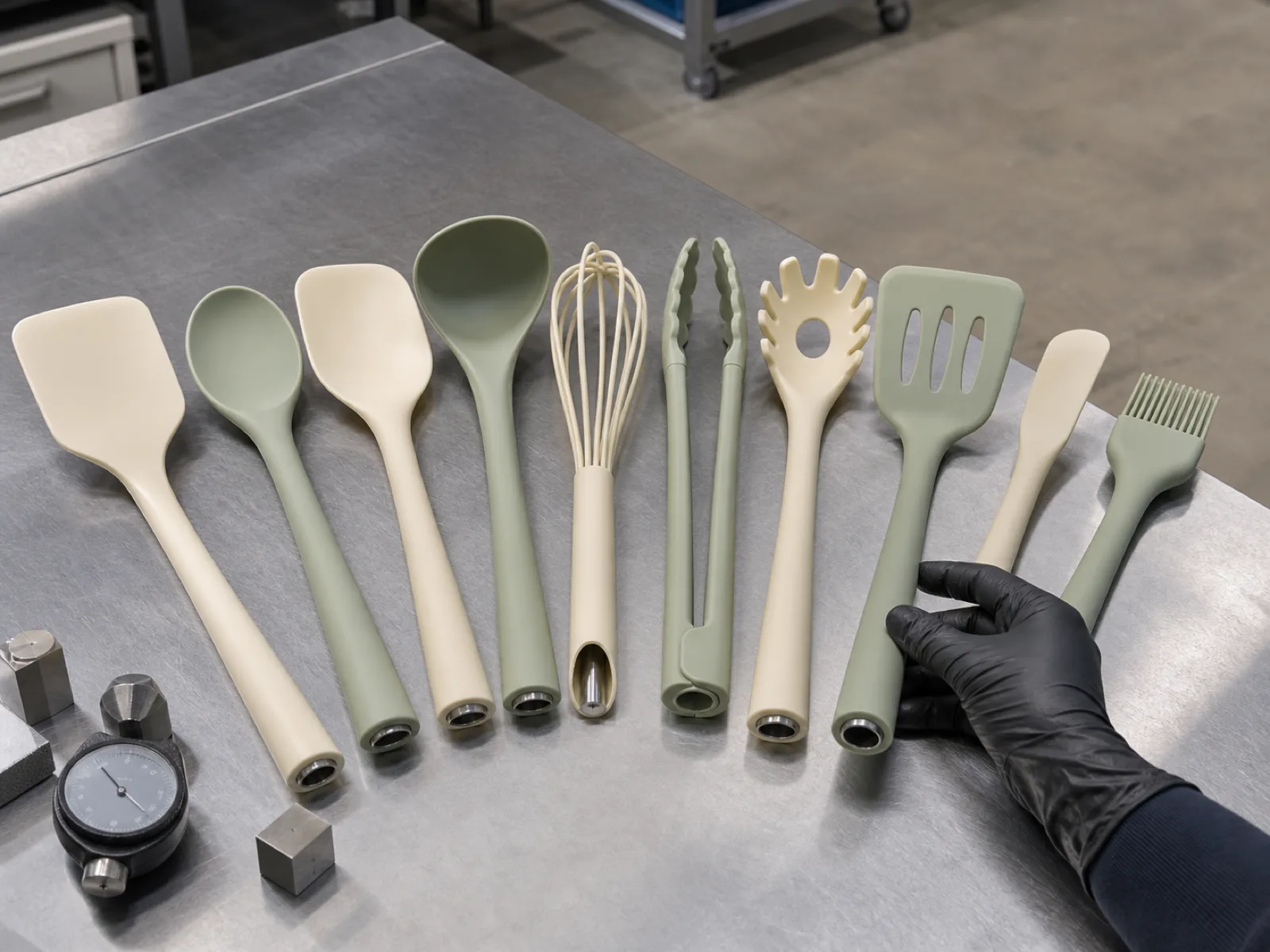
A silicone utensil set is a matched collection of food-contact cooking tools — typically 5 to 12 pieces — molded from platinum-cured silicone at Shore A 55–72, sharing one color family, one logo, and one certification packet. For a private-label buyer, the decisive fact is that a set is priced per finished set at retail but quoted and tooled per individual SKU at the factory, so a 10-piece set carries ten separate molds and ten cure cycles behind one shelf price. This guide is the engineering-desk brief for buyers launching a set program at 3,000 to 300,000 units, covering set composition, per-SKU MOQ math, OEM-vs-ODM economics, FDA and LFGB certification, handle-core construction, the pure-silicone filler test, gift-set packaging, lead time, and landed cost.
A silicone utensil set looks like a single product on the shelf and behaves like ten products on the factory floor. That gap is where first-time private-label buyers lose money — they negotiate "MOQ 500" thinking it means 500 sets, sign a color-match spec without checking it runs across every tool, and discover at the container-quantity conversation that the tooling bill, the compliance packet, and the pack-out engineering all scale with the piece count, not the set count. This guide is written from the engineering desk at Wetop's Dongguan floor for housewares brands, sink-adjacent retail chains, and private-label programs who want the actual set-manufacturing math, not a listicle of "top 10 factories." ## What is a silicone utensil set, and what belongs in each tier?A silicone utensil set is a matched group of food-contact cooking tools molded from platinum-cured silicone, sold under one brand, color, and certification packet. Retail sets cluster at 5, 8, 10, and 12 pieces. The 10-piece tier — turner, spoon, spoonula, ladle, whisk, tongs, pasta server, slotted turner, spreader, and basting brush — is the US big-box volume sweet spot.
The set tier you pick is a shelf-price and use-case decision before it is a manufacturing one. A 5-piece set is an entry gift or e-commerce SKU that covers the four daily-use tools plus one hero. A 10-piece set is a kitchen-completing assortment that lets a brand own a shelf reset. A 12-to-15-piece set adds a countertop holder, measuring spoons, or specialty tools (whisk, pastry brush, jar scraper) for a premium price ladder. Each added tool is a new mold, a new cavity plan, and a new line on the compliance packet — which is why the tier decision drives everything downstream. Every tool in a coherent set shares a Shore A hardness family and a handle architecture so the line reads as one product. Load-bearing tools (turner, ladle, pasta server) run stiffer, Shore A 65–72, often with a stiffening core. Conforming tools (spoonula, spreader, brush) run softer, Shore A 55–62. The set's identity comes from the shared color and handle profile, not from any single tool. | Set tier | Typical contents | Best retail position | Molds required | |---|---|---|---| | 5-piece | Turner, spoon, spoonula, ladle, whisk | Gift / e-commerce entry (USD 12.99–19.99) | 5 | | 8-piece | + slotted turner, tongs, spreader | Mid-market big-box (USD 19.99–27.99) | 8 | | 10-piece | + pasta server, basting brush | Big-box volume sweet spot (USD 24.99–34.99) | 10 | | 12–15-piece | + holder, jar scraper, measuring spoons | Premium / specialty (USD 34.99–59.99) | 12–15 | The mold-count column is the one buyers overlook. A 10-piece set is not "one product" from a tooling standpoint — it is ten products that happen to share a color and a box. The broader tool-by-tool geometry and Shore A logic lives in the [silicone kitchen utensils OEM guide](/guide/silicone-kitchen-utensils-oem-guide/) if you are still deciding which tools earn a slot in your set.
MOQ is counted per SKU — per individual utensil mold — not per finished set. A 10-piece set at MOQ 500 means 500 units of each of the ten tools: 5,000 molded pieces total. This per-SKU count governs your tooling and cure-cycle bill. Buyers who quote "MOQ 500 sets" face a 10× surprise on the first firm quote.
This is the single most expensive misunderstanding in set procurement. A factory sets MOQ per cavity-set because the cost floor is the cure-cycle setup and post-cure oven loading on each individual mold — not the assembled box. When Wetop quotes "MOQ 500," it means 500 pieces of each SKU in the set. For a 5-piece set that is 2,500 molded units; for a 10-piece set, 5,000; for a 12-piece set, 6,000. The per-set MOQ is therefore always 500, but the total molded volume scales with piece count. Set bundling changes the math in the buyer's favor in two ways. First, a single Pantone masterbatch and a single logo insert amortize across every tool, so the color and branding tooling is paid once for the whole set. Second, mixed-SKU cure scheduling lets the factory keep presses loaded — a set program flows more efficiently than ten unrelated single-SKU orders. The trade-off is inventory: you must forecast demand for ten tools that sell as one unit, so a slow-moving tool becomes dead stock the whole set carries. | Set size | MOQ per SKU | Total molded pieces | Finished sets | Practical floor cost driver | |---|---|---|---|---| | 5-piece | 500 | 2,500 | 500 sets | Cure-cycle setup × 5 molds | | 8-piece | 500 | 4,000 | 500 sets | Cure-cycle setup × 8 molds | | 10-piece | 500 | 5,000 | 500 sets | Cure-cycle setup × 10 molds | | 12-piece | 500 | 6,000 | 500 sets | Cure-cycle setup × 12 molds | The engineering-desk read: budget by total molded pieces, not by set count. If your first program is 500 sets of a 10-piece line, you are financing 5,000 molded, post-cured, and inspected units — plan the compliance, packaging, and cash accordingly. Why the 500 floor exists at all, and why sub-500 runs bleed money on cure setup, is worked through in the [real-factory MOQ math](/guide/real-factory-moq-the-math/). ## OEM vs ODM for a silicone utensil set — which model fits my brand?ODM brands Wetop's existing utensil tooling with your color and logo — tooling near zero, launch in 4–6 weeks, no IP transfer. OEM means you own bespoke molds and the design IP at USD 2,800–4,500 per mold. ODM fits sub-15,000-unit programs; escalate to OEM once volume clears ~15,000 units or you need a defensible product identity.
The OEM/ODM decision on a set is really a decision about mold ownership and where the design IP lives. In an ODM program, you select from Wetop's library of 40+ existing utensil tools, apply your Pantone color and debossed logo, and ship — the mold stays a shared factory asset, tooling cost is effectively zero, and your differentiation is color, logo, and packaging. In an OEM program, you commission bespoke head geometries and handle profiles, pay the per-mold tooling, and own the mold and the design as a transferable asset no other brand can run. The amortization crossover is a volume calculation. A 10-piece OEM set carries ten new molds at roughly USD 2,800–4,500 each — call it USD 28,000–45,000 in tooling. Spread across 15,000 sets, that is USD 1.87–3.00 per set in tooling amortization; across 3,000 sets it is USD 9.33–15.00 per set, which crushes the margin. Below ~15,000 annual units, ODM off existing tooling almost always wins. Above it, OEM's per-unit tooling drops into noise and the IP ownership becomes the deciding factor. | Dimension | ODM (existing tooling) | OEM (bespoke molds) | |---|---|---| | Tooling cost (10-piece set) | USD 0 | USD 28,000 – 45,000 | | Mold ownership | Wetop retains | Buyer owns after amortization | | Design IP / exclusivity | Shared library — non-exclusive | Buyer owns geometry, exclusive | | Time to first shipment | 4–6 weeks | 10–14 weeks | | Break-even annual volume | Any volume | ~15,000+ units | | Differentiation lever | Color, logo, packaging | Geometry, handle, color, logo, packaging | The honest recommendation for a first-time set launcher: start ODM to validate the assortment and shelf price, then escalate the winning SKUs to OEM tooling once the reorder signal is real. Wetop's tooling contract transfers mold title to the buyer on OEM programs after the first production run ships — we do not hold molds as leverage. ## Which certifications does a silicone utensil set need for US and EU retail?US retail needs finished-good FDA 21 CFR 177.2600 migration testing, a CPSIA General Certificate of Conformity, California Prop 65 screening, and ISO 9001 factory certification. EU retail adds LFGB §30/31 batch testing (BfR Recommendation XV as the technical basis), REACH SVHC screening, and an EU 1935/2004 Declaration of Compliance. Each material in the set carries its own document.
A utensil set is a multi-material product, and the certification trap is assuming one FDA statement covers the box. The silicone falls under FDA 21 CFR 177.2600[^fda-177-2600] — total extractives ≤ 20 mg/in² in n-hexane after 7 hours at 66 °C — but a steel handle core needs a mill test certificate, a nylon core falls under 21 CFR 177.1500, and a wood handle needs its own food-contact statement. The compliance packet is per material, per tool, then rolled up to a set-level certificate. LFGB is the stricter of the two frameworks and the one that separates a serious set supplier from an anonymous MOQ-1 marketplace listing. Where FDA sets a single extractables limit, LFGB §30/31 — built on BfR Recommendation XV[^bfr-xv] — additionally tests for sensory transfer (odor and taste), volatile matter, and peroxide residuals, which is why peroxide-cured sets that pass FDA still fail LFGB scent panels. Any set bound for German, French, or broader EU retail needs the LFGB packet, plus a REACH SVHC declaration[^echa-reach] screening every masterbatch and handle-core material against the current candidate list. | Certification | Market | What it governs on a set | Cadence | |---|---|---|---| | FDA 21 CFR 177.2600[^fda-177-2600] | US | Silicone extractables, per finished tool | Per lot / quarterly | | CPSIA GCC[^cpsc-cpsia] | US | Assembly-level conformity declaration | Per SKU | | California Prop 65 | US | Lead, cadmium, phthalate screening | Per material | | ISO 9001:2015[^iso-9001] | Global | Factory quality-management system | Annual (3-yr cert) | | LFGB §30/31 (BfR XV[^bfr-xv]) | EU | Extractables + sensory + volatiles | Per batch | | REACH SVHC[^echa-reach] | EU | Substance-of-very-high-concern screen | Per material, 2×/yr list | | EU 1935/2004 DoC | EU | Food-contact declaration of compliance | Per SKU | The first-time-buyer trap: an unaudited marketplace "FDA certified" set usually means the base-silicone compound has 177.2600 clearance from the material supplier — not that the finished tools have been lot-tested by an accredited third-party lab. US Customs FDA import review does not accept a compound COA in place of a finished-good migration report. The full framework-by-framework divergence is in the [FDA vs LFGB silicone breakdown](/guide/fda-vs-lfgb-silicone/) — read it before you promise a category buyer an EU launch. ## Platinum-cured vs peroxide-cured silicone for a full utensil set?Platinum-cured silicone is the only cure chemistry that passes retail scent-panel testing across a full utensil set. Peroxide-cured compounds leave 0.4–1.2 % residual byproducts (benzoic acid, acetophenone) that off-gas over the first 30 wash cycles — the "smells like a shoe" complaint. Platinum runs 12–18 % higher in cost and pays back on return-rate savings.
The cure system is a set-wide decision, not a per-tool one — you specify one compound family for the whole line so color and hand-feel stay consistent. Peroxide cure uses a free-radical initiator (dicumyl or 2,4-dichlorobenzoyl peroxide) that generates volatile byproducts the crosslink reaction leaves behind; a proper 4-hour, 200 °C post-cure is supposed to drive them off. Factories running compression cells on tight cycles skip that step to protect throughput, and 40–60 % of the volatile load stays in the tool, waiting to off-gas at the buyer's kitchen sink across a whole set of ten items. Platinum cure uses a platinum-catalyzed addition reaction between vinyl- and hydride-functional silicone with no byproducts — stoichiometrically clean, odorless, and the reason LSR ships to infant-nipple and medical applications without a post-cure in most cases[^nih-silicone-review]. On a set, the odor problem compounds: one smelly tool taints the buyer's perception of the whole box, so the scent-panel risk of peroxide is ten times more visible on a set than on a single spatula. | Attribute | Peroxide-cured | Platinum-cured HCR | Platinum-cured LSR | |---|---|---|---| | Raw-material cost (USD/kg, 2026) | 5.20 – 7.00 | 6.80 – 9.20 | 9.50 – 14.00 | | Volatile matter after cure | 0.4 – 1.2 % | 0.05 – 0.15 % | 0.02 – 0.08 % | | Scent-panel pass (unaged) | 60 – 75 % | 96 – 100 % | 98 – 100 % | | LFGB / BfR XV path | Often fails | Standard | Standard | | Best-fit process | Compression | Compression / transfer | Injection | | Typical set retail position | Sub-USD-20 | USD 20 – 40 | Premium USD 40+ | For any set with a shelf price above USD 19.99, Wetop only quotes platinum-cured. The reject-rate and scent-panel math kills peroxide before the raw-material saving pays. The full chemistry teardown lives in the [platinum-cured vs peroxide-cured silicone comparison](/guide/platinum-cured-vs-peroxide-cured-silicone/). ## Solid silicone, nylon, or steel core — which handle for a utensil set?Solid platinum-cured silicone gives the softest hand-feel and full 230 °C rating but flexes under load, so it suits spoons and spatulas. A 304 stainless core stiffens turners, ladles, and pasta servers without dropping heat rating. Nylon and beech-wood cores cut cost but cap continuous heat near 200 °C — fine for stirring, risky against a hot pan edge.
The handle-core decision is where a set's per-tool engineering diverges most. A silicone utensil set is not one construction repeated ten times — the load-bearing tools need a stiffening core and the conforming tools do not. Getting this wrong shows up as a ladle that folds under a full scoop or a turner that can't lift a load, both of which drive returns on the whole set. The core also sets the heat ceiling: solid silicone and steel hold the full −40 °C to 230 °C food-contact window, while nylon and wood cores soften the working range. Solid silicone construction (no core) is the cheapest and most flexible — right for spoonulas, spreaders, and brushes where flex is a feature. A 304 stainless steel core, fully encapsulated with zero exposed metal, is the retail-grade choice for turners, ladles, tongs, and pasta servers where stiffness under load matters; 304 clears 100,000 flex cycles where cheaper 430-grade cracks by 40,000. Nylon and beech-wood cores hit a mid-price hand-feel that some brands want for a "natural kitchen" aesthetic, at the cost of a lower heat ceiling and a second food-contact material on the compliance packet. | Handle core | Continuous heat rating | Stiffness under load | Cost adder / tool | Best-fit tools in a set | |---|---|---|---|---| | Solid silicone (no core) | −40 °C to 230 °C | Low (flexes) | USD 0 | Spoonula, spreader, brush, whisk | | 304 stainless steel, ≥1.2 mm | −40 °C to 230 °C | High | USD 0.08 – 0.18 | Turner, ladle, tongs, pasta server | | Nylon (glass-filled) | −40 °C to 200 °C | Medium-high | USD 0.05 – 0.12 | Slotted turner, stirring spoon | | Beech-wood core | −20 °C to 200 °C | Medium | USD 0.10 – 0.20 | Premium "natural" line accents | The engineering call on a mixed set: run 304 stainless cores on the four load-bearing tools and solid silicone on the six conforming tools — the split holds hand-feel consistency while keeping the heat rating uniform at 230 °C across the box. If a brand insists on wood-core accents for the aesthetic, isolate them to a labeled "230 °C-max" callout so the set's overall rating is not overstated.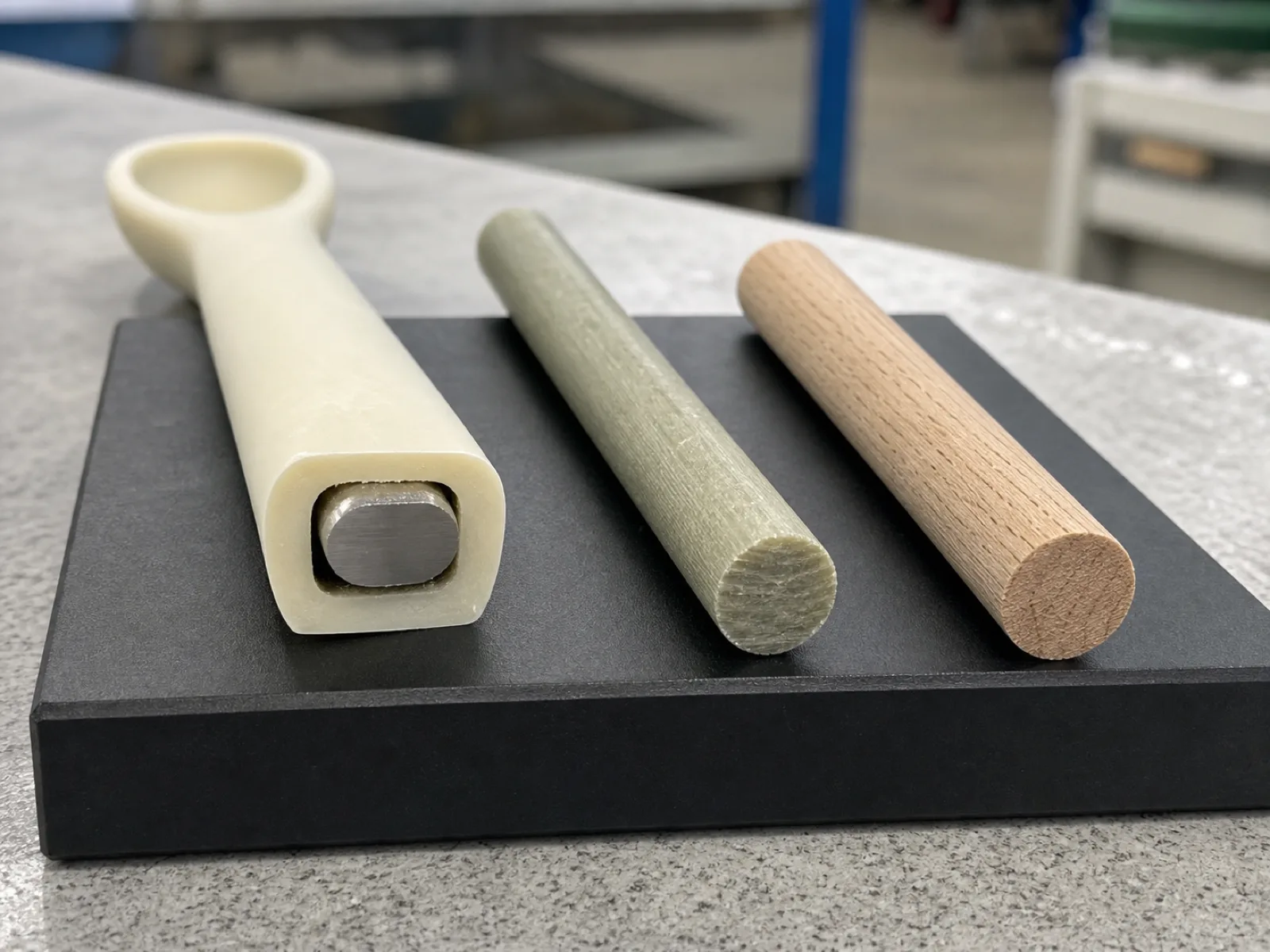
Run the pinch test: fold and twist a utensil edge hard — pure platinum-cured silicone stays its molded color, while filler-loaded compound (cut with calcium carbonate to lower cost) blooms a white stress mark. Back it with a raw-material COA naming a tier-1 base compound and a lot-level FDA 177.2600 migration report on the finished tool, not the raw compound.
The filler problem is the dirty secret of cheap utensil sets. To hit a sub-USD-10 shelf price, some factories cut virgin silicone with calcium carbonate (chalk) or other mineral fillers at 20–40 % loading. The result molds and looks like silicone but has lower tear strength, worse heat stability, and — critically — a higher extractables profile that can fail FDA and LFGB migration testing. Because filler-loaded compound costs 30–50 % less per kilogram, a factory can quote a price no pure-silicone shop can match, and the buyer doesn't discover the substitution until a lab report or a customs hold. The three-step buyer self-audit before you place a set order: 1. **Pinch-and-twist test.** Fold a utensil edge sharply and twist. Pure platinum-cured silicone holds its color under the stress. A filler-loaded compound whitens at the fold — the mineral filler debonds from the polymer and scatters light. This is a 30-second test any buyer can run on a sample. 2. **Burn test (destructive, one sacrificial sample).** Pure silicone burns to a fine white or gray ash with no black soot and no acrid plastic smell. Filler-loaded or plastic-adulterated compound leaves black residue and smells of burning plastic. Do this outdoors on one sample you're willing to destroy. 3. **Paper trail.** Demand a raw-material COA naming the base compound (Wacker Elastosil, Dow Silastic, Shin-Etsu KE-series, or Momentive Silopren) and a **finished-good** FDA 177.2600[^fda-177-2600] migration report — not a compound-level certificate. The finished-good report is the one filler substitution cannot survive. Wetop runs zero mineral filler in food-contact utensil compounds and delivers the raw-material COA plus lot-level finished-good migration reports as a standard part of every set's compliance packet. If a quote comes in far below the platinum-cured floor, the filler test is the first thing to run. ## Private-label branding — Pantone, logo, and gift-set packagingOne Pantone-matched masterbatch runs across the whole set at ΔE ≤ 1.5 on a D65 light box, amortizing color tooling better than single SKUs. Logos are debossed (mold-engraved, USD 180–350 per insert, zero unit adder), laser-marked, or pad-printed. Packaging spans bulk polybag to premium FSC gift box (USD 0.85–1.80/set) — the biggest per-SKU cost swing after utensil count.
Private-label differentiation on a set lives in three levers: color, logo, and the box. Color is the most efficient — a single Pantone masterbatch runs across every tool, so a 10-piece set pays the color-match trial cost (USD 120–180) once and applies it ten times. Inorganic pigments (iron oxide, titanium dioxide, chrome oxide) chosen for heat stability limit the gamut: muted sage, cream, terracotta, charcoal, and classic red hit retail ΔE tolerance cleanly, while deep neon blues and purples are hard to hold uniformly across a full set. Logo method is a durability-vs-cost trade, and on a set the deboss wins because it applies to the mold cavity once per tool and never wears. The gift-set packaging decision is where set economics really diverge from single-SKU — a set is a giftable object, and the box does more selling than any single utensil, which is why premium sets justify a printed FSC carton with a foam or molded-pulp insert. | Branding element | Method | Cost | Durability | Notes | |---|---|---|---|---| | Set color | Pantone masterbatch | USD 120–180 trial (once) | Permanent | Runs across all tools; ΔE ≤ 1.5 | | Logo — deboss | Mold-cavity engraved | USD 180–350 / insert | Unlimited | Zero unit adder; best-in-class | | Logo — laser | Per-unit laser mark | USD 0.20–0.35 / unit | 200+ cycles | Permanent, monochrome | | Logo — pad print | Per-unit print | USD 0.08–0.15 / unit | 30–60 cycles | Multi-color, wears | | Packaging — polybag | Bulk | USD 0.02–0.04 / pc | n/a | No retail readiness | | Packaging — kraft sleeve | E-commerce | USD 0.18–0.35 / pc | n/a | Hangtag-ready | | Packaging — gift box | FSC 4-color + insert | USD 0.85–1.80 / set | n/a | Premium shelf / gifting | The most-run private-label set spec for new US housewares brands: one shared Pantone color, debossed logo on every handle, 304 stainless cores on the load-bearing tools, and a printed FSC window box — retail-ready, distinctive, and landing under a USD 29.99 shelf price at 3,000-set MOQ. The method-by-method logo economics are worked through in full in the [silicone kitchen utensils OEM guide](/guide/silicone-kitchen-utensils-oem-guide/). ## How long does it take to launch a private-label silicone utensil set?On existing tooling (ODM), a color-matched, logo-debossed set ships a first-article sample in 12–15 days and production in 30–40 days. A full OEM set on new bespoke molds runs 25–35 days for T1 samples across all SKUs, then 30–45 days production — 70–95 days total from PO to warehouse, gated by the slowest mold in the set, not the average.
Set lead time is governed by a rule single-SKU buyers never encounter: the set ships when the *last* tool is ready, not when the average tool is ready. On an OEM program with ten new molds, if nine molds pass T1 and one needs a T2 correction, the whole set waits. This "slowest-mold-gates-the-set" reality is why experienced buyers stagger tooling — cut the geometrically simple molds first and the complex ones (whisk, tongs with a pivot) early, so a correction on a hard tool doesn't hold the easy ones hostage. The total-time-to-market breakdown for a private-label set: | Phase | ODM (existing tooling) | OEM (new molds) | |---|---|---| | Color match + logo insert | 5–8 days | 5–8 days | | Tooling (all SKUs, parallel) | n/a | 25–35 days | | First-article sample (full set) | 12–15 days | +5–7 days after tooling | | Production run | 30–40 days | 30–45 days | | Third-party lab testing | 7–14 days (parallel) | 7–14 days (parallel) | | **PO to warehouse total** | **35–45 days** | **70–95 days** | The parallel-path opportunity: run the FDA/LFGB lab testing on the first-article samples *while* the production run is molding, not after — this pulls 7–14 days off the critical path on almost every set program. Wetop schedules lab submission at first-article approval by default. The deeper mechanics of why molds take the time they take, and how retail line-review dates should back-schedule the PO, are in the [MOQ and lead-time guide](/guide/moq-and-lead-time-silicone-oem/). ## What is the quality-control plan for a silicone utensil set?A set QC plan runs three layers: material traceability (raw-material COA + lot code per tool), in-process control (Shore A durometer at lot release per ASTM D2240, cavity-ID traceability, D65 color-consistency check across all SKUs), and finished-good testing (FDA/LFGB migration, AQL 1.5 pre-shipment inspection). Color consistency across the set is the QC dimension unique to set programs.
Set QC adds a dimension single-SKU QC does not have: cross-SKU color consistency. Ten tools molded on ten cavities from one masterbatch must read as the same color under the shelf light, or the set looks like a mismatched afterthought. Wetop runs a D65 light-box comparison of one unit from every SKU against the master swatch at lot release — any tool drifting beyond ΔE 1.5 triggers a masterbatch review before the set is boxed. This is a check no single-SKU program needs and the one buyers most often forget to specify. The three-layer QC plan Wetop runs on set programs: - **Material traceability.** Every masterbatch lot carries a COA naming the tier-1 base compound. Each molded tool inherits a lot code tying it back to compound batch, cavity ID, cure date, and post-cure oven ID — so a return-rate spike on one tool traces to a specific cavity. - **In-process control.** Shore A durometer readings per ASTM D2240[^astm-d2240] at lot release, checked against each tool's spec value (±3 points); D65 cross-SKU color check; dimensional check against the drawing; visual defect inspection for flash, sink marks, and demold tears. - **Finished-good release.** Lot-level FDA 177.2600[^fda-177-2600] migration testing (and LFGB §30/31[^bfr-xv] for EU), plus an AQL 1.5 pre-shipment inspection sampling the whole set — a single failing tool holds the set. The traceability payoff is real money on a set: when a category buyer reports a defect on "the ladle in lot 4," the cavity-ID trail lets the engineering desk isolate whether it's a single cavity, a compound batch, or a post-cure oven — and fix the root cause instead of scrapping the whole run.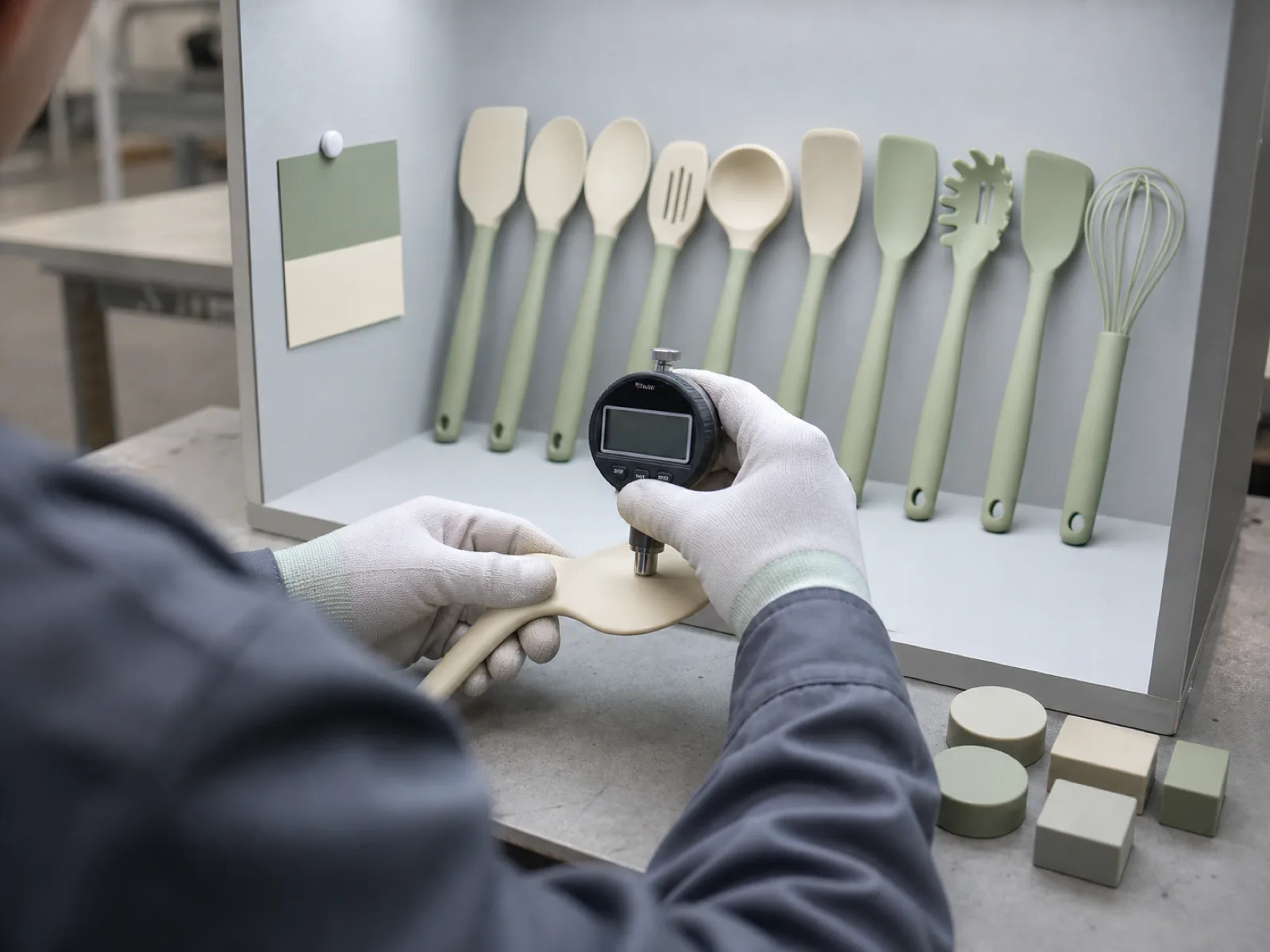
A mid-tier 10-piece private-label silicone utensil set runs USD 4.20–7.80 FOB Yantian: silicone material and molding, 304 cores on load-bearing tools, Pantone color, deboss logo, and a printed box. Landed to US West Coast adds ocean freight, 3.4 % duty under HTS 3924.10.4000, and brokerage — supporting a USD 19.99–34.99 shelf price at standard retail markup.
Set cost stacks differently from single-tool cost because the box and the piece count dominate. The silicone material and molding is a per-tool cost that scales with the set size; the color and logo tooling amortizes across the whole set; and the packaging is a per-set cost that, on a premium gift box, can rival the silicone content itself. The biggest cost swings, in order, are: number of pieces, packaging tier, and handle-core spec. A representative landed-cost stack for a 10-piece mid-tier set (six solid-silicone tools, four 304-core tools, Pantone-matched, deboss logo, printed FSC window box): | Line item | Cost per set | Notes | |---|---|---| | Silicone material + molding (10 tools) | USD 3.10 | Platinum-cured, ~six solid + four cored | | 304 stainless cores (×4) | USD 0.55 | Load-bearing tools only | | Pantone color + deboss logo | USD 0.15 | Amortized masterbatch + insert | | Printed FSC window box + insert | USD 1.15 | Premium retail packaging | | **FOB Yantian** | **USD 4.95** | Mid-tier 10-piece set | | Ocean freight (per set, mixed 40HQ) | USD 0.42 | LA/LB, 2026 rates | | Duty (HTS 3924.10.4000, 3.4 %)[^hts-3924] | USD 0.17 | General column | | Customs brokerage + drayage | USD 0.28 | Per-set allocation | | **Landed cost, US West Coast** | **USD 5.82** | Warehouse-received | At a standard 3.5–4× retail markup, a USD 5.82 landed set supports a USD 19.99–24.99 shelf price with room for retailer margin and MAP protection; upgrading the box and adding cores across more tools pushes the same 10-piece set toward a USD 29.99–34.99 premium position. The marketplace trap on sets is identical to single tools: an MOQ-1 reseller listing quotes a per-set price that reprices upward — often 40 % — at the container conversation, once filler substitution and packaging downgrades are ruled out. ## How do I vet a silicone utensil set manufacturer?Vet a set manufacturer on five axes: real molding capacity (owned presses and mold shop, not a trading desk), a certification packet delivered per finished good not per compound, a documented cross-SKU color-consistency process, a retail-chain track record you can reference, and willingness to run the filler test and share raw-material COAs. Trading companies fail the capacity and traceability checks.
The set-manufacturer market is crowded with trading companies fronting a factory-branded website, so the first filter is whether the supplier actually owns molding capacity. A real set factory runs its own compression and/or LSR cells, its own mold shop, and its own post-cure ovens — which you can verify by asking for cavity-ID traceability records, post-cure oven logs, and a live video walk of the floor. A trading company cannot produce cavity-level traceability because it doesn't own the cavities. The vetting checklist Wetop recommends buyers run on any set supplier: 1. **Capacity proof.** Ask for owned-equipment photos with cavity IDs, post-cure oven logs, and a real-time floor video. A trading company deflects to "our partner factory." 2. **Certification depth.** Confirm the FDA 177.2600 and LFGB reports are **finished-good, lot-level** — not compound COAs. This is the filler-substitution firewall. 3. **Color-consistency process.** Ask how they hold ΔE across ten SKUs from one masterbatch. A serious factory names the D65 light-box check; a weak one has no answer. 4. **Retail track record.** Ask for anonymized references to Tier-2 retail-chain or housewares-brand programs at comparable set volume. Named brands aren't necessary; a defensible tier is. 5. **Transparency.** A factory that welcomes the pinch/burn filler test and shares raw-material COAs is telling you it runs virgin platinum-cured compound. Reluctance is the signal. Wetop is a founder-led, ISO 9001 silicone factory in Dongguan running platinum-cured compression and LSR injection cells dedicated to kitchenware, with a 40+ tool utensil library for ODM programs and full OEM mold capability. We ship silicone utensil set programs to US and EU housewares brands, sink-adjacent retail chains, and private-label programs at 500-set to 300,000-set annual scale. ## Ready to launch a private-label silicone utensil set? If you have a set spec — piece count, target shelf price, color direction, and packaging tier — or a competitor set you want teardown-benchmarked, [talk to the engineering desk](/contact/). We'll return a first-pass set spec review, per-SKU tooling estimate, MOQ and lead-time schedule, and a landed FOB unit-price band inside two business days. Bring a competitor sample and we'll run the filler test, read the Shore A on every tool, and tell you exactly where the spec can be beaten before you commit a single dollar of tooling.