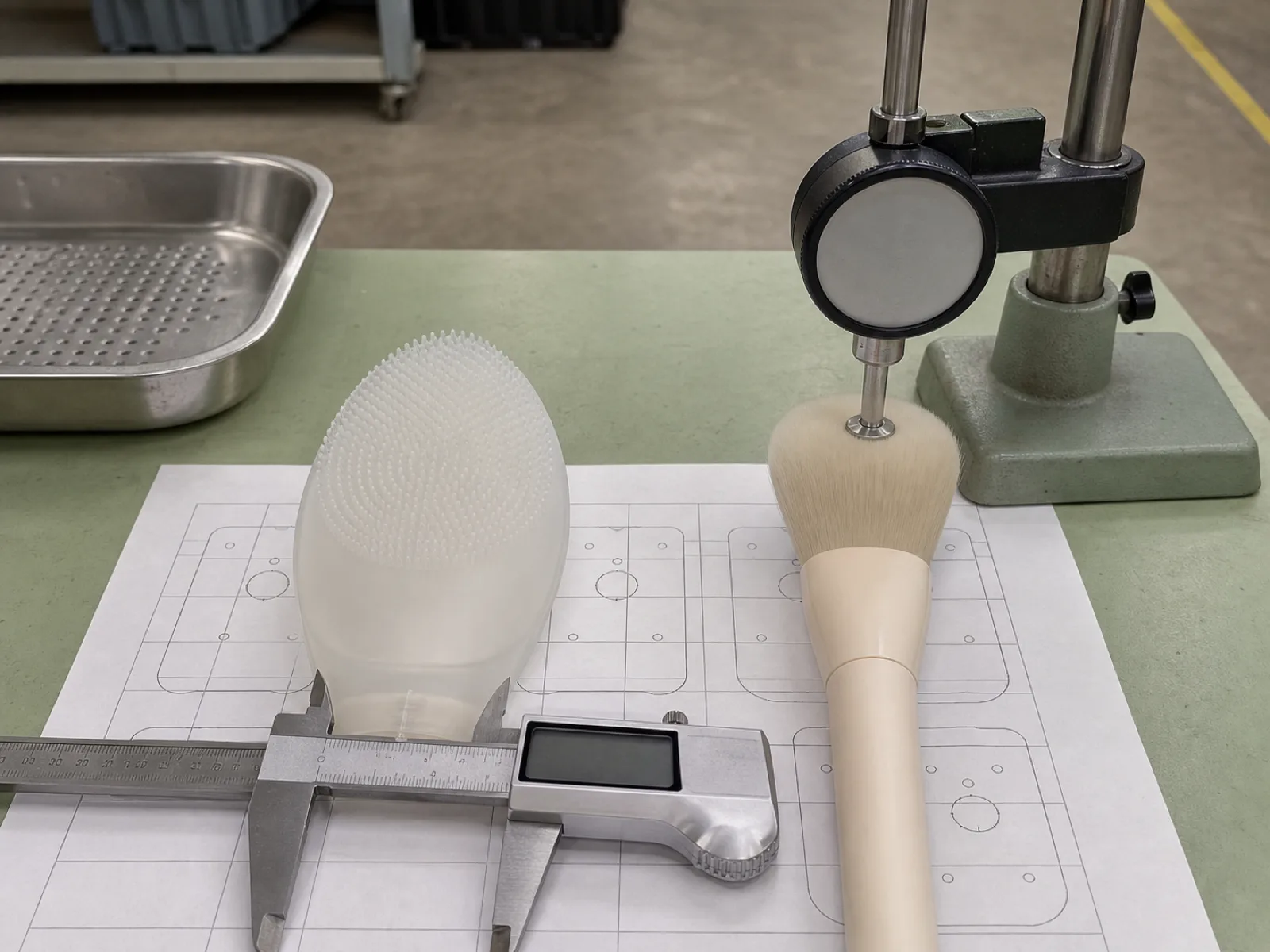
A silicone makeup brush and a synthetic makeup brush are different tools that beauty marketing keeps blurring together. A silicone brush applies makeup with non-porous molded nubs or a smooth gel head; a synthetic brush applies it with a bundle of tapered PBT or nylon fibers. Silicone wins hygiene, liquid-product control, and shed-free lifespan, while synthetic fiber still wins powder pickup and airbrushed diffusion.
This guide is written for beauty brands, private-label buyers, and product-development leads deciding whether to build a line around silicone applicators, synthetic brushes, or both. It resolves the terminology confusion competitor pages leave muddled — "silicone vs synthetic" is not the same axis as "natural vs synthetic" — and gives you the numbers a spec sheet needs: durometer, feel, a quantified hygiene comparison, a product-compatibility matrix, cleaning cadence, lifespan and cost-over-time, and the OEM MOQ economics that separate a molded silicone tool from an assembled fiber brush.
A silicone makeup brush applies product with a solid, non-porous head molded from platinum-cured silicone — usually raised nubs or a smooth gel pad. A synthetic makeup brush applies product with a bundle of tapered plastic fibers (PBT or nylon) crimped into a ferrule. Silicone is one molded piece with no fibers; synthetic is many fibers assembled into a shape. That structural difference drives every downstream trade-off.
The confusion starts with the word "synthetic." In brush marketing, "synthetic" is the opposite of "natural" (animal hair) — a synthetic brush is a fiber brush made from man-made PBT or nylon filaments instead of goat, squirrel, or pony hair. A silicone brush is a third category entirely: not a fiber brush at all, but a molded elastomer applicator. So "silicone vs synthetic" compares a molded tool against a fiber tool, while "natural vs synthetic" compares two kinds of fiber. Competitor pages that conflate the two send buyers looking for the wrong product. Mechanically, the silicone head picks up product on its surface and lays it down by gliding; the synthetic bundle picks up product between fibers and lays it down by diffusing and buffing. Neither is universally "better" — they excel with different formulas and different finishes. The rest of this guide maps exactly where each one wins so a brand can decide whether to launch one, the other, or a paired set. For the molded side of that decision, the [silicone makeup brush manufacturing guide](/guide/silicone-makeup-brush-oem-manufacturing-guide/) covers tooling and durometer in depth. ## How do silicone and synthetic makeup brushes feel on skin?A silicone makeup brush feels cool, smooth, and firm — nubs glide over skin without dragging or tickling, and the head keeps its shape under pressure. A synthetic brush feels soft and fluffy, with tapered tips that flex and diffuse. Silicone offers more control and less product loss; synthetic offers a lighter, more forgiving touch. The feel gap is a durometer question that a factory can tune.
Feel is engineered on the silicone side and fixed on the synthetic side. A molded head's softness is set by the Shore A durometer of the compound — the [Shore A hardness chart](/guide/shore-a-hardness-silicone-chart/) shows where each hardness lands on the touch scale. Skin-contact nubs are typically molded at Shore A 20-45: below 20 the head feels gummy and tears, above 50 it feels hard and scratches sensitive skin. Synthetic fiber softness is set by filament diameter and taper, which the brush maker buys rather than tunes. | Feel attribute | Silicone makeup brush | Synthetic makeup brush | | --- | --- | --- | | Surface sensation | Cool, smooth, gliding | Soft, fluffy, feathery | | Skin-contact hardness | Shore A 20-45 (tunable) | Fiber-diameter dependent | | Pressure behavior | Holds shape, controlled | Flexes and splays | | Drag on textured skin | Low — glides | Moderate — can catch | | First-use stiffness | Consistent from day one | Softens with washing | | Tickle / shed sensation | None | Occasional loose fiber | A common misread is that synthetic bristles "soften with use." They do — but that softening is early-stage fiber fatigue, the leading edge of the splaying that eventually retires the brush. A silicone head at Shore A 30 feels the same on day 1 and day 900. For brands, that consistency is a warranty and reorder advantage, not just a feel note. ## Which is more hygienic — silicone or synthetic makeup brushes?Silicone makeup brushes are more hygienic because platinum-cured silicone is non-porous. Cosmetic residue, oil, and moisture sit on the surface instead of soaking into fiber cores where bacteria multiply. A synthetic brush traps product deep in the bundle and stays damp after washing, giving bacteria a warm, moist, nutrient-rich home. Silicone rinses fully clean and tolerates boiling and alcohol sanitizing that would ruin fiber.
Hygiene is the single strongest argument for silicone, and it is a materials-science claim, not a marketing one. Porous fiber has enormous internal surface area and retains water; peer-reviewed work on used cosmetic applicators documents heavy microbial colonization on fiber and sponge surfaces, and public-health guidance is consistent that non-porous surfaces are far easier to sanitize than porous ones. Because a silicone head has no internal fiber network, there is nowhere for product to hide and nothing to stay damp — the surface dries almost instantly. | Hygiene factor | Silicone makeup brush | Synthetic makeup brush | | --- | --- | --- | | Surface porosity | Non-porous | Porous fiber bundle | | Product trapped internally | None | Significant | | Dry time after wash | Seconds (surface only) | Hours (core stays damp) | | Boil sterilization | Yes (silicone holds to 230 °C) | No — fibers deform | | Alcohol / sanitizer wipe | Yes, no degradation | Limited, can dry out fiber | | Recommended for acne-prone skin | Preferred | Use with strict washing | The practical takeaway for a beauty brand: a silicone applicator marketed for acne-prone or sensitive skin is a defensible claim you can back with the non-porous mechanism and a skin-safe compound. That skin-safety layer matters — verify it against the [is-silicone-body-safe breakdown](/guide/is-silicone-body-safe-guide/) so the compound on your order is genuinely platinum-cured and cleared under FDA 21 CFR 177.2600, not a filler-loaded imitation that defeats the hygiene story. ## Silicone vs synthetic makeup brush — which blends each product better?Silicone wins wet products — liquid and cream foundation, concealer, cream blush, primer, and masks — because its non-porous surface wastes no product and controls placement. Synthetic wins dry products — loose and setting powder, blush, bronzer, and eyeshadow — because fiber picks up and diffuses dry pigment. Match the material to the formula: liquids to silicone, powders to synthetic, and use both for a full routine.
Product compatibility is where the "which is better" question finally has a clean answer, because it depends entirely on whether the makeup is wet or dry. A silicone nub cannot hold loose powder — dry pigment slides off a smooth surface. A synthetic bundle handles powder beautifully but soaks up liquid foundation into its core, where a chunk of every application is lost at wash time. The matrix below is the decision tool competitors leave out. | Product | Best material | Why | | --- | --- | --- | | Liquid foundation | Silicone | Non-porous surface, less waste, streak-free on texture | | Cream foundation / concealer | Silicone | Precise placement, easy blend, no fiber absorption | | Cream blush / cream contour | Silicone | Controlled color payoff, no product loss | | Face masks (clay, gel, sheet serum) | Silicone | Even spread, rinses clean, no waste | | Primer / moisturizer | Silicone | Thin even film, hygienic | | Loose / setting powder | Synthetic | Fiber picks up and diffuses dry pigment | | Blush / bronzer (powder) | Synthetic | Soft diffusion, buildable | | Powder eyeshadow | Synthetic | Precise pickup and blending on the lid | | Buffing / final diffusion | Synthetic | Airbrushed finish silicone can't match | The most common professional workflow uses both: place liquid foundation with a silicone applicator to save product and control coverage, then buff it out with a synthetic brush for the airbrushed finish. For a brand, that insight is a merchandising opportunity — a paired silicone-plus-synthetic set solves the whole routine and lifts basket size over a single-tool SKU.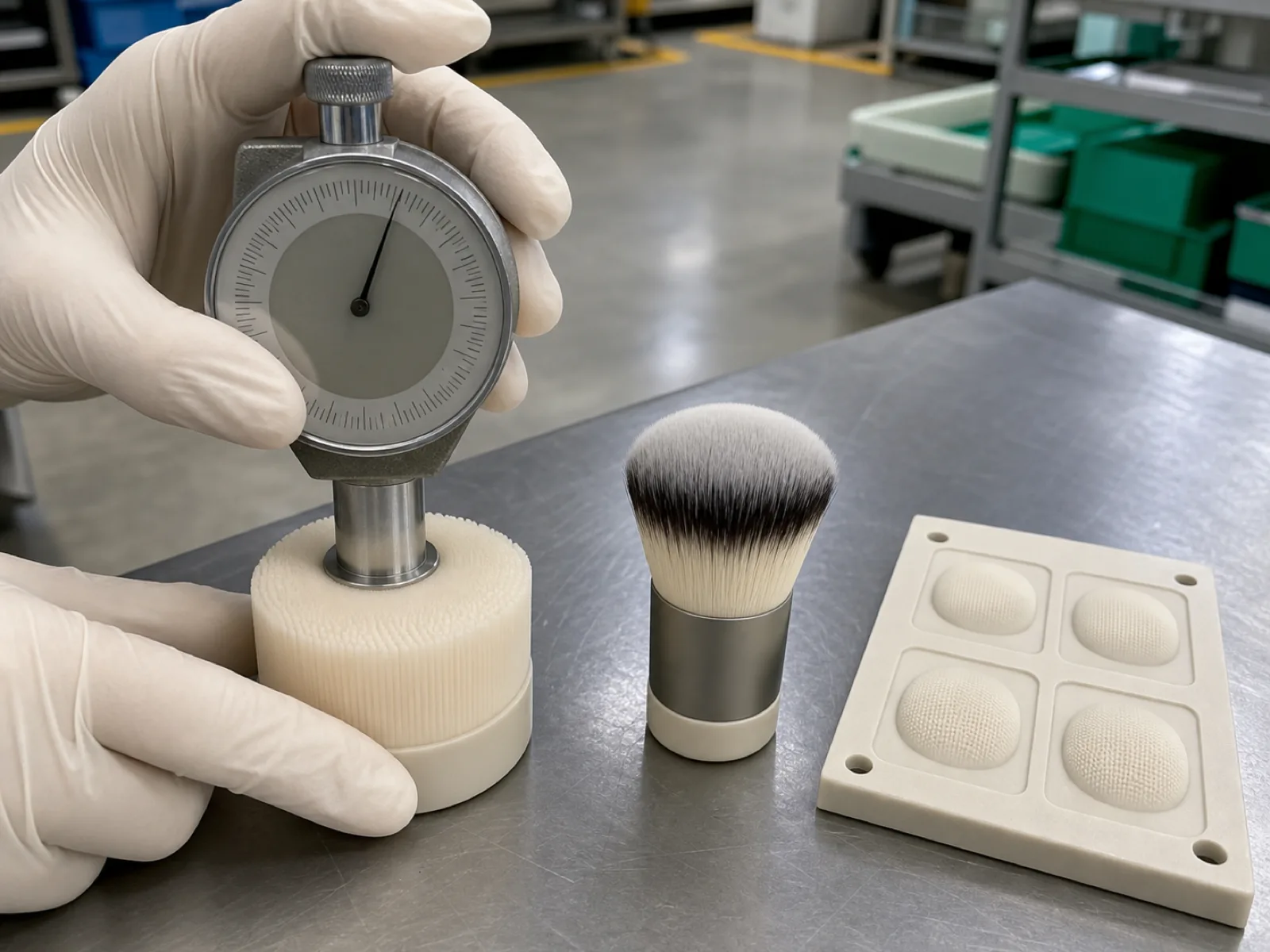
A silicone makeup brush cleans in seconds: rinse under water, wipe with soap, and it is dry almost immediately because nothing soaks into the surface. It also tolerates boiling and alcohol sanitizing. A synthetic brush needs a full wash-and-dry cycle — soap, careful rinse of the bundle, reshaping, and hours of flat drying to protect the ferrule glue. Cleaning effort is where silicone's non-porosity pays off daily.
Cleaning cadence is a real usage cost most comparisons ignore. Dermatology guidance recommends washing brushes that touch liquid products weekly and powder brushes at least monthly, and the labor of that cycle differs sharply by material. A synthetic brush must be washed without soaking the ferrule (water in the glue joint loosens fibers), then dried flat with the head reshaped, which ties the brush up for hours. A silicone head has no ferrule glue joint and no bundle to reshape. | Cleaning step | Silicone makeup brush | Synthetic makeup brush | | --- | --- | --- | | Method | Rinse + wipe, or boil / alcohol | Soap wash, careful rinse, reshape | | Time per clean | Under 1 minute | 3-5 minutes plus drying | | Dry time | Seconds | 4-12 hours flat | | Glue-joint risk | None (one piece) | Ferrule can loosen if soaked | | Deep sterilization | Yes | No | | Frequency needed | Fast, so easy to do often | Slow, so often skipped | The behavioral point matters more than the spec: because silicone is so fast to clean, users actually clean it — which closes the loop on the hygiene advantage. A synthetic brush that is technically washable but tedious tends to get washed less often than it should, and an under-washed fiber brush is the exact bacterial reservoir the hygiene section warned about. ## Which lasts longer — silicone or synthetic makeup brushes?A molded silicone makeup brush lasts longer because it cannot shed, fray, or splay — the failure modes that retire fiber brushes. A one-piece silicone head has no fibers to fall out and no ferrule glue to loosen, so its lifespan runs years. A mid-tier synthetic brush loses bristles and loses shape within 12-24 months of daily washing, and a shedding brush is discarded well before the fibers wear through.
Durability is a construction question. A synthetic brush has three failure points: fibers shed from the bundle, the bundle splays and loses its shaped tip, and the ferrule glue joint loosens under repeated wetting. A molded silicone applicator has none of these — it is a single cured elastomer part with tear strength governed by ASTM D412 tensile properties, and platinum-cured compound resists the compression fatigue that would flatten a lesser material. There is no glue joint to fail because there is no bundle to hold. | Durability factor | Silicone makeup brush | Synthetic makeup brush | | --- | --- | --- | | Shedding / fiber fallout | None | Progressive over time | | Shape retention | Permanent (molded) | Splays with washing | | Glue-joint failure | None (one piece) | Possible after repeated wetting | | Typical service life | 3+ years | 12-24 months (mid-tier) | | Failure signal | Rare tearing if abused | Loose fibers on the face | | Heat / sanitizer tolerance | High | Low | The lifespan gap flows straight into cost. A silicone applicator that survives three years replaces roughly three-to-six mid-tier synthetic brushes over the same window. Even when the silicone tool's sticker price is higher, the cost-per-year usually favors silicone once shedding-driven replacement is counted — a total-cost-of-ownership story a brand can put on the packaging, not just a unit-price contest. ## Which makeup brush is best for your skin type and use case?Choose a silicone makeup brush for acne-prone or sensitive skin, for liquid and cream products, for travel and hygiene-critical use, and for beginners who want mess-free control. Choose a synthetic brush for powder products, for buffing and airbrushed finishes, and for precision eye work. Most complete routines use both — silicone to place wet product, synthetic to diffuse and set.
The recommendation collapses into a short decision list once feel, hygiene, and product compatibility are settled. Answer the use case and the material usually picks itself. **Acne-prone or sensitive skin** — silicone first. Non-porous surface won't redeposit bacteria, glides without dragging on blemishes, and sanitizes fully. Pair with a skin-safe platinum-cured compound. **Liquid or cream foundation** — silicone for placement and product economy; add a synthetic brush if an airbrushed final finish is the goal. **Loose powder, blush, bronzer, eyeshadow** — synthetic. Silicone cannot pick up or diffuse dry pigment. **Beginners** — silicone for foundation is forgiving and mess-free with almost no learning curve; synthetic for powder. **Travel and gym bags** — silicone. It rinses in a sink, dries instantly, resists bacteria in a damp bag, and has nothing to crush out of shape. **Precision eye and detail work** — synthetic fiber, which tapers to a point silicone nubs cannot match. For a brand building a range, this list is a merchandising map: silicone owns the face-liquid and hygiene-forward segments; synthetic owns powder and detail; the paired set owns the "complete routine" shopper. ## Silicone vs synthetic makeup brush — material and safety specsA quality silicone makeup brush head is molded from platinum-cured silicone at Shore A 20-45, cleared for repeated skin contact under FDA 21 CFR 177.2600 and LFGB, with no latex, BPA, or phthalates. Synthetic brush fibers are non-latex PBT or nylon — safe and hypoallergenic, but porous. Both avoid animal hair; the safety difference is porosity and sterilizability, not toxicity.
Both materials are skin-safe when specified correctly; the spec sheet is where a private-label buyer protects the brand. On the silicone side, "platinum-cured" is the load-bearing phrase — addition-cure silicone leaves no peroxide byproducts and passes skin-contact and extractables testing that cheap peroxide-cured or filler-loaded compound can fail. On the synthetic side, PBT and nylon are inert plastics, non-latex and hypoallergenic, but they remain porous fibers. | Spec | Silicone makeup brush | Synthetic makeup brush | | --- | --- | --- | | Base material | Platinum-cured silicone rubber | PBT or nylon filament | | Skin-contact hardness | Shore A 20-45 (ASTM D2240) | Fiber grade dependent | | Food/skin-contact clearance | FDA 21 CFR 177.2600, LFGB | Cosmetic-grade fiber | | Latex / BPA / phthalate | None | None | | Temperature tolerance | -40 to 230 °C | Low (deforms with heat) | | Porosity | Non-porous | Porous | | Animal-derived | No | No | | Sterilizable | Yes (boil, alcohol) | Limited | The certification bundle a serious buyer requires is the same discipline either way: a compound Certificate of Compliance citing the applicable clause, a skin-contact test report, and lot traceability. The [FDA vs LFGB clause breakdown](/guide/fda-vs-lfgb-silicone/) explains which standard belongs on which market's drawing for the silicone head; the fiber side rides on the cosmetic-grade certification of the filament supplier. ## Silicone vs synthetic makeup brush — which is more sustainable?A reusable silicone makeup brush that lasts years and sheds nothing generates less replacement waste than synthetic brushes swapped every 6-12 months, and it uses no animal hair. Synthetic fibers are petroleum-derived and shed microplastic during washing. Neither is compostable, but silicone's long life and single-material construction make it the lower-waste, easier-to-recycle option over a multi-year window.
Sustainability is a lifespan-and-materials argument, and it favors silicone on both counts. Waste is dominated by replacement frequency: a tool that lasts three years and cannot shed simply enters the waste stream less often than one replaced twice a year. Microfiber shedding is a second axis — synthetic brush fibers release microplastic into wash water each cycle, while a solid silicone head sheds nothing during use or cleaning. Silicone is also a single material with no mixed fiber-glue-metal-ferrule assembly, so at end of life it is easier to sort for recycling than a multi-material synthetic brush. It is not biodegradable, and no honest comparison claims it is — but on the metrics that actually move brush waste (replacement rate, shedding, material separability) the durable single-material option is the lower-impact one. For brands with a sustainability position, that is a claim you can substantiate with lifespan data rather than vague "eco" language. ## Wetop's silicone makeup brush OEM positionWetop is a platinum-cured silicone specialist — we mold custom silicone makeup brush heads and applicators, not synthetic fiber brushes. MOQ is 500 pcs/SKU on new tooling with a 7-25 day first sample from our Dongguan factory, molded under ISO 9001 from FDA 21 CFR 177.2600 / LFGB skin-safe compound at a Shore A you specify. If your program needs fiber brushes, that is a different supply chain and we will say so.
The two products come from different factories for a reason. A synthetic brush is assembled — stock fiber cut and shaped, crimped into a ferrule, glued to a handle — so its supply chain is a bundling operation set by fiber and handle vendors. A silicone applicator is molded — a machined cavity, a platinum-cured compound, a cured one-piece head — so its supply chain is a tooling operation. We run the molding side. That specialization is why we can hold a Shore A 30 skin-contact target lot after lot and put full FDA / LFGB documentation behind it. If your line is silicone — a nub applicator for liquid foundation, a gel face-mask brush, a hygiene-forward tool for acne-prone skin, or a paired set that ships alongside a synthetic buffing brush you source elsewhere — we can quote from a sketch or a 3D file within one business day, including durometer recommendation, unit price at 500 / 5,000 / 50,000 pcs, tooling amortization, and sample lead time. The [MOQ and lead-time math](/guide/moq-and-lead-time-silicone-oem/) shows how the mold cost spreads across your first run. [Request a custom silicone makeup brush quote](/contact/) with your target head shape, Shore A, color (Pantone), branding method, and order volume — we return a compound recommendation, tooling plan, and price schedule within one business day from the engineering desk in Dongguan.