---
title: "Silicone Sink Grid Fit Guide — Sizing to Your Sink SKU"
description: "How to spec a silicone bottom grid for a specific sink SKU. Bay dimensions, drain cutout, corner radius — the four numbers procurement needs to send."
primaryKeyword: "silicone sink grid sized to sink SKU"
secondaryKeywords:
- "custom sink protector mat sized to my sink"
- "silicone sink grid fit guide"
- "custom silicone sink grid factory"
- "sink-brand silicone bottom grid OEM"
searchIntent: "commercial"
category: "Buyer Guide"
author:
name: "Wetop Silicone Sink Accessory Team"
credential: "Manufactures sink grids for 28+ sink-brand SKU references"
datePublished: 2026-05-14
dateModified: 2026-05-14
heroImage: "/images/guides/sink-grid-fit-hero.webp"
heroImageAlt: "Technical drawing of a silicone bottom grid template overlaid on a stainless single-bowl undermount kitchen sink"
keyTakeaways:
- "Sizing a silicone sink grid requires four numbers: internal length, internal width, corner radius, and drain cutout (location + diameter)."
- "Single-bowl sinks ≤ 24 in: one-piece molded grid is feasible and looks premium. 30+ in workstation sinks: two-piece snap-together is the only economical option."
- "We maintain pre-tooled molds across the six major sink categories (single-bowl, double-bowl, workstation, farmhouse, bar/prep, commercial) — sink-brand programs that match library geometry skip tooling cost."
- "Drain cutout location matters more than length tolerance. A grid that sits 2mm off-center looks broken; 2mm short on length is invisible."
- "Color-coordinate to the sink interior: stainless = matte coordinated grey; matte black sink = jet black; copper / gunmetal = custom Pantone."
recommended: true
faqs:
- question: "What dimensions do you need from me to design a custom sink grid?"
answer: "Four critical numbers: (1) internal bay length at the bottom of the sink, (2) internal bay width at the bottom, (3) corner radius at the bottom of the bay (this is the curve from bottom to side wall — often 10-30 mm), and (4) drain cutout — location relative to bay corners, and drain diameter (typically 89-95 mm for kitchen sinks). A picture from above with a ruler also helps."
- question: "Do you have pre-tooled molds for specific sink brand SKUs?"
answer: "Yes — our pre-tooled library covers the six major sink categories (single-bowl undermount, double-bowl, workstation, farmhouse, bar/prep, commercial) at the dimensional spec common to top-tier US sink-brand sink ranges. Programs matching library geometry skip tooling cost and sample in 7-10 days. Out of respect for our sink-brand customers, we do not list specific brand SKUs publicly — named references are provided under NDA during the RFP stage."
- question: "One-piece molded vs two-piece snap-together — which should I OEM?"
answer: "One-piece for sinks up to ~24 in internal length — looks seamless, premium feel. Two-piece for larger workstation sinks (30-45 in) because single-cavity molds at that size are economically unviable. The two-piece seam aligns under the accessory rail or sink center divider in normal use, so it is hidden."
- question: "What durometer should the silicone be for a sink grid?"
answer: "Shore A 65-75 is the sweet spot. Softer than 60 and cookware tips on the grid. Harder than 80 and the grid loses cushioning function, defeating the point vs steel. Shore A 70 is our default for premium sink-brand programs."
- question: "Are silicone sink grids safe for stone composite or fireclay sinks?"
answer: "Yes — actually they are the preferred protection over steel grids for those sink materials. Steel grids can chip granite composite, quartz composite, and fireclay; silicone cushions cookware impact and prevents that damage. Several premium stone-sink brands now spec silicone grids as the OEM accessory rather than steel."
---
If you make sinks — or if you sell aftermarket sink accessories — silicone bottom grids are a recurring sourcing problem. The reason: **a grid that is sized 5mm wrong looks broken, and a grid with the drain cutout 5mm off-center looks unprofessional.** Most buyers underestimate how tight the dimensional tolerance has to be, and how badly a generic "fits most 30-inch sinks" product performs against a sink-SKU-specific spec.
This is the guide we wish every sink-brand procurement team had before our first RFQ call.
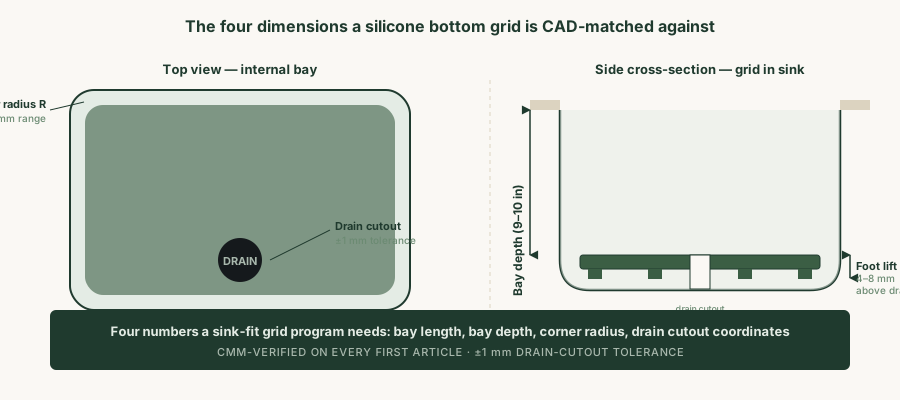
Sizing a silicone sink grid requires four numbers: internal bay length, internal bay width measured at the bottom, corner radius at the bottom-to-sidewall transition, and drain cutout location plus diameter. The drain cutout position is the dimension that ruins programs — a grid that sits 2mm off-center looks broken even if every other dimension is correct.
## The four numbers we need from you
To CAD a sink grid, our engineering team needs these four numbers. Anything else is nice-to-have.
The four dimensions a sink-grid CAD review depends on. Bay dimensions are always measured at the bottom (not the rim) because side-wall draft makes the two differ by 20-40 mm.
| Number | What it is | Why it matters |
|---|---|---|
| Internal length | Bay length measured at the bottom (not the rim) | Determines mold cavity length |
| Internal width | Bay width at the bottom | Determines mold cavity width |
| Corner radius | The curve from bottom to side wall (usually 10-30 mm) | Determines grid corner profile — too tight and the grid won't sit flat |
| Drain cutout | Location (X,Y from a corner) + drain diameter | This is the dimension that matters most for visual quality |
Bay dimensions at the **rim** are different from dimensions at the **bottom** — sometimes by 20-40 mm because of side-wall draft. Always measure at the bottom.
## Drain cutout: the dimension that ruins programs
If you remember nothing else from this guide, remember this: **the drain cutout position is the visible quality check.** Buyers who lift the grid out of a sink will visually align it to the drain. If it's off-center by 3mm, every dish they wash will sit on a slightly off-kilter grid. They will return the product.
Drain cutout dimensions to spec:
- **Location:** X distance from corner, Y distance from corner. Tolerance ±1 mm.
- **Diameter:** typical kitchen drain is 89 mm (3.5 in) or 95 mm (3.75 in). Tolerance ±0.5 mm.
- **Cutout style:** circular full-cut (most common), keyhole (allows grid placement without disconnecting drain), or D-cut (asymmetric).
For most US/EU kitchen sink SKUs, drain is approximately centered front-to-back and offset to one side or center. **Photograph the drain location from above with a ruler** if you cannot get drawings from the sink manufacturer.
## One-piece vs two-piece construction
| Sink internal length | Construction | Why |
|---|---|---|
| ≤ 16 in (40 cm) | One-piece, single-cavity mold | Simplest, lowest tooling cost |
| 16-24 in | One-piece, larger mold | Still single-piece; tooling cost steps up but visual quality unmatched |
| 24-30 in | One-piece if budget permits ($8-15k mold), else two-piece | Decision-point — most premium programs spec one-piece despite cost |
| 30-45 in (workstation) | Two-piece snap-together | Single-piece is uneconomical at this size |
| 45 in+ | Two-piece or three-piece | Common for commercial / prep sinks |
The two-piece seam can be designed to align under the workstation sink accessory rail (which sits in the center groove), so in normal use the seam is hidden by the rail.
## Sink categories our library covers
We pre-tool molds across the six dimensional clusters that account for the vast majority of US/EU residential sink-brand SKUs. Programs whose target sink falls inside one of these clusters skip the $1,500-$3,500 tooling cost and sample from existing molds in 7-10 days:
**Single-bowl undermount (24-30 in)** — the dominant US residential cluster. Internal bay length 22-27 in, internal width 14-17 in, depth 9-10 in. Rear-center or rear-offset drain. Corner radius typically 10-25 mm.
**Double-bowl undermount (30-36 in)** — equal 50/50 split or asymmetric low-divide. Per-bowl molds; programs pair grids in retail packaging.
**Workstation (30-45 in, apron + accessory rail)** — two-piece snap-together grids with seam aligned under the workstation rail (hidden in normal use). Single-piece tooling above 24 in is uneconomical.
**Farmhouse / apron-front (27-33 in)** — stainless, fireclay, and granite-composite variants. Slightly trapezoidal bays — we CAD-match the exact angle.
**Bar / prep (12-18 in)** — compact secondary-sink category. Smaller 60 mm drain typical (kitchen standard is 90 mm). Lower MOQ feasibility on existing mold.
**Commercial / restaurant prep (18-30 in)** — reinforced higher-durometer compound (Shore A 70-80) for daily heavy cookware impact. Different mold series from residential.
For sink SKUs outside the library, MOQ 500 + tooling cost ($1,500-$3,500) gets a custom mold made — 18-25 day first-article sample timeline.
> **A note on brand discretion.** Most of our active sink-brand programs are under partnership confidentiality, so we describe our library here by sink category rather than by specific brand SKU. If you are sourcing for a specific named sink range and want to know whether the geometry is already in our library, send the sink model and we will respond under NDA within one business day.
## Color-coordinating to the sink
Most sink-brand programs ask us to coordinate the grid color with the sink interior:
- **Stainless steel sink** → matte coordinated grey grid (most popular)
- **Matte black sink** (current trend) → jet black grid
- **Granite composite cinder grey** (stone-composite sink interior) → coordinated cinder grey
- **Copper or gunmetal undermount** → custom Pantone match (premium positioning)
- **Fireclay white** → cream / sand grid
Pantone matching within ±0.5 ΔE is standard. We mix color in master-batch so it stays consistent across all units in a production run.
## What goes wrong on bad sink-grid programs
If you've sourced sink grids before and had problems, it was probably one of these:
1. **"Universal fit" grid that fits nothing well.** These exist because some suppliers don't want to tool a custom mold. They look amateur on every specific sink they're supposed to fit.
2. **Drain cutout off-center.** Visible immediately when the grid is placed. Often a result of the supplier using a mold designed for a similar-but-different sink SKU.
3. **Corner radius doesn't match the sink corner radius.** Grid sits flat in the middle but lifts at corners. Looks broken even if dimensions are technically right.
4. **Color drift across the batch.** Cheaper formulations use surface dye that varies cycle-to-cycle. Master-batch color mixing prevents this.
Spec all four dimensions, demand the test report against your master-batch lot, and verify the first article sample against actual sink installation before approving production. A 30-minute QC step now saves a 5,000-piece reorder later.