Fortune 500 HVAC OEM caliber · Silicone Industrial Parts · Silicone door and access-panel gasket family for commercial rooftop HVAC unit
Rooftop HVAC Door Gasket Family — 180k pcs/yr Silicone OEM
Why this program is worth writing up
This is the OEM case where every buyer-side decision — cure chemistry, DFM corner geometry, compression-set target, IQC gate structure, kanban cadence — was made against a clause number or a dimensional tolerance rather than a marketing adjective. The 24-month record (412 PPM defect rate, warranty-return drop from 0.9% to under 0.1%, 11% landed-cost reduction versus a US regional extruder) is what a Fortune 500-caliber HVAC OEM supplier-quality team audits when a director defends a supplier switch to procurement leadership.
The customer isn’t named here — the program runs under an anonymization agreement standard for commercial-HVAC private-label supply. What matters for other industrial OEM procurement and reliability-engineering readers is the shape of the decisions, not the logo. Nothing in this write-up is a competitive claim against Trelleborg, Parker Hannifin, Freudenberg, or any specific US extruder; the tier reference exists so peers reading this recognize the audit posture and unit-economics envelope.
Cure system: why platinum-cure VMQ was locked at the RFQ stage
Platinum-cured VMQ (methyl vinyl silicone) uses a platinum-catalyst addition-cure system that produces no cure by-products, holds Shore A 50 ±5 through the −50 °C to +230 °C spec window without residue migration, and clears FDA 21 CFR 177.2600[^fda-177-2600] on the condensate-adjacent SKUs. Peroxide-cure silicone runs 15–20% cheaper per kilo but leaves 2,4-dichlorobenzoic acid or benzoic acid residues unless volatilized in a 4–6 hour post-bake at 180–200 °C — the step the incumbent skipped to save oven throughput. The root cause on the incumbent's corner tears was peroxide-decomposition surface bloom degrading tear resistance over 12–18 months of thermal cycling.
The customer’s reliability team had already run a Weibull fit against the field-pull data before we quoted. Median time-to-failure on the corner tears was 14 months with a shape parameter suggesting a wear-out mechanism, not an infant-mortality defect. That reading pointed at cure chemistry rather than tooling geometry as the dominant driver, which is why platinum-cure got locked into every clause of the RFQ.
DFM changes at first-article: three geometric fixes
Three DFM changes moved at first-article and eliminated the tear-initiation site the incumbent supplier had baked in. First: inside-corner radius on the door seals bumped from R0.5 to R1.5 mm, tripling the local strain-relief geometry and cutting peak stress under door-slam impact by roughly 55% per finite-element estimate. Second: parting line moved off the sealing face on both molded access-panel SKUs, so the microscopic flash ridge no longer intersected the metal-to-silicone contact line where compression sealing happens. Third: gate location on the 8-cavity compression mold shifted 90° to keep flow lines away from the corner region, which improves knit-line strength at the very point where corner tears had originated on the incumbent design.
Finite-element checks were run against ASTM D4121 tensile properties on the qualified compound so the corner-radius change was defended by actual measured elongation and tear numbers, not vendor datasheet values. All three DFM changes were owned by Wetop’s engineering team and delivered as annotated CAD deltas back to the customer — a posture the OEM’s supplier-quality director specifically called out at the year-1 review as the difference between a “molder” and an “engineering partner.”
Compression-set discipline: how we hold 18–22% after 22 h at 175 °C
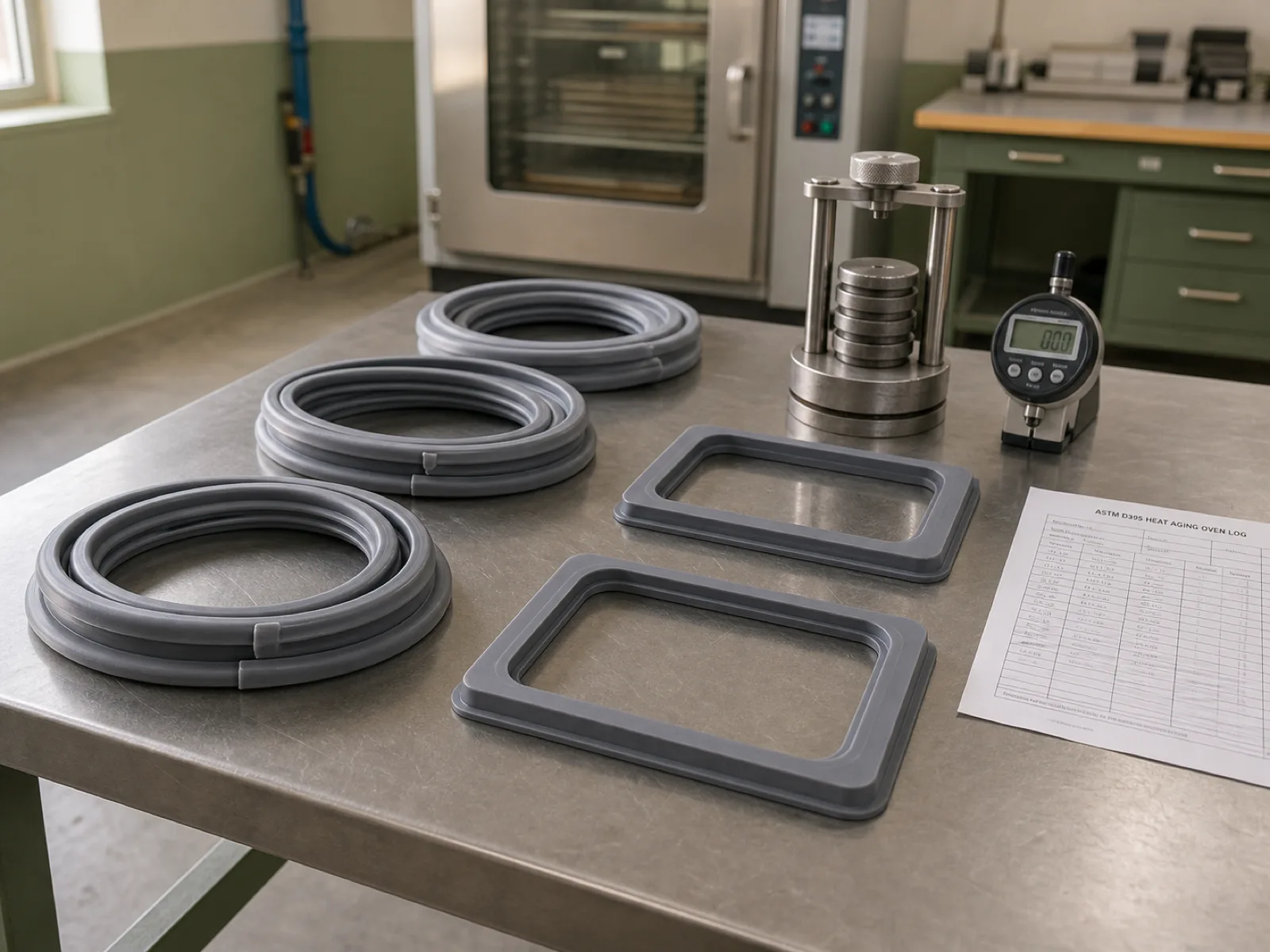
Compression set is measured per ASTM D395[^astm-d395] Method B on stacked discs held at 25% deflection for 22 hours at 175 °C, then released for 30 minutes before the residual set is measured. Production lots on this program hold 18–22% — comfortably inside the customer's <25% spec gate and materially better than the incumbent EPDM's 31–36% drift. The number is a function of three variables: (1) polymer molecular weight and crosslink density on the base compound, (2) the four-hour post-cure bake at 200 °C that volatilizes low-molecular-weight silicone cyclics, and (3) the platinum-catalyst loading that anchors network completion before the part demolds.
The 90-day accelerated-aging reference sample from every production run is not a decoration — it’s a diagnostic. If a lot’s 90-day post-oven-hold set number drifts more than two points versus the reference bank, that lot triggers a root-cause investigation before any additional production releases against the same compound drum. In two years of running production, three such alerts have fired and all three resolved back to a specific compound-house drum lot, not a process drift on our floor.
Sealing-force target and durometer window
Sealing-force target on the rooftop-unit door was 3.5–4.5 N per linear inch at 25% compression, which pinned the durometer window at Shore A 50 ±5 per ASTM D2240[^astm-d2240]. Too soft (Shore A < 45) and the seal cold-flows at −20 °C ambient loading and lets condensate migrate along the sealing face; too hard (Shore A > 60) and the door closure force exceeds the actuator torque specification the customer's mechanical team had budgeted for the latch mechanism. The Shore A 50 ±5 window is the intersection of thermal-cycling flexibility, condensate-migration resistance, and mechanical-latch compatibility across the −50 °C to +230 °C spec range.
Durometer is checked on every incoming compound drum and every finished-part lot with a bench-mounted digital durometer calibrated against a rubber reference block on a 30-day cadence. The reference block itself is re-certified annually against an ISO 17025-accredited lab standard so the on-floor readings are traceable back to a national metrology chain.
IQC / IPQC / OQC gate structure at ISO 9001 discipline
The QC gate structure runs three layers per ISO 9001:2015[^iso-9001] documented QMS. IQC on every incoming compound drum: durometer, specific gravity, mill-lot cert cross-check against the compound-house reference COA, and a fresh mixing-mill rheology curve before the drum releases to production. IPQC every 30 minutes during a run: dimensional (cord cross-section on extrusion, gate-witness dimension on compression molding), visual (tear marks, splice line, flash), and a hot-set check on the vulcanization tunnel exit. OQC per lot: dimensional AQL 1.5 per ISO 2859-1[^iso-2859-1] Level II, cosmetic AQL 2.5, plus a compression-set sample from every production run held for 90 days in the reference bank.
The 41-page first-article qualification report the customer accepted on first submission is the physical evidence of this gate structure at first-article scale — control plan, PFMEA, dimensional layout on 30 pieces, capability study on the critical corner-radius dimension (Cpk 1.68 measured, well above the 1.33 gate), gauge R&R on the durometer and dimensional measurement systems, and lab certifications on both compound and vulcanization tunnel calibration. Zero re-tests requested by the OEM’s supplier-quality team.
MOQ, tooling amortization, and pricing tiers
MOQ 500 pieces per SKU at pilot with FOB Yantian tiered pricing. Tooling: 8-cavity compression mold on the two molded access-panel SKUs at ~US$14,000 amortized over 24 months of running production; continuous extrusion + hot-air vulcanization on the three door seals uses standard tooling billed as NRE only on the cross-section die (~US$1,800 per profile). Sample lead-time 10 days, production 28–32 days FOB Yantian. Year-1 blended unit price landed 11% below the incumbent US regional extruder on the same 5-SKU basket, including sea freight to a US Midwest DC.
The unit-price step-down from the incumbent is not from cutting compound cost — the platinum-cured VMQ compound bill of materials sits at a small premium versus the incumbent’s peroxide-cure hybrid. The step-down comes from (1) 8-cavity compression tooling versus the incumbent’s 4-cavity setup, (2) tighter cycle time on the vulcanization tunnel via a redesigned dwell-zone profile, and (3) freight consolidation cadenced monthly out of Yantian Port rather than the incumbent’s mixed-mode US inland shipping. Landed cost including duty stays 11% below the incumbent even under a 7.5% tariff scenario.
UL 94 flammability, RoHS/REACH, and the condensate-path FDA gate
The compliance stack is UL 94 HB flammability rating (self-extinguishing horizontal burn) on all five SKUs, RoHS 2011/65/EU heavy-metal panel, REACH Annex XVII plus SVHC candidate-list declaration re-issued on ECHA's twice-yearly update cadence, and FDA 21 CFR 177.2600[^fda-177-2600] clause-level attestation on the two SKUs that sit in the condensate-adjacent air path. The condensate-adjacent gate exists because rooftop-unit condensate can migrate into the return-air stream on certain unit configurations, and OEM legal treats that path as food-contact-adjacent under a conservative reading of end-user liability.
REACH SVHC declarations get re-issued within 15 business days of each ECHA candidate-list update (typically January and June). Existing inventory in the customer’s DC is covered by the declaration in force at PO date; new POs after the update reference the new list. This is a documentation cadence a lot of Asian suppliers quietly skip, and the OEM’s supplier-quality office runs an annual spot-check on the declaration date.
Kanban replenishment and the 3-week safety stock buffer
The customer runs kanban replenishment against a 6-week rolling forecast, with a 3-week safety stock held at the Wetop finished-goods DC in Dongguan and container consolidation cadenced monthly out of Yantian Port. FOB Yantian to a US Midwest DC runs 32–38 days sea plus 4–6 days inland, so the 3-week buffer covers Chinese New Year shutdown, US port congestion events, and the customer's Q4 seasonal build spike simultaneously. Over the 24-month program window, on-time delivery held at 98.6% against the customer's 96.0% gate.
The two OTD misses that dropped us off 100% in year 1 both traced back to a specific US port congestion event, not a factory delay. The customer’s supply-chain office was in the loop 11 days ahead of the miss window with an air-freight upgrade path costed out; the customer chose to absorb the schedule slip rather than pay air premium because their downstream production had a compensating buffer. That kind of demand-signal transparency is what the OEM supplier-scorecard rewards.
Field-return trajectory: 0.9% → under 0.1% on the gasket-attributable failure mode
The warranty-return rate on the gasket-attributable failure mode dropped from 0.9% of units in the field (incumbent, 18-month field pull) to under 0.1% (Wetop, 24-month field pull), verified independently by the OEM's reliability engineering team pulling units back from installed rooftop equipment for tear-down analysis. The corner-tear failure mode that dominated the incumbent's return codes has not recurred on Wetop-supplied units. Compression-set-driven condensate ingress complaints also fell to sample-noise levels.
The reliability team’s tear-down protocol looks at three markers: (1) corner-radius geometry deviation from design intent, (2) surface bloom or discoloration indicating cure-residue migration, and (3) durometer drift measured on excised gasket segments versus new-part baseline. All three markers on Wetop-supplied field returns are within lab-noise range at 18-month service exposure. That is the metric the OEM’s reliability director cited when the program was extended into the heat-pump product family.
Program expansion: heat-pump gasket family under the same discipline
The customer's supplier-quality team has asked Wetop to quote a second gasket family — this time for a heat-pump product line — using the same platinum-cure VMQ compound base, the same DFM ownership posture, and the same 41-page qualification-report format. The heat-pump family adds a refrigerant-adjacent SKU that will require a lower gas-permeation compound variant plus a UL 94 V-0 rating rather than HB, which we're qualifying against an ASTM E96 water-vapor transmission baseline before the RFQ closes.
Program expansion after a two-year field-return record is the buyer-side signal that the underlying engineering-and-QC discipline was the actual differentiator, not a year-1 pricing concession. Unit-price competition becomes secondary once the OEM’s supplier-quality team stops flagging gasket SKUs as a re-verification target on adjacent product families.
Frequently asked
Q: Why platinum-cure VMQ specifically, and not a peroxide-cure silicone at lower unit cost? A: Platinum-cure produces no organic peroxide decomposition residues, so there’s no surface bloom to initiate tear-initiation sites at door-corner geometry over 12–18 months of thermal cycling. Peroxide-cure runs 15–20% cheaper per kilo of compound, but the field-return economics do not close on that saving once you carry the 0.9% warranty-return rate the incumbent was running. Platinum-cure at Shore A 50 ±5 with a 4-hour post-bake at 200 °C is the specification that clears both the compression-set gate and the corner-tear failure mode.
Q: How does the R0.5-to-R1.5 mm inside-corner radius change actually reduce tear initiation? A: Peak strain at a sharp interior corner scales roughly with the inverse square root of the radius. Going from R0.5 to R1.5 mm drops peak strain concentration by roughly a factor of 1.7, which moves the operating stress at door-slam impact from near the compound’s tear-strength envelope to comfortably inside it. Finite-element models against the qualified compound’s measured elongation and Die-B tear strength (per ASTM D624) validated the geometry before tooling was cut.
Q: Is 500 pieces per SKU a realistic MOQ for a compression-molded industrial gasket program? A: Yes for a real factory running its own compound inventory and its own vulcanization tunnels. It is not realistic for a broker-model supplier who buys press hours by the hour — their unit economics require 5,000+ pieces per SKU to cover the fixed cost of color-match, cure-cycle set-up, and QC batch. The 8-cavity compression tool amortization at ~US$14k over 24 months of running production is a manageable NRE for a Fortune 500 OEM pilot; the same NRE is prohibitive if it has to be recovered against a single 5,000-piece PO.
Q: What is a 412 PPM defect rate against typical industrial-gasket category norms? A: Automotive-supply gasket programs benchmark defect rates against IATF 16949 process discipline where 250–500 PPM is considered production-mature and under 100 PPM is world-class. For a commercial-HVAC application at the Fortune 500 OEM tier, the customer’s supplier-scorecard gate was set at 1,000 PPM; sustained performance at 412 PPM across all 5 SKUs sits comfortably in the “green” band of the scorecard. Zero regulatory incidents and zero field-safety escalations is the harder metric.
Q: What compliance documents ship with every PO? A: Every PO ships with a 6-document COA bundle: platinum-cure attestation, UL 94 HB burn-test certificate, RoHS 2011/65/EU heavy-metal panel, REACH SVHC declaration referencing the current ECHA candidate-list version, FDA 21 CFR 177.2600 clause-level attestation on the condensate-adjacent SKUs, and the ISO 2859-1 sampling record with lot-level AQL disposition. First-article submissions add the full 41-page qualification report; recurring POs reference the qualification report by ID rather than re-issuing.
Q: Can this discipline scale to a refrigerant-adjacent SKU under a UL 94 V-0 rating? A: Yes, and it’s the extension currently in RFQ for the heat-pump product line. The compound base moves from a standard VMQ to a fluorosilicone (FVMQ) variant with lower gas-permeation and V-0 flammability, which shifts the compound cost up roughly 40% but stays inside the customer’s target unit economics because the tooling and process discipline are already amortized. ASTM E96 water-vapor transmission and refrigerant-specific permeation testing are the additional gates on the qualification report.
References
Footnotes
-
ASTM International. ASTM D412-16 — Standard Test Methods for Vulcanized Rubber and Thermoplastic Elastomers—Tension. https://www.astm.org/d0412-16r21.html — the tensile-and-elongation test method backing the finite-element strain check on the R1.5 mm inside-corner geometry. ↩
Sourcing a similar program?
Get a CAD review and quote in one business day.
MOQ 500 per SKU. Samples in 7-25 days. We can share a more detailed reference (under NDA) for an adjacent program. Email inquiry@wetopsilicone.com or use the form.