Certification · commercial intent
FDA vs LFGB Silicone — Decoder for OEM Programs
What changed: Rewritten to v2 advanced-GEO standard — added direct-answer blocks per H2, expanded to 7 FAQs, 8 Tier-1 References (FDA / BfR / EC 1935/2004 / EFSA / USP / ECHA / ISO / ASTM), added QC-workshop and post-cure oven photos, added retail-tier certification decision matrix.
 Certification
 The single most-common compliance question on a silicone OEM RFQ is “do you provide FDA or LFGB testing?” — usually asked by a procurement manager who has been told one is stricter than the other but doesn’t know why. This guide is the engineering and regulatory reality: what each certification actually tests, when your retail buyer requires which, and what to demand on every incoming production batch.
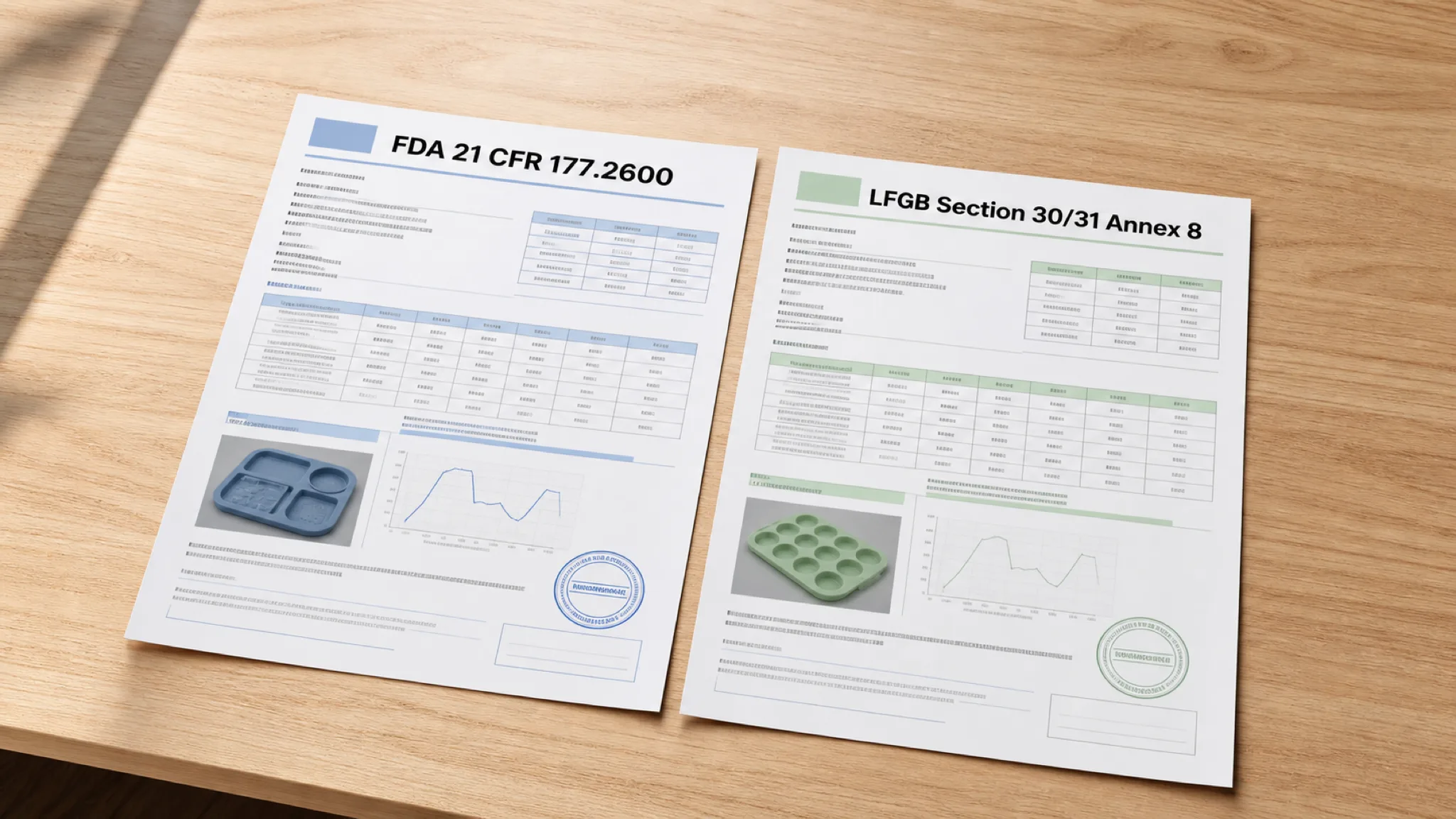
FDA 21 CFR 177.2600 is the US baseline food-contact regulation for silicone rubber articles — a single-solvent extraction test with composition limits. LFGB §30/31 is Germany's national verification of EU Regulation (EC) 1935/2004, and for silicone specifically it draws on BfR Recommendation XV, which requires three separate migration tests against aqueous, acidic, and fatty food simulants at controlled time-temperature conditions. LFGB catches quality problems FDA doesn't. Both certifications should be shipped per production batch, referencing the master-batch lot number, from an accredited third-party lab.
What is the difference between FDA 21 CFR 177.2600 and LFGB §30/31?
FDA sets composition limits; LFGB adds three separate extraction tests. FDA 21 CFR 177.2600[^fda-177-2600] regulates rubber articles intended for repeated use in food contact — it defines allowed constituent compounds and a single-solvent extraction ceiling. LFGB §30/31 draws on BfR Recommendation XV — Silicones[^bfr-lfgb-xv] to require three separate migration tests against distilled water, 3% acetic acid, and 95% ethanol simulants at temperatures matching the food-contact use case. The delta is depth of extraction testing.
The two regulations sit inside different legal frameworks. FDA is Title 21 of the US Code of Federal Regulations — a single national jurisdiction with unified testing methodology. LFGB is Germany’s implementation of EU Regulation (EC) 1935/20041, which is the pan-European framework establishing that materials in contact with food “shall not transfer their constituents in quantities that endanger human health, alter food composition, or cause organoleptic deterioration.” Individual EU member states verify against this framework using national methods; LFGB is Germany’s, and it’s the de facto EU-wide reference because most other member states accept LFGB test data as equivalent for import.
Side-by-side comparison
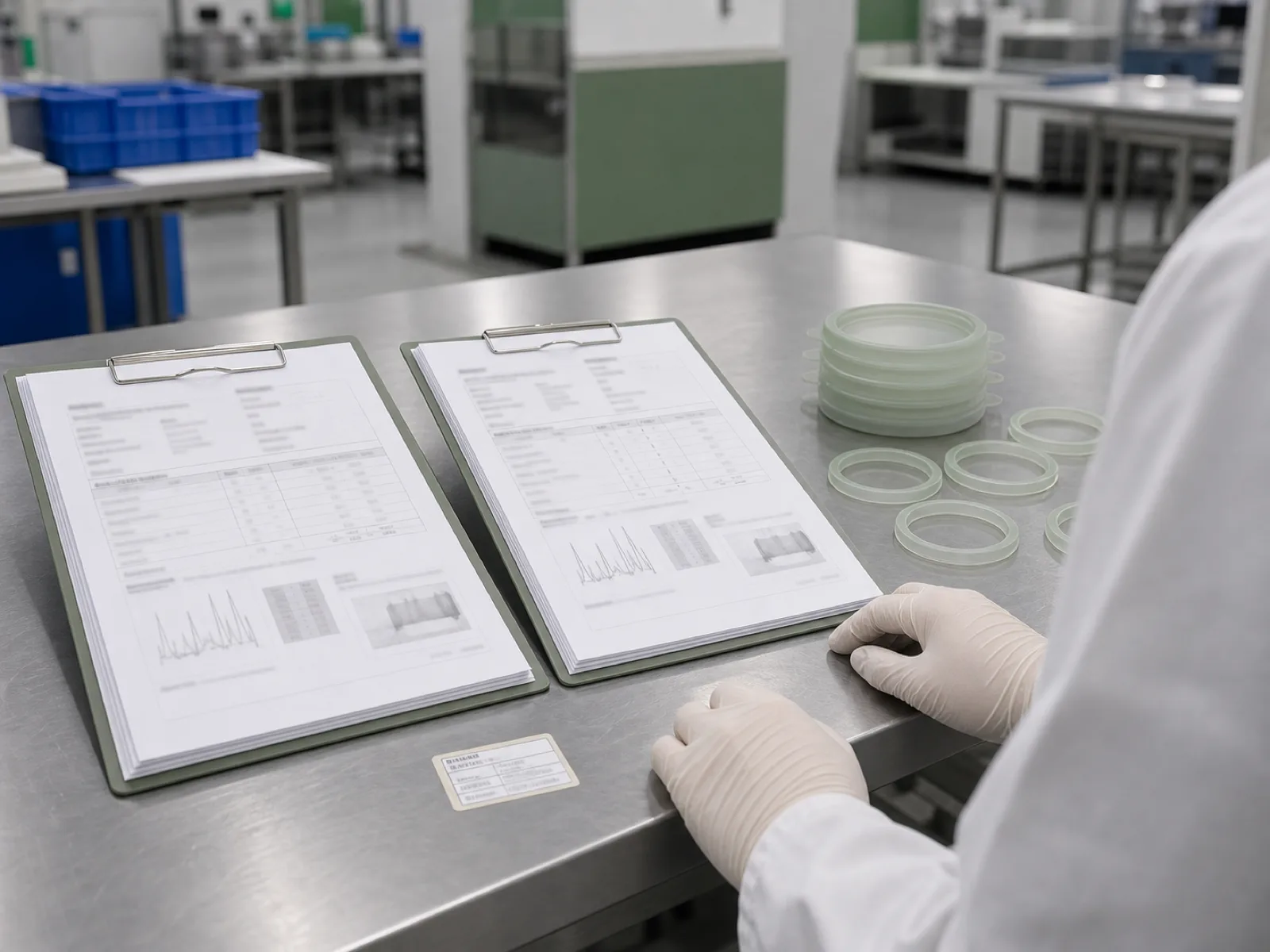
| Dimension | FDA 21 CFR 177.2600 | LFGB §30/31 (BfR XV) |
|---|---|---|
| Jurisdiction | United States | Germany (de facto EU-wide) |
| Legal framework | Title 21 CFR | EC 1935/2004 → LFGB → BfR XV |
| Test simulants | Water (typically) | Water + 3% acetic acid + 95% ethanol |
| Test conditions | 24 hr at 49°C (standard) | 4 hr at 100°C or 24 hr at 40°C (per use case) |
| What it measures | Extractable weight in single solvent | TNVR across three simulants |
| Ceiling | 175 mg/in² max chloroform extractable | ~10 mg/dm² typical aggregate |
| Cure system impact | Both cure systems pass with post-cure | Peroxide-cure fails without disciplined post-cure |
| PFAS scope | Not directly tested | Not directly tested — often bundled with PFAS non-detect on premium programs |
| Report retention | Batch-by-batch per ISO 90012 | Batch-by-batch per ISO 9001 |
| Accredited lab | Any accredited US lab | SGS / Intertek / TÜV / Bureau Veritas / Eurofins |
Which certification does your retail buyer actually require?
US mass retail and Amazon FBA typically require FDA-only. Premium US retail (Whole Foods, Sprouts, Erewhon caliber), all EU retail programs, and any premium DTC brand require both FDA and LFGB per batch. Medical-adjacent programs stack USP Class VI on top[^usp-class-vi]. On any RFQ where the target retail tier is uncertain, request both — the marginal per-batch cost from a competent OEM is under 2% of unit price.
The regulatory-scope-by-retail-tier mapping is deterministic once you know the channel. Ask the buyer directly what channels they’re targeting; the certification stack follows.
Retail-tier decision matrix
| Program archetype | FDA 177.2600 | LFGB §30/31 | PFAS non-detect | USP <88> |
|---|---|---|---|---|
| Amazon FBA private-label ($10-25) | ✅ Required | Nice-to-have | Increasingly expected | – |
| US mass retail (Home Depot / Wayfair / Bed Bath) | ✅ Required | Nice-to-have | Increasingly expected | – |
| US premium natural retail (Whole Foods orbit) | ✅ Required | ✅ Required | ✅ Required | – |
| US premium housewares (top-tier brand caliber) | ✅ Required | ✅ Required | ✅ Required | – |
| EU mass retail (Aldi, Lidl, Carrefour) | Nice-to-have | ✅ Required | Nice-to-have | – |
| EU premium retail (Waitrose, MPreis, Sainsbury’s Taste the Difference) | ✅ Required | ✅ Required | ✅ Required | – |
| Medical-adjacent accessories | ✅ Required | ✅ Required | ✅ Required | ✅ Required |
| Baby / infant feeding | ✅ Required | ✅ Required | ✅ Required | Often required |
The cost delta between “FDA-only per-batch” and “FDA + LFGB per-batch” is typically 40-80 USD per third-party test cycle at scale. On a 5,000-piece production run that’s under 2¢ per unit. On a 500-piece pilot it’s under 20¢. Any OEM who quotes the LFGB add-on at a materially higher figure is either not running LFGB in-house through their accredited lab relationship or is trying to margin the “premium” label.
Why do LFGB tests fail — and how is it fixed at the shop floor?
The single biggest LFGB failure mode is under-run post-cure. Peroxide-cured silicone that skips or shortens the 4-6 hour oven cycle at 180-200°C leaves residual acetophenone and dicumyl-peroxide fragments in the elastomer. These migrate into the 3% acetic acid simulant during the LFGB extraction test and blow through the TNVR ceiling. Platinum-cured silicone rarely fails LFGB — peroxide-cured with disciplined post-cure passes reliably.
The failure chemistry is well-understood in the compound-house literature. Peroxide crosslinking (typically dicumyl peroxide, DCP) leaves decomposition products in the elastomer that are only partially bound. Post-cure at 180-200°C for 4-6 hours drives these off through the oven exhaust. Without post-cure, the products remain in the finished part and are pulled into the extraction simulant during LFGB testing.
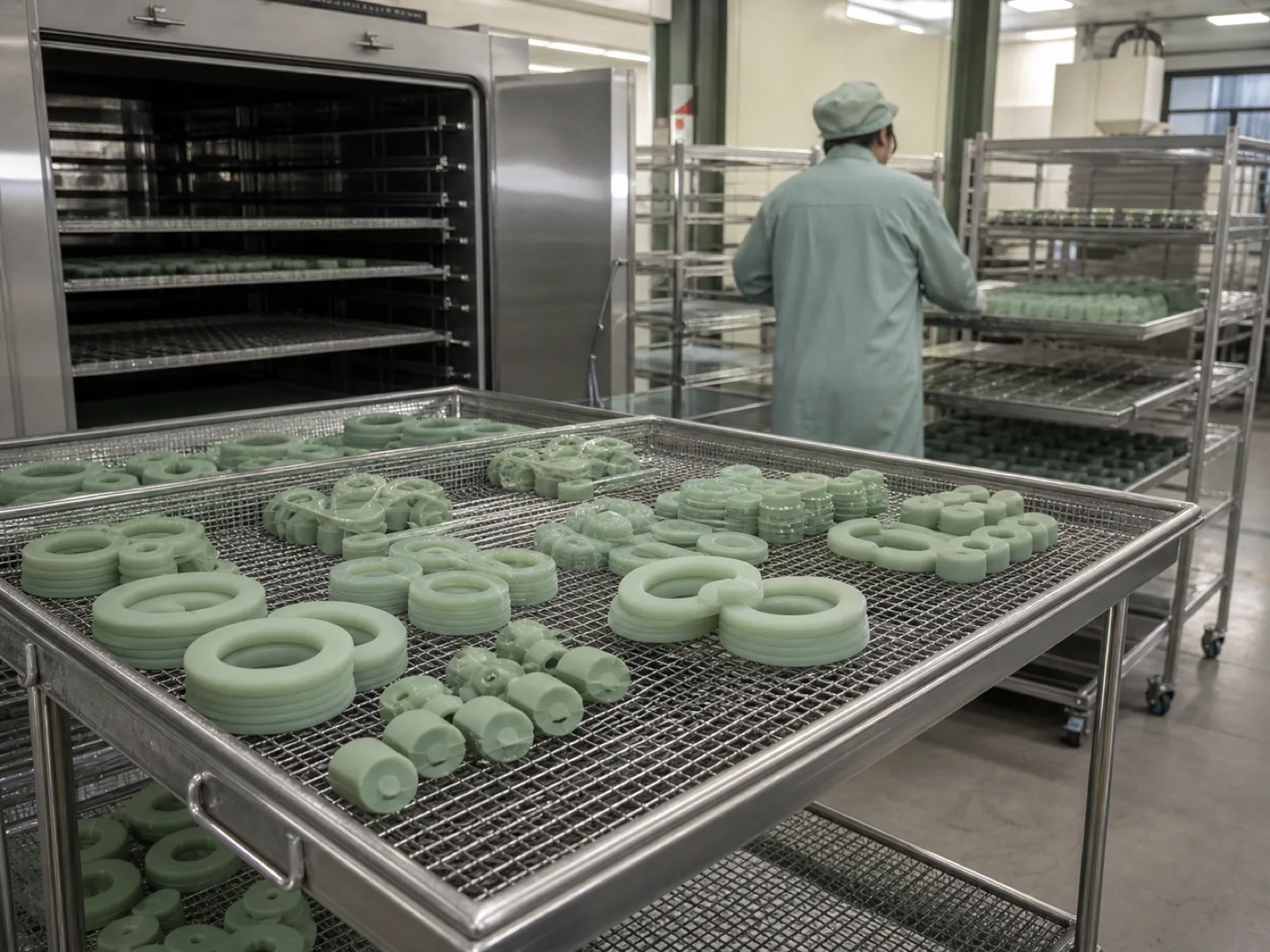
The reason cheaper suppliers skip post-cure is straightforward: oven capacity is finite, and post-cure occupies press-adjacent floor space for 4-6 hours per batch. Factories optimizing for cost-per-piece sometimes truncate the cycle — 90 minutes, or 2 hours at lower temperature. The finished parts look and feel identical to fully post-cured product until the LFGB simulant test is run. Then they fail.
The Platinum-vs-Peroxide cure guide walks the chemistry difference in detail. The short version: platinum-cure eliminates the failure mode; disciplined peroxide-cure with mandatory post-cure closes it. Lazy peroxide-cure is the actual problem.
How is silicone certification related to PFAS-free positioning?
PFAS non-detect testing is a separate parallel workflow — not embedded in FDA or LFGB. Neither regulation directly tests for PFAS at parts-per-billion levels. On EU premium and US premium natural retail programs, PFAS non-detect testing from an accredited lab is now table stakes, driven by the ECHA universal restriction proposal[^echa-pfas-proposal] and downstream retailer specifications. Ask for it whenever LFGB is in scope.
The regulatory trajectory is clear. ECHA published the PFAS universal restriction proposal in February 2023, and downstream EU retailer PFAS-free spec adoption has been accelerating since. West Coast US premium retail (Whole Foods, Erewhon) has run PFAS-free requirements longer than EU. Amazon FBA private-label brands increasingly face customer-facing PFAS-related complaints and are folding non-detect testing into their compliance packet by default.
Structurally: PFAS testing runs on the same production batch as FDA and LFGB extraction, from the same lab, referencing the same master-batch lot. The report is a separate document, usually 30-60 USD per batch. It’s not part of the FDA or LFGB framework — but the buyer expectation on premium programs bundles them together as one “food-safety” compliance packet.
The PFAS-free silicone guide covers the compound-house side and the accredited-lab report specifics.
What documents should you demand from any silicone OEM?
Six per-batch documents cover the certification stack on a serious silicone OEM RFQ: FDA 21 CFR 177.2600 third-party extract report, LFGB §30/31 three-simulant migration report, PFAS non-detect analysis, master-batch lot certificate specifying cure chemistry, post-cure cycle log with temperatures and duration, and the compound-house material traceability chain to the raw silicone gum lot number.
The six documents:
- FDA 21 CFR 177.2600 third-party extract report — from SGS / Intertek / TÜV / Bureau Veritas, per production batch, referencing the master-batch lot number.
- LFGB §30/31 three-simulant migration report — same lab, same batch, testing against aqueous / acidic / fatty simulants at temperatures matching the product’s food-contact application.
- PFAS non-detect analysis — parts-per-billion detection limits, accredited lab, per batch. Mandatory for EU premium and US premium natural retail.
- Master-batch lot certificate — specifies cure chemistry (platinum, peroxide, condensation), Shore A hardness measured per ASTM D52963 or equivalent, color / Pantone reference, and compound-house lot number.
- Post-cure cycle log — temperature-time profile, batch identifier, retention per ISO 90012 (36 months minimum).
- Compound-house material traceability — the chain from finished-part master-batch lot back to the raw silicone gum lot that fed the compound. Cracks in this chain are the single most common audit failure for suppliers who claim compliance without shipping the paperwork.
What Wetop OEMs
Wetop ships FDA + LFGB per-batch as a standard. No add-on, no line item. PFAS non-detect testing on request for any premium retail program at no per-unit surcharge. Every production batch documented against the master-batch lot, retention per ISO 9001 for 36 months minimum. Sample lead time 7-15 days on existing tooling; 18-25 days on new P20 molds; mass production 30-45 days after sample approval.
Wetop’s food-contact silicone program defaults:
- FDA 21 CFR 177.2600 per-batch third-party report — bundled into every quote at no add-on.
- LFGB §30/31 per-batch report — bundled at no add-on for programs where EU exposure is possible; provided on request otherwise.
- PFAS non-detect analysis — 30-60 USD per batch, non-margined pass-through from our accredited lab relationship, provided on any premium program.
- Cure system flexibility — see Platinum-vs-Peroxide decision guide for how we default programs.
- Documentation packet — every shipment includes the FDA + LFGB + master-batch lot certificate + post-cure log in one PDF bundle, referencing your PO number.
MOQ 500 per SKU. See MOQ & lead time on custom silicone kitchenware for how the schedule runs and how to source a silicone factory for the 12 verification questions we recommend every buyer ask us.
Sourcing a food-contact program where LFGB is in scope? Email inquiry@wetopsilicone.com with your target retail channel and shelf tier — we come back with a certification-stack recommendation, sample per-batch documentation packet, and price brackets at MOQ 500 / 1,000 / 5,000.
Ready to source? Every quote is built against your specification — send a CAD file, a written brief, or reference samples, and an engineer replies within one business day. Request a quote →
Footnotes
-
European Parliament and Council. Regulation (EC) No 1935/2004. https://eur-lex.europa.eu/legal-content/EN/TXT/?uri=CELEX%3A02004R1935-20090807 ↩
-
International Organization for Standardization. ISO 9001:2015 — Quality Management Systems. https://www.iso.org/standard/62085.html ↩ ↩2
-
ASTM International. ASTM D5296-19 — Standard Test Method. https://www.astm.org/d5296-19.html ↩
FAQ
-
Is LFGB stricter than FDA for silicone?
In a specific engineering sense — yes. FDA 21 CFR 177.2600[^fda-177-2600] sets composition limits and defines a single-solvent extraction ceiling; passing this proves the silicone formulation is nominally food-safe. LFGB §30/31, drawing on BfR Recommendation XV — Silicones[^bfr-lfgb-xv], requires three separate migration tests against water, 3% acetic acid, and 95% ethanol simulants at temperatures and durations that mirror actual food-contact conditions. A silicone that clears FDA may still fail LFGB if post-cure is under-run and organic volatiles migrate into the acidic simulant. LFGB isn't harder in every way — but it catches quality problems FDA doesn't.
-
Which certification does my retail buyer actually require?
Depends on channel. US mass retail and Amazon FBA private-label programs at $10-25 shelf typically require FDA-only documentation. US premium natural retail (Whole Foods, Sprouts, Erewhon), premium DTC brands, and any EU retail program require both FDA and LFGB per batch. Any medical-adjacent program adds USP <88> Class VI on top[^usp-class-vi]. On any RFQ where the retail tier is uncertain, request both — the marginal per-batch cost from a competent OEM is under 2% of the unit price.
-
How often does the testing need to be run — per year or per batch?
Per production batch, referencing the specific master-batch lot number of the silicone gum that fed the run. Suppliers who submit a single 18-month-old 'representative batch' certificate are shipping product that hasn't been tested to the certificate they're citing. Both regulations cover the material formulation, but the extraction tests apply to the specific batch of finished product — and residual volatile levels change batch-to-batch based on post-cure discipline, mold contamination, and compound-house lot variance. Wetop ships a per-batch report from SGS or Intertek with every production run of every SKU.
-
What does the LFGB §30/31 organic volatile test actually measure?
Total non-volatile residue (TNVR) after extraction against three food simulants under standardized time-temperature conditions defined in BfR Recommendation XV[^bfr-lfgb-xv]. Simulants: distilled water (aqueous foods), 3% acetic acid (acidic foods like tomato/citrus), and 95% ethanol (fatty foods and alcohol). Test conditions typically 4 hours at 100°C for high-temperature contact use cases. The measured TNVR must fall below defined ceilings — typically 10 mg/dm² for the aggregate. A silicone that under-post-cures leaves residual cure byproducts (acetophenone, oligomers) that fail the aqueous or acidic simulant test.
-
Is 'food-grade silicone' the same as 'FDA-approved silicone'?
No — and this distinction gets buyers into trouble. 'Food-grade silicone' is a marketing phrase with no legal meaning. FDA 21 CFR 177.2600[^fda-177-2600] compliance is a specific regulatory status verified by extraction testing of the finished part, not the raw silicone gum. A silicone gum can be labeled 'food-grade' by the compound house because the polymer is FDA-approvable — but the finished part still has to pass extraction testing to actually be FDA-compliant. Any supplier who sells you 'food-grade silicone' without a per-batch 177.2600 test report is selling the label, not the compliance.
-
How does EU Regulation (EC) 1935/2004 relate to LFGB?
EC 1935/2004 is the pan-European framework regulation for food-contact materials — it establishes the general safety principle (materials must not transfer components in quantities that endanger human health, alter food composition, or cause organoleptic deterioration)[^ec-1935-2004]. Individual member states then implement national verification standards; Germany's is LFGB, backed by BfR Recommendation XV for silicone specifically[^bfr-lfgb-xv]. Passing LFGB §30/31 equals passing the German verification of EC 1935/2004 for silicone. France, Italy, and the Netherlands accept LFGB test data as equivalent for import purposes, so LFGB is the practical single EU-wide verification most buyers reference. EFSA publishes the underlying scientific opinions the framework relies on[^efsa-food-contact].
-
Do I need FDA and LFGB if I'm shipping to Amazon FBA or Alibaba?
Yes — but with important nuance. Amazon's Product Safety Alerts and Consumer Product Safety Commission rules cover safety, not food-contact certification. However, FBA private-label programs that sell into the US typically face demand from downstream retailers when scaled. Get both FDA per-batch documentation and PFAS non-detect testing standardized from day one — retrofitting compliance mid-program is expensive. For Alibaba-sourced product, the burden is on the buyer to verify the extraction report and master-batch lot cert; assume nothing based on the listing alone. Wetop doesn't sell through Alibaba by choice — but the per-batch testing regime we ship is what a competent FBA buyer should be asking of any sourcing channel.
References
Authoritative sources cited in this guide
- US Food and Drug Administration (Code of Federal Regulations). 21 CFR 177.2600 — Rubber articles intended for repeated use. https://www.ecfr.gov/current/title-21/chapter-I/subchapter-B/part-177/subpart-C/section-177.2600 — The primary US regulation governing food-contact silicone. Establishes composition limits and extraction ceilings that Wetop's per-batch reports test against.
- German Federal Institute for Risk Assessment (BfR). BfR Recommendation XV — Silicones. https://www.bfr.bund.de/en/bfr_recommendations_on_food_contact_materials-7498.html — The technical standard underlying LFGB §30/31 for food-contact silicone. Defines the three-simulant migration test regime (aqueous, acidic, fatty).
- European Parliament and Council (EUR-Lex). Regulation (EC) No 1935/2004 on materials and articles intended to come into contact with food. https://eur-lex.europa.eu/legal-content/EN/TXT/?uri=CELEX%3A02004R1935-20090807 — The pan-EU framework regulation for food-contact materials. LFGB is Germany's national verification path under this regulation.
- European Food Safety Authority (EFSA). EFSA Scientific Opinions on Food Contact Materials. https://www.efsa.europa.eu/en/topics/topic/food-contact-materials — The scientific basis EFSA provides for national implementations of EC 1935/2004, including LFGB.
- United States Pharmacopeia. USP <88> — Biological Reactivity Tests, In Vivo. https://www.usp.org/harmonization-standards/pdg/excipients/plastic-materials — The additional biocompatibility standard applied to medical-adjacent silicone programs — sits on top of FDA + LFGB, not instead of.
- European Chemicals Agency (ECHA). PFAS Universal Restriction Proposal. https://eur-lex.europa.eu/legal-content/EN/TXT/?uri=CELEX%3A32006R1907 — The regulatory action driving PFAS-free spec adoption on top of LFGB in EU premium retail programs.
- International Organization for Standardization. ISO 9001:2015 — Quality Management Systems — Requirements. https://www.iso.org/standard/62085.html — The quality management system that governs batch documentation, retention policies, and the traceability tying test reports back to master-batch lots.
- ASTM International. ASTM D5296-19 — Standard Test Method for Molecular Weight Averages. https://www.astm.org/d5296-19.html — Reference method for analytical characterization of extractable residues in migration testing workflows.
Start a custom program
Send a brief. Get an engineer’s reply in one business day.
Every Wetop program is tooled from a customer’s specification. Send a CAD file (STEP · IGES · DWG) or a written brief and we’ll reply with a mold cost estimate, price brackets at MOQ 500 / 1,000 / 5,000, and any engineering questions.