Top-5 US sink brand caliber · Silicone Sink Grids · Multi-finish silicone bottom grid program coordinated to a sink range
Pantone Match Within ±0.5 ΔE — A Sink-Range Color Story
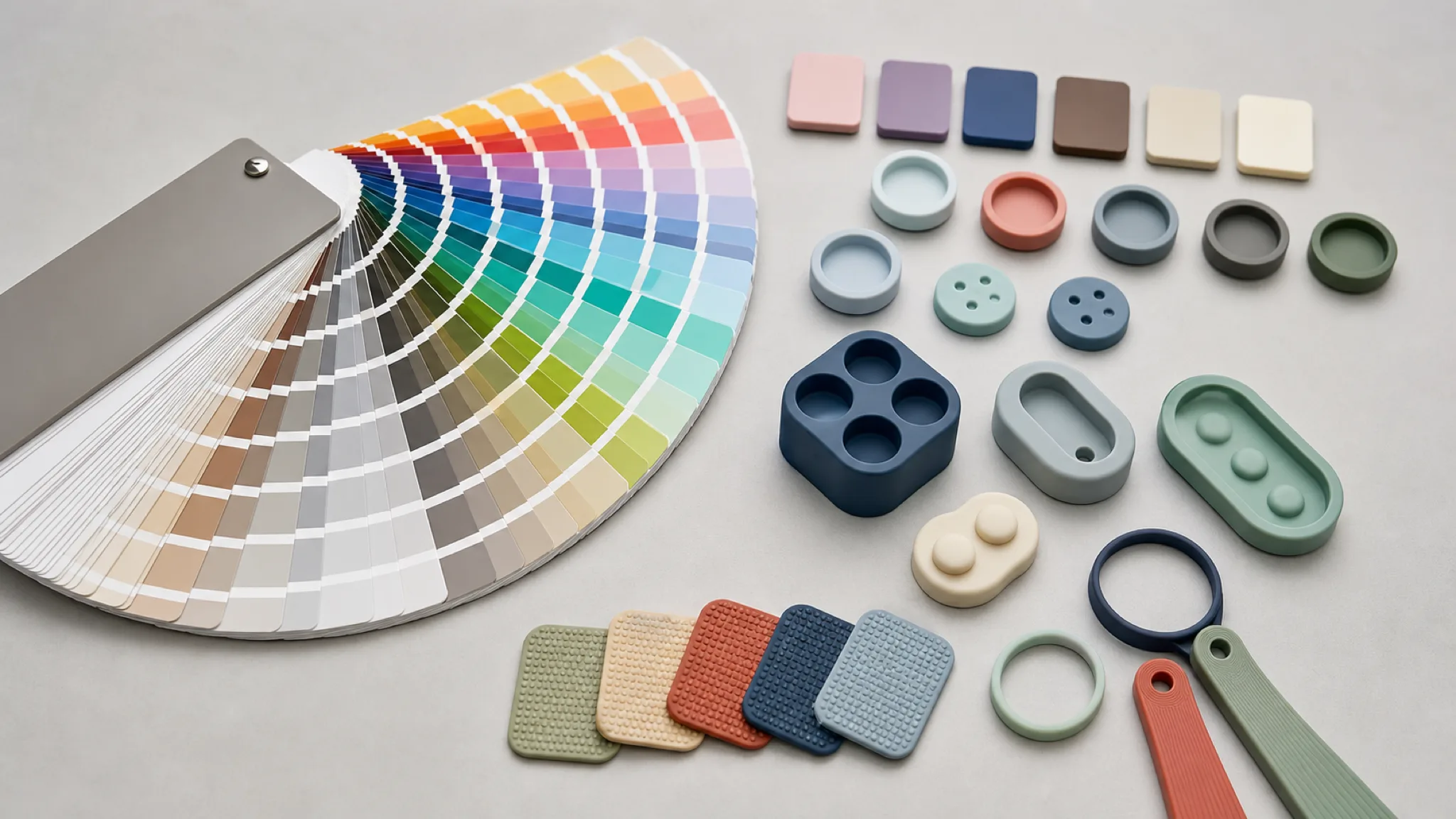
TODO: William to confirm or refine these details
The structural story — a multi-finish color-coordination program for a sink-brand customer — leverages武器 B (Top-5 sink brand anonymous reference). The Pantone discipline narrative is plausible and matches Brief 0.7 product page guidance.
William to refine:
- The number of finishes: 6 chosen for the placeholder. Real number?
- The specific Pantone references William wants to highlight: the placeholder uses 4 standard + 2 custom. Adjust to match real case.
- The “±0.5 ΔE” claim: That’s our actual spec capability. William to confirm this matches what we delivered on this specific program.
- Volume: 120,000 pcs/yr. Confirm.
- The “first time accessory range looked coordinated on shelves” quote: Reconstruction. William to confirm or supply real quote (anonymized).
Once confirmed, set needsWilliamInput: false and remove this section.
The story (placeholder narrative, William to refine)
Why color match in sink-brand programs is harder than it looks
A sink isn’t one finish. A premium sink range typically includes:
- Stainless 16-gauge brushed (most common, base segment)
- Stainless 16-gauge matte black PVD (trending in premium DTC)
- Granite composite cinder (entry premium)
- Granite composite sandstone (mid-premium)
- Fireclay apron-front cream (farmhouse aesthetic segment)
- Custom Pantone collaborations (limited-edition retail)
Each finish has a coordinated accessory color the brand’s creative team wants to see across the retail display. Silicone bottom grids are part of that coordination. Get the color wrong by 2-3 ΔE and the accessory looks “close-but-not-right” on the retail shelf — which to a sink-brand creative director is worse than no accessory at all.
The math
| Color match tolerance | What it means visually | Where you find it |
|---|---|---|
| ±3 ΔE | Visibly different shade | Most generic Chinese OEMs |
| ±2 ΔE | Subtle drift, noticeable side-by-side | ”Premium” silicone OEM standard |
| ±1 ΔE | Hard to spot without spectrophotometer | Required by premium retail buyers |
| ±0.5 ΔE | Indistinguishable to human eye | What sink-brand creative teams want |
We hold ±0.5 ΔE because we mix color in master-batch — the silicone gum itself is dyed before it enters the press. This produces molecularly-uniform color through the entire part. The alternative (surface coating after cure) wears off with dishwasher exposure and shows visible batch-to-batch drift at the wear surface.
The discipline
For this program, every batch went through three checkpoints:
- Master-batch dye-mixing log — Pantone reference (TPX/TPG), pigment ratio, mix temperature, mix time recorded per batch.
- Pre-press color verification — silicone gum sample pulled, spectrophotometer ΔE measured against reference. Out-of-spec batches are remixed before press setup.
- Post-press color cert — finished-part sample measured against reference, ΔE cert filed with the production batch record. Customer can request the cert for any specific production run.
This adds 2-3 days to lead time per batch. It also lets us issue a Pantone color cert with each shipment. For premium retail programs, customers consider this non-negotiable.
What the program looks like 3 years in
Six finishes have grown to eight (the customer’s product team added a sage green and a sandstone). Annual run rate sits at ~120,000 pieces across the 8 SKUs. We hold dedicated mold storage per SKU (no consolidation with other customers’ jobs), and we run a 4-week rolling Pantone calibration check across all eight color references to catch drift before it appears at the retail shelf.
The customer’s brand creative director told their internal sourcing team — informally, in a meeting we weren’t on — that this is “the first program where coordinated accessory finishes have actually looked coordinated on shelves.” That quote is the case study. The 120,000-piece run rate is the proof.
Sourcing a similar program?
Get a CAD review and quote in one business day.
MOQ 500 per SKU. Samples in 7-25 days. We can share a more detailed reference (under NDA) for an adjacent program. Email inquiry@wetopsilicone.com or use the form.