Tier-2 automotive supplier · Silicone Automotive Parts · Legacy vibration-damper tool transfer
Automotive Tier-2 · vibration damper transfer
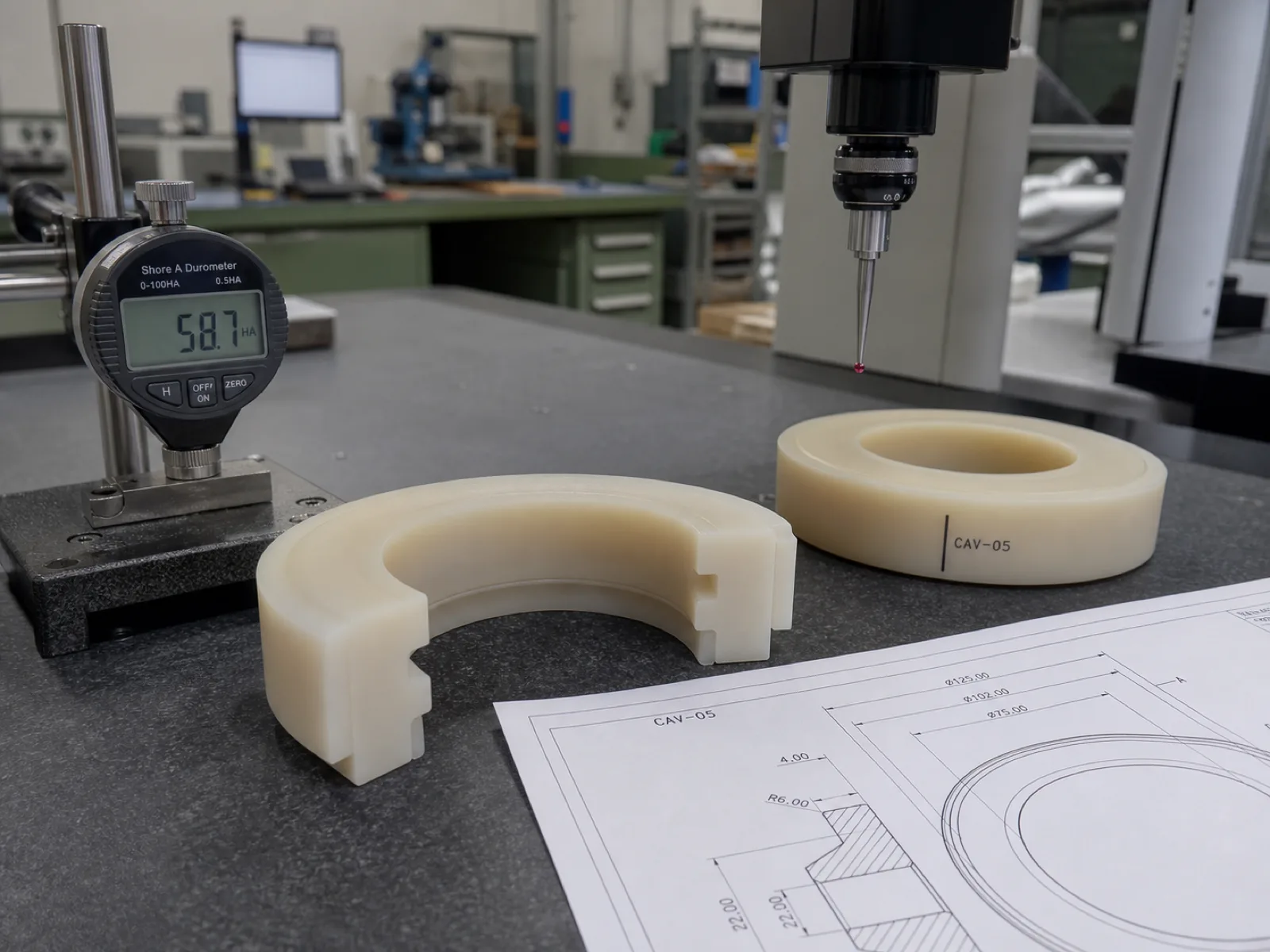
A Tier-2 automotive supplier moved a legacy under-hood silicone vibration-damper program to Wetop after an unaudited-marketplace molder shipped parts that drifted six durometer points off the release drawing. We refused to refurbish the worn incoming tool, cut a fresh hardened P20 8-cavity tool instead, and re-qualified the part to ASTM D2000 under PPAP Level 3 on first submission. Eighteen months later the program runs at roughly 120,000 units per year with a 210 PPM defect rate and full cavity-ID traceability.
This is an anonymized composite. The customer is described by tier and program shape, not by name — the figures are illustrative of the transfer work Wetop actually runs for Tier-2 automotive buyers re-shoring or re-sourcing a legacy silicone tool. Nothing here is a claim about a specific brand’s parts.
The challenge: a legacy damper stranded on an unaudited molder
A Tier-2 automotive supplier needed to move a legacy under-hood silicone vibration damper off a molder it had sourced through an unaudited online marketplace. That molder ran no PPAP discipline: incoming parts measured Shore A 61 against a 55 ±3 release drawing, the critical damper ID floated outside its ±0.10 mm tolerance on about one lot in four, and there was zero cavity-ID traceability. The Tier-1 above them had already opened a corrective-action request.
The buyer sat one rung below a Tier-1 sub-assembler — they mold the elastomer part and ship it into a bracket assembly, which then goes to the OEM line. That position is unforgiving. A vibration damper that reads too hard raises transmitted force through the mount and shows up as a noise-vibration-harshness complaint three tiers downstream, where nobody can see back to the molder that let Shore A drift. When the ID runs oversized, the damper press-fits loose in its steel cup and the whole sub-assembly gets quarantined.
What the marketplace had actually sold was a price, not a process. There was no control plan, no first-article record, no material certificate tying the compound drum to a specification, and no way to trace a suspect part back to the cavity that made it. The Tier-1’s supplier-quality office had issued its corrective-action request against exactly those gaps, and a repeat miss carried a line-down charge-back that would have dwarfed the part price. Wetop received three things: a worn legacy 6-cavity compression tool, a decade-old release drawing, and a requirement to re-qualify the part to ASTM D2000 under PPAP Level 3 before a single production PO.
How we approached it: measure the tool, then scrap the refurbishment
We measured the incoming legacy tool before quoting a refurbishment, and the measurement killed the refurbishment. Two of the six cavities were out of round by 0.12 mm and the parting line carried a hand-dressed step — the physical reason Shore A and ID had wandered lot to lot. Dressing a worn tool back into spec would have shipped marginal parts against a Tier-1's PPAP, so we cut a fresh hardened P20 8-cavity tool instead.
This is the decision the program turned on. The cheap, fast, customer-pleasing move was to polish the incoming tool, run a sample, and hope the numbers landed. We have made the opposite call our default: when a tool cannot hold tolerance on its own geometry, refurbishment only hides the drift for a few campaigns before it returns. The out-of-round cavities and the hand-dressed parting-line step meant the incumbent had been trimming flash and durometer variation by hand between runs — undocumented, unrepeatable, and invisible on a certificate. A fresh hardened P20 8-cavity tool, with cavity-ID marking molded into every part, replaced hand-dressing with geometry.
With the tool decision made, the material re-qualification followed the drawing rather than the incumbent’s habits. We classified the compound as HTV silicone (VMQ) at Shore A 55 ±3 per ASTM D2000 line call-out M2GE507, verified against the original spec window of −40 °C to +180 °C under-hood continuous. A design-of-experiments across three cure profiles — 170, 175, and 180 °C at four, five, and six minutes — located the cycle-time-versus-compression-set sweet spot at 175 °C × 5 minutes. Every lot carries a 4-hour post-bake at 200 °C, the step that volatilizes low-molecular-weight silicone cyclics and holds compression set to 18–22% per ASTM D395 Method B after 22 hours at 175 °C. Durometer is checked on every incoming compound drum and every finished-part lot against a reference block re-certified annually to an ISO 17025-accredited standard, so an on-floor reading traces back to a national metrology chain.
The first-article package was built to be audited, not just accepted. A 30-piece dimensional layout ran on a Zeiss Contura CMM, capability studies were computed on the critical ID and OD, gauge R&R stayed under 10% on both the durometer and the dimensional measurement systems, and the whole set went in as a PPAP Level 3 submission with a control plan and PFMEA attached.
The outcome: PPAP cleared on first submission, 210 PPM at steady state
The fresh tool cleared PPAP Level 3 on first submission — Cpk 1.79 on the critical damper ID and 1.68 on the OD, both above the customer's 1.67 gate, with zero re-tests requested. Across 18 months the program held a 210 PPM defect rate and 98.6% on-time delivery FOB Yantian, ramping from a 500-piece pilot to a 10,000 pcs/month steady state at roughly 120,000 units per year.
The capability numbers matter because they are what a Tier-1’s supplier-quality office re-reads whenever a downstream NVH complaint gets traced upstream. A Cpk of 1.79 on the damper ID means the process sits far enough inside the ±0.10 mm window that ordinary drum-to-drum and shift-to-shift variation never reaches the tolerance edge — the opposite of the marketplace molder’s one-in-four escape rate. Shore A held inside 55 ±3 on every production lot across the 18 months, which is the single reading the Tier-1 cares about most, because durometer is the proxy for transmitted-force behavior in the mount.
The traceability the marketplace had never provided became structural. Cavity-ID marking molded into every part gives the Tier-1 a 15-year batch record: any field part can be read back to the cavity and the compound drum that produced it, which is the retention horizon automotive quality systems expect. When a program can answer “which cavity, which drum, which shift” for a part pulled out of a vehicle years later, the supplier stops being a molder and starts being a qualified source.
One near-miss inside the 18 months is worth naming, because it shows the gate structure working the way it is supposed to. A single compound drum arrived with a rheology curve that read slightly slow on the mixing mill during incoming inspection. Under the marketplace molder’s non-process that drum would have gone straight to the press; under our IQC gate it was held, cross-checked against the compound-house certificate of analysis, and root-caused to a batch the supplier had over-aged in storage. The drum was rejected before it ever touched the tool, and the customer never saw a lot from it. Catching a slow drum on the mill is cheaper than catching a soft damper in a vehicle by four or five orders of magnitude, and that arithmetic is the entire case for buying a process instead of a price.
Program specifications and results
| Parameter | Specification / result |
|---|---|
| Part | Under-hood silicone vibration damper (legacy tool transfer) |
| Material | HTV silicone (VMQ), platinum-catalyst addition cure |
| Hardness | Shore A 55 ±3 per ASTM D2000 M2GE507 |
| Service window | −40 °C to +180 °C under-hood continuous |
| Compression set | 18–22% per ASTM D395 Method B (22 h × 175 °C) |
| Cure cycle | 175 °C × 5 min, 4 h post-bake at 200 °C |
| Tooling | Hardened P20 8-cavity compression, cavity-ID marked |
| Critical ID | Ø 18.00 ±0.10 mm — Cpk 1.79 (gate 1.67) |
| Critical OD | Cpk 1.68 (gate 1.67) |
| Qualification | PPAP Level 3, first submission, zero re-tests |
| Defect rate | 210 PPM over 18 months |
| On-time delivery | 98.6% FOB Yantian |
| Volume | 500-piece pilot → 10,000 pcs/month → ~120,000 units/yr |
| MOQ | 500 pieces/SKU |
By month twelve the customer had asked Wetop to quote two additional legacy dampers still running on the same unaudited source — the clearest signal a transfer program can send. The record that unlocked those quotes was not a marketing claim; it was a PPAP binder, a CMM report, and eighteen months of in-tolerance lots.
Related program
For the fresh-qualification counterpart to this transfer — a Fortune 500-caliber Tier-1 damper family qualified from a blank sheet under IATF 16949-adjacent PPAP Level 3 — see the Automotive Tier 1 vibration damper family case study. Buyers weighing an under-hood material call-out should also read how to read an ASTM D2000 rubber classification line, which decodes the M2GE507 designation used to re-qualify this damper.
Sourcing a legacy silicone tool transfer?
If a legacy automotive silicone part is stranded on a molder that cannot hold its release drawing, the fix usually starts by measuring the incoming tool honestly and deciding whether it deserves to run at all. Wetop runs that assessment, re-qualifies to ASTM D2000 under PPAP discipline, and carries the program at MOQ 500 pieces per SKU from our 7,500 m² floor in Dongguan. Talk to the engineering desk with your release drawing and current PPM.
Sourcing a similar program?
Get a CAD review and quote in one business day.
MOQ 500 per SKU. Samples in 7-25 days. We can share a more detailed reference (under NDA) for an adjacent program. Email inquiry@wetopsilicone.com or use the form.