Manufacturing · informational intent
ASTM D2000 Rubber Classification — Line Callout Decoded
 Manufacturing
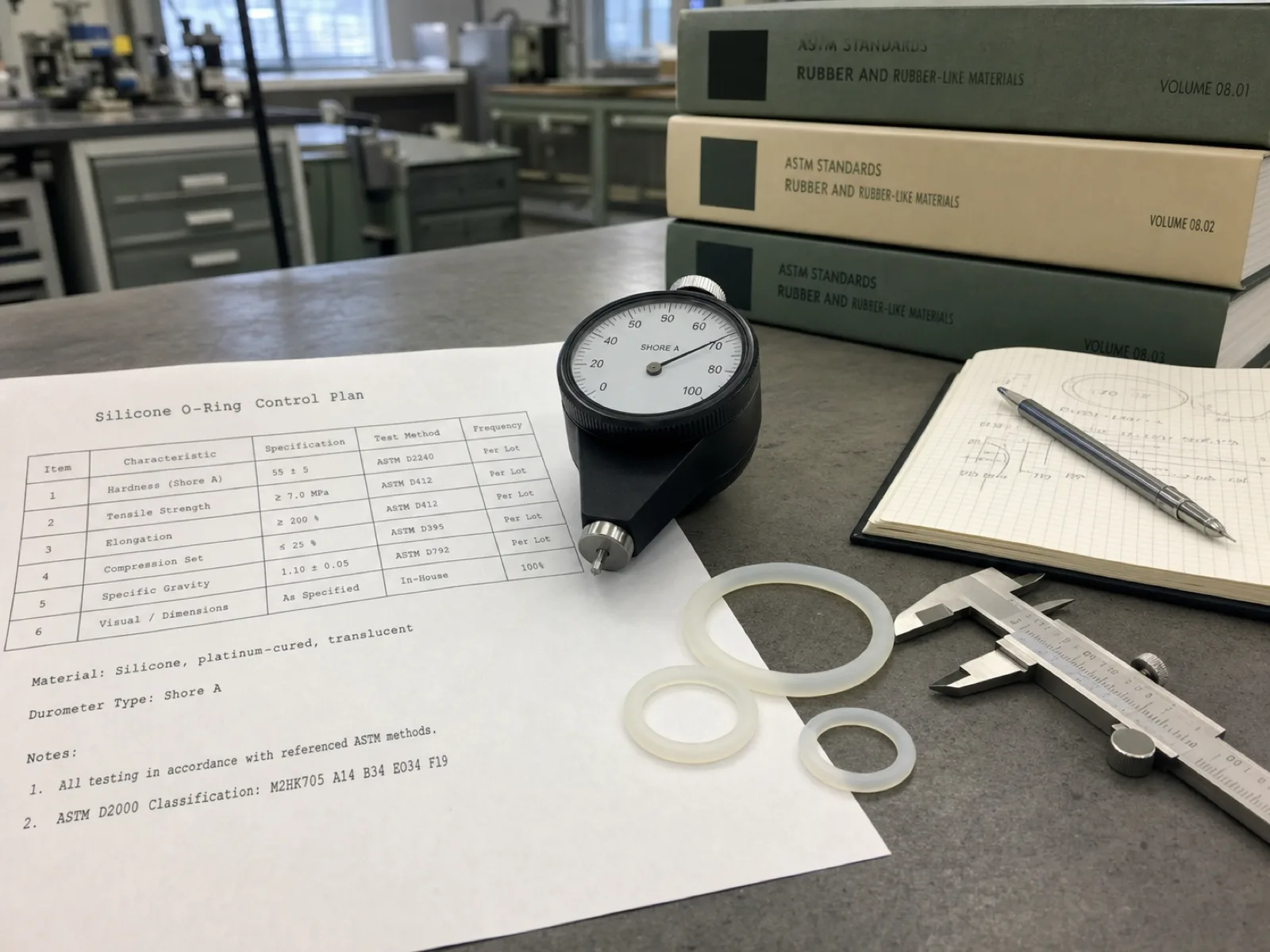
 This spoke is a companion to our cornerstone silicone rubber gasket manufacturing guide, which covers material selection, tooling economics, and OEM lead time across the full silicone-gasket workflow. Here we zoom in on one narrow angle the cornerstone can only summarize: how to decode an ASTM D2000 line callout character by character from a silicone manufacturer’s RFQ-intake perspective.
ASTM D2000 is a classification shorthand that packs a complete rubber material spec into a single line of letters and digits. The line starts with a units marker (M for metric), a grade number, a Type letter for heat aging, a Class letter for oil swell, a three-digit hardness-and-tensile pair, and then a chain of suffix codes that each demand a specific test result. Silicone almost always shows up as Type F or G, Class E or F — and this guide walks through every position so a buyer can write, read, or challenge any D2000 callout that lands in an RFQ.
What ASTM D2000 actually classifies
ASTM D2000 is a line-callout system for specifying rubber compounds by measurable performance — heat aging, oil swell, hardness, tensile strength, compression set, tear, low-temperature brittleness, fluid resistance, and specialty tests. It does not name the polymer, cure system, or filler. Two chemically different compounds can satisfy the same D2000 line if they both pass every referenced test method.[^astm-d2000]
The standard was written for the automotive supply chain in 1966 and has been maintained by ASTM Committee D11 ever since. Every automaker’s material engineering group uses it, most industrial-seal OEMs use it, and it is the reason a Tier-1 gasket supplier in Ohio and a silicone factory in Dongguan can quote against the same one-line spec without translation.
The callout has a fixed grammar. Read left to right:
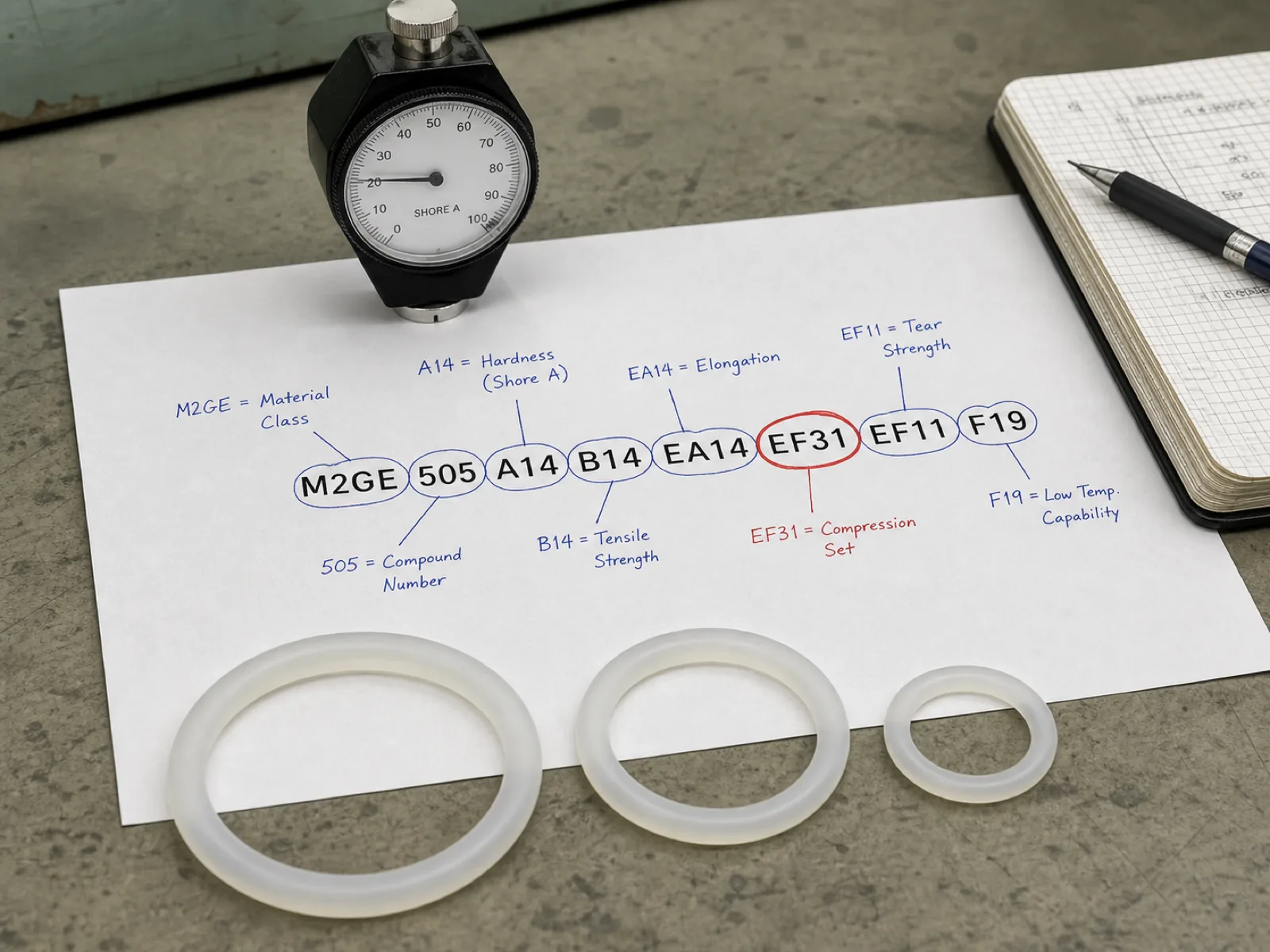
M 2 G E 505 A14 B14 EA14 EF31 EF11 F19
│ │ │ │  │   │   │   │    │    │   │
│ │ │ │  │   │   │   │    │    │   └── Low-temp brittleness suffix
│ │ │ │  │   │   │   │    │    └────── Fluid resistance (EF11)
│ │ │ │  │   │   │   │    └─────────── Fluid resistance (EF31)
│ │ │ │  │   │   │   └──────────────── Water resistance (EA14)
│ │ │ │  │   │   └──────────────────── Compression set (B14)
│ │ │ │  │   └──────────────────────── Heat aging (A14)
│ │ │ │  └──────────────────────────── Hardness (50 Shore A) + tensile (5 MPa)
│ │ │ └─────────────────────────────── Class letter (oil swell)
│ │ └───────────────────────────────── Type letter (heat aging)
│ └─────────────────────────────────── Grade (basic + suffix tests)
└───────────────────────────────────── Units marker (M = metric SI)
Nothing on this line tells you whether the compound is VMQ silicone, NBR nitrile, EPDM, or FKM. It only tells you what the compound must survive.
The Type letter — heat-aging class (A through K)
The Type letter fixes the maximum continuous service temperature by defining the pass/fail thresholds on ASTM D573 hot-air aging. Type A is the least demanding at 70 °C; Type K is the most demanding at 275 °C. Silicone compounds land at Type F (250 °C standard) or Type G (225 °C) on almost every RFQ we quote, because standard HTV silicone datasheets certify those temperatures with post-cure.[^astm-d573]
The test itself is straightforward. Samples are hung in a forced-air oven at the Type’s target temperature for 70 hours, then tested for change in hardness (Shore A), tensile strength, and elongation. The Grade table (see next section) sets how much change is allowed.
| Type | Max continuous °C | Common polymers at this Type |
|---|---|---|
| A | 70 | Natural rubber, SBR |
| B | 100 | NBR (nitrile) |
| C | 125 | CR (neoprene) |
| D | 150 | HNBR, some EPDM |
| E | 175 | HNBR, EPDM |
| F | 250 | Silicone (VMQ), some FKM |
| G | 225 | Silicone (VMQ) — the most common silicone callout |
| H | 250 | Silicone (tighter tolerance grade) |
| J | 275 | FKM, FFKM, high-temp silicone |
| K | 275 | FFKM (perfluoroelastomer) |
If a buyer’s callout starts with Type A, B, or C, silicone is a cost-inefficient answer — cheaper elastomers hit those temperatures. If Type F, G, or H shows up, silicone is likely the intent. Type J or K generally means the buyer wants FKM or FFKM; a silicone quote against those Types requires a technical conversation, not a form-fill quote.
The Class letter — oil-swell resistance (A through K)
The Class letter fixes the maximum volume swell in ASTM Oil No. 3 (formerly IRM 903) after 70 hours at 100 °C per ASTM D471. Class A has no requirement; Class K limits swell to 10 % max. Standard silicone hits Class E (80 % max swell) or Class F (60 % max) — which is the honest reason silicone is disqualified from gasoline, diesel, brake-fluid, and hydraulic-oil service.[^astm-d471]
| Class | Max volume swell in Oil No. 3 | Common polymers |
|---|---|---|
| A | No requirement | Any (silicone, EPDM, NR) |
| B | 140 % | EPDM, some silicone |
| C | 120 % | Silicone (VMQ) |
| D | 100 % | — |
| E | 80 % | Silicone (VMQ), most common |
| F | 60 % | Silicone (heat-stabilized) |
| G | 40 % | Fluorosilicone (FVMQ), CR |
| H | 30 % | NBR (medium) |
| J | 20 % | NBR (high nitrile), HNBR |
| K | 10 % | FKM, FFKM |
The Class letter is where silicone loses the automotive fuel-system argument. If an RFQ demands Class G or better and the environment is aromatic solvents, we quote fluorosilicone (FVMQ) at roughly 3–4× the material cost and lead-time impact — or we recommend the buyer switch to NBR or FKM if silicone’s other properties (extreme temperature, biocompatibility) are not required.
The Grade number and hardness-tensile pair
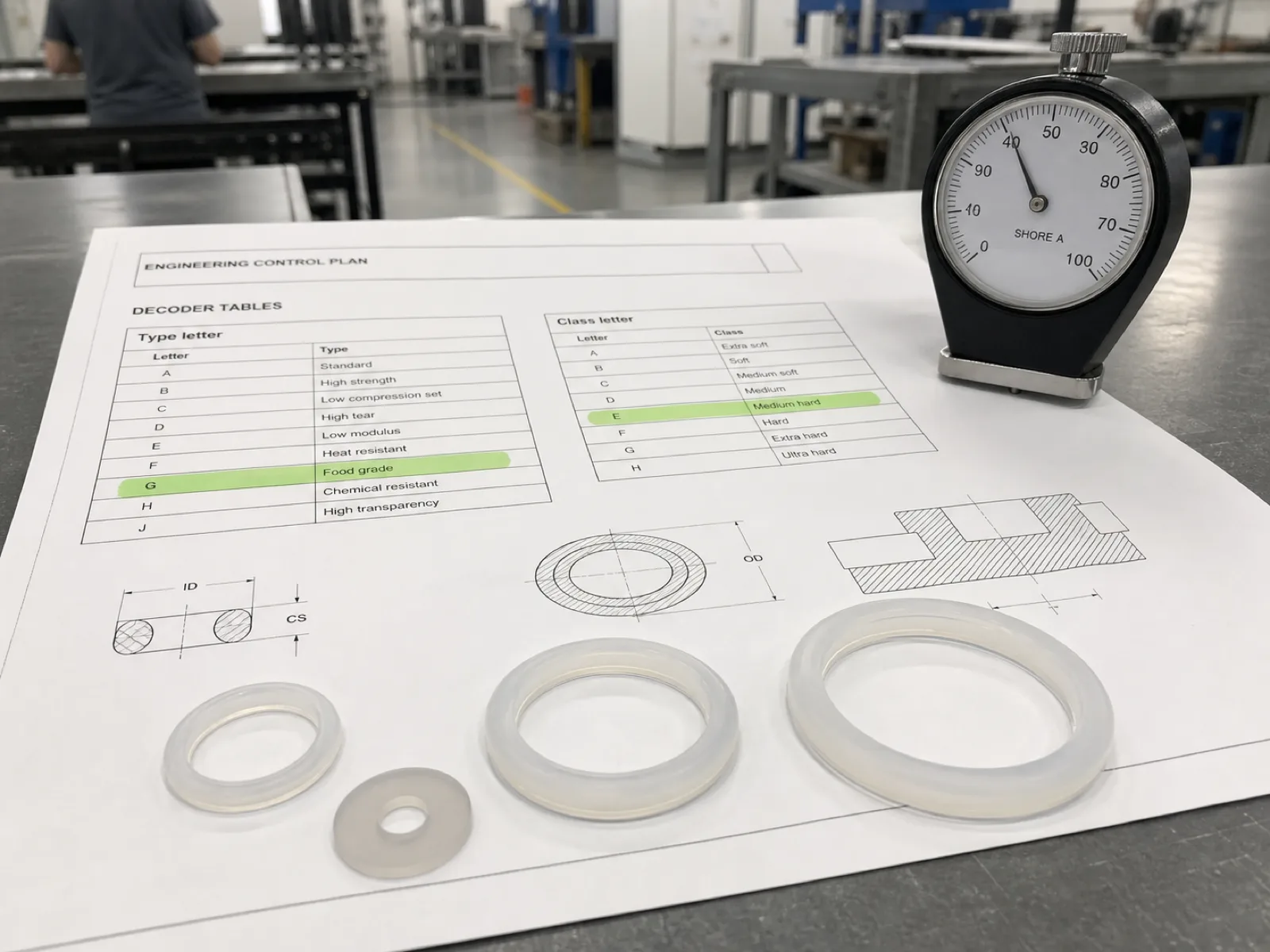
The Grade number (1 through 8) sets the tightness of the base performance table — higher grades demand tighter test results and more suffix requirements. The three-digit block after the Class letter encodes durometer hardness (first digit, in tens of Shore A per ASTM D2240) and minimum tensile strength (last two digits, in MPa per ASTM D412).[^astm-d2240][^astm-d412] So '505' means 50 Shore A ±5 and 5 MPa minimum tensile.
Grade 1 is the loosest — base heat-aging and no additional suffix requirements. Grades 2–8 progressively add mandatory suffix tests and tighten thresholds. Silicone gaskets in industrial service typically land at Grade 2 or Grade 4. Grade 6+ callouts usually appear on automotive underhood parts with aggressive compression-set, tear-strength, and fluid-resistance requirements stacked together.
The hardness-tensile block is compact:
| Callout | Shore A | Tensile min |
|---|---|---|
| 305 | 30 A | 5 MPa |
| 505 | 50 A | 5 MPa |
| 605 | 60 A | 5 MPa |
| 706 | 70 A | 6 MPa |
| 806 | 80 A | 6 MPa |
Silicone rarely goes above 80 Shore A on a D2000 callout — above that hardness, silicone becomes brittle and other elastomers take over. Below 30 A, sealing performance and dimensional stability collapse.
Suffix codes — decoded
Suffix codes are two-character letters followed by two digits: the letters name the test category (A, B, C, D, EA, EF, EO, F, G, Z) and the digits set the test suite and severity level. A callout can have zero suffixes (bare-minimum spec) or ten (fully-loaded automotive underhood spec). Every suffix is a pass/fail hurdle the compound must clear on top of the base Type/Class/Grade requirements.
The letter categories buyers see most often:
| Suffix letter | What it tests | ASTM method |
|---|---|---|
| A | Heat resistance (repeat of Type at custom temperature) | ASTM D573[^astm-d573] |
| B | Compression set | ASTM D395[^astm-d395] |
| C | Ozone resistance | ASTM D1149 |
| D | Tear resistance | ASTM D624 |
| EA | Water resistance | ASTM D471[^astm-d471] |
| EF | Fuel resistance (multiple fuels) | ASTM D471[^astm-d471] |
| EO | Oil resistance (Oils No. 1, 2, 3) | ASTM D471[^astm-d471] |
| F | Low-temperature brittleness | ASTM D2137[^astm-d2137] |
| G | Tear on aged samples | ASTM D624 aged |
| Z | Special custom test (buyer-defined) | Buyer-defined |
The two digits work as method-suite and severity. The first digit selects the test method variant; the second digit escalates the severity (temperature, duration, or pass threshold). So ‘B14’ means compression-set method B (per ASTM D395 Method B) at grade-4 severity — typically 25 % max after 70 h at 175 °C. ‘B34’ would mean the same method with grade-3 severity conditions. The exact grade-number-to-condition mapping is tabulated in ASTM D2000 tables 4–15; a sophisticated buyer keeps the standard open on their desk when writing callouts.
Worked example — decoding M2GE 505 A14 B14 EA14 EF31 EF11 F19
Read this callout character by character and it resolves into a real-world silicone specification. M is metric SI units. 2 is Grade 2. G is Type G (225 °C heat aging). E is Class E (80 % max oil swell). 505 is 50 Shore A, 5 MPa min tensile. A14, B14, EA14, EF31, EF11, and F19 are the six suffix tests the compound must clear.
Line-by-line translation of every element:
- M — Metric SI units (all values in °C, MPa, mm). Alternative would be blank for imperial.
- 2 — Grade 2. Basic requirements plus the suffix tests listed.
- G — Type G. Heat aging at 225 °C for 70 h per ASTM D573 with grade-limited property change.
- E — Class E. Volume swell ≤ 80 % after 70 h at 100 °C in ASTM Oil No. 3.
- 505 — 50 Shore A hardness (±5 per ASTM D2240), 5 MPa minimum tensile (per ASTM D412).
- A14 — Additional heat aging test at grade-4 severity conditions (typically 175 °C, 70 h) with tightened property-change limits.
- B14 — Compression set per ASTM D395 Method B, grade-4 severity — typically 25 % max after 70 h at 175 °C.
- EA14 — Water immersion resistance at grade-4 severity — volume-change and property-change limits after 70 h in water at 100 °C.
- EF31 — Fuel B resistance (ASTM Reference Fuel B, 70 % isooctane / 30 % toluene), grade-3 severity, tightest condition. This is where silicone typically fails — expect an explicit engineering deviation from the silicone supplier.
- EF11 — Fuel A resistance (ASTM Reference Fuel A, 100 % isooctane), grade-1 severity, loosest condition. Silicone can sometimes squeak past this one.
- F19 — Low-temperature brittleness per ASTM D2137, tested at −55 °C. Silicone passes this comfortably.
Handed this callout, a silicone supplier’s engineering intake concludes: the buyer wants a 50 Shore A platinum-cured VMQ silicone with post-cure. But EF31 (fuel B) is a red flag — standard silicone swells 40–80 % in Reference Fuel B and will fail. We would flag this back to the buyer and quote fluorosilicone (FVMQ) as the compliant alternative, at approximately 3.5× the base VMQ material cost and a 7–10 day longer cure cycle.
This is the value of D2000 for the supplier: the line callout surfaces conflicts early. Without D2000, the buyer might discover the fuel-swell problem after 5,000 parts shipped and a warranty return.
D2000 vs SAE J200 — same standard, different publishers
ASTM D2000 and SAE J200 are the same classification system published by two different standards bodies. The Type letters, Class letters, Grade numbers, hardness-tensile pairs, and suffix codes are word-for-word identical. An automotive RFQ that reads 'SAE J200 M2GE 705' can be directly quoted against ASTM D2000 M2GE 705 with no translation.[^sae-j200]
The historical split is straightforward. ASTM (American Society for Testing and Materials) and SAE (Society of Automotive Engineers) both wanted a rubber-classification standard for the automotive industry in the 1960s. They agreed to co-publish. SAE J200 is republished periodically to keep the automotive supply chain aligned with the current ASTM D2000 revision. When they diverge briefly during a revision cycle, the ASTM revision is authoritative.
Buyers should not treat a callout as different because it cites J200 versus D2000. If a supplier quotes different pricing or lead time based on which standard is cited, that is a red flag — the tests, thresholds, and pass criteria are the same.
When ASTM D2000 is the wrong specification to use
ASTM D2000 covers mechanical, thermal, and fluid-resistance performance only — it does not certify food contact, medical biocompatibility, potable water contact, or REACH/PFAS chemistry. Food-contact parts need FDA 21 CFR 177.2600 or LFGB cited alongside D2000. Medical parts need USP Class VI or ISO 10993. Potable water needs NSF/ANSI 61. Substituting D2000 for these regulations is a common and costly RFQ mistake.[^fda-177-2600]
Three failure modes we see monthly on RFQ intake:
- Food-contact silicone spec’d only as ASTM D2000 M2GE 505. The buyer assumes ‘ASTM certified’ equals ‘FDA compliant.’ It does not. D2000 says nothing about extractables, plasticizers, migration limits, or peroxide residuals. A peroxide-cured VMQ compound can hit M2GE 505 and still fail 21 CFR 177.2600. We require FDA compliance to be cited separately as a line item and default to platinum cure — see our FDA vs LFGB silicone breakdown.
- Medical silicone spec’d as D2000 without USP Class VI. D2000 has no biocompatibility test. A compound passing every suffix code can still trigger cell-culture cytotoxicity. Medical buyers must cite USP <88> Class VI or ISO 10993-5/-10/-11 alongside any D2000 line.
- Drinking-water silicone spec’d as D2000 without NSF/ANSI 61. NSF certifies extractables specific to drinking-water contact at 23 °C, 60 °C, and 82 °C. D2000’s EA suffix (water resistance) is a physical-property test — it measures swell, not extractables. These are different regulatory questions.
D2000 is a solid mechanical spec. Layer the regulatory standards on top when the application demands them; do not treat D2000 as a substitute.
The six common silicone grades under D2000
Silicone RFQ callouts almost always resolve into one of six standard compound families — general-purpose HTV, high-tear, low-compression-set, high-temperature, fluorosilicone, or food-grade platinum-cured. Each family satisfies a different combination of D2000 suffixes on top of the Type F/G, Class E/F base.
| Silicone family | Typical D2000 callout | What suffix drives selection |
|---|---|---|
| General-purpose HTV VMQ | M2GE 505 or M2GE 705 | Base spec, minimal suffixes |
| High-tear silicone | M2GE 606 D or M4GE 706 D | D-suffix (tear per ASTM D624) |
| Low-compression-set silicone | M4GE 706 B14 | Tight B-suffix at ≤ 15 % |
| High-temperature silicone | M2FE 606 or M2HE 705 | Type F or H (250 °C) |
| Fluorosilicone (FVMQ) | M2GG 706 EF31 | Class G + EF fuel resistance |
| Food-grade platinum-cured | M2GE 505 + FDA 21 CFR 177.2600 (cited separately) | Regulatory, not D2000 |
Reading this table backward is how a silicone factory quotes D2000 quickly. See the callout, identify the family, pull the corresponding compound spec sheet from the material library, and confirm the suffix conditions the sales sample must certify against.
For related deep-dives: our Shore A hardness silicone chart explains the durometer axis in more detail, and our cornerstone silicone rubber gasket manufacturing guide walks through how these compound families translate into tooling, MOQ, and lead time.
References
The tables, methods, and thresholds in this guide are extracted from the following standards and regulations. Each is authoritative for the claim it backs.
Get an ASTM D2000 callout quoted in 24 hours
Send us your D2000 line — including every suffix code — and we return a compound match, a pass/fail assessment against each suffix, and a manufacturability review within one business day. If a suffix conflicts with silicone chemistry (fuel resistance, aggressive oil swell), we flag it up front and quote fluorosilicone or recommend a substitute polymer rather than deliver a compound that fails at field service.
FAQ
-
What does an ASTM D2000 line callout like 'M2GE 505 A14 B14 EA14 EF31 EF11 F19' actually mean?
The 'M' fixes SI (metric) units. '2' is Grade 2, meaning basic requirements plus additional test suffixes. 'G' is the heat-aging Type — 225 °C max service temperature. 'E' is the oil-swell Class — 80–120 % volume swell in ASTM Oil No. 3. '505' means 50 Shore A hardness and 5 MPa minimum tensile. Each 'A/B/EA/EF/F' suffix adds a specific test: A14 = heat aging at 175 °C for 70 h, B14 = compression set, EA14 = water immersion, EF31 = fuel B resistance, F19 = low-temperature brittleness at −55 °C. Read the [worked example section](#worked-example-decoding-m2ge-505-a14-b14-ea14) below character by character.
-
Where does silicone (VMQ) fit in the ASTM D2000 Type and Class matrix?
Silicone lands almost exclusively at Type F (250 °C max continuous), Type G (225 °C), or occasionally Type H (250 °C tighter tolerance). On the oil-swell axis, standard VMQ silicone hits Class E (moderate — 80 to 120 % swell) or Class F (worse — 60 to 120 % swell). Fluorosilicone (FVMQ) improves to Class G/H. If a buyer writes 'Type G Class E' on an RFQ, they are almost always asking for a silicone compound; a Type A or Type B callout rules silicone out entirely.
-
Is ASTM D2000 the same as SAE J200?
Yes — ASTM D2000 and SAE J200 are two publications of the same classification system. ASTM publishes the civilian version; SAE publishes the automotive-industry mirror. The Type letters, Class letters, suffix codes, and grade tables are identical line for line. An automotive RFQ that reads 'SAE J200 M2GE 705' can be quoted directly against ASTM D2000 M2GE 705 with no translation.
-
When is ASTM D2000 the wrong specification to use on a silicone rubber part?
ASTM D2000 covers mechanical, thermal, and fluid-resistance performance only. It does not certify food-contact safety (that requires FDA 21 CFR 177.2600 or LFGB), medical biocompatibility (USP Class VI or ISO 10993), potable-water contact (NSF/ANSI 61), or REACH/PFAS chemistry. If the part touches food, drug product, drinking water, or human tissue, D2000 is not sufficient on its own — cite the applicable regulation in addition to D2000, or drop D2000 in favor of the domain-specific standard. See our [FDA vs LFGB silicone](/guide/fda-vs-lfgb-silicone/) guide for food-contact certifications.
-
What are the Type letters (A–K) in ASTM D2000?
Type is the heat-aging class — the maximum continuous service temperature the compound survives when tested per ASTM D573 with limits set by the Grade table. Type A = 70 °C, B = 100 °C, C = 125 °C, D = 150 °C, E = 175 °C, F = 250 °C, G = 225 °C, H = 250 °C (tighter), J = 275 °C, K = 275 °C (tighter). Type G is the most common silicone callout because 225 °C matches typical HTV silicone datasheet limits; Type F applies to specialty high-temp VMQ.
-
What are the Class letters (A–K) in ASTM D2000?
Class is the oil-swell resistance in ASTM Oil No. 3 (formerly IRM 903), measured as % volume change after 70 h at 100 °C per ASTM D471. Class A = no requirement, B = 140 % max, C = 120 %, D = 100 %, E = 80 %, F = 60 %, G = 40 %, H = 30 %, J = 20 %, K = 10 %. Standard silicone hits Class E or F; NBR/HNBR hits Class G–J; FKM hits Class H–K. This single letter is why silicone is disqualified from fuel-system service.
-
What do suffix codes like B14, EA14, EF31 mean?
Suffix codes bolt individual performance tests onto the base callout. The letter identifies the test category (A = heat resistance, B = compression set, C = ozone, D = tear, EA = water resistance, EF = fuel resistance, EO = oil resistance, F = low-temp brittleness, G = tear strength on aged samples, Z = special custom test). The first digit is the test method suite and the second digit is the severity — higher numbers mean harsher conditions. B14 means compression set per ASTM D395 with grade-4 severity (typically 25 % max at 175 °C for 70 h).
-
How do buyers actually use ASTM D2000 on an RFQ vs writing a custom material spec?
Sophisticated automotive and industrial buyers write ASTM D2000 line callouts because they compress a full material spec into one line and enforce standard test methods across suppliers. Non-automotive buyers more often write plain-language specs ('platinum-cured silicone, 50 Shore A, FDA 21 CFR 177.2600, compression set ≤ 25 %'). Both are valid — but a D2000 callout is unambiguous, auditable, and forces the supplier to certify against ASTM test methods rather than in-house shortcuts. Our RFQ intake accepts either format; see [sourcing silicone factory checklist](/guide/sourcing-silicone-factory-checklist/) for how we translate buyer intent into a compound spec.
-
What are the six common silicone grades a D2000 callout typically maps to?
General-purpose HTV (Type G Class E, 40–70 Shore A), high-tear silicone (Type G Class E, elevated D suffix for tear), low-compression-set silicone (Type G Class E with tight B suffix), high-temperature silicone (Type F or H, Class E), fluorosilicone FVMQ (Type G Class G, for fuel/oil resistance), and food-grade platinum-cured silicone (Type G Class E plus FDA 21 CFR 177.2600 cited separately outside D2000).
-
Does ASTM D2000 tell me anything about cure system (platinum vs peroxide) or filler?
No — D2000 is chemistry-agnostic. The Type/Class/Grade only constrain measurable performance. A supplier can meet the same D2000 callout with peroxide-cured or platinum-cured silicone, with fumed or precipitated silica filler, or with a completely different base polymer if it hits the numbers. If cure system matters (food contact, medical, low-outgassing), specify it as a separate line item alongside the D2000 callout. See [platinum-cured vs peroxide-cured silicone](/guide/platinum-cured-vs-peroxide-cured-silicone/) for why the cure system is often the deciding purchase criterion even when D2000 is satisfied.
References
Authoritative sources cited in this guide
- ASTM International. ASTM D2000 — Standard Classification System for Rubber Products in Automotive Applications. https://www.astm.org/d2000-18.html — The primary standard defining the line-callout syntax, Type/Class tables, and suffix-code system.
- SAE International. SAE J200 — Classification System for Rubber Materials. https://www.sae.org/standards/content/j200_201705/ — The SAE-published mirror of ASTM D2000 with identical tables and callout syntax.
- ASTM International. ASTM D573 — Rubber—Deterioration in an Air Oven. https://www.astm.org/d0573-04r19.html — The heat-aging test method referenced by every ASTM D2000 Type letter.
- ASTM International. ASTM D471 — Rubber Property—Effect of Liquids. https://www.astm.org/d0471-16a.html — The fluid-swell test that defines the D2000 Class letter oil-resistance grid.
- ASTM International. ASTM D395 — Standard Test Methods for Rubber Property—Compression Set. https://www.astm.org/d0395-18.html — The compression-set test method invoked by every B-suffix in a D2000 callout.
- ASTM International. ASTM D2240 — Standard Test Method for Rubber Property—Durometer Hardness. https://www.astm.org/d2240-15r21.html — The Shore A hardness method that the first digit of the D2000 hardness/tensile pair references.
- ASTM International. ASTM D412 — Vulcanized Rubber and Thermoplastic Elastomers—Tension. https://www.astm.org/d0412-16r21.html — The tensile-strength test method behind the second half of the D2000 hardness/tensile pair.
- ASTM International. ASTM D2137 — Rubber Property—Brittleness Point of Flexible Polymers. https://www.astm.org/products-services/standards-and-publications/standards.html — The low-temperature brittleness test invoked by F-suffix codes in a D2000 callout.
- US Food and Drug Administration. 21 CFR 177.2600 — Rubber articles intended for repeated use. https://www.ecfr.gov/current/title-21/chapter-I/subchapter-B/part-177/subpart-C/section-177.2600 — The food-contact regulation that ASTM D2000 does not replace on any part touching food.
Start a custom program
Send a brief. Get an engineer’s reply in one business day.
Every Wetop program is tooled from a customer’s specification. Send a CAD file (STEP · IGES · DWG) or a written brief and we’ll reply with a mold cost estimate, price brackets at MOQ 500 / 1,000 / 5,000, and any engineering questions.