Premium skincare brand · Multi-Category · Body-scrubber line OEM
Skincare brand · silicone body scrubber OEM
Why this skincare program is worth writing up
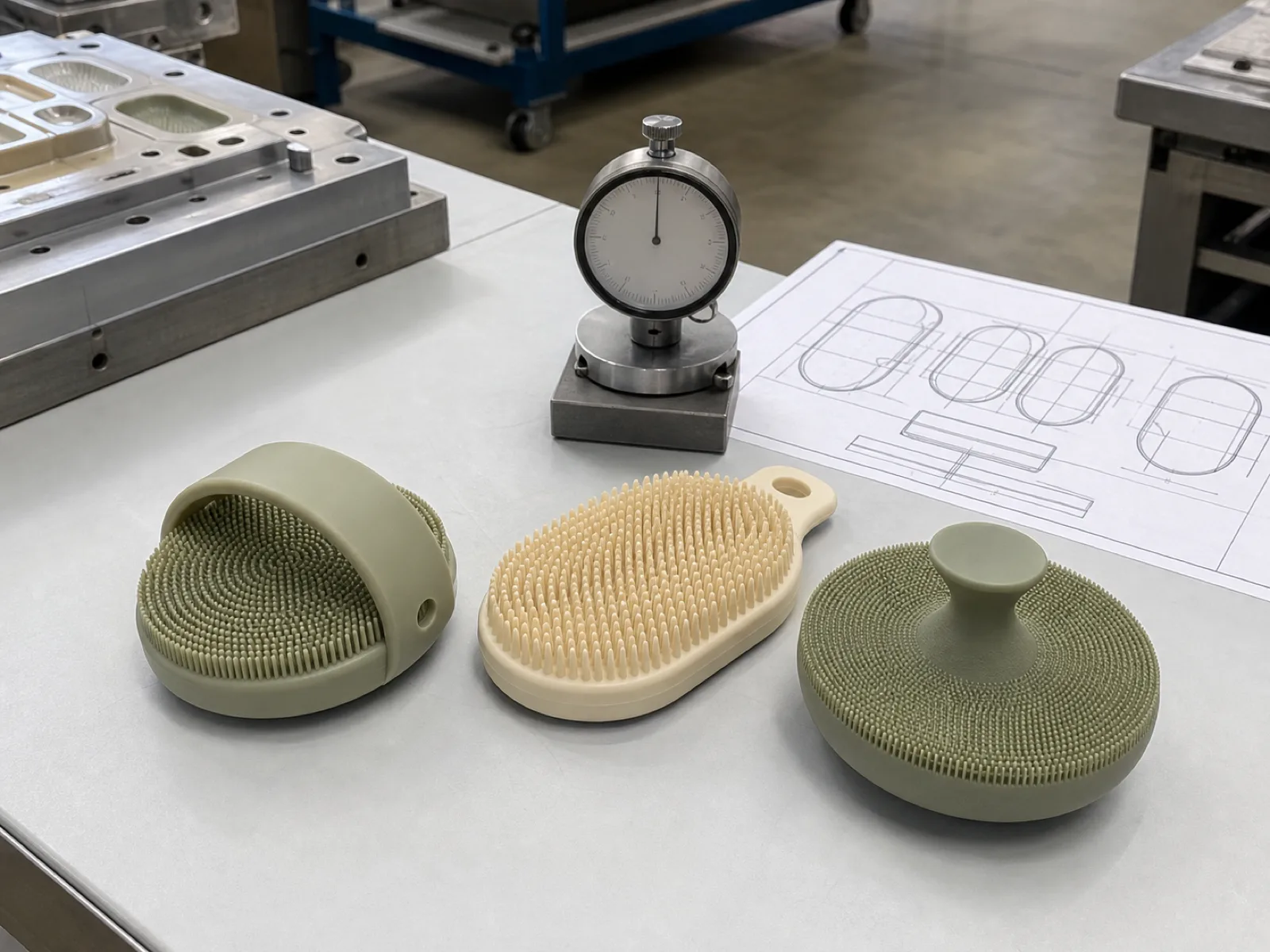
A premium skincare brand needed a silicone body-scrubber line where the exfoliating nubs drag soft on skin but the tool grips firm in a wet hand — a single part with three durometers co-molded together. The first tool set was scrapped when the softest nubs tore at the root under wet-hand shear, and re-cut before a single retail unit shipped. The line now runs 18 months at ~120,000 units/yr across three SKUs, all platinum-cured to a documented USP Class VI extractables profile.
This is an anonymized composite. The brand is not named — DTC skincare programs run under standard confidentiality, and the figures here are illustrative of the type of work Wetop runs for buyers in the personal-care segment. What matters for other skincare and beauty-brand procurement readers is the shape of the engineering decisions, because a body scrubber is deceptively simple: it looks like a molded rubber pad, and it is actually a skin-contact medical-grade part with three competing mechanical requirements in one shot.
The brand’s positioning made the material non-negotiable before any geometry conversation. “Medical-grade silicone against your skin” is a claim a marketplace or a retailer’s compliance desk will ask you to defend with a document, not an adjective. So this program started at the compound and the cure system, then worked outward to the nubs.
The challenge: soft on skin, firm in a wet hand, safe by document
The core challenge was a durometer conflict: exfoliating nubs soft enough to drag across facial skin without abrasion complaints (Shore A 35) on the same part as a body stiff enough to grip in a soapy hand (Shore A 65). Add USP Class VI skin-contact compliance, ±0.5 ΔE match across two muted brand shades, and a 500-unit-per-SKU pilot MOQ, and the standard single-durometer molded scrubber could not meet the brief.
Most silicone body scrubbers on the market are a single durometer — usually Shore A 45-55 — which is a compromise that pleases nobody. Too soft and the tool folds in a wet hand and the nubs feel mushy; too firm and the exfoliation feels scratchy on the face. The brand had shipped a first-generation product with a prior supplier at a flat Shore A 50 and carried a steady trickle of “too harsh on my face, too floppy on my back” reviews. Their brief for the reorder was explicit: solve the durometer conflict inside one molded part, or they would keep the two-product SKU split they were trying to eliminate.
Layered on top was the compliance depth. The brand’s creative narrative leaned on “medical-grade” language, which meant the extractables profile had to be real and documented, not a letter of guarantee. A DTC brand that sells through its own storefront plus third-party marketplaces gets audited from two directions at once — the payment platform’s restricted-products team and the marketplace’s compliance bots both ask for skin-contact substantiation. The brand had been burned once by a supplier whose “food-grade” certificate did not cover skin-contact extractables and had a listing temporarily suspended over it. This time, USP Class VI was a gating requirement at RFQ, not a nice-to-have.
The third constraint was color. Both brand shades — a muted sage and a warm cream — sat in the low-chroma range where batch-to-batch drift is most visible to a consumer holding two units side by side. The brand’s creative team wanted ±0.5 ΔE but had stopped asking for it in RFPs because no prior personal-care OEM had hit it. That is a recurring pattern we see: buyers quietly lower their own spec because the supply base trained them to expect ±2-3 ΔE.
How we approached it: cure system first, then three durometers, then color
We locked the platinum-cured LSR compound and cleared its USP Class VI extractables profile before quoting geometry, then engineered the scrubber as a three-durometer co-mold — Shore A 35 facial nubs, Shore A 50 body nubs, Shore A 65 structural spine — so one part flexes soft on skin and grips firm wet. Color was dyed in master-batch and spectrophotometer-verified per lot, not surface-coated.
Sequencing matters here, and it is the part broker-model suppliers skip. We qualified the compound against USP <88> Class VI and 21 CFR 177.2600 first, so the brand’s compliance reviewer read the extractables data at the RFQ stage — before anyone spent money on tooling. If the material had failed the skin-contact profile, the program would have ended on a spreadsheet, not on a scrapped mold. Platinum-cure (addition cure) was mandatory because it leaves no peroxide-decomposition residues to migrate to a skin-contact surface; the is-silicone-body-safe reasoning on cure chemistry was the framework we handed their reviewer.
The durometer conflict was solved by treating the scrubber as three materials in one shot rather than one material as a compromise. The facial nubs were molded at Shore A 35 so they buckle gently against skin instead of scratching. The body-side nubs ran Shore A 50 for grip-and-scrub on thicker skin. Underneath, a Shore A 65 structural spine — invisible to the user — keeps the pad from folding when a wet hand squeezes it. Co-molding three durometers means three compound feeds, sequenced curing, and a tool that indexes the shots to within a fraction of a millimeter so the hardness transitions land exactly where the geometry changes.
Then the “scrapped and re-cut” moment. First-article units looked perfect and failed the wet-shear test: the Shore A 35 facial nubs, being the softest, tore at their base when a gloved technician dragged them across a wetted acrylic plate under load — simulating a consumer scrubbing a collarbone with soap. Root-cause was two-fold: the mold gate fed too close to the nub field, work-hardening the softest material at the exact stress riser, and the nub root had a sharp corner instead of a fillet. We scrapped that cavity insert, moved the gate, and cut a root radius into every soft nub. That is a five-figure decision made before a single retail unit shipped — the alternative was a viral “the nubs fell off” review thread that would have killed the SKU. This is the same discipline described in our remold mid-program account: catch it on the bench, not on the shelf.
Color ran in master-batch, meaning the silicone gum is pigmented before molding so the shade is uniform through the part — no surface coating to scuff off against skin. Every lot was read on a CIE Lab spectrophotometer (ΔE00 formula) against a physical TPX Pantone chip, five points per part, logged on the batch COA.
The specs and the outcome
All three SKUs passed the re-engineered wet-shear protocol with zero base-tear escapes, both shades held within ±0.5 ΔE across six production cycles, and the line has run 18 months at ~120,000 units/yr. The USP Class VI documentation has cleared every DTC marketplace and retailer audit without a re-test, and the brand has scoped a fourth SKU on the same compound and color system.
The measurable results against the brief:
| Attribute | Spec / target | Result over 18 months |
|---|---|---|
| Cure system | Platinum-cured LSR (addition cure) | Logged on every batch COA |
| Skin-contact grade | USP <88> Class VI + 21 CFR 177.2600 | Cleared at RFQ; zero re-tests on audit |
| Facial nub hardness | Shore A 35 ± 3 (ASTM D2240) | Held; wet-shear passing after re-cut |
| Body nub hardness | Shore A 50 ± 3 | Held |
| Structural spine | Shore A 65 ± 3 | Held; no wet-hand fold complaints |
| Color match | ±0.5 ΔE, sage + warm cream | ±0.42 ΔE mean across 6 cycles |
| PFAS | Non-detect panel per lot | Zero regulatory flags |
| Sampling | AQL 1.5 cosmetic / 0.65 critical | Held (ISO 2859-1 Level II) |
| Volume | Pilot 500/SKU → run rate | ~120,000 units/yr across 3 SKUs |
| Sample lead time | On new tooling | 12-18 days first-article |
The business result is the one the brand cares about: the two-product SKU split they had been carrying — a separate “soft” and “firm” scrubber — collapsed into a single tool that does both, because the durometer conflict was solved in the mold instead of in the catalog. The “too harsh / too floppy” review pattern flattened out within the first shipment cycle. The USP Class VI packet, structured to the PO number as one PDF, is what lets their compliance contact answer a marketplace restricted-products query in an afternoon rather than a week.
Eighteen months in, the brand’s product team has scoped a fourth SKU — a scalp massager — on the identical platinum-cure compound and color system, which is the clearest re-order signal a program gives: the buyer stops re-qualifying the supplier and starts treating the tooling shop as an extension of their product roadmap.
Related program and further reading
For the buyer-side engineering framework behind this kind of skin-contact tool, the silicone body scrubber OEM guide covers durometer selection, nub geometry, and the compliance stack in depth. For a peer program in the same DTC personal-care tier — where color discipline and re-order dynamics played out on a different product — see the subscription DTC brand color-refresh program.
Sourcing something similar?
If you are a skincare or personal-care brand scoping a silicone tool line and the hard problem is skin-contact compliance, multi-durometer geometry, or muted-shade color discipline, talk to the engineering desk before you cut tooling. We qualify the compound and clear the extractables profile at RFQ stage, run 500-unit-per-SKU pilots, and bundle per-lot FDA / LFGB / PFAS documentation to the PO number. Start a conversation via contact.
Sourcing a similar program?
Get a CAD review and quote in one business day.
MOQ 500 per SKU. Samples in 7-25 days. We can share a more detailed reference (under NDA) for an adjacent program. Email inquiry@wetopsilicone.com or use the form.