Zero-waste kitchen brand · Multi-Category · Reusable food-wrap + jar-lid OEM
Zero-waste brand · food wrap + jar lid OEM
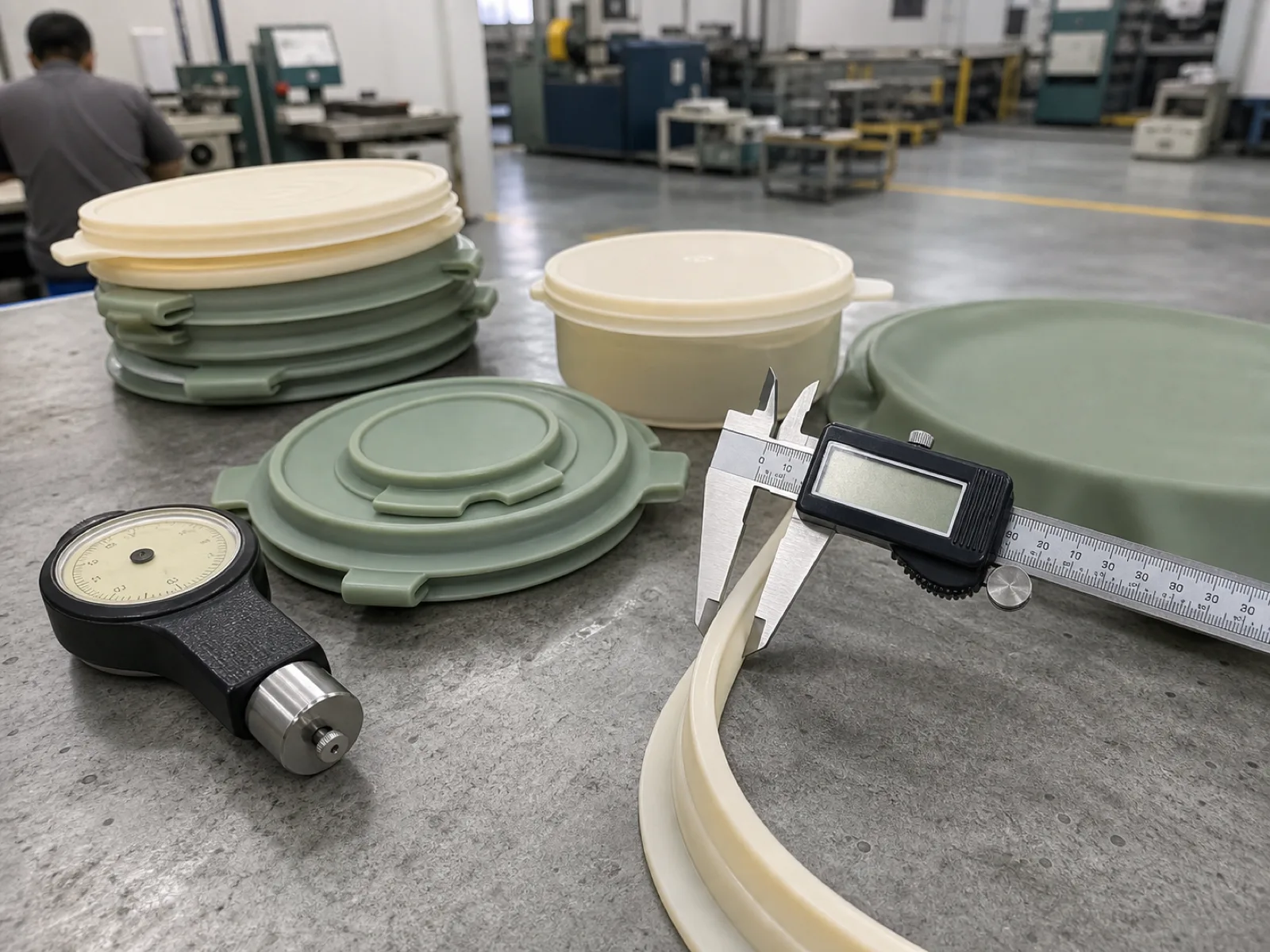
A zero-waste kitchen brand had two silicone hero categories running on two unaudited marketplace suppliers, two cure systems, and two versions of the same “cream.” We consolidated stretch food wraps and suction jar lids onto one platinum-cured program, re-cut the jar-lid tool when first-article samples failed compression-set testing, and put an FDA + LFGB per-batch packet behind the brand’s direct-food-contact claim. Eighteen months in, both categories ship at ~120,000 units/year with seal-fit and color held to spec.
This is an anonymized composite account. The customer name is withheld; the specifications, failure mode, and process decisions described are representative of the reusable food-storage programs Wetop Silicone runs from Dongguan and are defensible against our standard tooling and QC records.
The challenge
The brand's two silicone categories were sourced from two unaudited marketplace suppliers with mismatched cure systems, no shared color reference, and no per-batch food-safety documentation. The jar lids intermittently lost suction within days, and neither supplier would share the tooling or durometer data needed to diagnose the seal failure.
A reusable food wrap and a suction jar lid look like simple parts. They are not. Both are sealing products — the entire value proposition is that the wrap clings to a bowl rim and the lid pulls and holds a vacuum over a jar mouth. When the seal fails, the product fails, and the brand eats the return.
The brand came to us carrying three separate problems that had grown together into one. First, the two categories were made by two different shops sourced through an unaudited marketplace. The wraps were peroxide-cured (a cheaper, faster cure route) and carried the faint sulfur-tinged odor that peroxide cure by-products leave behind — unacceptable on a product that wraps food. The jar lids came from a second supplier entirely, on a different silicone grade, with no shared Pantone or master-batch reference. On the shelf, the “matching” wrap-and-lid range read as two different creams. For a brand whose whole positioning is a coordinated, calm, low-waste kitchen aesthetic, two mismatched creams undercut the story at the point of sale.
Second, the jar lids kept losing suction. Customers reported lids that sealed on day one and went slack within a week. Neither supplier could explain it, because neither would share the sealing-lip geometry, the durometer of the rubber, or any compression-set data. Without that engineering data, the failure was undiagnosable — the brand was flying blind on its own product.
Third, and most seriously for a food-contact brand: there was no per-batch food-safety paper trail. The suppliers offered a one-time certificate from years prior, not batch-level testing. The brand was making a “safe for direct food contact” claim on a product line it could not actually document. That is exactly the exposure the unaudited-marketplace sourcing model creates — a confident claim with nothing verifiable behind it.
How we approached it
We consolidated both categories onto one platinum-cured LSR platform, engineered the jar-lid sealing lip to 45 ± 5 Shore A with seal-lip thickness held to ±0.15 mm, and ran first-article suction domes through 72-hour compression-set testing. When the first tool relaxed past our set threshold, we scrapped and re-cut it before mass production.
The first decision was cure chemistry. We moved both categories onto a single platinum-cured (addition-cure) LSR platform. Platinum cure leaves no sulfur by-products and no residual odor, and it produces a cleaner extractables profile for direct food contact. Just as importantly, running both wraps and lids on the same cure system meant one odor profile, one food-safety story, and one set of test reports across the whole range — instead of two suppliers’ worth of variance the brand had to reconcile.
The engineering crux was the jar-lid seal. A suction lid has to do two contradictory things: the sealing lip has to be soft enough to deform around the imperfect rim of a real glass jar and conform tightly, but the suction dome has to be resilient enough to spring back and hold negative pressure for weeks. Get the durometer too soft and the dome stays collapsed — no suction. Too firm and the lip won’t conform — it leaks. We specified the sealing lip at 45 ± 5 Shore A, on the soft end of the food-grade band, and controlled seal-lip thickness to ±0.15 mm on a digital caliper across every first-article run, because a few tenths of a millimeter on the sealing lip is the difference between a clean vacuum and a slow leak.
Then we tested the failure mode the previous supplier never did. First-article suction domes went under 72-hour compression-set testing — the dome held compressed at temperature, then measured for how much permanent deformation (“set”) it retained. A dome that takes a permanent set has lost its spring; that is precisely why the marketplace lids went slack after a week in a customer’s fridge. Our first jar-lid tool produced domes that relaxed past our ≤ 15% compression-set threshold. Rather than ship a lid we already knew would fail in the field, we scrapped the tool and re-cut it — a thicker dome wall and a revised radius — which cost about three weeks of tooling time. That “scrapped-and-restarted” call is the difference between finding the seal-failure mode on a QC bench in Dongguan and finding it in ten thousand customer complaints.
Color was the last piece. Both categories were mixed in master-batch — the silicone gum dyed before molding, not surface-coated — against the brand’s cream and sage references, and spectrophotometer-checked to ΔE ≤ 1.0. Because both wraps and lids draw from the same calibrated master-batch, they finally read as one coordinated range on shelf. Surface coating — the cheaper route the marketplace suppliers had used — would have chipped and shifted color batch to batch on a product that gets stretched, washed, and flexed hundreds of times; master-batch color runs uniformly through the part, so it cannot wear off. Every batch of both categories ships with FDA 21 CFR 177.2600 and LFGB §30/31 test reports, so the brand’s direct-food-contact claim rests on per-batch documents, not a supplier’s word.
Outcome
Both categories now ship from one platinum-cured program at ~120,000 units/year across 18 months. The re-cut jar-lid tool holds vacuum through the full 72-hour compression-set window at under 12% set, color holds ΔE ≤ 1.0 across the range, and every shipment carries FDA + LFGB per-batch reports backing the brand's direct-food-contact claim.
The re-cut jar-lid tool cleared the test that killed the first one: suction domes now hold through the full 72-hour compression-set window at under 12% set, comfortably inside our threshold, and the field suction complaints the brand had tracked under the marketplace suppliers effectively stopped once the corrected lids reached retail. The seal-failure mode was designed out on the bench, not patched in the field.
Consolidating both categories onto one platinum-cured platform retired the odor problem and the color mismatch in a single move. Wraps and lids now hold ΔE ≤ 1.0 against the shared cream and sage master-batch, so the range reads as one coordinated system at the point of sale — the calm, matched aesthetic the brand’s positioning depends on. And every shipment across both categories carries per-batch FDA and LFGB reports, which means the brand’s “safe for direct food contact” claim clears retail food-safety audits on documentation instead of relying on an unverifiable marketplace assurance.
The program has run 18 months at ~120,000 units/year across both categories, and the brand has since scoped a third SKU — a nesting lid set — onto the same tooling and QC discipline. One engineering-led program replaced two unaudited suppliers, and the seal, the odor, the color, and the paper trail are now all under one roof.
| Spec / result | Target | Delivered |
|---|---|---|
| Cure system | Platinum-cured (addition-cure) LSR | Both categories, one platform |
| Sealing-lip durometer | 45 ± 5 Shore A | Held on jar-lid seal lip |
| Seal-lip thickness | ±0.15 mm (digital caliper) | Verified every first-article run |
| Compression set (72 h) | ≤ 15% | Re-cut tool: < 12% |
| Color match | ΔE ≤ 1.0 vs cream + sage master-batch | Held across both categories |
| Food-safety packet | Per-batch, direct-contact | FDA 21 CFR 177.2600 + LFGB §30/31 |
| Volume | Two-category consolidation | ~120,000 units/yr |
| Duration | — | 18 months active |
| MOQ | 500 units / SKU | — |
Related program
For another multi-category consolidation held to tight color tolerance, see our multi-color pet slow-feeder program, where six coordinated finishes were held to ±0.5 ΔE across a slow-feeder and lick-mat range. For the food-safety documentation behind the direct-contact claim in this program, see the guide on food-grade silicone certification and FDA vs LFGB testing.
Sourcing something similar?
If you are running a reusable food-storage line — wraps, jar lids, stretch covers, bowl seals — off unaudited marketplace suppliers and cannot get seal-fit data, a matched color story, or a per-batch food-safety packet, that is exactly the consolidation this program solved. Talk to the engineering desk about your seal geometry, durometer target, and food-contact documentation. Start a conversation with the engineering desk.
Sourcing a similar program?
Get a CAD review and quote in one business day.
MOQ 500 per SKU. Samples in 7-25 days. We can share a more detailed reference (under NDA) for an adjacent program. Email inquiry@wetopsilicone.com or use the form.