Certification · informational intent
Are Silicone Utensils Safe? FDA + LFGB Engineering Answer
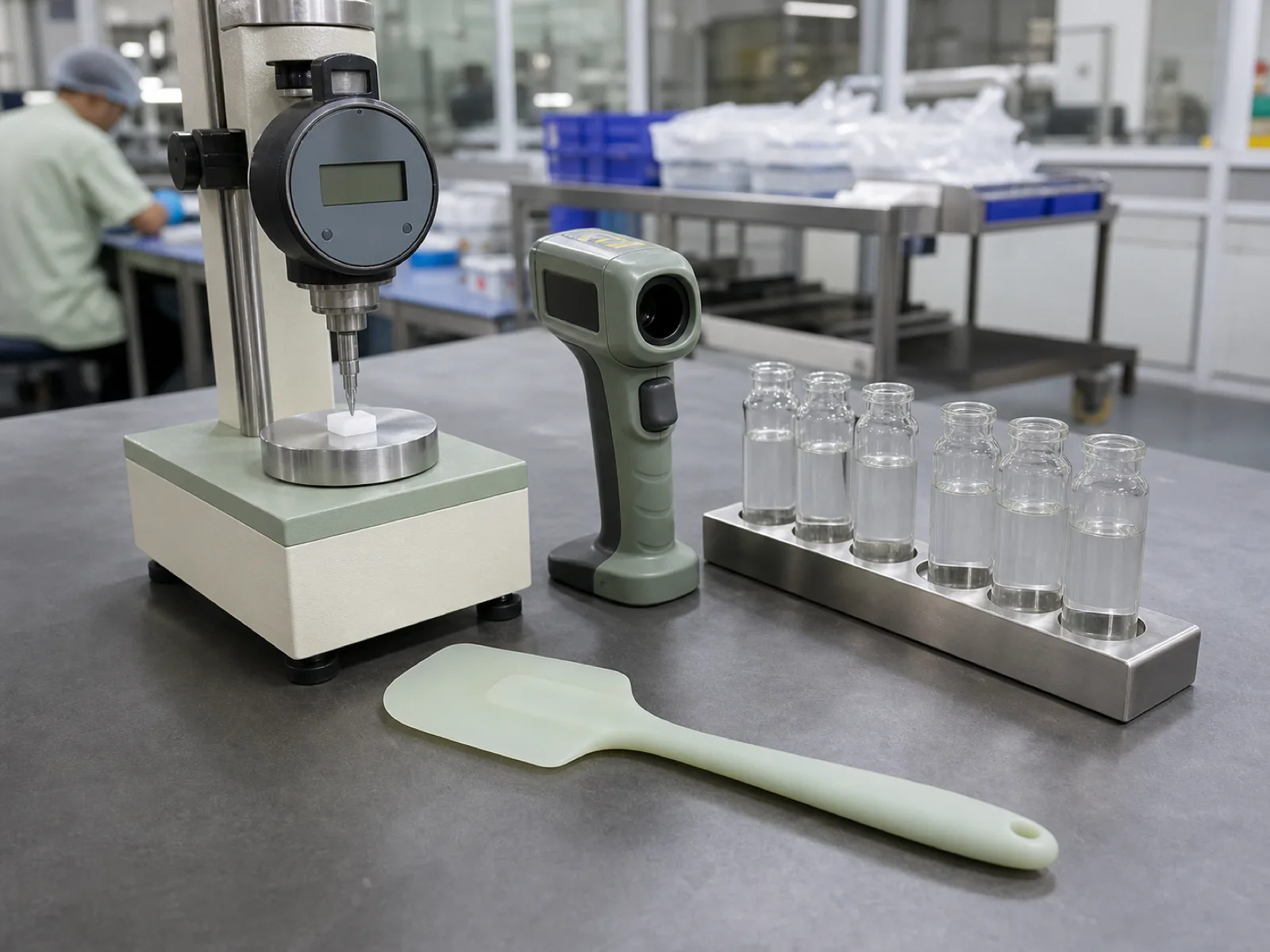 Certification
 Silicone kitchen utensils are safe when the polymer is platinum-cured food-grade silicone cleared under FDA 21 CFR 177.2600 and post-cured four hours at 200 °C to drive out residual siloxanes. That single manufacturing step — not the FDA logo on the tag — is what separates a compliant spatula from a filler-adulterated one. The engineering evidence is in the extractables report, the cure log, and the eight-document retail compliance stack, not in a marketing claim.
The short answer travels fine on a consumer blog, but a sourcing manager listing a private-label silicone utensil at a Tier-2 US home-improvement chain needs the long answer — the exact clause numbers, the peroxide-value caps, the migration data, and the eight documents a QA team will ask for during factory qualification. This guide is the long answer, written from a Dongguan silicone factory floor where we run 60 employees across compression and LSR injection cells and post-cure every batch before it ships. If your compliance packet is missing any of the artifacts below, an audit will catch it.
What does “food-grade” actually mean for a silicone utensil?
Food-grade silicone for kitchen utensils means the polymer clears FDA 21 CFR 177.2600 — a specific regulation on rubber articles intended for repeated food contact — with n-hexane and ethanol extractables under 20 mg/in² on the first 7-hour reflux extraction and under 1 mg/in² on successive extractions[^fda-177-2600]. Anything vaguer than that clause is marketing.
The label “food-grade” is not a certification anyone hands out. It is a shorthand for having a batch-level extractables test on file that satisfies 21 CFR 177.2600 for repeated-use food contact articles. The regulation lists the allowed polymer components (dimethyl polysiloxane, methyl vinyl polysiloxane, and a short list of catalysts and additives) and caps the migration of those components into food-simulating solvents. A supplier that cannot produce a Certificate of Compliance citing the clause and the test lab is not selling food-grade silicone — they are selling a silicone utensil with a hopeful claim on the tag.
For the EU market, the parallel regulation is Commission Regulation (EU) 10/2011, which sets an overall migration limit of 60 mg/kg into food simulants and lists specific migration limits (SML) for individual substances[^eu-10-2011]. A US-only compliance packet is not enough for a retail chain with European buying arms — the packet must layer FDA + LFGB + EU 10/2011 to survive a joint qualification.
The failure mode is silent. A utensil made from peroxide-cured silicone cut with 15% calcium carbonate filler will still pass a casual sniff test at 25 °C. It will fail the 7-hour n-hexane reflux, and it will discolor and off-gas at oven temperature. The extractables report is the only pre-shipment artifact that catches this.
The other quiet failure is regulatory drift. 21 CFR 177.2600 was last substantively amended in 1998, but the FDA’s Food Contact Substance Notification (FCN) program has cleared dozens of specific silicone additives since then — pigments, processing aids, mold-release agents — under a parallel pathway. A finished utensil that clears the 1998 polymer clause but uses a 2015 mold-release agent not on any positive list is technically non-compliant. The FCN inventory is the searchable source of truth[^fda-cfsan-inventory], and a compliant supplier cross-references every additive by CAS number against it before compounding.
The practical implication for a sourcing manager: a “food-grade” claim without a citation to the specific clause, the specific test lab, the specific ISO 17025 accreditation number, and the specific batch traced by the test is not a claim — it is a hope. A compliant Certificate of Compliance names all four.
Does 21 CFR 177.2600 alone make a silicone utensil safe?
No — 21 CFR 177.2600 is necessary but not sufficient. It clears the polymer chemistry but does not test the finished utensil's peroxide value, volatile content, or per-batch cure completeness. Serious retail programs layer FDA clearance with LFGB §30/31 test reports (peroxide value ≤ 0.5%, volatiles ≤ 0.5% after 4 h at 200 °C) to catch factories that skip the post-cure[^bfr-xv-silicones].
21 CFR 177.2600 is a formulation-level regulation. It says: if you use these polymers and these additives within these limits, and if the finished article passes the extractables test, the material is cleared for repeated food contact. It does not verify that a given production batch of a given spatula was post-cured. It does not verify that the factory did not switch to a peroxide-cured masterbatch to hit a lower cost target. It does not verify that the pigment masterbatch is on the FDA positive list.
That is why sourcing managers at chains like Home Depot, Wayfair, Bed Bath & Beyond, Tesco, and Carrefour — the Tier-2 retail tier Wetop actually runs programs for — layer LFGB §30/31 testing on top of FDA. LFGB §30/31 caps peroxide value and volatile content on the finished article, which forces the factory to run a proper post-cure cycle and to compound with platinum catalysts. Filler-adulterated peroxide-cure silicone fails LFGB reproducibly, which is why the report is worth the extra ~$400 per SKU per year.
For the French market — and any harmonized-import EU program — French Decree 2012-13 further caps peroxide value at 0.5% and post-cure volatiles at 0.5% after 4 h at 200 °C[^decree-2012-13]. Wetop’s compliance pack includes it by default because retail chains with European buying arms request it during qualification even for US-only programs.
Platinum-cure vs peroxide-cure — which is safe for utensils above 200 °C?
Only platinum-cured silicone is safe for utensils rated above 200 °C. The Karstedt platinum catalyst drives a clean hydrosilylation with no organic byproducts, so residual chemistry is confined to short-chain siloxanes that volatilize during the standard 200 °C × 4 h post-cure. Peroxide-cured silicone releases 2,4-dichlorobenzoic acid, discolors, and fails LFGB volatiles caps unless heavily over-cured.
The cure system is the single biggest safety variable at the factory floor. Two utensils sitting side-by-side at retail can share a spec sheet, a color, a shape, and a “food-grade silicone” tag — and one is safe to bake with while the other is not. The difference is the cure chemistry the factory chose upstream.
Peroxide-cured silicone uses 2,4-dichlorobenzoyl peroxide (BPO) or 2,5-dimethyl-2,5-di(tert-butylperoxy)hexane (DBPH) as the crosslinker. The peroxide decomposes at cure temperature, splitting into radicals that crosslink the polymer chains. It also decomposes into 2,4-dichlorobenzoic acid, a soluble organic residue that must be driven off in a post-cure oven. Skip the post-cure and that residue migrates into food. It also causes the characteristic yellow-brown discoloration you see on cheap silicone bakeware after a few hundred cycles.
Platinum-cured silicone uses a Karstedt-class Pt(0) catalyst that drives hydrosilylation between Si-H and Si-vinyl groups. The reaction is atom-economical — no organic byproducts, no acidic residue. The only volatiles are cyclic siloxanes (D4, D5, D6) formed as a side reaction during compounding, and those are what the 200 °C × 4 h post-cure eliminates. Peer-reviewed migration studies confirm that a properly post-cured platinum silicone releases D4-D6 below analytical detection limits into food simulants[^pubmed-siloxane-migration].
Cost delta at the compound level: platinum-cured silicone runs 20-30% more per kilogram than peroxide-cured. That is why grey-market factories use peroxide stock and skip the post-cure — the raw math on a spatula is $0.08 vs $0.11 in material. A Tier-2 retail chain absorbs the $0.03 delta because the return rate and product liability delta is 10x that.
There is a second dimension the cure-system choice controls: mold flow and part geometry. Platinum-cured LSR (Liquid Silicone Rubber) is a two-part injection-molding system that hits ±0.05 mm tolerance on complex geometries — the standard for medical, baby-feeding, and premium-utensil programs. Peroxide-cure HCR (High-Consistency Rubber) is a compression-mold system that runs at ±0.1-0.15 mm tolerance and cannot form deep undercuts without secondary machining. A utensil with a co-molded soft grip or a printed food-portion scale requires LSR — and LSR is platinum-cured by chemistry, not by choice. The moment a program asks for a co-molded feature, the cure system is decided and the safety story simplifies.
Cure-system spec matrix — the numbers that matter:
| Property | Peroxide-cured HCR | Platinum-cured HCR | Platinum-cured LSR |
|---|---|---|---|
| Max continuous use temp | 200 °C | 230 °C | 230 °C |
| Post-cure requirement | 4-6 h at 200 °C mandatory | 4 h at 200 °C recommended | Not required (kit-cured) |
| Residual byproduct | 2,4-dichlorobenzoic acid | D4/D5/D6 siloxanes | D4/D5/D6 siloxanes |
| Typical Shore A range | 40-80 | 40-80 | 20-70 |
| Tolerance (finished part) | ±0.1-0.15 mm | ±0.1-0.15 mm | ±0.05 mm |
| Raw material cost delta | Baseline | +20-25% | +25-30% |
| LFGB §30/31 pass rate | 60-70% without over-cure | 95%+ standard | 99%+ standard |
| Suited for utensils above 200 °C | No | Yes | Yes |
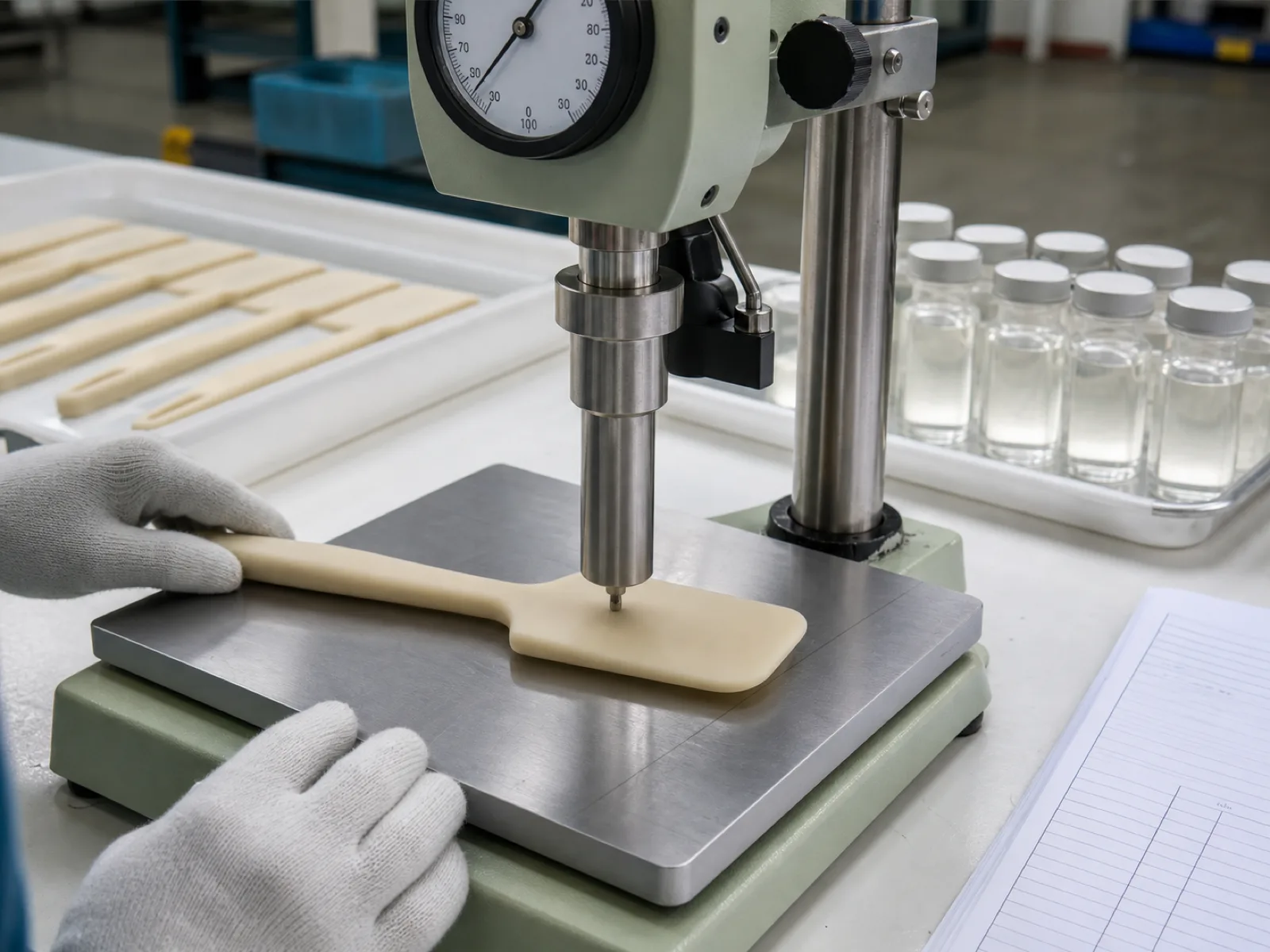
The row that matters for a safety claim is the LFGB pass rate. A supplier who quotes peroxide-cured stock and promises LFGB compliance is either running an extended over-cure they will not disclose (which drives up energy cost) or falsifying the test report. Either way, the price they quote is not a price you can hold. Platinum-cure is the only cure system with structural LFGB pass rates above 95%.
What does the post-cure cycle actually do to make a silicone utensil safe?
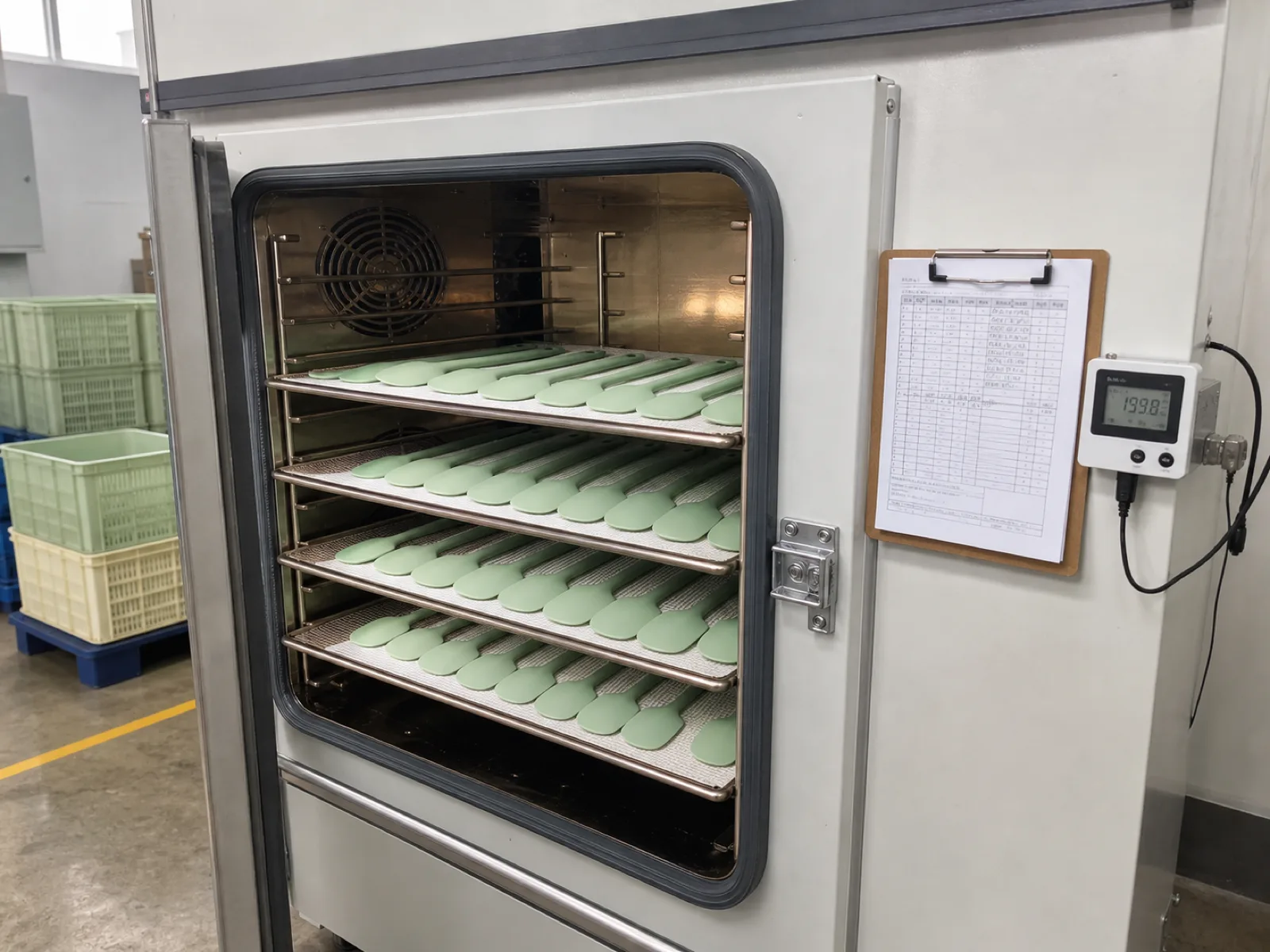
The 200 °C × 4 h post-cure volatilizes residual cyclic siloxanes (D4, D5, D6) and, for peroxide-cure stock, drives off 2,4-dichlorobenzoic acid decomposition residue. Without the post-cure, both classes of residue migrate into food during cooking. Skipping this step is the single most common failure mode in cheap silicone utensils and the one LFGB §30/31 catches reproducibly[^bfr-xv-silicones].
A post-cure oven is not a nice-to-have. It is the safety-critical step that turns raw cured silicone into food-contact-ready silicone. At Wetop the cycle is 200 °C for 4 hours in a forced-air convection oven, with the batch cure log signed by the QC engineer on shift and stapled to the per-batch COA that ships with the product. If a customer’s audit team wants to see the last 30 days of cure logs, we hand them the folder. That is the operational meaning of “food-grade” at the factory floor.
Two facts about post-cure that matter for a buyer:
- A shorter cycle is not equivalent. Reducing to 200 °C × 2 h leaves ~15% of D4-D6 volatiles in place, which will fail LFGB volatiles caps. Reducing temperature to 180 °C × 4 h leaves ~25% in place. The 4-hour dwell at 200 °C is not a padded spec — it is the point at which residual siloxanes drop below LFGB thresholds.
- The oven must be forced-air, not still-air. Still-air ovens develop a boundary layer of high-siloxane vapor around each part, which slows outgassing dramatically. A factory using a repurposed drying oven without forced-air convection cannot hit LFGB reproducibly, no matter how long they run the cycle.
The 8th document in the retail compliance stack — the batch migration report — is what verifies the cure worked on the actual production batch, not the qualification sample. It is also the document counterfeit factories cannot produce because they cannot trace batches.
Post-cure economics, quantified. A 4-hour cycle at 200 °C on a 30 m³ forced-air oven pulls roughly 45-55 kWh per batch. At industrial power rates in Guangdong (~$0.10/kWh at 2026 tariff) that is $5-6 per batch. On a batch that produces ~3,000 spatulas the cure adds ~$0.002 per unit to landed cost. Grey-market factories skip it not because it is expensive — it is not — but because the oven itself is a capital line item ($30,000-60,000) they never bought, and because compressing throughput by 4 hours per lot cuts effective daily capacity by ~15%. A factory that treats post-cure as core process, not overhead, has already made the capital decision that determines whether their utensils are safe.
How to spot a cheated post-cure. Two field artifacts leak. First: a batch of utensils that smells faintly of solvent or “new silicone” on unbox and takes 3-5 wash cycles to lose the odor. That is D4/D5 outgassing at room temperature — the residue that should have gone to the oven’s extraction stack. Second: a batch that develops a subtle stickiness on the handle after 30-60 days sitting in retail packaging. That is uncured oligomer migrating to the surface. Neither is dangerous at consumer exposure levels, but both indicate the cure log is fiction. Reject the batch and audit the supplier.
How do the twist-and-pinch test and lab methods verify silicone purity?
The twist-and-pinch test flexes the utensil 180° at the thickest section — a white bloom means calcium carbonate or silica fillers cutting virgin silicone. Lab-grade verification uses TGA (single decomposition peak near 500 °C) and FTIR (clean Si-O-Si peaks at 1000-1100 cm⁻¹ and Si-CH₃ at 1260 cm⁻¹) to confirm polymer purity to compound-lot level.
The twist test works because filler particles do not deform with the polymer matrix. Under 180° flex, they debond from the surrounding silicone chains and reflect light — you see a white cloudy region on the flexed surface. Pure platinum-cured silicone flexes without color change because it is a homogeneous polymer network with no discontinuities. It is a cheap field test any sourcing manager can run in a hotel room during a factory visit.
The mechanism matters. Calcium carbonate at 10-20% loading brings the raw-material cost down by roughly 15%, but it also depresses tear strength by 30-40% and destroys tail-of-life durability. On a spatula this shows up as edge tearing after 200-300 dishwasher cycles, plus surface porosity that captures food residue. On a baby-food container this shows up as micro-cracking that reads as “silicone is not safe” in a customer review but is really “adulterated silicone is not safe.”
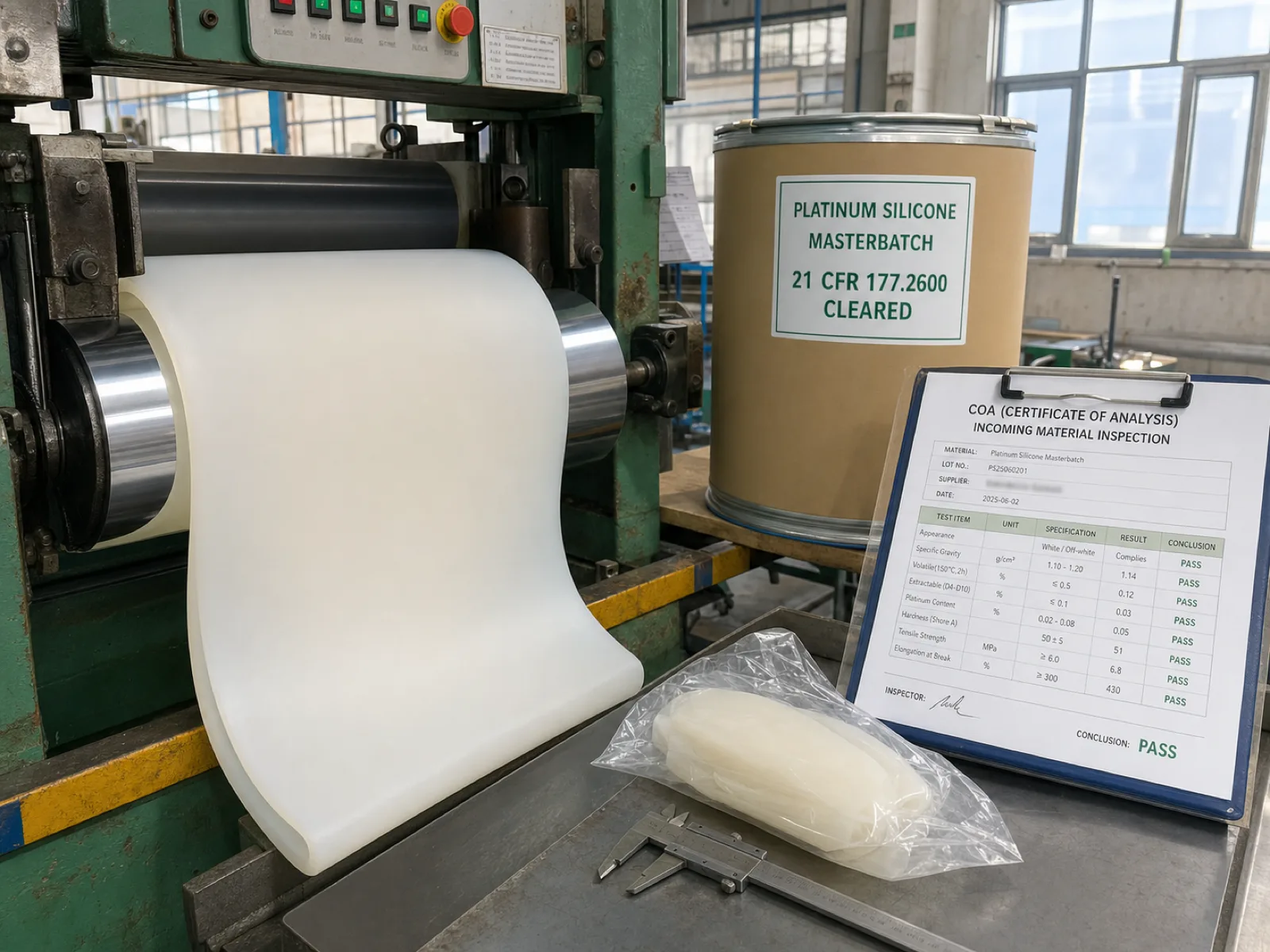
For lab-grade verification Wetop runs two tests on incoming silicone masterbatch and on a random per-lot finished-goods sample:
- TGA (Thermogravimetric Analysis) — heats the sample at 10 °C/min under nitrogen. Pure PDMS silicone shows a single sharp decomposition step around 480-520 °C with residual ash under 3% (Pt catalyst plus reinforcing silica). Filler-adulterated stock shows a second decomposition around 700-800 °C from calcium carbonate breakdown, and residual ash over 15%. That is a hard reject.
- FTIR (Fourier-Transform Infrared Spectroscopy) — pure silicone shows Si-O-Si asymmetric stretching at 1000-1100 cm⁻¹, Si-CH₃ symmetric bending at 1260 cm⁻¹, and CH₃ stretching at 2960 cm⁻¹. Filler adulteration adds a strong C-O stretch around 1420 cm⁻¹ (calcium carbonate) or a broadening of the Si-O peak (silica filler).
Neither method is exotic — an ISO 17025 lab in Guangzhou charges ~$60 per sample for the combined trace. Wetop runs the trace monthly on incoming masterbatch as a supplier hygiene check.
What is the 8-document retail compliance stack a sourcing manager will audit?
A Tier-2 US home-improvement chain will ask for eight documents before qualifying a silicone utensil: FDA 21 CFR 177.2600 CoC, LFGB §30/31 test report, California Prop 65 letter, TSCA §5 statement, REACH SVHC declaration, French Decree 2012-13 conformity, per-batch migration report, and ISO 9001:2015 audit certificate. Anything less signals a non-audit-ready supplier.
The stack looks like paperwork, but each document guards against a specific failure mode. Here is the exhaustive list Wetop maintains for every silicone utensil program:
| # | Document | Guards against | Source |
|---|---|---|---|
| 1 | FDA 21 CFR 177.2600 Certificate of Compliance | Non-compliant polymer chemistry or additives | Third-party lab per FDA method[^fda-177-2600] |
| 2 | LFGB §30/31 test report | Peroxide-cure residue, filler adulteration, skipped post-cure | Fresenius, Eurofins, SGS, or TÜV lab report[^bfr-xv-silicones] |
| 3 | California Prop 65 letter | Cadmium, lead-chromate pigments, phthalate contamination | Manufacturer declaration referencing test data[^prop-65-list] |
| 4 | TSCA §5 statement | US-restricted substances (PFAS, PCB residuals) | Manufacturer declaration cross-checked against TSCA inventory |
| 5 | REACH SVHC declaration | EU-restricted substances (SVHC candidate list, 235+ substances) | Manufacturer declaration referencing ECHA current list[^echa-reach] |
| 6 | French Decree 2012-13 conformity | Peroxide value > 0.5%, post-cure volatiles > 0.5% | Third-party lab report per Decree method[^decree-2012-13] |
| 7 | Per-batch migration report | Cure escape on a specific production batch | Wetop QC lab (LFGB spot test on 1 unit per 5,000) |
| 8 | ISO 9001:2015 audit certificate | Uncontrolled process drift, missing batch traceability | Registrar (SGS, Bureau Veritas, TÜV Rheinland)[^iso-9001] |
The stack is what separates a factory qualified for a Tier-2 retail chain from an Alibaba trading company. A trading company can produce documents 1, 3, 4, and 5 on demand — those are declarations. It cannot produce documents 2, 6, 7, or 8, because those require a real factory, a real QC lab, a real registrar audit, and a real per-batch traceability system.
Wetop maintains all eight documents pre-signed and pre-tested on every SKU we manufacture. A quotation packet includes them by default; a buyer does not have to ask. That is the operational meaning of “OEM-ready” in Wetop’s marketing.
Are colored, printed, and embossed silicone utensils safe?
Colored and printed silicone utensils are safe when the pigment masterbatch uses FDA-listed inorganic pigments (iron oxides, titanium dioxide, ultramarine blue) or organic pigments cleared under 21 CFR 178.3297 at loadings under 3%. Embossed logos are inherently safe because they are polymer displacement, not surface application[^fda-cfsan-inventory].
The safety risk on colored silicone utensils lives in the masterbatch, not in the base silicone. Cheap grey-market masterbatch may use cadmium-selenide red (banned in the EU under REACH SVHC), lead-chromate yellow (Prop 65), or azo dyes that decompose under repeated 200 °C exposure. The utensil clears an FDA test on day 1 and fails a home consumer’s dishwasher trial on day 100 because the pigment migrates.
The counter-move at compounding is a masterbatch COA that names the pigment by CAS number and cross-references it against the FDA CFSAN Food Contact Substance inventory or the 21 CFR 178.3297 positive list. Wetop’s default masterbatch supplier ships COAs; grey-market suppliers ship “food safe” claims without CAS numbers. Reject anything in the second category.
Printing on silicone utensils — pad printing for logos, laser marking for lot codes — is safe when the ink is a silicone-based system cleared under the same 21 CFR 177.2600 framework. Solvent-based printing inks are not; they will leach at cook temperature. Debossing (in-mold displacement of the polymer to create a raised or recessed logo) has zero migration risk because there is no added chemistry — it is the safest customization pathway for a silicone utensil program and the one Wetop pushes first when a brand wants “premium feel” branding.
What are the field failure modes that signal an unsafe silicone utensil?
Six field failure modes signal safety concerns: yellow-brown discoloration after oven use (peroxide-cure residue), surface tackiness after dishwasher cycling (under-cured stock), tearing at flex points under 300 cycles (filler adulteration), persistent chemical odor (skipped post-cure), color migration onto light-colored food (masterbatch failure), and shape distortion above 200 °C (thermal degradation from over-rated stock).
The failure-mode map is what a sourcing manager uses to triage returns and to decide whether a supplier is worth requalifying. Every mode maps back to a specific factory-floor decision:
- Yellow-brown discoloration after 100-500 oven cycles → peroxide-cure stock without adequate post-cure. Root cause: 2,4-dichlorobenzoic acid oxidation over repeated heat cycles. Fix at supplier: switch to platinum-cure or extend post-cure to 200 °C × 6 h.
- Surface tackiness after 50-100 dishwasher cycles → under-crosslinked polymer network. Root cause: cure oven ran cold or the platinum catalyst was diluted. Fix at supplier: recalibrate cure oven, verify catalyst dose per batch.
- Edge tearing at flex points under 300 cycles → filler adulteration cutting tear strength. Root cause: calcium carbonate at 10-20% loading. Fix at supplier: reject to virgin platinum silicone, verify via TGA.
- Chemical odor on first unboxing that persists after 3-5 washes → residual siloxanes not driven off. Root cause: post-cure skipped or cycle too short. Fix at supplier: enforce 200 °C × 4 h forced-air cycle with per-batch log.
- Color migration onto light-colored food (pasta, dough) after routine use → pigment migration from masterbatch. Root cause: non-food-grade pigment or excess loading. Fix at supplier: switch masterbatch supplier, verify CAS numbers against FDA CFSAN inventory[^fda-cfsan-inventory].
- Shape distortion at 200 °C oven use → utensil over-rated for temperature; base stock was actually 200 °C-rated peroxide silicone marketed as 230 °C. Fix at supplier: verify base polymer TGA trace and stop over-labeling.
Field returns above 0.5% on any of these modes are a supplier requalification trigger. Field returns above 2% are a program-kill signal for a Tier-2 retail chain.
Sourcing checklist — what to ask a silicone utensil factory
Ask five questions and require documented answers: (1) is the base polymer platinum-cured or peroxide-cured, (2) what is the post-cure cycle by time and temperature, (3) which lab issues the LFGB §30/31 report and how often is it renewed, (4) does incoming silicone masterbatch have a supplier COA with TGA/FTIR trace, and (5) does every finished-goods batch ship with a per-lot COA linking cure log to shipment.
The five-question filter is what Wetop’s own sales engineers walk buyers through when a new program starts. A supplier who can answer four of five with documentation may still be a candidate — the fifth answer is negotiable. A supplier who can answer three or fewer with documentation is not audit-ready. Move on.
Two more filter questions that catch trading companies posing as factories:
- Show me the post-cure oven. A factory has a forced-air convection oven the size of a shipping container on the floor. A trading company has photos.
- Show me the last 30 days of batch cure logs. A factory has a folder with signed logs. A trading company has an offer to “have them ready for the audit.”
Every claim in this guide traces to a factory-floor operation Wetop runs continuously across three product families (silicone drying racks, drying mats, sink grids) and the utensil OEM programs those platforms support. If you are qualifying a supplier for a silicone utensil program and want to walk the 8-document compliance stack against a real factory rather than a marketing deck, talk to the engineering desk. We will send the current CoCs, the LFGB reports, and a Loom video of the post-cure oven running the current batch before we quote a single unit.
Related engineering guides
FAQ
-
Are silicone utensils safe at high temperatures like 450°F oven use?
Yes, but only platinum-cured food-grade silicone rated to 230 °C (446 °F) continuous. Above that the polymer starts thermal degradation, releasing volatile methylsiloxanes. Wetop rates spatulas and turners at 230 °C max, cleared under 21 CFR 177.2600 with LFGB §30/31 test reports on file. Reject any utensil labeled beyond 260 °C — it is either misrated or filler-adulterated peroxide-cure stock that will discolor and off-gas.
-
Do silicone utensils leach chemicals into food?
Peer-reviewed migration studies (Swiss BAG 2005, followed by EU Commission Regulation 10/2011 SML monitoring) show properly cured platinum silicone releases well under the 60 mg/kg total-migration limit into fatty and aqueous simulants. Peroxide-cured silicone without a 200 °C × 4 h post-cure can release residual D4/D5/D6 cyclic siloxanes — which is why the post-cure cycle is the single most important safety step at the factory, not a spec-sheet formality.
-
How can you tell if silicone utensils are food grade?
Three checks. First: ask for the 21 CFR 177.2600 Certificate of Compliance and LFGB §30/31 test report by batch — not by product family. Second: twist and pinch the handle 180°; a white bloom means calcium-carbonate or silica filler diluting virgin silicone, which will fail LFGB. Third: request the TGA and FTIR polymer purity trace. Compliant food-grade silicone shows a single decomposition peak around 500 °C and clean Si-O-Si peaks around 1000-1100 cm⁻¹.
-
What is the difference between platinum-cured and peroxide-cured silicone in utensils?
Cure system determines residue chemistry. Platinum-cured silicone uses a Karstedt Pt catalyst; the reaction is a hydrosilylation with no organic byproducts — safe for utensils above 200 °C. Peroxide-cured silicone uses 2,4-dichlorobenzoyl peroxide, which decomposes into 2,4-dichlorobenzoic acid that can migrate into food. Peroxide stock is 20-30% cheaper but fails LFGB volatiles testing unless heavily post-cured. Reject peroxide-cure for any utensil rated over 200 °C.
-
Do silicone spatulas contain BPA, PFAS, or plastic fillers?
Virgin food-grade silicone is a silicon-oxygen polymer — no BPA and no PFAS in the base chemistry. The risk is fillers added to cut cost: calcium carbonate, silica, or (in the worst grey-market stock) plastic pellets. A properly compounded Wetop utensil declares zero PFAS per the 2024 EU restriction and clears TSCA §5 for the US market. The twist-and-pinch bloom test plus a supplier FTIR trace catches filler adulteration before shipment.
-
Are silicone utensils safe for the dishwasher, microwave, and freezer?
Yes across all three. Platinum-cured food-grade silicone at Shore A 50-70 has a -40 °C to 230 °C continuous operating window, so freezer (-18 °C typical) and microwave heating (well under 200 °C in most cook cycles) are inside spec. Dishwasher cycles top out around 75 °C. Repeated cycling does not cross-link or degrade the polymer if the compound was properly post-cured 4 h at 200 °C at the factory.
-
How do I verify a silicone utensil supplier's safety claims for retail listing?
Request the full 8-document compliance stack: FDA 21 CFR 177.2600 Certificate of Compliance, LFGB §30/31 test report from a Fresenius or Eurofins lab, California Prop 65 warning statement, TSCA §5 declaration, REACH SVHC statement, French Decree 2012-13 conformity, batch migration report, and factory ISO 9001:2015 audit certificate. If any is verbal or 'available on request but not now,' the supplier is not audit-ready — walk away.
-
What are the safety red flags on a silicone kitchen utensil at a factory audit?
Six visible red flags. One: no post-cure oven on the floor. Two: no metal detector on the finished-goods line. Three: peroxide stock stored next to platinum stock without segregation. Four: no per-batch COA linking cure log to shipment. Five: incoming silicone masterbatch without a supplier COA. Six: LFGB reports issued by unnamed labs rather than Fresenius, Eurofins, SGS, or TÜV. Any two together disqualify the factory from a Tier-2 retail program.
-
Does French Decree 2012-13 apply to silicone utensils sold outside France?
It applies whenever the utensil is placed on the French market, and by extension in any harmonized-import EU program. Decree 2012-13 restricts total peroxide value (max 0.5%) and volatile content (max 0.5% after 4 h at 200 °C) in silicone kitchenware. A well-run compliance pack includes it even for US-only programs, because retail chains with European buying arms (Ahold Delhaize, Lidl-Kaufland, Costco EU) request it during qualification.
-
Are colored silicone utensils safe or does the pigment leach?
Colored utensils are safe when the masterbatch uses FDA-listed inorganic pigments (iron oxides for red-brown, titanium dioxide for white, ultramarine blue) at ≤ 3% loading, or FDA-listed organic pigments cleared under 21 CFR 178.3297. Cheap grey-market masterbatch may use cadmium, lead-chromate, or azo dyes that fail Prop 65 and REACH. Request the masterbatch COA and confirm the pigment CAS numbers appear on FDA's positive list before approving a color.
References
Authoritative sources cited in this guide
- US Food and Drug Administration (Electronic Code of Federal Regulations). 21 CFR 177.2600 — Rubber Articles Intended for Repeated Use. https://www.ecfr.gov/current/title-21/chapter-I/subchapter-B/part-177/subpart-C/section-177.2600 — The primary US regulation for silicone kitchen utensils — sets n-hexane and ethanol extractables limits (max 20 mg/in² first extraction, 1 mg/in² successive extractions at 7 h reflux).
- European Commission. Commission Regulation (EU) No 10/2011 on plastic materials and articles intended to come into contact with food. https://eur-lex.europa.eu/homepage.html — Sets the EU 60 mg/kg overall migration limit and specific migration limits (SML) that a silicone utensil must clear when sold into the EU market.
- German Federal Institute for Risk Assessment (BfR). BfR Recommendation XV — Silicones. https://www.bfr.bund.de/en/bfr_recommendations_on_food_contact_materials-7498.html — The German recommendation LFGB §30/31 test methods reference — defines the peroxide-value and volatiles-content caps that separate compliant food-grade silicone from filler-adulterated stock.
- European Chemicals Agency (ECHA). REACH — Registration, Evaluation, Authorisation and Restriction of Chemicals — Substances of Very High Concern list. https://eur-lex.europa.eu/legal-content/EN/TXT/?uri=CELEX%3A32006R1907 — The SVHC candidate list a silicone utensil declaration must screen against before EU retail listing.
- US Food and Drug Administration. Food Ingredients & Packaging — Food Contact Substances (FCS). https://www.fda.gov/food/food-ingredients-packaging — FDA's food-contact substances program and inventory access point — used to confirm a silicone additive or pigment is cleared for repeated food contact.
- International Organization for Standardization. ISO 9001:2015 — Quality Management Systems — Requirements. https://www.iso.org/standard/62085.html — The QMS framework that binds batch traceability, post-cure logs, and metal-detection records into an auditable paper trail.
- ASTM International. ASTM D2240 — Standard Test Method for Rubber Property — Durometer Hardness. https://www.astm.org/d2240-15r21.html — The Shore A durometer method Wetop uses at incoming and post-cure QC to verify Shore A 50-70 spec on food-grade silicone utensils.
- California Office of Environmental Health Hazard Assessment (OEHHA). Proposition 65 List of Chemicals Known to the State of California to Cause Cancer or Reproductive Toxicity. https://oehha.ca.gov/proposition-65/proposition-65-list — The California regulated-substance list a silicone utensil declaration must screen against before US retail listing.
- Food Additives & Contaminants: Part A (PubMed). Migration of cyclic and linear siloxanes from silicone baking moulds into simulated foodstuffs. https://pubmed.ncbi.nlm.nih.gov/22029433/ — Peer-reviewed migration study confirming that a proper 200 °C post-cure reduces D4/D5/D6 siloxane migration below detection limits.
- French Republic — Legifrance. French Decree No. 2012-13 of 4 January 2012 on materials in contact with foodstuffs made of silicone elastomers. https://www.legifrance.gouv.fr/loda/id/JORFTEXT000025105084/ — The French-market peroxide-value (≤ 0.5%) and post-cure volatiles (≤ 0.5%) caps that harmonized EU retail buyers request as part of the compliance stack.
Start a custom program
Send a brief. Get an engineer’s reply in one business day.
Every Wetop program is tooled from a customer’s specification. Send a CAD file (STEP · IGES · DWG) or a written brief and we’ll reply with a mold cost estimate, price brackets at MOQ 500 / 1,000 / 5,000, and any engineering questions.