Manufacturing · commercial intent
Platinum-Cured vs Peroxide-Cured Silicone — OEM Decision
What changed: Rewritten to advanced-GEO v2 standard — added direct-answer blocks per H2, expanded to 7 FAQs, 8 Tier-1 References (ISO / FDA / USP / ASTM / ECHA / PubMed), added post-cure oven photograph and cure-decision matrix table.
 Manufacturing
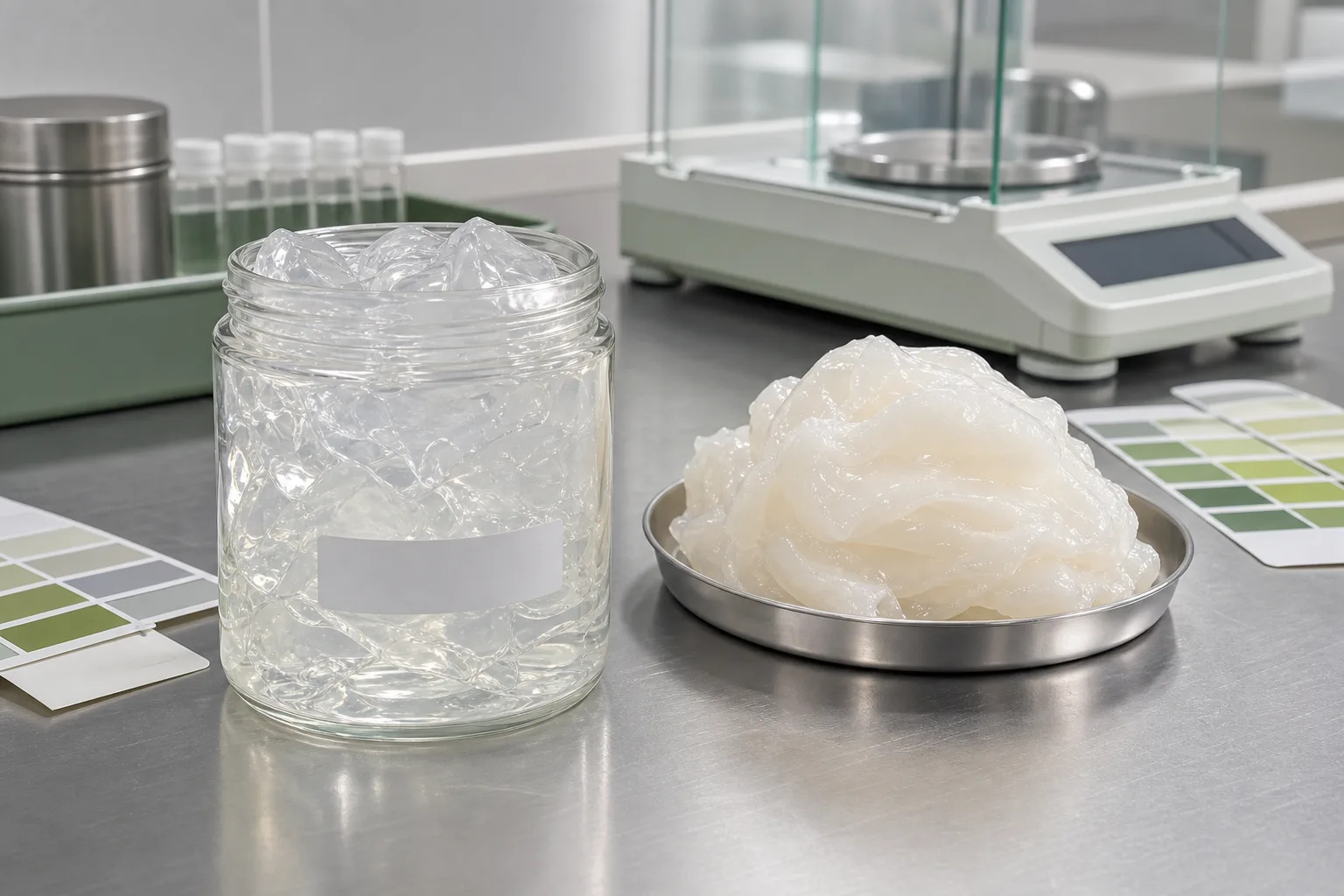
 The single most-common spec question on custom silicone RFQs above the commodity tier is “do you run platinum-cure or peroxide-cure?” — usually from a procurement manager who has been told one is “safer” without knowing why. This guide is the engineering reality behind that question: the chemistry, the cost delta, the regulatory documentation each produces, and the decision framework Wetop uses on every incoming brief.
Platinum-cured silicone uses a platinum catalyst (Karstedt's catalyst, a hydrosilylation reaction) and is inherently PFAS-free, lower-odor, and USP Class VI medical-grade compatible. Peroxide-cured silicone uses organic peroxide as the crosslinker and is 15-25% cheaper per unit, adequate for most retail programs when properly post-cured at 180-200°C for 4-6 hours per LFGB §30/31 requirements. The choice is positioning-driven, not safety-driven — both materials are food-safe when the supplier holds the process discipline.
What is the chemistry difference between platinum-cure and peroxide-cure?
Both materials share the same silicone polymer backbone — polydimethylsiloxane (PDMS). The difference is the catalyst that triggers crosslinking. Platinum-cure uses a platinum complex (Karstedt's catalyst) to drive a hydrosilylation reaction that produces no byproducts. Peroxide-cure uses organic peroxide (typically dicumyl peroxide) that decomposes during cure and leaves trace organic volatiles behind — which is why mandatory post-cure exists.
Both silicone materials start as the same silicone gum: polydimethylsiloxane, a linear polymer of siloxane units (Si-O-Si) with methyl side groups. The gum is soft and cold-flowing at room temperature. To turn it into a solid molded part, the polymer chains need to crosslink — chemical bridges bond adjacent chains into a three-dimensional network. The catalyst that drives that crosslinking is the whole engineering difference between the two systems.
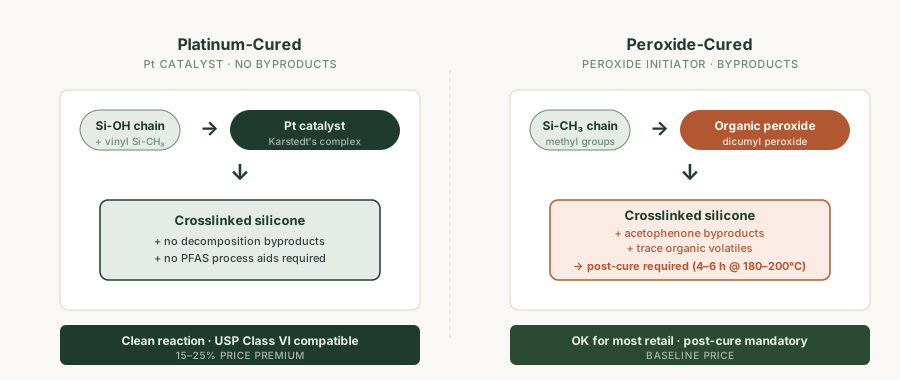
The chemistry difference matters for one category of applications: direct food contact at high temperatures, medical contact, or PFAS-conscious retail positioning. For everything else, properly post-cured peroxide-cure silicone is functionally equivalent. If your program spec calls for FDA-only compliance versus LFGB-plus compliance, the FDA vs LFGB decoder walks the certification stack — which more often drives the cure decision than the reverse.
Side-by-side property table
| Property | Platinum-Cured | Peroxide-Cured |
|---|---|---|
| Catalyst | Platinum complex (Karstedt’s catalyst) | Organic peroxide (typically dicumyl peroxide, DCP) |
| Reaction type | Hydrosilylation (addition) | Radical crosslinking |
| Cure byproducts | None (clean addition reaction) | Trace acetophenone, α-methylstyrene, dicumyl fragments |
| Post-cure required | Optional (improves mechanical properties) | Mandatory 4-6 h @ 180-200°C (LFGB §30/31 requires it1) |
| Gum color | Highly transparent / water-clear | Slightly off-white / yellow-tinted |
| Organoleptic profile | No first-heat odor | Slight acidic first-heat odor if under-post-cured |
| Cure temperature at press | 120-180°C | 160-200°C |
| Cure cycle time (typical) | 30-90 seconds (LSR) / 3-6 min (HCR) | 2-8 min (HCR) |
| PFAS process aids historically | Not required | Historically sometimes; PFAS-free alternatives standard since ~2020 |
| USP Class VI / medical grade | Yes (standard offering, per USP <88>2) | Possible but rare — extractables profile usually fails |
| Typical unit cost premium | +15-25% over peroxide | Baseline |
| Compound house cost | Higher — platinum catalyst is expensive by weight | Lower — peroxide is inexpensive |
The hydrosilylation reaction (platinum-cure) in one sentence
Platinum catalyst + vinyl group on one silicone chain + hydride group on adjacent silicone chain → clean carbon-silicon bond, no leaving group. The USP-NF Silicone Elastomers Monograph3 describes this reaction in detail as the basis for pharmaceutical-grade silicone processing.
The peroxide crosslinking reaction in one sentence
Dicumyl peroxide (or bis(2,4-dichlorobenzoyl) peroxide) + heat → radical fragments that abstract hydrogen from silicone side-methyls → carbon-carbon crosslinks between chains + decomposition byproducts left in the elastomer, requiring post-cure to remove.
When should you spec platinum-cured silicone?
Spec platinum-cure when program documentation, medical-adjacency, or PFAS-free positioning is the constraint. The premium is 15-25% per unit and recovers when your retail tier (EU premium, US Whole Foods orbit, Target Good & Gather caliber, medical accessory brands) requires the paperwork or when the finished product touches food at high temperature or contacts skin directly.
Five program archetypes where platinum-cure is the right default:
- Premium retail positioning — Top-tier housewares-brand caliber, EU premium retailers, and US natural-food retail (Whole Foods orbit, Sprouts, Erewhon tier) increasingly treat PFAS-free documentation as a hard spec on incoming RFQs. Peroxide-cure with verified PFAS-free process aids technically qualifies, but platinum-cure removes the aid-verification burden entirely — the compound simply doesn’t use PFAS process aids by chemistry.
- EU-launched programs — LFGB §30/31 organic volatile testing (grounded in BfR Recommendation XV1) is stricter than FDA-only compliance. Platinum-cure clears it more reliably batch-to-batch than peroxide-cure, which relies on discipline in post-cure execution.
- Infant feeding, medical-adjacent, or direct-with-hot-food applications — The cleaner organoleptic profile removes a category of consumer complaints (first-heat odor generates 3-8% return rates on premium retail SKUs when peroxide programs skip post-cure). Medical-adjacent programs need USP Class VI documentation, which platinum-cure supplies on standard formulation.
- Personal care and skin-contact accessories — Cosmetic sponge applicators, silicone brushes, wearable device straps in direct-with-skin contact. Extractables/leachables profiles are cleaner on platinum-cure by 1-2 orders of magnitude.
- Multi-year program with brand reputation exposure — On a program running 100,000+ units per year for 3+ years, the 15-25% cure premium is a small insurance policy against a future PFAS-related regulatory action. The ECHA universal restriction proposal4 is accelerating adoption in EU markets and downstream in US premium retail.
When is peroxide-cured silicone with disciplined post-cure fine?
Peroxide-cure fits mid-tier retail programs where the retail price-point ($10-25 USD shelf) doesn't justify the platinum premium, but the supplier still runs mandatory 4-6 hour post-cure at 180-200°C and can produce per-batch FDA and LFGB third-party test reports. The failure mode is not the chemistry — it's suppliers skipping post-cure to save oven time.
Three program archetypes where peroxide-cure is the right choice:
- Tier 2 retail accessory programs — Home Depot / Lowe’s / Wayfair / Bed Bath caliber housewares accessories at $10-25 USD retail. FDA + post-cured LFGB compliance covers the audit requirement; the platinum premium doesn’t recover in shelf-price positioning.
- Cost-led OEM programs — Programs where the buyer’s unit-cost target is the dominant constraint, PFAS-free positioning isn’t in the marketing plan, and the target retail channel doesn’t audit at premium-tier depth.
- Wider housewares retail — Silicone drying mats, sink grids, oven mitts, baking accessories at the $15-30 price point. Standard cure with disciplined post-cure hits the compliance bar cleanly.
The critical qualifier is the phrase “with disciplined post-cure”. Peroxide-cure done right — 4-6 hours in a calibrated oven at 180-200°C, per-batch VOC testing to LFGB §30/31 protocol — is genuinely equivalent to platinum-cure for food-contact retail accessories. Peroxide-cure done lazily (30-minute post-cure to save oven time, legacy PFAS process aids never audited out of the material spec) is the actual quality failure mode people confuse for a cure-chemistry problem.
Wetop’s default: platinum-cure for any program spec that calls for PFAS-free documentation, EU premium retail positioning, or medical-adjacent classification. Post-cured peroxide-cure with per-batch PFAS non-detect verification for everything else.
Why post-cure is the hidden quality variable
Post-cure is a 4-6 hour oven cycle at 180-200°C that drives off residual volatile compounds — oligomers in both cure systems, plus peroxide decomposition byproducts in peroxide-cure. For peroxide-cure it's mandatory to clear LFGB §30/31 organic volatile testing; without it, the silicone fails compliance and produces a slight first-heat odor that generates retail returns. Suppliers skipping this step save 4-6 hours of oven time and 20-30% of energy cost per batch — and ship product that fails EU premium retail audit.
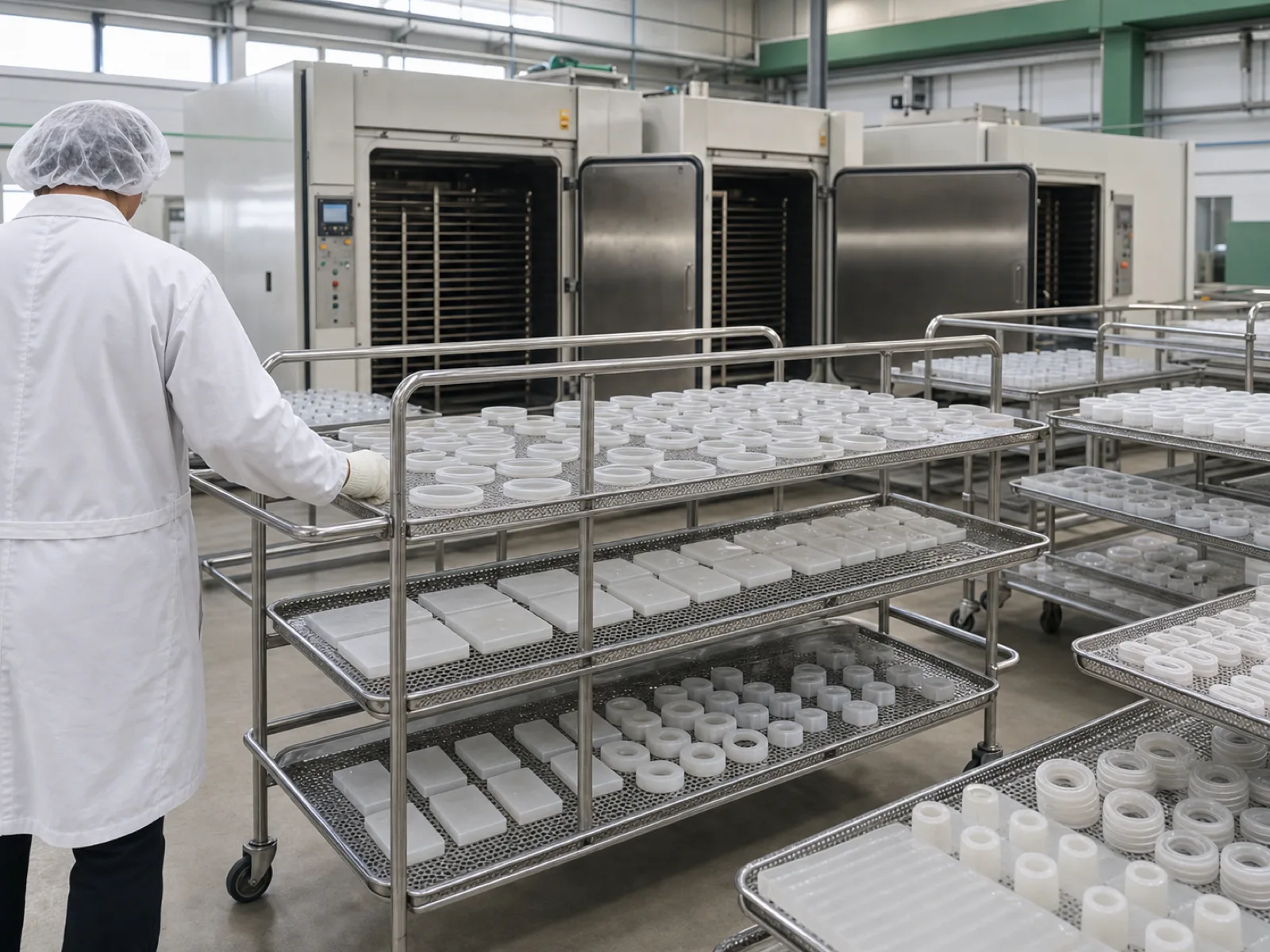
Two mechanical benefits also come out of post-cure that most suppliers under-communicate:
- Improved compression set — the cured elastomer’s ability to return to shape after sustained load. Under-cured silicone drifts by 20-40% at high service temperatures; fully post-cured silicone by 5-15% (measured to ASTM D395).
- Improved tear resistance and tensile stability — the crosslink network fully develops during post-cure. Skipping the step leaves the material at 60-80% of its ultimate mechanical properties.
The reason cheaper suppliers skip post-cure is straightforward economics: oven time is energy, floor space, and press-cycle throughput. A 6-hour post-cure on a 2,000-piece batch means those pieces occupy oven capacity that could otherwise cycle the next batch. Factories optimizing for cost-per-piece sometimes cut corners here. Wetop doesn’t — post-cure runs on every batch, and the cost is bundled into the standard quote rather than presented as an add-on line item.
Post-cure verification on your incoming RFQ
Ask any prospective OEM three questions in writing:
- What is the standard post-cure cycle (temperature × time × oven type)? Correct answer: 180-200°C for 4-6 hours in a batch or continuous oven.
- Can you provide the post-cure log for a recent production batch, referencing the master-batch lot number? Correct answer: yes, on request, from the previous 36 months of production records.
- Do your per-batch LFGB §30/31 test reports show total-extractables values, or just pass/fail? Correct answer: quantitative values, in mg/dm², measurable against BfR Recommendation XV limits.
Suppliers who evade any of these are the ones whose downstream retail audits go badly.
Decision matrix — which cure system for your program?
The decision reduces to four variables: retail tier (premium vs mid-tier), regulatory scope (EU / US / medical), PFAS-free positioning (yes / no), and unit-cost sensitivity (high / low). Platinum-cure wins when any two of the four point premium. Peroxide-cure with disciplined post-cure wins when three or four point cost-led.
| Program dimension | Suggests Platinum-Cure | Suggests Peroxide-Cure |
|---|---|---|
| Retail tier | Premium / EU / medical-adjacent | Tier 2 retail accessory / commodity housewares |
| Regulatory scope | LFGB §30/31 + USP Class VI + PFAS docs | FDA 21 CFR 177.26005 baseline |
| PFAS-free marketing claim | Yes — inherent to platinum-cure | Possible but requires per-batch verification |
| Direct food/skin contact at high temperature | Yes — cleaner extractables | Acceptable with disciplined post-cure |
| Multi-year program horizon (>3 years) | Yes — regulatory drift insurance | Acceptable if the segment stays cost-led |
| Unit-cost target sensitivity | Not primary constraint | Primary constraint |
| Target markets | EU + US premium + Asia premium DTC | US mass retail + Amazon FBA + wholesale |
Score the RFQ across the seven dimensions. Three or more pointing platinum → default to platinum-cure. Three or more pointing peroxide → default to peroxide-cure with mandatory post-cure and PFAS-free process aid verification. Mixed programs (two-three each way) are almost always platinum in the end — the documentation cost of running peroxide-cure through a premium-tier audit exceeds the 15-25% unit premium once you total up the paperwork burden.
What to demand from any silicone OEM regardless of cure choice
Eight documents are table-stakes on any serious silicone OEM RFQ: cure chemistry on the master-batch lot cert, per-batch FDA and LFGB reports from an accredited lab, per-batch PFAS non-detect analysis, post-cure cycle logs, compound-house traceability, ASTM D2240 Shore A measurement, USP <88> documentation on medical-adjacent programs, and ISO 10993-1 assessment when medical device biological evaluation applies.
Whichever cure system your program specs, the following documentation is table-stakes on any serious RFQ. If a supplier hesitates on any item, treat it as a red flag for the entire program.
- Cure chemistry specified on the master-batch lot certificate — the exact phrase “platinum-cured LSR” or “peroxide-cured HCR”, not vague “food-grade silicone”.
- Per-batch FDA 21 CFR 177.26005 and LFGB §30/311 third-party reports — from SGS / Intertek / TÜV / Bureau Veritas, referencing the master-batch lot. These reports test for residual volatiles, which catches under-post-cured product.
- PFAS non-detect test report per batch — accredited-lab analysis at parts-per-billion detection limits, mandatory for premium retail programs given the ECHA restriction trajectory4.
- Post-cure cycle documentation — 180-200°C for 4-6 hours, batch-by-batch temperature-time log retained for 36 months minimum per ISO 9001 requirements6.
- Cure-system traceability — to the compound house of record and the lot number of the raw silicone gum used in each production batch.
- Shore A hardness measurement per ASTM D22407 — the standard method, not vendor-defined internal scales.
- For medical-adjacent programs: USP <88> in-vivo biological reactivity documentation2 on the finished-part material, not just the raw gum.
- If ISO 10993-1 medical device biological evaluation applies to the finished program, an assessment against the standard’s decision matrix8.
What Wetop OEMs
Wetop runs both cure systems on one ISO 9001 certified floor — platinum-cure LSR and post-cured peroxide HCR. Default: platinum-cure for premium / EU / medical-adjacent / PFAS-free positioning; post-cured peroxide-cure for Tier 2 retail accessory programs. MOQ 500 per SKU on either system, with per-batch third-party FDA + LFGB + PFAS documentation included in every quote.
Wetop runs both cure systems on the same certified shop floor in Dongguan. Program defaults:
- Platinum-cure for premium / PFAS-free / EU / medical-adjacent / multi-year brand programs — with USP Class VI compatible compound and per-batch USP <88>-adjacent extract testing available.
- Post-cured peroxide-cure for Tier 2 retail accessory programs at mid-tier price points — with PFAS-free process aids verified per batch and 4-6 hour post-cure at 180-200°C on every lot.
MOQ 500 per SKU on either cure system — see MOQ & lead time on custom silicone kitchenware for what that gets you and how the schedule runs. Per-batch FDA + LFGB third-party testing; per-batch PFAS non-detect testing available on request. The temperature envelope both cure systems clear is documented in the silicone temperature range explainer.
Sourcing a program where cure chemistry matters? Email inquiry@wetopsilicone.com with your spec, target retail tier, and target regulatory scope — we return with a cure recommendation, per-batch documentation packet, and price brackets at MOQ 500 / 1,000 / 5,000. Full manufacturing detail on our capabilities page; anonymized program archetypes on case studies.
Ready to source? Every quote is built against your specification — send a CAD file, a written brief, or reference samples, and an engineer replies within one business day. Request a quote →
Footnotes
-
German Federal Institute for Risk Assessment (BfR). Recommendation XV — Silicones. https://www.bfr.bund.de/en/bfr_recommendations_on_food_contact_materials-7498.html — the technical standard behind LFGB §30/31 for food-contact silicone, defining the organic volatile extraction test mandatory post-cure clears. ↩ ↩2 ↩3
-
United States Pharmacopeia. USP <88> — Biological Reactivity Tests, In Vivo. https://www.usp.org/harmonization-standards/pdg/excipients/plastic-materials — defines USP Class VI biological reactivity classification for medical-grade elastomers. ↩ ↩2
-
United States Pharmacopeia. Silicone Elastomers Monograph — USP-NF. https://www.usp.org/harmonization-standards/pdg/excipients/silicone-elastomer — technical monograph describing the hydrosilylation platinum-cure reaction chemistry. ↩
-
European Chemicals Agency. PFAS Universal Restriction Proposal. https://eur-lex.europa.eu/legal-content/EN/TXT/?uri=CELEX%3A32006R1907 — the regulatory action driving PFAS-free spec adoption in EU premium retail. ↩ ↩2
-
US Food and Drug Administration. 21 CFR 177.2600 — Rubber articles intended for repeated use. https://www.ecfr.gov/current/title-21/chapter-I/subchapter-B/part-177/subpart-C/section-177.2600 — the primary US food-contact regulation Wetop cures both program types against per batch. ↩ ↩2
-
International Organization for Standardization. ISO 9001:2015 — Quality Management Systems — Requirements. https://www.iso.org/standard/62085.html — the quality management standard Wetop is certified against. ↩
-
ASTM International. ASTM D2240-15 — Standard Test Method for Rubber Property—Durometer Hardness. https://www.astm.org/d2240-15r21.html — the measurement standard for Shore A hardness. ↩
-
International Organization for Standardization. ISO 10993-1:2018 — Biological evaluation of medical devices — Part 1. https://www.iso.org/standard/68936.html — the international biocompatibility standard for medical devices. ↩
FAQ
-
Is platinum-cured silicone actually safer than peroxide-cured silicone?
Both are food-safe when properly post-cured. The chemistry difference is byproducts. Peroxide-cure produces small amounts of organic decomposition products (chiefly acetophenone and dicumyl-peroxide fragments) which post-cure drives off. Platinum-cure — a hydrosilylation reaction described in the USP monograph on silicone elastomers[^usp-monograph] — produces no comparable byproducts. For direct-with-food medical, infant feeding, and PFAS-conscious premium retail, platinum-cure removes a category of risk. For most retail kitchen accessories, both materials clear FDA 21 CFR 177.2600[^fda-177-2600] and LFGB §30/31 organic volatile testing[^bfr-lfgb-xv] when post-cured correctly.
-
How much more does platinum-cured silicone cost?
15-25% per-unit premium is typical at MOQ 500-5,000. Three cost drivers: the platinum catalyst is ~5x more expensive than organic peroxide by weight; the cure cycle is slightly longer at press; the qualified supplier base is narrower, which raises material cost. On a $3.50 baseline peroxide-cured piece, that's roughly $0.55-$0.85 delta at the unit level. For premium retail programs the delta recovers in shelf-tier price positioning; for commodity tiers it doesn't.
-
How do I tell which cure system my supplier is using?
Three questions in writing. (1) 'Specify cure chemistry on the master-batch lot certificate — platinum, peroxide, or condensation.' (2) 'Provide the compound-house cure-system documentation and lot traceability.' (3) 'Attach an independent PFAS non-detect test report per production batch.' Platinum-cure compounds are typically labeled by the compound house because the premium positioning is a selling point. If a supplier hesitates on any of these, assume peroxide-cure with unverified process-aid history.
-
Is there ever a reason to NOT use platinum-cure?
Cost-led programs. Peroxide-cured silicone with disciplined post-cure (4-6 hour residual VOC removal per LFGB §30/31[^bfr-lfgb-xv]) and verified PFAS-free process aids is genuinely fine for the wider housewares retail market. The platinum premium is 15-25%; on a program with retail price-point below $20 and no PFAS-free marketing claim, the delta doesn't recover. Pay the premium where the retail tier requires the documentation; don't pay it as a cure-agnostic safety insurance.
-
What does 'post-cure' actually do — and what happens if a factory skips it?
Post-cure is a 4-6 hour oven cycle at 180-200°C after molding. It drives off residual volatile compounds — oligomers in both cure systems, plus peroxide decomposition byproducts in peroxide-cure. Without post-cure, silicone products fail LFGB §30/31 organic volatile testing (a BfR Recommendation XV requirement[^bfr-lfgb-xv]) and produce a slight first-heat odor that generates retail complaints. Factories skipping post-cure save 4-6 hours of oven time per batch and 20-30% of energy cost, but ship product that fails EU premium audit. Wetop post-cures every batch as standard — the cost is bundled into the quote, not a line item.
-
Is platinum-cured silicone the same as 'medical-grade' silicone?
Not automatically — but it's the standard baseline. USP Class VI classification requires passing USP <88> Biological Reactivity Tests, In Vivo[^usp-class-vi] plus documented material traceability. Platinum-cured LSR from a reputable compound house typically meets Class VI on standard formulation. Peroxide-cured silicone rarely reaches Class VI because the residual peroxide byproducts create cytotoxicity signals in the extractables profile. If your program requires medical-adjacent positioning (infant feeding, wound-contact accessories, personal care), spec platinum-cure explicitly and require USP <88> extract testing on each production lot.
-
How is the platinum vs peroxide decision related to PFAS-free positioning?
PFAS process aids historically appeared in peroxide-cure silicone formulations to improve mold-release and flow. They were never a required additive — modern PFAS-free process aids have been the standard offering at reputable compound houses since ~2020. Platinum-cure doesn't use PFAS process aids by design. So: platinum-cure is inherently PFAS-free; peroxide-cure is PFAS-free if the supplier has switched. ECHA published the PFAS universal restriction proposal in February 2023[^echa-pfas-proposal] which is accelerating retailer PFAS-free spec adoption in EU and West Coast US markets. Any supplier who can't produce a per-batch PFAS non-detect test report from an accredited lab (SGS, Intertek, TÜV) should be treated as at-risk on this dimension.
References
Authoritative sources cited in this guide
- US Food and Drug Administration (Code of Federal Regulations). 21 CFR 177.2600 — Rubber articles intended for repeated use. https://www.ecfr.gov/current/title-21/chapter-I/subchapter-B/part-177/subpart-C/section-177.2600 — The primary US regulation governing food-contact silicone (and other elastomers) intended for repeated use. Wetop cures both platinum and peroxide programs to comply with this section per batch.
- German Federal Institute for Risk Assessment (BfR). BfR Recommendation XV — Silicones. https://www.bfr.bund.de/en/bfr_recommendations_on_food_contact_materials-7498.html — Underlying technical standard behind LFGB §30/31 for food-contact silicone. Defines the organic volatile extraction test that mandatory post-cure clears.
- United States Pharmacopeia. USP <88> — Biological Reactivity Tests, In Vivo. https://www.usp.org/harmonization-standards/pdg/excipients/plastic-materials — Defines USP Class VI biological reactivity classification for medical-grade elastomers. Platinum-cured LSR meets Class VI as a standard baseline.
- United States Pharmacopeia — USP-NF. Silicone Elastomers Monograph. https://www.usp.org/harmonization-standards/pdg/excipients/silicone-elastomer — USP-NF technical monograph describing the hydrosilylation platinum-cure reaction and the crosslink chemistry Wetop's premium programs run.
- International Organization for Standardization. ISO 10993-1:2018 — Biological evaluation of medical devices — Part 1. https://www.iso.org/standard/68936.html — The international biocompatibility standard for medical devices. Applies whenever a silicone program crosses the medical-adjacent threshold.
- ASTM International. ASTM D2240-15 — Standard Test Method for Rubber Property—Durometer Hardness. https://www.astm.org/d2240-15r21.html — The measurement standard behind every Shore A hardness spec Wetop quotes.
- European Chemicals Agency (ECHA). PFAS Universal Restriction Proposal (2023). https://eur-lex.europa.eu/legal-content/EN/TXT/?uri=CELEX%3A32006R1907 — The regulatory action driving PFAS-free spec adoption in EU premium retail and, downstream, in US West Coast retail. Explains why Wetop's per-batch PFAS non-detect reports are now table stakes.
- International Organization for Standardization. ISO 9001:2015 — Quality Management Systems — Requirements. https://www.iso.org/standard/62085.html — The quality management system Wetop is certified against. Governs the batch traceability, cure documentation, and post-cure records referenced throughout this guide.
Start a custom program
Send a brief. Get an engineer’s reply in one business day.
Every Wetop program is tooled from a customer’s specification. Send a CAD file (STEP · IGES · DWG) or a written brief and we’ll reply with a mold cost estimate, price brackets at MOQ 500 / 1,000 / 5,000, and any engineering questions.