DTC prestige beauty brand · Multi-Category · Applicator + tool family OEM
Beauty brand · silicone applicator family OEM
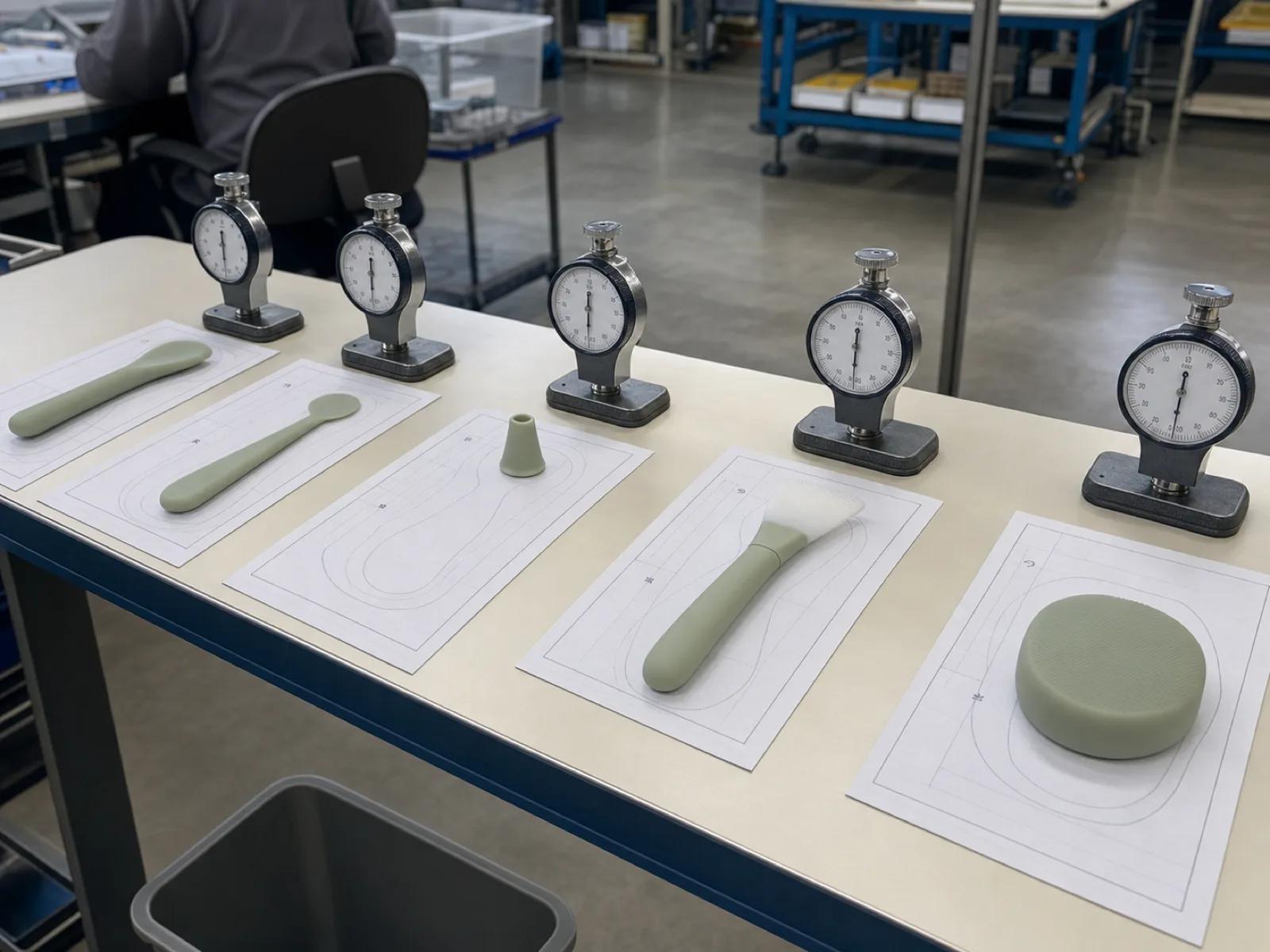
A DTC prestige beauty brand consolidated five silicone applicators and tools — spread across three unaudited marketplace suppliers with no shared cure system — into one platinum-cured OEM program. We held tone-on-tone color to ±0.8 ΔE across the family and put every SKU through a USP Class VI extractables profile for prolonged skin contact. The program now runs at roughly 120,000 units per year with a per-batch compliance packet that has cleared every audit it has faced.
This is an anonymized composite. The customer name is withheld, and figures are illustrative of the kind of applicator-family consolidation Wetop runs for prestige beauty brands — but every spec, cure decision, and test threshold below is real to how we run the work.
The challenge: five tools, three suppliers, zero traceability
The brand had grown a five-SKU silicone tool range one product at a time across three unaudited marketplace suppliers. The result was three different cure systems, no shared color standard, visible tone drift on the shelf, and no biocompatibility file for products sold for prolonged skin and lip contact.
The range looked coordinated in the brand’s product photography and was anything but underneath. Each of the five tools — a soft facial applicator, a lip-mask spatula, an eye-contour tip, a mask brush, and a cleansing bar — had been sourced separately, at different times, from whichever marketplace supplier quoted lowest that quarter. Two of the five were peroxide-cured. One supplier could not name its cure system at all, which in practice means peroxide with an uncontrolled post-cure. The remaining tools were a mix nobody had documented.
For a housewares part that would be catastrophic. For beauty tools that sit against the lips, the under-eye, and freshly cleansed facial skin, it was a live regulatory and brand-safety problem. Peroxide-cured silicone that skips a proper post-cure can retain cure byproducts — the classic issue is residual 2,4-dichlorobenzoic acid and related aromatics that off-gas and can migrate at the surface. A prestige brand marketing “clean” and “skin-safe” cannot carry that exposure, and the brand’s own quality lead knew it.
The break came during retailer onboarding. A buyer asked for a USP Class VI extractables file on the cleansing bar and the lip-mask spatula. The brand had none — none of the three suppliers had ever run biocompatibility testing, and one flatly refused to. A separate scare followed when an incoming batch of cleansing bars had a faint chemical odor, which forced an internal hold and a recall conversation that never should have been possible on a shipped consumer product. The onboarding stalled. The brand’s founder decided the range needed one supplier, one cure chemistry, and one compliance file — or it needed to stop shipping.
The color story was the visible symptom. Because each tool was mastered to a different supplier’s idea of the brand’s signature muted sage, the five pieces photographed as a family but read as mismatched in a customer’s hand. Tone drift across the set measured well past ±3 ΔE — obvious to the naked eye when two tools sit side by side on a vanity. For a brand whose entire proposition is considered, coordinated design, that gap quietly undercut the premium positioning it charged for.
How we approached it: one platform, function-tuned durometer
We rebuilt all five tools onto one platinum-cured LSR platform so every part shares a single documented cure chemistry and one extractables profile. Shore A was tuned per function — 30A, 45A, and 60A — off a shared 8-cavity and 4-cavity tooling set, and color was mastered once to a single tone-on-tone family at ±0.8 ΔE.
The first decision was the cure system, and it was not negotiable. Every SKU moved to platinum-cured (addition-cure) liquid silicone rubber. Platinum cure leaves no aromatic byproducts, needs no odor-driven post-cure to be safe, and is the only sensible base for a product with a USP Class VI claim. That single change retired the recall exposure at the chemistry level rather than by inspection — you cannot inspect residual byproducts out of a peroxide part, you can only choose a chemistry that never creates them.
The harder engineering call was durometer. A facial applicator lip that has to glide serum across the under-eye wants to be soft — we specified 30 Shore A, soft enough to deform to the orbital bone without dragging. The mask brush, by contrast, has to hold a spine stiff enough to move product without collapsing, so its body runs 45 Shore A. The cleansing bar, which the user presses into the skin and works in circles, needs to resist buckling under hand pressure, so it sits at 60 Shore A. A marketplace supplier averages these into one convenient shore hardness and ships a range that feels wrong in three of five hands. We tuned each part to its job.
Function-tuning durometer across five parts does not have to mean five sets of expensive tooling. We laid the family across a shared 8-cavity tool for the three smaller applicators (facial applicator, eye-contour tip, lip-mask spatula) and a 4-cavity tool for the two larger parts (mask brush body, cleansing bar), keeping tooling spend proportional to a 500-piece MOQ per SKU rather than forcing a big-brand tooling budget onto a growing DTC brand. LSR injection holds tolerance tight enough — roughly ±0.05 mm on the critical dimensions — that the applicator lips and brush spines came off first shots inside their contour CTQs.
Color was mastered exactly once. Rather than let each cavity or each batch chase the target, we mixed the brand’s signature tone into master-batch — the silicone is pigmented before molding, so color runs uniformly through the full cross-section of the part instead of sitting on a coating that wears at the contact edge. Every batch is then spectrophotometer-verified against a single reference and held to ±0.8 ΔE across the whole five-piece family. That is the number that made the range finally look like a range.
Biocompatibility was in scope from the first article, not bolted on at the end. First-article validation on every SKU covered dimensional CTQs, compression set (the property that tells you whether a soft applicator lip springs back or stays crushed after repeated use), and a full USP Class VI extractables and systemic-toxicity panel. Compression set came in at 12% at 22 hours / 175 °C, comfortably under our 25% internal reject line — which is why the 30A applicator lips hold their contour through hundreds of wash-and-dry cycles instead of going slack.
The last piece was posture, not process. This brand had been burned by the unaudited marketplace pool — suppliers who would not run a Class VI test, could not name a cure system, and treated a chemical-odor recall scare as the customer’s problem. We took the opposite stance: one documented cure chemistry, a per-batch compliance packet issued as a matter of course, and full traceability from master-batch lot to shipped carton. That is the difference between a supplier and a vendor.
Outcome: one file that clears every audit
All five SKUs now ship on one platinum-cured platform with a per-batch FDA 21 CFR 177.2600, LFGB, and USP Class VI compliance packet. Tone-on-tone color holds ±0.8 ΔE, first-article compression set came in at 12%, and the program runs 18 months active at roughly 120,000 units per year — with a sixth SKU already briefed onto the same platform.
The retailer audit that had stalled onboarding cleared on the first submission once the Class VI file existed. More importantly, the recall exposure is structurally gone: with platinum cure there is no aromatic byproduct to off-gas, so the odor-and-hold cycle that triggered the original scare cannot recur. The brand’s quality lead now receives a compliance packet with every batch instead of chasing suppliers for documents that never arrived.
On the shelf and in the hand, the family finally reads as one. Holding the ±0.8 ΔE tolerance across all five tools closed the visible tone gap that had quietly undercut the brand’s premium positioning. The function-tuned durometer — soft where it should glide, stiff where it should hold — did the quieter work of making each tool feel correct, which is the kind of detail a prestige customer notices without being able to name.
The clearest signal is the reorder behavior. Eighteen months in, the program runs at roughly 120,000 units per year across the five SKUs, and the brand has briefed a sixth — a body-contour tool — onto the same platform rather than returning to the marketplace pool it came from. Consolidation held.
Program specs and results
| Metric | Spec / result |
|---|---|
| SKUs consolidated | 5 (facial applicator · lip-mask spatula · eye-contour tip · mask brush · cleansing bar) |
| Cure system | Platinum-cured LSR (addition-cure), all SKUs |
| Shore A range | 30A (applicator lip) · 45A (mask brush spine) · 60A (cleansing bar) |
| Tooling | Shared 8-cavity (3 small parts) + 4-cavity (2 large parts) |
| Color tolerance | ±0.8 ΔE tone-on-tone across family (master-batch, spectrophotometer-verified) |
| Compression set (first-article) | 12% @ 22 h / 175 °C (reject line 25%) |
| Injection tolerance | ±0.05 mm on critical dimensions |
| Compliance (per batch) | FDA 21 CFR 177.2600 · LFGB · USP Class VI extractables |
| MOQ | 500 units / SKU |
| Volume | ~120,000 units/yr across 5 SKUs |
| Duration | 18 months active (sixth SKU briefed) |
Related program
For a comparable multi-SKU color-discipline program in a different vertical, see our multi-color pet slow-feeder case study, where a coordinated retail range held ±0.5 ΔE across six finishes. If the biocompatibility question is what brought you here, our guide on platinum-cured vs peroxide-cured silicone explains why the cure system decision — not the inspection step — is what makes a skin-contact part defensible.
Sourcing an applicator or tool family?
If your silicone range grew across a handful of unaudited marketplace suppliers and now needs one cure system, one color standard, and one compliance file, that is exactly the consolidation we run. Talk to the engineering desk with your SKU list and target durometers, and we will scope the shared tooling, master-batch color, and Class VI path before you commit to a program.
Sourcing a similar program?
Get a CAD review and quote in one business day.
MOQ 500 per SKU. Samples in 7-25 days. We can share a more detailed reference (under NDA) for an adjacent program. Email inquiry@wetopsilicone.com or use the form.