Industrial sealing distributor · Silicone Industrial Parts · Multi-SKU gasket stocking program
Sealing distributor · gasket program OEM
Why this program is worth writing up
This is the OEM case where a distributor stopped buying silicone gaskets by the anonymous marketplace listing and started buying them by the ASTM D2000 line callout. The consolidation win was not one hero part — it was pulling 40 scattered low-volume SKUs onto a single audited four-durometer platform, with per-lot durometer and compression-set certification, at a 500-piece MOQ that let a broad catalog stay economically stockable. The 18-month record (480 PPM, ±2 Shore A lot-to-lot, incoming rejections from 6% to under 0.5%) is the metric a distributor's quality manager takes to their own MRO and regional-OEM customers to defend the supplier switch.
The customer is not named here — the program runs under a standard private-label anonymization agreement for industrial sealing distribution. What matters for other distributor and industrial-procurement readers is the shape of the decisions: how a catalog of unglamorous 40 / 50 / 60 / 70 Shore A gaskets and dampers gets put on a defensible spec basis. Nothing here is a competitive claim against any specific compounder or extruder; the tier reference exists so peers recognize the audit posture and the unit-economics envelope.
The challenge: 40 SKUs, no traceable spec, and marketplace durometer drift
The distributor's core problem was traceability. Their 40 gasket and damper SKUs came from a rotating set of unaudited marketplace molders who shipped no compound COA, no ASTM D2000 line callout, and durometer that wandered ±8 Shore A lot to lot. Their own customers — MRO buyers and regional equipment OEMs — were rejecting incoming lots on hardness and color inconsistency, and the distributor had no cert to defend the parts with.
A silicone gasket without a durometer guarantee is a liability sitting on a shelf. When a Shore A 50 nominal seal arrives at 44 on one lot and 58 on the next, the softer lot cold-flows and leaks, the harder lot won’t seat and cracks the mating flange — and the distributor eats the return either way. The marketplace-sourcing model gave them no lever to fix it: no single molder owned the catalog, no compound was locked, and no lot shipped a document anyone could audit. The distributor’s quality manager described the incoming-inspection queue as “a full-time job rejecting things we already paid for.”
The second constraint was economic. These are low-to-mid-volume SKUs — a few thousand pieces a year each, many far less. Every marketplace quote carried a 5,000-piece-per-SKU floor because broker-model molders buy press hours by the hour and need volume to absorb color-match and cure set-up cost. A 5,000-piece floor on a SKU that sells 800 a year is dead inventory. The distributor needed a real factory whose MOQ math let a broad catalog stay stockable.
How we approached it: a four-durometer color-coded platform
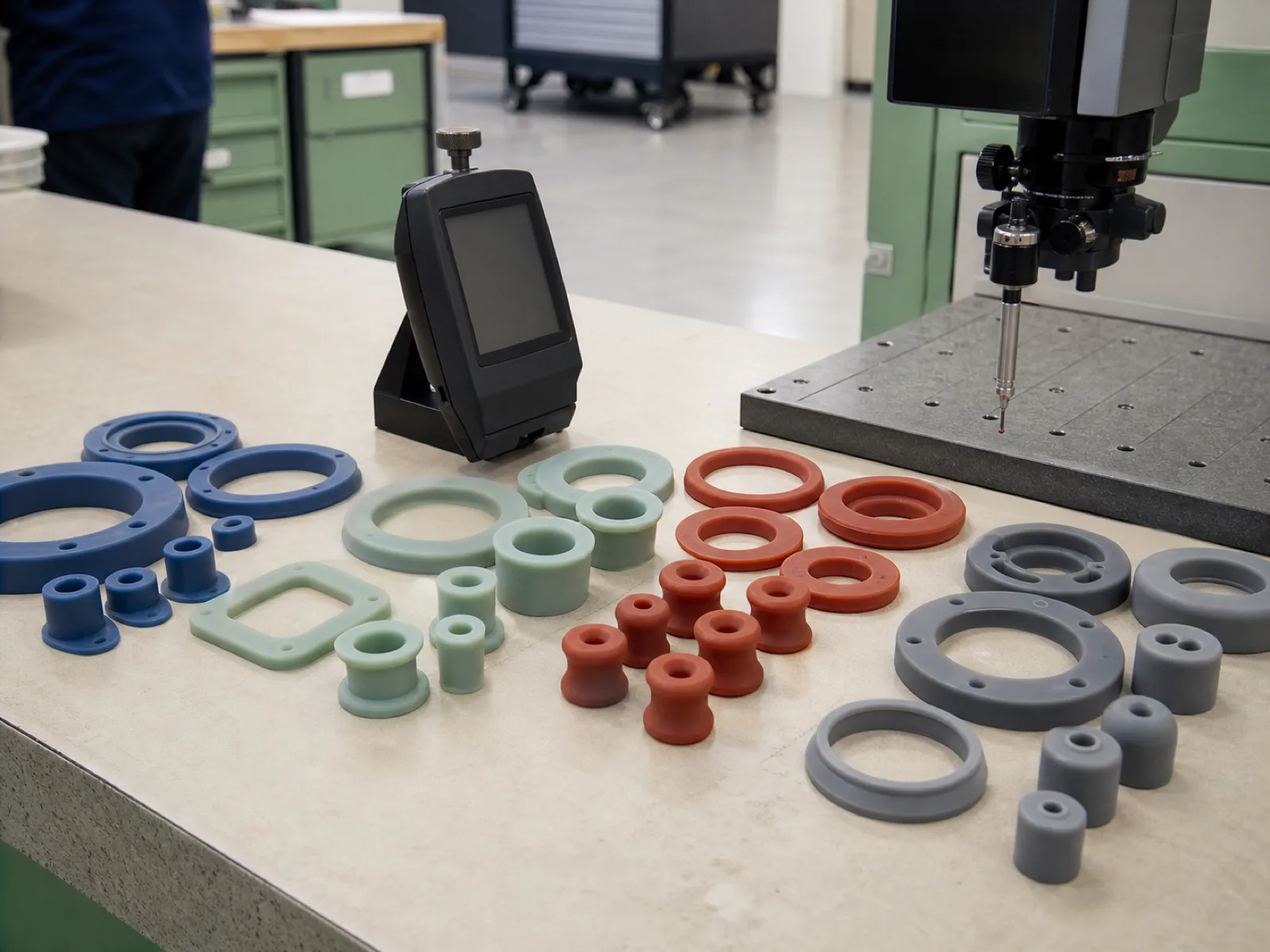
We rebuilt the catalog on one platform: four platinum-cured VMQ grades at Shore A 40, 50, 60, and 70, each assigned a fixed master-batch color — grey, terracotta, sage, and charcoal — held to ±1.0 ΔE. Color-coding durometer at the pigment stage means a warehouse picker verifies hardness by sight, not just by reading a bag label, which removes an entire class of mis-pick and mis-ship error that had plagued the marketplace catalog.
The platform decision was the whole program. Instead of 40 independent one-off compounds, every SKU maps to one of four locked base compounds, so IQC, cure profile, and QC references collapse from 40 unknowns to four known systems. Color goes in as master-batch — the silicone gum is pigmented before molding, not surface-coated — so the durometer-to-color mapping is molecularly uniform through the part and survives abrasion in service. Holding each grade to ±1.0 ΔE against a reference chip means the sage 60 from January and the sage 60 from a lot ten months later read as the same part on the shelf.
Every SKU got a first-article qualification before it released to stocking: a CMM dimensional layout on the critical seal cross-section, a capability study (Cpk ≥ 1.33 gate) on the sealing dimension, and a full property panel — durometer per ASTM D22401, compression set per ASTM D3952 Method B, and tensile/elongation per ASTM D4123 — mapped onto an ASTM D20004 line callout so each SKU now carries an industry-standard material spec string a customer engineer can drop straight into a drawing.
The scrapped-and-restarted lot
The food-grade translucent Shore A 50 SKU nearly shipped out of spec. The first pilot lot came off the press measuring 27% compression set after 22 hours at 175 °C — outside the program's <25% gate — a sign of incomplete network cure and residual low-molecular-weight cyclics. We scrapped the entire lot before a single part left the building and re-ran it with an extended four-hour post-cure at 200 °C.
The restart held 19–21% compression set and cleared FDA 21 CFR 177.26005 on the extractables profile for the food-contact-adjacent application. Scrapping a qualified-looking lot over a compression-set number that a marketplace molder would have shipped without measuring is exactly the discipline the distributor was paying to buy. The post-cure step is the difference between a gasket that holds sealing force after a year of thermal cycling and one that takes a permanent set and leaks — and it is the first corner an unaudited vendor cuts to free up oven throughput.
Outcome: 480 PPM, ±2 Shore A, and a compliance packet on every PO
Across 18 months and all 40 SKUs, the program holds a 480 PPM blended defect rate, ships a per-lot durometer + compression-set + ASTM D2000 COA on every shipment, and issues a ROHS / REACH-SVHC / FDA 21 CFR 177.2600 compliance packet with each PO. Lot-to-lot durometer variation dropped from ±8 Shore A to ±2, and the distributor's own incoming-inspection rejection rate fell from roughly 6% to under 0.5%.
The consolidation also fixed the inventory math. MOQ 500 pcs/SKU with tooling amortized across the program — rather than recovered against a single order — let the distributor stock the full 40-SKU catalog without carrying 5,000-piece dead lots. Sampling runs 10 days on existing platform tooling; production runs 25–30 days FOB Yantian. The program now replenishes on blanket-PO call-off against an 8-week rolling forecast, with a 3-week safety buffer held at the Wetop finished-goods area in Dongguan and monthly container consolidation out of Yantian Port.
The trust signal is the follow-on. Eighteen months in, the distributor moved a second family onto the same platform — food-grade tri-clamp sanitary gaskets in the translucent 50 and 60 grades — and asked us to quote a line of grommets and bumper feet in the same durometer-coded system. Program expansion after a clean incoming-rejection record is the buyer-side proof that the audited-platform discipline, not a per-unit price concession, was the differentiator.
Program specs and 18-month results
| Metric | Marketplace baseline (before) | Wetop program (18 months) |
|---|---|---|
| Catalog | 40 SKUs across rotating vendors | 40 SKUs, one audited platform |
| Durometer grades | Nominal only, no guarantee | Shore A 40 / 50 / 60 / 70, color-coded |
| Lot-to-lot durometer | ±8 Shore A | ±2 Shore A |
| Color tolerance | Uncontrolled, batch shift | ±1.0 ΔE per grade (master-batch) |
| Compression set (22 h/175 °C, ASTM D395 B) | Not measured | 19–22%, <25% gate |
| Material spec | None | Per-SKU ASTM D2000 line callout |
| Per-lot certification | None | Durometer + comp-set + D2000 COA |
| Compliance packet | Ad hoc / none | ROHS + REACH-SVHC + FDA 177.2600 per PO |
| Incoming rejection (distributor side) | ~6% | <0.5% |
| Blended defect rate | Untracked | 480 PPM |
| MOQ | 5,000 pcs/SKU floor | 500 pcs/SKU |
| Cure system | Mixed / unknown | Platinum-cured VMQ |
| Replenishment | Spot POs | Blanket-PO call-off, 8-wk forecast |
Frequently asked
Q: Why color-code durometer instead of just labeling the bags? A: Bag labels get swapped, torn, and mis-read; a picker under time pressure grabs the wrong hardness and the error surfaces at the customer’s assembly line. Pigmenting each Shore A grade at the master-batch stage — grey 40, terracotta 50, sage 60, charcoal 70, each held to ±1.0 ΔE — makes durometer visible in the part itself. It is a poka-yoke built into the material, not the packaging.
Q: Is 500 pieces per SKU really workable for a 40-SKU gasket catalog? A: Yes, because the 40 SKUs sit on four locked base compounds, so cure set-up and QC references are shared across the catalog rather than re-established per SKU. Tooling amortizes across the program instead of against a single order. A broker-model marketplace molder needs a 5,000-piece floor per SKU to cover color-match and set-up on unshared compounds — which is why they can’t stock a broad, low-volume catalog economically.
Q: What is an ASTM D2000 line callout and why does it matter to a distributor? A: ASTM D2000 is the standard classification system for rubber materials — a coded string that specifies the polymer type, durometer, and required property grades (heat resistance, compression set, oil resistance, and so on). Putting each SKU on a D2000 callout gives the distributor’s customers a spec string they can drop straight into an engineering drawing, so the part is defined by an industry standard rather than a vendor’s marketing sheet.
Q: Why platinum-cured silicone across the whole platform? A: Platinum-cure (addition-cure) produces no organic peroxide decomposition residues, so there is no surface bloom to migrate out over service life and no post-cure de-gassing needed to pass extractables on the food-grade SKUs. It holds durometer stable through the −50 °C to +230 °C VMQ window and clears FDA 21 CFR 177.2600 on the food-contact-adjacent parts. It costs a small premium per kilo over peroxide-cure, but the traceability and lot-consistency it buys is the entire point of the program.
Q: How did the durometer variation drop from ±8 to ±2 Shore A? A: Three levers. First, four locked base compounds instead of whatever a rotating vendor pool had in the mixer that week. Second, IQC durometer, specific gravity, and mill-lot cert on every incoming compound drum before it releases to production. Third, a consistent four-hour 200 °C post-cure on every lot, so network cure completes to the same endpoint each run rather than drifting with oven throughput pressure.
Q: What ships with every purchase order? A: A per-lot COA carrying durometer (ASTM D2240), compression set (ASTM D395 Method B, 22 h/175 °C), and the SKU’s ASTM D2000 line callout, plus a compliance packet — ROHS 2011/65/EU heavy-metal panel, REACH SVHC declaration against the current ECHA candidate list, and FDA 21 CFR 177.2600 attestation on the food-contact-adjacent SKUs. First-article submissions add the CMM dimensional layout and capability study; recurring call-offs reference the qualification report by ID.
Related program
For the reliability-engineering side of silicone sealing at the Fortune-500 OEM tier — cure chemistry, DFM corner geometry, and a 24-month field-return record — see the commercial-HVAC gasket OEM case study. If you are specifying the parts themselves, the high-temperature silicone gasket specs guide walks the durometer, compression-set, and temperature-window decisions this program was built on.
Sourcing something similar?
If you are a distributor or industrial buyer trying to consolidate a scattered gasket catalog onto one audited, per-lot-certified platform — with a workable MOQ instead of a 5,000-piece floor — talk to the engineering desk. Bring your SKU list and current failure modes and we will map the catalog to a durometer platform and an ASTM D2000 spec basis. Contact the engineering desk.
Footnotes
-
ASTM International. ASTM D2240-15 — Standard Test Method for Rubber Property—Durometer Hardness. https://www.astm.org/d2240-15r21.html — the Shore A hardness measurement standard behind the 40 / 50 / 60 / 70 durometer platform and the ±2 lot-to-lot control. ↩
-
ASTM International. ASTM D395-18 — Standard Test Methods for Rubber Property—Compression Set. https://www.astm.org/d0395-18.html — the compression-set method (Method B, 22 h at 175 °C) defining the <25% gate that triggered the scrapped-and-restarted food-grade lot. ↩
-
ASTM International. ASTM D412-16 — Standard Test Methods for Vulcanized Rubber and Thermoplastic Elastomers—Tension. https://www.astm.org/d0412-16r21.html — the tensile-and-elongation method in the per-SKU first-article property panel. ↩
-
ASTM International. ASTM D2000-18 — Standard Classification System for Rubber Products in Automotive Applications. https://www.astm.org/d2000-18.html — the line-callout classification system used to give each gasket SKU a standard, drawing-ready material specification. ↩
-
US Food and Drug Administration. 21 CFR 177.2600 — Rubber articles intended for repeated use. https://www.ecfr.gov/current/title-21/chapter-I/subchapter-B/part-177/subpart-C/section-177.2600 — the US food-contact regulation the food-grade translucent and tri-clamp SKUs are tested against. ↩
Sourcing a similar program?
Get a CAD review and quote in one business day.
MOQ 500 per SKU. Samples in 7-25 days. We can share a more detailed reference (under NDA) for an adjacent program. Email inquiry@wetopsilicone.com or use the form.