Buyer Guide · commercial intent
High Temperature Silicone Gasket: Full Spec Guide
 Buyer Guide
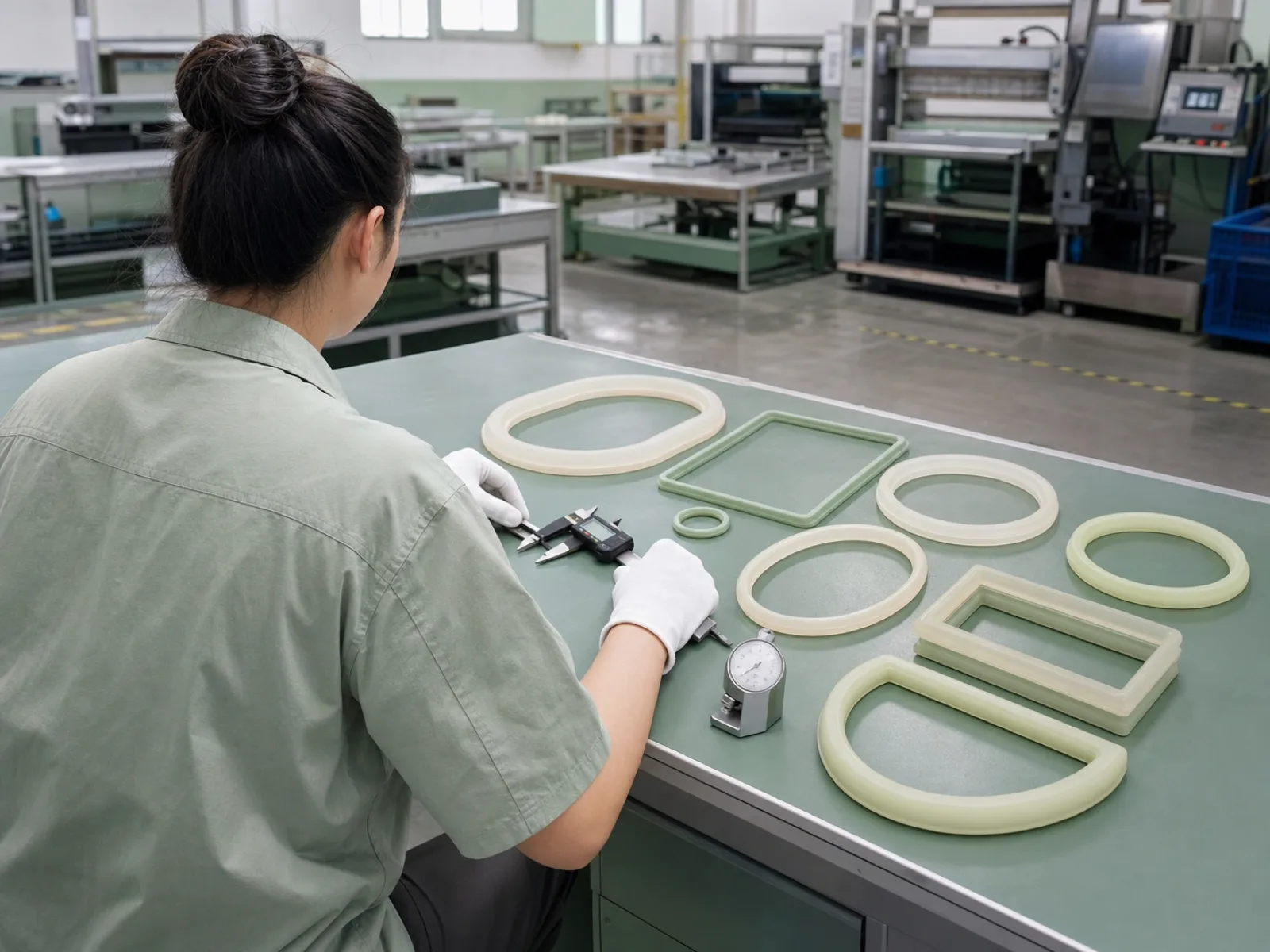
 A high temperature silicone gasket is a platinum-cured or peroxide-cured VMQ elastomer part engineered to seal against continuous service temperatures from -60°C to +230°C, with intermittent spikes tolerable to +315°C. Compression set stays under 25% at 175°C / 22 hr per ASTM D395 Method B when specified at Shore A 60 with a 4-hour post-cure at 200°C. Wetop compression-molds custom high temperature silicone gaskets at MOQ 500 with 35-55 day drawing-to-FAI lead time from a 7,500 m² ISO 9001 factory in Dongguan.
This guide is the engineering-desk reference for buyers specifying a custom high temperature silicone gasket program — durometer selection, compression-set targets, cure-system trade-offs, material selection matrix versus fluorosilicone and FKM, standards-compliance stack, groove design, failure modes, and tooling economics at 500-10,000 unit tiers. Every recommendation carries a specific number, a cert clause, or a process step. Read it before your next RFQ and you will spec a gasket that ships on time and holds pressure across the heat cycle you actually run.
What temperature range does a high temperature silicone gasket actually cover?
A platinum-cured VMQ silicone gasket runs -60°C to +230°C continuous service, with intermittent +260°C excursions safe for one to two hours and +315°C peak spikes safe under 30 minutes per ASTM D573 heat-aging protocols[^astm-d573]. Below -60°C the elastomer glasses out; above the ceiling the siloxane backbone scissions and the gasket takes permanent compression set within a single heat cycle.
The specification that matters is not the marketing headline temperature — it is the continuous service temperature measured against a target compression-set percentage at the end of design life. A silicone gasket that survives 250°C for six hours is not the same part as one that survives 250°C for six months. When you write “high-temp” on the drawing without qualifying continuous versus intermittent, the factory has no way to price or grade the compound correctly.
The table below is the working reference we hand engineering desks when they ask for a first-cut material grade.
| Service window | VMQ silicone continuous | VMQ silicone intermittent (< 30 min) | Fluorosilicone (FVMQ) continuous | FKM / Viton continuous | EPDM continuous |
|---|---|---|---|---|---|
| Minimum | -60°C | -70°C | -55°C | -20°C | -50°C |
| Maximum | +230°C | +315°C | +260°C | +250°C | +150°C |
| Compression set @ high end | 15-25% @ 175°C / 22 hr | 35-45% @ 250°C / 22 hr | 20-30% @ 200°C / 22 hr | 15-25% @ 200°C / 22 hr | 40-55% @ 150°C / 22 hr |
| Typical cost multiplier | 1.0× | 1.0× | 2.0-2.5× | 3-4× | 0.6-0.8× |
The 230°C VMQ continuous ceiling assumes a post-cured platinum-cured stock — see our post-cure discussion below for why the number collapses without it. For a deeper walk through the physics of the elastomer at temperature, see our companion piece on the silicone temperature range explained.
How do I select Shore A durometer for a high temperature silicone gasket?
Shore A 50-60 for static seals on rough or waved flange faces at low bolt torque; Shore A 65-70 for high-torque bolted joints, dynamic sealing, and extrusion-critical geometries. Under Shore A 50 the gasket leaks under torque and takes excessive set; over Shore A 70 it cannot conform to the surface waviness a machined flange actually has (Ra 3.2 μm typical).
Durometer is the single most miscalled parameter on gasket drawings. Buyers copy “70A” from an old drawing without understanding it was chosen for a completely different sealing geometry. The correct approach is to map durometer to sealing pressure and gap-fill requirement, not to whatever the previous supplier delivered.
The rule of thumb we apply in DFM review:
- Shore A 40-50 — cast-flange sealing where the mating face has surface waviness > 100 μm. Rare in modern equipment; specify only when the drawing genuinely calls for it.
- Shore A 50-60 — sheet-metal enclosure gaskets, oven-door seals, appliance vents. Low bolt torque (< 10 N·m per fastener). This is the sweet spot for high temperature silicone gasket sealing on 70%+ of buyer programs.
- Shore A 60-70 — precision-machined bolted flanges, pressure-cooker gaskets, autoclave door seals. Higher torque (10-30 N·m per fastener). Better extrusion resistance under load.
- Shore A 70-80 — dynamic seals, reciprocating shafts, high-cycle-count applications. Rare in a static gasket brief; usually indicates you should be specifying an O-ring instead of a flat gasket (see our silicone O-ring specifying guide).
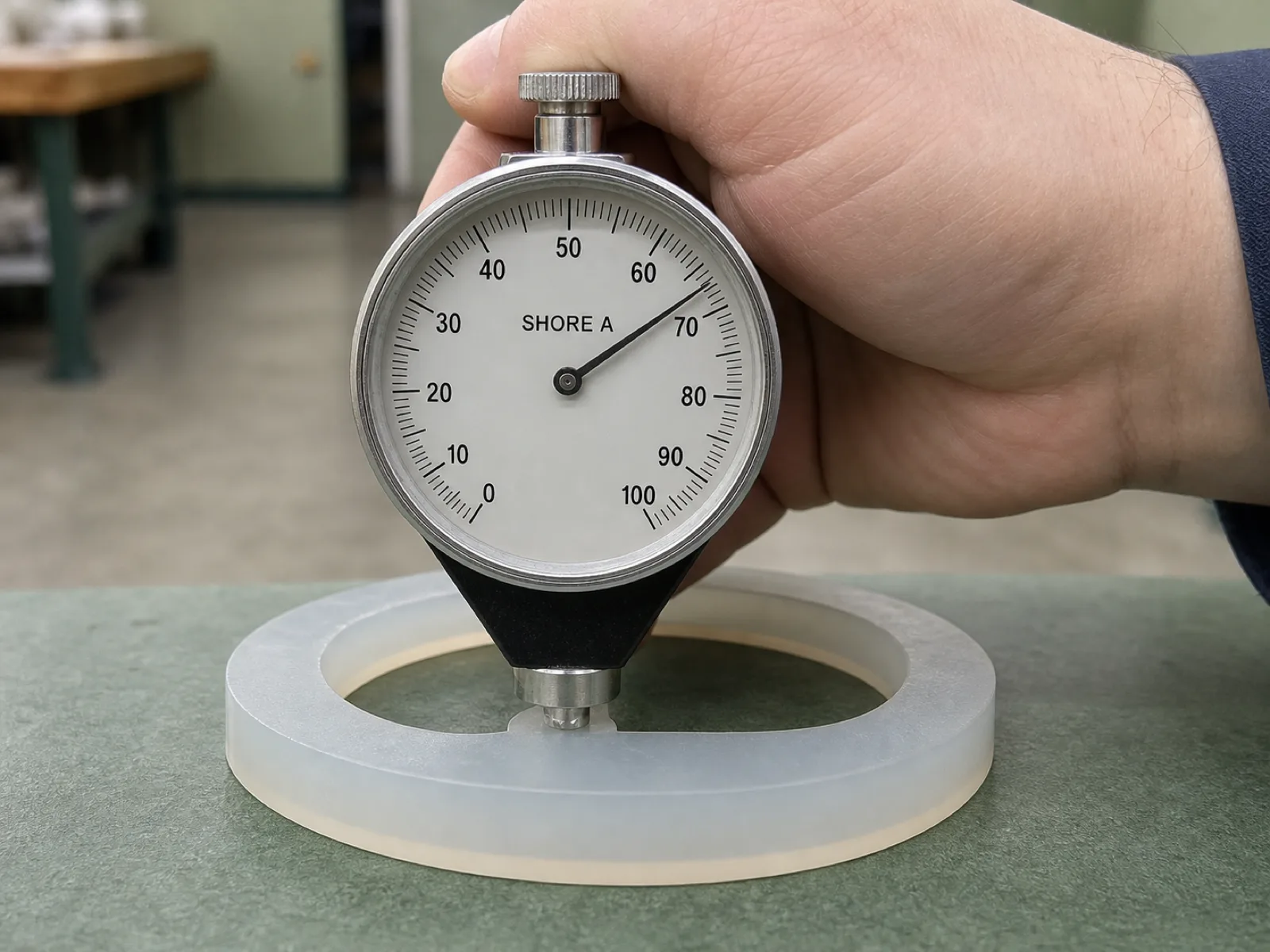
Durometer is measured per ASTM D2240 with a Type A durometer against a 6.4 mm thick sample stack conditioned 30 seconds under the indenter1. On any gasket program we run, the durometer target ships as a ±5 shore-A tolerance band — tighter than that is not achievable in production compression molding at scale.
What compression set percentage should I specify at temperature?
Specify ≤ 25% compression set at 175°C / 22 hr per ASTM D395 Method B for a post-cured platinum silicone at Shore A 60[^astm-d395]. Peroxide-cured or unposted silicone routinely drifts to 35-45% under the same test — enough to lose sealing pressure on any bolted joint within one heat cycle. Every 10°C above 175°C roughly doubles the set-rate slope.
Compression set is the number that predicts whether a gasket will still seal after the first thermal cycle. It measures how much permanent deformation the elastomer takes after 22 hours held at 25% compression at elevated temperature. A gasket with 40% compression set has permanently lost 40% of its rebound — the bolt torque that once compressed it to 25% now compresses it to 15%, and the seal leaks.
The table below is what we cite in our DFM review response to a customer drawing. If your drawing is silent on compression set, we default to the middle column.
| Test condition | Peroxide-cured VMQ (no post-cure) | Platinum-cured VMQ (4 hr / 200°C post-cure) | Fluorosilicone FVMQ (post-cured) |
|---|---|---|---|
| ASTM D395 Method B · 22 hr @ 100°C | 20-30% | 8-15% | 10-18% |
| ASTM D395 Method B · 22 hr @ 175°C | 35-50% | 15-25% | 20-28% |
| ASTM D395 Method B · 22 hr @ 200°C | 50-70% | 25-35% | 25-35% |
| ASTM D395 Method B · 22 hr @ 250°C | not survivable | 40-55% | 30-45% |
Method B (the constant-deflection test) is the sealing-relevant one — Method A (constant-load) is used for cushioning applications and is not comparable. Always cite Method B on the drawing. If the drawing says only “ASTM D395” without the method letter, the factory will guess and you may not like the answer.
Peroxide-cured vs platinum-cured — which cure system for high temp?
Platinum-cured is mandatory for any food-contact (FDA 21 CFR 177.2600[^fda-177-2600]) or medical (USP Class VI[^usp-class-vi]) high temperature silicone gasket. Peroxide-cured is acceptable for industrial-only sealing where cost matters and outgassing is tolerable, but it leaves dichlorobenzoic acid (DCBA) residues that volatilize at temperature and contaminate any sealed fluid. Post-cure removes most peroxide residues; platinum cure leaves none to begin with.
Cure system is the parameter that most directly determines whether the gasket can clear food and medical certification. The engineering difference in one sentence: peroxide catalysts leave decomposition by-products in the finished elastomer that outgas at temperature; platinum catalyst leaves elemental platinum ppm that does not.
For a high temperature silicone gasket application, the practical implications:
- Food-contact, medical, biopharm, cleanroom, aerospace-hydraulic-adjacent → platinum-cured, no exception. FDA 21 CFR 177.2600 clearance requires < 0.5% extractable volatile content, and peroxide-cured stock cannot hit that without an aggressive 8-hour post-cure that voids the cost advantage.
- Industrial-only, ambient-temperature, non-consumable-contact → peroxide-cured with a 4-hour post-cure at 200°C is fine, and lands 15-20% cheaper on material cost per kg.
- Never ship peroxide-cured stock into a food or medical program on the promise “the post-cure will handle it.” Test data varies batch to batch and per-lot certification becomes unreliable.
We wrote a dedicated deep dive on this decision — see platinum-cured vs peroxide-cured silicone for the full cure-chemistry walkthrough.
What certifications and standards apply to high temp silicone gaskets?
The standard high temperature silicone gasket compliance stack is FDA 21 CFR 177.2600 (food-contact), USP Class VI (medical biocompatibility), UL 94 V-0 (flame retardance where required)[^ul-94], ASTM D395 (compression set), ASTM D573 (heat aging), ASTM D2240 (durometer), and MIL-DTL-25988 for aerospace fluorosilicone[^mil-dtl-25988]. Every Wetop batch ships with per-lot certificates against an ISO 9001 quality system[^iso-9001].
Standards compliance is where high temperature silicone gasket programs get expensive if the buyer under-specifies. A drawing that says “food-safe silicone” without citing the clause creates ambiguity that leads to non-conforming material. The clauses your drawing should actually cite:
| Compliance requirement | Clause / standard | What it certifies |
|---|---|---|
| Food contact — US | FDA 21 CFR 177.2600 | Repeated-use rubber articles; extractable limits in water, hexane, ethanol |
| Food contact — EU | LFGB §30/31 · BfR XV | German federal food-safety analogue with per-batch chromatographic testing |
| Medical biocompatibility | USP Class VI | In-vivo systemic toxicity, intracutaneous, and implantation tests |
| Flame retardance | UL 94 V-0 | Self-extinguishing within 10 seconds after ignition source removal |
| O-ring dimensions | ISO 3601 | Standard sizes, tolerances, groove design — the reference for any O-profile gasket |
| Aerospace fluorosilicone | MIL-DTL-25988 | Class 1/2/3 fluorosilicone for oil and fuel resistance |
| Heat aging test | ASTM D573 | Air-oven aging at spec temperature/duration; tensile / elongation retention |
| Compression set | ASTM D395 Method B | Constant-deflection permanent-deformation test |
The quality-system substrate under all of this is ISO 9001:2015 — the framework that makes per-lot certificate traceability defensible in an audit. For the geometry side of O-profile gaskets, ISO 3601 is the reference the drawing should cite for groove dimensions2.
How do groove design and squeeze percentage affect sealing performance?
For a static face seal, target 20-30% squeeze on the gasket cross-section and 70-85% gland fill volume. Under 20% squeeze the seal is torque-sensitive and leaks with any surface waviness; over 30% squeeze the gasket extrudes and takes permanent set within one heat cycle. Groove side-walls angle 5° for compression-molded gasket ease of insertion.
The three parameters that determine whether a gasket seals are cross-section geometry, squeeze percentage, and groove fill. Getting these wrong is the #1 cause of “the material is right but it still leaks” problems on a high temperature silicone gasket program.
Cross-section choice:
- O-profile (round cross-section) — best sealing pressure per unit compression force, tolerates surface waviness up to 50 μm, standard sizes per ISO 3601. Default choice for high-pressure gasket sealing.
- Rectangular (flat gasket) — cheapest to tool, easiest to die-cut from calendered sheet, but requires 2× the bolt torque of an O-profile to achieve equivalent sealing pressure. Standard for low-pressure appliance and enclosure gaskets.
- Custom cross-section (D-profile, X-ring, U-cup, sculpted profiles) — required when a specific bolt pattern, surface irregularity, or space constraint drives the geometry. Adds 15-25 days to the tooling schedule.
Squeeze target math: If your gland depth is 3.0 mm and you want 25% squeeze, spec a 4.0 mm cross-section gasket (4.0 × 0.75 = 3.0). Below 20% squeeze the seal is sensitive to bolt-torque scatter; above 30% squeeze the elastomer extrudes into the flange gap and takes accelerated set.
Gland fill target math: Cross-section area × unstretched length should occupy 70-85% of gland volume. Below 70% you get a floppy seal; above 85% you get extrusion. Getting this right is why we run DFM review on every drawing before quote.
Silicone vs fluorosilicone vs FKM vs EPDM — which material?
Silicone (VMQ) wins on temperature range, cost, and food/medical certifiability. Fluorosilicone (FVMQ) wins when fuels, oils, or aromatic hydrocarbons contact the seal at temperature. FKM/Viton wins on chemical breadth to 250°C but glasses at -20°C and cannot clear FDA 21 CFR 177.2600 without expensive post-processing. EPDM is cheap but caps out at 150°C.
The material selection matrix below is the one-page decision tree we hand engineering desks. Read the rows in order — the first row where the answer is “no” points you to the correct grade.
| Question | If “yes” → | If “no” → |
|---|---|---|
| Does the gasket contact food, potable water, or human tissue? | Platinum-cured VMQ silicone (default) | Continue |
| Does the fluid include hydrocarbon fuels, oils, or aromatic solvents at > 100°C? | Fluorosilicone FVMQ | Continue |
| Does the fluid include ketones, esters, or amines? | EPDM (up to 150°C) — silicone will swell | Continue |
| Is the continuous service temp > 230°C? | Fluorosilicone FVMQ (to 260°C) or FKM/Viton (to 250°C) | VMQ silicone works |
| Is the continuous service temp < -20°C? | VMQ silicone or FVMQ — FKM glasses | Any of the four |
| Is the budget the primary constraint and no food/medical requirement? | Peroxide-cured VMQ silicone or EPDM | Platinum-cured VMQ |
Silicone is the default answer for high temperature gasket sealing 70% of the time. Fluorosilicone is the answer when the fluid is aggressive. FKM is the answer when the chemical breadth requirement is broader than the temperature range. EPDM is the answer only when cost dominates and the temperature ceiling is 150°C.
What are the common failure modes at temperature, and how do we prevent them?
The five failure modes we see on failed-return high temperature silicone gasket samples are compression set (permanent deformation), thermal degradation (surface hardening and cracking), reversion (softening and gumminess), chemical attack (swelling, discoloration), and extrusion (groove-edge deformation under pressure). Four of the five trace back to wrong durometer, wrong cure system, wrong squeeze percentage, or missing post-cure — issues that are decidable at drawing review.
Failure mode analysis on a returned gasket is fastest when you know what to look for. The pattern we see on the QC bench:
- Compression set (60% of failures) — the gasket comes back with a flat cross-section where it once was round. Root cause: durometer too soft, squeeze too high, or post-cure skipped. Fix: raise durometer 10 shore-A, drop squeeze to 22-25%, mandate post-cure.
- Thermal degradation (20% of failures) — surface hardening, checking, glass-like cracking. Root cause: continuous service above the elastomer’s ceiling. Fix: step up to fluorosilicone or FKM, or reduce operating temp.
- Reversion (8% of failures) — softening, tackiness, mass loss. Root cause: hot moist steam attack on peroxide-cured stock. Fix: switch to platinum-cured VMQ, which does not revert.
- Chemical attack (7% of failures) — swelling > 15% by volume, color change. Root cause: wrong material for the fluid. Fix: rerun the material selection matrix above.
- Extrusion (5% of failures) — gasket flowed into flange gap. Root cause: durometer too soft for the pressure. Fix: raise durometer, add anti-extrusion backup ring, or reduce gland depth.
Compression molding vs LSR injection vs die-cut — which process?
Compression molding is the default for a custom high temperature silicone gasket program at MOQ 500-10,000 units — single-cavity tooling amortizes at 3,000-5,000 units and holds ±0.15 mm on cross-section. LSR injection molding wins above 10,000 units where multi-cavity automation cuts unit cost 40-60%, and holds ±0.05 mm tolerance. Die-cut from calendered sheet stock wins under 500 units with no tooling cost.
The manufacturing process decision follows volume and tolerance requirements. The table below is the process-selection matrix we use in DFM review:
| Volume tier | Process | Tolerance | Tooling cost | Per-unit cost | Lead time |
|---|---|---|---|---|---|
| 50-500 units | Die-cut from calendered sheet | ±0.30 mm | $0-500 (die only) | $$$ (highest) | 5-15 days |
| 500-10,000 units | Single-cavity compression | ±0.15 mm | $1,500-5,000 | $$ | 35-55 days |
| 10,000-50,000 units | Multi-cavity compression (4-8 cav) | ±0.10 mm | $8,000-25,000 | $ | 50-75 days |
| 50,000+ units | LSR injection molding | ±0.05 mm | $25,000-80,000 | $ (lowest) | 65-95 days |
Compression molding is the workhorse. It gives you the flexibility to run any cure system, any color, any hardness, at MOQ 500 with sensible tooling economics. For the process deep dive, see silicone rubber gasket manufacturing guide.
What does the OEM RFQ-to-production timeline look like?
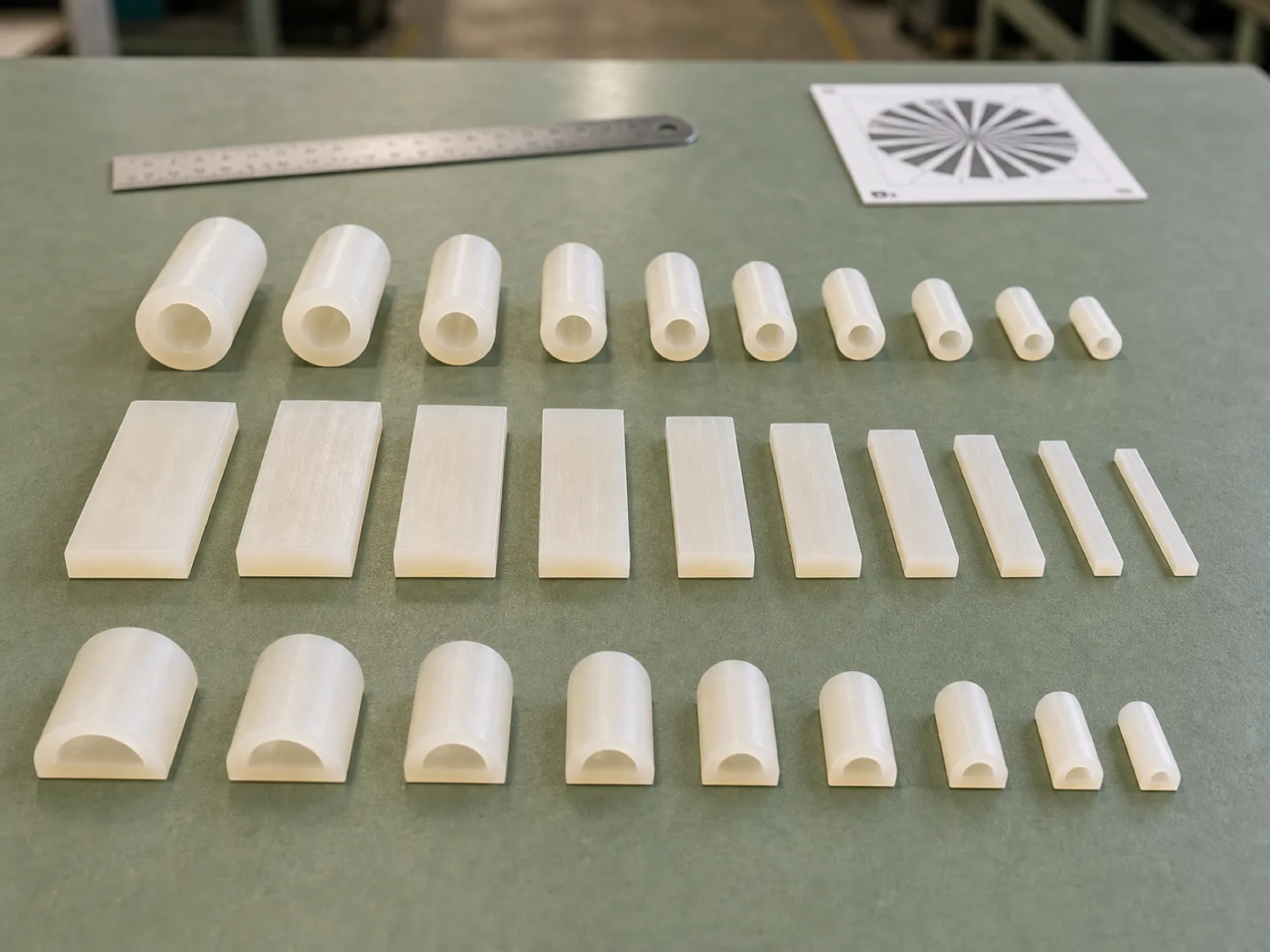
A custom high temperature silicone gasket program runs 35-55 days from drawing lock to FAI (First Article Inspection) sample approval at MOQ 500: 5 days DFM review, 15-25 days single-cavity tool build, 7 days T0 sample and dimensional FAI, 5-10 days customer approval, 3-8 days first production run. LSR multi-cavity programs add 10-15 days for the tool build.
The timeline is not marketing — it is what the tooling shop and the compression cell can actually deliver. Where programs slip is invariably in the drawing-review phase: incomplete tolerances, missing durometer callout, no cure-system spec, no compression-set target. Every day gained in drawing quality is three days saved in the schedule.
The stages we walk each program through:
- RFQ intake + DFM review (5 days) — engineering desk reviews your drawing, flags spec gaps (durometer without ±band, no compression-set target, geometric conflicts with cure shrinkage), quotes tooling and unit cost.
- Drawing lock and PO (customer-side, uncounted) — signed drawing, signed PO, tooling deposit.
- Tool build (15-25 days compression / 30-45 days LSR) — single-cavity or multi-cavity mold cut on 3-axis CNC, polished, first fit checked.
- T0 sample + FAI (7 days) — 30-50 unit sample run, dimensional FAI on 100% of critical dimensions, durometer check, compression-set test coupon pulled.
- Customer approval (5-10 days) — customer receives FAI report and physical samples, signs off or requests tooling revision.
- First production run (3-8 days for MOQ 500) — full-batch production against ISO 9001 process controls, per-lot certificate issued.
For the OEM pricing and MOQ math underneath these numbers, see our real factory MOQ math walkthrough.
Frequently asked questions
Q: What is the maximum temperature a silicone gasket can handle? A standard platinum-cured silicone gasket handles -60°C to +230°C continuous service, with intermittent spikes to +315°C tolerable for under 30 minutes. Beyond that, the polymer chain scissions and the gasket takes permanent compression set. Fluorosilicone (FVMQ) extends the ceiling to +260°C continuous.
Q: How do I choose Shore A hardness for a high temperature silicone gasket? Shore A 50-60 for low bolt-torque static seals against rough or waved flanges (cast iron manifolds, sheet-metal enclosures). Shore A 65-70 for high-torque bolted joints and dynamic seals where extrusion resistance matters. Under 50 leaks; over 70 will not conform to surface irregularity.
Q: What compression set percentage should I specify for a high temp silicone gasket? Specify ≤ 25% at 175°C / 22 hr per ASTM D395 Method B for a post-cured platinum silicone. Peroxide-cured or unposted silicone drifts to 35-45% under the same test — enough to lose sealing pressure on any bolted joint within one heat cycle.
Q: Silicone vs fluorosilicone vs Viton — which is right for a high temp gasket? Silicone (VMQ) wins on temperature range, cost, and food/medical certifiability. Fluorosilicone (FVMQ) wins when fuels, oils, or aromatic hydrocarbons are present at temperature. FKM/Viton wins on chemical breadth up to 250°C but fails below -20°C and cannot clear FDA 21 CFR 177.2600 easily.
Q: Does a high temperature silicone gasket need post-curing? Yes for any sealing-critical or food-contact application. Post-cure at 200°C for 4 hours drives out residual peroxide by-products (in peroxide-cured stock) or completes the platinum crosslink network. Without it, compression set doubles and volatile content stays above the 0.5% ceiling FDA and LFGB require.
Q: What certifications do custom high temperature silicone gaskets carry? The standard stack: FDA 21 CFR 177.2600 (food-contact), USP Class VI (medical implant-grade biocompatibility), UL 94 V-0 (flame retardant when needed), ASTM D573 heat aging, and MIL-DTL-25988 for aerospace. Every batch ships with per-lot certificates of compliance from an ISO 9001 factory.
Q: What is the MOQ for custom high temperature silicone gaskets? MOQ 500 per SKU on Wetop compression-molded gaskets — the floor where single-cavity tooling amortizes cleanly on a 60-day payback. LSR injection programs need MOQ 2,000 to justify the multi-cavity mold investment. Die-cut sheet-stock gaskets ship at MOQ 100 with no tooling cost.
Q: How long does a custom high temp silicone gasket program take from drawing to production? 35-55 days total: 5 days drawing review + DFM feedback, 15-25 days single-cavity compression tool build, 7 days T0 sample + dimensional FAI, 5-10 days customer approval, 3-8 days first production run. LSR programs add 10-15 days for multi-cavity tooling.
Q: Can a silicone gasket be food-safe and high-temperature at the same time? Yes — platinum-cured VMQ silicone at Shore A 50-70, post-cured 4 hours at 200°C, clears FDA 21 CFR 177.2600 and LFGB §30/31 while handling 230°C continuous service. This is the standard grade for oven-door seals, sous-vide gaskets, and pressure-cooker rings.
Next step — engineer-to-engineer drawing review
If you have a high temperature silicone gasket drawing that needs a technical read — durometer callout, compression-set target, cure-system flag, tolerance sanity check — send it to our engineering desk. We return DFM feedback within 3 business days along with tooling cost and unit-cost quotation at your target MOQ.
Request a drawing review and quote →
Footnotes
-
ASTM International. ASTM D2240 — Standard Test Method for Rubber Property — Durometer Hardness. Available at https://www.astm.org/d2240-15r21.html. ↩
-
International Organization for Standardization. ISO 3601 — Fluid Power Systems — O-Rings — Dimensions and Tolerances. Available at https://www.iso.org/standard/73141.html. ↩
FAQ
-
What is the maximum temperature a silicone gasket can handle?
A standard platinum-cured silicone gasket handles -60°C to +230°C continuous service, with intermittent spikes to +315°C tolerable for under 30 minutes. Beyond that, the polymer chain scissions and the gasket takes permanent compression set. Fluorosilicone (FVMQ) extends the ceiling to +260°C continuous.
-
How do I choose Shore A hardness for a high temperature silicone gasket?
Shore A 50-60 for low bolt-torque static seals against rough or waved flanges (cast iron manifolds, sheet-metal enclosures). Shore A 65-70 for high-torque bolted joints and dynamic seals where extrusion resistance matters. Under 50 leaks; over 70 will not conform to surface irregularity.
-
What compression set percentage should I specify for a high temp silicone gasket?
Specify ≤ 25% at 175°C / 22 hr per ASTM D395 Method B for a post-cured platinum silicone. Peroxide-cured or unposted silicone drifts to 35-45% under the same test — enough to lose sealing pressure on any bolted joint within one heat cycle.
-
Silicone vs fluorosilicone vs Viton — which is right for a high temp gasket?
Silicone (VMQ) wins on temperature range, cost, and food/medical certifiability. Fluorosilicone (FVMQ) wins when fuels, oils, or aromatic hydrocarbons are present at temperature. FKM/Viton wins on chemical breadth up to 250°C but fails below -20°C and cannot clear FDA 21 CFR 177.2600 easily.
-
Does a high temperature silicone gasket need post-curing?
Yes for any sealing-critical or food-contact application. Post-cure at 200°C for 4 hours drives out residual peroxide by-products (in peroxide-cured stock) or completes the platinum crosslink network. Without it, compression set doubles and volatile content stays above the 0.5% ceiling FDA and LFGB require.
-
What certifications do custom high temperature silicone gaskets carry?
The standard stack: FDA 21 CFR 177.2600 (food-contact), USP Class VI (medical implant-grade biocompatibility), UL 94 V-0 (flame retardant when needed), ASTM D573 heat aging, and MIL-DTL-25988 for aerospace. Every batch ships with per-lot certificates of compliance from an ISO 9001 factory.
-
What is the MOQ for custom high temperature silicone gaskets?
MOQ 500 per SKU on Wetop compression-molded gaskets — the floor where single-cavity tooling amortizes cleanly on a 60-day payback. LSR injection programs need MOQ 2,000 to justify the multi-cavity mold investment. Die-cut sheet-stock gaskets ship at MOQ 100 with no tooling cost.
-
How long does a custom high temp silicone gasket program take from drawing to production?
35-55 days total: 5 days drawing review + DFM feedback, 15-25 days single-cavity compression tool build, 7 days T0 sample + dimensional FAI, 5-10 days customer approval, 3-8 days first production run. LSR programs add 10-15 days for multi-cavity tooling.
-
Can a silicone gasket be food-safe and high-temperature at the same time?
Yes — platinum-cured VMQ silicone at Shore A 50-70, post-cured 4 hours at 200°C, clears FDA 21 CFR 177.2600 and LFGB §30/31 while handling 230°C continuous service. This is the standard grade for oven-door seals, sous-vide gaskets, and pressure-cooker rings.
References
Authoritative sources cited in this guide
- ASTM International. ASTM D395 — Standard Test Methods for Rubber Property — Compression Set. https://www.astm.org/d0395-18.html
- ASTM International. ASTM D573 — Standard Test Method for Rubber — Deterioration in an Air Oven. https://www.astm.org/d0573-04r19.html
- ASTM International. ASTM D2240 — Standard Test Method for Rubber Property — Durometer Hardness. https://www.astm.org/d2240-15r21.html
- US Food and Drug Administration. 21 CFR 177.2600 — Rubber Articles Intended for Repeated Use. https://www.ecfr.gov/current/title-21/chapter-I/subchapter-B/part-177/subpart-C/section-177.2600
- United States Pharmacopeia. USP <88> Biological Reactivity Tests, In Vivo — Class VI Plastics. https://www.usp.org/harmonization-standards/pdg/excipients/plastic-materials
- International Organization for Standardization. ISO 9001:2015 — Quality Management Systems — Requirements. https://www.iso.org/standard/62085.html
- International Organization for Standardization. ISO 3601 — Fluid Power Systems — O-Rings — Dimensions and Tolerances. https://www.iso.org/standard/73141.html
- US Department of Defense. MIL-DTL-25988C — Rubber, Fluorosilicone Elastomer, Oil-and-Fuel-Resistant. https://www.nist.gov/standardsgov
- Underwriters Laboratories. UL 94 — Tests for Flammability of Plastic Materials for Devices and Appliances. https://www.ul.com/
Start a custom program
Send a brief. Get an engineer’s reply in one business day.
Every Wetop program is tooled from a customer’s specification. Send a CAD file (STEP · IGES · DWG) or a written brief and we’ll reply with a mold cost estimate, price brackets at MOQ 500 / 1,000 / 5,000, and any engineering questions.