DTC pet e-commerce brand · Silicone Pet Products · Multi-SKU pet-product OEM
Pet e-commerce brand · multi-SKU OEM
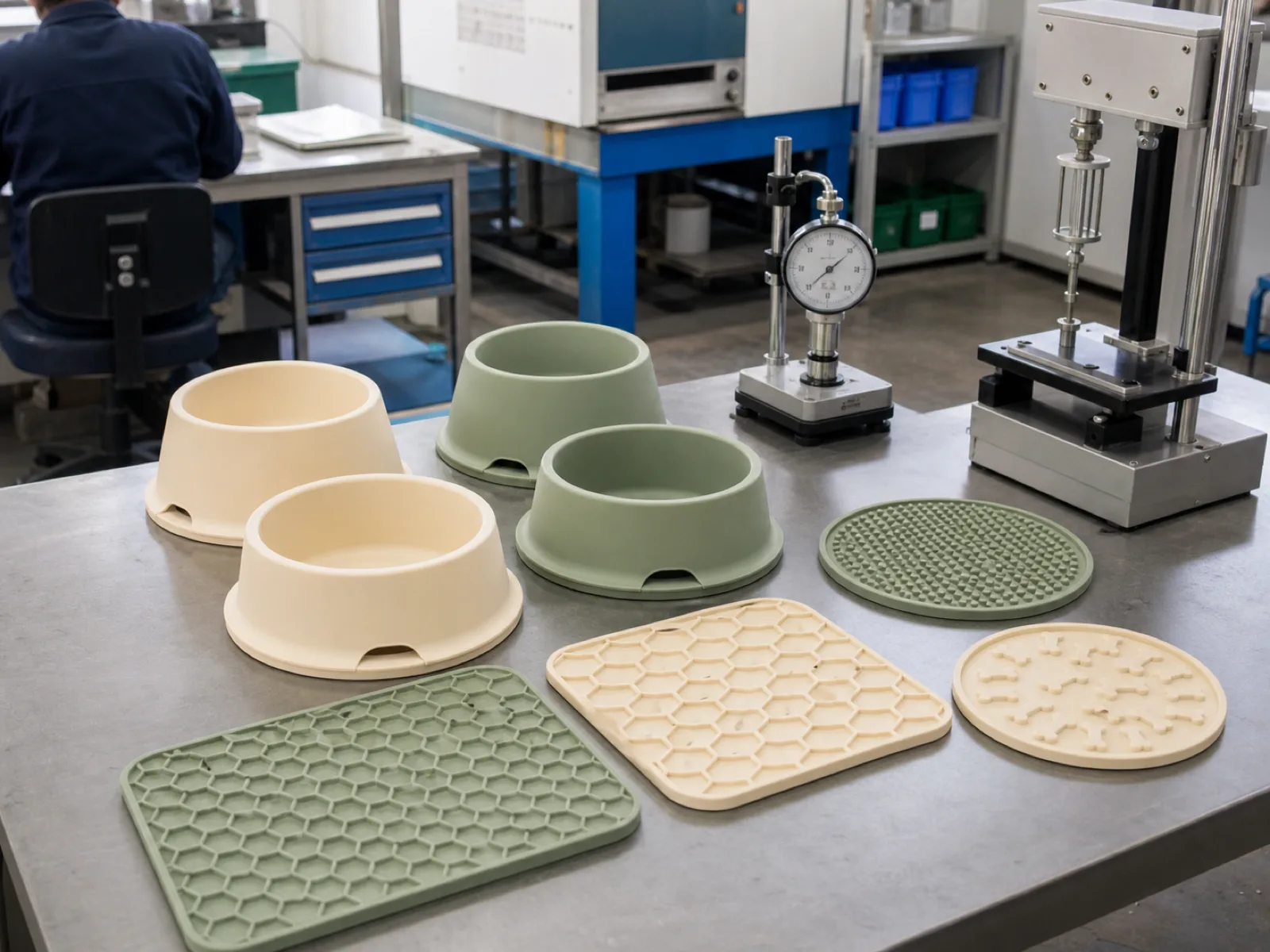
A DTC pet e-commerce brand consolidated nine silicone products — feeding bowls, lick mats, slow feeders, and collapsible travel bowls — spread across four unaudited marketplace suppliers with no shared cure system into one platinum-cured OEM program. We tuned Shore A per function, validated every suction base to a ≥ 30 N pull-force floor, and held catalog color to ±0.8 ΔE. The program now runs at roughly 120,000 units per year with a per-batch compliance packet that has cleared every audit it has faced.
This is an anonymized composite. The customer name is withheld, and the figures are illustrative of the kind of catalog consolidation Wetop runs for direct-to-consumer pet brands — but every spec, cure decision, tooling call, and test threshold below is real to how we run the work.
The challenge: nine SKUs, four suppliers, one public review feed
The brand had grown a nine-SKU silicone catalog one product at a time across four unaudited marketplace suppliers. The result was three cure systems, no shared color reference, no common suction spec, and — because the products sell on public storefronts — a review feed that turned every demold tear and dropped suction base into a 1- or 2-star rating.
On the storefront the catalog looked like a coordinated house brand. Underneath it was four suppliers’ worth of unrelated decisions. The feeding bowls came from one factory, the lick mats from another, the slow feeders from a third, and the collapsible travel bowls from whoever had quoted lowest the quarter they launched. Two of the nine SKUs were peroxide-cured. One supplier could not name its cure system at all — which in practice means peroxide with an uncontrolled post-cure. Nobody had documented the rest.
For a DTC brand, the exposure is not a buried QA metric — it is the star rating on the product page. Two failure modes were doing the damage. The first was suction. The lick mats and several bowls were sold on the promise that they stick to a floor, a wall, or a fridge door so a dog cannot flip them. When a suction base is molded with a sealing lip that is too thin, too stiff, or slightly out-of-flat, it lets go — and a customer whose dog just dragged a full bowl across the kitchen writes a one-star review that sits at the top of the page for a year. The second was demold damage on the textured lick-mat surfaces: the fine ridges that make a lick mat work are exactly the geometry a marketplace supplier tears on ejection, and micro-splits at the ridge roots read to a customer as a torn, cheap product.
Together those two modes were pushing the catalog’s return rate past 6% and dragging the average rating down where it costs the most — on the storefront’s own search ranking. A DTC brand that slips below a review threshold loses placement, and losing placement is losing the business. The brand’s founder could see the pattern in the review text long before any supplier admitted a process problem.
The break came during a retailer onboarding. The brand had started moving beyond its own storefront into a Tier-2 retail chain, and the chain’s buyer asked for a USP Class VI extractables file on the lick mats and bowls — products that sit against a dog’s tongue for the length of a meal. None of the four suppliers had ever run biocompatibility testing. One refused outright. The onboarding stalled, and the founder decided the catalog needed one supplier, one cure chemistry, one color standard, and one compliance file — or it needed to stop growing.
How we approached it: one platform, function-tuned durometer, a validated suction floor
We rebuilt all nine SKUs onto one platinum-cured LSR platform so every part shares one documented cure chemistry and one extractables profile. Shore A was tuned per function — 30A for lick-mat pliability, 50A for slow-feeder ribs, 55A for bowl rims — off a shared 8-cavity and 4-cavity tooling set, and every suction base was validated to a ≥ 30 N pull-force floor before the SKU could run.
The cure system came first and was not negotiable. Every SKU moved to platinum-cured (addition-cure) liquid silicone rubber. Platinum cure leaves no aromatic byproducts, needs no odor-driven post-cure to be safe, and is the only defensible base for a product a dog licks through an entire meal. That single change retired the biocompatibility exposure at the chemistry level rather than by inspection — you cannot inspect residual cure byproducts out of a peroxide part, you can only choose a chemistry that never creates them.
Durometer was the engineering call that made the products feel right in use. A lick mat has to be soft enough to press flat against a wall and pliable enough that the ridges flex under a tongue without going stiff and slick — we specified 30 Shore A. A slow feeder’s internal ribs have to stand up to a determined dog nosing food out of the channels without collapsing, so its body runs 50 Shore A. The feeding and travel bowls need a rim that holds its shape and a base that presses into a flat sealing contact, so they sit at 55 Shore A. A marketplace supplier averages these into one convenient hardness and ships a catalog that feels wrong in two hands out of three. We tuned each part to its job.
Function-tuning across nine SKUs did not mean nine sets of expensive tooling. We laid the smaller parts — the lick mats and travel bowls — across a shared 8-cavity tool, and the larger feeding bowls and slow-feeder bodies across a 4-cavity tool, keeping tooling spend proportional to a 500-piece MOQ per SKU rather than forcing a big-brand tooling budget onto a growing DTC catalog. LSR injection holds tolerance tight enough — roughly ±0.05 mm on the critical dimensions — that the bowl rims and lick-mat ridge geometry came off first shots inside their CTQ windows.
The suction base is where the program was won, and it is also where we scrapped a tool. Suction is not a marketing word here — it is a measurable sealing-lip design problem. We set a ≥ 30 N vertical pull-force floor: the force required to peel a seated base off a clean flat surface, measured on a calibrated pull rig. The first-article slow-feeder base came in at 18 N — it seated, but it released under a dog’s normal shove. Rather than tweak process settings around a base that was designed wrong, we scrapped the base insert and recut it with a redesigned sealing lip: a thinner, more compliant outer skirt over a stiffer support ring, so the lip conforms to the surface and holds a vacuum instead of levering itself off. The recut base cleared a 34 N mean pull-force. This is the “scrapped-and-restarted” discipline we run rather than shipping a first article that technically demolds but fails in the customer’s kitchen — the same review that would have cost the brand a placement.
Color was mastered exactly once. Rather than let each supplier or batch chase the brand’s cream-and-sage palette, we mixed each color into master-batch — the silicone is pigmented before molding, so color runs uniformly through the full cross-section instead of sitting on a coating that scuffs at the contact edge. Every batch is spectrophotometer-verified against a single reference and held to ±0.8 ΔE across the whole catalog. That is the number that finally made the storefront’s product photos match what arrived in the box.
Biocompatibility and traceability were in scope from the first article, not bolted on for the audit. First-article validation on every SKU covered dimensional CTQs, compression set — the property that tells you whether a soft lick-mat surface or a suction lip springs back or stays crushed after repeated use — and a full USP Class VI extractables and systemic-toxicity panel. Compression set came in at 12% at 22 hours / 175 °C, comfortably under our 25% internal reject line, which is why the 30A lick-mat ridges and the suction lips hold their geometry through hundreds of wash cycles instead of going slack. Against the unaudited marketplace pool the brand came from — suppliers who would not run a Class VI test and treated a suction complaint as the customer’s problem — we took the opposite posture: one documented cure chemistry, a per-batch compliance packet issued as a matter of course, and full traceability from master-batch lot to shipped carton.
Outcome: the review feed recovered and the audit cleared
All nine SKUs now ship on one platinum-cured platform with a per-batch FDA 21 CFR 177.2600, LFGB, and USP Class VI compliance packet. Suction pull-force cleared a 34 N mean against the 30 N floor, lick-mat demold rejects fell from 19% to under 1.5%, color holds ±0.8 ΔE, and the return rate dropped below 1.5% — with the review profile recovering across the catalog.
The two failure modes that were driving the bad reviews are structurally gone. Suction bases now leave the line only after clearing the 30 N pull floor, so the “it fell off the fridge” review has no source. The textured lick-mat surfaces demold clean off the recut tooling and the reject rate fell from 19% to under 1.5%, which took the torn-ridge complaints off the storefront. The measured return rate dropped from over 6% to below 1.5%, and the average rating across the affected SKUs climbed back above the placement threshold the brand had slipped under — the outcome that actually pays for the program.
The retailer onboarding that had stalled cleared on the first submission once the USP Class VI file existed. More importantly, the recall-style exposure is retired at the chemistry level: with platinum cure there is no aromatic byproduct to off-gas, so the odor-and-hold cycle that haunts peroxide parts on skin- and tongue-contact products cannot recur. The brand’s quality lead now receives a compliance packet with every batch instead of chasing four suppliers for documents that never arrived.
The clearest signal is the reorder behavior. Eighteen months in, the program runs at roughly 120,000 units per year across the nine SKUs, and the brand has briefed a slow-feeder-plus-mat travel kit onto the same tooling platform rather than returning to the marketplace pool it came from. Consolidation held.
Program specs and results
| Metric | Spec / result |
|---|---|
| SKUs consolidated | 9 (feeding bowls · lick mats · slow feeders · collapsible travel bowls) |
| Cure system | Platinum-cured LSR (addition-cure), all SKUs |
| Shore A range | 30A (lick mat) · 50A (slow-feeder ribs) · 55A (bowl / travel-bowl rim) |
| Tooling | Shared 8-cavity (small parts) + 4-cavity (bowls, slow-feeder bodies) |
| Suction pull-force | ≥ 30 N floor; 34 N mean after base recut (first article 18 N, tool scrapped) |
| Lick-mat demold rejects | 19% → under 1.5% after tooling recut |
| Color tolerance | ±0.8 ΔE across catalog (master-batch, spectrophotometer-verified) |
| Compression set (first-article) | 12% @ 22 h / 175 °C (reject line 25%) |
| Injection tolerance | ±0.05 mm on critical dimensions |
| Compliance (per batch) | FDA 21 CFR 177.2600 · LFGB · USP Class VI extractables |
| Return rate | 6%+ → under 1.5% |
| MOQ | 500 units / SKU |
| Volume | ~120,000 units/yr across 9 SKUs |
| Duration | 18 months active (travel kit briefed) |
Related program
For a closer look at the suction-base engineering that anchored this program, see our premium pet-brand lick-mat suction case study, where a coordinated mat range was validated on the same pull-force discipline. If you are earlier in the process and weighing whether to run your catalog as a private-label program at all, our guide on private-label silicone pet products walks through cure systems, MOQ tiers, and the compliance file a retail buyer will ask for.
Sourcing a pet-product catalog?
If your silicone catalog grew across a handful of unaudited marketplace suppliers and now needs one cure system, one color standard, a validated suction spec, and one compliance file, that is exactly the consolidation we run. Talk to the engineering desk with your SKU list, target durometers, and suction requirements, and we will scope the shared tooling, master-batch color, and USP Class VI path before you commit to a program.
Sourcing a similar program?
Get a CAD review and quote in one business day.
MOQ 500 per SKU. Samples in 7-25 days. We can share a more detailed reference (under NDA) for an adjacent program. Email inquiry@wetopsilicone.com or use the form.