Buyer Guide · commercial intent
Private Label Pet Products — Silicone OEM Buyer Guide
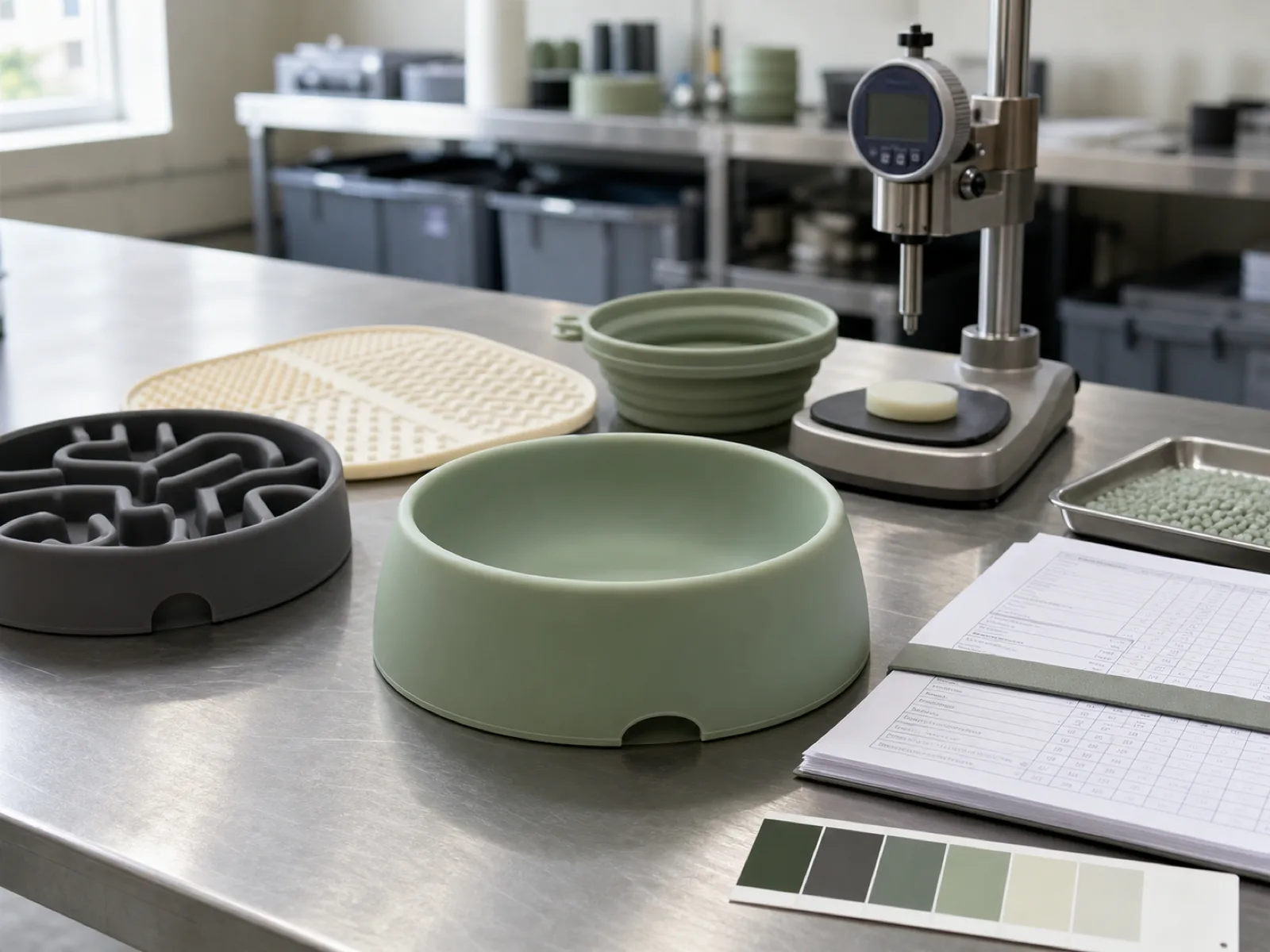 Buyer Guide
 Private label pet products means a brand builds a dedicated mold to its own CAD and controls the SKU, while white label means slapping a logo on a factory's shared catalog part. For silicone pet bowls, slow feeders, and lick mats sold on Chewy or Petco, private label with FDA 21 CFR 177.2600 + LFGB per-batch testing is the only defensible route. First-time programs run MOQ 500-1,000 with 90-120 day lead times and $2,500-$8,000 in tooling per cavity.
Every quarter another DTC pet brand emails us the same question: they’ve hit a ceiling with a white-labeled silicone slow feeder from a marketplace listing, Chewy is asking for a per-batch report their supplier won’t provide, and they’re trying to figure out what “private label” actually costs in real numbers. This guide answers that from the factory side — what the tooling economics look like, what compliance testing is non-negotiable for pet food-contact, and how to tell a real silicone factory from a trading company reselling shared molds.
What does “private label” mean for silicone pet products?
Private label pet products means the brand owns a dedicated mold cut to its own CAD, and the specific geometry + brand mark runs exclusively for that buyer. White label means branding a factory's shared catalog SKU that any other buyer can also purchase with a different logo. For a defensible pet-product line on Chewy, Petco, or Amazon, private label with dedicated tooling is the only long-term option.
The distinction matters because it maps directly onto the mold. A private-label silicone pet bowl starts from your CAD file, gets cut into a P20 or NAK80 steel cavity on a 5-axis CNC, and lives in our tool crib under your part number. When another buyer asks for a “similar” bowl, we quote them their own tooling — we don’t run your cavity for them. That’s the exclusivity that lets a brand invest in packaging, listing photography, and retail buyer meetings without watching a lookalike appear on the same shelf six weeks later.
White label works for market validation. If a brand wants to test whether a lick-mat category concept sells at all before committing to $6,000 in tooling, ordering 500 units of a shared factory SKU with a pad-printed logo is a defensible three-month experiment. The moment the brand has product-market fit, though, the shared-mold economics turn against them: every competitor selling the same underlying part erodes the pricing power that justified the investment in the first place.
What are realistic MOQ and tooling costs for a private-label silicone pet program?
First-time silicone pet-product programs run MOQ 500-1,000 per SKU on new tooling. P20 steel mold tooling costs $2,500-$8,000 per cavity depending on geometry complexity. A single-cavity pet-bowl mold is $3,500-$5,000; a 4-cavity lick-mat mold is $6,000-$8,000. Amortized against MOQ 500, tooling adds $2-$8 per unit; at MOQ 5,000 it drops to $0.20-$0.80.
Here is the honest cost table for a Tier 2 retail private-label silicone pet-product program, broken out per line item at MOQ 500 and MOQ 5,000. This is what we quote when a serious buyer sends us a real CAD file, not a sales-pitch price:
| Line item | MOQ 500 | MOQ 5,000 |
|---|---|---|
| Raw silicone compound (platinum-cured) | $0.40-$0.90 | $0.35-$0.80 |
| P20 mold amortization | $2.00-$8.00 | $0.20-$0.80 |
| Dedicated press time + labor | $0.35-$0.75 | $0.25-$0.55 |
| Post-cure oven cycle (4 hr @ 200°C) | $0.15-$0.30 | $0.10-$0.20 |
| Per-batch FDA + LFGB testing | $0.15-$0.35 | $0.02-$0.05 |
| Master-batch color matching (Pantone) | $0.10-$0.25 | $0.08-$0.20 |
| Retail-ready packaging (polybag + UPC) | $0.35-$0.90 | $0.30-$0.75 |
| Per-unit FOB Yantian, target range | $2.20-$6.50 | $1.30-$3.35 |
The pattern is that tooling amortization dominates the first PO. A brand quoted “MOQ 100 for private-label silicone” is almost always looking at a shared mold with pad-printed branding — the tooling math simply does not work at that volume for a dedicated cavity. If MOQ 100 is what the program can support this quarter, white-label is the honest structure; the buyer can graduate to private-label at MOQ 500+ once the SKU proves out. See the MOQ math guide for the full break-even model on when to cut tooling.
Which silicone grade and material spec do pet bowls, slow feeders, and lick mats need?
Platinum-cured food-grade silicone tested to FDA 21 CFR 177.2600 and LFGB §30/31 is the baseline for anything a pet eats, drinks, or licks from. Shore A hardness varies: bowls 60-70, lick mats 40-55, collapsible travel bowls 55-65, chew-adjacent 70-85 with reinforced walls. Peroxide-cured silicone at pet-product price points is a red flag — the cure-system economics don't add up for legitimate food-contact use.
The material spec matters more for pet products than most buyers realize, because dogs and cats are chemically noisier consumers than humans. A dog licks a slow feeder for 20-40 minutes daily; a cat chews an edge of a placemat while eating. Under those exposure conditions, the difference between platinum-cured and peroxide-cured silicone is measurable: peroxide-cured silicone leaves peroxide-decomposition byproducts (benzoic acid, dichlorobenzoic acid) that can migrate over time, and BfR Recommendation XV[^bfr-lfgb-xv] sets residue thresholds specifically to bound this risk.
For premium programs — especially aggressive-chew categories or SKUs sold into veterinary-adjacent retail — a defensible upgrade is specifying USP Class VI biocompatibility[^usp-vi]. USP Class VI is a pharmaceutical / medical-device biocompatibility framework, not a pet-product requirement, but calling it out on the spec sheet and Chewy listing separates a serious brand from the marketplace commodity crowd. It also adds $0.10-$0.25 per unit to the compound cost — cheap insurance against a viral safety complaint. See the platinum vs peroxide comparison for the cure-system economics in full.
What does FDA vs LFGB testing actually scope for pet food-contact silicone?
FDA 21 CFR 177.2600[^fda-177-2600] scopes overall migration + volatile organic content on rubber articles intended for repeated food contact — a US retail baseline. LFGB §30/31 per BfR Recommendation XV[^bfr-lfgb-xv] adds peroxide residue and cyclic siloxane (D3-D6) volatile thresholds — the EU distribution baseline. Chewy and Petco vendor onboarding require the per-batch report; Amazon FBA doesn't gate on it during listing.
Here is the side-by-side test scope, which is the level of detail Chewy category buyers actually ask about when they’re vetting a new supplier:
| Test parameter | FDA 21 CFR 177.2600 | LFGB §30/31 (BfR XV) |
|---|---|---|
| Overall migration (3% acetic acid, distilled water) | Required | Required |
| Volatile organic content | Required | Required |
| Peroxide residue | Not scoped | Required (< 0.5%) |
| Cyclic siloxane D3-D6 volatiles | Not scoped | Required (< 0.5%) |
| Extractable at 200°C, 4 hr | Not scoped | Required (< 0.5%) |
| Per-batch reporting | Yes (Wetop standard) | Yes (Wetop standard) |
| Third-party lab (SGS, Intertek, Bureau Veritas) | Yes | Yes |
The reason both matter for a pet-product private-label program: Chewy, Petco, and PetSmart accept FDA alone for US-only SKUs, but any brand planning to distribute into EU markets (or sell through Amazon.de / Amazon.co.uk) needs LFGB on the same production run. Testing both simultaneously at production time costs 15-30¢ per unit at MOQ 500 — trivial compared to the cost of a re-run to satisfy an EU buyer later. Full test-scope walkthrough in FDA vs LFGB silicone.
Which decoration method holds up to dishwashing and chewing?
Ranked by durability under dishwasher cycles + chew exposure: debossed-in-mold > laser etch > pad print > silk screen. Debossed marks are permanent because the brand mark is a physical impression cut into the mold. Pad print and silk screen fade in 50-100 dishwasher cycles or 30-60 days of aggressive chew exposure. For pet products, debossed-in-mold is the professional default.
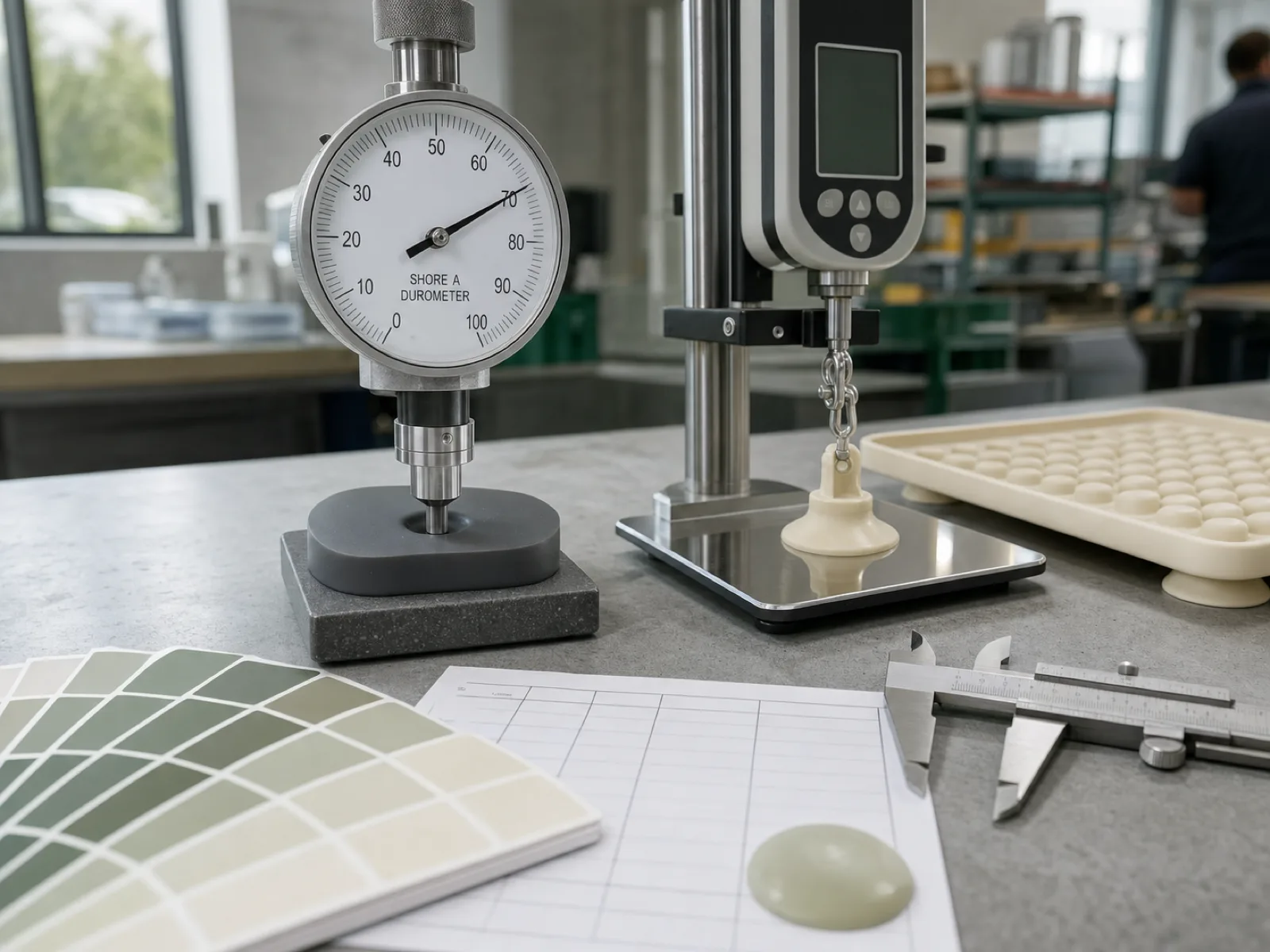
The decoration decision has downstream consequences that many first-time pet-product brands miss. A pad-printed brand mark on a slow feeder looks great in listing photography and the sample delivered to your desk — and then the customer reviews start showing photos of the logo half-worn-off after two months. Amazon reviews compound: three “logo faded” one-star reviews on a $19 SKU drag the listing rank enough to matter. Debossed-in-mold branding removes that risk because there’s nothing to wear off; the logo is the product’s surface geometry itself.
Debossed-in-mold does add $500-$1,200 to tooling cost because the brand mark has to be EDM-cut into the mold cavity, and it commits the mold to that specific brand mark for its entire life. That’s the trade: higher up-front cost, permanent brand mark, zero customer-service exposure. For a serious brand at MOQ 500+, it’s the right call. For a market-validation run at MOQ 200 on shared tooling, pad print is fine — you’re testing category demand, not building a brand yet. Full method-by-method durability table with cure-time data in the logo customization guide.
What retail-ready packaging do Chewy, Petco, and Amazon FBA actually require?
Three separate specs. Chewy vendor central requires individual polybag + UPC-A + GS1-compliant SSCC pallet label. Petco adds a case label with PO number. Amazon FBA requires FNSKU sticker per unit (not UPC), polybag suffocation warning for openings > 5", and master carton ≤ 22.5 kg / 63.5 cm longest side. Wetop handles all three at packaging spec-out; incremental cost is $0.15-$0.60 per unit versus loose bulk.
The retail-readiness step is where most first-time private-label pet-product programs slip schedule. A brand assumes packaging is a downstream problem to solve after production, and then discovers three weeks before ship date that Chewy’s routing guide requires a specific pallet configuration their factory can’t produce without a mid-run change. The fix is boring: put packaging into the RFP alongside the CAD, get sample polybag + master carton + pallet spec approved before mold cutting starts, and treat retail-ready packing as a first-class deliverable rather than a shipping-department afterthought.
For a brand selling on multiple channels simultaneously (Chewy + Amazon + DTC Shopify), the packaging spec becomes a matrix. Same SKU, three different unit-level barcodes (UPC for Chewy, FNSKU for Amazon FBA, plain SKU for DTC), one master carton configuration that works across all three. Wetop’s answer is a modular packaging spec: printed retail box with UPC pre-applied for retail-channel SKUs, unbranded polybag for FBA prep with FNSKU applied at the Amazon prep center, and bulk master carton for DTC fulfillment. Costs vary by channel mix but land in the $0.35-$0.90 range at MOQ 500.
How do I vet a real silicone factory versus a trading company?
Four immediate red flags: (1) the seller can't name specific press tonnage or cure system; (2) no auditable ISO 9001 certificate number verifiable at the issuing registrar's database[^iso-9001]; (3) refuses per-batch FDA + LFGB testing bundled into the PO; (4) quotes MOQ 100 on new tooling — economically implies a shared mold. Real factories quote MOQ 500-1,000 on dedicated cavities and welcome third-party lab reports.
The trading-company problem in the silicone pet-product category is worse than in most B2B verticals because the marketplace platform incentives select for the exact opposite of buyer safety. Marketplace sellers rank by response speed and MOQ flexibility, both of which reward middlemen who aggregate multiple factory relationships and quote generously without owning any actual production. When a real quality issue emerges, the middleman’s response is “we’ll try a different factory next batch” — which means every batch is essentially a new manufacturer, and any batch-level traceability that ISO 9001 requires simply doesn’t exist.
The vetting framework we recommend is boring but effective. Ask for the ISO 9001 certificate number and verify it at the issuing registrar’s website (SGS, TÜV Rheinland, Bureau Veritas, DNV all have public verification tools). Ask what specific press tonnage they’ll run your part on — a real factory says “350-ton hydraulic vulcanizing press with 400 mm × 400 mm platen” without pause. Ask for a factory audit video call showing the specific production floor, not a slideshow. And ask what happens if a customer reports an issue three months post-shipment — a real factory pulls the master-batch lot number from the 36-month ISO 9001 retention archive and walks the root cause. The sourcing checklist has the full 12-question vetting protocol.
What are the tariff and landed-cost implications for importing silicone pet products from China?
Silicone pet bowls, slow feeders, lick mats, and placemats classify under HTS 3924.90.5650 (household plastic articles) at 3.4% MFN duty from China. Chew toys under HTS 4016.99.6050 at 2.5%. Neither sits on Section 301 List 4A exclusion, so no additional China-specific tariff beyond MFN through 2026. Budget landed cost at FOB × 1.045-1.065 before ocean freight; confirm with a licensed customs broker.
The tariff picture matters for the pricing model because it changes the FOB-to-retail multiple by a couple of points, which for a $19 SKU with a 45% target retail margin is the difference between a viable and unviable program. The current state as of mid-2026: HTS 3924.90.5650 covers most silicone pet-product geometry (bowls, mats, placemats, slow feeders) and carries 3.4% MFN duty. HTS 4016.99.6050 (rubber articles, other) applies to chew-toy geometry designed for pet dental use and carries 2.5%.
Neither classification currently has a Section 301 China-specific additional tariff. That’s worth confirming annually because the trade-policy environment moves — but the 2026 baseline is that a Chinese silicone pet-product private-label program lands at CBP with a 3-6% duty add on top of FOB, plus MPF (merchandise processing fee, 0.3464% of value up to a cap) and HMF (harbor maintenance fee, 0.125%). Round to FOB × 1.045-1.065 for landed cost before ocean freight for planning purposes; the actual filing needs a licensed customs broker to confirm the specific HTS classification for your part geometry and avoid CBP audit exposure.
Ready to start a private-label silicone pet-product program?
Wetop runs private-label silicone pet-product OEM programs from RFP through retail-ready shipment. FDA + LFGB per-batch testing is bundled into every PO, tooling is customer-property with mold dedication clauses standard, and packaging matrices for Chewy + Petco + Amazon FBA + DTC are handled at spec-out — not as a post-production surprise. Send us your CAD (or a hand sketch and a target retail price) and we’ll return a formal quote with tooling cost, per-unit price at your MOQ, and a dated 90-120 day production schedule. Request a private-label quote.
FAQ
-
What is the difference between private label and white label for silicone pet products?
Private label means the manufacturer builds a mold to your CAD and your brand mark is the only mark that ever runs from that mold. You own the tool and the SKU. White label means a factory has a shared catalog SKU that any buyer can put a logo on — the same underlying product ships to your competitors. For pet products sold on Chewy or Petco, private-label with dedicated tooling is the only path to a defensible brand; white label is fine only for early-market MVP testing before you commit to tooling.
-
What are realistic MOQ and tooling costs for a private-label silicone pet-product program?
First-time silicone pet-product programs run MOQ 500-1,000 per SKU on new tooling. P20 mold tooling costs $2,500-$8,000 per cavity — a single-cavity pet-bowl mold is $3,500-$5,000; a 4-cavity lick-mat mold is $6,000-$8,000. Amortized against MOQ 500, tooling adds $2-$8 per unit; at MOQ 5,000 it drops to $0.20-$0.80. See the [MOQ math guide](/guide/real-factory-moq-the-math/) for why tooling economics dominate the first PO.
-
Do I need FDA or LFGB testing for silicone pet bowls, slow feeders, and lick mats?
US retail buyers require FDA 21 CFR 177.2600 conformance for any silicone that contacts pet food or saliva. EU distribution adds LFGB §30/31 per BfR Recommendation XV[^bfr-lfgb-xv]. Chewy and Petco vendor onboarding require a per-batch third-party lab report; Amazon FBA does not gate on it during listing, but a Section 5 safety complaint at scale triggers account-level suspension. Test scope: overall migration, volatile organic content, and cyclic siloxane (D3-D6) volatiles. See [FDA vs LFGB silicone](/guide/fda-vs-lfgb-silicone/) for the side-by-side test-scope comparison.
-
What decoration methods work for branding silicone pet products, and how long do they last?
Four decoration methods, ranked by durability: (1) Debossed-in-mold — brand mark cut into the mold cavity so every part carries a permanent embossed impression. Zero fade, zero peel. Preferred method. (2) Laser etching — CO2 or fiber laser marks a matte surface. Permanent under dishwasher + chewing but limited to line-art. (3) Pad print — silicone-compatible ink transferred via silicone pad. Fades in 50-100 dishwasher cycles or 30-60 days of aggressive chew exposure. (4) Silk screen — cheapest, least durable, not recommended for pet products. Full spec sheet in the [logo customization guide](/guide/customize-silicone-logo-deboss-print-laser/).
-
How long from RFP to first container for a private-label silicone pet product?
90-120 calendar days on new tooling for a first-time program. Sequence: 5-7 days RFP + CAD review, 12-18 days P20 mold cutting on 5-axis CNC, 5-7 days first-article sample production, 10-21 days customer approval + revision cycle (this is the schedule slip point — buffer it), 30-45 days mass production including per-batch FDA + LFGB testing, 5-10 days pre-shipment AQL 2.5 inspection + retail-ready packaging + documentation packet, then ocean freight or DDP AWD. Reorders against existing tooling: 45-60 calendar days.
-
What retail-ready packaging do Chewy, Petco, and Amazon FBA require for silicone pet products?
Three sets of requirements. Chewy vendor central: individual polybag with UPC-A barcode, master carton with SKU + quantity + gross weight, GS1-compliant SSCC pallet label. Petco routing guide: same UPC-A + master carton spec plus a case-label with PO number. Amazon FBA: FNSKU sticker on each unit (not UPC), polybag suffocation warning if opening > 5", master carton max 22.5 kg / 63.5 cm on longest side. Wetop handles all three at packaging spec-out; the incremental cost is $0.15-$0.60 per unit versus loose bulk.
-
How do I vet a real silicone factory versus a trading company or Alibaba middleman?
Four red flags: (1) The seller cannot name specific press tonnage (real factories say '350-ton hydraulic vulcanizing press' or 'LSR injection unit with 5cc shot volume'). (2) No auditable ISO 9001 certificate number you can verify at the issuing registrar's database. (3) Refuses per-batch FDA + LFGB third-party testing bundled into the PO. (4) Quotes 'MOQ 100' on new tooling — this economically implies a shared mold (i.e. white label with your logo pad-printed on). Full 12-question checklist in the [sourcing silicone factory guide](/guide/sourcing-silicone-factory-checklist/).
-
What are the HTS code and duty exposure for importing silicone pet products from China to the US?
Silicone pet bowls, slow feeders, lick mats, and placemats classify under HTS 3924.90.5650 (household articles of plastic, other) at 3.4% MFN duty. Chew toys designed for pet dental use may classify under HTS 4016.99.6050 (rubber articles, other) at 2.5% duty. Neither category currently sits on Section 301 List 4A exclusion, so no additional China-specific tariff beyond MFN through 2026. Budget landed cost at FOB × 1.045-1.065 before ocean freight. Confirm the specific classification with a licensed customs broker — misclassification is a CBP audit trigger.
-
Can Wetop guarantee brand exclusivity on a private-label silicone pet-product SKU?
Yes at the SKU level, negotiable at the category level. Standard on every private-label PO: SKU exclusivity — the specific geometry + brand mark combination we produce runs only for you. Tooled mold is customer property; we don't run your geometry for competing buyers. Category-level exclusivity (Wetop won't OEM competing pet-bowl SKUs for another brand in the same retail channel) is available as a contract clause at MOQ 2,000+ programs. Multi-year non-compete with dedicated press capacity is available at MOQ 5,000+ or multi-year commitments.
-
What silicone grade and Shore A hardness should I specify for pet bowls versus lick mats versus chew toys?
Grade: platinum-cured food-grade silicone for anything contacting pet food or saliva. Shore A hardness varies by application. Pet bowls and slow feeders: Shore A 60-70 (rigid enough to hold shape when full of food or water). Lick mats and placemats: Shore A 40-55 (soft enough to conform to surfaces and dishwashing without cracking). Collapsible travel bowls: Shore A 55-65. Chew toys: Shore A 70-85 with reinforced wall thickness — but silicone is not the ideal chew-toy material for aggressive chewers; thermoplastic rubber (TPR) or natural rubber outperforms it on tear strength. See the [Shore A hardness chart](/guide/shore-a-hardness-silicone-chart/) for the full application matrix.
References
Authoritative sources cited in this guide
- US Food and Drug Administration. 21 CFR 177.2600 — Rubber articles intended for repeated use. https://www.ecfr.gov/current/title-21/chapter-I/subchapter-B/part-177/subpart-C/section-177.2600 — The US food-contact regulation applied to silicone pet bowls, slow feeders, and lick mats via per-batch overall migration + volatile organic content testing.
- German Federal Institute for Risk Assessment (Bundesinstitut für Risikobewertung). BfR Recommendation XV — Silicones. https://www.bfr.bund.de/en/bfr_recommendations_on_food_contact_materials-7498.html — Technical standard behind LFGB §30/31 covering peroxide residue, volatile organics, and cyclic siloxane thresholds for food-contact silicone in EU markets.
- International Organization for Standardization. ISO 9001:2015 — Quality Management Systems — Requirements. https://www.iso.org/standard/62085.html — The QMS standard behind master-batch lot retention, per-batch documentation, and the 36-month traceability that anchors private-label program accountability.
- International Organization for Standardization. ISO 2859-1:1999 — Sampling procedures for inspection by attributes. https://www.iso.org/standard/1141.html — The AQL 2.5 sampling framework used for pre-shipment inspection of private-label silicone pet-product batches destined for retail.
- United States Pharmacopeia. USP <88> Biological Reactivity Class VI. https://www.usp.org/harmonization-standards/pdg/excipients/silicone — Biocompatibility framework relevant to premium pet-product silicone grades — a Class VI grade is a defensible spec for aggressive-chew or high-value SKUs.
- US Consumer Product Safety Commission. 16 CFR Part 1500 — Hazardous Substances and Articles. https://www.ecfr.gov/current/title-16/chapter-II/subchapter-C/part-1500 — US general safety framework applied to consumer articles including pet products intended for indoor household use.
- Association of American Feed Control Officials. AAFCO Model Regulations for Pet Food. https://www.aafco.org/ — The pet-food regulatory framework whose contact-material assumptions inform silicone bowl and slow-feeder spec design in the US market.
- US Patent and Trademark Office. USPTO Design Patent Application Guide. https://www.uspto.gov/patents/basics/types-patent-applications/design-patent-application-guide — The US design patent framework applicable to distinctive visual appearance of private-label silicone pet-product geometry.
Start a custom program
Send a brief. Get an engineer’s reply in one business day.
Every Wetop program is tooled from a customer’s specification. Send a CAD file (STEP · IGES · DWG) or a written brief and we’ll reply with a mold cost estimate, price brackets at MOQ 500 / 1,000 / 5,000, and any engineering questions.