Manufacturing · informational intent
Shore Hardness Silicone Chart — Durometer Guide for OEM
 Manufacturing
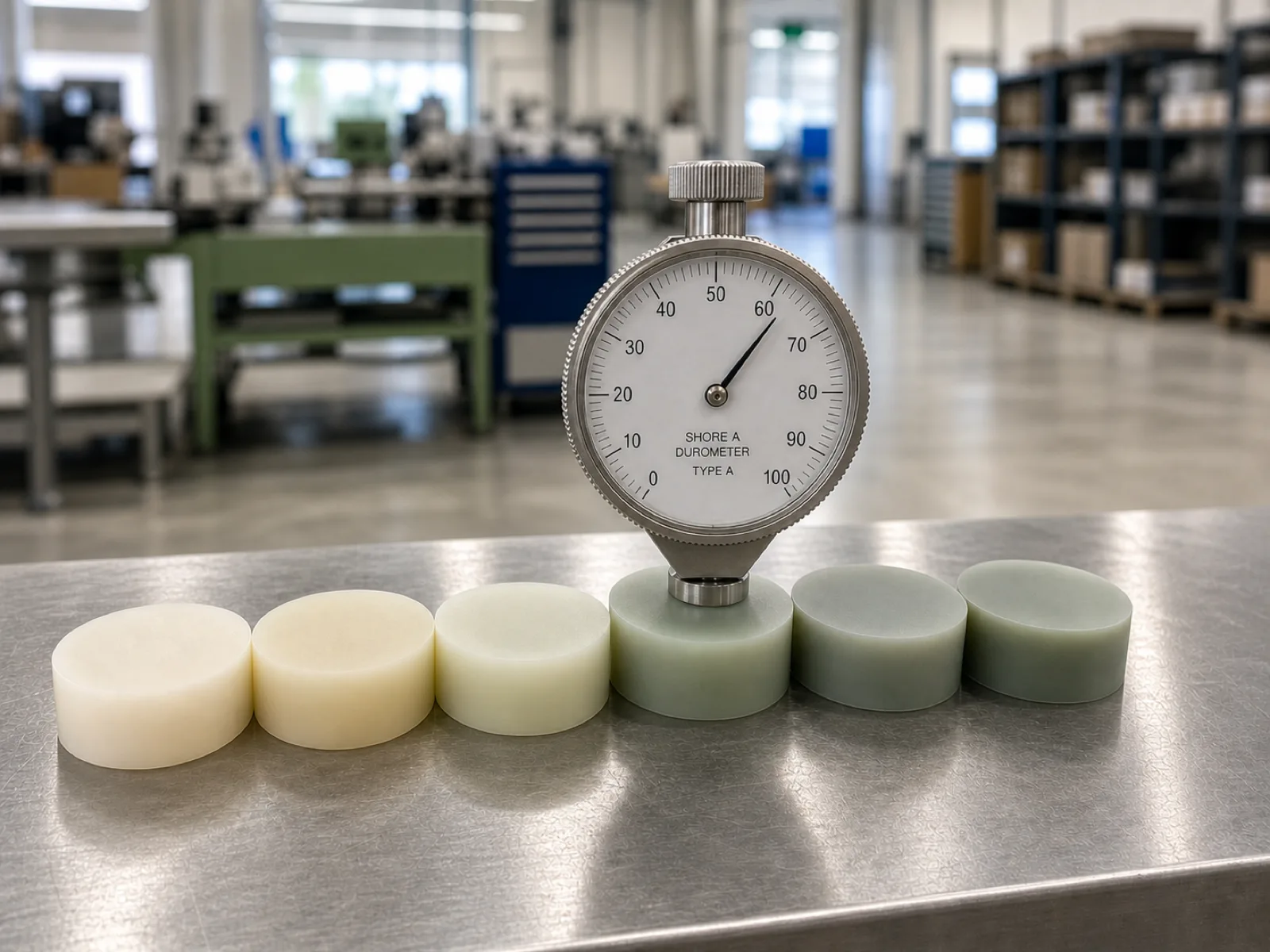
 Shore A hardness is a durometer scale from 0 to 100 that measures how far a spring-loaded indenter sinks into silicone rubber — the higher the number, the harder the compound. Production silicone runs 10 Shore A at the gel-soft end to 90 Shore A at the hard-rubber end, with the 50-70 A band covering most food-contact, sealing, and kitchenware programs. Read on a calibrated Type A durometer per ASTM D2240 with a 6 mm sample and a 15-second dwell, hardness is the single fastest number to spec — and one of the easiest to spec wrong.
This guide is written for OEM sourcing engineers, product managers, and QC leads who need to pick a Shore A target for a silicone part, write a shippable drawing spec, and read a supplier durometer report without getting bluffed. It covers the full Shore A hardness silicone chart 10A-90A with tactile references and application examples, how the ASTM D2240 method actually works, how Shore 00 / Shore A / Shore D scales fit together, how hardness trades against tear and compression set, and the exact durometer ranges Wetop compounds for silicone drying racks, drying mats, and sink grids.
What is Shore A hardness and how does a durometer measure it?
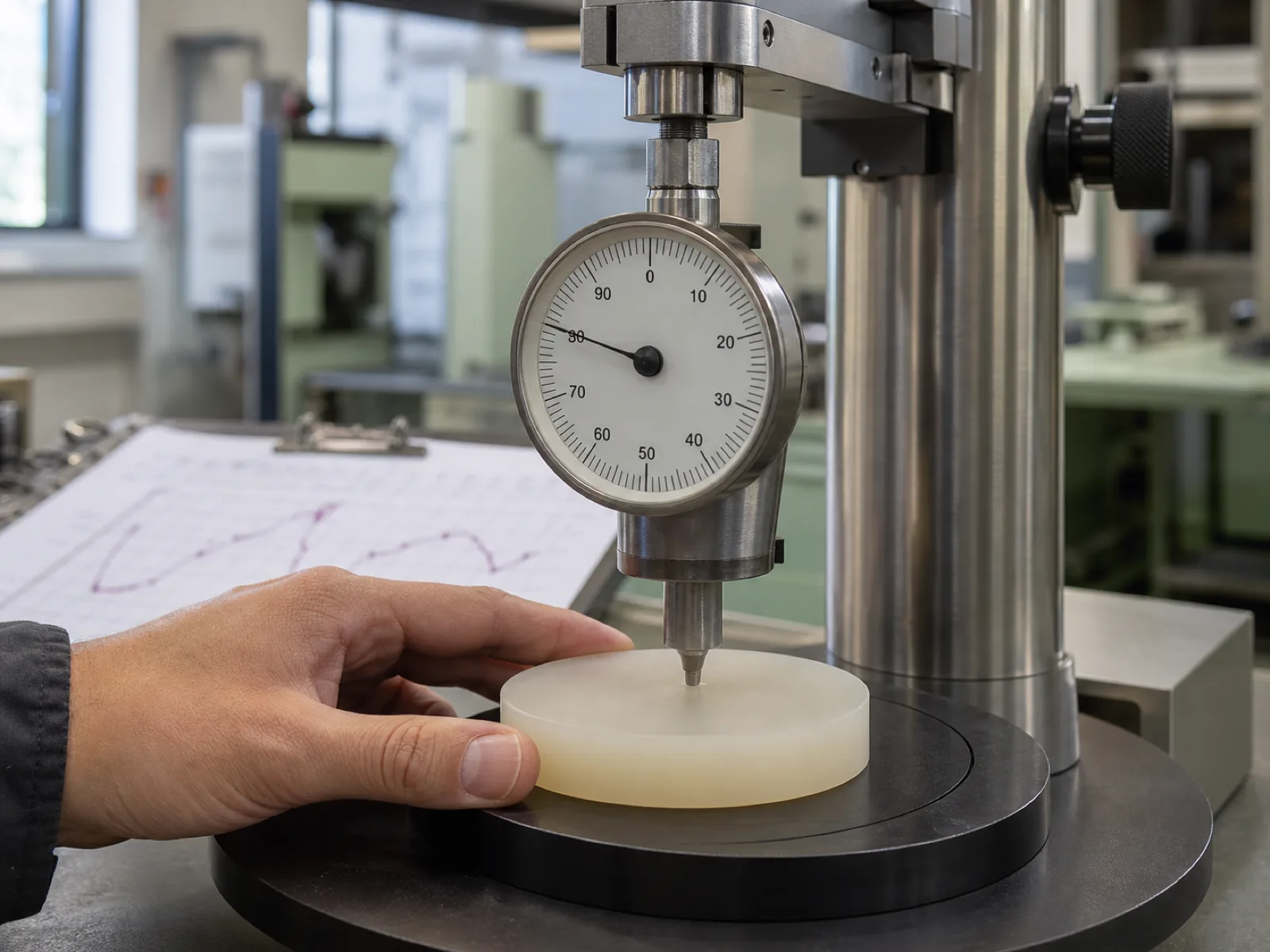
Shore A hardness measures how far a truncated-cone indenter sinks into a rubber sample under a 1 kg spring load, expressed on a 0-100 scale where 0 is fully compressed and 100 is no indentation. The test method is ASTM D2240 (Type A durometer). Reading is taken 15 seconds after full contact on a sample at least 6 mm thick, conditioned at 23 ±2 °C.
The durometer itself is a simple device: a calibrated spring pushes a truncated-cone indenter against the rubber surface, and the dial reads how far the indenter fails to penetrate. Full penetration reads 0, no penetration reads 100. The 1 kg spring load and truncated-cone tip are what define the Shore A scale — swap the tip for a rounded one and lighter spring and you’re on Shore 00; swap it for a sharp pin and heavier spring and you’re on Shore D.
Three parameters decide whether the number on the durometer dial is trustworthy or garbage:
- Sample thickness ≥ 6 mm. A 3 mm coupon reads 5-10 Shore A softer than the same compound at 6 mm because the indenter feels the platen underneath. Stack thinner samples to hit 6 mm or reject the reading.
- Dwell time = 15 seconds. Silicone creeps — the number drops 2-5 points between the 1-second peak and the 15-second stable reading. Anyone quoting a durometer number without a dwell time is quoting a peak reading, and peak readings are always high.
- Conditioning at 23 ±2 °C for ≥ 1 hour. Silicone hardness is temperature-sensitive by roughly 0.5 Shore A per °C in the 15-40 °C range. A part read hot off the press or straight out of a summer-warm carton reads soft.
The ISO equivalent is ISO 7619-1[^iso-7619-1], updated by ISO 48-4[^iso-48-4] — both are harmonized with ASTM D2240 for cross-border shipment. Wetop reports Shore A on the ASTM method by default because North American PPAP submissions cite ASTM; we cross-check to ISO on EU-bound programs.
The full Shore A silicone hardness chart — 10A to 90A
Production silicone spans 10 Shore A (extremely soft, wound-care gel range) to 90 Shore A (hard rubber, backup rings and machine feet). The commercially useful window is 30-80 Shore A. Below 30A the compound loses tear resistance; above 80A it stops behaving like an elastomer and reads on the boundary of the Shore D scale.
The chart below is the working Shore A silicone hardness reference sourcing engineers actually use — every band tied to a tactile everyday object and a typical silicone product example. Print it and pin it above the RFQ desk.
| Shore A | Tactile reference | Feel | Typical silicone product |
|---|---|---|---|
| 10-20 A | Chewed gum, gel bracelet | Extremely soft, sticky rebound | Wound-care gel, breast-form insert, TENS pad |
| 20-30 A | Pencil eraser, rubber band (thick) | Soft, high elongation | Baby bib bumper, teether, prosthetic liner |
| 30-40 A | Standard rubber band, gasket lip | Soft, easy compression | Weather strip, low-torque enclosure gasket, silicone bib |
| 40-50 A | Silicone spatula head, ear plug | Medium-soft, springy | Baking mat, spatula, ice cube tray, drying mat |
| 50-60 A | Shoe sole (running shoe midsole) | Firm, controlled rebound | Silicone drying mat, kitchen utensil, oven mitt |
| 60-70 A | Car tire tread, hockey puck | Firm, resists indent | Drying rack, sink grid, seal, gasket, o-ring |
| 70-80 A | Skateboard wheel, harder tire | Hard, low elongation | Industrial gasket, roller wheel, sink strainer |
| 80-90 A | Rubber shoe heel, tool grip | Very hard, minimal give | Backup ring, machine foot, hard-duty bumper |
| 90+ A | Golf ball cover, hard puck | On the Shore D boundary | Rigid seal, structural pad — reads better on Shore D |
Two things worth flagging at the extremes. First, below 10A the reading transitions to the Shore 00 scale — a Shore 00-30 gel and a Shore A 10 rubber are not the same measurement, though the number ranges overlap. Second, at 90A the Shore A curve compresses (a 10-point difference at 30A is a big compound change; at 85A it’s a small one) so 85-95A parts get spec’d on Shore D for meaningful resolution.
How do the Shore 00, Shore A, and Shore D scales fit together?
Shore 00 measures gels and foams with a rounded indenter under 400 g load. Shore A measures soft-to-medium rubber (10-90A) with a truncated-cone indenter under 1 kg. Shore D takes over at Shore A 90+ using a sharp 30° conical indenter under 5 kg for hard rubber and rigid plastic. The scales overlap: Shore 00-80 ≈ Shore A 30, Shore A 95 ≈ Shore D 45.
The three scales cover different material stiffness ranges because a single spring-and-indenter geometry can only resolve about a 60-point-wide band before the numbers stop being useful. Below is the coverage map and where silicone products land.
| Scale | Indenter | Spring load | Silicone products in scale |
|---|---|---|---|
| Shore 00 | Rounded, 2.54 mm | 0.4 kg | Silicone gels (breast-form, wound care, cushioning pad) |
| Shore 000 | Rounded, 12.5 mm | 0.2 kg | Ultra-soft gels — rarely used on silicone |
| Shore A | Truncated cone, 0.79 mm flat tip | 1.0 kg | Molded silicone rubber (95 % of SKUs) |
| Shore D | 30° conical, 0.1 mm point | 5.0 kg | Hard silicone (backup rings, structural pads) |
Cross-scale conversions are approximate. Common bridge points sourcing engineers need to know:
- Shore 00-80 ≈ Shore A 30 — a soft silicone drying mat can be measured either way
- Shore A 55 ≈ Shore 00-90 — sanity check when a lab hands you a Shore 00 report on a Shore A part
- Shore A 95 ≈ Shore D 45 — anything above Shore A 90 should be re-tested on Shore D
- Shore D 60 ≈ Shore A 100+ — rigid rubber, no longer elastomeric
The conversion is not linear — trust the direct measurement on the correct scale over the conversion table.
What Shore A hardness should I specify by application?
Shore A selection follows the failure mode, not the datasheet's suggested band. Soft compounds (30-50 A) win on conformance and grip. Mid-range (50-70 A) is the sealing and food-contact sweet spot. Hard compounds (70-90 A) win on extrusion resistance and abrasion but lose tear strength, rebound, and compression-set performance.
Below is the application-to-hardness selection matrix Wetop applies at RFQ. It reflects what actually ships in kitchenware, sealing, and industrial silicone programs — not the aspirational spread on catalog datasheets.
| Application | Shore A range | Why this band |
|---|---|---|
| Silicone gel pad, wound care, cushioning | 10-20 A | Maximum conformance, cushioning, tack |
| Baby bib bumper, teether, prosthetic liner | 20-30 A | Soft, high elongation, safe on skin |
| Silicone drying mat, weather strip | 40-55 A | Grip on wet dishes, rolls flat, resists tear |
| Silicone baking mat, spatula head | 45-60 A | Non-slip grip, thermal cycling, flex |
| Silicone drying rack (roll-up) | 55-65 A | Roll for storage, support wet cast-iron |
| Silicone sink grid (bottom of sink) | 60-70 A | Point-load from pans, knife-drop, scrub |
| Low-pressure enclosure gasket | 40-55 A | Conforms to rough flange, low bolt torque |
| Machined-flange gasket, 3-5 bar | 50-65 A | Sealing without extrusion |
| O-ring, fluid manifold, 5-10 bar | 60-75 A | Line-pressure hold, low compression set |
| Silicone keypad button | 40-60 A | Tactile feel + long cycle life |
| Industrial roller wheel, backup ring | 70-85 A | Abrasion, no cold flow |
| Structural pad, machine foot | 80-95 A | Rigidity, load-bearing |
The platinum-cured vs peroxide-cured cure system comparison walks through why the same compound formula can read 3-5 Shore A different depending on cure chemistry and post-cure — cure chemistry is the second-largest lever on hardness after filler load.
How does Shore A trade off against tear, tensile, and compression set?
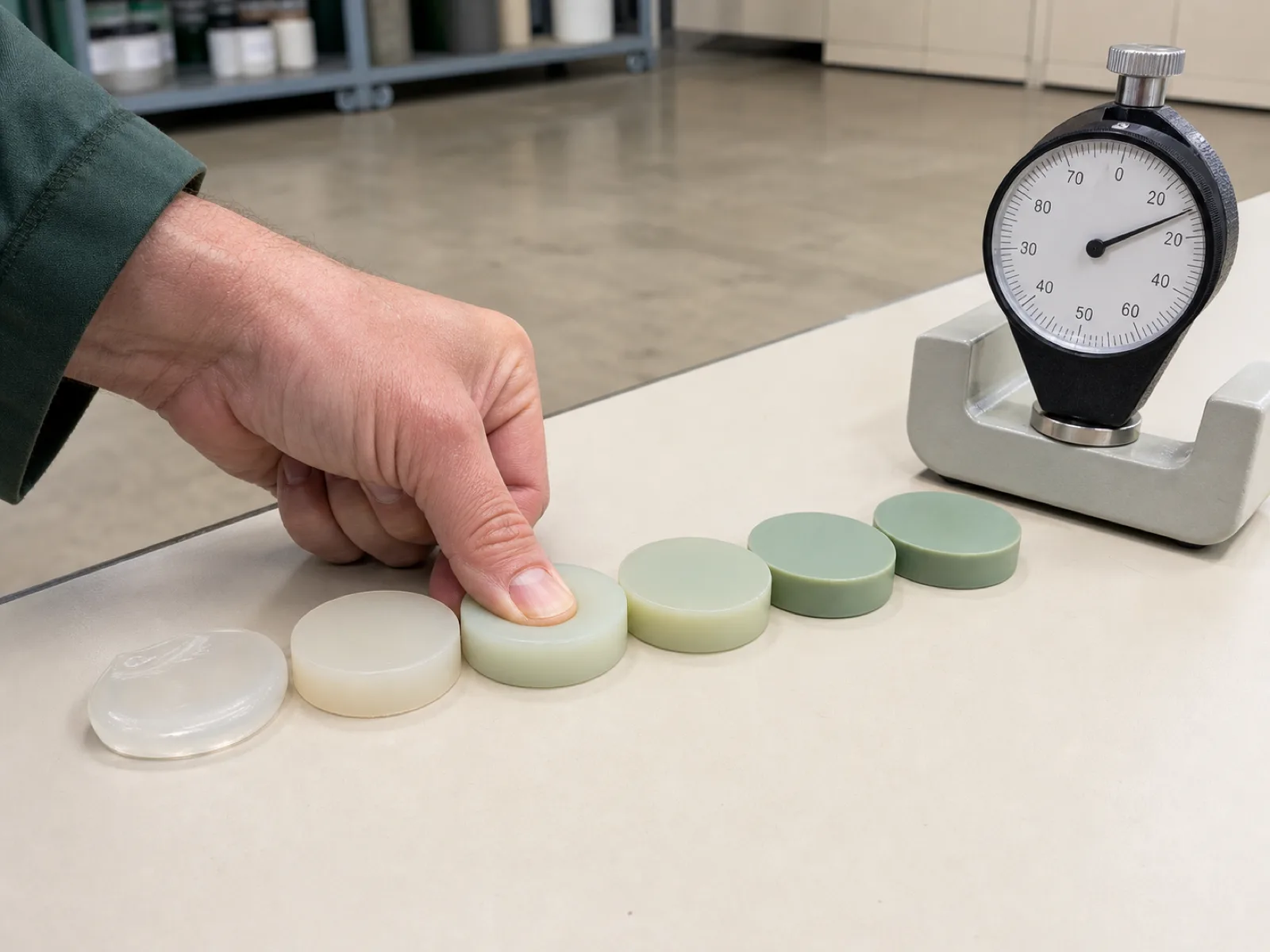
Rising Shore A costs tear strength, rebound, and compression-set performance while gaining extrusion resistance and abrasion life. The 50-70 Shore A band is the design sweet spot because it maximizes tear and tensile without crossing the knee where filler load collapses every other physical property. Above 75A, tear strength drops 30-40 %.
Every Shore A choice is a trade — hardness is not free. The compounder either raises silica filler to hit a higher durometer, which cuts tear and elongation, or uses a stiffer base polymer, which cuts thermal aging headroom. There is no compound formula that reads 80 A and matches the tear strength of the same base at 55 A. Below is the qualitative trade curve every OEM sourcing engineer should have in their head.
| Property | 30-40 A | 50-60 A | 70-80 A | 85-90 A |
|---|---|---|---|---|
| Tear strength (ASTM D624) | 25-35 kN/m | 30-40 kN/m | 20-28 kN/m | 12-18 kN/m |
| Tensile strength (ASTM D412) | 6-8 MPa | 8-10 MPa | 7-9 MPa | 5-7 MPa |
| Elongation at break | 500-700 % | 400-550 % | 200-350 % | 100-200 % |
| Compression set @ 175 °C, 70 h | 30-45 % | 15-25 % | 20-30 % | 35-50 % |
| Sealing force at 25 % compression | Low | Medium | High | Very high |
| Extrusion resistance at 5 bar | Poor | Good | Excellent | Excellent |
The takeaway most first-time OEM buyers miss: spec’ing “harder” as a proxy for “better” is a fast way to a part that meets Shore A and fails in the field. A 55 Shore A drying rack outlives an 80 Shore A drying rack in real kitchen use because it recovers from cast-iron point-loads instead of taking a permanent set. The right question is never “how hard should this be” but “which failure mode am I engineering against.”
What Shore A hardness does Wetop compound for drying racks, mats, and sink grids?
Wetop targets 55-65 Shore A on roll-up silicone drying racks, 50-60 Shore A on silicone drying mats, and 60-70 Shore A on silicone sink grids. Each range is the compounding sweet spot for the SKU's dominant failure mode: point-load recovery on racks, non-slip grip and roll-flatness on mats, and knife-drop and scrub abrasion on sink grids.
The three ranges below are what actually ships from Wetop’s Dongguan compression cells. Each one is set on cure system, silica filler load, and post-cure schedule — not on a single dial. Lot-to-lot tolerance holds ±5 Shore A across a 12-month production window on all three lines.
| Product | Shore A target | Failure mode engineered against |
|---|---|---|
| Roll-up silicone drying rack | 55-65 A (default 60 A) | Cast-iron pan point-load, roll-storage crease, wet grip |
| Silicone drying mat | 50-60 A (default 55 A) | Non-slip grip on wet dishes, flat storage, tear at edge |
| Silicone sink grid | 60-70 A (default 65 A) | Knife-drop impact, sponge-scrub abrasion, stockpot point-load |
| Silicone bakeware liner | 45-55 A (default 50 A) | Thermal cycling, non-stick surface, oven-safe |
| Silicone bib / kitchen utensil | 40-60 A | Skin-safe conformance, dishwasher cycling |
Compounding hardness starts with the base VMQ polymer choice, adds fumed silica in a 5-40 phr range for reinforcement and durometer control, and finalizes on a 4-hour secondary cure at 200 °C that drives residual crosslinking to completion. Skip the post-cure and the batch reads 3-5 Shore A softer, then hardens in the shipping carton and fails incoming inspection at the customer — the single most common hardness dispute in silicone OEM.
How do I specify Shore A on a drawing or PO?
Write hardness as target ±5 Shore A per ASTM D2240 Type A durometer, sample ≥ 6 mm thick, 15-second reading, conditioned at 23 ±2 °C for ≥ 1 hour, measured on molded part away from gates and parting lines. That single sentence eliminates ~90 % of hardness-related first-article QC disputes because it locks method, sample geometry, dwell, and measurement location.
A drawing that says “60A silicone” is unshippable. It gives QC no method, no tolerance, no dwell, no sample condition — every one of which changes the number on the dial. Below is the spec block Wetop hands to program managers writing their first silicone drawing.
Copy-ready spec block for the drawing / PO:
- Material: Platinum-cured VMQ silicone rubber, food-contact grade per FDA 21 CFR 177.2600[^fda-177-2600]
- Hardness: 60 ±5 Shore A per ASTM D2240 Type A durometer[^astm-d2240]
- Test conditions: Sample thickness ≥ 6 mm (stack thinner samples if needed), 15-second dwell, conditioned at 23 ±2 °C for ≥ 1 hour before reading
- Measurement location: On finished molded part, at least 12 mm from any gate, parting line, or feature edge
- Reporting: Certificate of Analysis per lot with mean and range of 5 readings
Three specification traps to avoid:
- Single-point spec (“60A” with no tolerance). Rejected — no factory can hold ±0. Always include a tolerance band.
- Impossible tolerance (“±2 Shore A”). Only defensible with 90 days of SPC control-chart evidence. Default to ±5 or accept a 20-30 % reject rate at incoming.
- Missing method (“Shore A 60”). Which scale, what dwell, what sample? Cite ASTM D2240 Type A or ISO 7619-1 — the method fixes every ambiguous parameter.
The silicone rubber gasket manufacturing guide walks through the full PPAP-grade documentation stack that surrounds a Shore A spec — CoA, CoC, first-article dimensional report, and material property panel — for gasket programs where hardness is only one of eight numbers that must clear submission.
How does Wetop control Shore A hardness lot-to-lot?
Wetop holds Shore A within ±5 points lot-to-lot through platinum-cured VMQ base polymer control, silica filler weighed to ±0.5 % on a calibrated mass balance, closed-loop compression press temperature and time recording, mandatory 4-hour post-cure at 200 °C, and 5-point durometer readings on every production lot with SPC charting per ISO 9001[^iso-9001].
Hardness variation is a process control problem, not a compound problem. Same formula on the same press held to different temperatures, cure times, or post-cure schedules produces parts reading 3-8 Shore A apart. The controls below are what keep Wetop’s hardness SPC chart tight across a 12-month production window.
- Compound weighing: platinum-cured VMQ base + silica filler + cure agent weighed on a calibrated balance to ±0.5 % of target mass. Weekly balance calibration against class F1 reference weights.
- Press cycle: temperature recorded per cycle by an in-mold thermocouple, cure time driven by the press PLC — no operator override.
- Post-cure: 4-hour secondary cure at 200 °C in a chart-recorder-monitored oven. Traveler card logs oven start and end timestamps against the chart trace.
- Hardness sampling: 5 durometer readings per lot on a 6 mm coupon, conditioned overnight at 23 ±2 °C. Mean and range logged to the SPC chart against control limits set at ±3σ.
- Reject rule: any single reading outside ±5 A of nominal, or any lot mean outside ±3 A of nominal, triggers a hold and root-cause investigation before shipment.
Anyone quoting tighter than ±5 Shore A without producing the SPC chart to back it is estimating. Ask for the last 90 days of hardness data before believing a ±2 tolerance claim.
FAQ — Shore A silicone hardness
Detailed Q&A on Shore A hardness specification, measurement, and the failure modes it does and does not predict. Each answer opens with a direct claim in ≤ 2 sentences.
What is Shore A hardness on a silicone chart and how is it measured? Shore A hardness is a durometer scale from 0-100 that measures a silicone rubber’s resistance to indentation by a truncated-cone indenter under a 1 kg spring load, per ASTM D2240. Higher numbers mean harder rubber. The reading is taken 15 seconds after full contact on a sample at least 6 mm thick conditioned at 23 ±2 °C — anything else drifts the number by 5-10 points.
What is the full Shore A hardness range for silicone rubber? Production silicone runs 10 Shore A (extremely soft, wound-care gel range) to 90 Shore A (hard rubber, backup rings). Below 10A the compound is measured on the Shore 00 scale (silicone gels, breast-form inserts). Above 90A it converts to the Shore D scale where 90A ≈ 40D. The commercially useful window for molded parts is 30-80 Shore A.
What Shore A hardness is silicone for kitchen products like baking mats and drying racks? Kitchen silicone lands 40-70 Shore A depending on the SKU. Baking mats and drying mats run 50-60 Shore A for grip and rollability. Roll-up drying racks target 55-65 Shore A to survive point-loading from wet cast-iron pans. Sink grids run 60-70 Shore A because they must resist knife drop and sponge-scrub wear without deforming under a 4 kg stockpot.
What is the difference between Shore 00, Shore A, and Shore D on a silicone hardness chart? Shore 00 measures very soft materials (gels, foams, silicone breast-form inserts) using a rounded indenter under 400 g load. Shore A covers soft-to-medium rubber (10-90A) with a truncated-cone indenter under 1 kg. Shore D takes over at Shore A 90+ and uses a sharp pin under 5 kg for hard rubber and rigid plastics. The scales overlap only slightly: Shore 00-80 ≈ Shore A 30, Shore A 90 ≈ Shore D 40.
What is the tolerance on a Shore A hardness spec for silicone rubber? Industry standard is ±5 Shore A lot-to-lot on a competent line running platinum-cured VMQ with tight cure control. Point-to-point on a single molded part reads within ±3 A. A single Shore A number on a drawing without a tolerance is unshippable — QC will reject roughly one-third of first-article samples. Always spec “target ±5 A per ASTM D2240 Type A” on the drawing.
Why do silicone drying racks and sink grids use different Shore A hardness? Drying racks are compression-molded to 55-65 Shore A because they need to flex when rolled up for storage while still supporting wet stemware without deforming. Sink grids are molded to 60-70 Shore A because they receive point-loads from cast-iron pans, dropped utensils, and hard-scrub sponges — a 55A grid would take a permanent set and cup within a month of daily service.
How does filler loading change silicone Shore A hardness? Silica-reinforced VMQ hardness climbs roughly 4-6 Shore A per 10 phr of fumed silica filler until the compound plateaus around 75-80 A. Above that, hardness rises but tear strength, elongation, and rebound all collapse. This is why 80A+ silicone gaskets often fail at the first thermal cycle — the compounder pushed filler past the trade-off knee to hit the hardness spec at the cost of every other physical property.
Does post-cure change measured Shore A hardness on silicone? Yes, by 2-5 Shore A upward. A 4-hour post-cure at 200 °C completes the vulcanization crosslinks that a 5-minute press cycle leaves incomplete, driving off residual peroxide byproducts on peroxide-cured stock. Read hardness after post-cure, not straight off the press — a batch tested green will read soft, then harden in the shipping carton and fail incoming inspection at the customer.
How do I write a Shore A hardness spec on a PO or drawing for silicone parts? Write: “Hardness: 60 ±5 Shore A per ASTM D2240 Type A durometer, 6 mm minimum sample thickness, 15-second reading, sample conditioned 23 ±2 °C for ≥ 1 hour, measured on molded part at a location away from gates and parting lines.” That one sentence eliminates ~90 % of hardness-related QC disputes.
Is Shore A hardness a reliable quality indicator for silicone rubber? No — Shore A alone tells you nothing about tear strength, tensile, compression set, or heat aging. A cheap silicone padded with calcium carbonate can hit 60 Shore A and fail tear at 8 kN/m; a properly compounded platinum VMQ at the same 60A reads 30-40 kN/m tear. Always pair Shore A with ASTM D412 tensile, D624 tear, and D395 compression set on the datasheet.
Talk to the engineering desk
Bringing a silicone drying rack, drying mat, sink grid, or gasket program to production and need help pinning the Shore A target to the right failure mode? Wetop’s engineering team will spec durometer, tear, tensile, and compression set together on a single-page datasheet keyed to your service condition — then send a 5-puck hardness ladder (30 / 45 / 60 / 75 / 90 A) so your team can feel the trade in-hand before committing to tooling. Talk to the engineering desk — 24-hour response, NDA on request, sampling in 7-15 days on existing tooling.
FAQ
-
What is Shore A hardness on a silicone chart and how is it measured?
Shore A hardness is a durometer scale from 0-100 that measures a silicone rubber's resistance to indentation by a truncated-cone indenter under a 1 kg spring load, per ASTM D2240[^astm-d2240]. Higher numbers mean harder rubber. The reading is taken 15 seconds after full contact on a sample at least 6 mm thick conditioned at 23 ±2 °C — anything else drifts the number by 5-10 points.
-
What is the full Shore A hardness range for silicone rubber?
Production silicone runs 10 Shore A (extremely soft, wound-care gel range) to 90 Shore A (hard rubber, backup rings). Below 10A the compound is measured on the Shore 00 scale (silicone gels, breast-form inserts). Above 90A it converts to the Shore D scale where 90A ≈ 40D. The commercially useful window for molded parts is 30-80 Shore A.
-
What Shore A hardness is silicone for kitchen products like baking mats and drying racks?
Kitchen silicone lands 40-70 Shore A depending on the SKU. Baking mats and drying mats run 50-60 Shore A for grip and rollability. Roll-up drying racks target 55-65 Shore A to survive point-loading from wet cast-iron pans. Sink grids run 60-70 Shore A because they must resist knife drop and sponge-scrub wear without deforming under a 4 kg stockpot.
-
What is the difference between Shore 00, Shore A, and Shore D on a silicone hardness chart?
Shore 00 measures very soft materials (gels, foams, silicone breast-form inserts) using a rounded indenter under 400 g load. Shore A covers soft-to-medium rubber (10-90A) with a truncated-cone indenter under 1 kg. Shore D takes over at Shore A 90+ and uses a sharp pin under 5 kg for hard rubber and rigid plastics. The scales overlap only slightly: Shore 00-80 ≈ Shore A 30, Shore A 90 ≈ Shore D 40.
-
What is the tolerance on a Shore A hardness spec for silicone rubber?
Industry standard is ±5 Shore A lot-to-lot on a competent line running platinum-cured VMQ with tight cure control. Point-to-point on a single molded part reads within ±3 A. A single Shore A number on a drawing without a tolerance is unshippable — QC will reject roughly one-third of first-article samples. Always spec 'target ±5 A per ASTM D2240 Type A' on the drawing.
-
Why do silicone drying racks and sink grids use different Shore A hardness?
Drying racks are compression-molded to 55-65 Shore A because they need to flex when rolled up for storage while still supporting wet stemware without deforming. Sink grids are molded to 60-70 Shore A because they receive point-loads from cast-iron pans, dropped utensils, and hard-scrub sponges — a 55A grid would take a permanent set and cup within a month of daily service.
-
How does filler loading change silicone Shore A hardness?
Silica-reinforced VMQ hardness climbs roughly 4-6 Shore A per 10 phr of fumed silica filler until the compound plateaus around 75-80 A. Above that, hardness rises but tear strength, elongation, and rebound all collapse. This is why 80A+ silicone gaskets often fail at the first thermal cycle — the compounder pushed filler past the trade-off knee to hit the hardness spec at the cost of every other physical property.
-
Does post-cure change measured Shore A hardness on silicone?
Yes, by 2-5 Shore A upward. A 4-hour post-cure at 200 °C completes the vulcanization crosslinks that a 5-minute press cycle leaves incomplete, driving off residual peroxide byproducts on peroxide-cured stock. Read hardness after post-cure, not straight off the press — a batch tested green will read soft, then harden in the shipping carton and fail incoming inspection at the customer.
-
How do I write a Shore A hardness spec on a PO or drawing for silicone parts?
Write: 'Hardness: 60 ±5 Shore A per ASTM D2240 Type A durometer, 6 mm minimum sample thickness, 15-second reading, sample conditioned 23 ±2 °C for ≥ 1 hour, measured on molded part at a location away from gates and parting lines.' That one sentence eliminates ~90 % of hardness-related QC disputes.
-
Is Shore A hardness a reliable quality indicator for silicone rubber?
No — Shore A alone tells you nothing about tear strength, tensile, compression set, or heat aging. A cheap silicone padded with calcium carbonate can hit 60 Shore A and fail tear at 8 kN/m; a properly compounded platinum VMQ at the same 60A reads 30-40 kN/m tear. Always pair Shore A with ASTM D412 tensile[^astm-d412], D624 tear[^astm-d624], and D395 compression set[^astm-d395] on the datasheet.
References
Authoritative sources cited in this guide
- ASTM International. ASTM D2240 — Standard Test Method for Rubber Property—Durometer Hardness. https://www.astm.org/d2240-15r21.html — The primary test method for reading Shore A, Shore 00, and Shore D on rubber and silicone.
- International Organization for Standardization. ISO 7619-1:2010 — Rubber, vulcanized or thermoplastic — Determination of indentation hardness — Part 1: Durometer method. https://www.iso.org/standard/50756.html — The ISO equivalent to ASTM D2240 for Shore A and Shore D durometer measurement.
- ASTM International. ASTM D412 — Vulcanized Rubber and Thermoplastic Elastomers—Tension. https://www.astm.org/d0412-16r21.html — Tensile strength and elongation test — the second number to spec after Shore A.
- ASTM International. ASTM D624 — Tear Strength of Conventional Vulcanized Rubber and Thermoplastic Elastomers. https://www.astm.org/d0624-00r20.html — Tear strength test method that reveals whether a silicone compound has been filler-loaded past its knee.
- ASTM International. ASTM D395 — Rubber Property—Compression Set. https://www.astm.org/d0395-18.html — Compression set test — the durability number that Shore A cannot substitute for.
- US Food and Drug Administration. 21 CFR 177.2600 — Rubber articles intended for repeated use. https://www.ecfr.gov/current/title-21/chapter-I/subchapter-B/part-177/subpart-C/section-177.2600 — The federal regulation food-contact silicone must clear regardless of Shore A.
- International Organization for Standardization. ISO 48-4:2018 — Rubber, vulcanized or thermoplastic — Determination of hardness — Part 4: Indentation hardness by durometer method (Shore hardness). https://www.iso.org/standard/74969.html — ISO's updated durometer method, harmonized with ASTM D2240 for international shipments.
- International Organization for Standardization. ISO 9001:2015 — Quality Management Systems — Requirements. https://www.iso.org/standard/62085.html — The QMS standard Wetop's hardness SPC and traveler-card process is certified against.
Start a custom program
Send a brief. Get an engineer’s reply in one business day.
Every Wetop program is tooled from a customer’s specification. Send a CAD file (STEP · IGES · DWG) or a written brief and we’ll reply with a mold cost estimate, price brackets at MOQ 500 / 1,000 / 5,000, and any engineering questions.