Certification · informational intent
LFGB Section 30 Organic Volatile Test — Method Decoder
 Certification
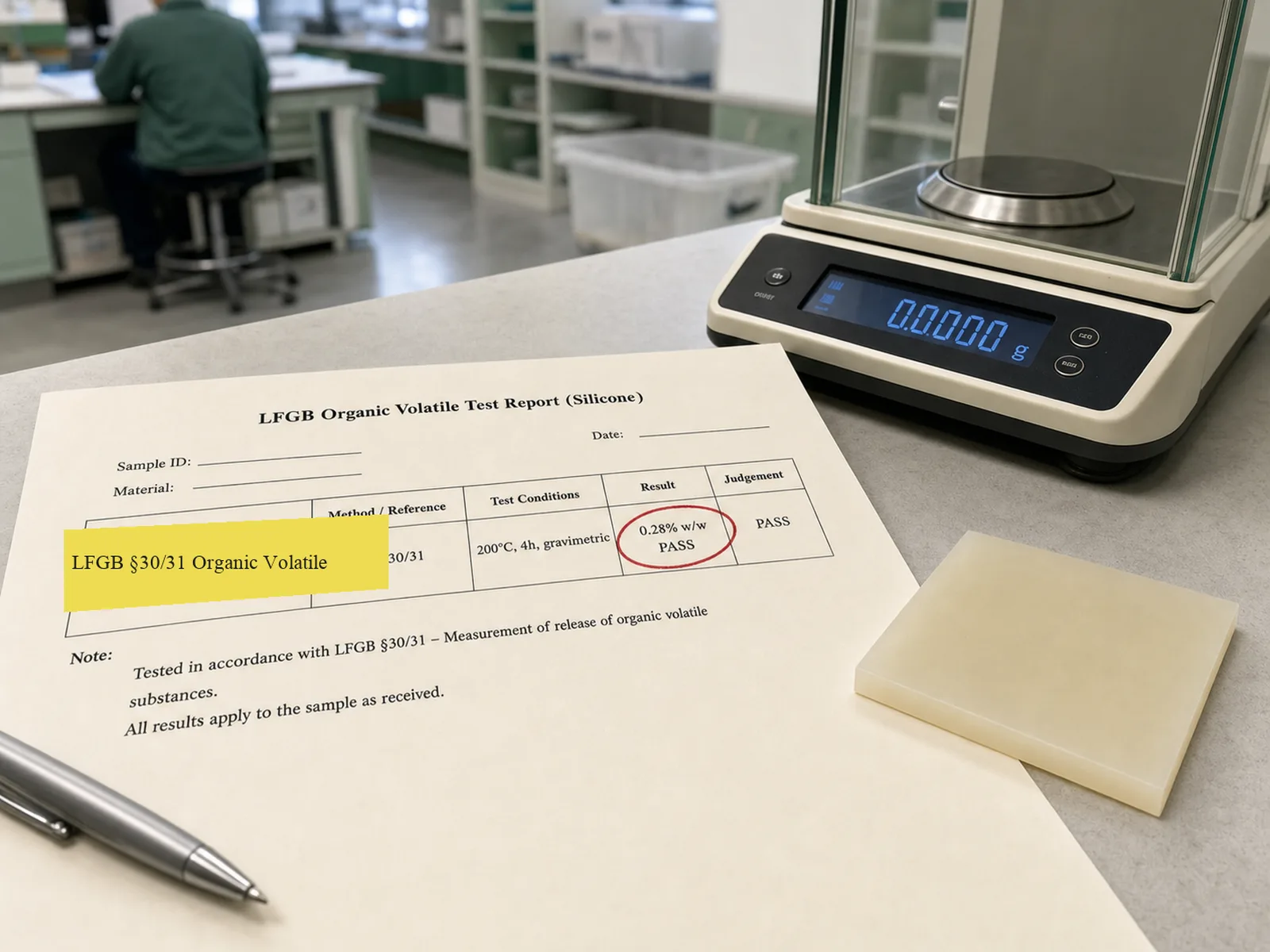
 The LFGB §30/31 organic volatile test on silicone is a gravimetric weight-loss test run at 200°C for 4 hours in a ventilated oven. The sample must lose no more than 0.5% w/w to pass. The technical method is defined in BfR Recommendation XV — Silicones, and the test is the single most reliable indicator that a food-contact silicone article was properly post-cured before shipping.
This spoke guide expands on one narrow angle of our cornerstone FDA vs LFGB silicone decoder: the specific test method behind the “LFGB §30/31” line item on a compliance report. The cornerstone tells you which retail buyers ask for LFGB and how it fits alongside FDA 21 CFR 177.2600. This one goes down one level — into the oven, onto the balance, and across a lab report — so you can read a supplier’s LFGB volatile line item the way an engineering desk reads it, not the way a marketing deck presents it.
What LFGB §30 and §31 actually cover
LFGB §30 is a statutory prohibition — consumer goods must not transfer substances that endanger health or alter food composition to consumers[^lfgb-30]. LFGB §31 is the specific consumer-goods rule that operationalizes §30 for materials and articles intended to contact food[^lfgb-31]. For silicone, both sections point at the same technical method: BfR Recommendation XV — Silicones[^bfr-lfgb-xv].
The two sections are almost always cited together as “LFGB §30/31” on a compliance report because §31 is the practical mechanism for verifying §30 compliance for a physical article. §30 is the “why” (protect the consumer); §31 is the “how” (test the article under defined conditions and report the result). Neither section names silicone by material — the material-specific method is delegated to the BfR (Bundesinstitut für Risikobewertung / Federal Institute for Risk Assessment), which publishes numbered recommendations for each polymer family. Silicone lives in Recommendation XV.
BfR XV covers both branches of LFGB testing on silicone: the organic volatile gravimetric procedure (the subject of this guide) and the three-simulant migration test regime (distilled water, 3% acetic acid, 95% ethanol). A complete “LFGB §30/31 pass” for silicone requires both branches to clear, plus sensory testing under §31 for taste and odor transfer. This guide focuses on the volatile branch because it is the fastest indicator of manufacturing quality — a supplier who fails the volatile test almost certainly fails the migration test too, and the volatile test surfaces the failure mode (under-cure) directly.
What the 200°C × 4-hour method actually does
The current unified method holds a standardized silicone coupon at 200°C ± 5°C for 4 hours ± 5 minutes in a forced-convection ventilated oven, then reweighs the coupon on a 0.1 mg-resolution balance. Weight loss is reported as % w/w. Pass ceiling is 0.5% w/w. Method detection limit is approximately 0.1% w/w — anything below that is reported as ND (not detected / nicht nachweisbar).
The method name in German lab reports is “Bestimmung von flüchtigen Verbindungen in Bedarfsgegenständen aus Silikon” — determination of volatile compounds in silicone consumer goods. The sample geometry is a standardized coupon, typically 60 × 60 × 2 mm cut from a molded article, conditioned at 23°C / 50% RH for 24 hours before initial weigh-in. Any lower conditioning time and residual atmospheric moisture skews the result — one of the reproducibility drivers detailed in the GMP literature on gravimetric silicone VOC testing.
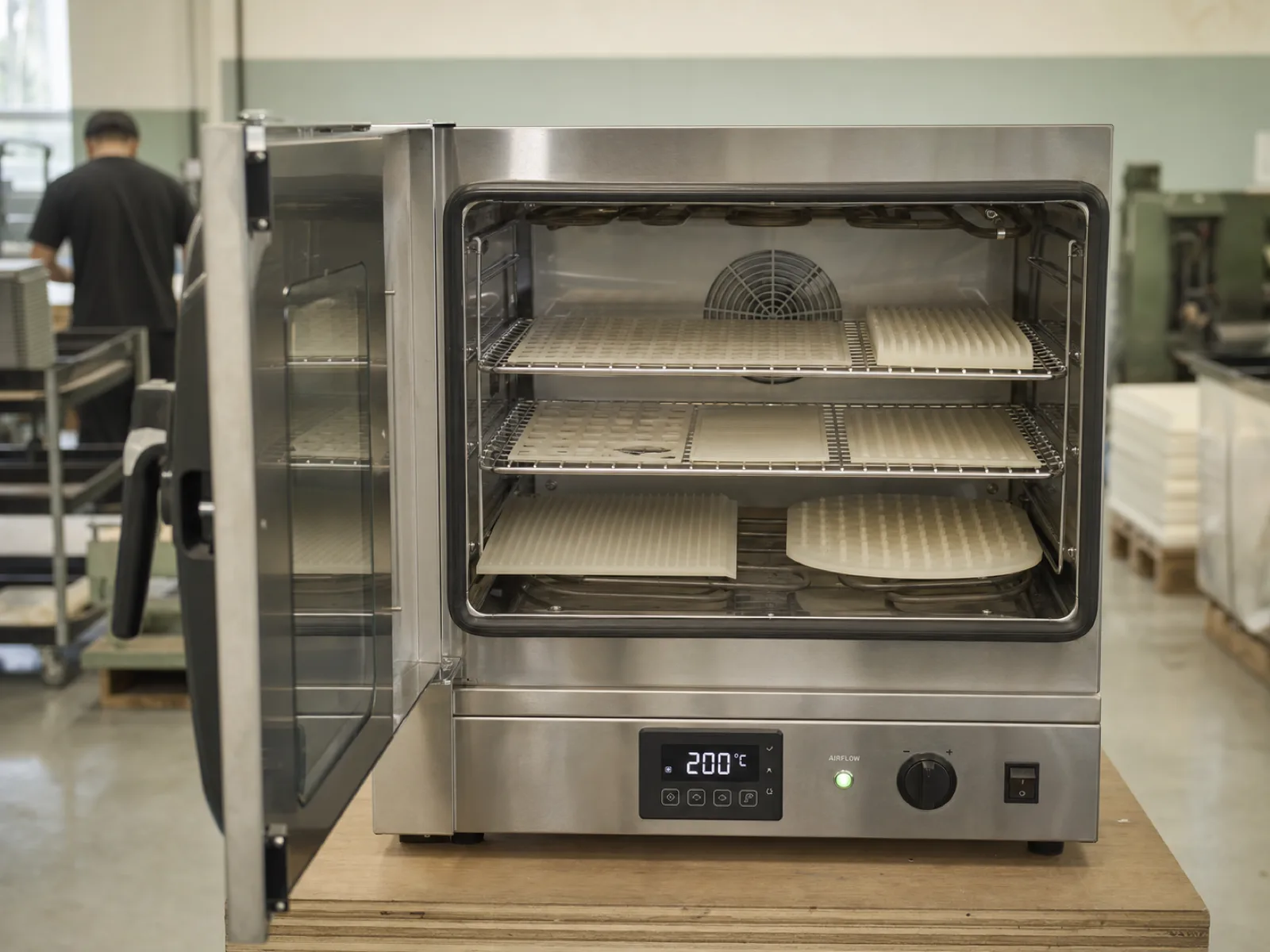
What the weight loss measures is not a specific toxic compound. It measures the aggregate mass of everything that boils out of the silicone under those conditions: low-molecular-weight cyclic siloxanes (D3, D4, D5), residual monomer, acetophenone if the silicone was peroxide-cured, and absorbed water. A compression- or LSR-molded silicone leaves the press with 0.8-2.5% residual volatiles. Post-cure at 200°C for 4-6 hours in a forced-convection oven drives residuals below 0.3% within the first 4 hours and asymptotes near 0.15% by 6 hours. This is why the shop-floor discipline of post-cure — not the raw silicone gum specification — is what determines LFGB §30/31 volatile pass or fail.
Why the 0.5% w/w pass threshold exists
The 0.5% w/w ceiling is a 60-year-old good-manufacturing-practice indicator, not a toxicological limit. It signals that the silicone has been properly post-cured and residual cure byproducts have been driven off. A reading of 1-2% is not necessarily toxic — it is under-cured, and under-cure predicts other quality problems: off-taste, odor transfer, oven off-gassing, and stress relaxation over service life.
The 0.5% number appears in the original BfR volatile method[^bfr-method-2003] and has been carried forward into the current unified procedure without change. It was calibrated in the 1960s against the observation that silicones falling below this ceiling do not produce detectable taste or odor transfer in the accompanying sensory panel, do not fail the three-simulant migration test, and do not exhibit meaningful stress relaxation over the expected service life of food-contact articles. Above 0.5%, at least one of those downstream failure modes lights up. The threshold is a quality gate that surfaces manufacturing shortcuts, not a risk gate on a specific hazardous substance.
This is why buyers should not treat a quantified pass number as inferior to an ND. A silicone reporting 0.28% w/w is passing cleanly — well below the ceiling, well within the range Wetop’s own post-cure discipline reliably delivers. An ND result (< 0.1%) is also passing, and indicates either an unusually well-run post-cure or a low-volatile compound formulation to begin with. Both outcomes clear §30/31. The number to worry about is anything approaching or exceeding 0.5%.
The method change buyers need to recognize
The BfR method for silicone volatiles was updated. The pre-2020 method tiered test temperature to the article's intended service condition (70°C / 100°C / higher). The current unified method fixes conditions at 200°C × 4h across all use cases, making reports directly comparable. Supplier reports dated 2018-2019 citing the tiered method are technically outdated but not fraudulent — request a re-run under the current unified method before scaling a program.
The old method was published as “61. Mitteilung über die Untersuchung von Kunststoffen” in Bundesgesundheitsblatt 46 (2003), page 362[^bfr-method-2003]. It required the lab to choose a test temperature based on how the finished article would be used: 70°C for cold food contact, 100°C for hot food contact, and higher temperatures for baking or oven applications. This was analytically messy — a silicone baking mat and a silicone drying rack made from the same compound could not be tested against each other directly, and inter-lab comparability suffered when different labs assumed different service temperatures for the same article category.
The current unified method solves both problems by fixing conditions at 200°C × 4h regardless of end use. Any article that passes at 200°C × 4h is presumed to pass at lower service temperatures too — the volatiles that would have boiled off at 70°C are a subset of those that boil off at 200°C. From a buyer’s perspective, this means:
| Report vintage | Method cited | What to do |
|---|---|---|
| 2020 or later | ”200°C, 4h, gravimetric” or “unified BfR XV method” | Accept — current standard |
| 2018-2019 | Tiered temperature (70°C / 100°C / higher) | Ask for re-run under unified method |
| Pre-2018 | 61. Mitteilung, 2003 method | Reject — obsolete and stale |
| Any vintage, no method cited | Report is not defensible | Reject and request re-issue |
If you inherit a program with legacy tiered-method reports, the cost of a re-run at SGS or Intertek is roughly $180-300 per SKU per master-batch lot — trivial compared to the exposure from shipping to EU retail against an outdated method citation. Our sourcing silicone factory checklist covers the fuller RFQ paperwork audit; this guide is the deeper cut on the volatile line specifically.
The shop-floor variables that swing pass/fail
Four variables drive LFGB volatile results, and post-cure is by far the largest. Under-post-cure (2 hours or lower temperature) routinely reports 0.6-1.2% w/w — a hard fail. Adequate post-cure (200°C × 4-6 hours, forced convection) drives residuals to 0.15-0.35%. The other three drivers are compound-house lot variance, mold contamination, and sample-conditioning humidity before the test weigh-in.
Post-cure discipline. This is 80% of the story. Every food-contact silicone program at Wetop runs a mandatory 4-6 hour post-cure at 200°C in a forced-convection oven before the finished article touches the QC bench. The oven has to be forced-convection because static ovens don’t clear the boundary layer of volatiles that concentrate around each article, and the residuals re-adsorb during cool-down. Under-cured product is the number-one root cause of LFGB volatile failures across the industry.
Compound-house lot variance. Silicone gum from a competent compound house (Dow, Wacker, Momentive, Shin-Etsu, KCC) is spec’d to ±0.15% w/w on residual volatiles at delivery. Off-spec lots exist — Wetop tests every incoming gum batch on a 5-gram coupon at 200°C × 4h before releasing the lot for production. Compound lots that report > 0.4% w/w residual at incoming go back to the supplier, not into the press.
Mold contamination. Release-agent buildup on mold cavities contributes to volatile carry-over. Wetop’s molds run a scheduled ultrasonic clean at every 40-hour production cycle for food-contact tools; contaminated tooling produces articles that fail volatile testing even with adequate post-cure.
Sample-conditioning humidity. This one is on the lab, not the supplier. Silicone re-absorbs atmospheric moisture rapidly after post-cure. If the lab conditions the sample at high humidity (> 60% RH) before the initial weigh-in, the initial weight is inflated by absorbed water, and the reported weight loss overstates the actual volatile content. Reputable ISO/IEC 17025 labs[^iso-17025] condition at 23°C / 50% RH for 24 hours minimum. This is one reason buyers should stay with a single accredited lab across a program’s lifetime rather than mixing SGS and Intertek results directly — inter-lab spread on the same silicone batch is typically ±0.08% w/w even under best practice.
Where the volatile line sits inside a full LFGB package
The organic volatile test is one of four lines in a full LFGB compliance package. The other three are the three-simulant migration test (aqueous / acidic / fatty, per BfR XV), the sensory panel (§31 taste and odor transfer), and peroxide residue quantification when a peroxide-cured formulation is used. A full pass requires all four to clear — the volatile line is the fastest to fail and the first place a buyer's QC desk looks.
The relative diagnostic value of each line, from an engineering-desk perspective:
| LFGB test line | What it screens | Typical pass rate at Wetop |
|---|---|---|
| Organic volatile (§30/31, 200°C × 4h) | Post-cure discipline | 99%+ |
| Aqueous simulant migration (distilled water, 100°C × 4h) | Water-soluble residuals | 100% |
| Acidic simulant migration (3% acetic acid, 100°C × 4h) | Acid-labile cure byproducts | 100% |
| Fatty simulant migration (95% ethanol, 60°C × 4h) | Fat-soluble oligomers | 99%+ |
| Sensory panel (§31) | Taste and odor transfer | 100% |
| Peroxide residue (peroxide-cured only) | Cure completeness for peroxide systems | N/A — Wetop runs platinum-cured only |
Peroxide residue is a non-issue on platinum-cured formulations because there is no peroxide in the cure system to leave residues. This is one of the reasons Wetop runs platinum-cured across every food-contact program — the compliance packet is simpler and the volatile test result is systematically cleaner. Our platinum-cured vs peroxide-cured silicone breakdown covers this trade-off in detail.
Buyer QC checklist — how to read the volatile line
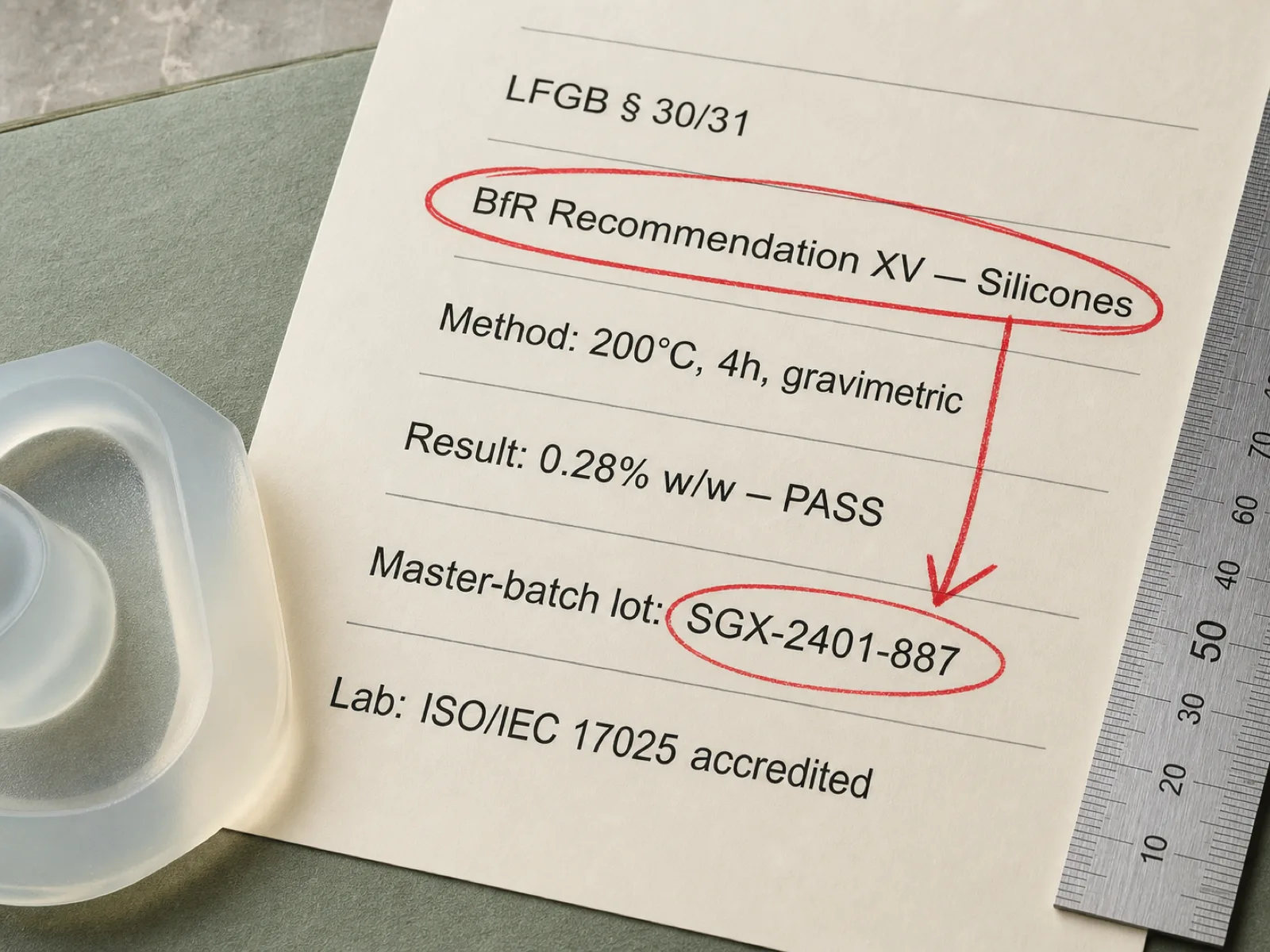
Verify six fields on any LFGB §30/31 volatile line item: (1) regulation citation, (2) BfR Recommendation XV method reference, (3) test conditions ("200°C, 4h, gravimetric"), (4) result in % w/w or ND, (5) master-batch lot number, (6) accredited-lab identity. Anything else is a self-declared report and does not clear a retail buyer's compliance desk.
The checklist in practice:
-
Regulation citation. Look for “LFGB §30/31” or “LFGB § 30 und § 31” or “Lebensmittel- und Futtermittelgesetzbuch §§ 30, 31.” Not “LFGB compliant” (marketing phrase, no legal weight) — the specific section reference must appear.
-
BfR method backbone. Look for “BfR Recommendation XV — Silicones” or “BfR Empfehlung XV Silikone.” The report should explicitly cite the recommendation, not just LFGB.
-
Test conditions. Look for “200°C, 4 h” and “gravimetric weight loss” or “gravimetrische Gewichtsverlust.” If the report cites tiered temperatures (70°C / 100°C bands), request a re-run under the unified method.
-
Result field. Either a quantified number in % w/w (e.g. “0.28% w/w”) or “ND” / “n.n.” / “nicht nachweisbar.” Both are passes if the number is ≤ 0.5% w/w.
-
Master-batch lot number. The lot number on the test coupon must match the master-batch lot number of the silicone gum that fed the production run you are buying. A test on a “representative batch” from 18 months ago does not certify the batch currently sitting in your inbound container.
-
Accredited-lab identity. SGS, Intertek, TÜV Rheinland, Bureau Veritas, or Eurofins are the labs that clear retail compliance desks. All operate under ISO/IEC 17025[^iso-17025]. Any other lab — including in-house factory labs — is a self-declared report.
If any of the six fields is missing, the report is not defensible against a downstream retail audit. This is not a Wetop-specific opinion; it is the operating standard on any premium EU retail program and on US premium natural retail programs where LFGB is in scope. The DIN EN 1186 series[^din-en-1186] provides the underlying gravimetric method backbone that BfR XV cross-references — worth citing if a compliance desk pushes back on method provenance.
Talk to the engineering desk
If you are auditing a supplier’s LFGB paperwork, staging a new program that will ship into EU retail, or trying to figure out why a legacy supplier’s volatile results are drifting toward the 0.5% ceiling, the fastest path is a 30-minute call with our engineering desk. We ship per-batch LFGB §30/31 reports under the current unified method with every food-contact production run, and we can walk you through a supplier’s report line-by-line before you sign a PO. Talk to the engineering desk — no gate, no sales rep, just William or one of the Wetop compliance leads.
FAQ
-
What is the LFGB Section 30 organic volatile test?
It is the gravimetric weight-loss test used to verify that a food-contact silicone article does not shed excessive organic volatiles during real service. The current unified method holds a prepared silicone sample at 200°C for 4 hours in a ventilated oven and reports weight loss as % w/w. Result must be ≤ 0.5% w/w to pass. The method backbone is BfR Recommendation XV — Silicones[^bfr-lfgb-xv], invoked under LFGB §30's prohibition on harmful-substance transfer to food.
-
What is the difference between LFGB §30 and LFGB §31?
LFGB §30 is a statutory prohibition: consumer goods must not transfer substances to food in quantities that endanger health or alter food composition[^lfgb-30]. LFGB §31 is the specific consumer-goods rule that operationalizes §30 for materials and articles intended to contact food[^lfgb-31]. In practice, an LFGB report on silicone cites both together as '§30/31' because §31 is how §30 is verified for a physical article. The technical method both point at, for silicone, is BfR Recommendation XV.
-
Why is the pass threshold 0.5% w/w?
The 0.5% ceiling is a 60-year-old good-manufacturing-practice indicator, not a toxicological limit. It signals that the silicone has been properly post-cured and residual cure byproducts (low-molecular-weight siloxane oligomers, acetophenone from peroxide systems, absorbed water) have been driven off. A silicone reading 1-2% weight loss is not necessarily 'toxic' — it is under-cured, and that under-cure predicts other quality problems (off-taste, odor transfer, oven off-gassing, stress relaxation). Ceiling is quality-gate, not risk-gate.
-
What temperature and duration is the current LFGB volatile method?
Unified conditions: 200°C ± 5°C for 4 hours ± 5 minutes in a forced-convection, ventilated oven. Sample geometry is a standardized coupon (typically 60 × 60 × 2 mm) conditioned at 23°C / 50% RH before weigh-in. Method name in German lab reports: 'Bestimmung von flüchtigen Verbindungen in Bedarfsgegenständen aus Silikon.' If a supplier report cites use-condition-tiered temperatures (e.g. 70°C / 100°C bands), that report is on the 2003 61. Mitteilung method — outdated. Request a re-run under the unified 200°C × 4h method[^bfr-method-2003].
-
What does 'ND' mean on an LFGB volatile test report?
'ND' means 'not detected' — the measured weight loss fell below the method detection limit, which is approximately 0.1% w/w for the gravimetric procedure. German reports write 'n.n.' or 'nicht nachweisbar.' A properly post-cured platinum-cured silicone often reports as ND. A number like '0.28% w/w' is also a pass — anything up to 0.5% is compliant. Only above 0.5% is a fail. Buyers who reject a report because it shows a quantified number rather than ND are misreading the standard; both outcomes pass.
-
How does post-cure affect LFGB §30/31 volatile results?
Directly and predictably. Compression- or LSR-molded silicone leaves the press with 0.8-2.5% residual volatiles — cure byproducts and absorbed monomer. Post-cure at 200°C for 4-6 hours in a forced-convection oven drives residuals below 0.3% within the first 4 hours and asymptotes near 0.15% by 6 hours. Under-post-cured product (2 hours or lower temperature) routinely reports 0.6-1.2% — a hard fail. Wetop runs every food-contact program at 200°C × 4-6 hours minimum post-cure, per SKU, before shipping to the QC bench for extraction paperwork.
-
Is LFGB §30/31 organic volatile the same as the migration test?
No — they are two different LFGB test lines on the same report. The organic volatile test is a gravimetric weight-loss test in dry air. The migration tests (also under BfR XV) run three simulants (distilled water, 3% acetic acid, 95% ethanol) at simulant-specific time-temperature conditions and measure total non-volatile residue (TNVR) migrating into each simulant, reported in mg/dm². A full LFGB compliance package covers both — plus sensory (§31 taste/odor transfer) and peroxide residues. See our [cornerstone FDA vs LFGB decoder](/guide/fda-vs-lfgb-silicone/) for how the full test package fits into a per-batch compliance report.
-
Why do old supplier reports cite different LFGB volatile methods?
The BfR method for silicone volatiles was updated. The pre-2020 method (61. Mitteilung über die Untersuchung von Kunststoffen, published in Bundesgesundheitsblatt 46 (2003) 362[^bfr-method-2003]) tiered the test temperature to the article's intended service condition — 70°C for cold contact, 100°C for hot contact, higher for oven use. This was analytically messy and produced non-comparable results across suppliers. The current unified method fixes conditions at 200°C × 4h across all use cases, making reports directly comparable. A 2018-2019-dated supplier report citing the tiered method is technically obsolete but not fraudulent — request a re-run before scaling a program.
-
How reproducible are gravimetric volatile results between labs?
Moderately reproducible, with known swing variables. A ScienceDirect study on GMP for gravimetric silicone VOC testing identified four reproducibility drivers: (1) sample conditioning humidity and duration before weigh-in, (2) oven air-change rate (forced convection vs static), (3) handling speed between oven and balance (silicone re-absorbs moisture rapidly), (4) balance resolution (0.1 mg minimum for a 5-gram coupon). Inter-lab spread on the same silicone batch is typically ±0.08% w/w. This is why buyers should request repeat testing at the same accredited lab across a program's lifetime rather than comparing SGS results to Intertek results directly.
-
What should I check on a supplier's LFGB §30/31 volatile line item?
Six fields. (1) The regulation citation — 'LFGB §30/31' or 'LFGB § 30 und § 31.' (2) The method backbone — 'BfR Recommendation XV — Silicones' or 'Empfehlung XV Silicone.' (3) Test conditions — '200°C, 4 h, gravimetric.' (4) Result — % w/w or 'ND / n.n.' (5) The master-batch lot number on the sample — must match the production lot you are buying. (6) Accredited-lab identity — SGS, Intertek, TÜV Rheinland, Bureau Veritas, or Eurofins. Anything else is a self-declared report and does not clear a retail buyer's compliance desk.
References
Authoritative sources cited in this guide
- Bundesministerium der Justiz (Gesetze im Internet). Lebensmittel- und Futtermittelgesetzbuch (LFGB) § 30 — Verbot zum Schutz der Gesundheit. https://www.gesetze-im-internet.de/lfgb/__30.html — The statutory prohibition on transfer of harmful substances to consumers from consumer goods. This is the legal hook the LFGB volatile test hangs on for silicone.
- Bundesministerium der Justiz (Gesetze im Internet). Lebensmittel- und Futtermittelgesetzbuch (LFGB) § 31 — Übergang von Stoffen auf Lebensmittel. https://www.gesetze-im-internet.de/lfgb/__31.html — The consumer-goods-specific rule operationalizing §30 for materials and articles intended to contact food.
- German Federal Institute for Risk Assessment (BfR). BfR Recommendation XV — Silicones. https://www.bfr.bund.de/en/bfr_recommendations_on_food_contact_materials-7498.html — The technical standard underlying LFGB §30/31 for food-contact silicone. Defines both the organic volatile gravimetric procedure and the three-simulant migration test regime.
- Bundesgesundheitsblatt (BfR predecessor publication). 61. Mitteilung über die Untersuchung von Kunststoffen — Bundesgesundheitsblatt 46 (2003) 362. https://www.bfr.bund.de/en/bfr_recommendations_on_food_contact_materials-7498.html — The 2003 method reference that use-condition-tiered LFGB reports cite. Replaced by the unified 200°C × 4h method — buyers should recognize this citation as legacy.
- European Parliament and Council (EUR-Lex). Regulation (EC) No 1935/2004 on materials and articles intended to come into contact with food. https://eur-lex.europa.eu/legal-content/EN/TXT/?uri=CELEX%3A02004R1935-20090807 — The pan-EU framework regulation that LFGB implements at member-state level. Article 3 general safety principle is what §30 mirrors in German law.
- European Food Safety Authority. EFSA — Food Contact Materials Scientific Opinions and Guidance. https://www.efsa.europa.eu/en/topics/topic/food-contact-materials — The scientific basis EU member states (including BfR) draw on when setting migration and volatile ceilings for polymer food-contact articles.
- International Organization for Standardization. ISO/IEC 17025:2017 — General requirements for the competence of testing and calibration laboratories. https://www.iso.org/standard/66912.html — The lab-accreditation standard SGS / Intertek / TÜV / Bureau Veritas / Eurofins operate under. An LFGB report from a non-17025 lab does not clear a retail buyer's compliance desk.
- Deutsches Institut für Normung (DIN) / CEN. DIN EN 1186 — Materials and articles in contact with foodstuffs — Plastics. https://www.dinmedia.de/en — The European gravimetric total-migration test method series that BfR XV cross-references for silicone extraction procedures.
Start a custom program
Send a brief. Get an engineer’s reply in one business day.
Every Wetop program is tooled from a customer’s specification. Send a CAD file (STEP · IGES · DWG) or a written brief and we’ll reply with a mold cost estimate, price brackets at MOQ 500 / 1,000 / 5,000, and any engineering questions.