Buyer Guide · commercial intent
Silicone Factory Sourcing Checklist — 12 Questions to Ask
What changed: Rewritten to v2 advanced-GEO standard — added direct-answer blocks per H2, expanded to 8 FAQs, 8 Tier-1 References (ISO 9001 / ISO 14001 / ISO 45001 / SA8000 / Sedex SMETA / FDA / BfR / ECHA), added compression press and mold workshop photographs, added scoring rubric for supplier responses.
 Buyer Guide
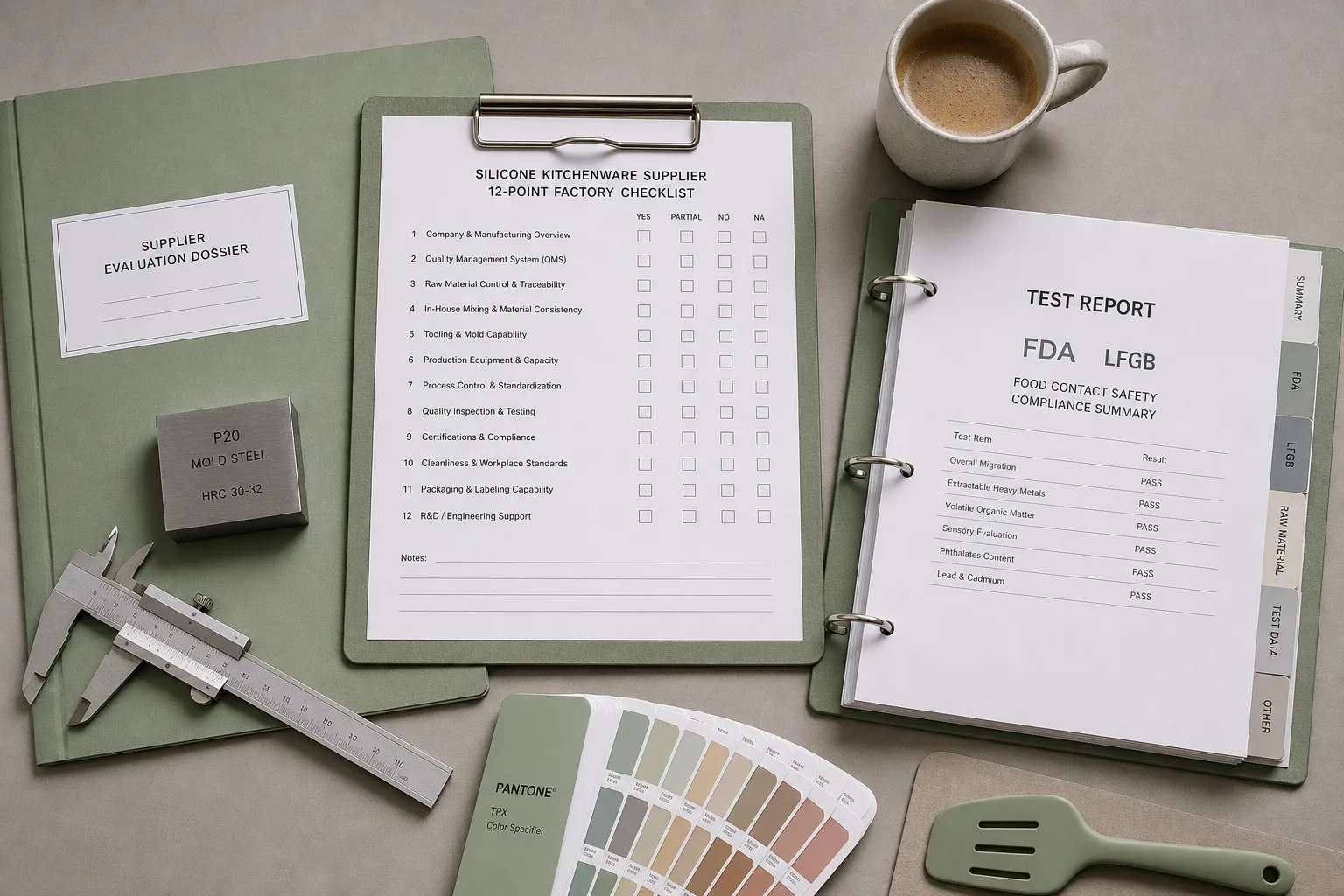
 If you’ve ever run an RFP for custom silicone kitchenware and ended up with 12 quotes that all look identical, you know the problem: every supplier claims ISO 9001, FDA, LFGB, MOQ 500, and “premium quality.” On paper they’re indistinguishable. In production they’re not. Here are the 12 questions that filter the real factories from the trading companies, consolidators, and middlemen — and the correct-answer benchmark each should meet.
12 questions filter trading companies from real silicone factories on any OEM RFP. Each has a clear correct answer real factories have ready in writing. The questions cover ownership, master-batch lot retention, per-batch third-party FDA + LFGB testing, mold material, decoration methods, Pantone tolerance, press capacity, audit welcome, IP terms, payment terms, PFAS-free documentation, and published lead-time discipline. A supplier scoring below 10 out of 12 will run into quality or traceability issues during your program.
Why publish the list that filters against you?
Because the standard in the wider silicone OEM market should be higher than it currently is — and Wetop wins more programs when buyers ask better questions of every supplier including us than when the RFP process treats all "food-grade silicone MOQ 500" quotes as equivalent. Every question here has a clear correct answer with defined red flags. If a supplier is uncomfortable being measured against this list, that discomfort is itself the answer.
The pattern that runs the wider Chinese silicone OEM market is straightforward: many suppliers optimize their marketing collateral to look identical to serious factories on Alibaba and their own websites, then compete on price. When the buyer asks specific spec questions, the response is either evasive or takes 3-5 business days while the sales team hunts for answers they don’t know. The specific-questions vetting layer this list documents is what separates the real factories from that pattern.
The 12 questions to send to every silicone OEM shortlist
1. Do you own the molds, presses, and QC stations — or do you subcontract?
Correct answer: "We own all three. Mold workshop, press floor, and QC stations are all on one factory floor. You're welcome to walk all of them on audit." Red flag: Vague answer, "we work with the best factories", "our partner factory", or "we coordinate production." These are trading companies. They don't own the production assets and your IP, traceability, and QC accountability fragment across whatever downstream factory they route the order to.

2. What is your master-batch lot retention policy?
Correct answer: “36 months minimum. We can produce a master-batch lot record from any production run within that window on request.” Per ISO 90011 documented process control requirements.
Red flag: “We keep records” with no specific duration. This usually means no formal retention policy and no real lot traceability. Every downstream test report, every quality investigation, every RMA workflow depends on this retention chain.
3. Per-batch third-party FDA + LFGB test reports — yes or no, and from which lab?
Correct answer: “Yes, per production batch, from SGS / Intertek / TÜV / Bureau Veritas, referencing your master-batch lot number. Here is a sample report from a recent batch.” Per FDA 21 CFR 177.26002 and LFGB §30/31 drawing on BfR Recommendation XV3.
Red flag: “We have FDA and LFGB certification” pointing to a single 18+ month-old certificate from a “representative” batch. This means production runs go untested in practice, and your retail-buyer audit will flag it. See the FDA vs LFGB decoder for what each report actually covers.
4. Mold material — P20 hardened steel, aluminum, or epoxy?
Correct answer: “P20 hardened steel for production. Aluminum or epoxy only for soft-tool prototypes when explicitly requested by the customer.”
Red flag: Claims “P20” while quoting tooling at $300-500 (real P20 single-cavity is $1,200-$3,500), or admits aluminum / epoxy on production tooling. Soft-mold production will drift dimensionally within 200-1,000 cycles. See the math behind 500-piece minimums for the full tooling cost breakdown.
5. In-mold decoration or post-cure surface decoration?
Correct answer: “In-mold debossing or in-mold label (IML) for permanent decoration; silk-screen or laser etching for stainless component decoration. We do not run post-cure surface decoration on silicone for daily-use products — it wears within 6-12 months of dishwasher exposure.”
Red flag: Surface printing or surface coating on silicone parts. These look great at unboxing and wear visibly within 12 months of use. Retail returns spike.
6. Pantone match tolerance — ±0.5 ΔE or “approximate”?
Correct answer: “±0.5 ΔE measured with spectrophotometer against TPX/TPG reference, mixed in master-batch (not surface coating). We file a color cert per production batch.”
Red flag: “Approximate”, “color matched”, “we’ll get it close”, or no spectrophotometer documentation. Anything looser than ±1 ΔE shows as visible batch-to-batch drift on the retail shelf.
7. Cycle time and press capacity for my program volume?
Correct answer: “Specific cycle time per part (typically 3-8 minutes for silicone compression, 30-90 seconds for LSR injection), specific press tonnage assigned to your mold geometry, and a published production schedule slot. For a 5,000-piece order: ~25-30 working days of press time plus post-cure and packaging.”
Red flag: Vague timeline answers or “we’ll fit you in.” This means your order will queue behind larger customers, and your launch date is at someone else’s mercy.
8. Customer audit policy — in-person and virtual welcome?
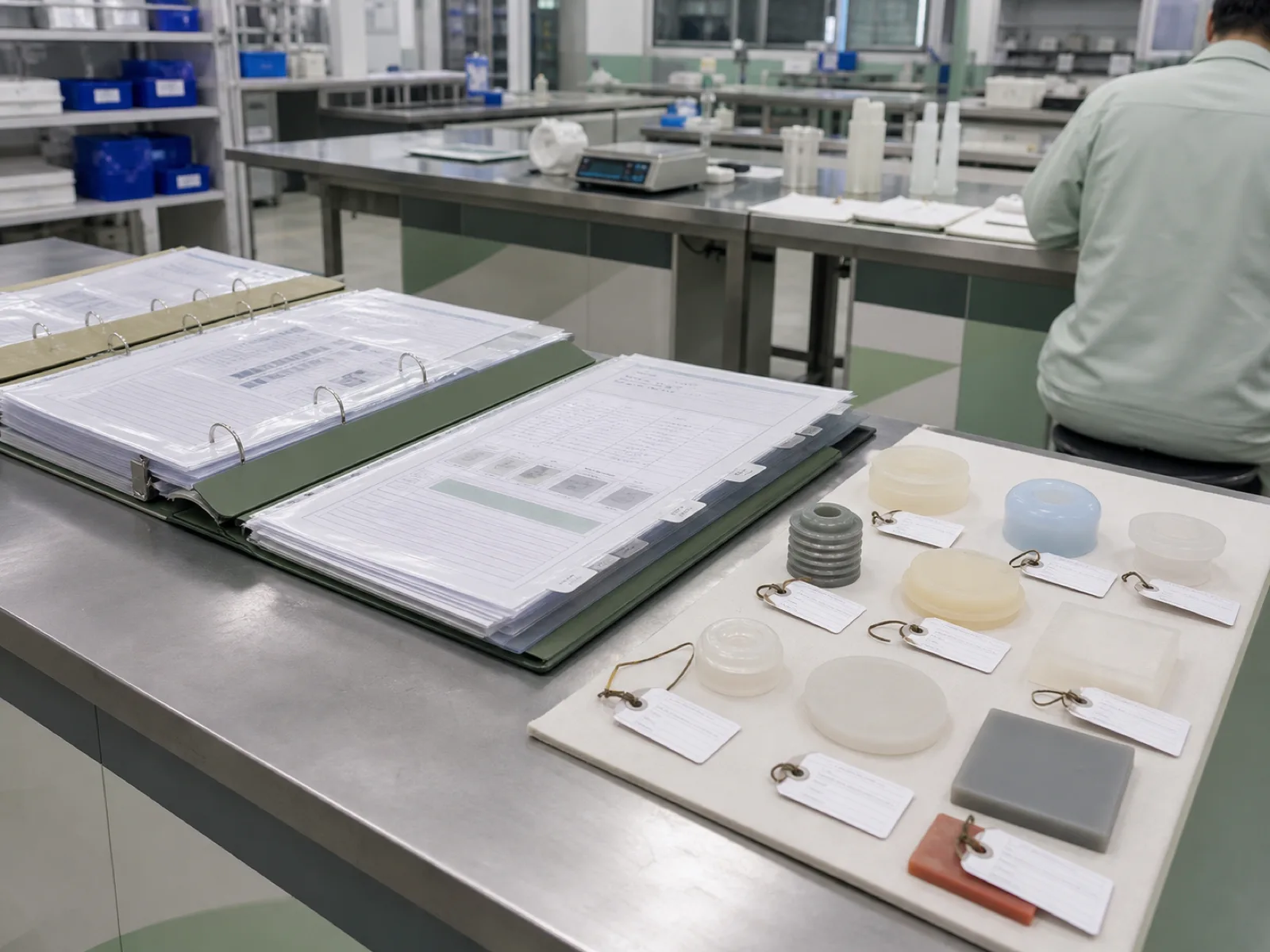
Correct answer: "Yes. Virtual factory walkthrough within 24 hours of request, in-person audit within 2 weeks. Full press floor / mold workshop / QC station / packaging line access. We host approximately one customer audit per month." Red flag: Refusal, postponement, or pre-recorded video tours. This is the strongest single signal in silicone OEM vetting. A supplier that won't show you the floor has something to hide. Serious factories treat audit welcome as routine — it's the shop-floor version of the transparency this list documents.
9. IP / NDA terms — mold ownership and exclusivity?
Correct answer: “Mutual NDA before sensitive technical discussion (we sign your template or use ours). The tooled mold is yours — we don’t run your geometry for other buyers. Multi-year non-compete available for tooled designs.”
Red flag: No clear NDA process, refusal to commit mold dedication, or evasion on non-compete terms. Your tooling and design can end up running for competing buyers.
10. Payment terms — milestones, L/C acceptance, escrow option?
Correct answer: “30% deposit after PO and mold approval, 70% after production QC pass and pre-shipment inspection. L/C and escrow available on larger programs. We do not require 100% upfront wire transfer.”
Red flag: Demand for 100% upfront with no recourse. This is supplier-risk concentration — if production fails, you have no leverage to recover.
11. PFAS-free formulation — independent test report available?
Correct answer: “Yes — independent third-party non-detect PFAS test reports per production batch on request. Standard for premium retail programs (Whole Foods, West Coast organic retail, EU premium). Aligns with ECHA universal restriction trajectory4.”
Red flag: Claims of “PFAS-free” without test report documentation, or hesitation on the PFAS question. Increasingly required by premium retail buyers; suppliers without it lose programs at audit. Deeper reading: PFAS-free silicone as a retail spec and platinum vs peroxide cure.
12. Lead time discipline — published commitments with track record?
Correct answer: “Sample: 7-15 days from existing mold, 18-25 days for new tooling. Mass production: 30-45 days for 500-5,000 pieces. We add a 7-10 day buffer on Tier 2 retail chain programs (chain DCs don’t accept late shipments). Our 12-month on-time delivery rate is published on request.”
Red flag: No published lead-time commitments, or refusal to share on-time delivery data. You’ll bear all the schedule risk on retail launches. For the full timeline model — RFQ to warehouse — see MOQ & lead time on custom silicone kitchenware.
How should you score supplier responses to these 12 questions?
Score each question 1 point for the correct-answer benchmark, 0 for the red-flag pattern. 12/12 = serious factory. 10-11/12 = workable with specific risk on the missing dimensions — usually addressable through explicit contractual carve-outs. Below 10/12 = the program will run into quality or traceability issues during execution. Pay particular attention to Questions 1, 3, 4, and 8 — these are the load-bearing questions where a no is a program-level deal-breaker.
Practical scoring workflow:
- Email the 12 questions to your shortlisted suppliers with the RFP, requesting written answers signed by the engineering lead.
- Score the written answers — clear “yes” answers with specifics = full credit. Vague or evasive = no credit. Non-response within 3 business days = disqualification.
- A supplier at 12/12 is a real factory. 10-11/12 is workable with risk on specific dimensions. Below 10 means quality or traceability issues will surface during your program.
- Weight Questions 1, 3, 4, and 8 double — these are the load-bearing questions. A no on any of these is a deal-breaker regardless of total score.
The 5-minute version of this checklist: Question 1 and Question 8. If a supplier can’t immediately say “we own the production assets” and “we welcome an audit within 2 weeks,” they’re not a serious shortlist candidate.
How do retail buyer certifications (SMETA, BSCI, ISO 14001, ISO 45001) fit in?
Premium retail buyers increasingly fold social and environmental audit certifications into the same supplier vetting workflow. Sedex SMETA[^sedex-smeta] covers labor, health & safety, environment, and business ethics. SA8000[^sa8000] certifies against ILO conventions. ISO 14001[^iso-14001] certifies environmental management systems. ISO 45001[^iso-45001] certifies occupational health and safety. Ask the OEM to attach the most recent audit reports (not just the certificate) alongside their responses to the 12 questions above.
Certification bundles map to retail-tier expectation:
| Retail tier | ISO 9001 | ISO 14001 | ISO 45001 | Sedex SMETA | SA8000 | EcoVadis |
|---|---|---|---|---|---|---|
| US mass retail | ✅ Required | Nice-to-have | Nice-to-have | Nice-to-have | – | – |
| US premium natural (Whole Foods orbit) | ✅ Required | ✅ Required | ✅ Required | ✅ Required | Nice-to-have | Nice-to-have |
| UK / EU premium retail | ✅ Required | ✅ Required | ✅ Required | ✅ Required | ✅ Required | Increasingly required |
| Amazon FBA private-label | ✅ Required | Nice-to-have | Nice-to-have | Nice-to-have | – | – |
| Medical-adjacent programs | ✅ Required | ✅ Required | ✅ Required | ✅ Required | Nice-to-have | – |
Wetop is audit-ready against ISO 9001, ISO 14001, and ISO 45001 baseline, with Sedex SMETA and SA8000 documentation available on request under NDA for premium retail programs.
What Wetop scores against the 12 questions
Wetop scores 12/12 against the checklist — we publish this list because we want customers measuring us against the real standard, not against our marketing. Ownership of molds + presses + QC (Q1), 36-month master-batch retention (Q2), per-batch FDA + LFGB third-party testing bundled at no add-on (Q3), P20 hardened steel tooling (Q4), in-mold decoration (Q5), ±0.5 ΔE Pantone (Q6), specific cycle-time commitments (Q7), audit welcome within 2 weeks (Q8), mutual NDA + mold dedication (Q9), 30/70 milestone payments (Q10), per-batch PFAS non-detect on request (Q11), and published lead-time discipline with track record (Q12).
If you’re running a program with a serious retail buyer and a real launch timeline, you should be asking these questions of every supplier you’re considering, including us. Full manufacturing detail on our capabilities page; anonymized program archetypes are on case studies; the underlying MOQ economics are on real factory MOQ math.
Email inquiry@wetopsilicone.com or open a brief with your spec and any of the 12 questions you want answered in writing. We reply within one business day, with the engineering lead’s signoff.
Footnotes
-
International Organization for Standardization. ISO 9001:2015 — Quality Management Systems. https://www.iso.org/standard/62085.html ↩
-
US Food and Drug Administration. 21 CFR 177.2600. https://www.ecfr.gov/current/title-21/chapter-I/subchapter-B/part-177/subpart-C/section-177.2600 ↩
-
German Federal Institute for Risk Assessment. Recommendation XV — Silicones. https://www.bfr.bund.de/en/bfr_recommendations_on_food_contact_materials-7498.html ↩
-
European Chemicals Agency. PFAS Universal Restriction Proposal. https://eur-lex.europa.eu/legal-content/EN/TXT/?uri=CELEX%3A32006R1907 ↩
FAQ
-
Why do you publish the questions that filter against suppliers like yourselves?
Because the standard in the wider silicone OEM market should be higher than it currently is, and we win more programs by helping buyers ask better questions than by hiding the standard. Every question here has a clear correct answer. We meet all 12 and we want our customers comparing us against a real benchmark — not against our marketing claims. A supplier afraid of you asking these questions is a supplier you don't want.
-
What is the single biggest filter on this list?
Question 1 — 'Do you own the molds, presses, and QC stations, or do you subcontract?' Trading companies and order-consolidation middlemen fail this question immediately because they don't own the production assets. Everything downstream — traceability under ISO 9001[^iso-9001], audit access, mold dedication, cure-system discipline — depends on the answer to question 1 being 'yes'. If a supplier subcontracts production, none of the downstream commitments they make are enforceable against actual factory practice.
-
How should I score a supplier's answers?
Each question has a clear correct answer with defined red flags. Score 12/12 = serious factory. 10-11/12 = workable with specific risk on the missing dimensions — usually addressable through explicit contractual carve-outs. Below 10/12 = the program will run into quality or traceability issues during execution. Pay particular attention to questions 1 (ownership), 3 (per-batch third-party testing to FDA 21 CFR 177.2600[^fda-177-2600] and LFGB §30/31[^bfr-lfgb-xv]), 4 (P20 mold material), and 8 (audit welcome). These are the load-bearing questions.
-
Can I really expect a factory to answer all 12 in writing during the RFP?
Yes — a real factory has these answers ready and treats them as routine due-diligence. Email the 12 questions to your shortlisted suppliers and ask for written answers, signed by the engineering lead. Time-to-respond and quality-of-response are themselves signals. Serious factories respond within one business day. Evasive or delayed responses correlate strongly with downstream execution problems. We respond to questions like these within one business day with the engineering lead's signoff.
-
What if my procurement timeline is too tight to vet 5 suppliers like this?
Start with Question 1 (ownership) and Question 8 (audit welcome). If a supplier can't immediately answer 'yes we own the production assets' and 'yes we welcome an audit within 2 weeks', remove them from the shortlist. Those two questions alone filter out 60-70% of the noise in the Chinese silicone OEM market. Then run the remaining 10 questions against the 1-2 shortlisted survivors. A tight timeline is not an excuse for skipping vetting — it is a reason to filter faster with the highest-leverage questions.
-
How does Sedex SMETA or BSCI social audit compliance fit into this checklist?
Both are increasingly folded into the same vetting process, especially for programs targeting UK premium retail (Waitrose, Sainsbury's, M&S), EU premium retail, or US natural retail chains like Whole Foods and Target's Good & Gather. Sedex SMETA[^sedex-smeta] audits against a four-pillar framework (labor standards, health & safety, environment, business ethics); SA8000[^sa8000] certifies against the ILO conventions; ISO 14001[^iso-14001] certifies environmental management systems. Wetop is audit-ready against all three. If your target retail channel requires any of these, ask the OEM to attach the most recent audit report to the RFP response — a real factory has it filed and ready to share under NDA.
-
Are there red flags in HOW the supplier responds that are as important as WHAT they answer?
Yes. Three response-pattern red flags: (1) generic marketing PDF response with no specific answers to your numbered questions — signals a sales team responding, not an engineering team. (2) 'We'll get back to you' delays exceeding 3 business days for the initial response — signals no established process for this type of due-diligence request. (3) Any pushback on the questions themselves ('too many questions', 'unusual to ask this level of detail') — signals a supplier accustomed to buyers who don't vet. Real factories respond to due-diligence rigor because they've been through retail-buyer audits and know the questions matter.
-
How does this checklist relate to certifications like ISO 9001, ISO 14001, and ISO 45001?
The checklist is a specific-questions layer sitting on top of the certification framework. ISO 9001[^iso-9001] certifies the quality management system — the shop-floor discipline behind master-batch lot retention, per-batch documentation, and traceability. ISO 14001[^iso-14001] certifies environmental management systems. ISO 45001[^iso-45001] certifies occupational health and safety management systems. Certification alone doesn't guarantee execution — Question 8 (audit welcome) is what lets you verify certifications are being lived, not just filed. Ask for both the certificate PDF and the most recent surveillance audit report.
References
Authoritative sources cited in this guide
- International Organization for Standardization. ISO 9001:2015 — Quality Management Systems — Requirements. https://www.iso.org/standard/62085.html — The primary QMS standard behind Question 2 (master-batch lot retention), Question 5 (documented process control), and the audit welcome workflow in Question 8.
- International Organization for Standardization. ISO 14001:2015 — Environmental management systems — Requirements with guidance for use. https://www.iso.org/standard/60857.html — The environmental management standard increasingly folded into premium retail supplier vetting alongside ISO 9001.
- International Organization for Standardization. ISO 45001:2018 — Occupational health and safety management systems. https://www.iso.org/standard/63787.html — The occupational health and safety standard often bundled with ISO 9001 + ISO 14001 for premium retail buyer supplier assessments.
- Social Accountability International (SAI). SA8000 Standard — Social Accountability. https://sa-intl.org/programs/sa8000/ — The social accountability standard used by premium retail buyers to verify labor conditions in the supply chain.
- Sedex. Sedex Members Ethical Trade Audit (SMETA). https://www.sedex.com/our-services/smeta-audit/ — The four-pillar ethical trade audit framework used by UK / EU premium retailers as a supplier vetting standard.
- US Food and Drug Administration. 21 CFR 177.2600 — Rubber articles intended for repeated use. https://www.ecfr.gov/current/title-21/chapter-I/subchapter-B/part-177/subpart-C/section-177.2600 — The US food-contact regulation whose per-batch third-party test report is verified in Question 3.
- German Federal Institute for Risk Assessment. BfR Recommendation XV — Silicones. https://www.bfr.bund.de/en/bfr_recommendations_on_food_contact_materials-7498.html — The technical standard underlying LFGB §30/31 verified in Question 3.
- European Chemicals Agency (ECHA). PFAS Universal Restriction Proposal. https://eur-lex.europa.eu/legal-content/EN/TXT/?uri=CELEX%3A32006R1907 — The regulatory framework behind Question 11 (PFAS-free documentation).
Start a custom program
Send a brief. Get an engineer’s reply in one business day.
Every Wetop program is tooled from a customer’s specification. Send a CAD file (STEP · IGES · DWG) or a written brief and we’ll reply with a mold cost estimate, price brackets at MOQ 500 / 1,000 / 5,000, and any engineering questions.