Manufacturing · informational intent
Silicone Temperature Range — Why -40°C to 230°C Is Standard
What changed: Rewritten to v2 advanced-GEO standard — added direct-answer blocks per H2, expanded to 8 FAQs, 8 Tier-1 References (ASTM / NIST / ISO / FDA / BfR / USP / NIH PubMed / ACS), added Si-O bond dissociation energy data table, added post-cure oven photograph.
 Manufacturing
 The single most-asked technical question on a silicone kitchenware RFQ is “can it really handle both freezer and oven use?” — usually from a product manager who has been told silicone works in a wide temperature range but hasn’t been given the physics. This guide is the actual thermal envelope of food-grade silicone, why the range is what it is, and how to spec for the specific application.
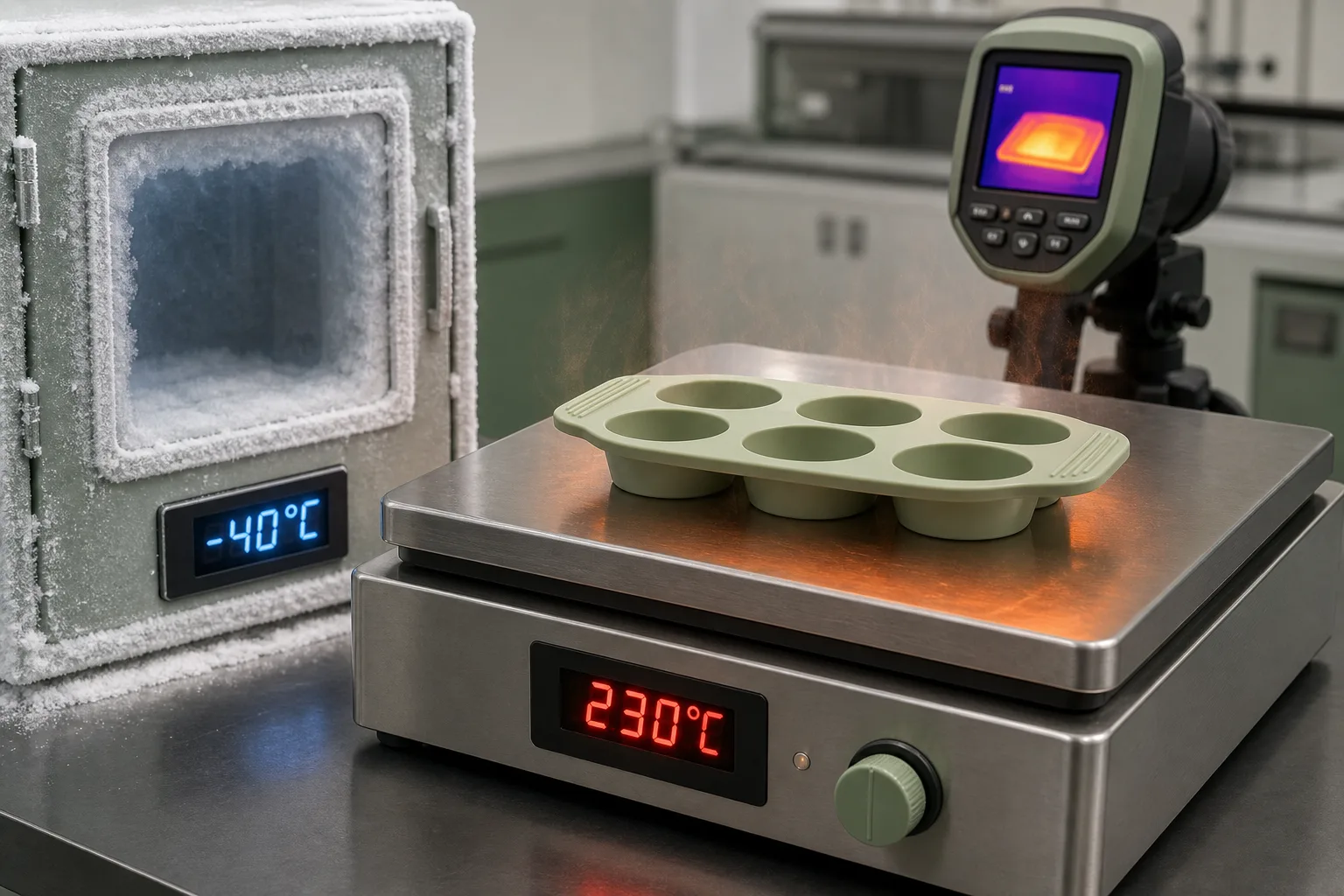
Standard food-grade silicone has a service temperature range of -40°C to 230°C (-40°F to 446°F), with some specialty formulations reaching -60°C to 260°C. The wide range is a direct consequence of the silicon-oxygen bond in the polymer backbone — the Si-O bond has a dissociation energy of ~452 kJ/mol, significantly higher than the ~347 kJ/mol carbon-carbon bond in most polymers. Silicone doesn't melt (it's a thermoset with crosslinked structure) and doesn't freeze functionally (its glass transition temperature is ~-127°C, well below any residential or commercial freezer). For retail kitchenware, this range covers freezer, refrigerator, dishwasher, microwave, and oven use without material failure.
What is silicone’s actual thermal service range?
Standard food-grade silicone: -40°C to 230°C (-40°F to 446°F). Specialty formulations from qualified compound houses reach -60°C to 260°C. The specific rating depends on the cure system (platinum-cure or peroxide-cure), the compound-house material specification, and post-cure discipline. Always check the master-batch lot certificate — not just the marketing sticker. For most residential kitchen use, the -40°C to 230°C range covers freezer, refrigerator, dishwasher, microwave, and standard oven baking without concern.
The range varies subtly across formulations. The compound house’s material spec is the definitive source. Typical values across the food-grade silicone category:
| Formulation category | Cold end | Hot end | Typical application |
|---|---|---|---|
| Standard food-grade silicone (peroxide-cure, post-cured) | -40°C | 230°C | Retail kitchenware, drying mats, sink grids, utensils |
| Premium food-grade silicone (platinum-cure, standard) | -50°C | 240°C | Premium retail bakeware, oven mitts, baby feeding |
| Medical-grade silicone (platinum-cure, USP Class VI1) | -60°C | 260°C | Medical-adjacent accessories, infant feeding, personal care |
| Specialty high-temp silicone (phenyl-modified) | -50°C | 300°C | Industrial gaskets, commercial kitchen sustained-heat use |
| Fluorosilicone (FVMQ) | -60°C | 200°C | Aggressive chemical + moderate temp — fuel systems, oil resistance |
For retail programs, the standard -40°C to 230°C range covers virtually every use case — freezer storage, dishwasher cycles, microwave reheating, and residential oven baking at typical 150-230°C temperatures. Programs targeting sustained commercial kitchen use above 250°C should spec premium or specialty formulations explicitly.
Why does silicone tolerate temperatures that melt plastic?
The Si-O bond in the polymer backbone. Silicone's backbone is polydimethylsiloxane — a chain of alternating silicon and oxygen atoms with methyl side groups. The Si-O bond has a dissociation energy of ~452 kJ/mol[^ashby-materials], significantly higher than the ~347 kJ/mol C-C bond in most thermoplastics. It takes more thermal energy to break silicone chains, which is why silicone maintains structural integrity at temperatures that melt polypropylene, polyethylene, PET, and polystyrene. Silicone is also a thermoset with crosslinked structure — it doesn't melt at any temperature; it slowly oxidizes over long dwell times above ~250°C.
Bond dissociation energy comparison
| Bond | Dissociation energy (kJ/mol) | Where it appears | Thermal implication |
|---|---|---|---|
| Si-O (siloxane) | ~452 | Silicone polymer backbone | Highest thermal stability of common polymer backbones |
| C-F (carbon-fluorine) | ~485 | PTFE, PFA (fluoropolymers) | Similar/slightly higher — but PFAS regulatory concerns |
| C=O (carbon-oxygen double bond) | ~750 | Ester/carbonyl groups | Very high but requires specific chemistry to leverage |
| C-C (carbon-carbon) | ~347 | Polyethylene, polypropylene, polystyrene backbone | Standard for common polymers — melts at 100-160°C typically |
| C-H (carbon-hydrogen) | ~413 | All hydrocarbon polymers | Sets ceiling for methyl side group oxidation |
The practical translation: silicone (~452 kJ/mol backbone) requires ~30% more thermal energy to degrade than polyethylene (~347 kJ/mol backbone). The methyl side groups on silicone eventually oxidize at high sustained temperatures — but this happens at 300°C+ over hours, well outside normal kitchen use. Reference data on these bond energies is compiled in materials science texts including Ashby’s Materials Selection in Mechanical Design2 and cross-referenced in the NIST Chemistry WebBook3.
What happens at freezer temperatures — does silicone become brittle?
No. Silicone's glass transition temperature (Tg) is ~-127°C[^nist-webbook] — well below any residential or commercial freezer temperature. Below Tg, silicone would become rigid and brittle; above Tg (which is everywhere in normal use), it stays flexible and rubbery. Freezer temperatures (-18°C to -25°C) are 100°C+ above Tg. Even dry ice temperature (-78°C) is 50°C above Tg. Silicone ice trays, freezer bags, and cold-storage accessories work as designed at any freezer or subzero temperature encountered in food-service use.
The glass transition temperature is the physical parameter that matters for cold-end behavior. At Tg, an amorphous polymer transitions between a rubbery and a glassy state — flexible above Tg, brittle below. For most common polymers, Tg sits between -100°C and +150°C depending on the specific material. Polydimethylsiloxane’s Tg of ~-127°C is one of the lowest in the polymer world, which is why silicone stays functionally rubbery at temperatures that embrittle PVC, polypropylene, and PET.
Cold-end behavior of silicone in practice:
- Standard freezer (-18°C): No change. Silicone remains flexible; ice cubes release from silicone trays easily; freezer bags flex normally.
- Deep freezer (-30°C): No change. Some slight stiffening but well within functional range.
- Dry ice contact (-78°C): Minor stiffening. Silicone remains flexible enough for demolding. No brittle failure.
- Liquid nitrogen (-196°C): This is 69°C below Tg. Silicone becomes glassy and brittle here — but this is well outside food-service use. Cryogenic-application programs use specialty low-Tg silicone formulations.
Practical implication for retail kitchenware: freezer trays, ice cube molds, freezer bags, popsicle molds, and cold-storage accessories all perform as designed at any freezer temperature encountered in residential or commercial food service.
What actually happens above 230°C — does silicone burn or melt?
Neither, in the normal sense. Silicone is a thermoset — the polymer chains are permanently crosslinked, so silicone can't melt at any temperature. Above ~230°C sustained, silicone slowly degrades through oxidation of the methyl side groups and eventual chain scission. This shows as discoloration (yellowing → browning over hours), gradual stiffening, and eventual embrittlement. Short excursions to 250-300°C are non-destructive. Direct flame contact (600°C+) will eventually char silicone, but even this doesn't produce toxic combustion products in the way that thermoplastics do — silicone burns to primarily silica (SiO₂) and CO₂.
High-temperature behavior timeline (standard food-grade silicone in sustained 250°C oven)
| Duration | Visible effect | Material property change |
|---|---|---|
| 0-30 min | None | None measurable |
| 1-3 hr | Slight yellowing possible | Minimal — 5-10% modulus change |
| 5-10 hr | Visible yellowing | 10-20% modulus increase; slight brittleness |
| 20+ hr sustained | Yellowing → brown; loss of clarity in translucent formulations | Significant embrittlement; loss of tear strength |
| 100+ hr sustained | Brown; may develop surface cracks | Substantial mechanical degradation |
For retail kitchen applications, the practical implication: a silicone spatula that occasionally rests near a hot burner element for 5-10 minutes at 250°C is fine. A silicone pastry mat used for 90-minute bakes at 230°C is fine — this is well within the design envelope. A silicone gasket in a commercial oven sustained at 260°C for years will slowly discolor and require replacement on a maintenance cycle. The recovery pathway when discoloration appears is not repair — the material has undergone chemistry change and should be replaced.
Peer-reviewed research on silicone thermal degradation mechanisms is documented in polymer chemistry literature4 and cross-indexed in PubMed for medical-adjacent silicone applications5.
What Wetop OEMs — how do we spec temperature range on production programs?
Wetop specifies temperature range on every master-batch lot certificate. Standard programs: -40°C to 230°C (post-cured peroxide-cure with PFAS-free process aids per BfR Recommendation XV[^bfr-lfgb-xv]). Premium programs: -50°C to 240°C (platinum-cure LSR with USP Class VI compatible formulation[^usp-class-vi]). Specialty high-temp programs available on request at -50°C to 300°C (phenyl-modified silicone). Every batch's temperature rating is documented on the master-batch lot certificate and traceable to the compound-house material specification.
The specification chain:
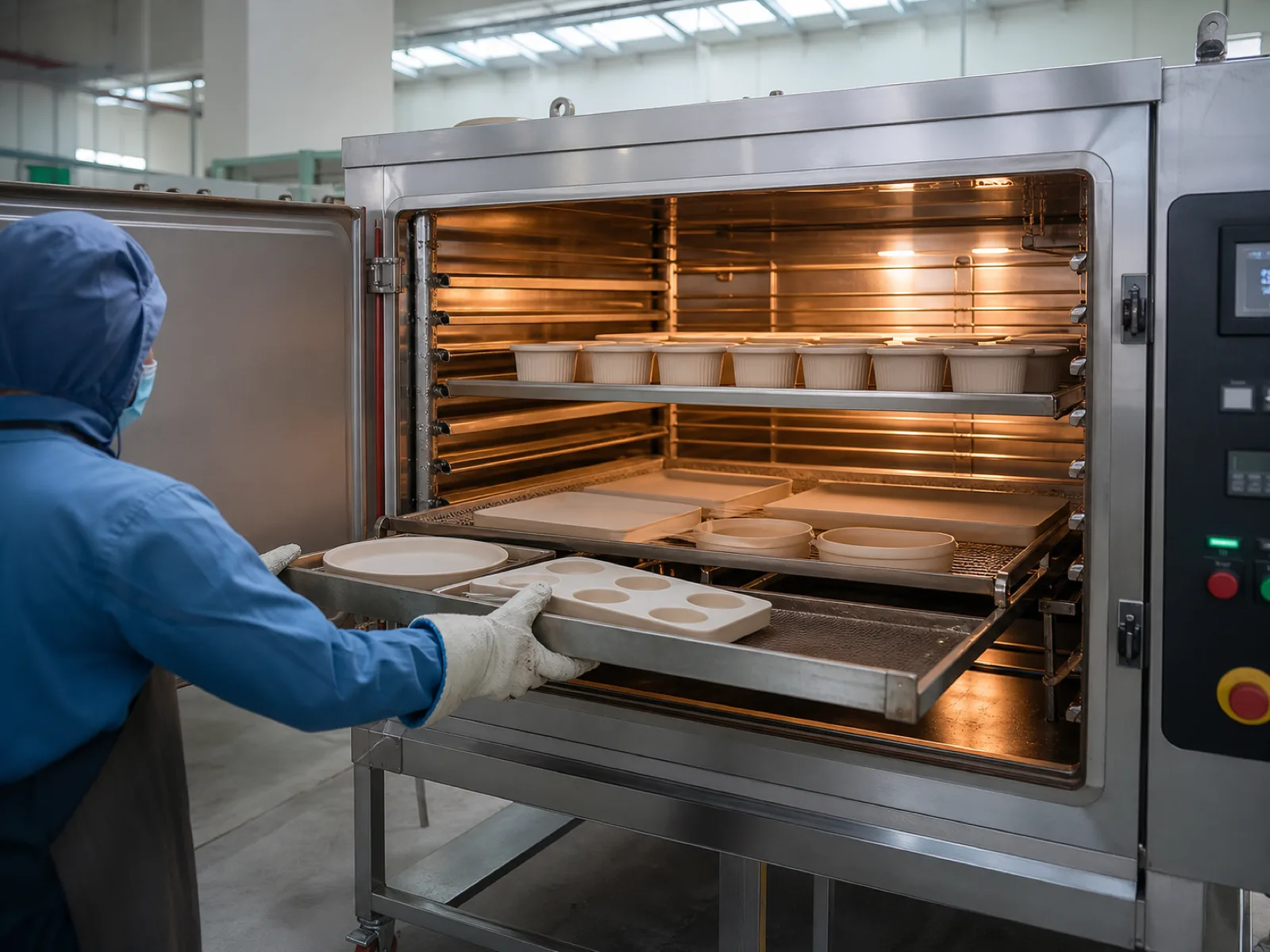
- Standard retail kitchenware program — peroxide-cured HCR, post-cured 4-6 hours at 180-200°C, service range -40°C to 230°C. Suitable for freezer, dishwasher, microwave, oven use to 230°C sustained. FDA 21 CFR 177.26006 and LFGB §30/31 compliant per batch.
- Premium retail program — platinum-cured LSR, service range -50°C to 240°C. Same use cases + medical-adjacent accessories. Also PFAS-free by chemistry (see the platinum vs peroxide guide).
- Commercial kitchen or industrial program — specialty phenyl-modified silicone on request, service range up to 300°C sustained. For programs where sustained 250°C+ operation is expected.
MOQ 500 per SKU on all temperature ratings. See MOQ & lead time on custom silicone kitchenware for how spec choice interacts with tooling schedule; the FDA vs LFGB decoder for how food-contact testing interacts with temperature service; and platinum vs peroxide cure decision for the material selection framework.
Sourcing a program where sustained temperature matters (commercial kitchen, industrial application, medical-adjacent)? Email inquiry@wetopsilicone.com with your service-temperature requirement and target retail tier — we come back with a formulation recommendation and per-batch documentation packet.
Ready to source? Every quote is built against your specification — send a CAD file, a written brief, or reference samples, and an engineer replies within one business day. Request a quote →
Footnotes
-
United States Pharmacopeia. USP <88> — Biological Reactivity Tests, In Vivo. https://www.usp.org/harmonization-standards/pdg/excipients/plastic-materials ↩
-
Ashby, M.F. Materials Selection in Mechanical Design. Butterworth-Heinemann / Elsevier. https://www.elsevier.com/books/materials-selection-in-mechanical-design/ashby/978-0-08-100599-6 ↩
-
US National Institute of Standards and Technology. NIST Chemistry WebBook. https://webbook.nist.gov/chemistry/ ↩
-
American Chemical Society. Journal of Polymer Chemistry. https://pubs.acs.org/journal/jpolyc ↩
-
US National Institutes of Health. PubMed Silicone Polymer Research. https://pubmed.ncbi.nlm.nih.gov/?term=silicone+thermal+stability ↩
-
US Food and Drug Administration. 21 CFR 177.2600. https://www.ecfr.gov/current/title-21/chapter-I/subchapter-B/part-177/subpart-C/section-177.2600 ↩
FAQ
-
What is the actual temperature range for silicone kitchenware?
Standard food-grade silicone: -40°C to 230°C (-40°F to 446°F). Some formulations reach -60°C to 260°C (-76°F to 500°F). The specific rating depends on the compound house's cure system and any additives — always check the master-batch lot certificate, not just the marketing sticker. For most residential and typical retail commercial applications, the -40°C to 230°C range covers freezer to oven use without concern. See the [FDA vs LFGB decoder](/guide/fda-vs-lfgb-silicone/) for how testing standards define the ceiling.
-
Why does silicone tolerate temperatures that would melt plastic?
The polymer backbone is different. Silicone is polydimethylsiloxane — a chain of alternating silicon and oxygen atoms with methyl side groups. The Si-O bond in the backbone has a dissociation energy of ~452 kJ/mol[^ashby-materials], significantly higher than the C-C bond in carbon-based polymers (polyethylene ~347 kJ/mol). This means it takes more thermal energy to break silicone chains, which is why silicone maintains structural integrity at temperatures that would melt or chemically degrade polypropylene, polystyrene, and most thermoplastics. Silicone is also a thermoset (crosslinked), not a thermoplastic — it doesn't melt at any temperature; it slowly degrades through oxidation over long dwell times above ~250°C.
-
What happens to silicone at freezer temperatures?
Nothing structurally. Silicone's glass transition temperature (Tg) is ~-127°C for polydimethylsiloxane[^nist-webbook] — well below any residential or commercial freezer temperature. Below Tg, silicone would become rigid and brittle; above Tg (which is everywhere in normal use), it stays flexible and rubbery. Freezer temperatures (-18°C to -25°C) are 100°C+ above Tg. Even dry ice temperature (-78°C) is 50°C above Tg. Silicone ice trays, freezer bags, and cold-storage accessories work as designed at any freezer temperature; there is no brittleness, mechanical failure, or dimensional distortion in normal use.
-
Can silicone melt?
No — silicone is a thermoset polymer with crosslinked structure. Thermosets can't melt because their crosslinks are covalent bonds, not the physical entanglements of thermoplastics. What silicone can do is degrade thermally through oxidation of the methyl side groups and eventual chain scission at very high sustained temperatures (~300-400°C for hours). This shows as discoloration (yellowing, then browning), loss of flexibility, and eventual embrittlement. In normal kitchen use, this never happens — the temperatures and dwell times are too low. Silicone in professional kitchens (repeated 230°C dwell for years) will slowly discolor over multi-year service life; it doesn't melt or fail suddenly.
-
What does 230°C mean in practice for silicone kitchenware?
230°C is the sustained-service ceiling for standard food-grade silicone. Practical implications: bakeware, pastry mats, and utensils are safe in a 230°C oven for the typical 30-90 minute baking cycles residential and commercial kitchens run. Short excursions to 250-260°C (e.g., accidentally leaving a silicone spatula near a hot stovetop element for 10 minutes) are non-destructive. Sustained exposure above 230°C — broiler contact for hours, direct flame contact, laying silicone on a red-hot burner — will slowly discolor and reduce mechanical properties. For commercial kitchen applications where sustained 250°C+ contact is expected, specify silicone rated to 260°C or 300°C (available formulations exist).
-
How does silicone's thermal stability compare to other food-contact materials?
Silicone tolerates a wider thermal range than most alternatives. Comparison at food-contact temperatures — polypropylene service ceiling ~100°C (melts at ~160°C); polyethylene ~80°C ceiling; PET ~70°C ceiling; melamine ~80-100°C ceiling; polystyrene ~70°C ceiling. Materials that match or exceed silicone's range: PFA and PTFE (fluoropolymers, up to 260°C — but with PFAS concerns[^echa-pfas-proposal]), ceramics, stainless steel. For most kitchen accessory categories that need both freezer and oven service, silicone is the only polymer that spans the range without failure. See [silicone vs diatomaceous drying mats](/guide/silicone-vs-diatomaceous-drying-mats/) for how thermal range factors into material selection at retail.
-
Does the temperature range change based on cure system (platinum vs peroxide)?
Marginally. Both cure systems produce silicone with -40°C to 230°C service range as standard baseline. Platinum-cured silicone with USP Class VI grade formulation[^usp-class-vi] typically reaches -60°C to 260°C on premium compound-house materials. Peroxide-cured silicone with disciplined post-cure at 180-200°C for 4-6 hours per BfR Recommendation XV[^bfr-lfgb-xv] achieves the standard -40°C to 230°C range. Under-post-cured peroxide-cured silicone may show a slight first-heat odor at temperatures above 180°C due to residual byproducts — a compliance failure, not a thermal ceiling issue. See [platinum vs peroxide cure decision](/guide/platinum-cured-vs-peroxide-cured-silicone/) for the full framework.
-
Are there any silicone applications where the temperature range is a limiting factor?
A few. Direct-flame contact (over gas stove burners without a barrier) can produce sustained temperatures above 300°C at the contact point — outside standard silicone's envelope. Continuous exposure to cooking oil at deep-fry temperature (~180°C sustained) is within range but accelerates any oxidation degradation over multi-year service. Laser-etched or IML-decorated silicone parts should be spec'd carefully for prolonged high-temperature applications — the decoration bond is less thermally stable than the base silicone. Industrial applications approaching 260°C sustained typically move to fluorosilicone (temperature range up to 200°C+ but with better chemical resistance) or specialty high-temp silicone formulations. For 99% of retail kitchenware and consumer accessory use, standard silicone's -40°C to 230°C range is more than adequate.
References
Authoritative sources cited in this guide
- Butterworth-Heinemann / Elsevier. Materials Selection in Mechanical Design (Ashby). https://www.elsevier.com/books/materials-selection-in-mechanical-design/ashby/978-0-08-100599-6 — The reference text on materials science whose Si-O bond dissociation energy tables (~452 kJ/mol) inform silicone thermal analysis. Ashby's material property charts are the standard framework for polymer comparison.
- US National Institute of Standards and Technology (NIST). NIST Chemistry WebBook — Polydimethylsiloxane. https://webbook.nist.gov/chemistry/ — The authoritative reference for the -127°C glass transition temperature (Tg) of polydimethylsiloxane cited throughout this guide.
- International Organization for Standardization. ISO 9001:2015 — Quality Management Systems — Requirements. https://www.iso.org/standard/62085.html — The QMS standard behind the master-batch lot certificate documenting the specific cure system and temperature-range formulation for each production batch.
- US Food and Drug Administration. 21 CFR 177.2600 — Rubber articles intended for repeated use. https://www.ecfr.gov/current/title-21/chapter-I/subchapter-B/part-177/subpart-C/section-177.2600 — The US regulation whose extraction testing establishes food-safety at specific service temperatures — the compliance framework behind the practical temperature range.
- German Federal Institute for Risk Assessment. BfR Recommendation XV — Silicones. https://www.bfr.bund.de/en/bfr_recommendations_on_food_contact_materials-7498.html — The technical standard behind LFGB §30/31 organic volatile testing at defined time-temperature conditions — establishes the practical service-temperature envelope.
- United States Pharmacopeia. USP <88> — Biological Reactivity Tests, In Vivo. https://www.usp.org/harmonization-standards/pdg/excipients/plastic-materials — The biocompatibility standard applied to premium/medical silicone formulations — typically extends thermal range to -60°C to 260°C on qualifying compounds.
- US National Institutes of Health (NIH) — National Library of Medicine. PubMed Silicone Polymer Research. https://pubmed.ncbi.nlm.nih.gov/?term=silicone+thermal+stability — Peer-reviewed research database for silicone polymer thermal stability studies — reference literature for the specific thermal degradation mechanisms discussed in this guide.
- American Chemical Society (ACS). Journal of Polymer Chemistry (American Chemical Society). https://pubs.acs.org/journal/jpolyc — The peer-reviewed publication for polymer science research including silicone thermal degradation mechanisms — reference framework for the oxidative crosslinking discussion.
- European Chemicals Agency (ECHA). PFAS Universal Restriction Proposal. https://eur-lex.europa.eu/legal-content/EN/TXT/?uri=CELEX%3A32006R1907 — The regulatory framework behind PFAS-free spec adoption — relevant because PTFE/PFA fluoropolymers compete with silicone in the high-temperature range but face increasing PFAS regulatory scrutiny.
Start a custom program
Send a brief. Get an engineer’s reply in one business day.
Every Wetop program is tooled from a customer’s specification. Send a CAD file (STEP · IGES · DWG) or a written brief and we’ll reply with a mold cost estimate, price brackets at MOQ 500 / 1,000 / 5,000, and any engineering questions.