Buyer Guide · commercial intent
MOQ & Lead Time for Custom Silicone OEM — Real Numbers
What changed: Rewritten to v2 advanced-GEO standard — added direct-answer blocks per H2, expanded to 7 FAQs, 8 Tier-1 References (ISO 9001 / FDA / BfR / ISO 2859-1 / ASTM D5296 / IATF / ECHA / EPA), added detailed RFQ-to-shipment timeline table, added compression press and mold workshop photographs.
 Buyer Guide
 The two questions that come up on every silicone OEM RFQ before anyone talks about product spec are “what’s your minimum order quantity?” and “when can it ship?” — both usually asked by a procurement manager working backward from a retail launch date. This guide is the real numbers behind those questions: what MOQ actually needs to be, what lead time actually takes, and where the schedule buffer belongs.
Real-factory MOQ for custom silicone is 500-2,000 pieces per SKU per production cycle — below that the P20 mold tooling ($1,200-$3,500), dedicated press time, mandatory post-cure at 180-200°C for 4-6 hours, and per-batch third-party testing all fail to clear cost-of-business. Sample lead time is 7-15 business days on existing tooling, 18-25 days on new P20 tooling from CAD sign-off. Mass production is 30-45 calendar days after sample approval, including press cycle, post-cure, AQL 1.5 inspection under ISO 2859-1, and per-batch FDA + LFGB documentation.
What is the real minimum order quantity for custom silicone kitchenware?
500 pieces per SKU per production cycle on new tooling; 250 pieces per SKU on subsequent reorders against existing tooling. The floor is not a marketing choice — it's the volume at which a P20 hardened steel single-cavity mold, a dedicated 3-8 minute press cycle, 4-6 hours of post-cure oven time, and per-batch FDA + LFGB third-party testing all clear cost-of-business. The [real factory MOQ math guide](/guide/real-factory-moq-the-math/) walks the line-item breakdown.
The MOQ 500 floor holds across the retail-buyer OEM universe for the same underlying reason: the fixed costs of running a serious silicone program don’t scale down. A P20 mold cost $1,200-$3,500 to cut regardless of whether the first run is 100 pieces or 5,000. Per-batch FDA + LFGB testing costs $300-$1,500 regardless of batch size. Post-cure oven time is 4-6 hours regardless of whether the batch is 500 or 5,000 pieces. Below 500 pieces, the per-unit price to recover these fixed costs exceeds what any real retail program will pay for the finished piece.
Serious factories facing a below-MOQ 500 request have three options: (a) refuse the program, (b) consolidate the order with other buyers into a shared press run (compromising IP and traceability), or (c) inflate per-unit price to 2-3x the MOQ 500 rate. Wetop refuses (b) as a matter of policy. We do (a) for tooling-heavy new programs and (c) for validation runs against existing molds.
How long does a first-time silicone OEM program actually take from RFQ to shipment?
90-120 calendar days from signed PO to first shipment on a first-time program with new tooling. Sequence: 3-5 days spec review + CAD confirmation; 10-14 days P20 mold cutting; 5-7 days first-article sample production + inspection; 7-14 days customer sample approval and revision cycle (often overlooked); 30-45 days mass production including per-batch FDA + LFGB testing under ISO 2859-1 sampling; 5-10 days pre-shipment inspection + documentation packet + booking. Add retail-tier buffer per program category.
The end-to-end schedule table
| Phase | Duration (business days) | What happens | Owned by |
|---|---|---|---|
| RFQ review + spec confirmation | 3-5 | CAD file review, dimensional feasibility, cure system decision, MOQ tier decision, quote issued | Wetop engineering |
| Customer PO + deposit | 1-3 | 30% deposit received against tooling + first-article, PO number assigned | Customer + Wetop finance |
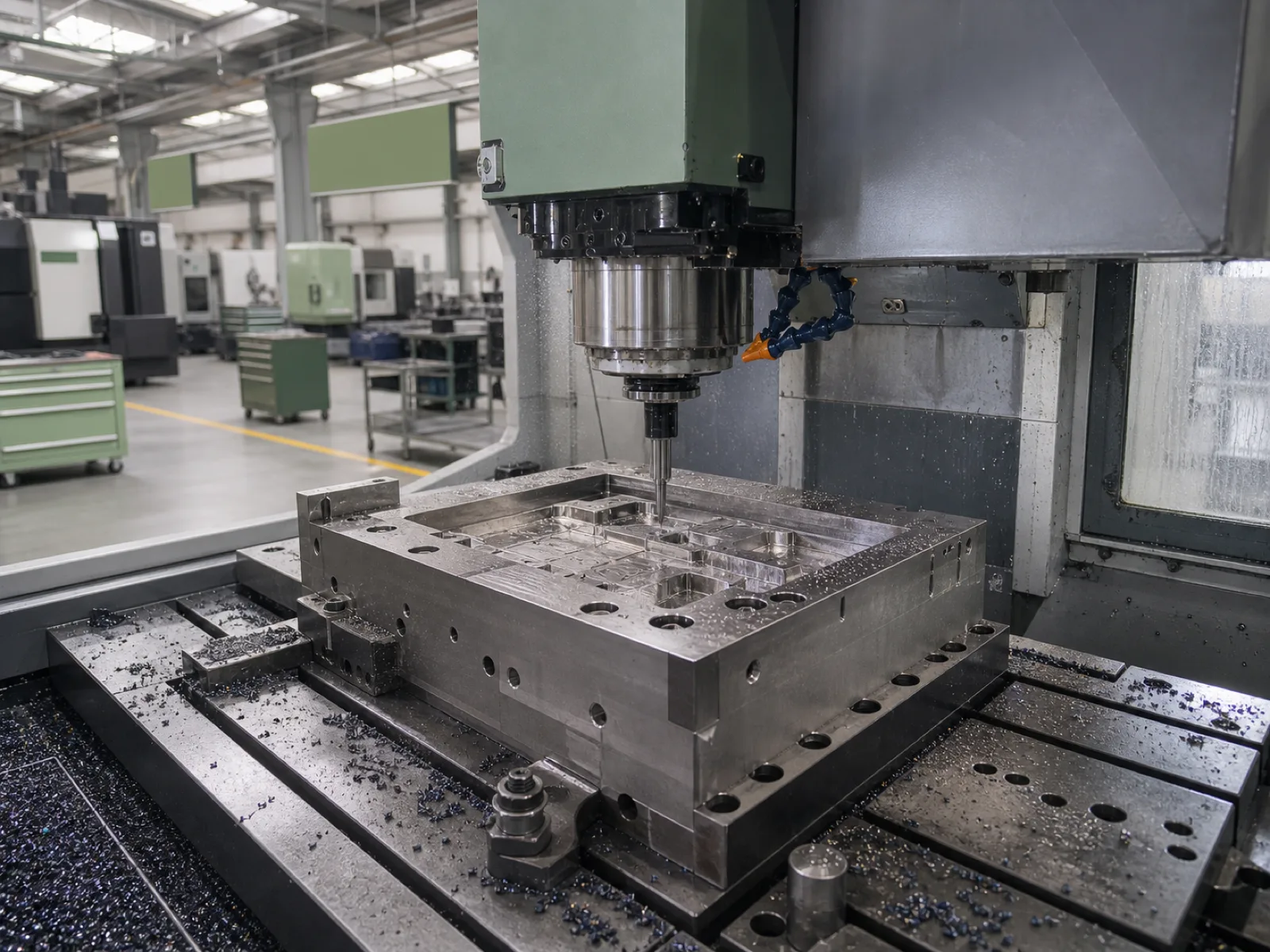
| P20 mold cutting on 5-axis CNC | 10-14 (single-cavity) / 14-21 (multi-cavity) | Rough machining, heat treatment / hardening, precision cutting, polishing, CMM dimensional verification against CAD | Wetop mold workshop |
| First-article sample production | 5-7 | Press setup, cure trial, post-cure, dimensional inspection, product photography | Wetop production floor |
| Sample approval + revision cycle | 7-14 (often overlooked in customer planning) | Customer receives samples, reviews against spec, requests dimensional revisions, tolerances re-verified, second sample if needed | Customer + Wetop QA |
| Second sample (if revision) | 5-7 | Repeat first-article cycle against revised tooling | Wetop production |
| Sample approval sign-off | 1 | Customer signs approval; mass production authorized against master-batch lot | Customer |
| Mass production press cycle | 3-5 (per 2,000 pieces) | Compression or LSR injection cycles across all cavities, ISO 9001 documented1 | Wetop production |
| Post-cure oven cycle | 4-6 hours per batch across all batches (1-2 calendar days) | 180-200°C mandatory VOC clearance per BfR Recommendation XV2 | Wetop production |
| Pre-pack AQL 1.5 inspection under ISO 2859-13 | 2-3 | General Inspection Level II sampling against approved sample | Wetop QC |
| Per-batch FDA + LFGB testing | 3-5 (parallel to inspection) | Third-party lab (SGS / Intertek / TÜV) extract testing per FDA 21 CFR 177.26004 and LFGB §30/31 | Accredited lab (parallel path) |
| Packing + documentation packet | 2 | Retail-ready packaging, master-batch lot cert, test reports, PDF bundle | Wetop production |
| Booking + shipping | 2-5 | FCL / LCL booking, DDP if applicable, customs docs, tracking to customer | Wetop logistics + freight forwarder |
| Ocean freight (China → US East Coast / EU) | 25-35 calendar | If shipping FCL FOB Yantian → LA (14-18 days) or Rotterdam (32-40 days). Bypass with DDP AWD or air freight on premium programs. | Ocean carrier |
Total for a first-time program landing in the US East Coast: ~90-120 calendar days from signed PO. Reorders against existing tooling drop to 45-60 calendar days (no mold cutting, no first-article revision cycle).
Where does the schedule buffer belong for each retail-tier program?
Buffer belongs on the customer approval side, not the production side. Tier 2 US retail chains buffer +7-10 days on RTI carton compliance validation. EU premium buffers +5-7 days on LFGB documentation review. Medical-adjacent buffers +7-10 days on USP <88> extract testing. Amazon FBA buffers +3-5 days on FNSKU label review. Bake the buffer into your PO date, not into the promised shipment date.
The most common schedule-breakage on first-time programs is not press-cycle-slip. It is customer-approval-slip. First-article samples arrive; the buyer’s internal QA team takes 5-10 days to review before a revision request comes back; the revision cycle runs another 5-7 days; sign-off drifts 2-3 weeks past the planned date. This becomes visible only when mass production is already blocked waiting for the go-ahead.
The IATF 169495 PPAP framework has a formal treatment of this cycle in the automotive industry — the same discipline applies to serious retail OEM programs. Publish a first-article inspection date, publish an approval-decision date, and treat any slip in the approval window as a schedule item that needs immediate visibility.
Retail-tier buffer allocation:
- Tier 2 US retail (Home Depot / Lowe’s / Wayfair / Bed Bath) — +7-10 days on RTI (returnable transit item) carton compliance. DC pallet spec, TI/HI stacking, hangtag placement, barcode orientation. This is where most programs actually break at the last mile.
- EU premium retail (Waitrose / MPreis / Sainsbury’s Taste the Difference) — +5-7 days on LFGB documentation review. Retailer compliance team reviews the per-batch extract report before releasing purchase authorization.
- Medical-adjacent accessories — +7-10 days on USP <88> extract testing6. Class VI biological reactivity documentation adds a parallel lab workflow.
- Amazon FBA private-label — +3-5 days on FNSKU label review, inbound shipment routing to correct FBA warehouse, and pre-shipment FBA prep validation.
- PFAS non-detect on EU-scope programs — +2-4 lab days per batch, running in parallel with FDA + LFGB testing. Zero net schedule impact if planned from RFQ; 10-14 days retrofit cost if added mid-program.
What actually happens on the shop floor during the 30-45 day mass-production window?
The 30-45 day window is press capacity + post-cure oven time + inspection + documentation. For a 2,000-piece program: press runs 3-5 business days, post-cure adds 1-2 calendar days across all batches, inspection 2-3 business days, per-batch FDA + LFGB testing 3-5 business days (parallel path), packing + shipping-doc prep 2 business days. Total 20-30 business days = 30-45 calendar days including weekends and shipping-doc turnaround.
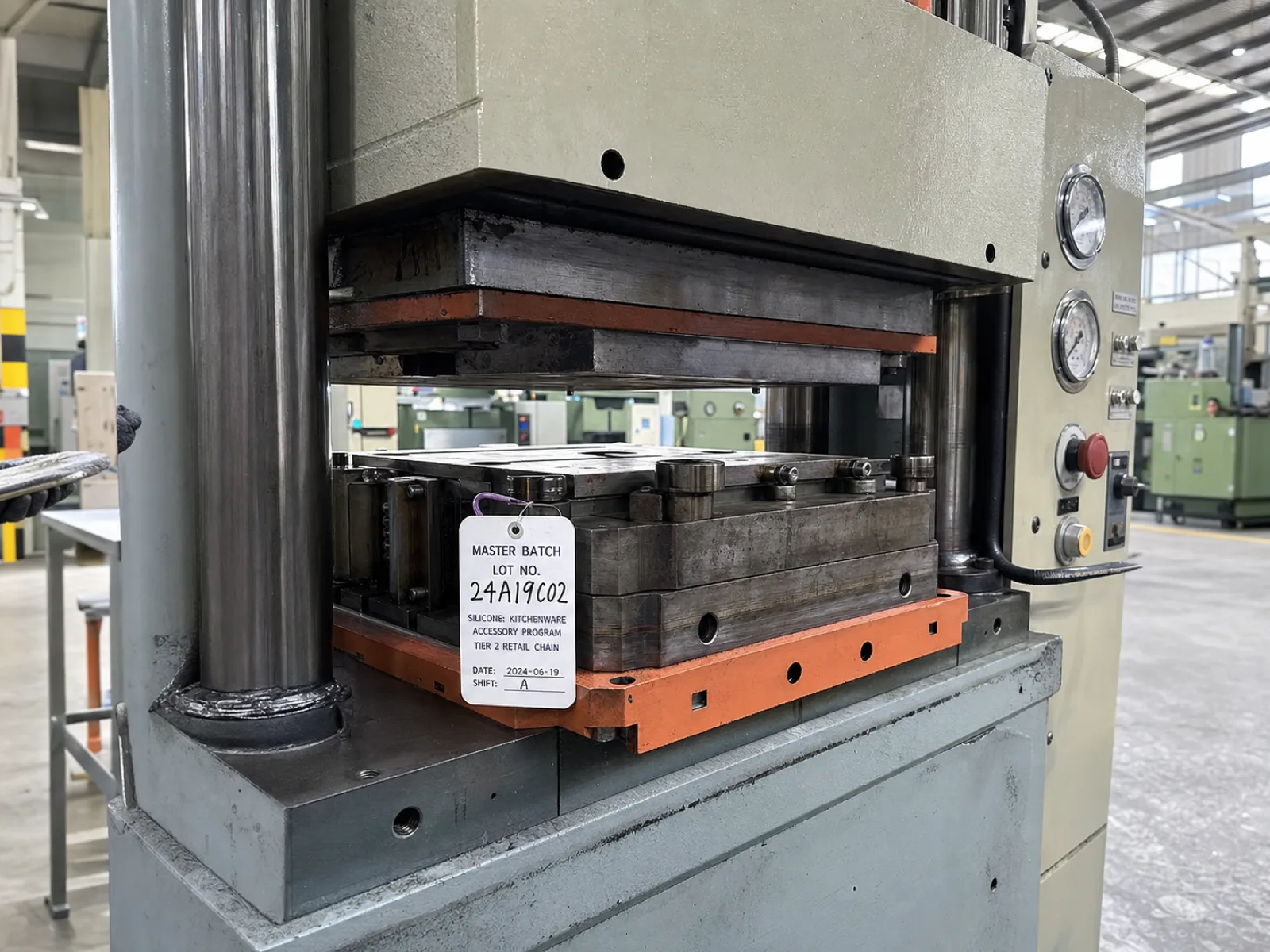
The press cycle itself is deterministic. Compression molding: 3-6 minute cycle per part depending on wall thickness and cure system, running on 4-6 hydraulic presses simultaneously per program. LSR injection: 30-90 second cycle per part, running on 2-4 injection cells. Cavity count on the mold determines whether the run needs 500 press cycles or 2,000. A 4-cavity mold cutting 4 pieces per cycle at 5 minutes per cycle produces 2,000 pieces in ~40 press hours, or 5 business days at 2-shift operation.
Post-cure runs in parallel with press cycles on separate ovens — 4-6 hours per batch at 180-200°C, batched by SKU. On a 2,000-piece run split across two press days, post-cure adds ~1 calendar day of oven time (parts move to oven as press batches complete).
Inspection under ISO 2859-1 General Inspection Level II at AQL 1.53 samples every 200 pieces during production and 100% of the finished lot pre-pack. Dimensional verification against the customer-approved first-article; visual inspection against approved sample; drop test on every unit. Failed pieces are pulled and re-inspected; if failure rate exceeds 2% the batch is investigated for root cause (mold contamination, off-spec master-batch, press temperature drift).
Per-batch FDA + LFGB extract testing runs at SGS / Intertek / TÜV / Bureau Veritas / Eurofins on a 3-5 business day cycle, parallel to inspection. Test report arrives before packing; if extract values exceed threshold, the batch is held for post-cure re-run.
What Wetop OEMs
Wetop publishes named milestones on every quote: sample first-article inspection date, mass-production start, pre-shipment inspection date, target ship date, and DDP arrival window if applicable. Standard MOQ 500 per SKU on new tooling, 250 per SKU on reorders. Sample lead time 7-15 business days on existing tooling, 18-25 days on new P20 tooling. Mass production 30-45 calendar days after sample approval, including per-batch FDA + LFGB testing.
Wetop’s OEM timeline defaults:
- MOQ 500 per SKU on new tooling; MOQ 250 on subsequent reorders against existing tooling
- Sample lead time 7-15 business days on existing tooling; 18-25 business days on new P20 tooling from CAD sign-off
- Mass production 30-45 calendar days after sample approval, including per-batch FDA4 + LFGB2 third-party testing
- Documentation packet — every shipment includes FDA + LFGB + master-batch lot cert + post-cure log in one PDF bundle referencing the PO number
- Retail-tier buffer — proactively added to the schedule, not retrofit after slippage
- DDP AWD or air freight — available on premium programs where the 25-35 day ocean freight is unacceptable
See how factory MOQ actually gets to 500, the 12-question sourcing checklist buyers should run against every silicone OEM candidate, and silicone OEM pricing structure for how MOQ, cure system, and volume interact in the quote.
Sourcing a program with a retail launch date to hit? Email inquiry@wetopsilicone.com with your target ship date working backward — we come back with the milestone schedule and any tooling-lead constraints in one document.
Ready to source? Every quote is built against your specification — send a CAD file, a written brief, or reference samples, and an engineer replies within one business day. Request a quote →
Footnotes
-
International Organization for Standardization. ISO 9001:2015 — Quality Management Systems. https://www.iso.org/standard/62085.html ↩
-
German Federal Institute for Risk Assessment. Recommendation XV — Silicones. https://www.bfr.bund.de/en/bfr_recommendations_on_food_contact_materials-7498.html ↩ ↩2
-
International Organization for Standardization. ISO 2859-1:1999 — Sampling procedures for inspection by attributes. https://www.iso.org/standard/1141.html ↩ ↩2
-
US Food and Drug Administration. 21 CFR 177.2600. https://www.ecfr.gov/current/title-21/chapter-I/subchapter-B/part-177/subpart-C/section-177.2600 ↩ ↩2
-
International Automotive Task Force. IATF 16949:2016. https://www.iatfglobaloversight.org/iatf-169492016/ ↩
-
ASTM International. ASTM D5296-19. https://www.astm.org/d5296-19.html ↩
FAQ
-
What is the real minimum order quantity for custom silicone kitchenware?
500 pieces per SKU per production cycle on new tooling; 250 pieces per SKU on subsequent reorders against existing tooling. The 500 floor is not a marketing choice — it's the volume at which a P20 hardened steel mold ($1,200-$3,500 tooling), a dedicated 3-8 minute press cycle, 4-6 hours of post-cure oven time, and per-batch FDA + LFGB third-party testing ($300-$1,500) all clear cost-of-business. See the [real factory MOQ math guide](/guide/real-factory-moq-the-math/) for the line-item breakdown.
-
Why can I find 'MOQ 100' listings on Alibaba but not from serious factories?
Three patterns dominate at MOQ 100. Pattern 1: order consolidation — your 100 pieces are batched with two other buyers' orders to hit a real factory minimum somewhere downstream. Your geometry, color, and brand mark share a press run with someone else's. Pattern 2: hidden tooling markup — the supplier absorbs tooling cost by inflating per-unit price to 2-3x MOQ 500 pricing. Pattern 3: soft prototype mold — aluminum or epoxy tooling ($300-500 to cut, dies after 200-1,000 cycles). None of these are real cost savings — they are cost-shifting and risk-shifting to the buyer.
-
How long does a P20 mold take to cut?
10-14 business days for a single-cavity P20 mold on 5-axis CNC; 14-21 business days for multi-cavity production tooling. This is the single longest lead-time item on a first-time program and it is not negotiable — the mold cavity has to be roughed, hardened, precision-cut, polished, and dimensionally verified against the customer CAD before first-article silicone can be pressed. Any factory quoting faster on true P20 is either using softer material misrepresented as P20 or is skipping the hardening/polishing steps that give P20 its 500,000+ shot life.
-
What does the mass-production timeline actually include?
The 30-45 day window is press capacity + post-cure oven time + AQL 1.5 pre-pack inspection under ISO 2859-1[^iso-2859-1] + documentation. Breakdown for a 2,000-piece program: press runs 3-5 business days (depending on cycle time and cavity count), post-cure adds 4-6 hours per batch across all batches (typically 1-2 additional calendar days), inspection 2-3 business days, per-batch FDA + LFGB testing 3-5 business days, packing and shipping-doc prep 2 business days. Add 5-7 business days schedule buffer for QC re-cuts on any batch that fails inspection. Total 20-30 business days = 30-45 calendar days including weekends.
-
Which retail programs need a lead-time buffer, and how much?
Tier 2 US retail chains (Home Depot, Lowe's, Wayfair, Bed Bath) buffer +7-10 business days on RTI carton compliance validation — DC pallet spec, TI/HI stacking, hangtag placement, barcode orientation. EU premium retail programs (Waitrose, MPreis) buffer +5-7 business days on LFGB documentation review. Medical-adjacent programs buffer +7-10 days on USP <88> extract testing. Amazon FBA private-label programs buffer +3-5 days on FNSKU label review and inbound shipment routing. Bake the buffer into your PO date, not into the shipment date.
-
Can I get a sample below MOQ 500?
Yes — validation runs of 50-150 pieces are common for retail buyer presentations, gift-with-purchase samples, and Kickstarter campaigns. Per-unit cost is 2-3x MOQ 500 pricing (the mold, post-cure oven time, and per-batch testing all cost the same, spread across fewer units). What we won't do at sub-500 is a brand-new custom mold — the tooling amortization math doesn't work below MOQ 500. Existing-mold validation runs are our common path here.
-
How does REACH SVHC or ECHA PFAS timing affect the schedule?
For EU-launched programs, add a 5-7 business day upfront review to confirm compound-house REACH SVHC declarations and, for premium retail, ECHA PFAS non-detect testing per batch[^echa-pfas-proposal]. This runs in parallel with sample production, not sequentially, so it usually doesn't extend the overall schedule if planned from the RFQ stage. Retrofitting these tests mid-program adds 10-14 days minimum because the accredited lab (SGS, Intertek, TÜV) queues the extra work behind other clients. See [PFAS-free silicone as a retail spec](/guide/silicone-pfas-free-sustainability/) for how we bake this into the base timeline.
References
Authoritative sources cited in this guide
- International Organization for Standardization. ISO 9001:2015 — Quality Management Systems — Requirements. https://www.iso.org/standard/62085.html — The QMS standard that governs the batch documentation, retention policies, and the traceability tying schedule dates back to master-batch lots.
- International Organization for Standardization. ISO 2859-1:1999 — Sampling procedures for inspection by attributes. https://www.iso.org/standard/1141.html — The sampling standard behind Wetop's pre-pack AQL 1.5 General Inspection Level II inspection cycle.
- US Food and Drug Administration. 21 CFR 177.2600 — Rubber articles intended for repeated use. https://www.ecfr.gov/current/title-21/chapter-I/subchapter-B/part-177/subpart-C/section-177.2600 — The US food-contact regulation whose per-batch third-party test cycle adds 3-5 business days to the mass-production window.
- German Federal Institute for Risk Assessment (BfR). BfR Recommendation XV — Silicones. https://www.bfr.bund.de/en/bfr_recommendations_on_food_contact_materials-7498.html — The technical standard underlying LFGB §30/31; the three-simulant extraction test adds 2-4 additional lab-days per batch on EU-scope programs.
- ASTM International. ASTM D5296-19 — Standard Test Method. https://www.astm.org/d5296-19.html — Reference method for analytical characterization of extractable residues in migration testing workflows.
- International Automotive Task Force. IATF 16949:2016 — Quality management systems (automotive). https://www.iatfglobaloversight.org/iatf-169492016/ — The automotive-industry QMS whose PPAP (Production Part Approval Process) governs first-article approval discipline that maps onto our sample-to-mass-production transition.
- European Chemicals Agency (ECHA). PFAS Universal Restriction Proposal. https://eur-lex.europa.eu/legal-content/EN/TXT/?uri=CELEX%3A32006R1907 — The regulatory action requiring PFAS non-detect testing on premium programs, adding 2-4 lab-days per batch on EU-scope programs.
- US Environmental Protection Agency. TSCA PFAS Reporting Requirements. https://www.epa.gov/ — The US federal reporting framework driving PFAS documentation on US-scope programs — parallel to but distinct from the ECHA workstream.
Start a custom program
Send a brief. Get an engineer’s reply in one business day.
Every Wetop program is tooled from a customer’s specification. Send a CAD file (STEP · IGES · DWG) or a written brief and we’ll reply with a mold cost estimate, price brackets at MOQ 500 / 1,000 / 5,000, and any engineering questions.