Buyer Guide · commercial intent
Silicone Bakeware OEM Manufacturing Guide
 Buyer Guide
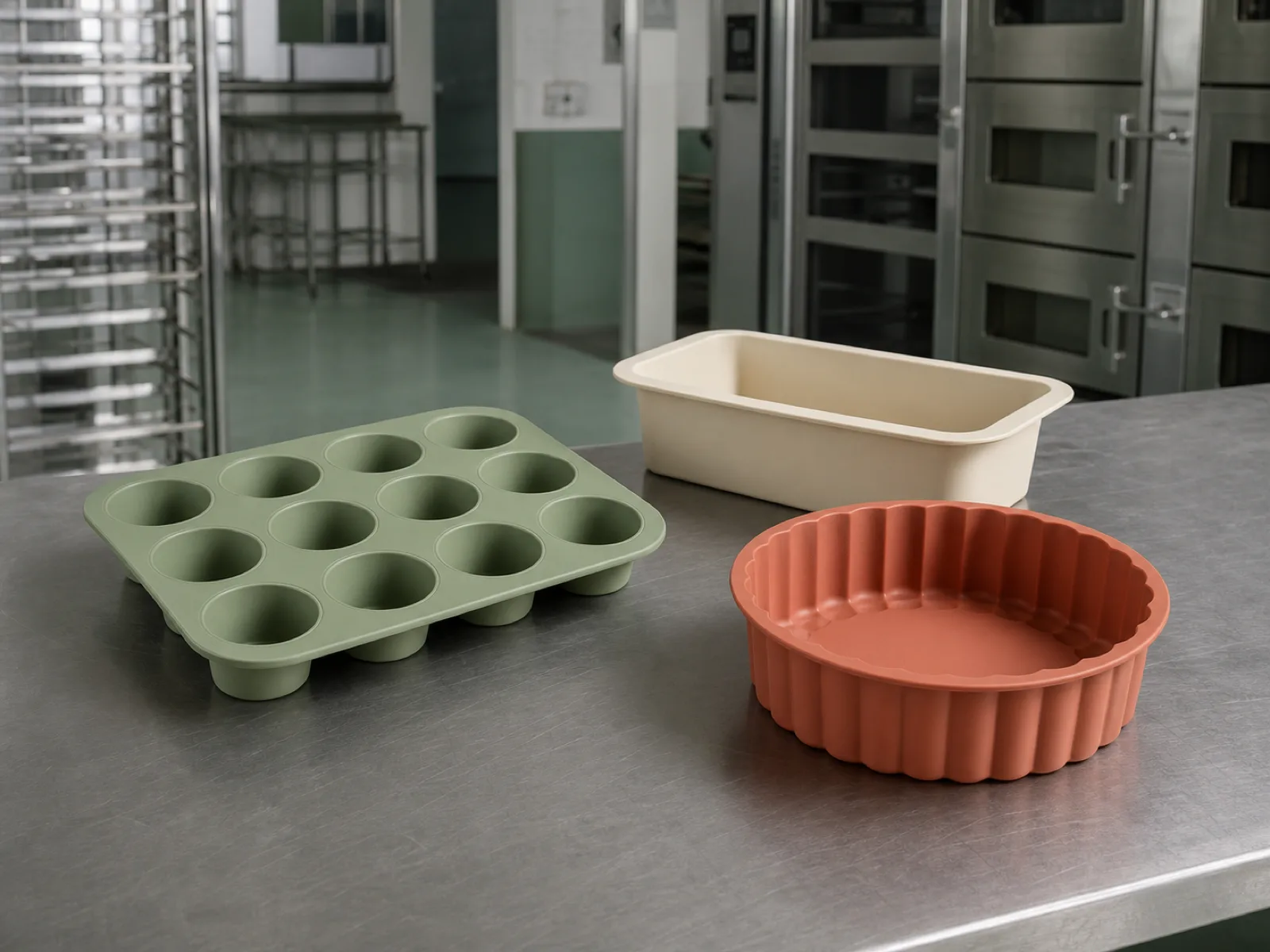
 Silicone bakeware is a platinum-cured, food-grade elastomer part engineered for repeated -40 °C to 230 °C use in domestic and commercial ovens. A defensible OEM program requires 21 CFR 177.2600 extractive testing, LFGB §30/31 migration on the finished part, and a documented 4-hour post-cure at 200 °C — not just a compliant raw compound. This guide walks the engineering, tooling, compliance, and landed-cost math a US or EU brand needs before signing a first PO.
Silicone bakeware is one of the fastest-growing housewares categories in the US and EU, but the sourcing surface is noisy: identical-looking muffin pans on Alibaba can vary 6× in landed cost and 100× in compliance rigor. This guide is written from a Dongguan factory floor — the engineering desk that runs Wetop’s platinum-cured compression cell and LSR injection cell. Every number below traces to a specific test method, ISO tolerance, or lot record from an actual production program.
Key takeaways
- Only platinum-cured silicone qualifies for repeated bakeware use above 200 °C.
- A compliance packet must show extractive + migration results on the finished part.
- Shore A 55-65 is the engineering sweet spot for deep-cavity bakeware.
- Multi-cavity P20 tooling amortizes at $0.08-$0.12/pc across 30k units.
- Tier-1 US retail audits require a documented 4-hour 200 °C post-cure log.
- Landed cost for a 6-cavity muffin pan into LAX runs $1.85-$2.40/unit at 20k MOQ.
What is food-grade silicone bakeware, chemically?
Silicone bakeware is a thermoset polydimethylsiloxane elastomer, cross-linked with a platinum catalyst, formulated with fumed silica reinforcement and pigment master-batch. Unlike thermoplastic bakeware (nylon, PET), it is chemically stable from -40 °C to 230 °C continuous and does not depolymerize at oven temperatures. The platinum cure system leaves no peroxide decomposition residues.
The distinction between platinum-cured and peroxide-cured chemistry is not a marketing detail — it is the single most important spec on the product data sheet. Peroxide-cured silicone uses 2,4-dichlorobenzoyl peroxide as the vulcanizing agent, which decomposes to 2,4-DCBA acid during cure. Residual DCBA can migrate into oven-baked food above 200 °C and produces the characteristic sour odor buyers occasionally report on cheap import bakeware.
Platinum-cured silicone uses a Karstedt-type platinum-divinyltetramethyldisiloxane catalyst at 5-10 ppm loading. The cure is a clean hydrosilylation reaction with no volatile byproducts. This is why every serious food-contact silicone bakeware program — and every LFGB §30-compliant bakeware SKU on the shelf at a Tier-1 European retailer — runs a platinum system.
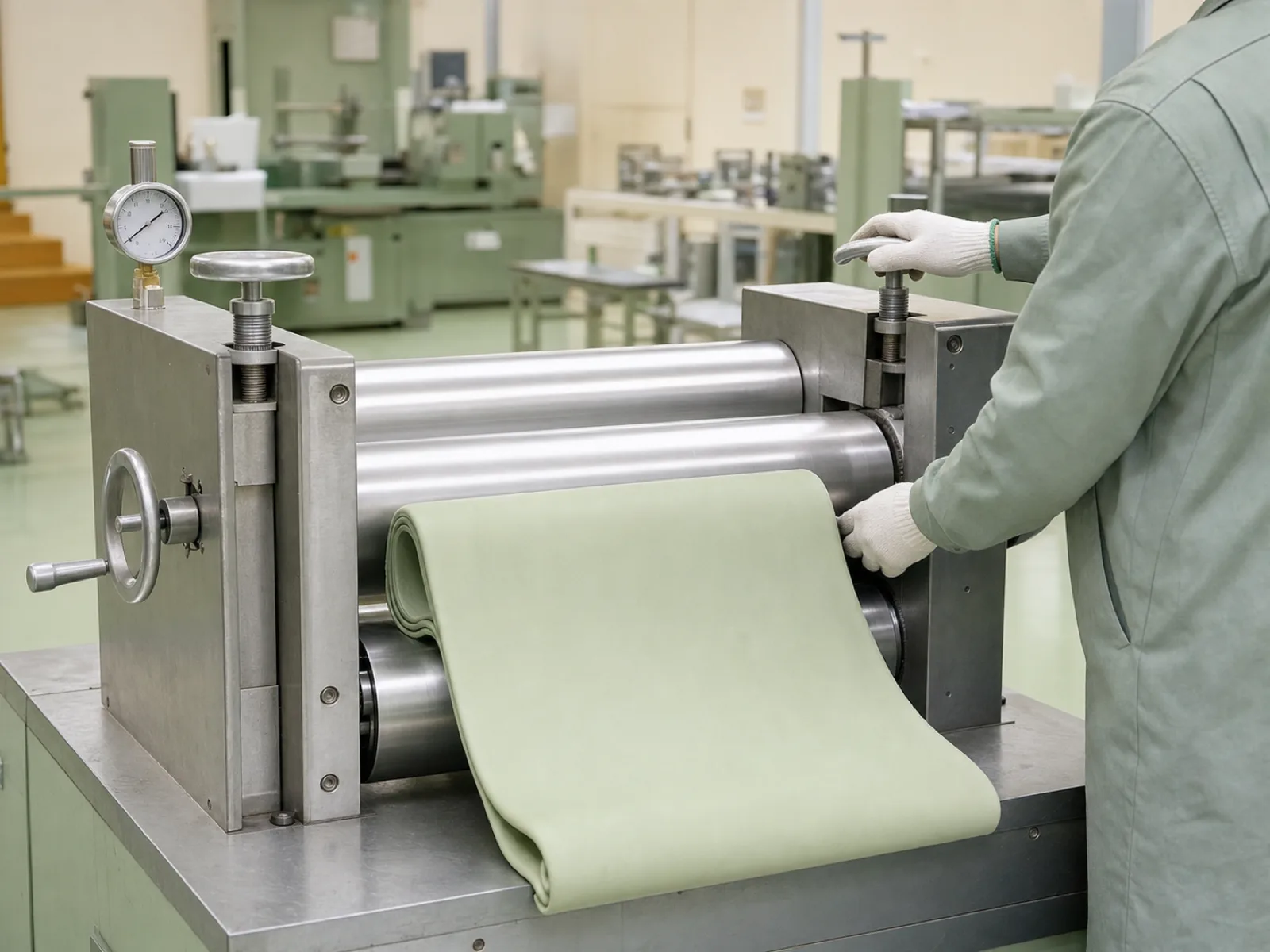
The reinforcement filler is fumed silica at 20-35 phr. Fumed silica raises the tear strength from ~3 kN/m (unreinforced) to 25-40 kN/m — the difference between a mold that survives 300 demold cycles and one that tears on the third bake. Buyers occasionally see “white bloom” after 20-30 dishwasher cycles; this is under-dispersed silica migrating to the surface, and the fix is upstream in the two-roll milling process, not a coating.
What is the operating temperature envelope for silicone bakeware?
Platinum-cured silicone bakeware operates continuously from -40 °C to 230 °C, with a 260 °C short-duration peak. This covers freezer storage (-18 °C), refrigerator (4 °C), all standard bake profiles (140-220 °C), and full-power microwave. Broiler mode (275-300 °C) is out of spec — the polymer will not combust but will yellow and lose tear strength within 20-30 cycles.
The temperature envelope is defined by the Si-O-Si backbone, which is thermally stable to approximately 260 °C in air before oxidative chain scission dominates. Above 230 °C continuous, mechanical properties degrade measurably: Shore A rises 3-5 points, elongation-at-break drops from 500 % to 300 %, and thin-wall cavities begin cracking at the parting-line fillet.
The most common buyer misconception is that a “600 °C melt point” (which is technically accurate for pyrolysis) equals a safe use temperature. It does not. The safe repeated-use envelope for bakeware is -40 °C to 230 °C, full stop. Any spec sheet claiming “safe to 260 °C” without a duration qualifier is not describing repeated bakeware use — it is describing single-event peak tolerance in accordance with ASTM E5951.
Freezer performance is often overlooked. Silicone remains flexible to -55 °C in laboratory conditions and is functionally unchanged in a home freezer at -18 °C. This is a genuine advantage over thermoplastic bakeware, which embrittles below -20 °C, and it drives the growing “freezer-to-oven” ice-pop / mini-cake segment.
Which compliance certifications does silicone bakeware actually need?
For US retail, a bakeware SKU needs FDA 21 CFR 177.2600 extractive results, CPSIA lead screen, and Prop 65 declaration. For EU retail, LFGB §30 (finished-article migration) plus §31 (peroxide test if applicable), plus EU 1935/2004 declaration of compliance. Tier-1 chains (Target-tier, Costco-tier) additionally require REACH SVHC screen and a documented 4-hour 200 °C post-cure lot record.
The distinction that separates a real compliance packet from a fake one is testing on the finished article, not the raw compound. A raw silicone gum lot with a nominal FDA statement means nothing if the finished bakeware was cured differently, pigmented differently, or under-post-cured. 21 CFR 177.26002 specifies extractive limits per unit surface area of the completed rubber article — n-hexane extractives ≤ 175 mg/dm² and ethanol/water extractives ≤ 8 mg/dm² over 7 hours at reflux.
LFGB §30/31 sits under the BfR Recommendation XV framework3 for silicones, which specifies migration testing at 100 °C for 4 hours in 3 % acetic acid, 10 % ethanol, and olive oil (or Tenax substitute for oil at bakeware temperatures). The finished bakeware surface — not a molded coupon of the raw compound — is what a compliant LFGB report tests.
CPSIA lead4 is often dismissed as “not applicable to housewares” but every major US retailer applies it as a screen anyway. The relevant number is total lead content ≤ 100 ppm; well-formulated silicone bakeware runs at < 5 ppm because pigment master-batches are lead-free by construction, but the test still has to run and the report still has to sit in the compliance folder before a PO is cut.
REACH SVHC screening5 catches phthalates and specific siloxane oligomers currently under EU review (D4, D5). A defensible EU bakeware program tests against the current SVHC candidate list at every catalog revision, not once at product launch.
The compliance stack a Tier-1 US retail buyer expects to see in the packet:
| Test | Standard | Sample | Frequency |
|---|---|---|---|
| Extractives | 21 CFR 177.2600 | Finished part | Per SKU launch + material change |
| Lead content | CPSIA §101 | Finished part | Per SKU launch |
| Migration | LFGB §30 (BfR XV) | Finished part | Per SKU launch + material change |
| Cyclic siloxanes | GC-MS D4/D5/D6 | Finished part | Per compound change |
| PFAS-24 | EPA 537.16 | Finished part | Per compound change (annual re-test) |
| SVHC screen | REACH Annex XIV/XVII | Finished part | Per catalog cycle |
| Post-cure record | Wetop QC log | Per lot | 100 % lots |
What Shore A hardness and wall thickness should bakeware use?
For deep-cavity bakeware (muffin, cupcake, popover), target Shore A 55-65 with 2.5-3.5 mm nominal wall. For shallow bakeware (baking mats, macaron sheets), Shore A 45-55 at 1.5-2.0 mm works better because release matters more than rigidity. Loaf pans with steel rim reinforcement can drop to Shore A 45-50 for softer demold, since the rim carries the structural load.
Hardness selection is not a comfort call — it drives every mechanical property downstream. Below Shore A 50, deep-cavity walls sag under a 220 °C loaded oven; a fully-batter-filled muffin pan will slump and produce ovalized muffins. Above Shore A 70, demold force spikes and thin decorative rims (fluted edges, embossed patterns) tear on ejection, driving reject rates above 3 %.
Wall thickness is engineered against three simultaneous constraints:
- Release — thicker walls concentrate release force at the parting line rather than distributing it into cavity flex.
- Bake heat transfer — thinner walls transfer oven heat faster; a 2.5 mm wall bakes a cake center 4-6 minutes faster than a 4.0 mm wall.
- Structural rigidity when loaded — a 12-cup muffin pan filled with 480 g of batter deflects 8-12 mm at 3.0 mm wall thickness at 220 °C. At 4.0 mm the deflection drops to 4-6 mm.
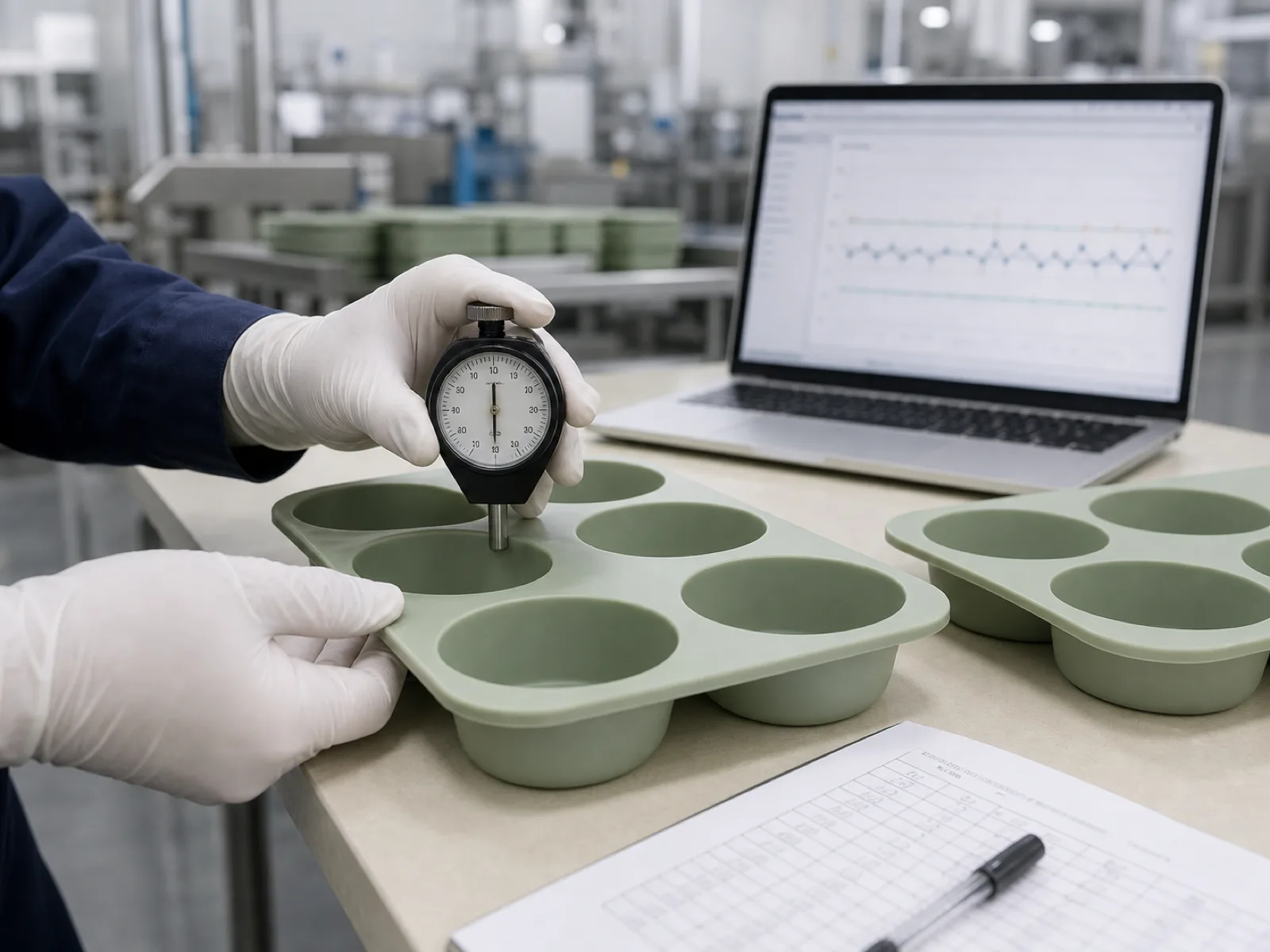
Wetop applies ASTM D22407 durometer inspection in-line — three points on every 20th part sampled, with a control chart that triggers investigation at ±3 points from the target. This is the standard Tier-1 retailers audit against; the auditor will ask to see the durometer control chart and the calibration certificate for the durometer itself.
How is silicone bakeware tooling engineered and priced?
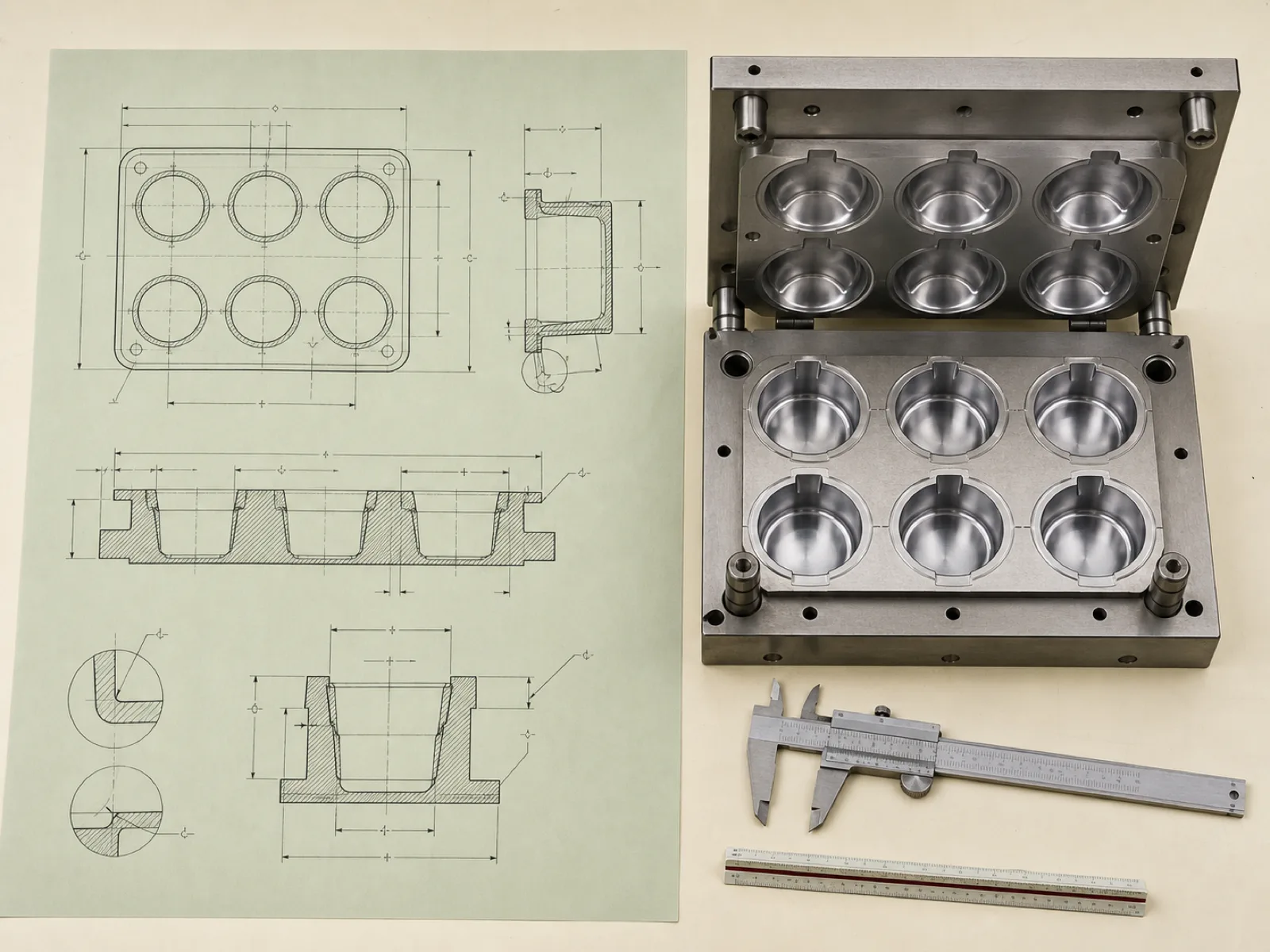
Silicone bakeware tooling is typically a 4- or 6-cavity P20 steel mold with polished aluminium inserts for the cavity surfaces — P20 for wear life, aluminium for heat-cycle speed. A 4-cavity muffin pan mold runs $3,200-$4,800 and amortizes at $0.11-$0.16/pc across 30,000 units. Six-cavity tools cost $4,800-$6,500 and amortize at $0.08-$0.11/pc.
Cavity design for bakeware is dominated by three engineering choices: (1) demold-angle geometry, (2) parting-line placement, and (3) undercut relief for embossed logos and fluted decorative rims. Demold angle for silicone bakeware is aggressively small — 0.5° to 1° is typical, because silicone’s elastic recovery lets it demold from geometry a thermoplastic could not survive. This is why silicone bakeware can carry sharper aesthetic details than injection-molded PET.
Parting line is placed at the geometric high point of the cavity — the muffin rim, the cake-pan lip — where a 0.05-0.10 mm flash line is aesthetically acceptable and where it also sits above the batter fill line. A parting line placed in the cavity wall or floor prints a visible line on every baked good and immediately triggers a retail-audit warning.
Cavity count economics run against MOQ tier:
| Program size | Cavity count | Mold cost (USD) | Amortization (USD/pc) | Sensible if MOQ ≥ |
|---|---|---|---|---|
| Pilot / test | 1-cavity beryllium-copper | $1,200-$1,800 | $0.24-$0.36 | 500 |
| Small run | 2-cavity P20 | $2,000-$2,800 | $0.13-$0.18 | 3,000 |
| Standard | 4-cavity P20 + Al insert | $3,200-$4,800 | $0.11-$0.16 | 10,000 |
| Volume | 6-cavity P20 + Al insert | $4,800-$6,500 | $0.08-$0.11 | 20,000 |
| High volume | 8-cavity + hot-runner | $8,500-$12,000 | $0.07-$0.09 | 50,000 |
Dimensional tolerances follow ISO 3302-18 Class M2 for cavity dimensions and Class M3 for rim flatness. This is the tolerance class Tier-1 retailers accept without argument; anything looser triggers a re-inspection at receiving.
What does the post-cure step do, and why does it matter?
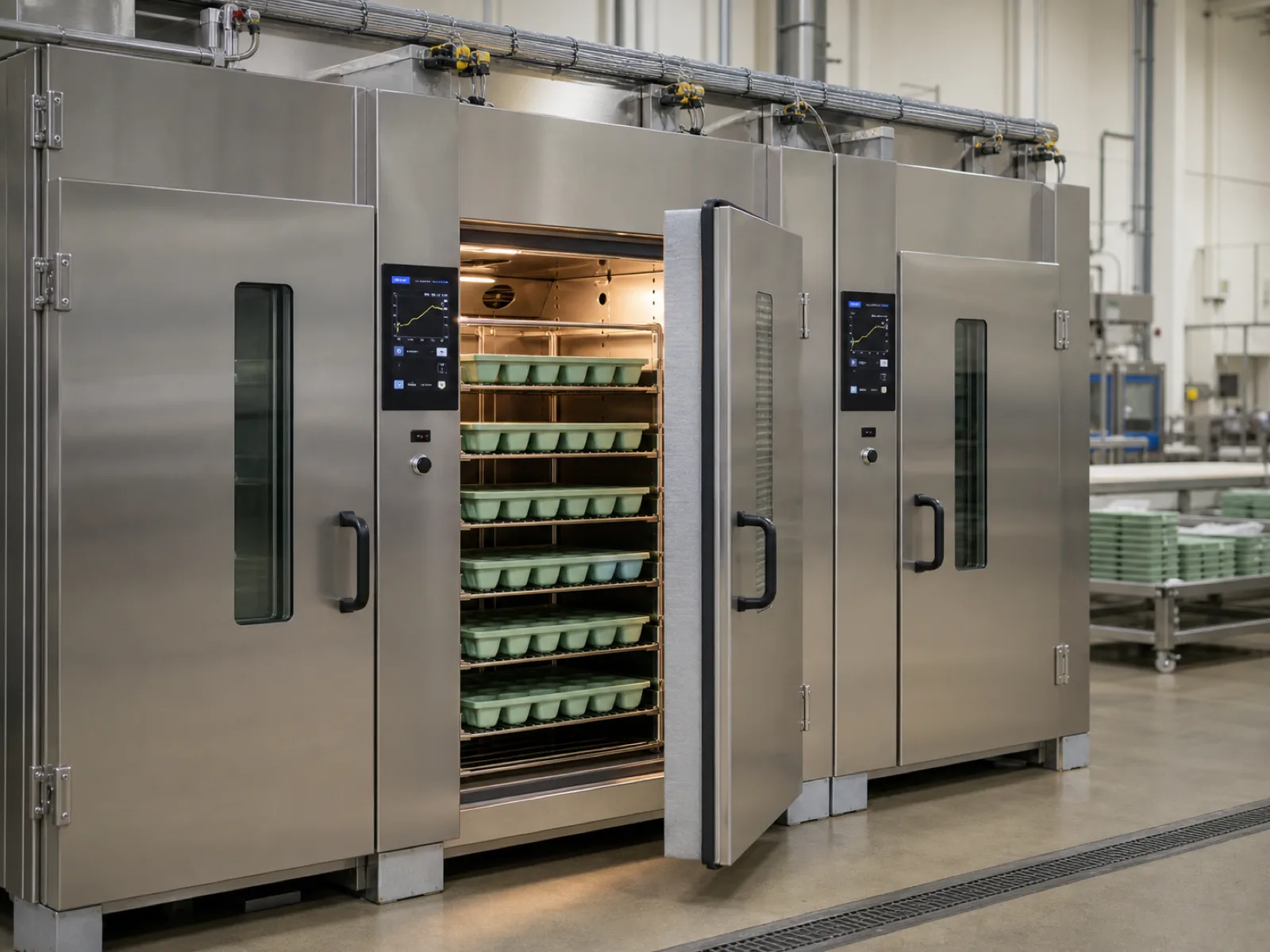
Post-cure is a 4-hour heat treatment at 200 °C after primary vulcanization. It drives residual volatile cyclic siloxanes (D4, D5, D6) below the 0.5 % LFGB threshold and completes cross-linking that was kinetically incomplete during the 90-second press cycle. Skipping post-cure is the single most common defect vector in cheap import silicone bakeware — it is what produces first-bake odor and elevated migration values.
The primary molding step — whether compression or LSR injection — delivers the geometry and roughly 85-90 % of the final cross-link density. The remaining 10-15 % develops during post-cure, along with the diffusion of low-molecular-weight cyclic siloxanes out of the polymer bulk and into the oven atmosphere. Without this step, those cyclics remain in the finished part and outgas during the first consumer bake.
Wetop runs a dedicated post-cure oven bank — six chambers, each 1.2 m³ interior, with forced-convection airflow of 15 air changes per hour. The 4-hour, 200 °C protocol is measured at three thermocouple points per chamber; the lot moves to packaging only when all three thermocouples log ≥ 3.8 hours above 195 °C. This log becomes part of the shipping documentation.
The volatile-content spec is drawn from ASTM E5951 adapted for repeated food contact: total mass loss (TML) < 1.0 %, collected volatile condensable material (CVCM) < 0.1 %. A compliant post-cure record makes LFGB §30 migration pass first-time; a skipped or shortened post-cure is the reason a “compliant” raw material lot fails migration on the finished part.
What are the customization and decoration options for OEM bakeware?
The four production-proven decoration options for silicone bakeware are: in-mold debossing (0.3-0.5 mm depth, permanent), pad printing (60-cycle dishwasher life), two-color LSR overmold (permanent, $0.18-$0.30/pc premium), and full pigment-body color (permanent, no premium). Debossing is the default for logo durability; pad printing survives only for gift-set bakeware not intended for heavy dishwasher exposure.
Pigment-body color is the cheapest and most durable decoration option — the pigment master-batch is dispersed into the compound at the two-roll mill stage and the color is uniform through the wall thickness. Pantone match tolerance is ΔE ≤ 2.5 against the approved reference chip, verified under D65 light-box at the QC station. Custom Pantone colors add $0.02-$0.05/unit for master-batch amortization at 5k MOQ.
In-mold debossing (or embossing) is engineered directly into the cavity insert. Depth of 0.3-0.5 mm and a 5° draft angle on the letter walls give clean release even at Shore A 65. The logo is a geometric feature and cannot fade, chip, or dishwasher-off. This is the specification Tier-1 retail buyers ask for when they need brand marks that survive the product’s full lifetime.
Two-color LSR overmold requires a dedicated tool with a rotary or shuttle plate and adds $0.18-$0.30/unit at 10k volume. It is used when brand marks need contrast (light logo on dark bakeware) that pigment-body color cannot deliver. The bond between the two silicones is chemical, not mechanical, so the overmold survives dishwasher and oven cycles indefinitely.
Pad printing is available but Wetop only recommends it for gift-set or promotional bakeware where dishwasher exposure is expected to be light. Even with a heat-cured silicone-compatible ink, pad print begins visible fade at 40-60 dishwasher cycles.
How do MOQ economics, lead time, and landed cost actually break down?
Wetop's baseline MOQ is 500 units per SKU on existing tooling. New tooling amortization pushes the sensible MOQ to 3,000-20,000 depending on cavity count. Lead time on new tooling: 25-35 days to T1 samples plus 30-45 days mass production. Landed cost for a 6-cavity muffin pan into LAX at 20k MOQ runs $1.85-$2.40/unit inclusive of tooling amortization, master carton, and FCL sea freight.
The landed-cost math for a representative silicone muffin pan program:
| Cost element | USD/unit at 20k MOQ | Notes |
|---|---|---|
| Silicone gum (platinum-cured, food-grade) | $0.68 | 165 g/unit at $4.12/kg |
| Pigment master-batch | $0.04 | 3 % loading, custom Pantone |
| Compounding + molding labor | $0.32 | 6-cavity, 90 s cycle, 2-shift |
| Post-cure (4 h at 200 °C) | $0.11 | Oven amortization + energy |
| QC (durometer + AQL 1.5 visual) | $0.06 | Per lot |
| Tooling amortization | $0.24 | $4,800 tool over 20k units |
| Retail box + master carton | $0.35 | 1 unit / retail box, 24 / MC |
| FOB Yantian handling | $0.09 | Export docs + terminal |
| Sea freight FCL to LAX | $0.28 | 40’HC, mixed load |
| Landed cost | $2.17 | Ex-warehouse LAX |
Lead time Gantt for a new bakeware program:
| Phase | Days | Milestone |
|---|---|---|
| Dieline + engineering review | 5-7 | Approved 3D + drawings |
| Tooling manufacture | 25-30 | Mold ready for T1 |
| T1 samples | 3-5 | Physical samples FedEx to buyer |
| T1 review + revisions | 7-14 | Buyer sign-off |
| T2 samples + PPAP | 10-14 | First-article inspection |
| Pilot run (500-1,000 units) | 7-10 | Retail-shelf validation |
| Mass production (20k units) | 30-45 | FOB Yantian |
| Sea freight to US West Coast | 22-28 | Arrival LAX |
Total from signed PO to warehouse receipt: 110-150 days for a new-tooling program. Repeat orders on existing tooling collapse to 55-70 days.
What retail-audit and QC gates does bakeware have to survive?
Tier-1 US retail chains audit against a stack that includes AQL 1.5 visual inspection, dimensional verification per ISO 3302-1, ASTM D2240 hardness sampling, a 20-cycle accelerated bake-wash test, and a full compliance packet (177.2600, CPSIA, Prop 65, REACH SVHC, PFAS-24). Missing any single element cancels the PO. Wetop's internal QC runs the same stack pre-shipment so nothing is surfaced at receiving.
The accelerated bake-wash test is the single most predictive lot-quality gate. Wetop pulls 5 units per lot and cycles them: bake empty at 220 °C for 30 min, cool to room, dishwasher cycle (60 °C, standard detergent), inspect for hardness shift, color shift, or surface defect. Twenty cycles at accelerated cadence simulates roughly 100 real-use cycles. Pass criteria: Shore A shift ≤ ±3 points, ΔE color shift ≤ 3.0, no visible cracks or blooming.
AQL 1.5 visual inspection samples per ISO 2859-1 — for a 20k lot, that means a 315-piece sample with 7 major defects allowed as the accept/reject cutoff. Common defects that trigger reject: flash > 0.15 mm, embedded contamination visible without magnification, color out of Pantone tolerance, missing or misplaced debossed logo.
Dimensional verification per ISO 3302-18 Class M2/M3 uses a Vernier caliper or optical CMM depending on cavity geometry — rim ovality on a muffin pan is caught at the 0.3 mm level, flash on the cake-pan lip at the 0.05 mm level. Auditors will spot-check these dimensions themselves; the ability to hand over a full dimensional inspection report per lot separates OEM-capable factories from the trading-company middle layer.
Why does a sink-grid factory make sense as a bakeware OEM?
The tooling steel, compound-mixing equipment, post-cure ovens, and dimensional QC infrastructure for silicone sink grids are engineered to the same tolerances as bakeware, and often to tighter ones. A factory that has cleared Tier-1 kitchen-brand audits for sink protection has already passed the compliance and process-discipline gate that new bakeware buyers apply. Shared tooling shop + shared compounding line + shared post-cure bank means the marginal cost of adding a bakeware SKU to a sink-grid factory's mix is lower than standing up a new dedicated bakeware line.
Wetop’s core three-category focus — sink grids, drying racks, drying mats — shares roughly 70 % of the process infrastructure with silicone bakeware. The compression cells run the same platinum-cured compounds. The post-cure oven bank runs the same 4-hour 200 °C protocol. The QC station runs the same ASTM D2240 durometer sampling and the same D65 light-box color check.
The audit gate that Tier-1 sink brands apply to Wetop is documented in ISO 90019 language and covers material traceability, process control, and complaint response with numbered lot records. This is the same audit shape that Target, Costco, and Wayfair apply to housewares — the paperwork translates directly.
For a bakeware brand evaluating manufacturing partners, the practical implication is: a factory that has cleared kitchen-tier retail audits on functionally comparable silicone SKUs is a lower-risk supplier than a bakeware-only shop that has never faced a Tier-1 chain. The compliance stack is the moat, not the product category.
Where to go next
- If your program is a comparison between cure systems, read Platinum-cured vs peroxide-cured silicone for the chemistry deep-dive.
- If your compliance packet needs both hemispheres, read FDA vs LFGB silicone for the test-method-by-test-method contrast.
- If you also carry silicone baking mats in your catalog, read Silicone baking mat OEM guide for the tooling and print options.
Ready to run the numbers on a specific bakeware SKU? Talk to the engineering desk — send a dieline or a benchmark part and we return DFM notes, cavity-count recommendation, and a landed-cost quote within 3 business days.
Footnotes
-
ASTM International, ASTM E595 — Total Mass Loss / CVCM. ↩ ↩2
-
US FDA, 21 CFR 177.2600 — Rubber articles intended for repeated use. ↩
-
US CPSC, CPSIA Lead Content Requirements. ↩
-
ECHA, REACH SVHC Candidate List. ↩
-
US EPA, Method 537.1 — PFAS analysis. ↩
-
ASTM International, ASTM D2240 — Durometer Hardness. ↩
FAQ
-
Is silicone bakeware safe for oven use up to 230 °C?
Yes — platinum-cured food-grade silicone bakeware carries a continuous service window of -40 °C to 230 °C with a 260 °C peak, well above the 175-190 °C baking envelope for bread, cakes, and macarons. Peroxide-cured lots are not equivalent and can outgas 2,4-DCBA residues above 200 °C.
-
What certifications must silicone bakeware pass for US and EU retail?
For US retail: FDA 21 CFR 177.2600 total-extractive testing, CPSIA lead screen, and California Prop 65. For EU retail: LFGB §30 and §31 migration on the finished part plus EU 1935/2004 declaration. Tier-1 chains additionally demand REACH SVHC and a documented 4-hour post-cure record.
-
What Shore A hardness is correct for silicone baking molds?
For muffin, cupcake, and cake bakeware, Shore A 55-65 is the engineering sweet spot. Below 50A the deep-cavity walls collapse under a 220 °C loaded oven; above 70A the release tears thin decorative rims. Loaf pans with steel rim reinforcement can drop to 45-50A for softer release.
-
What MOQ and tooling investment does silicone bakeware OEM require?
Wetop's baseline MOQ is 500 units per SKU at existing tooling. New silicone bakeware tooling runs $2,800-$6,500 for a 4-cavity P20 aluminium-insert mold and amortizes cleanly over 20-30k units. Sub-5k programs remain viable via single-cavity beryllium-copper but tooling cost per unit doubles.
-
Does silicone bakeware release PFAS or 'forever chemicals' during baking?
Platinum-cured food-grade silicone contains no intentionally added PFAS. Third-party PFAS-24 screens (EPA Method 537.1) on Wetop bakeware compounds return below the 0.1 ppb reporting limit for all 24 target analytes. Non-stick performance comes from silicone's inherent low surface energy, not fluoropolymer coatings.
-
Why does new silicone bakeware sometimes smell during first use?
Volatile cyclic siloxanes (D4, D5, D6) from incomplete post-cure. A compliant 4-hour post-cure at 200 °C reduces total volatile content below the 0.5 % LFGB threshold. If a first bake still shows odor at 175 °C, the lot was under-cured and should be quarantined and re-tested against §30/31 protocols.
-
Can silicone bakeware be logo-decorated so it survives dishwasher and oven cycles?
Yes — in-mold debossing (0.3-0.5 mm depth) survives every cycle indefinitely because it is a geometric feature, not a coating. Pad-printed logos degrade after 40-60 dishwasher cycles. Two-color LSR overmold logos survive but require dedicated tooling and add $0.18-$0.30/unit at 10k volume.
-
How long does silicone bakeware OEM sampling and production take?
On existing tooling: 7-15 days for T1 samples. On new tooling: 25-35 days from signed dieline to T1 samples, then 10-14 days for PPAP-equivalent first-article and pilot run. Mass production runs 30-45 days for 20k units on a 4-cavity mold with a 4-hour post-cure bottleneck.
-
What are the failure modes buyers should test silicone bakeware for?
White filler blooming after 30 dishwasher cycles, thin-wall tear at deep muffin cavities, odor from incomplete post-cure, dishwasher fade on pad-print logos, and shape distortion after repeated 230 °C peaks. Every Wetop production lot pulls 5 units for a 20-cycle accelerated bake-wash test before container release.
References
Authoritative sources cited in this guide
- US Food and Drug Administration (Electronic Code of Federal Regulations). 21 CFR 177.2600 — Rubber articles intended for repeated use. https://www.ecfr.gov/current/title-21/chapter-I/subchapter-B/part-177/subpart-C/section-177.2600 — Federal regulation governing extractive limits for rubber (including silicone) in repeated food-contact use — n-hexane ≤ 175 mg/dm², ethanol/water ≤ 8 mg/dm².
- German Federal Institute for Risk Assessment (BfR). BfR Recommendation XV: Silicones. https://www.bfr.bund.de/en/bfr_recommendations_on_food_contact_materials-71195.html — German framework underlying LFGB §30/31 migration tests for silicone bakeware and baking molds.
- European Commission (EUR-Lex). Regulation (EC) No 1935/2004 on materials and articles intended to come into contact with food. https://eur-lex.europa.eu/legal-content/EN/TXT/?uri=CELEX%3A32004R1935 — Umbrella regulation setting general safety and traceability requirements for all EU food-contact materials, including silicone bakeware.
- US Consumer Product Safety Commission. Consumer Product Safety Improvement Act (CPSIA) — Lead Content Limits. https://www.ecfr.gov/current/title-16 — Federal lead limit of 100 ppm total content for children's products; retail chains apply the same screen to housewares including silicone bakeware.
- ASTM International. ASTM D2240 — Standard Test Method for Rubber Property — Durometer Hardness. https://www.astm.org/d2240-15r21.html — Shore A durometer test method Wetop applies in-line on every silicone bakeware lot for wall-hardness verification.
- International Organization for Standardization. ISO 3302-1:2014 — Rubber — Tolerances for products, Part 1: Dimensional tolerances. https://www.iso.org/standard/59252.html — Governs dimensional tolerance classes M1-M4 applied to silicone bakeware cavity dimensions and rim flatness.
- ASTM International. ASTM E595 — Total Mass Loss and Collected Volatile Condensable Materials. https://www.astm.org/e0595-15r21.html — Volatile-content protocol adapted to verify post-cure completeness on silicone bakeware compounds — TML < 1.0 %.
- European Chemicals Agency (ECHA). REACH SVHC Candidate List. https://eur-lex.europa.eu/legal-content/EN/TXT/?uri=CELEX%3A32006R1907 — Substances of Very High Concern list screened on every silicone bakeware compound for EU retail acceptance.
- US Environmental Protection Agency. EPA Method 537.1 — Determination of Selected Per- and Polyfluoroalkyl Substances. https://cfpub.epa.gov/si/si_public_record_report.cfm?Lab=NERL&dirEntryId=343042 — PFAS-24 analytical method Wetop applies to bakeware compounds — all target analytes below 0.1 ppb reporting limit.
Start a custom program
Send a brief. Get an engineer’s reply in one business day.
Every Wetop program is tooled from a customer’s specification. Send a CAD file (STEP · IGES · DWG) or a written brief and we’ll reply with a mold cost estimate, price brackets at MOQ 500 / 1,000 / 5,000, and any engineering questions.