Buyer Guide · commercial intent
Silicone Baking Mat OEM Guide — Cure, Spec, Compliance, MOQ
What changed: First publication under v2 advanced-GEO standard — benchmarked against top-ranking consumer-roundup pages and rewritten from inside the factory floor with FDA/LFGB clause citations, MOQ-tier FOB pricing, cure-system decision matrix, and B2B audit checklist that consumer coverage does not touch.
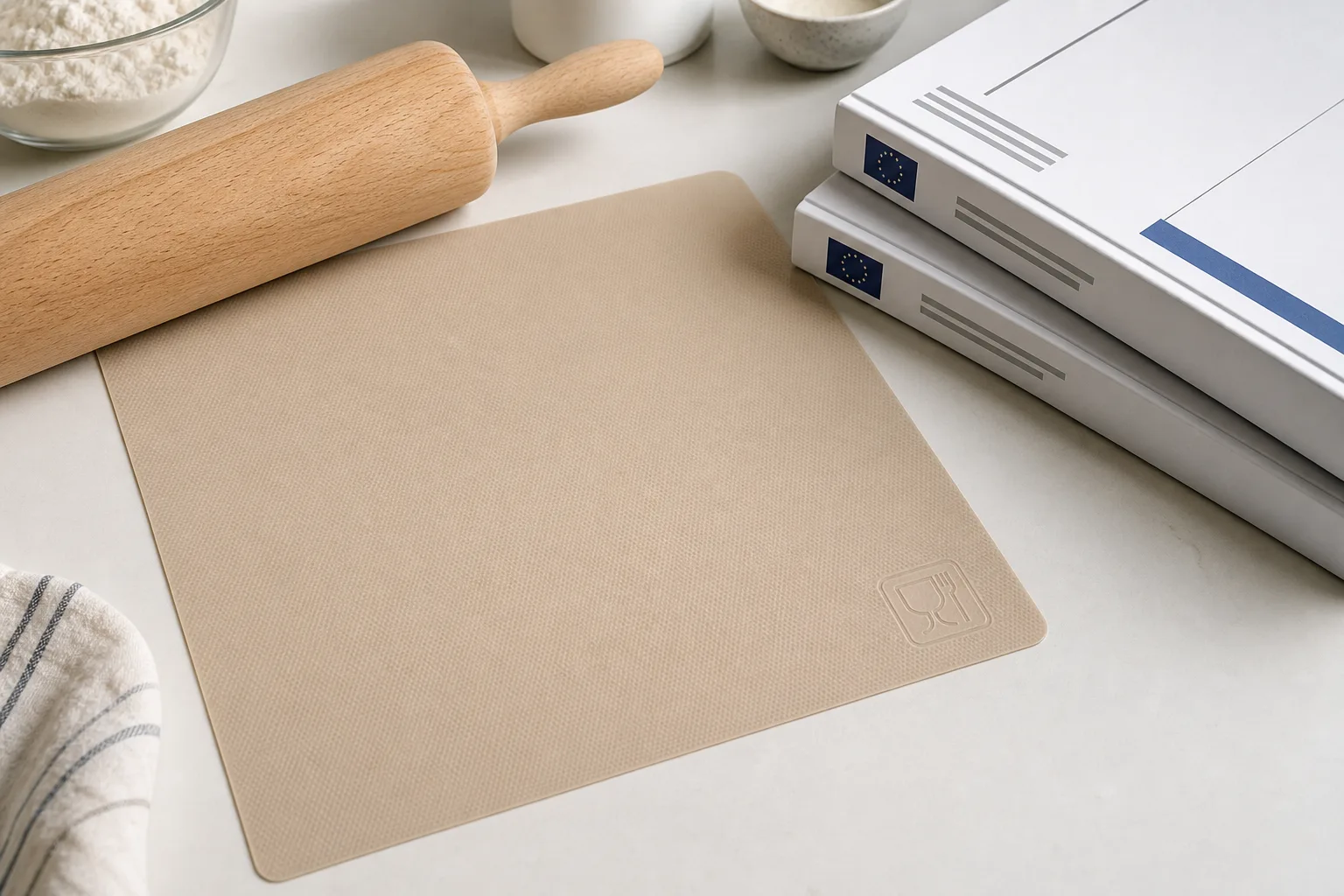 Buyer Guide
 The silicone baking mat sits at the intersection of the most-scrutinized food-contact regulatory stack (FDA + LFGB + PFAS documentation) and the highest-throughput housewares retail channel (Home Depot, Wayfair, Bed Bath tier, Tesco, Carrefour). Every serious retail program above $10 shelf-price now audits the same six documents pre-PO. This guide is the engineering reality of manufacturing that product — cure chemistry, fiberglass gauge, MOQ-tier FOB pricing, defect CTQ points, and the sourcing workflow from RFQ to PPAP — written from inside a working OEM factory floor, not from a consumer roundup surface.
A silicone baking mat is a fiberglass-reinforced silicone composite laminate 0.4-0.75 mm thick, Shore A 55-65, cured under compression at 160-200°C and post-cured 4-6 hours at 180-200°C to clear LFGB §30/31 organic volatile testing per BfR Recommendation XV. For B2B OEM programs, MOQ 500 pieces per SKU delivers per-batch FDA 21 CFR 177.2600 + LFGB third-party test reports. FOB Yantian for a standard 40×30 cm platinum-cure mat with 1-color debossed logo runs $1.85-$2.40 at 500 pieces, dropping to $1.20-$1.55 at 5,000 pieces. Total realistic lead from RFQ to US warehouse: 60-90 days including 14-18 day Yantian sailing.
What is a silicone baking mat, engineered for OEM production?
A silicone baking mat is a two-layer composite laminate — polydimethylsiloxane silicone bonded around a woven fiberglass mesh skeleton, cured under a hydraulic compression press at 160-200°C. Total thickness 0.4-0.75 mm, Shore A 55-65 durometer per ASTM D2240[^astm-d2240], continuous service temperature -40°C to 230°C. The fiberglass provides dimensional stability; the silicone provides the food-safe release surface and thermal envelope.
The consumer-facing description of a silicone baking mat is “a reusable non-stick surface”. The engineering description is a two-material composite with three distinct functions layered into one 0.5 mm sheet. The silicone provides food-contact chemistry (FDA 21 CFR 177.26001 compliance, non-stick release, thermal envelope). The fiberglass provides mechanical stability (prevents stretch, cup, and thermal creep). The bonding chemistry at the silicone-fiberglass interface provides delamination resistance across thousands of oven cycles.
Every meaningful engineering decision on a silicone baking mat program is a trade-off between those three functions. Thicker silicone layer = better non-stick, worse heat conduction. Denser fiberglass mesh = better dimensional stability, worse flexibility. Platinum cure = cleaner extractables profile, higher per-unit cost. The rest of this guide walks the trade-offs one by one.
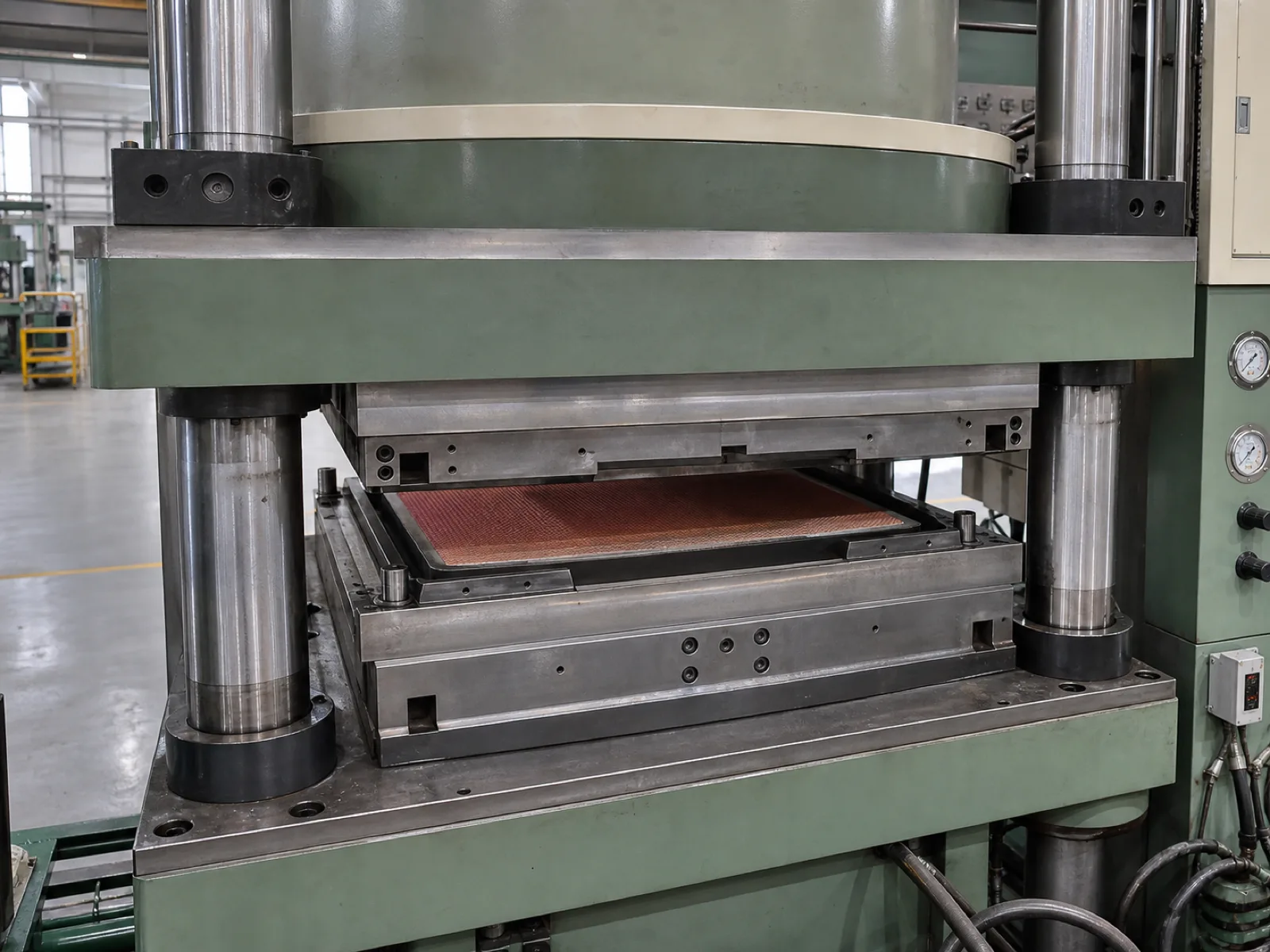
Baseline engineering spec sheet
| Parameter | Standard range | Test method |
|---|---|---|
| Total thickness | 0.4-0.75 mm (typical retail: 0.55-0.65 mm) | Digital caliper, 5-point sampling |
| Silicone layer thickness (each side) | 0.15-0.30 mm | Cross-section microscopy |
| Fiberglass mesh weight | 60-80 g/m² (retail); 100-120 g/m² (commercial) | Areal weight balance |
| Shore A hardness | 55-65 (retail); 65-75 (heavy-duty commercial) | ASTM D22402 |
| Tensile strength | ≥ 5.5 MPa | ASTM D412 |
| Elongation at break | ≥ 200% | ASTM D412 |
| Tear resistance | ≥ 18 kN/m | ASTM D624 |
| Continuous service temperature | -40°C to 230°C | Manufacturer spec + LFGB thermal cycling |
| Peak service temperature (short exposure) | 260°C | LFGB extractables at peak |
| Cure system | Platinum (LSR) or peroxide (HCR) | Master-batch lot certificate |
| Cure temperature at press | 160-200°C | Press log |
| Post-cure cycle | 4-6 h @ 180-200°C | Batch oven log |
What certifications does a silicone baking mat need for retail?
The mandatory stack for serious retail programs is FDA 21 CFR 177.2600[^fda-177-2600] (US food contact), LFGB §30/31 organic volatile testing per BfR Recommendation XV[^bfr-lfgb-xv] (EU food contact), ISO 9001:2015[^iso-9001] (quality management system), and per-batch PFAS non-detect testing at accredited-lab detection limits. Retail auditors at the Home Depot, Wayfair, Tesco, Carrefour tier want all four documents referencing a specific master-batch lot from the last 6 months.
The certification stack is documentation-depth, not a binary pass/fail. Every level of retail positioning raises the bar on which reports the buyer’s auditor expects to see.
The four-layer certification stack
Layer 1 — FDA 21 CFR 177.2600 (US baseline). The primary US regulation governing food-contact silicone (and other rubber articles) intended for repeated use. Tests aqueous, 8% ethanol, and n-heptane extractables against defined limits. Every US retail SKU needs this on file. Wetop tests per master-batch lot at accredited third-party labs (SGS, Intertek, TÜV, Bureau Veritas).
Layer 2 — LFGB §30/31 (EU / premium US). German Food and Feed Code sections 30 and 31, technically grounded in BfR Recommendation XV3 and framed by EU Regulation 1935/20044. Tests organic volatile extractables under stricter protocols than FDA — the reason mandatory post-cure exists. Any EU retail program and any US premium retail (Whole Foods orbit, Target Good & Gather caliber) will demand this alongside FDA.
Layer 3 — ISO 9001:2015 (quality system). The internationally recognized quality management system standard. Not a product certification — it certifies the factory’s documented process discipline. Auditors verify certificate validity, scope (silicone molding must be in-scope), and the current calendar date on the certificate. Wetop’s scope covers compression molding, LSR injection, secondary process (post-cure, printing, deburring), and QC.
Layer 4 — PFAS non-detect (accelerating requirement). Per-batch PFAS testing at parts-per-billion detection limits from an accredited lab. Not a formal certification — a test report on the finished-part material. Driven by the ECHA universal restriction proposal5 and downstream retailer spec adoption. Now table-stakes on any EU premium program and increasingly required on US West Coast retail.
Tier-specific additional documents
| Retail tier | Layer 1 | Layer 2 | Layer 3 | Layer 4 | Additional |
|---|---|---|---|---|---|
| US mass retail ($10-20 shelf) | Required | Recommended | Required | Recommended | — |
| US premium retail ($20-40 shelf) | Required | Required | Required | Required | — |
| EU retail (all tiers) | Required | Required | Required | Required | REACH declaration |
| Commercial kitchen adjacent | Required | Required | Required | Required | NSF/ANSI 516 |
| Infant / children’s tier | Required | Required | Required | Required | CPSIA7 |
| Amazon FBA private-label | Required | Recommended | Required | Recommended | — |
Full breakdown of the FDA-vs-LFGB decision on our FDA vs LFGB silicone decoder.
Platinum-cured or peroxide-cured silicone for baking mats — which cure system?
Platinum-cure by default for EU premium, PFAS-free positioning, and infant-baking tier. Peroxide-cure with mandatory 4-6 hour post-cure at 180-200°C for US mid-tier retail at $10-25 shelf price. Baking mats amplify the cure decision because the product sees repeated 200°C+ oven cycles — under-post-cured peroxide-cure will out-gas for the first 5-8 uses and generate return complaints that under-post-cured drying mats (much lower service temperature) do not.
Both cure systems use the same silicone polymer (polydimethylsiloxane). The catalyst that triggers crosslinking is where they diverge — platinum for platinum-cure, organic peroxide for peroxide-cure — and that catalyst choice cascades into byproduct chemistry, first-heat odor risk, per-unit cost, and regulatory positioning.
For baking mat programs specifically, the cure decision has one extra layer that doesn’t apply to drying mats or sink grids: the product’s continuous service temperature envelope tops out at 230°C. Any residual peroxide decomposition byproduct that survives post-cure will out-gas during the first several oven cycles, producing a first-heat odor and, in edge cases, faint deposits on food. This is the actual mechanism behind the “silicone baking mat smell” complaint category on retail reviews — it is a post-cure discipline problem, not a chemistry problem.
Cost delta at baking mat MOQ tiers
| Cure system | 500 pcs (40×30 cm) | 1,000 pcs | 5,000 pcs | 10,000 pcs |
|---|---|---|---|---|
| Peroxide-cured (post-cured, PFAS-free process aid verified) | $1.55-$2.00 | $1.30-$1.65 | $1.00-$1.30 | $0.85-$1.15 |
| Platinum-cured (LSR or premium HCR) | $1.85-$2.40 | $1.55-$1.95 | $1.20-$1.55 | $1.05-$1.35 |
| Delta | +15-25% | +15-22% | +15-22% | +15-20% |
Numbers are FOB Yantian, Q3 2026 benchmarks, standard 40×30 cm with 1-color debossed logo, PDMS at Shore A 55-65, 0.55-0.65 mm total thickness, standard fiberglass mesh (60-80 g/m²). Custom Pantone-matched master-batch adds $0.08-$0.15 per unit. 4C sublimation printing over the mat surface adds $0.04-$0.10 per unit.
Full engineering decision framework for the cure question on our platinum-vs-peroxide-cured silicone decision guide. The temperature envelope both cures clear is detailed in the silicone temperature range explainer.
Why fiberglass mesh reinforcement is the load-bearing structure
The fiberglass mesh is the dimensional skeleton of a silicone baking mat — a woven fiberglass fabric at 60-120 g/m² areal weight laminated between two silicone layers during compression cure. Without it, the mat stretches, cups, and curls at oven temperatures. Fiberglass gauge selection drives the trade-off between dimensional stability (heavier mesh = better) and flexibility for roll-up storage (lighter mesh = better). Retail-tier 60-80 g/m²; commercial-kitchen tier 100-120 g/m².
The lay-up sequence in a compression mold is: bottom silicone gum sheet → fiberglass mesh centered on the tool → top silicone gum sheet → mold closes at 180°C for 3-6 minutes. The silicone flows into and through the mesh openings during cure, encapsulating each fiberglass strand and bonding to itself through the mesh interstices. The result is a fully encapsulated fiberglass skeleton — no fiberglass surface exposure if the process runs correctly.
The critical CTQ (critical-to-quality) point is edge encapsulation. If the compression cycle runs too fast or the silicone gum is under-viscosity, fiberglass fibers can protrude at the mat edges. This is the single most-common cause of retail return complaints on fiberglass-reinforced baking mats — consumers see fiberglass strands and (correctly) refuse the product. Zero-tolerance defect at Wetop’s AQL 1.5 inspection per ISO 2859-18 sampling.
Fiberglass gauge decision matrix
| Fiberglass mesh weight | Best for | Trade-off |
|---|---|---|
| 60 g/m² | Roll-up retail mats, flexible storage positioning | Lower dimensional stability at high cycles |
| 70-80 g/m² | Standard retail (Home Depot, Wayfair, BBB tier) | Balanced — the retail default |
| 100 g/m² | Semi-professional / heavy-duty retail | Slightly stiffer, harder to roll |
| 120 g/m² | Commercial kitchen, food-service equipment | Won’t roll — requires flat storage |
Silicone baking mat programs that skip fiberglass entirely exist — pure-silicone mats at 2-4 mm thickness — but they are a specialty tier at 3-4x per-unit cost with worse dimensional stability. Wetop OEMs both formats but recommends fiberglass-reinforced for any retail program at $10-30 shelf price.
MOQ tiers and FOB Yantian pricing benchmarks
Wetop's MOQ is 500 pieces per SKU — the minimum that supports per-batch third-party FDA and LFGB testing economics. FOB Yantian Q3 2026 benchmarks for standard 40×30 cm platinum-cure with 1-color debossed logo: 500 pcs $1.85-$2.40, 1,000 pcs $1.55-$1.95, 5,000 pcs $1.20-$1.55, 10,000 pcs $1.05-$1.35. Tooling cost for a new size runs $2,800-$4,500 amortized against first-order volume.
The MOQ math is not arbitrary. Below 500 pieces per SKU, the per-batch third-party test report cost (FDA + LFGB + PFAS at ~$800-$1,200 combined) dominates the per-unit price to the point where the finished product isn’t retail-competitive. Above 500 pieces, the test cost amortizes to $1.60-$2.40 per piece and drops fast — 5,000 pieces amortizes to $0.16-$0.24 per piece.
Full MOQ-tier FOB Yantian pricing (40×30 cm standard mat, Q3 2026)
| Volume tier | Peroxide-cure post-cured | Platinum-cure LSR/HCR | 4C printed surface add | Pantone master-batch add |
|---|---|---|---|---|
| 500 pcs | $1.55-$2.00 | $1.85-$2.40 | +$0.10-$0.15 | +$0.12-$0.18 |
| 1,000 pcs | $1.30-$1.65 | $1.55-$1.95 | +$0.08-$0.12 | +$0.10-$0.15 |
| 2,500 pcs | $1.10-$1.45 | $1.35-$1.75 | +$0.06-$0.10 | +$0.09-$0.13 |
| 5,000 pcs | $1.00-$1.30 | $1.20-$1.55 | +$0.05-$0.09 | +$0.08-$0.12 |
| 10,000 pcs | $0.85-$1.15 | $1.05-$1.35 | +$0.04-$0.08 | +$0.06-$0.10 |
| 20,000+ pcs | $0.75-$1.00 | $0.90-$1.20 | Quote | Quote |
Prices exclude retail packaging (a typical color header card with backing runs $0.18-$0.35 per unit fully assembled), certification fees for a specific retailer or regulatory scope, and destination-country duties.
Tooling investment for custom sizes
New tooling amortizes as follows for a compression mold covering one mat size:
- Small (up to 30×22 cm quarter-sheet): $2,800-$3,400
- Standard (40×30 cm half-sheet retail): $3,200-$4,000
- Large (40×60 cm full-sheet): $3,800-$4,500
- Extra-large (custom, >60 cm dimension): $4,500-$6,500
Tooling is a one-time cost that Wetop typically amortizes against the first production order rather than billing as a separate line item — the amortization is baked into a slightly higher per-unit price on the first 5,000-10,000 pieces, then unit price drops on re-orders. Full pricing structure detail on the silicone OEM pricing structure guide. The MOQ economics logic in full on the real factory MOQ math guide.
Lead time from RFQ to warehouse — what’s realistic
Total realistic lead is 60-90 days from RFQ to US warehouse receipt. 7-15 days for sample on existing tooling (2-3 weeks if new mold cut required), 35-45 days for production of 5,000-20,000 pieces after PO and 30% deposit, plus 14-18 day Yantian-to-US-West-Coast sailing (25-32 days East Coast, 30-38 days Northern Europe). Suppliers quoting 30-day cold-start-to-warehouse totals are compressing a step — usually post-cure.
Lead-time compression is a common tactic in RFQ responses that a buyer needs to interrogate. The three places suppliers cut corners:
- Skip or shorten post-cure. 4-6 hours of oven time at 180-200°C per batch is the LFGB §30/31 compliance step. Skipping it saves 20-30% oven energy and 4-6 hours of dwell time — and ships product that fails EU premium retail audit.
- Skip incoming raw material QC. Master-batch lot verification at receipt catches ~1-2% of upstream compound-house defects. Skipping saves 4-6 hours per shipment and creates traceability gaps.
- Skip pre-shipment AQL inspection. ISO 2859-18 AQL 1.5 sampling on a 5,000-piece batch takes ~4-8 hours by a qualified inspector. Skipping saves the inspection cost and creates the defect complaints downstream.
The full RFQ-to-PPAP workflow at Wetop
| Stage | Duration | Key deliverables | Buyer approval gate |
|---|---|---|---|
| 1. RFQ receipt & engineering review | 1-2 business days | Spec confirmation, cure recommendation, price bracket at MOQ tiers | — |
| 2. Sample production (existing tooling) | 7-15 days | Physical sample + master-batch lot cert + Shore A test | Sample approval + PO |
| 2b. New tooling cut (if custom size) | +14-21 days (parallel where possible) | Tooling drawing + first article inspection report | Tooling approval |
| 3. PO + 30% deposit + material procurement | 5-10 days | Master-batch purchase from compound house, receiving QC | — |
| 4. Production (5,000-20,000 pcs) | 35-45 days | Compression molding + post-cure + secondary process + retail packaging | — |
| 5. In-process QC + AQL 1.5 pre-shipment inspection | +3-5 days (overlaps production) | FDA + LFGB test reports, PFAS non-detect report, AQL inspection report | Buyer inspection sign-off |
| 6. 70% balance + shipping documentation | 2-3 days | Commercial invoice, packing list, B/L, COO, MSDS | — |
| 7. Yantian to destination sailing | 14-38 days depending on port | On-board notification, tracking | — |
| Total realistic | 60-90 days |
Full breakdown of the timeline drivers on the MOQ and lead time on silicone OEM guide.
Factory audit checklist — what retail buyers actually verify
The retail-audit checklist reduces to six documents plus one video verification. ISO 9001 certificate with current validity and silicone-molding scope, FDA + LFGB test reports referencing a specific master-batch lot from the last 6 months, post-cure log for that same batch, factory production video showing compression presses and post-cure ovens in use, PFAS non-detect report per batch, and business + export license copies. A supplier resisting any of these is answering the audit question.
Consumer-facing coverage of silicone baking mats obsesses over “how to spot a good product”. B2B retail audit obsesses over “how to verify a factory’s process discipline”. The latter is what actually determines whether the product will pass retailer QA on the receiving dock in 90 days.
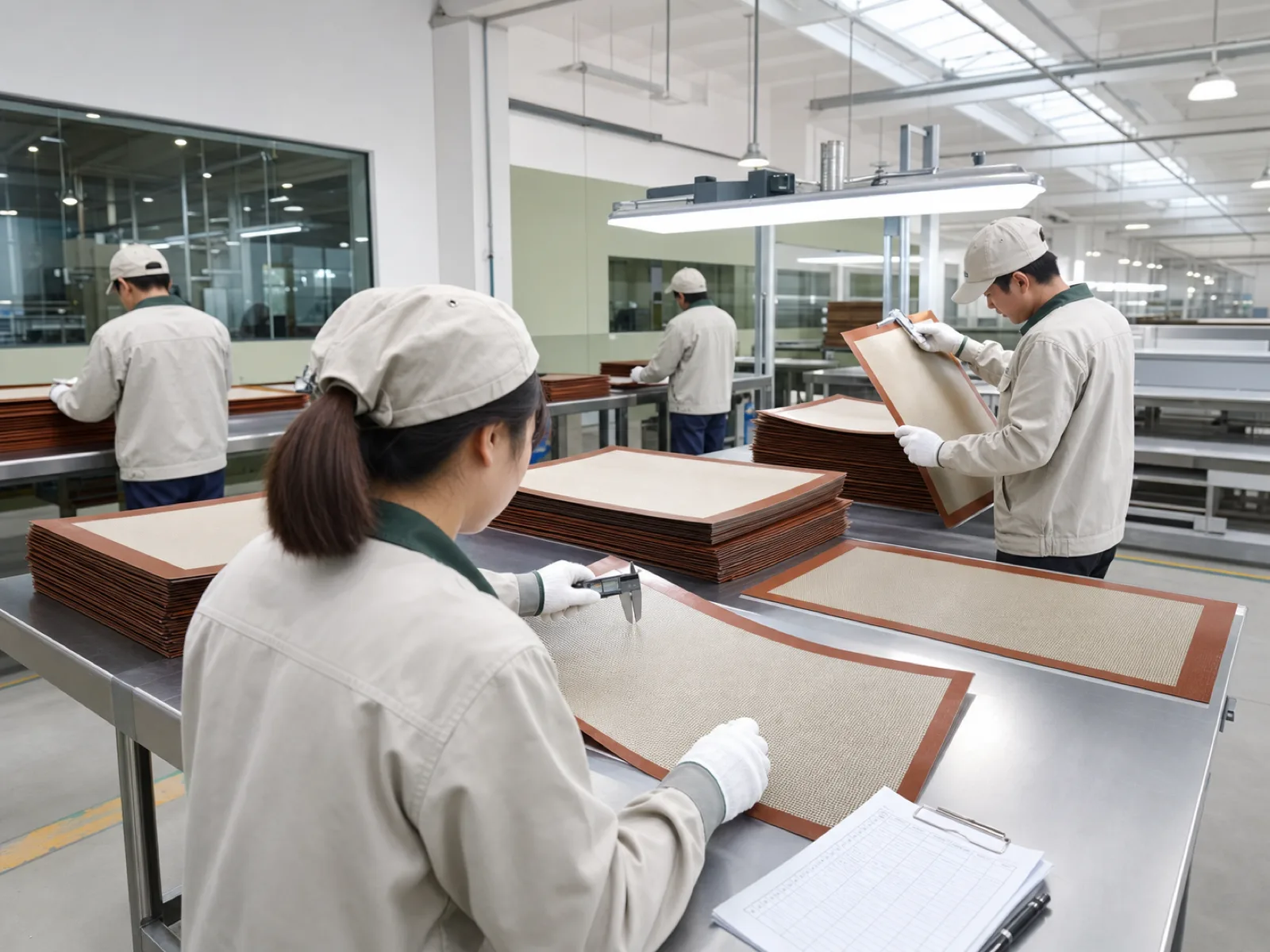
The six-document audit stack
- ISO 9001:2015 certificate — current validity date, silicone molding in scope, issued by a recognized certification body (SGS, TÜV, Bureau Veritas, DNV, DEKRA). Verify against the certification body’s public register.
- FDA 21 CFR 177.2600 + LFGB §30/31 test reports — referencing a specific master-batch lot number from production in the last 6 months. Reports issued by SGS, Intertek, TÜV, or Bureau Veritas. Quantitative extractables values, not just pass/fail.
- Post-cure cycle log — batch temperature-time record from the oven’s PLC or manual logbook, referencing the same master-batch lot. 180-200°C for 4-6 hours documented per batch, retained for 36 months minimum per ISO 9001.
- Factory production video / photos — actual compression presses and post-cure ovens in use, not stock footage. Verify the equipment count matches the claimed production capacity. Wetop shares short walk-through video on request under NDA.
- PFAS non-detect test report — per-batch analysis at ppb detection limits from an accredited lab. Accelerating requirement given the ECHA restriction proposal5.
- Business license + export license copies — verify legal entity name matches the trade partner on all commercial documents. Guard against factory-vs-trading-company confusion.
The single video verification worth 10 documents
Request a 2-3 minute unedited walk-through video of the compression molding floor with the current date shown (holding a printed daily newspaper or shift log). A working silicone OEM factory has:
- 4-12 active compression molding presses (depending on scale), not idle
- Visible post-cure ovens with batches inside (not empty)
- Raw material staging with visible master-batch lot labels
- A secondary process area with printing / deburring / packaging in progress
- Not just a lobby, showroom, or empty warehouse
Full sourcing-verification framework on the sourcing silicone factory checklist.
Private-label vs OEM vs ODM — the decision matrix for buyers
The three sourcing models differ by documentation depth and design ownership, not by manufacturing quality. Private-label: our tooling library, your logo. OEM: your CAD or spec, we cut new tooling, you own the design. ODM: we develop the SKU from a brief, you license or purchase. Wetop runs all three at MOQ 500. Choose by whether the retail positioning requires design differentiation or brand-only differentiation.
The private-label / OEM / ODM distinction is a documentation and IP question that determines both time-to-market and the ceiling of retail differentiation.
Decision matrix by program archetype
| Program type | Private-label | OEM | ODM |
|---|---|---|---|
| Design ownership | Factory | Buyer (you) | Shared / licensed |
| Tooling cost | $0 (existing library) | $2,800-$4,500 | $0 (shared library) or licensed |
| Time to first sample | 7-15 days | 21-35 days (tooling cut) | 7-15 days |
| Best for | Fast-launch retail SKUs, Amazon FBA | Differentiated retail line, exclusive design | New brands, category test, limited-run |
| MOQ | 500 pcs | 500 pcs | 500-1,000 pcs |
| Design exclusivity | No | Yes (buyer owns tooling) | Negotiated |
| Retail differentiation ceiling | Logo + color | Full design + template + logo | Full design + brand narrative |
Wetop’s baseline baking mat tooling library covers: 40×30 cm (half-sheet retail), 40×60 cm (full-sheet), 30×42 cm (quarter-sheet European), 22×29 cm (small template), macaron template with 20 mm circles, and a rolling-pin overlay mat with imperial + metric grid. All available at 500-piece MOQ under private-label with debossed or printed logo customization.
Full workflow detail on customize silicone logo — deboss, print, or laser and the private-label silicone kitchen products guide.
CTQ inspection points — the six defect modes and how they surface
Six defect modes account for ~85% of retail return complaints on silicone baking mats. Fiberglass edge exposure (zero tolerance), silicone-fiberglass delamination under thermal cycling, thickness variance beyond ±0.05 mm, first-heat odor from under-post-cured peroxide-cure, warping or edge curl from thermal shock cool-down, and debossed logo fill discoloration from pigment migration during post-cure. All six are catchable at AQL 1.5 inspection[^iso-2859-1] pre-shipment.
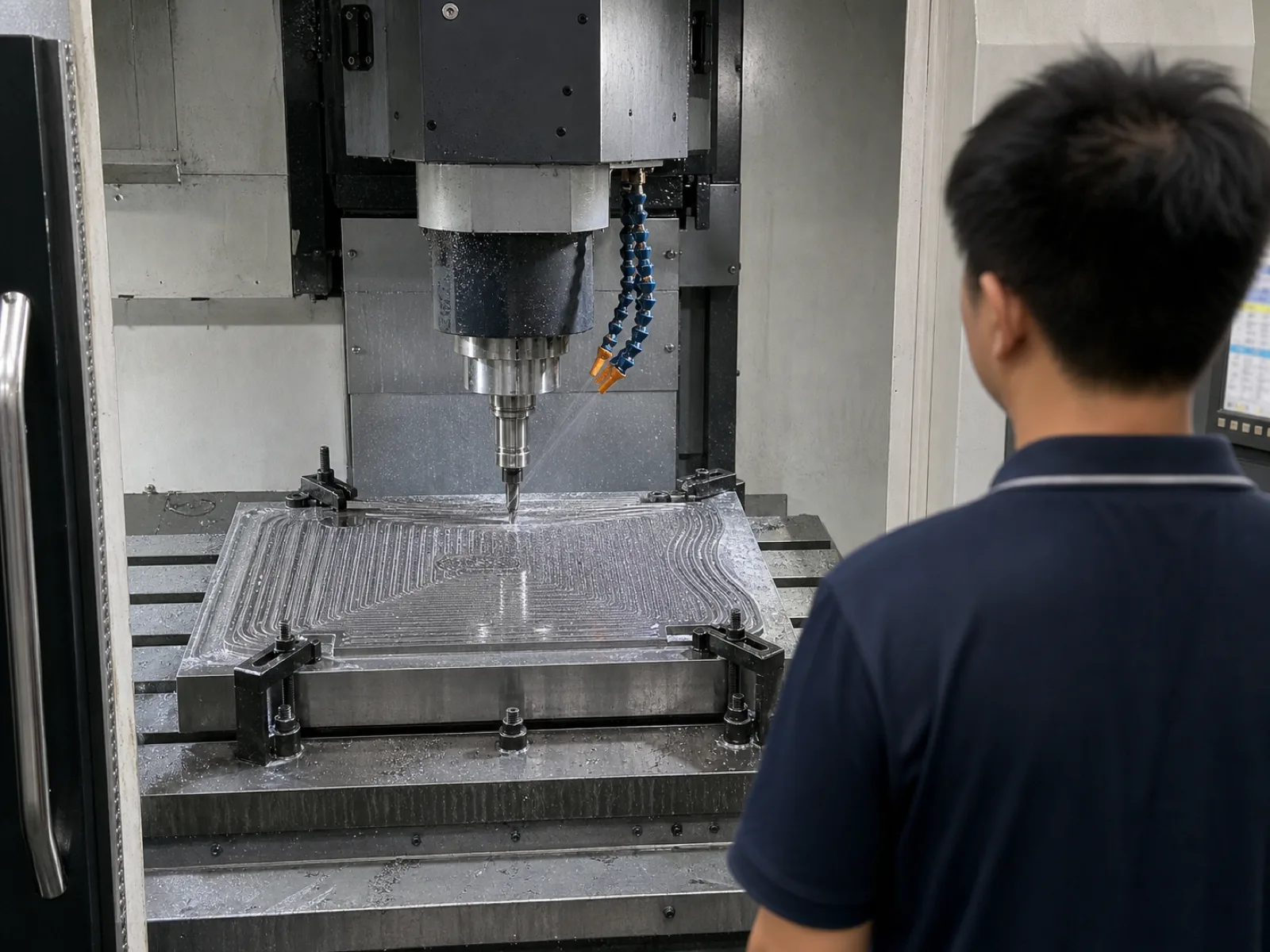
The six defect modes catalogued
Defect 1 — Fiberglass exposure at edges. Fibers protrude through the silicone at the mat perimeter. Cause: under-viscosity gum, compression cycle too fast, or mesh cut oversized relative to mold cavity. Detection: visual + tactile inspection at 100% inspection points on AQL 1.5 sampling. Zero tolerance.
Defect 2 — Silicone-fiberglass delamination. Layers separate under repeated 200°C+ thermal cycles. Cause: under-cure, missing bonding primer, or contaminated mesh at lay-up. Detection: destructive thermal shock testing on samples (20 cycles at 230°C to -40°C to 230°C) plus visual inspection for micro-blister formation. Zero tolerance on any delamination signal.
Defect 3 — Thickness variance beyond ±0.05 mm. Uneven baking heat distribution. Cause: mold surface wear, unequal gum weight per side, or compression stroke drift. Detection: digital caliper 5-point sampling per mat, statistical process control chart across batch.
Defect 4 — First-heat odor. Slight acidic or plasticky odor on first 5-8 uses at 200°C+. Cause: under-post-cured peroxide-cure — residual acetophenone or dicumyl fragments out-gassing. Detection: LFGB §30/31 organic volatile testing3 on the finished-part material plus organoleptic panel testing on production samples.
Defect 5 — Warping or edge curl. Mat won’t lie flat on the sheet pan; corners curl up. Cause: thermal shock during cool-down (mold opened too early), unbalanced silicone layer thickness, or fiberglass mesh weight mismatch to silicone gum volume. Detection: 24-hour flatness check on a machined granite surface plate; deviation ≤ 2 mm across a 40 cm diagonal.
Defect 6 — Debossed logo fill discoloration. Logo appears yellowed, grey, or mottled instead of clean color. Cause: pigment migration during post-cure at 180-200°C, incompatible pigment chemistry, or contaminated master-batch. Detection: D65 daylight-simulation light-box color check per ISO 2859-1 sampling; ΔE ≤ 2 against approved sample.
Pre-shipment inspection deliverables
Every Wetop batch ships with a pre-shipment inspection report covering:
- AQL 1.5 sampling plan per ISO 2859-18
- Dimensional check (5-point thickness per sample)
- Shore A durometer check per ASTM D22402 (5-sample)
- Visual inspection log (edge encapsulation, surface flatness, logo fidelity)
- Thermal shock sample destructive test result (delamination check)
- FDA + LFGB test report referencing the master-batch lot
- PFAS non-detect test report referencing the master-batch lot
- Post-cure oven log for the batch
Sample buyers who want to run their own third-party pre-shipment inspection (via SGS, Bureau Veritas, TIC, or their own QC team) can arrange it directly with the factory at any point in the production timeline.
Sustainability and PFAS-free positioning for silicone baking mats
Silicone baking mats displace ~500-1,200 sheets of parchment paper over their service life (2-4 years of moderate home baking use). The sustainability positioning is real but only defensible with per-batch PFAS non-detect testing at ppb detection limits and cure system documentation. Platinum-cure is inherently PFAS-free; peroxide-cure requires supplier verification that PFAS process aids have been designed out of the compound. ECHA's universal restriction proposal[^echa-pfas-proposal] is accelerating the spec adoption in EU premium retail.
The sustainability narrative on silicone bakeware — reusable, recyclable at end-of-life (some regions), long service life — is the actual differentiation available to retail marketing. The narrative fails to survive audit only when PFAS process-aid history in the compound isn’t documented. Full detail on the PFAS-free silicone sustainability guide.
What Wetop OEMs on silicone baking mats
Wetop runs silicone baking mat programs at 500-piece MOQ per SKU on both cure systems from a 7,500 m² founder-led Dongguan floor. Platinum-cure LSR for EU premium, PFAS-free positioning, and infant-baking tier. Post-cured peroxide-cure HCR for US Tier 2 retail accessory programs at $10-25 shelf price. Per-batch FDA 21 CFR 177.2600 + LFGB §30/31 test reports + PFAS non-detect analysis included in every quote. FOB Yantian pricing published above.
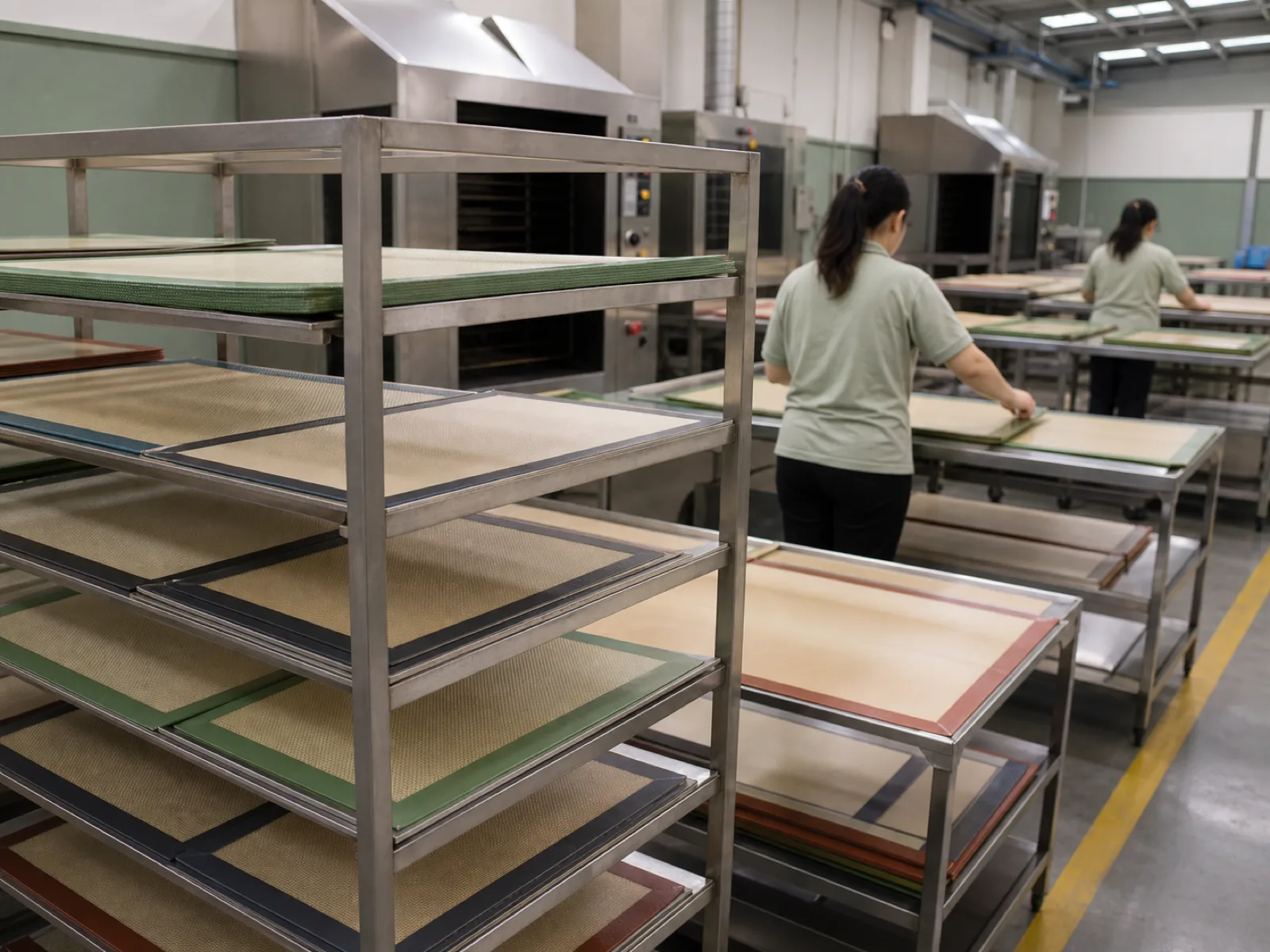
Program defaults:
- Platinum-cure LSR / premium HCR — for EU premium retail, PFAS-free marketing positioning, infant-baking tier, and multi-year brand programs where regulatory-drift insurance matters. USP <88>-adjacent extract testing available on request.
- Post-cured peroxide-cure HCR — for US mass and mid-tier retail programs at $10-25 shelf price, with PFAS-free process aids verified per batch and mandatory 4-6 hour post-cure at 180-200°C on every lot.
Tooling library covers 40×30 cm, 40×60 cm, 30×42 cm, 22×29 cm, macaron template, and rolling-pin overlay grid at private-label MOQ 500. Custom tooling for OEM programs at $2,800-$4,500 amortized against first order.
Sourcing a silicone baking mat program? Email inquiry@wetopsilicone.com with your target retail tier, target regulatory scope (US-only, EU-inclusive, medical-adjacent), preferred cure system (or ask for recommendation), and target volume — we return within 2 business days with a cure recommendation, per-batch documentation packet outline, and price brackets at MOQ 500 / 1,000 / 5,000 / 10,000. Mutual NDA available at our NDA page. Full manufacturing detail on the capabilities page; anonymized program archetypes at case studies; direct engineering contact via the contact page.
Footnotes
-
US Food and Drug Administration. 21 CFR 177.2600 — Rubber articles intended for repeated use. https://www.ecfr.gov/current/title-21/chapter-I/subchapter-B/part-177/subpart-C/section-177.2600 — the primary US food-contact regulation Wetop cures every baking mat batch against. ↩
-
ASTM International. ASTM D2240-15 — Standard Test Method for Rubber Property—Durometer Hardness. https://www.astm.org/d2240-15r21.html — the Shore A hardness measurement standard. ↩ ↩2
-
German Federal Institute for Risk Assessment (BfR). Recommendation XV — Silicones. https://www.bfr.bund.de/en/bfr_recommendations_on_food_contact_materials-7498.html — the technical standard behind LFGB §30/31 organic volatile testing for food-contact silicone. ↩ ↩2
-
European Parliament and Council. Regulation (EC) No 1935/2004 — Materials intended to come into contact with food. https://eur-lex.europa.eu/legal-content/EN/TXT/?uri=CELEX%3A02004R1935-20090807 — the EU framework regulation for food-contact materials. ↩
-
European Chemicals Agency. PFAS Universal Restriction Proposal. https://eur-lex.europa.eu/legal-content/EN/TXT/?uri=CELEX%3A32006R1907 — the regulatory action driving PFAS-free specification adoption in EU premium retail. ↩ ↩2
-
NSF International / ANSI. NSF/ANSI 51 — Food Equipment Materials. https://www.ecfr.gov/current/title-21/chapter-I/subchapter-B/part-177 — occasionally required for silicone baking mats sold into commercial-kitchen adjacent channels. ↩
-
US Consumer Product Safety Commission. CPSIA — Consumer Product Safety Improvement Act. https://www.ecfr.gov/current/title-16 — the US consumer product safety framework for children’s-tier and infant-baking silicone mat programs. ↩
-
International Organization for Standardization. ISO 2859-1:1999 — Sampling procedures for inspection by attributes. https://www.iso.org/standard/1141.html — the sampling standard behind AQL 1.5 pre-shipment inspection. ↩ ↩2 ↩3
FAQ
-
What is a silicone baking mat actually made of?
A silicone baking mat is a composite laminate — polydimethylsiloxane (PDMS) silicone bonded to a woven fiberglass mesh, cured under compression at 160-200°C. The fiberglass is the dimensional skeleton that prevents the mat from stretching or cupping on the sheet pan; the silicone provides the non-stick surface, food-safe release, and temperature envelope from -40°C to 230°C continuous. Total thickness runs 0.4-0.75 mm — thinner mats (0.4-0.55 mm) for professional bakery, thicker (0.6-0.75 mm) for retail-tier durability positioning. Cure system (platinum vs peroxide) drives the odor, extractables profile, and regulatory positioning — not the mechanical function.
-
What is the MOQ for custom silicone baking mats and what does it cost?
Wetop's MOQ is 500 pieces per SKU. FOB Yantian benchmarks as of Q3 2026 for a standard 40×30 cm platinum-cure fiberglass-reinforced mat with 1-color debossed logo: 500 pcs $1.85-$2.40 / 1,000 pcs $1.55-$1.95 / 5,000 pcs $1.20-$1.55 / 10,000 pcs $1.05-$1.35. Peroxide-cure with disciplined post-cure runs 15-25% below platinum. Tooling for a new size runs $2,800-$4,500 amortized against first-order volume. Add $0.08-$0.15 per unit for custom Pantone-matched master-batch, $0.04-$0.10 for 4C printing over debossing.
-
How long is the lead time from PO to delivery?
7-15 day sample on existing tooling (2-3 weeks if a new mold needs to be cut). 35-45 day production for 5,000-20,000 pieces after PO and 30% deposit. Add 14-18 day sailing time from Yantian Port to US West Coast, 25-32 days to US East Coast, 30-38 days to Northern Europe. Total realistic buyer-side lead: 60-90 days from RFQ to warehouse receipt. Suppliers quoting 30-day total from cold start are either running unqualified tooling, skipping post-cure, or both.
-
What is the difference between private-label, OEM, and ODM for silicone baking mats?
Private-label: you buy from our existing tooling library (40×30 cm, 40×60 cm, half-sheet 30×42 cm, quarter-sheet 22×29 cm, macaron template) and we deboss or print your logo. Fastest, cheapest, no tooling investment. OEM: you supply CAD or a physical reference, we cut new tooling to your spec — custom size, custom edge geometry, custom template printing. Full design ownership stays with you. ODM: we develop the design from a brief (target retail tier, desired features, price target) and you license or purchase the resulting SKU. Wetop runs all three at MOQ 500. See our custom silicone logo and private-label kitchenware guides for the full workflow.
-
How do I audit a silicone baking mat factory without visiting in person?
Six documents cover 90% of what an on-site audit would verify. (1) ISO 9001:2015 certificate with current validity date and scope covering silicone molding. (2) FDA 21 CFR 177.2600 and LFGB §30/31 test reports referencing a specific master-batch lot number from the last 6 months. (3) Post-cure log showing 4-6 hour cycles at 180-200°C from the same batch. (4) Factory production photos or short video showing compression presses and post-cure ovens actually in use (not stock imagery). (5) PFAS non-detect test report from an accredited lab (SGS, Intertek, TÜV, Bureau Veritas). (6) Business license and export license copies. If a supplier resists sending any of these, treat that as the audit answer.
-
What are the common defect modes on silicone baking mats?
Six defects account for ~85% of retail return complaints. (1) Fiberglass exposure at the edges — silicone doesn't fully wrap the mesh, fiberglass migrates into food. Zero tolerance defect. (2) Delamination between silicone and fiberglass under repeated 200°C+ cycles — usually a bonding-primer or under-cure issue. (3) Thickness variance beyond ±0.05 mm — causes uneven baking heat distribution. (4) First-heat odor from under-post-cured peroxide-cure product. (5) Warping or curl at edges from thermal shock during cool-down. (6) Debossed logo fill or discoloration from pigment migration during post-cure. Wetop's AQL 1.5 inspection catches all six pre-shipment; the CTQ inspection points below are what any serious buyer's incoming QC also checks.
-
What is fiberglass mesh reinforcement and can I get a mat without it?
The mesh is a woven fiberglass fabric (typically 60-80 g/m² areal weight) laminated between silicone layers during compression cure. It gives the mat dimensional stability so it doesn't stretch, cup, or curl at oven temperatures. Fiberglass-free silicone baking mats exist but are functionally different — thicker (2-4 mm), heavier, more expensive per unit, and prone to warping. Wetop OEMs both formats but recommends fiberglass-reinforced for any retail program at the $10-30 shelf price point. Fiberglass-free is a specialty tier for niche premium positioning.
-
How do fiberglass mesh gauge and edge encapsulation drive the retail return rate on a silicone baking mat?
The fiberglass mesh gauge (60-120 g/m² areal weight) and how well the silicone encapsulates it at the mat perimeter are the two variables that dominate retail return rates on silicone baking mats. At 60-80 g/m² (retail default for Home Depot, Wayfair, Bed Bath tier), the mesh gives roll-up flexibility while holding dimensional stability across 500+ oven cycles. Below 60 g/m² the mat cups on the sheet pan. Above 100 g/m² it will not roll for retail packaging and slides into commercial-kitchen positioning. Edge encapsulation is the zero-tolerance CTQ point. The compression lay-up is bottom silicone gum sheet → fiberglass mesh centered on the tool → top silicone gum sheet → 180°C hydraulic clamp for 3-6 minutes. If the silicone gum viscosity is too low, if the compression cycle runs faster than 3 minutes, or if the mesh is cut oversized relative to the mold cavity, fiberglass strands protrude at the mat perimeter. Consumers see the fibers, correctly assume food contamination risk, and return the SKU. On a 5,000-piece production batch Wetop runs a 100% visual + tactile perimeter check on the AQL 1.5 sampling plan per ISO 2859-1[^iso-2859-1], plus a destructive 20-cycle thermal shock test (230°C → -40°C → 230°C) on samples to verify no silicone-fiberglass delamination initiates from the edge. Buyer's incoming QC should run the same perimeter check under a 10x loupe — five random mats from a 20-carton receipt. Any single fiberglass strand exposed is grounds for the batch to be quarantined pending root-cause and re-inspection at supplier cost. For the platinum-vs-peroxide cure decision that also affects edge behavior, see the [platinum-vs-peroxide-cured silicone decision guide](/guide/platinum-cured-vs-peroxide-cured-silicone/).
-
How does a silicone baking mat OEM program compare against parchment paper and pure-silicone (fiberglass-free) mats for a private-label retail line?
A silicone baking mat competes on three axes against parchment paper and against pure-silicone (fiberglass-free) mats: unit economics over service life, shelf presentation, and retail-tier ceiling. Against parchment paper, a fiberglass-reinforced silicone baking mat at $10-25 shelf price displaces ~500-1,200 parchment sheets over 2-4 years of moderate home use. Retail marketing survives audit only when the mat carries per-batch PFAS non-detect testing at ppb detection limits — the ECHA universal restriction proposal[^echa-pfas-proposal] is accelerating this into EU premium spec sheets and is downstream in US West Coast retail. Against pure-silicone (fiberglass-free) mats at 2-4 mm thickness, the fiberglass-reinforced format at 0.4-0.75 mm total wins on three retail-driven variables: (1) unit cost 3-4x lower at MOQ 500 (fiberglass-free at 500 pcs runs $5.50-$7.20 FOB vs $1.85-$2.40 fiberglass-reinforced); (2) rolls flat for retail packaging in a 60 mm diameter tube; (3) dimensional stability at 200°C+ cycles is superior — the fiberglass skeleton prevents the stretch and cup that plague thick pure-silicone mats after ~100 cycles. Pure-silicone (fiberglass-free) is a defensible specialty tier for premium-housewares-brand-caliber positioning at $30-45 shelf price with cornerstone marketing on "nothing between food and silicone." It is not a retail mass-market answer. For a private-label retail line targeting Home Depot / Wayfair / Bed Bath tier at $12-22 shelf, the fiberglass-reinforced format at 0.55-0.65 mm total, Shore A 55-65, platinum-cure or post-cured peroxide-cure is the defensible spec. Full sourcing model tradeoffs on the [private-label silicone kitchen products guide](/guide/private-label-silicone-kitchen-products/).
-
What tooling library covers the standard silicone baking mat sizes and where does new-tool investment actually pay back?
Wetop's baseline compression-mold tooling library for silicone baking mats covers six sizes at 500-piece private-label MOQ with debossed or 4C-printed logo: 40×30 cm half-sheet (US retail default), 40×60 cm full-sheet (European commercial + heavy-duty retail), 30×42 cm quarter-sheet (European retail), 22×29 cm small template (breakfast / macaron adjacent), macaron template with 20 mm circle grid, and rolling-pin overlay mat with imperial + metric measurement grid debossed into the silicone surface. Any of these six can run private-label with your brand logo at zero tooling investment, 7-15 day sample turnaround, and 35-45 day production. If the retail buyer's line-review deck calls for a size or template pattern outside this library, the OEM path applies: new compression tooling runs $2,800-$3,400 for a small (up to 30×22 cm) mold, $3,200-$4,000 for a standard 40×30 cm, $3,800-$4,500 for a 40×60 cm large mold, and $4,500-$6,500 for extra-large (>60 cm dimension). Payback math on new tooling: at $3,600 average tooling and a $0.35-$0.55 per-unit premium over private-label at MOQ 500, the tooling breaks even against a differentiated retail SKU at ~7,000-10,000 units of sell-through — typically inside the first two seasonal orders for a well-positioned Tier 2 US or EU retail listing. Tooling ownership transfers to the buyer once fully amortized, which protects the design against grey-market copying by the factory in year 2+. For programs where design exclusivity is not the driver (Amazon FBA private-label, fast-launch DTC), the library covers 85% of retail size briefs at zero tooling cost. Full pricing structure on the [silicone OEM pricing structure guide](/guide/silicone-oem-pricing-structure/).
References
Authoritative sources cited in this guide
- US Food and Drug Administration. 21 CFR 177.2600 — Rubber articles intended for repeated use. https://www.ecfr.gov/current/title-21/chapter-I/subchapter-B/part-177/subpart-C/section-177.2600 — The primary US food-contact regulation Wetop cures every silicone baking mat batch against, testing per master-batch lot.
- German Federal Institute for Risk Assessment. BfR Recommendation XV — Silicones. https://www.bfr.bund.de/en/bfr_recommendations_on_food_contact_materials-7498.html — The technical standard behind LFGB §30 and §31 organic volatile testing for food-contact silicone — the reason mandatory post-cure exists.
- International Organization for Standardization. ISO 9001:2015 — Quality Management Systems — Requirements. https://www.iso.org/standard/62085.html — The quality management system Wetop is certified against — governs batch traceability, post-cure records, and audit documentation trail.
- International Organization for Standardization. ISO 2859-1:1999 — Sampling procedures for inspection by attributes. https://www.iso.org/standard/1141.html — The sampling standard behind AQL 1.5 inspection Wetop runs pre-shipment on every silicone baking mat batch.
- ASTM International. ASTM D2240-15 — Standard Test Method for Rubber Property—Durometer Hardness. https://www.astm.org/d2240-15r21.html — The measurement standard behind every Shore A hardness spec Wetop quotes on baking mat programs.
- European Parliament and Council. Regulation (EC) No 1935/2004 — Materials intended to come into contact with food. https://eur-lex.europa.eu/legal-content/EN/TXT/?uri=CELEX%3A02004R1935-20090807 — The overarching EU framework regulation for food-contact materials — LFGB compliance sits inside this framework.
- European Chemicals Agency. PFAS Universal Restriction Proposal. https://eur-lex.europa.eu/legal-content/EN/TXT/?uri=CELEX%3A32006R1907 — The regulatory action driving PFAS-free specification adoption in EU premium retail and, downstream, in US retail — accelerating per-batch PFAS non-detect testing as table stakes.
- NSF International / ANSI. NSF/ANSI 51 — Food Equipment Materials. https://www.ecfr.gov/current/title-21/chapter-I/subchapter-B/part-177 — Occasionally required for silicone baking mats sold into commercial-kitchen adjacent channels.
- US Consumer Product Safety Commission. CPSIA — Consumer Product Safety Improvement Act. https://www.ecfr.gov/current/title-16 — The US consumer product safety framework any children's-tier or infant-baking silicone mat program must certify against.
Start a custom program
Send a brief. Get an engineer’s reply in one business day.
Every Wetop program is tooled from a customer’s specification. Send a CAD file (STEP · IGES · DWG) or a written brief and we’ll reply with a mold cost estimate, price brackets at MOQ 500 / 1,000 / 5,000, and any engineering questions.