Buyer Guide · commercial intent
Silicone Bathroom Accessories Manufacturer Guide
 Buyer Guide
 A silicone bathroom accessories manufacturer molds wet-environment personal-care items — soap dishes, toothbrush and razor holders, toiletry organizers, non-slip bath mats, hair catchers, and spout covers — from platinum-cured, food- and skin-safe silicone. The specification decisions that separate a durable, mold-resistant, grippy accessory from a returns problem are the cure system, the Shore A hardness of each component, the drain-and-dry geometry, and the anti-slip or suction pull-test protocol, and every one of them is locked before the first sample is cut. This guide is the engineering-desk brief for housewares and bath-brand buyers running a silicone bathroom accessories program at 3,000 to 500,000 pcs, covering what can be OEM-built, material and hardness selection, wet-environment engineering, molding process, MOQ and tooling math, customization, quality control, and the compliance packet that clears a retailer audit.
To a housewares buyer, a silicone bathroom line looks like the easy part of the catalog — a soft soap dish, a grippy bath mat, a few dollars landed. Then the first container arrives with a soap dish that pools gray slurry instead of draining it, a bath mat that curls at the corners and slides on wet tile, and a suction razor holder that falls off the shower glass by day three. None of that is bad luck. Each maps to a specific decision the factory made — or skipped — during durometer targeting, drainage design, and suction validation. This guide is written from the engineering desk at Wetop’s Dongguan floor for brand owners and private-label buyers who want the manufacturing math behind bathroom accessories that survive a wet, warm, daily-use environment.
What silicone bathroom accessories can be OEM manufactured?
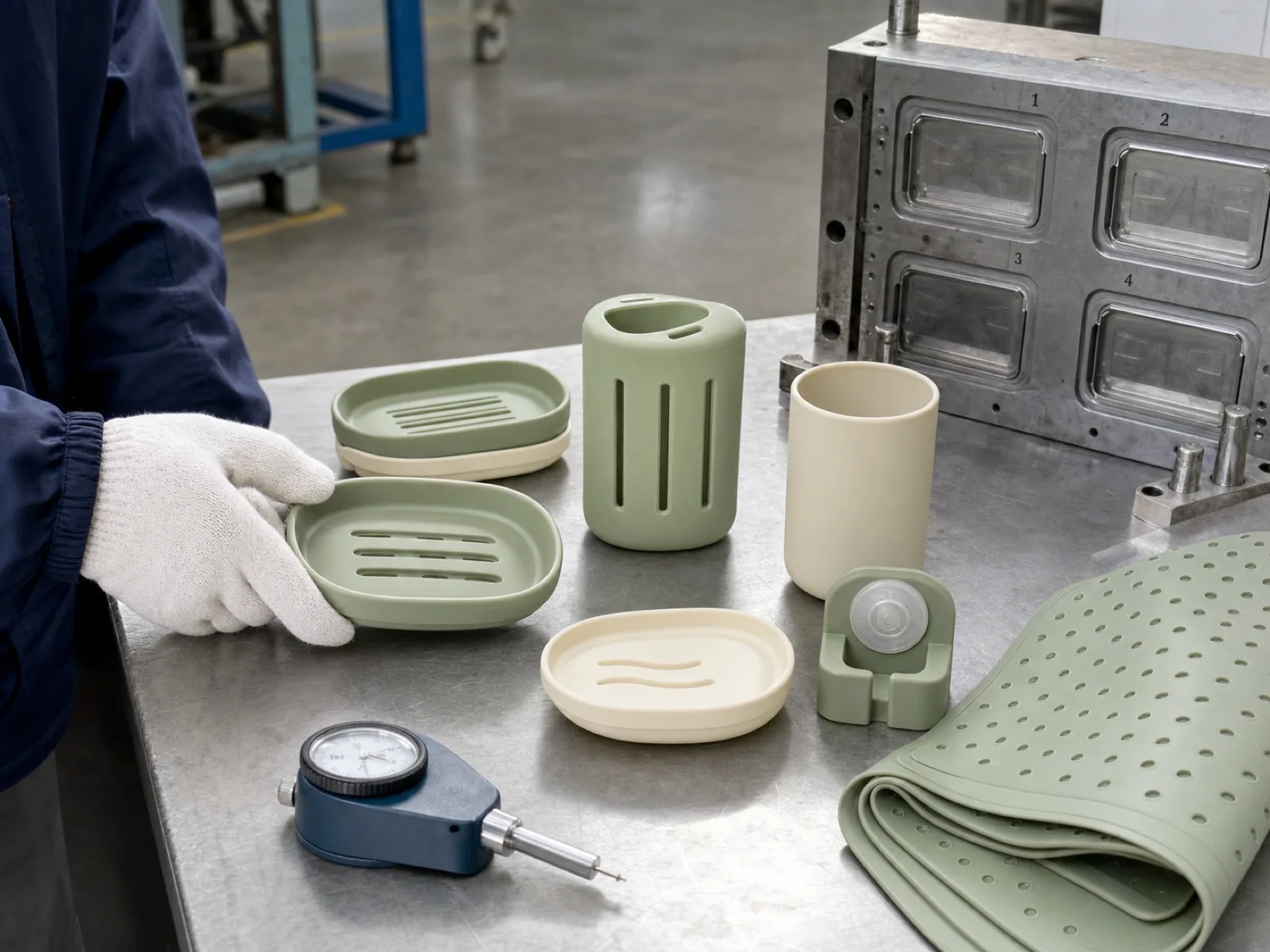
A silicone bathroom accessories manufacturer can OEM or ODM almost any wet-environment personal-care item molded from food- or skin-safe silicone: draining soap dishes and shower trays, toothbrush and razor holders, toiletry organizers, non-slip bath and shower mats, hair catchers and drain covers, faucet and spout splash covers, travel bottles, and tube squeezers. Each shares the same platinum-cured silicone family but differs in wall thickness, Shore A hardness, and functional detail — drainage, grip, or suction.
The category is one manufacturing logic wearing many bodies, and grouping them by function — not by the marketing word “holders” — is the first move in a clean RFQ. There are four engineering families, and every accessory belongs to one of them:
Draining trays and organizers — soap dishes, shower-caddy trays, cosmetic and toiletry organizers, sink-side catch-alls. The load-bearing detail is drainage: a sloped, slotted, or ridged floor that sheds soap slurry and water instead of pooling it. Body Shore A runs firm (50–70) so the tray holds shape under a wet bar of soap.
Suction-mounted holders — razor holders, toothbrush caddies, shower shelves, spout and faucet covers that clip on. The load-bearing detail is suction retention on wet glass or tile, which is a durometer, sealing-face, and pull-test problem.
Non-slip floor and surface mats — bath mats, shower mats, sink mats, tub-corner pads. The load-bearing detail is anti-slip performance wet, plus drainage so the mat does not trap a mildew film underneath.
Drain and hair-catch parts — hair catchers, drain covers, plug seals, overflow gaskets. The load-bearing detail is the sealing or straining geometry and, on plugs, a soft sealing lip.
| Accessory family | Example products | Load-bearing engineering detail | Typical body Shore A |
|---|---|---|---|
| Draining trays / organizers | Soap dish, shower tray, toiletry caddy | Drainage slope + slotted floor | 50–70 |
| Suction-mounted holders | Razor holder, toothbrush caddy, shower shelf | Suction retention + sealing face | 40–60 body / 30–45 cup |
| Non-slip floor mats | Bath mat, shower mat, sink mat | Wet anti-slip texture + drainage | 40–55 |
| Drain / hair-catch parts | Hair catcher, drain cover, plug seal | Straining or sealing geometry | 30–55 |
Because the four families fail in four different ways, the single most useful thing a buyer can do is tell the factory which family each SKU belongs to and let the durometer and test protocol follow from there.
Which silicone grade and Shore A hardness suit bathroom accessories?
Use platinum-cured, food-grade silicone cleared to FDA 21 CFR 177.2600 and LFGB for all skin- and wet-contact bathroom accessories, and match Shore A to the part: a soap dish or holder body wants Shore A 50–70 to hold structure, a non-slip bath mat wants 40–55 to conform and grip, and a suction cup or sealing lip wants a softer 30–45 to seat leak-tight. Skin contact does not require medical-grade silicone — food-grade platinum-cured is the correct, inert grade.
Two decisions live inside “which silicone,” and both get skipped in low-cost quoting. The first is cure system. Platinum (addition) cure crosslinks silicone in a stoichiometrically clean reaction that generates no volatile byproducts, so the part ships without an odor or a leaching risk. Peroxide cure leaves benzoic-acid residues that a proper 4-hour, 200 °C post-cure is meant to drive off — but a factory protecting throughput often shortens it, and the residual smell shows up on a warm, wet soap dish or bath mat as a rubbery odor that reads as a defect. For any bathroom accessory above entry price, specify platinum cure; the full breakdown is in the platinum-cured vs peroxide-cured silicone guide.
The second decision is grade level, and here buyers often over-spec. A soap dish, organizer, or bath mat involves incidental skin contact and wet contact, which is exactly what food-grade platinum-cured silicone is cleared for — it is chemically inert, non-porous, and contains no BPA, BPS, phthalates, or PVC by chemistry. Medical-grade silicone (validated to USP Class VI or ISO 10993) is only warranted for prolonged mucosal or broken-skin contact, which a bathroom accessory does not involve, so paying the medical-grade premium on a soap dish is spending money the SKU cannot recover. Where the food-grade vs medical-grade line actually falls is covered in the FDA vs LFGB silicone guide.
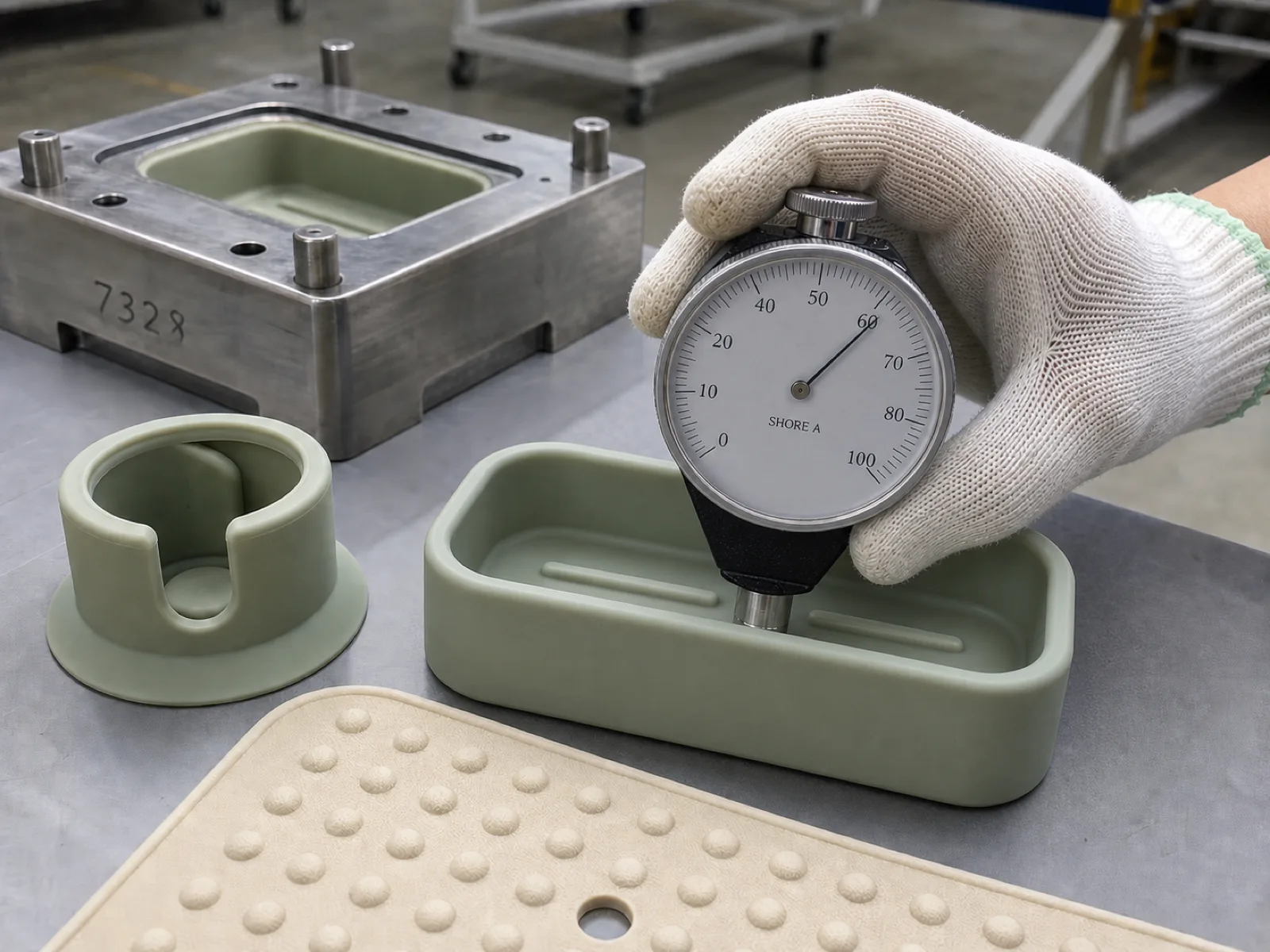
“Soft,” “medium,” and “firm” are not a spec — they are how two people end up arguing over a rejected lot. Perceived firmness is driven by three variables: the durometer of the cured silicone (measured on the Shore A scale per ASTM D2240[^astm-standards]), the wall thickness, and the geometry. So a bathroom accessory spec names a Shore A target and a ±5 tolerance for each functional component:
| Component | Shore A target | Why this band | Verification at lot release |
|---|---|---|---|
| Soap dish / organizer / holder body | 50–70 | Holds shape under a wet load, feels solid | Durometer on the body wall, ±5 |
| Non-slip bath / shower mat | 40–55 | Conforms to tile, grips wet, resists curling | Durometer + wet slide-force check |
| Suction cup / sealing lip / plug | 30–45 | Deforms into glass or tile, pulls leak-tight | Durometer + suction pull test |
| Faucet / spout cover, gasket | 35–50 | Stretches over hardware, seals without tearing | Durometer + fit check |
Platinum-cured silicone holds a service range of roughly −40 °C to 230 °C, so a hot shower, steam, and a top-rack dishwasher cycle are all well inside its envelope — an important point for any accessory a shopper will clean with hot water. If your team wants the full durometer scale mapped to tactile feel, the reasoning generalizes across product classes, and the mistake to avoid is approving a hand-feel prototype without recording each component’s Shore A, then having no objective way to hold the production lot to the same firmness and grip.
How are silicone bathroom accessories engineered for a wet environment?
Wet-environment durability rests on two things: an inherently non-porous, inert material and a drain-and-dry geometry. Platinum-cured silicone gives mold and mildew almost no surface to colonize, but the part still has to shed water — a soap dish needs a sloped, slotted floor, a bath mat needs drainage holes and raised feet, and every accessory needs smooth internal radii with no blind pockets where water pools. Steam and hot-water tolerance follow from silicone's −40 °C to 230 °C range.
The bathroom is the harshest home environment a molded part faces: standing water, soap film, warmth, and humidity for hours a day. Competitors describe accessories as “mildew-resistant” and validate almost none of it, because the honest version is a design discipline, not a sprayed-on claim. Mold and mildew resistance starts with the material — platinum-cured silicone is non-porous and has no plasticizer to feed biofilm, so unlike a foam mat or a textured plastic tray it offers nothing for mold to root into. But material is necessary, not sufficient: the geometry has to let water leave. A bath mat needs drainage holes or channels plus raised feet so a film of water cannot sit trapped against the tub; a soap dish needs a sloped, ridged, or slotted floor so soap slurry drains instead of pooling into a gray scum.
The anti-slip requirement is its own engineering problem. A bath mat grips through a combination of durometer (soft enough to conform to the tile), underside texture or suction dimples, and weight distribution. A mat molded too hard or too thin curls at the corners and slides; a mat with the right Shore A 40–55 and a suction-dimple or ribbed underside stays put on wet glazed tile. Water pooling and drainage design is what separates a hygienic accessory from a mildew farm — the surrounding paragraph’s rule is simple: if water can sit anywhere on the part after use, redesign that surface to drain.
Steam and humidity aging is where cheap materials fail and silicone does not. Polypropylene and PVC accessories craze, cloud, and go brittle after repeated hot-water and steam exposure; platinum-cured silicone is dimensionally stable across the shower’s full thermal swing and does not embrittle, which is why a silicone soap dish outlasts a plastic one by years. The one claim to avoid is an “antimicrobial” or “antibacterial” line built on a silver-ion additive — that turns the accessory into a regulated product under the US EPA and the EU Biocidal Products Regulation, a registration liability inherited from copying a competitor’s copy. The defensible position is the inherent non-porous property plus a drain-and-dry geometry, which is a substantiated engineering claim rather than a regulated biocide statement.
| Wet-environment risk | Cheap-material failure mode | Silicone engineering defense |
|---|---|---|
| Mold / mildew growth | Foam and textured plastic harbor biofilm | Non-porous surface + drainage geometry |
| Water pooling | Flat trays pool soap slurry | Sloped, slotted, ridged draining floor |
| Slipping on wet tile | Hard or thin mat curls and slides | Shore A 40–55 + suction/rib underside |
| Steam / hot-water aging | PP/PVC crazes, clouds, embrittles | Stable −40 °C to 230 °C, no embrittlement |
| Suction release on glass | Rigid cup loses vacuum | Soft Shore A 30–45 cup, defect-free rim |
How is suction and anti-slip performance validated in QC?
Suction and anti-slip are pull-tested and slide-tested, not asserted. A suction razor holder is mounted wet on the target glass or tile and loaded to a minimum hold force for a minimum dwell, repeated across mount-and-remount cycles; a bath mat is checked for wet slide-force on glazed tile. Each has a written per-lot acceptance criterion — a minimum load and dwell before creep — so a rejected batch is settled by a number, not an argument.
The words “strong suction” and “non-slip grip” appear on every listing and are validated on almost none of them. Wetop treats both as measured QC gates, not adjectives. For a suction-mounted holder, the validation is a wet-mount pull test: the holder is pressed onto a smooth glass or glazed-tile plate wetted to simulate a shower wall, then a measured pull or hang load is applied to confirm it holds without creeping or releasing over a set dwell time. The cup is molded in a softer Shore A 30–45 silicone with a smooth, defect-free sealing face — because a single flash line, pinhole, or texture defect on the contact rim breaks the vacuum, so the mold’s sealing surface is inspected as carefully as the pull result. The buyer should state the target surface up front: suction on textured or porous tile is physically weaker than on glass, and a holder specced for glass will underperform on stone, which is a spec issue, not a defect.
For a non-slip mat, the validation is a wet slide-force or tilt check on the intended surface, confirming the mat resists sliding under a representative load when wet. Both tests fold into a standard IQC / IPQC / OQC workflow that the ISO 9001[^iso-9001] quality system documents end to end:
| QC stage | What is checked on bathroom accessories | Acceptance basis |
|---|---|---|
| IQC (incoming) | Raw compound COA, pigment REACH screen, cure system | Platinum-cured, food-grade, on spec |
| IPQC (in-process) | Shore A per component, dimensions, flash on sealing face | Durometer ±5, CMM/gauge, no rim defects |
| Functional test | Suction pull-and-dwell, mat wet slide-force, drainage | Written min load / min dwell per lot |
| OQC (outgoing) | AQL 1.5 visual, color ΔE ≤ 1.5, packaging | Sampling plan pass, D65 light-box match |
Because a suction or draining part is proven on the physical part rather than on a drawing, a bathroom accessory program usually budgets one extra sample-correction round versus a flat part — the T2 sample is where the suction pull test and drainage behavior get signed off before production release.
Compression molding, LSR injection, or extrusion — how are they made?
Most silicone bathroom accessories are compression-molded from high-consistency rubber (HCR): a pigmented slug cures inside a heated, cavity-engraved mold under press tonnage in a few minutes, then is deflashed and post-cured. LSR injection molding suits very high volumes or fine sealing geometry but only pays back above roughly 200,000 pcs/year. Extrusion produces continuous profiles — spout covers, edge trims, tubing — cut to length. The make-or-break step for any wet product is the 4-hour, 200 °C post-cure.
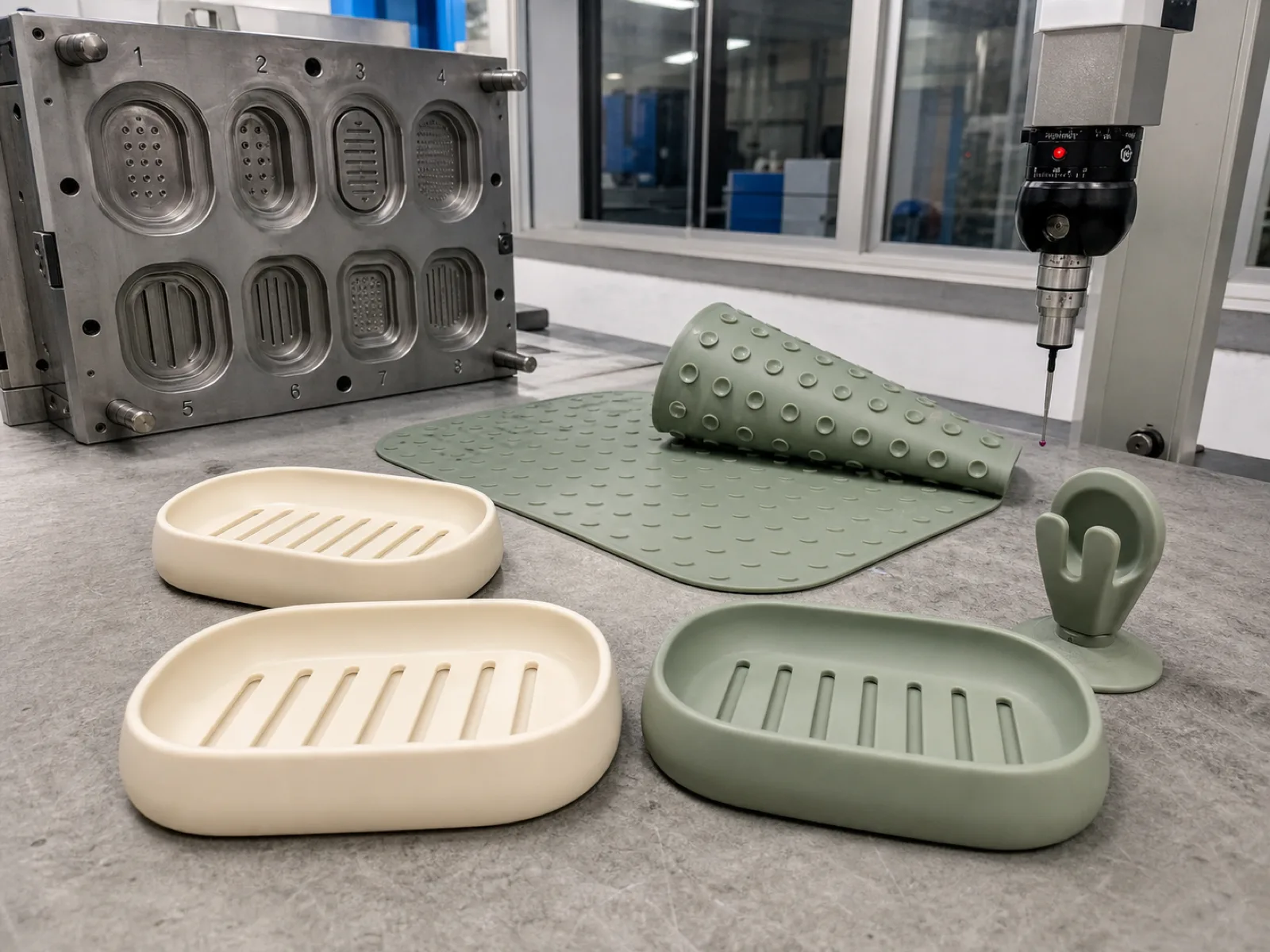
The process choice is an economic decision disguised as a technical one, and it maps to accessory type. Compression molding places a pre-weighed slug of pigmented HCR into an open heated cavity; the press closes under tonnage, the silicone flows to fill the soap-dish, mat, or holder geometry, and it cures in place. It is the right method for most bathroom accessories because the tooling is comparatively cheap, color changes are fast, and large textured parts like bath mats mold cleanly. The trade-offs — a longer cycle and a manual deflash step — are easily absorbed at these volumes.
LSR injection molding pumps two-part liquid silicone into a closed heated mold where it cures in 15–90 seconds, fully automated, holding tight tolerance. It shines on ultra-high volumes and on fine, repeatable sealing geometry — a precision plug seal or a thin sealing lip — where dimensional consistency drives leak performance. But the tooling is multiples more expensive and color changes are slower, so under roughly 200,000 pcs/year the automation savings never catch the tooling premium. Extrusion is the third process, used for continuous profiles: spout and faucet covers, edge and corner trims, tubing, and gasket cord, all extruded as a continuous profile and cut to length. Many bathroom lines are a hybrid — compression-mold the trays and mats, extrude the trims, and reserve LSR for a high-volume sealing component.
| Process | Best-fit bathroom accessories | Tooling cost | Cycle | Best volume band |
|---|---|---|---|---|
| Compression (HCR) | Soap dishes, mats, holders, organizers | USD 3,000 – 8,000 | 2 – 5 min | up to ~200,000 pcs/yr |
| LSR injection | Fine plug seals, thin sealing lips, high-volume parts | USD 15,000 – 45,000+ | 15 – 90 s | 200,000 pcs/yr and up |
| Extrusion | Spout covers, edge trims, tubing, gasket cord | Low (die) | Continuous | Any (length-based) |
After demolding, the make-or-break step for a wet product is the post-cure: a 4-hour bake at 200 °C that drives off residual volatiles. On an accessory that sits warm and wet all day, this is the difference between an odor-free part and a rubbery smell, so a factory that shortens it to protect throughput is disqualifying itself for a bathroom program.
OEM vs ODM, MOQ tiers, tooling cost, and lead time
OEM means the factory builds to your finished design and dedicated tooling; ODM means you customize the factory's existing accessory platform to skip new-mold cost and lead time. Wetop's MOQ starts at 500 pcs/color on existing tooling and 3,000 pcs on a new compression mold at USD 3,000–8,000 tooling cost. Samples land in 7–15 days on existing tools and 25–35 days on new tools; bulk runs 20–30 days after approval.
Most first-time bathroom buyers should start ODM — pick a proven soap dish, mat, or holder platform, then customize color, size, texture, and branding on top. It reaches market months faster and avoids sinking tooling money before the SKU proves itself. Once annual volume justifies the investment, move to a dedicated OEM mold for a distinctive accessory you own outright. The suction-and-seal or drainage geometry is why a bathroom-accessory tool can cost more than a flat part: it is a functional, multi-surface mold validated on a physical pull or drainage test, not just dimensionally. The general MOQ and lead-time framework is laid out in the MOQ and lead time silicone OEM guide.
MOQ and tooling tier structure at Wetop (2026 pricing):
| Program tier | MOQ per color | Tooling cost | Unit price band (FOB) | Best for |
|---|---|---|---|---|
| Stock platform, Wetop packaging | 500 pcs | USD 0 | USD 0.60 – 3.50 | Sample orders, small brands |
| Stock platform, custom Pantone + logo deboss | 1,000 pcs | USD 150 – 350 (logo insert) | USD 0.55 – 3.20 | Private-label test runs |
| Custom soap dish / holder, new compression mold | 3,000 pcs | USD 3,000 – 8,000 | USD 0.50 – 2.90 | Brands wanting a distinct accessory |
| Custom textured bath mat, larger mold | 3,000 pcs | USD 5,000 – 12,000 | USD 1.80 – 5.50 | Larger-footprint mat programs |
| Full private-label — mold + color + set + carton | 5,000 – 10,000 pcs | USD 5,000 – 14,000 all-in | USD 1.20 – 5.00 all-in | Bathroom-retail PL programs |
Sample timeline (existing tooling): color-matched pre-production sample in 7–10 days; retail-ready first-article in 12–15 days. Sample timeline (new tooling): T1 sample off the new mold in 25–30 days; T2 suction/drainage corrections in 5–7 days; production release after the functional test passes on T2. Bulk production: 20–30 days for a standard container order, driven by color-match sign-off, packaging artwork, and any secondary assembly such as a mounted hook or a multi-piece organizer set.
To spec a clean RFQ, hand the factory: the accessory family and function, the size and capacity, the target surface for any suction part, the target Shore A per component, the Pantone color, the logo method, the certification markets (US / EU / both), and the annual volume. Those lines let an engineering desk quote tooling, unit price, and lead time without a week of back-and-forth.
How do you customize and brand silicone bathroom accessories?
Color is matched to Pantone solid-coated within ΔE ≤ 1.5 on a D65 light box using platinum-cured masterbatch, so a full soap-dish, mat, and holder set carries one brand color. Logos are debossed or embossed into the mold cavity at USD 150–350 per insert with zero unit-cost adder and full wash durability — the right method on a wet, frequently cleaned product. Surface finish (matte, satin, soft-touch) and functional texture are additional levers, and on a bath mat texture doubles as the anti-slip feature.
Branding a wet, frequently cleaned product has one governing rule: the mark must survive daily water and cleaning, which rules out anything that sits on top of the surface as a wearable layer. Debossing or embossing the logo directly into the mold cavity is the default — it is molded into the silicone itself, carries no per-unit cost once the insert is cut, and cannot wear off in a shower or a dishwasher. Pad printing and heat transfer handle multi-color artwork but wear faster in a wet bathroom and should be positioned away from high-abrasion contact zones. In-mold decoration (IMD) is available at higher volumes for a durable multi-color graphic. The full method comparison generalizes across products, but for bathroom accessories, deboss-first is almost always the correct engineering call.
Color is matched on the platinum-cured masterbatch, not painted on, so the color runs all the way through the part and cannot chip. A ΔE ≤ 1.5 match on a D65 light box keeps a coordinated bath set visually consistent across a soap dish, a toothbrush holder, and a mat molded on different tools. Surface finish is a customization lever in its own right — matte, satin, or a soft-touch texture changes both the look and the tactile premium feel — and on a non-slip mat the underside texture is not cosmetic at all: it is the functional anti-slip feature, so the “customization” and the “engineering” are the same decision. Packaging spans polybag, kraft hang card, printed sleeve, and full-color retail box with a custom hangtag, plus multi-piece organizer or bath-set kitting as a secondary assembly step.
How do you vet a real silicone bathroom accessory factory vs a trader?
Vet on in-house capability, not on a catalog. A real factory owns its compression presses and tooling shop, runs its own IQC/IPQC/OQC lab, can produce finished-good FDA 21 CFR 177.2600 and LFGB test reports on request, and will walk you through a suction pull test or drainage validation on the physical part. A trading company subcontracts all of it, quotes vaguely on MOQ and tooling, and supplies only a raw-compound COA in place of a finished-good report.
The audit signals that separate a manufacturer from a middleman are concrete and checkable. A real factory gives you exact numbers: MOQ per color, tooling cost by part, sample lead time, and unit price banded by volume — because it controls the presses and the mold shop that produce them. It runs in-house tooling, so a new soap-dish or mat mold is cut and corrected on its own floor rather than shipped to an unnamed subcontractor, which is what lets it commit to a 7–25 day first sample and a physical suction or drainage validation. It produces finished-good FDA 21 CFR 177.2600[^fda-177-2600] and LFGB §30/31[^bfr-xv] reports — testing the actual accessory, not just handing over the compound supplier’s certificate. And it documents a real quality system: an ISO 9001[^iso-9001] certificate you can verify, an AQL-based inspection plan, and a written per-lot acceptance criterion for the suction and anti-slip tests.
A trading company shows the opposite pattern: a broad, unfocused catalog spanning every silicone category, vague or shifting MOQ and tooling answers, no in-house lab, and a raw-compound COA offered in place of the finished-good test a customs review actually asks for. The finished-good-versus-compound distinction is the single most reliable tell — the framework regulation behind it, EU 1935/2004[^eu-1935-2004] and the FDA food-contact program[^fda-food-packaging], grades the finished article, so a supplier that cannot produce a finished-part report is a supplier that did not do the test. Screen for these signals before the first PO, and the leaking-holder, sliding-mat, mildew-pooling failures largely disappear because you have selected a factory that engineers the part rather than reselling it.
Sourcing a silicone bathroom accessories program?
Wetop runs one compression cell and one LSR injection cell on a 7,500 m² floor in Dongguan, molding platinum-cured, food- and skin-safe silicone against FDA 21 CFR 177.2600, LFGB §30/31, and ISO 9001 — with every suction and draining accessory proven on a physical pull-and-drainage test before the mold is signed off. Bring the accessory family, size, target surface, and markets, and the engineering desk will quote tooling, unit price, and a 7–25 day first sample. Talk to the engineering desk to start a silicone bathroom accessories RFQ.
FAQ
-
What silicone bathroom accessories can be custom OEM manufactured?
A silicone bathroom accessories manufacturer can OEM or ODM almost any wet-environment personal-care item molded from food- or skin-safe silicone. The common categories are draining soap dishes and shower-caddy trays, toothbrush and razor holders, toiletry and cosmetic organizers, non-slip bath and shower mats, hair catchers and drain covers, faucet and spout splash covers, travel bottles and squeeze tubes, toothpaste tube squeezers, and edge or corner guards. Each is molded from the same platinum-cured silicone family; what changes is the wall thickness, the Shore A hardness, and the functional detail — a soap dish needs drainage slope, a mat needs anti-slip texture, a razor holder needs suction retention. A factory that segments the quote by function, rather than lumping everything into 'holders', is the one that understands the engineering.
-
Which silicone grade and Shore A hardness suit skin-contact bathroom products?
Use platinum-cured, food-grade silicone cleared to FDA 21 CFR 177.2600 and LFGB for all skin- and wet-contact bathroom accessories, and match the Shore A to the part. A rigid soap dish, organizer, or holder body wants Shore A 50–70 to hold structure under a wet load. A non-slip bath mat wants Shore A 40–55 so it conforms to tile and grips underfoot without curling. A suction cup, sealing lip, or gasket wants a softer Shore A 30–45 so it deforms into glass or tile and pulls leak-tight. Skin contact rarely needs medical-grade silicone; food-grade platinum-cured is inert, non-leaching, and the correct grade for a soap dish or bath mat. Medical grade (USP Class VI) only becomes relevant for prolonged mucosal or broken-skin contact, which a bathroom accessory does not involve.
-
How are silicone bath mats and holders made mold and mildew resistant?
Mold resistance is a material-and-geometry outcome, not a spray-on treatment. Platinum-cured silicone is chemically inert and non-porous, so unlike a foam or textured plastic mat it gives mold and mildew almost nothing to root into — there is no absorbent surface and no plasticizer to feed biofilm. The design then has to let water leave: a bath mat needs drainage holes or channels and raised feet so it does not trap a film of standing water against the tub, and a soap dish needs a sloped, slotted floor that drains soap slurry instead of pooling it. An 'antimicrobial' additive is usually the wrong answer — a silver-ion biocide turns the part into a regulated product under EPA and the EU Biocidal Products Regulation. The defensible claim is the inherent non-porous property plus a drain-and-dry geometry.
-
How is a suction-cup silicone bathroom accessory validated for grip?
Suction retention is pull-tested, not assumed. A suction-mounted razor holder, toothbrush caddy, or shower shelf is validated by mounting it wet on the target surface — smooth glass or glazed tile — and applying a measured pull or hang load to confirm it holds without creeping or releasing over a set dwell time, repeated across mount-and-remount cycles. The suction cup itself is molded in a softer Shore A 30–45 silicone with a smooth, defect-free sealing face, because any flash line or pinhole on the contact rim breaks the vacuum. The acceptance criterion is written per lot — a minimum hold load and a minimum dwell before creep — so a rejected batch is settled by the number, not by argument. Suction on textured or porous tile is inherently weaker, which is a spec the buyer should state up front.
-
What is the MOQ and tooling cost for custom silicone bathroom accessories?
Wetop's silicone bathroom accessories MOQ starts at 500 pcs per color on existing tooling. A custom soap dish, mat, or holder that needs a new compression mold starts at 3,000 pcs to amortize a USD 3,000–8,000 tooling cost, with the price driven by part size and geometry — a large textured bath mat mold costs more than a small soap dish cavity. A full private-label program with a custom mold, Pantone color, debossed logo, and retail packaging typically runs 5,000–10,000 pcs to hit bathroom-retail landed-cost targets. LSR injection tooling (for very high volumes or fine sealing geometry) runs USD 15,000–45,000 and only pays back above roughly 200,000 pcs/year.
-
What certifications should a silicone bathroom accessories supplier provide?
For US and EU retail, require FDA 21 CFR 177.2600 extractables clearance on the finished part, LFGB §30/31 batch reports for the EU (BfR Recommendation XV as the technical basis), BPA- and phthalate-free declarations, REACH SVHC screening on every pigment and additive, California Prop 65 screening for US listings, and an ISO 9001 supplier certificate. The critical distinction is finished-good versus raw-compound testing: a 'FDA compliant' claim usually means the base silicone carries a supplier certificate, not that your finished soap dish or mat was lot-tested by an accredited lab. Because a soap dish contacts skin and a bath mat contacts wet feet, and because customs and retailer audits ask for it, screen the finished-good report, not the compound COA.
-
How do you customize silicone bathroom accessories with color and logo?
Color is matched to Pantone solid-coated within ΔE ≤ 1.5 on a D65 light box using platinum-cured masterbatch, so a soap dish, mat, and holder set can all carry one brand color across the range. Logos are debossed or embossed into the mold cavity at roughly USD 150–350 per insert with zero unit-cost adder and full wash durability, which is the right method on a wet, frequently cleaned product because it cannot wear off. Pad printing and heat transfer are available for multi-color artwork but wear faster in a wet bathroom, and in-mold decoration is an option at higher volumes. Surface finish is also a customization lever — matte, satin, or a soft-touch texture — and texture doubles as function on a non-slip mat.
-
What is the lead time for a custom silicone bathroom accessories order?
On existing tooling, a color-matched pre-production sample takes 7–15 days. A new custom compression mold takes 25–35 days for a T1 sample, plus 5–7 days for corrections after your review, and a suction or draining part usually needs one extra correction round because the suction pull test or drainage behavior is validated on the physical part, not on a drawing. Bulk production runs 20–30 days after sample approval for a standard container order, subject to color-match sign-off, packaging artwork, and any secondary assembly such as a mounted hook, a printed card, or a multi-piece organizer set.
References
Authoritative sources cited in this guide
- US Food and Drug Administration. 21 CFR 177.2600 — Rubber articles intended for repeated use. https://www.ecfr.gov/current/title-21/chapter-I/subchapter-B/part-177/subpart-C/section-177.2600 — The controlling US extractables limit for repeated-use silicone in food- and skin-contact articles — total extractives in n-hexane ≤ 20 mg/in² — used here as the baseline migration standard for silicone bathroom accessories.
- International Organization for Standardization. ISO 9001:2015 — Quality Management Systems — Requirements. https://www.iso.org/standard/62085.html — The QMS Wetop is certified against — the documented quality system a bathroom-accessories retailer audit and a suction pull-test lot-release protocol are built on top of.
- ASTM International. ASTM International — Standards & Publications. https://www.astm.org/products-services/standards-and-publications/standards.html — Source for ASTM D2240 durometer methodology used to bench-verify the Shore A hardness spec on a soap dish body, bath mat, and suction sealing lip.
- German Federal Institute for Risk Assessment (BfR). BfR Recommendations on Food Contact Materials — Recommendation XV, Silicones. https://www.bfr.bund.de/en/bfr_recommendations_on_food_contact_materials-7498.html — The technical basis for LFGB §30/31 clearance on repeated-contact silicone — sets peroxide residual and volatile-matter limits relevant to skin-contact bathroom accessories.
- European Chemicals Agency (ECHA) / EUR-Lex. REACH Regulation (EC) No 1907/2006 — Registration, Evaluation, Authorisation and Restriction of Chemicals. https://eur-lex.europa.eu/legal-content/EN/TXT/?uri=CELEX%3A32006R1907 — Screening framework for every masterbatch, pigment, and additive used in a silicone bathroom accessory sold into the EU — the SVHC candidate-list check an importer must file.
- California Office of Environmental Health Hazard Assessment (OEHHA). Proposition 65 — The Safe Drinking Water and Toxic Enforcement Act. https://oehha.ca.gov/proposition-65 — The California list a bathroom-products importer must screen a soap dish or mat's compound and colorants against before a US retail listing.
- US Food and Drug Administration. Food Ingredients & Packaging. https://www.fda.gov/food/food-ingredients-packaging — FDA's landing page for food-contact substance regulation — the authority context for why a repeated-use skin-contact silicone article is graded under 21 CFR 177.2600.
- European Commission / EUR-Lex. Regulation (EC) No 1935/2004 on materials and articles intended to come into contact with food. https://eur-lex.europa.eu/legal-content/EN/TXT/?uri=CELEX%3A32004R1935 — The EU framework regulation underpinning LFGB and BfR clearance for silicone articles in repeated skin and personal-care contact.
Start a custom program
Send a brief. Get an engineer’s reply in one business day.
Every Wetop program is tooled from a customer’s specification. Send a CAD file (STEP · IGES · DWG) or a written brief and we’ll reply with a mold cost estimate, price brackets at MOQ 500 / 1,000 / 5,000, and any engineering questions.