Buyer Guide · commercial intent
Reusable Silicone Dryer Sheet OEM Guide
 Buyer Guide
 A reusable silicone dryer sheet is a thin, flexible, perforated silicone sheet tossed into a tumble dryer to reduce static cling, separate the load, and cut wrinkling for thousands of cycles instead of one — replacing the disposable sheet that leaves a quaternary-ammonium and silicone-oil film on your clothes. It works by mechanical anti-static and fabric lubrication rather than a consumable chemical coating, and food/skin-grade silicone's -40 °C to 230 °C range gives it a wide safety margin over a dryer's 55–75 °C interior. This guide is the engineering-desk brief for laundry, home-care, and sustainability brands running a reusable silicone dryer sheet program, covering how the product works, how it compares to disposables and dryer balls, the material and thickness spec, the molding process, the compliance packet, lifespan and total cost of ownership, and the MOQ, tooling, and lead-time math.
To a home-care buyer, a reusable silicone dryer sheet looks like a novelty — a floppy square that replaces a box of paper sheets. Then the first container arrives with sheets too thin to survive the dryer’s tumble, a faint rubber odor transferring onto towels on the second lot, and a “reduces static” claim that a reviewer disproves in one over-dried load of synthetics. None of those failures are bad luck. Each maps to a decision the factory made — or skipped — during cure-system selection, thickness targeting, and claim substantiation. This guide is written from the engineering desk at Wetop’s Dongguan floor for brand owners and private-label buyers who want the manufacturing math behind a durable, honest, sellable product.
What is a reusable silicone dryer sheet, and how does it actually work?
A reusable silicone dryer sheet is a thin, perforated, flexible silicone sheet added to a tumble dryer to reduce static and separate laundry across thousands of cycles. It works mechanically: its body physically parts the load and increases airflow, and silicone's surface bleeds off the triboelectric charge that causes cling — instead of depositing the quaternary-ammonium and silicone-oil coating a single-use sheet leaves on fabric.
The mechanism is the whole story, and it is where honest marketing separates from wishful marketing. A tumble dryer generates static through the triboelectric effect: dissimilar fabrics rub against each other and against the drum, transferring electrons and building a stored charge that makes clothes cling when the load cools. A disposable dryer sheet attacks that chemically — it is a nonwoven substrate loaded with a quaternary-ammonium (quat) fabric softener plus a silicone oil, both of which melt in the dryer’s heat and transfer onto fibers, leaving a lubricating, charge-dissipating film. That film is also what coats towels and reduces their absorbency, and what triggers fragrance and skin-sensitivity complaints.
A reusable silicone dryer sheet does the job without the deposit. Its flexible, perforated body physically separates the load so fabrics have fewer sustained rub contacts, increases air movement through the tumble, and presents a silicone surface that lets charge bleed off gradually rather than accumulate. The result is reduced static and wrinkling with nothing left behind on the fabric — no quat film, no fragrance unless the user adds it. That is the defensible claim: it reduces static mechanically and is reusable for the life of the dryer. It does not chemically eliminate static in a badly over-dried synthetic load the way a heavy quat coating can, and a factory that promises “eliminates all static” is writing a claim its own mechanism cannot support.
Two product architectures ship under this one mechanism. A pure anti-static sheet works dry and needs nothing added. A re-dosable sheet is molded with a textured or micro-reservoir surface so the end user can apply a few drops of liquid fabric softener before a load for added scent or softness, then reapply at will — a bridge for shoppers who still want the softener experience without a single-use sheet. Both are moldable; the re-dosable version simply needs a surface-texture insert in the tool. If you are new to the material itself, the FDA vs LFGB silicone guide covers the food/skin-grade compound framework this product is built on.
Reusable silicone dryer sheet vs disposables, wool balls, and vinegar
A reusable silicone dryer sheet beats disposable sheets on cost-per-use, waste, and fabric residue; beats wool dryer balls on longevity, hygiene, and shedding; and beats a vinegar rinse on convenience and dryer-stage static control. Disposables win only on immediate softness-and-scent, wool balls on drying-time reduction, and vinegar on lowest raw cost. Range silicone for the durability-and-clean-fabric buyer.
The buyer’s real question is not “is silicone good” but “which anti-static solution do I put on the shelf, and how do I position it against the four things a shopper already knows.” Each alternative has a distinct failure mode a silicone sheet is engineered around, and each has one thing it does better — an honest range acknowledges both.
| Attribute | Reusable silicone dryer sheet | Disposable dryer sheet | Wool dryer balls | Vinegar rinse |
|---|---|---|---|---|
| How it reduces static | Mechanical separation + charge bleed | Quat + silicone-oil coating | Mechanical agitation | Ionic rinse (wash stage) |
| Reusability | Thousands of cycles | Single use | ~1,000 loads, sheds over time | Per wash |
| Residue on fabric | None | Quat/oil film, cuts towel absorbency | Wool lint/pilling | None |
| Fragrance | User-added, optional | Built-in, hard to avoid | None | None |
| Drying-time effect | Neutral | Neutral | Reduces drying time | None |
| Works at dryer stage | Yes | Yes | Yes | No (wash only) |
| Waste per year | ~1 sheet | ~500–1,000 sheets | ~2–6 balls | Bottles |
| Typical retail price | USD 8 – 20 (set) | USD 5 – 12 / box | USD 10 – 25 / set | USD 3 – 6 |
The line that captures the sale is residue plus longevity. Fragrance-sensitive, eczema-prone, and towel-focused shoppers actively want the quat film gone, and that is precisely what a silicone sheet removes from the equation. Against wool balls — the closest reusable competitor — silicone does not shed fiber, wipes clean under water, holds a stable geometry, and offers the clean re-dosable softener option, while wool balls keep their edge on cutting drying time. Positioning the two as complementary (balls for speed, silicone sheet for static and clean fabric) is more defensible than claiming silicone wins on every axis. For the underlying cure-chemistry reason silicone stays odor-free where a cheaper compound does not, see the platinum-cured vs peroxide-cured silicone guide.
What material grade and spec belong in a reusable silicone dryer sheet?
A reusable silicone dryer sheet should be molded from platinum-cured, food/skin-grade silicone at 1.2–2.5 mm thickness and Shore A 40–60, so it stays flexible in tumble yet holds its perforation geometry. Because dried laundry is worn against skin, grade the compound to skin contact, require FDA 21 CFR 177.2600 clearance, and reject peroxide-cured compound, which off-gasses a rubber odor onto fabric.
The dryer sheet is a thin-sheet part, and thin-sheet parts fail in two directions that the spec must bracket. Too thin or too soft and the sheet tears at the perforations under tumble load; too thick or too hard and it stops being a flexible sheet and starts thumping the drum like a puck. The controlling specs are therefore thickness and durometer together, not either alone.
| Spec | Target range | Why it matters |
|---|---|---|
| Thickness | 1.2 – 2.5 mm | Below ~1.2 mm the perforations tear; above ~2.5 mm the sheet loses flex and thumps |
| Durometer (Shore A) | 40 – 60 | Flexible enough to conform in tumble, firm enough to hold perforation shape |
| Cure system | Platinum (addition) | No benzoic-acid volatiles to off-gas onto fabric in heat |
| Service temperature | -40 °C to 230 °C | 150-plus-degree margin over a 55–75 °C dryer interior |
| Tensile / tear strength | Per ASTM D412 | Predicts perforation survival over thousands of cycles |
| Fragrance / VOC | None (post-cured) | Fragrance-free by default; scent added by user |
| Colorant | Inorganic masterbatch | Heat- and wash-stable; holds ΔE ≤ 1.5 |
Two crossroads decide safety and durability. The first is cure chemistry. Platinum (addition) cure crosslinks the silicone in a stoichiometrically clean reaction that produces no volatile byproducts, which is why platinum-cured silicone ships into infant-feeding and skin-contact applications with minimal residual off-gassing[^nih-silicone-review]. Peroxide cure leaves benzoic acid and related volatiles that a full 4-hour, 200 °C post-cure is meant to drive off — but a factory protecting throughput often shortens it, and the residual volatiles off-gas a rubber smell in the hot dryer that then transfers onto towels and bedding. On a laundry product, that odor is a fast one-star review, so Wetop only quotes platinum-cured compound here.
The second crossroad is service temperature, which is the durability headline. A household tumble dryer runs an interior air temperature of roughly 55–75 °C. Food/skin-grade silicone has a continuous service range of about -40 °C to 230 °C, so the sheet operates with a margin of well over 150 °C below its limit — it will not melt, deform, embrittle, or scorch across the life of the appliance. That headroom is the entire reason a silicone sheet outlives a coated-paper disposable that is chemically consumed and physically degraded by the same heat in one cycle. The silicone temperature range explained guide breaks down how that -40 °C to 230 °C envelope is derived and where the real limits sit.
Compression molding, calendering, or LSR — how is a silicone dryer sheet made?
A reusable silicone dryer sheet is produced by compression molding of high-consistency rubber (HCR) or by calendering-and-die-cutting a silicone sheet, with the perforation and any surface texture formed in the tool. LSR injection molding is reserved for very high volumes or ultra-fine geometry, because its higher tooling cost only pays back above roughly 200,000 pcs/year. Geometry and volume drive the choice, not preference.
The process decision is an economics decision disguised as a technical one, and for a flat, perforated, thin part there are three viable paths.
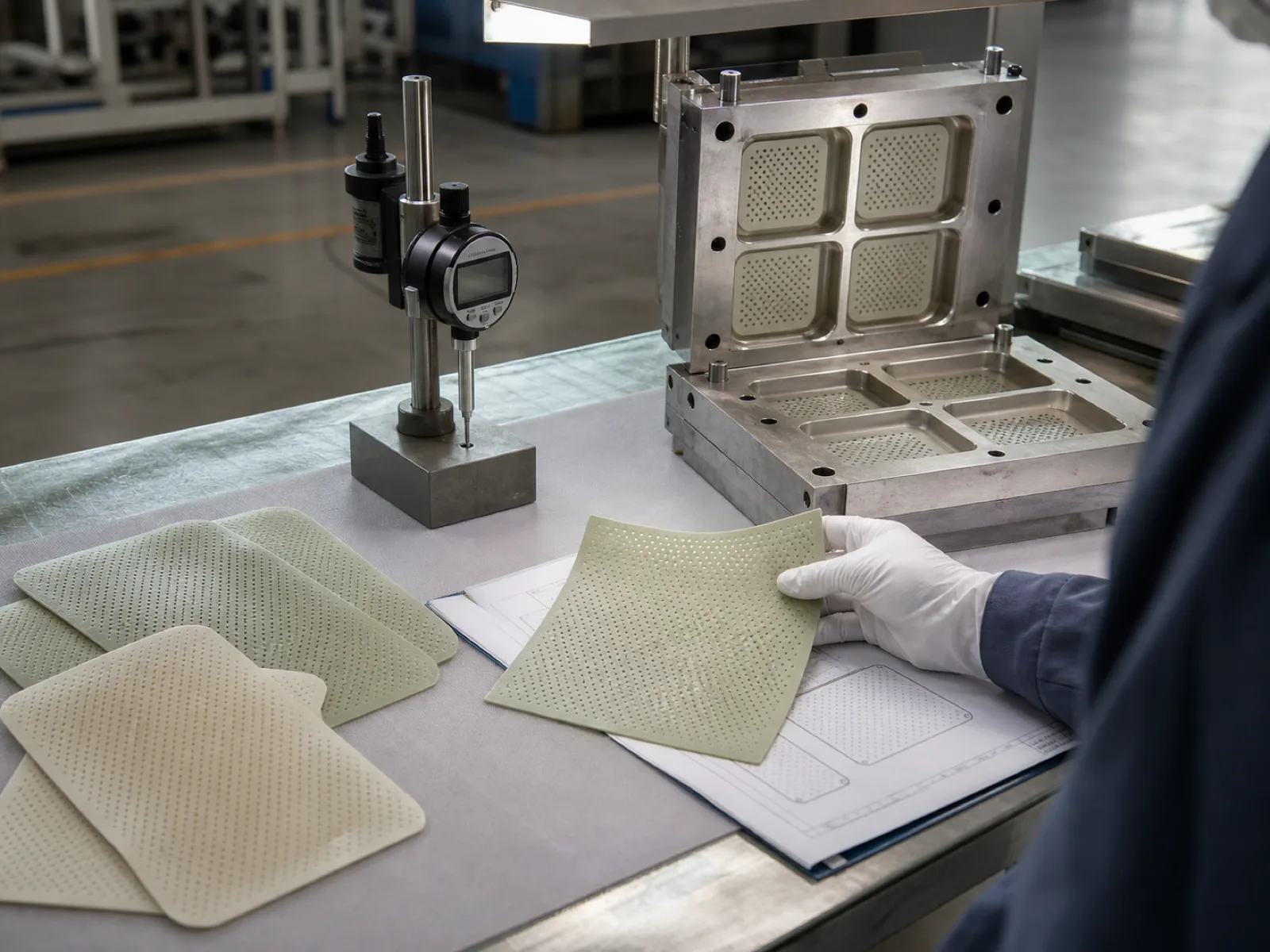
Compression molding places a pre-weighed slug of pigmented HCR into an open, heated cavity engraved with the perforation field and any embossing; the press closes under tonnage, the material flows to fill the pattern, and it cures in place in a few minutes. It is the default for a dryer sheet with molded-in perforations, a hang hole, and a debossed logo, because the tooling is comparatively cheap, color changes are fast, and the geometry molds cleanly.
Calendering and die-cutting rolls HCR into a continuous sheet of controlled thickness, cures it, and then die-cuts the outline and perforations. It shines when the sheet is a simple flat shape at high volume with no molded-in texture, giving a very consistent gauge across a run. The trade-off is that intricate molded-in features (deep debossing, a re-dosable reservoir texture, three-dimensional edges) are harder to achieve than in a dedicated compression cavity.
LSR injection molding pumps two-part liquid silicone into a closed, heated mold where it cures in 15–90 seconds, fully automated and holding tight tolerance. It is the right call for ultra-high volumes or very fine, thin-wall geometry, but the tooling costs multiples more and color changeover is slower. For a typical dryer-sheet program under roughly 200,000 pcs/year, LSR’s automation savings never overtake its tooling premium.
| Factor | Compression molding (HCR) | Calendered + die-cut | LSR injection |
|---|---|---|---|
| Tooling cost | USD 2,000 – 5,500 | USD 1,500 – 4,000 (die) | USD 12,000 – 40,000+ |
| Cycle time | 2 – 5 min | Continuous roll | 15 – 90 s |
| Molded-in texture / deboss | Excellent | Limited | Excellent |
| Gauge consistency | Good | Excellent | Excellent |
| Best volume band | up to ~200,000 pcs/yr | mid-to-high, flat parts | 200,000 pcs/yr and up |
| Right call for dryer sheets | Yes (textured / branded) | Yes (simple flat, high vol) | Only at very high volume |
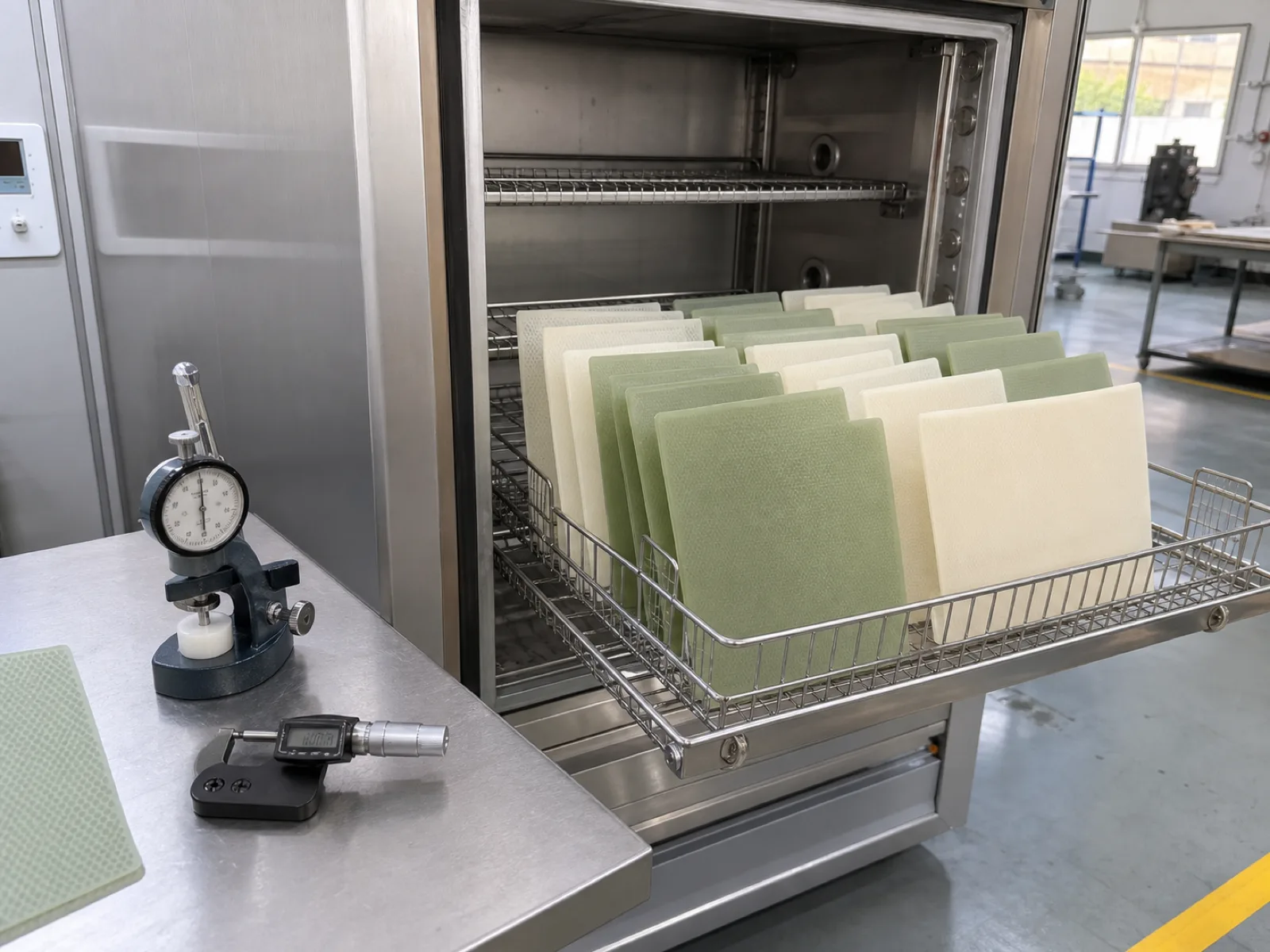
Whichever path is chosen, the make-or-break step is the post-cure: a 4-hour bake at 200 °C that drives off residual volatiles. On a product that will sit in a hot dryer against fabric, this is what stands between a clean, odor-free sheet and a rubber smell on the towels, so a factory that skips it to protect throughput is disqualifying itself from a laundry program.
What certifications and compliance does a silicone dryer sheet program need?
A US/EU reusable silicone dryer sheet needs FDA 21 CFR 177.2600 extractables clearance on the finished good, LFGB §30/31 batch reports for EU markets (BfR Recommendation XV basis, with the EU 10/2011 10 mg/dm² migration limit as the benchmark), REACH SVHC screening on all additives, BPA/phthalate-free declarations, and a California Prop 65 statement — plus an ISO 9001 supplier certificate.
Because dried laundry is worn directly against skin, a dryer sheet is best treated as a skin-adjacent article and documented to that bar, even though it never contacts food. That framing gives the buyer the strongest, most defensible safety file. Two documentation traps catch first-time buyers.
The first is the finished-good versus base-compound distinction. A listing that says “FDA-grade silicone” almost always means the raw silicone carries a 177.2600[^fda-177-2600] letter from its supplier — not that the finished sheet was lot-tested by an accredited lab. US Customs FDA review and a retailer’s supplier audit both want the finished-good report. The minimum documentation packet:
- Finished-good FDA 21 CFR 177.2600[^fda-177-2600] migration report from an accredited lab (Intertek, SGS, or Eurofins), per lot or per quarter
- LFGB §30/31 batch report for EU markets, with BfR Recommendation XV[^bfr-xv] as the technical basis and the EU 10/2011[^eu-10-2011] 10 mg/dm² overall migration limit as the benchmark
- REACH SVHC screening[^echa-reach] on every pigment, masterbatch, and additive against the current candidate list
- BPA-free and phthalate-free declarations (silicone contains neither by chemistry; the declaration is what the retailer files)
- California Prop 65[^ca-prop65] statement covering the compound and any colorant
- ISO 9001[^iso-9001] certificate — Wetop is certified since 2008
- Tensile / tear report per ASTM D412 and durometer per ASTM D2240[^astm-standards] to substantiate the durability claim
The second trap is the “antibacterial” or “eco” over-claim. An added silver-ion or other biocidal masterbatch is a regulated substance and turns a marketing line into a registration obligation, so the honest hygiene story is silicone’s inherent non-porous, wipe-clean surface — not a treated additive. Likewise, a sustainability claim must be substantiated by the lifecycle math in the next section, not asserted. For a full clause-by-clause read on the two regimes that govern this product, the FDA vs LFGB silicone guide is the reference to hand your compliance team.
Reusability, lifespan, and total cost of ownership vs disposables
One reusable silicone dryer sheet lasts thousands of dryer cycles — effectively the life of the appliance — because its anti-static effect is mechanical, not a consumable coating. Against a disposable baseline of one sheet per load, a single silicone sheet displaces roughly 500–1,000 disposables over its life, which is the substantiated total-cost-of-ownership and waste-reduction claim a sustainability brand can defend on-pack.
The economic argument is the strongest one this category has, and it is one competitors consistently fail to quantify. A disposable dryer sheet is consumed every load; a household running 4–6 loads a week burns roughly 200–300 sheets a year, or a case of boxes. A reusable silicone sheet is not chemically consumed — it does the same mechanical job on load 1,000 that it did on load 1 — so a single sheet spanning two to three years of typical use displaces 500 to 1,000 disposables.
| Metric | Reusable silicone dryer sheet | Disposable dryer sheets |
|---|---|---|
| Units consumed / year (5 loads/wk) | ~0 (one sheet lasts years) | ~260 sheets |
| Sheets over 3 years | 1 | ~780 |
| Waste to landfill | ~1 sheet at end of dryer life | ~780 non-recyclable sheets |
| Fabric residue accumulated | None | Quat/oil film build-up |
| Est. 3-year spend | USD 8 – 20 once | USD 25 – 45 in boxes |
That replacement-rate difference is a claim a brand can put on the pack and defend, because it is arithmetic, not a vibe. Care is what protects the lifespan number: silicone is non-porous, so the sheet rinses clean under warm water or runs on a dishwasher top rack to clear lint and any softener film, then air-dries fast. No oiling, conditioning, or reactivation is needed between loads on a pure anti-static design. The single failure mode that can undercut the lifespan claim is mechanical tearing at the perforations, which is why the thickness and Shore A specs above are non-negotiable and durometer-verified at lot release — a durability claim is only as good as the QC that backs it.
OEM vs ODM, MOQ tiers, tooling cost, and lead time
OEM means the factory builds your finished design on dedicated tooling; ODM means you customize an existing silicone dryer sheet platform to skip new-mold cost and lead time. Wetop's MOQ starts at 500 pcs/color on existing tooling and 3,000 pcs on a new mold at USD 2,000–5,500 tooling cost. Samples land in 7–15 days on existing tools, 25–35 days on new tools; bulk runs 15–25 days after approval.
Most first-time laundry and home-care buyers should start ODM — pick a proven sheet platform, then customize color, perforation pattern, logo, and packaging on top. It reaches market months faster and avoids sinking tooling money before the SKU proves itself. Once annual volume justifies it, move to a dedicated OEM mold for a distinctive shape, re-dosable surface texture, or perforation pattern you own outright. The branding options that ride on either path are detailed in the platinum-cured vs peroxide-cured silicone guide for the material side and validated at QC below.
MOQ and tooling tier structure at Wetop (2026 pricing):
| Program tier | MOQ per color | Tooling cost | Unit price band (FOB) | Best for |
|---|---|---|---|---|
| Stock platform, Wetop packaging | 500 pcs | USD 0 | USD 0.55 – 1.60 | Sample orders, small brands |
| Stock platform, custom Pantone + logo deboss | 1,000 pcs | USD 150 – 350 (logo insert) | USD 0.50 – 1.45 | Private-label test runs |
| Custom shape / perforation, new mold | 3,000 pcs | USD 2,000 – 5,500 | USD 0.45 – 1.30 | Brands wanting a distinct sheet |
| Full private-label — mold + color + card + carton | 5,000 – 10,000 pcs | USD 3,000 – 7,500 all-in | USD 0.65 – 1.70 all-in | Laundry-aisle PL programs |
Sample timeline (existing tooling): color-matched pre-production sample in 7–10 days; retail-ready first-article with card in 12–15 days. Sample timeline (new tooling): T1 sample off the new mold in 25–30 days; T2 corrections in 5–7 days; production release after T2 approval. Bulk production: 15–25 days for a standard container order, driven by color-match sign-off, packaging artwork, and any re-dosable texture insert.
Mold ownership is the buyer’s asset upon full payment of tooling — Wetop transfers title after the first production run ships and does not hold molds as end-of-program leverage. Dryer sheets often ship as multi-packs, so quote the set landed cost, not just the piece price, when you build retail margin.
What supplier QC and material-safety validation should a program run?
Run a five-check QC regime on every lot: Shore A durometer against spec ± 3, thickness-gauge verification against the 1.2–2.5 mm target, an ASTM D412 tear/tensile check on the perforation field, a scent panel after a 48-hour 60 °C soak to catch cure odor, and pre-shipment inspection at AQL 1.5. Validate safety with a finished-good migration report per lot or quarter — never a base-compound COA alone.
A reusable silicone dryer sheet lives or dies on two properties: it must survive thousands of hot tumble cycles without tearing, and it must never transfer an odor onto fabric. Both are QC problems before they are marketing problems. The bench regime that keeps a program out of the return pile:
- Shore A durometer — verifies cure completeness and firmness against the spec ± 3 band; a low reading signals an incomplete cure that predicts both tearing and odor
- Thickness gauge — confirms the 1.2–2.5 mm target across the sheet; a thin edge is a tear origin
- Tear / tensile per ASTM D412[^astm-standards] — pull-tests the perforation field, the load-bearing geometry that fails first
- Scent panel — five blind noses after a 48-hour 60 °C soak; any rubber off-note fails the lot (the peroxide-cure tell that a dryer’s heat would amplify onto laundry)
- Pre-shipment inspection at AQL 1.5 — in-house or third-party, sampling the full carton for perforation defects, color drift, and flash
On the safety file, the discipline is simple and non-negotiable: require a finished-good FDA 21 CFR 177.2600[^fda-177-2600] and LFGB report on the actual sheet, tested by an accredited lab, refreshed per lot or per quarter — a base-compound COA certifies the raw silicone the factory bought, not the product you will sell. A full first-article test package runs USD 500–1,300 in accredited-lab fees. Skipping it saves that money once and loses it many times over on the first customs hold or fragrance-sensitivity complaint.
Ready to source a reusable silicone dryer sheet program?
Wetop is a founder-led, ISO 9001 silicone factory in Dongguan running platinum-cured compression cells on a 7,500 m² floor. We manufacture reusable silicone dryer sheet, re-dosable softener sheet, and related laundry-accessory programs for US and EU home-care and sustainability brands at 500-pc to 500,000-pc annual scale, with the skin-contact material spec, thickness and durometer engineering, compliance packet, and lifespan-validation QC built in.
If you have a spec sheet, an RFQ, or a competitor sample you want teardown-benchmarked for cure system, thickness, and Shore A, talk to the engineering desk. We will return a first-pass spec review, tooling estimate, and MOQ / lead-time / FOB unit-price band inside two business days.
FAQ
-
Do reusable silicone dryer sheets actually reduce static cling?
Yes, but by a different mechanism than a disposable sheet. A tumble dryer builds triboelectric charge as fabrics rub; that stored charge is what makes clothes cling. A reusable silicone dryer sheet works mechanically — its flexible, perforated body physically separates the load and increases air movement, and silicone's surface bleeds charge off gradually instead of letting it accumulate. It does not coat fibers with the quaternary-ammonium softener film a disposable sheet leaves behind. Static reduction is real but partial; the honest claim is 'reduces static cling,' not 'eliminates' it, and it improves further in loads that are not badly over-dried.
-
How many loads does a reusable silicone dryer sheet last?
A properly molded platinum-cured silicone dryer sheet is rated for thousands of dryer cycles — practically the life of the dryer. Because the anti-static effect is mechanical rather than a consumable coating, the sheet does not 'run out' the way a disposable does. Field-life claims of 500–1,000-plus loads are common and defensible against a disposable-sheet baseline of one use each. The failure mode is not chemical exhaustion but mechanical: a sheet that is too thin or under-cured can tear at the perforations, which is why thickness and Shore A must be specified and durometer-verified at lot release.
-
Do you have to add fabric softener to a silicone dryer sheet?
It depends on the design, and this is a decision a brand makes before tooling. A pure anti-static silicone dryer sheet needs nothing added — it works dry and reduces static and wrinkling mechanically. A re-dosable design is engineered with a textured or micro-reservoir surface so the end user can apply a few drops of liquid fabric softener before a load when they want added scent or softness, then reapply as desired. Wetop can mold either architecture; the re-dosable version needs a surface-texture insert in the mold and a clear use instruction on pack so the softener claim stays honest.
-
Are reusable silicone dryer sheets safe and non-toxic?
A reusable silicone dryer sheet made from platinum-cured, food/skin-grade silicone is inert, VOC-free once post-cured, and contains no BPA, phthalates, or added fragrance. Because dried laundry is worn against skin, spec the compound to skin contact and require a finished-good FDA 21 CFR 177.2600 extractables report plus LFGB clearance — not just a raw-compound COA. Avoid peroxide-cured compound, which can retain benzoic-acid volatiles that off-gas a rubber odor onto fabric in a hot dryer. The safety story is strongest when the sheet is fragrance-free by default and any scent is added by the user.
-
Can silicone dryer sheets handle dryer heat without melting?
Comfortably. A household tumble dryer runs an interior air temperature of roughly 55–75 °C on normal and high-heat settings. Food/skin-grade silicone has a continuous service range of about -40 °C to 230 °C, so a silicone dryer sheet operates with a 150-plus-degree margin below its limit and will not melt, deform, or scorch. This thermal headroom is the core durability advantage over a coated-paper disposable, which is chemically consumed and physically degraded by the same heat in a single cycle.
-
How do I clean and store a reusable silicone dryer sheet?
Silicone is non-porous, so a reusable silicone dryer sheet rinses clean under warm water and mild soap, and it is dishwasher-safe on the top rack. Wipe or rinse it every few weeks to clear lint and any residual softener film, then air-dry — it dries fast because nothing soaks in. Store it flat or hung by its perforation; a hang hole molded into the sheet doubles as a storage feature and a drainage point. No special conditioning, oiling, or reactivation is required between loads for a pure anti-static design.
-
Are silicone dryer sheets better than wool dryer balls?
They solve overlapping problems with different trade-offs. Wool dryer balls bounce through the load to reduce drying time and soften mechanically, but they shed fiber over time, can pill onto delicates, and do little for static once wool itself dries out. A silicone dryer sheet does not shed, wipes clean, lasts far longer, and holds a stable perforation geometry, but it does not cut drying time the way agitating balls can. Many brands range both; the silicone sheet wins on longevity, hygiene, and a clean re-dosable softener option, while wool balls win on drying-time reduction.
-
What is the MOQ for custom silicone dryer sheets?
Wetop's reusable silicone dryer sheet MOQ starts at 500 pcs per color on existing tooling. A custom shape, perforation pattern, or re-dosable surface texture that needs a new mold starts at 3,000 pcs to amortize the USD 2,000–5,500 tooling cost. A full private-label program — custom mold, Pantone color, debossed logo, and printed retail packaging — typically runs 5,000–10,000 pcs to hit laundry-aisle landed-cost targets. Sampling is 7–15 days on existing tooling and 25–35 days on a new mold.
-
Can you private-label silicone dryer sheets with our logo and color?
Yes. Wetop's color desk matches Pantone solid-coated within ΔE ≤ 1.5 on a D65 light box using platinum-cured masterbatch, so muted laundry-aisle tones — sage, cream, slate, blush — hold cleanly. A logo debossed into the mold cavity costs roughly USD 150–350 per insert, adds nothing to unit cost, and survives unlimited dryer and wash cycles; full-color heat transfer is available for multi-color art but wears faster in hot-tumble use. Packaging spans polybag, kraft hang card, printed sleeve, and full-color retail box with a molded-in hang hole for shelf display.
References
Authoritative sources cited in this guide
- US Food and Drug Administration. 21 CFR 177.2600 — Rubber articles intended for repeated use. https://www.ecfr.gov/current/title-21/chapter-I/subchapter-B/part-177/subpart-C/section-177.2600 — The controlling US extractables limit for repeated-use silicone in food- and skin-adjacent articles — total extractives in n-hexane ≤ 20 mg/in² — used here as the baseline migration standard for a reusable dryer sheet touched by dried laundry.
- International Organization for Standardization. ISO 9001:2015 — Quality Management Systems — Requirements. https://www.iso.org/standard/62085.html — The QMS Wetop is certified against — the documented quality system a private-label laundry buyer's supplier audit is built on top of.
- ASTM International. ASTM International — Standards & Publications. https://www.astm.org/products-services/standards-and-publications/standards.html — Source for ASTM D2240 durometer methodology and ASTM D412 tensile testing used to bench-verify the Shore A and tear-strength specs of a thin silicone dryer sheet.
- European Chemicals Agency (ECHA) / EUR-Lex. REACH Regulation (EC) No 1907/2006 — Registration, Evaluation, Authorisation and Restriction of Chemicals. https://eur-lex.europa.eu/legal-content/EN/TXT/?uri=CELEX%3A32006R1907 — Screening framework for every pigment, masterbatch, and additive used in a silicone dryer sheet sold into the EU — the basis for the SVHC candidate-list screen in the compliance packet.
- European Union / EUR-Lex. Commission Regulation (EU) No 10/2011 on plastic materials and articles intended to contact food. https://eur-lex.europa.eu/legal-content/EN/TXT/?uri=CELEX%3A32011R0010 — Source of the 10 mg/dm² overall migration limit (OML) used across EU food-contact materials as the migration benchmark; silicone itself is governed nationally via BfR Recommendation XV under Framework Regulation 1935/2004.
- German Federal Institute for Risk Assessment (BfR). BfR Recommendations on Food Contact Materials — Recommendation XV, Silicones. https://www.bfr.bund.de/en/bfr_recommendations_on_food_contact_materials-7498.html — The technical basis for LFGB §30/31 clearance on silicone — sets peroxide residual and volatile-matter limits relevant to the odor risk on a dryer sheet exposed to repeated heat.
- California Office of Environmental Health Hazard Assessment (OEHHA). Proposition 65 — The Safe Drinking Water and Toxic Enforcement Act of 1986. https://oehha.ca.gov/proposition-65 — The California listing and warning framework a silicone dryer sheet and its colorants must be screened against before sale into the US market.
- US National Library of Medicine (PubMed). Silicone in consumer and biomedical applications — migration and safety review. https://pubmed.ncbi.nlm.nih.gov/23256725/ — Peer-reviewed migration and biocompatibility data underpinning FDA and LFGB clearance of platinum-cured silicone, cited here to support the inert, VOC-free safety claim on a laundry accessory.
Start a custom program
Send a brief. Get an engineer’s reply in one business day.
Every Wetop program is tooled from a customer’s specification. Send a CAD file (STEP · IGES · DWG) or a written brief and we’ll reply with a mold cost estimate, price brackets at MOQ 500 / 1,000 / 5,000, and any engineering questions.