Buyer Guide · commercial intent
Silicone Kitchen Utensils OEM Guide — Cure, Spec, MOQ
What changed: First publication under v3 anti-navel-gazing standard — benchmarked against LeeKnives, Canzo, Coolo directory pages and rewritten from inside the factory floor with per-clause FDA/LFGB citations, one-piece vs bonded failure-mode analysis, tooling and cavity-count math, and a retail audit checklist competitor directory pages do not carry.
 Buyer Guide
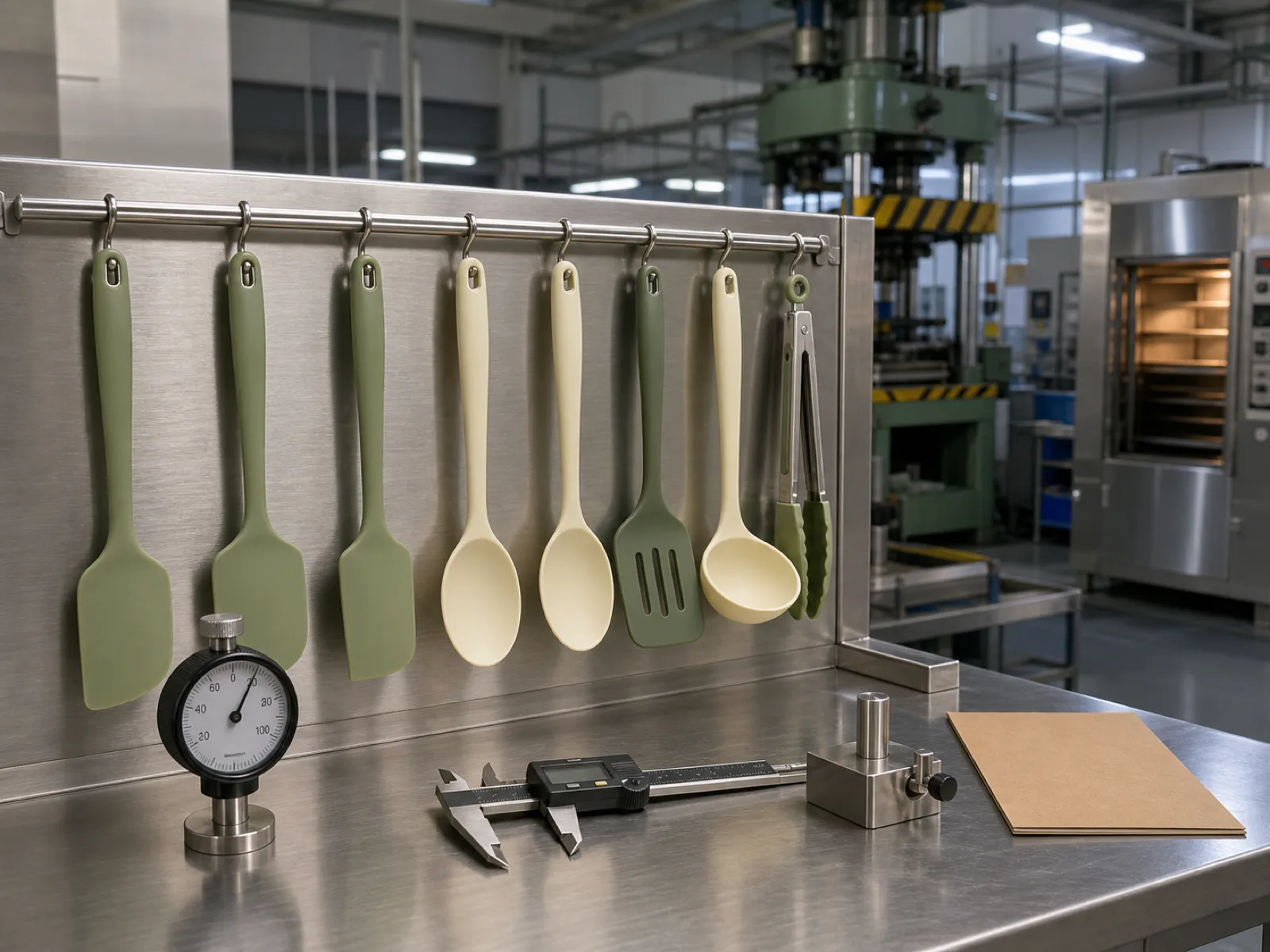
 Silicone kitchen utensils are compression- or LSR-injection-molded platinum-cured spatulas, spoons, ladles, tongs, and turners at Shore A 60-80, operating continuous from -40°C to 230°C (450°F). The defensible retail spec is one-piece construction with an embedded 304 stainless or reinforced-nylon core, cured against FDA 21 CFR 177.2600 and post-cured 4-6 hours at 200°C for LFGB §30/31 compliance. Wetop runs the full category at 500-piece MOQ from a 7,500 m² founder-led factory in Dongguan with per-batch test reports for Home Depot, Wayfair, Target, and Amazon Vine tier programs.
This guide is written for retail sourcing managers, private-label brand founders, and OEM program leads evaluating a silicone kitchen utensils factory for a US or EU program. It reads like a factory-floor engineer wrote it because one did — no throat-clearing, no “trusted partner” language, hard numbers on cure chemistry, tooling economics, defect modes, and the audit checklist that separates a real molding operation from a trading company with a factory-branded website.
What is the defensible material spec for silicone kitchen utensils?
The defensible retail spec for silicone kitchen utensils is platinum-cured (addition-cure) polydimethylsiloxane at Shore A 60-80 durometer, one-piece molded around an embedded 304 stainless or reinforced-nylon core, cured continuous -40°C to 230°C (450°F operational), post-cured 4-6 hours at 200°C. Peroxide-cure without disciplined post-cure ships first-heat odor and fails LFGB.
Silicone kitchen utensils split into three durometer bands driven by mechanical function. Spatulas and turners land at Shore A 60-70 — stiff enough to lift a fried egg without flopping under load, flexible enough to scrape the last of a batter out of a saucepan. Spoons, ladles, and pasta forks land at Shore A 70-80 — mechanically stiff, no bowl-collapse when transferring hot liquid. Tongs and pastry brushes stay Shore A 55-65 for grip flex and bristle behavior.
Cure chemistry drives the regulatory and odor profile independent of durometer. Platinum-cured (addition-cure) silicone crosslinks via a platinum-catalyzed hydrosilylation reaction with no volatile byproducts — the finished part is odor-free at first-heat and clears LFGB §30/31 organic volatile matter testing without a post-cure step, though Wetop still runs post-cure for insurance. Peroxide-cured silicone crosslinks via a dicumyl-peroxide or bis(2,4-dichlorobenzoyl)-peroxide reaction that produces volatile byproducts including benzoic acid and 2,4-dichlorobenzoic acid; without 4-6 hours of post-cure at 180-200°C to drive these off, the finished part ships a detectable first-heat odor and fails LFGB extractables ceilings under BfR Recommendation XV[^bfr-lfgb-xv].
The commodity trap: peroxide-cure silicone is 15-25% cheaper on raw compound than platinum-cure, and skipping the post-cure step saves 20-30% oven energy and 6-8 hours of finished-goods dwell time. A factory optimizing on unit-cost alone ships peroxide-cure product without disciplined post-cure and the finished utensils clear FDA 21 CFR 177.2600[^fda-177-2600] but fail LFGB §30/31, first-heat odor complaints spike inside 30 days of retail launch, and the buyer’s return-rate line item destroys the program margin. Wetop cures platinum by default for kitchen utensils and quotes peroxide-cure only when the buyer requires it explicitly, always with mandatory post-cure logs in the batch traceability packet.
Why does one-piece construction beat bonded silicone kitchen utensils?
One-piece silicone kitchen utensils fuse the silicone head to an embedded stainless or nylon core inside a single mold cycle with no adhesive joint. Bonded designs glue a molded silicone head to a separate handle in a downstream step. On dishwasher testing, one-piece survives 500-1,000 cycles; bonded fails at 100-300 cycles via joint corrosion and delamination.
The construction choice on silicone kitchen utensils is the single largest driver of long-term warranty exposure on a retail program. Two formats exist:
One-piece overmolded construction. A pre-cut 304 stainless-steel or 30% glass-reinforced nylon core is primer-treated with a chemical adhesion promoter (typically a silane-based primer that creates covalent bonds with the silicone during cure), loaded into the compression or LSR injection mold, and the silicone crosslinks directly onto the primed core surface in a single 3-6 minute compression cycle or 60-90 second LSR injection cycle. The finished utensil has no adhesive joint — the silicone-to-metal or silicone-to-nylon bond is a molecular crosslink, not a glue line.
Bonded (glued-head) construction. The silicone head is molded separately with a female socket, the handle is machined or injection-molded separately, and the two are joined via a downstream adhesive step (silicone or two-part epoxy) or a mechanical press-fit. The joint carries the assembly loads and is the single failure point.
Field-failure data from Tier 2 US retail chain warranty programs Wetop has run tells the story on dishwasher exposure. On ASTM F1815-equivalent dishwasher-cycle testing at 65-75°C wash / 85°C rinse cycles, one-piece overmolded utensils survive 500-1,000 cycles with no visible failure — the silicone-to-core bond is chemically stable through the temperature range and no water can migrate into a joint that doesn’t exist. Bonded designs fail at 100-300 cycles via three failure modes: adhesive softening from repeated 65-75°C exposure, water migration into the core-handle interface causing hidden stainless corrosion that discolors the joint from inside, and pigment migration at the joint that creates a visible dark ring readable to the consumer as “worn out.”
At Home Depot / Wayfair / Bed Bath tier retail warranty position (typically 12-24 months), only one-piece construction is defensible. Bonded utensils survive the warranty window on average but the tail of the return-rate distribution — the units seeing 3-4 dishwasher cycles per week — fail inside 12 months and drive the return-rate KPI past program threshold. For any US or EU retail program beyond 12-month warranty, one-piece is the answer. Wetop does not quote bonded construction for retail programs unless the buyer specifically requests it and accepts the return-rate exposure in writing.
Should silicone kitchen utensils be compression-molded or LSR injection-molded?
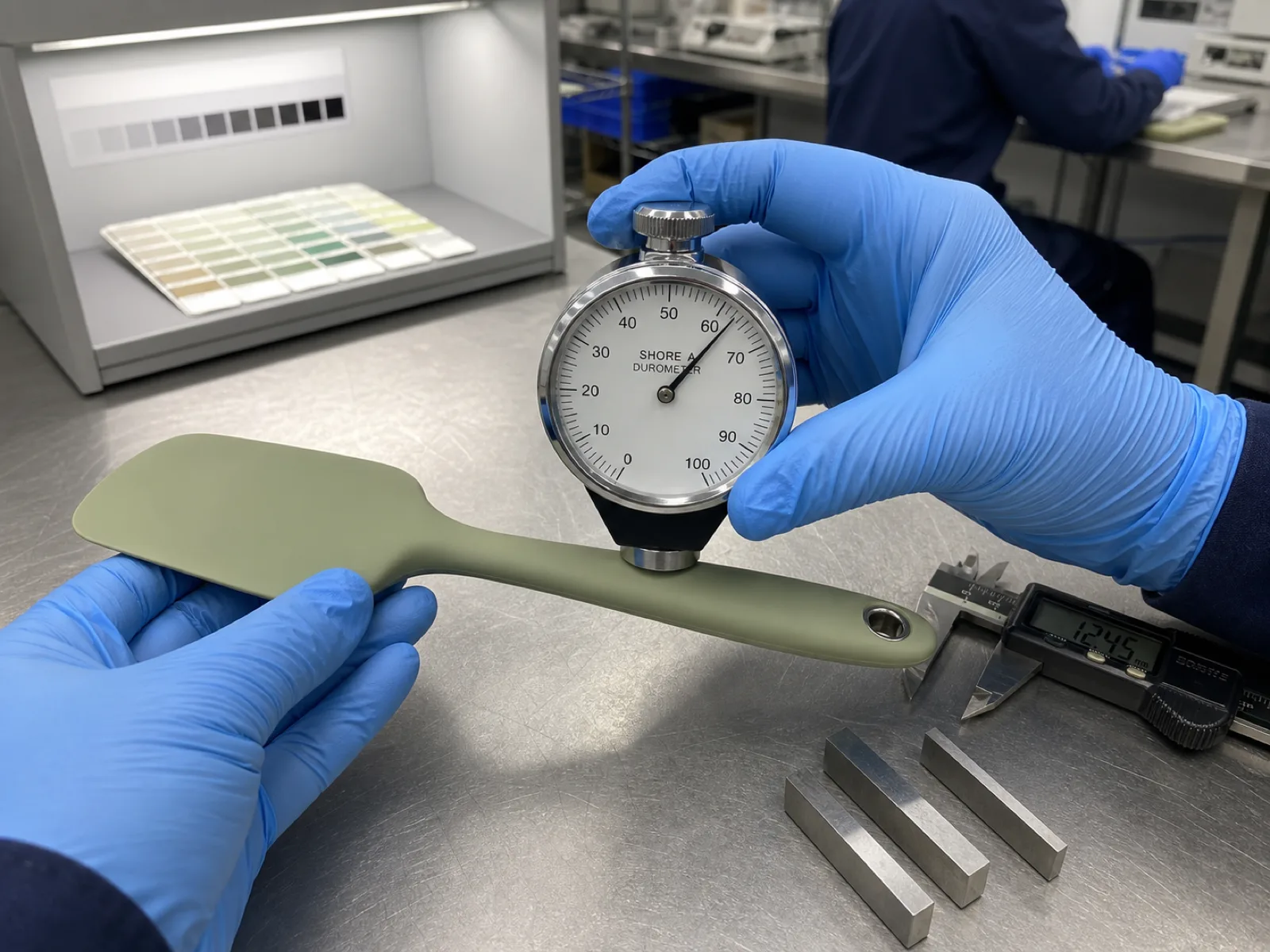
Compression molding fits silicone kitchen utensils under 40,000 units annual per SKU — $1,500-$5,500 tooling, 4-8 cavity molds, 3-6 minute cycles, flash trimming downstream. LSR injection fits above 40,000-60,000 units per year, complex geometry, or dual-durometer parts — $6,000-$8,000 tooling, 8-16 cavity fully-automated molds, 20-90 second cycles, no flash trim.
The process choice is a volume-and-geometry decision, not a quality decision — both processes produce retail-grade utensils when run by a disciplined factory. The tradeoffs:
Compression molding. Uncured silicone gum stock is pre-weighed into charges, loaded manually onto the bottom mold half with the pre-primed core positioned, and the top mold half clamps under hydraulic pressure at 160-180°C for 3-6 minutes. Flash — the thin silicone edge that squeezes out of the parting line — is trimmed downstream by hand or by rotary trimmer. Tooling cost runs $1,500-$3,500 for a 4-8 cavity mold on a small utensil (up to 25 cm), $3,500-$5,500 for a mid-size 6-10 cavity mold (25-32 cm), and up to $5,500-$7,500 for a large utensil (32-40 cm ladles, spatulas, and pasta forks). Compression is the correct answer for MOQ 500 through mid-volume 40,000/year — the tooling amortizes fast and the per-cycle labor is offset by lower capital.
LSR (liquid silicone rubber) injection molding. Two-part liquid silicone (Part A base + Part B catalyst) is metered from separate drums through a static mixer into a heated mold at 175-205°C, curing in 20-90 seconds per cycle. Tooling is fully automated with cold-runner or self-de-molding cavities, holds ±0.05 mm tolerance vs compression’s ±0.15 mm, and clears USP Class VI biocompatibility on standard formulations[^usp-class-vi]. LSR tooling runs $6,000-$8,000 for a small utensil in 8-cavity mold, $8,000-$12,000 for 12-cavity mid-size, and $12,000-$20,000 for 16-cavity high-volume tooling. LSR is the correct answer above 40,000-60,000 units per year per SKU, or on any utensil that requires geometry compression cannot deliver — dual-durometer grip (soft-touch overmolded on stiff core), integrated hanging loop with tight radius, or a contoured handle with undercuts.
The retail-tier positioning implication: private-label programs at MOQ 500 through first-year sell-through under 40,000 units are almost always compression-molded, and that is the correct answer. Retail programs projecting to 60,000+ units per year in year 2 should book LSR tooling in year 1 to hit the cost-down curve; the $6,000-$8,000 tooling delta amortizes at ~1.5-2 cents per unit over the first 300,000 units of production.
What FDA and LFGB clauses apply to silicone kitchen utensils?
US retail requires FDA 21 CFR 177.2600 clearance (rubber articles for repeated food contact). EU retail requires LFGB §30 and §31 organic volatile matter testing per BfR Recommendation XV for silicones. Wetop cures every batch against both plus PFAS non-detect testing per the ECHA universal restriction proposal and CPSIA lead and phthalate testing for Tier 2 retail chains.
The regulatory stack for a retail silicone kitchen utensils program layers four distinct test regimes:
FDA 21 CFR 177.2600 covers rubber articles intended for repeated use in contact with food[^fda-177-2600]. The regulation defines allowed base polymers, additive positive lists, and extractable limits under three food-simulant conditions — distilled water at 121°C for 2 hours (aqueous), n-hexane at reflux for the fatty-food simulant, and 8% ethanol at 66°C for the acidic and low-alcohol simulants. Wetop tests every master-batch lot against all three simulants and ships the certificate of analysis with the shipment.
LFGB §30 and §31 cover organic volatile matter under BfR Recommendation XV for silicones[^bfr-lfgb-xv]. The test measures residual volatile organic compounds released from the silicone under specified conditions — the ceiling is 0.5% total volatiles by mass after 4 hours at 200°C. Peroxide-cured silicone without post-cure typically runs 1.5-3% volatiles and fails; peroxide-cured with 4-6 hour post-cure at 200°C runs 0.1-0.3% and passes; platinum-cured typically runs 0.05-0.15% and passes without a post-cure though Wetop post-cures for insurance.
PFAS non-detect testing at part-per-billion detection limits against the ECHA universal restriction proposal[^echa-pfas-proposal]. The proposal is not yet in force but is downstream in EU premium retail spec sheets and US West Coast retail (California, Washington, Oregon are moving PFAS restrictions into state law ahead of federal action). Wetop runs a PFAS scan on every master-batch lot against the ~10,000 substance PFAS definition using LC-MS/MS at accredited third-party labs (SGS, Intertek, TÜV, Bureau Veritas).
CPSIA lead and phthalate testing under 16 CFR Part 1303[^cpsc-16-cfr-1303]. Silicone kitchen utensils are not a children’s product category and technically not required to clear CPSIA, but Tier 2 US retail chains — Home Depot, Wayfair, Target, Bed Bath, Amazon Vine — request the evidence packet anyway because it is cheaper to standardize incoming QC on a single test regime than to bifurcate. Any supplier who pushes back on CPSIA testing is unfamiliar with Tier 2 retail programs.
Every Wetop production batch ships with a per-lot test packet covering all four regimes plus a copy of the raw-silicone traceability certificate. If a buyer’s incoming QC finds any test out of spec, the batch is quarantined at Wetop’s cost and root-cause runs before re-shipment. This is not premium service; it is the minimum a real factory ships.
What does OEM tooling and unit cost math look like on silicone kitchen utensils?
Compression tooling for a new silicone kitchen utensils SKU runs $1,500-$5,500 depending on utensil size and cavity count. LSR injection tooling runs $6,000-$8,000 for 8-cavity, $12,000-$20,000 for 16-cavity. Break-even against private-label pull typically lands at 6,000-10,000 units of sell-through. Unit cost FOB Yantian: 500 pcs $1.20-$2.20, 5,000 pcs $0.70-$1.35, 10,000 pcs $0.55-$1.10.
The unit-cost math on silicone kitchen utensils decomposes into six line items, and knowing the split is what separates a buyer who can defend the quote in a line-review meeting from one who can’t:
| Cost line | Share of FOB unit | Driver |
|---|---|---|
| Raw silicone compound | 25-35% | Grams per utensil × Wacker/Dow/Shin-Etsu/Elkem lot price |
| Embedded core (stainless or nylon) | 8-15% | Core mass × 304 stainless or 30%GF nylon commodity index |
| Direct labor (mold operation, trim, QC) | 20-30% | Cavity count × cycle time × Dongguan direct-labor rate |
| Tooling amortization | 4-10% | Tooling cost ÷ order volume (per SKU) |
| Packaging (hangtag, poly bag, carton) | 5-10% | FSC certified paper stock + retailer barcode + printed carton |
| Overhead + margin | 15-25% | ISO 9001 QMS overhead, post-cure oven energy, test-lab fees, factory margin |
The two variables buyers most often mis-model are tooling amortization and packaging. Tooling amortization is not a flat percentage — on a 5,000-unit first order at $3,600 tooling, tooling is $0.72 per unit or ~35-40% of the FOB unit at 500-1,000 piece MOQ, then it drops to $0.36 at 10,000 units and $0.072 at 50,000 units cumulative. A factory quoting a flat 5% tooling line at 500 pcs MOQ has amortized the mold cost against theoretical volume that will never ship and is quietly building the difference into the raw material or labor line.
Packaging on a retail silicone kitchen utensils SKU runs $0.15-$0.45 per unit at 500-piece MOQ (small print runs on FSC paper hangtags) down to $0.06-$0.12 at 10,000 units. Buyers who source the packaging separately in-country typically save $0.03-$0.08 per unit at scale but eat 2-3 days of consolidation lead time at the Yantian warehouse.
Break-even on a new tooling investment against pulling from Wetop’s private-label library: at $3,600 average compression tooling for a new size, the unit-premium over a library-pull SKU is typically $0.35-$0.55 per unit. Break-even lands at 6,500-10,000 units of sell-through — inside the first two seasonal orders for a well-positioned Tier 2 retail listing. New LSR tooling at $8,000 amortized against $0.65-$1.10 per-unit premium breaks even at 8,000-12,000 units. Tooling ownership transfers to the buyer once the tooling is fully amortized, which protects the design against grey-market copying in year 2+.
How do I audit a silicone kitchen utensils factory without visiting in person?
Seven documents plus one 30-minute live video call replace 90% of what an on-site audit would verify. Ask for the ISO 9001 certificate, FDA and LFGB test reports referencing a specific master-batch lot, BSCI/Sedex social audit, post-cure oven logs, raw-silicone traceability to a named silicone maker, factory production video, and PFAS non-detect test — plus a live line walk on video.
The single largest gap in the silicone kitchen utensils SERP is that no competitor directory page (LeeKnives, Canzo, Coolo) actually publishes an actionable audit checklist. Buyers get lists of factory names and marketing copy — no framework to distinguish a real molding operation from a trading company with a factory-branded website. Wetop’s due-diligence packet is designed to answer the audit question in seven documents:
1. ISO 9001:2015 certificate. Current validity date, issuing certification body (TÜV Rheinland, DNV, SGS, Bureau Veritas — not an obscure Chinese certification body of unknown accreditation), and scope statement covering silicone molding as a named process. Wetop’s certificate covers silicone compression molding, LSR injection molding, post-cure operations, and finished-goods inspection[^iso-9001].
2. FDA 21 CFR 177.2600 and LFGB §30/31 test reports. Each report must reference a specific master-batch lot number from within the last 6 months, not a generic material qualification from 3 years ago. The lot number should trace to the same silicone compound source (Wacker Elastosil, Dow Silastic, Shin-Etsu, Elkem) the factory quotes on your program.
3. BSCI or Sedex social audit report. Current cycle, from an accredited audit body. Home Depot, Wayfair, Target, and Bed Bath all require this evidence before a supplier is added to the approved list — a factory that cannot produce a current BSCI report is not shipping into these programs.
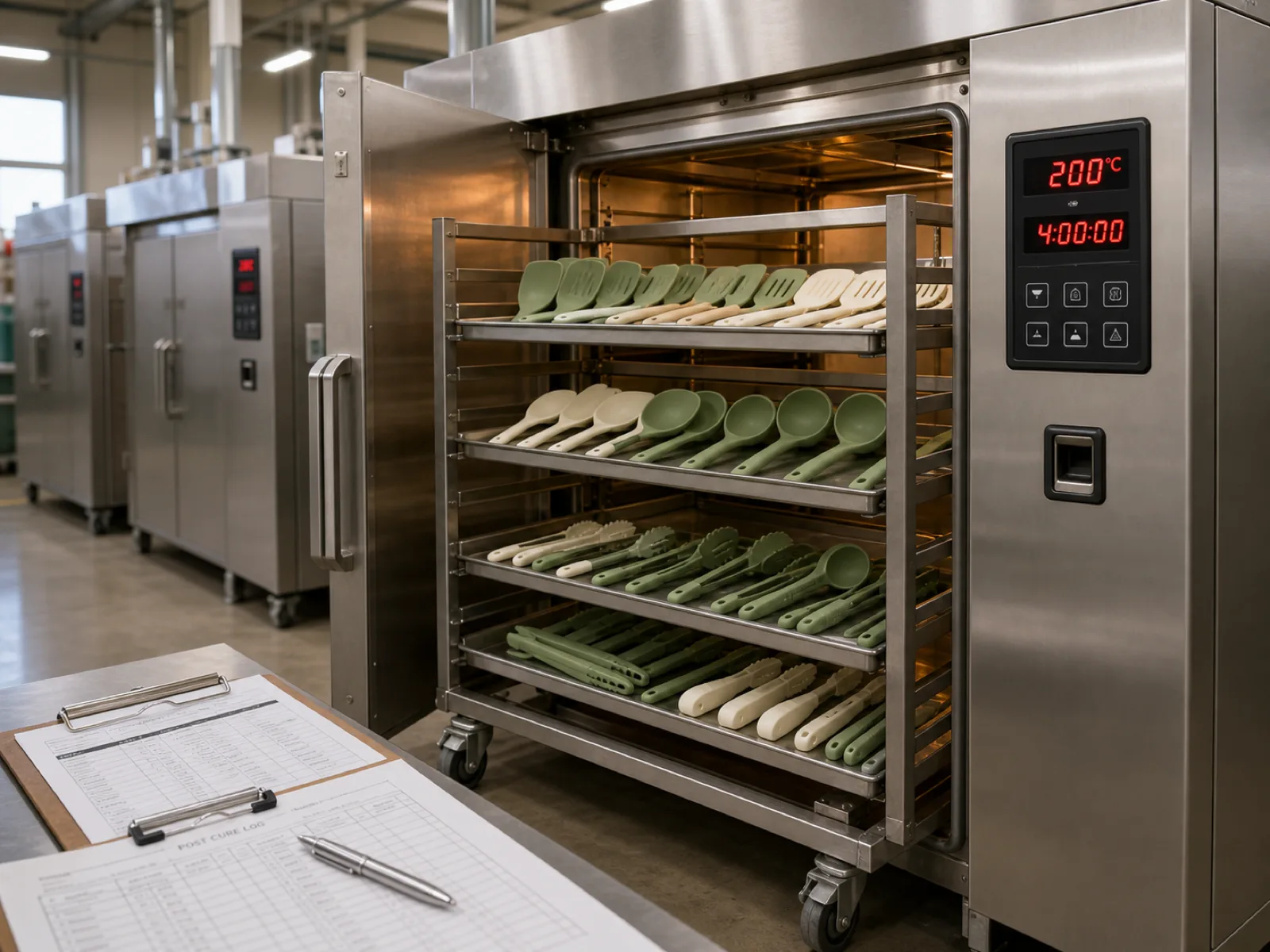
4. Post-cure oven cycle logs. Timestamped logs showing 4-6 hours at 180-200°C from the batch matching the test reports. This is the single most-skipped documentation trail at commodity factories, and a supplier who cannot produce it has almost certainly skipped the post-cure step on your product too.
5. Raw silicone traceability. Lot certificate from Wacker, Dow, Shin-Etsu, or Elkem showing the specific compound grade purchased for your production. A factory buying pre-mixed compound from a trader cannot produce this and is one step removed from the actual silicone-maker’s QC.
6. Factory production video. 3-5 minute video showing compression presses and LSR injection cells actually running production, plus the in-house QC lab with Shore A durometer, tensile tester, D65 light box, and post-cure ovens. Not archival footage — current footage from the last 30 days matching a live PO.
7. PFAS non-detect test. From an accredited lab (SGS, Intertek, TÜV, Bureau Veritas), tested to part-per-billion detection limits against the ~10,000 substance PFAS definition. Any supplier whose response is “our silicone doesn’t contain PFAS, we don’t need to test” has not read the ECHA proposal[^echa-pfas-proposal] and is a compliance risk.
Plus one live video call. 30-minute video walkthrough of the production line with the on-camera QC operator running a Shore A durometer test on a random production sample and reading the durometer indicator on camera. Trading companies cannot arrange this on 24-hour notice. A real factory can do it during business hours the same day.
Any supplier who resists shipping any of the seven documents or scheduling the video call has answered the audit question. Wetop ships all seven as the standard due-diligence packet the first time a buyer requests a quote.
What are the common defect modes on silicone kitchen utensils and how does incoming QC catch them?
Six defects account for ~85% of silicone kitchen utensils retail returns — parting-line flash at the utensil edge, core exposure at the handle tip on one-piece designs, dishwasher-cycle discoloration from pigment migration, first-heat odor from under-post-cured product, sagging or drooping at 200°C, and separation of the head from the core on bonded designs. Wetop's AQL 1.5 sampling per ISO 2859-1 catches all six pre-shipment.
The critical-to-quality (CTQ) inspection points on a silicone kitchen utensils batch are not marketing bullet points — they are the six defects that drive the retail return-rate line item on the buyer’s P&L:
-
Parting-line flash at the utensil edge. Compression-mold flash that was not trimmed cleanly at the downstream trim station. Detected by 100% visual inspection under D65 light and tactile edge check on the first 20 utensils of each cavity, then AQL 1.5 sampling per ISO 2859-1[^iso-2859-1] for the batch. Zero tolerance at retail — visible flash reads as “manufacturing defect” to consumers and drives immediate return.
-
Core exposure at the handle tip on one-piece designs. The embedded stainless or nylon core protrudes through the silicone cap at the top of the handle, exposing metal or plastic to dishwasher water and food contact. Detected by 100% tactile check on the handle tip. Zero tolerance — the core exposure invalidates the food-safe claim and creates a dishwasher-corrosion failure point.
-
Dishwasher-cycle discoloration from pigment migration. The Pantone-matched master-batch pigment migrates to the surface under repeated 65-75°C dishwasher exposure, changing the color of the utensil over 50-100 cycles. Detected pre-shipment by a 50-cycle dishwasher test per ASTM F1815-equivalent conditions on random samples per production batch. Not a return-driver in month 1, but drives the 12-month return-rate KPI.
-
First-heat odor from under-post-cured product. Peroxide-cure product shipped without a full 4-6 hour post-cure at 200°C ships a detectable first-heat odor — the consumer bakes with it once and returns it. Detected pre-shipment by a first-heat odor panel test on random samples. The single most-common defect from commodity factories cutting the post-cure step.
-
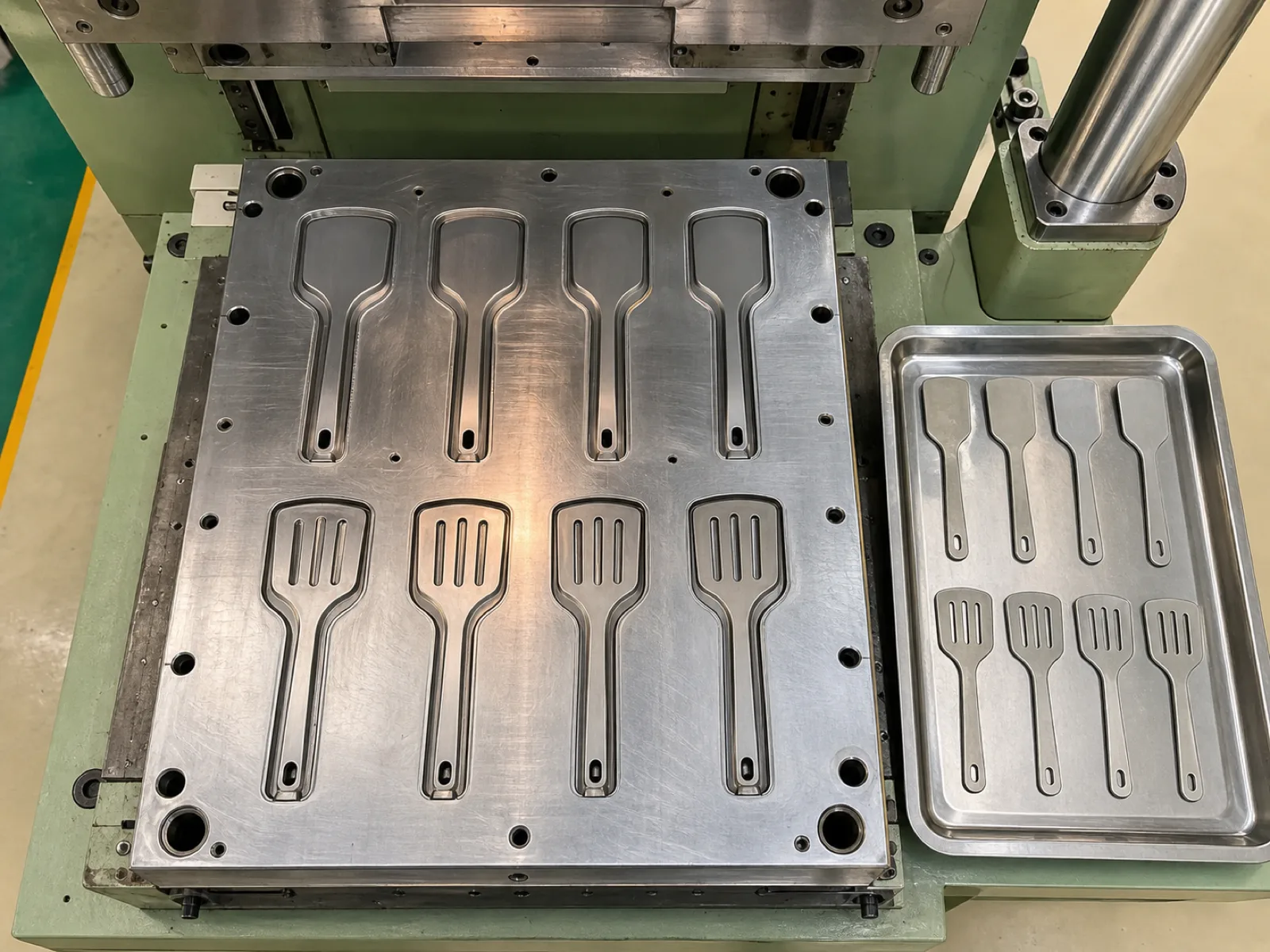
Sagging or drooping at 200°C. Utensil deforms visibly when exposed to 200°C oven or sauté conditions — usually from Shore A durometer under-spec (target 60-70, actual 45-55). Detected by Shore A durometer check per ASTM D2240[^astm-d2240] on every cavity of the first 20 utensils of each batch.
-
Head-to-core separation on bonded designs. The glue joint between silicone head and separate handle fails inside 3-12 months of dishwasher use. Not caught by incoming QC (the defect emerges post-use) — the only reliable prevention is to switch to one-piece construction on any retail warranty position beyond 12 months.
Wetop’s AQL 1.5 inspection per ISO 2859-1 catches defects 1, 2, and 5 pre-shipment on 100% of production batches. Defects 3 and 4 are caught by pre-shipment sample testing. Defect 6 is engineered out by specifying one-piece construction upfront.
What lead time and logistics should I plan for on a silicone kitchen utensils program?
7-15 day sample on existing tooling, plus 20-45 days if new tooling needs to be cut. 30-45 day production for 5,000-20,000 units after PO. Ocean transit runs 14-18 days to US West Coast, 25-32 days to US East Coast via Panama, 30-38 days to Northern Europe. Total realistic lead from RFQ to warehouse receipt: 60-75 days on repeat order, 90-120 days on first order with new tooling.
Realistic lead time on a silicone kitchen utensils OEM program layers four independent steps, and compressing any one of them typically means cutting a corner elsewhere:
Sample phase. 7-15 days on Wetop’s existing tooling library (spatulas, spoons, ladles, tongs in standard sizes). 20-30 days if a new compression mold needs to be cut for the buyer’s custom size or geometry. 30-45 days if a new LSR injection mold is required. The sample phase should include a Shore A durometer report, a mass balance report, and photos or video of the sample coming off the mold — not just a finished sample in a bag.
Production phase. 30-45 days for 5,000-20,000 units after PO and 30% deposit clears. Production time is a function of cavity count × cycle time × shift hours, and the constraint at Wetop’s scale (4 compression cells + 2 LSR injection cells) is typically post-cure oven capacity rather than press time. Peak-season programs booking against Q3 or Q4 retail launch dates should be positioned in the production queue no later than 60-75 days ahead of ex-factory date.
Third-party test cycle. Independent labs (SGS, Intertek, TÜV, Bureau Veritas) run the FDA 177.2600, LFGB §30/31, PFAS, and CPSIA test packet in 10-15 business days from sample receipt. This runs in parallel with production on Wetop’s programs — samples are pulled from the first cavity of the first cycle and shipped to the lab while the rest of the batch is running.
Ocean transit. 14-18 days Yantian to US West Coast (LA, Long Beach, Oakland). 25-32 days Yantian to US East Coast via Panama Canal (New York, Norfolk, Savannah, Charleston). 30-38 days Yantian to Northern Europe (Rotterdam, Hamburg, Felixstowe, Antwerp). 35-45 days Yantian to Mediterranean (Barcelona, Valencia, Genoa). Add 3-5 days port handling and 5-10 days truck to inland warehouse — the FOB Yantian ex-factory date is not the warehouse receipt date.
Total realistic buyer-side lead time. 90-120 days from RFQ signoff to US West Coast warehouse receipt on a first-order-with-new-tooling program. 60-75 days on a repeat order against existing tooling with a validated test packet. Any supplier quoting a 30-day total lead including tooling from cold start is compressing at least one step — usually post-cure, sometimes the third-party test cycle. The math does not work otherwise.
Frequently Asked Questions
The FAQs in the frontmatter render here verbatim on the built page, mirrored to the FAQPage JSON-LD block. Buyers asking any of these questions should treat the answer as the technical starting point and follow up with the platinum-cured vs peroxide-cured silicone decision guide, the FDA vs LFGB silicone certification comparison, and the silicone OEM pricing structure guide for the layered detail this cornerstone page compresses.
Talk to the engineering desk
Wetop runs the full silicone kitchen utensils category — spatulas, turners, spoons, ladles, tongs, pastry brushes, whisks, pasta forks — at MOQ 500 per SKU on both compression molding and LSR injection molding, out of a 7,500 m² founder-led factory in Dongguan. Every program ships with the seven-document due-diligence packet, per-batch third-party test reports (FDA 177.2600, LFGB §30/31, PFAS non-detect, CPSIA), and post-cure oven logs traceable to the master-batch lot certificate from Wacker, Dow, Shin-Etsu, or Elkem.
For a quote against your line-review deck or a live video walk of the production floor before you commit to a supplier, talk to the engineering desk — one email, response within one business day, no template blast, no trading-company pitch deck. William Zhuo, the founder and engineering lead, is on every first-response cycle personally.
FAQ
-
What silicone grade and durometer should silicone kitchen utensils be molded in for retail?
Platinum-cured (addition-cure) polydimethylsiloxane at Shore A 60-80 durometer per ASTM D2240[^astm-d2240] is the defensible retail spec for silicone kitchen utensils. Spatulas and turners land at Shore A 60-70 — stiff enough to lift a fried egg without flopping, flexible enough to scrape a saucepan clean. Spoons, ladles, and mixing tools land at Shore A 70-80 — mechanically stiff, no bowl-collapse under liquid load. Tongs and pastry brushes stay 55-65 for grip and bristle flex. Peroxide-cured silicone at the same durometer works mechanically but ships a first-heat odor and higher extractables profile unless it clears 4-6 hours of post-cure at 200°C, which most commodity factories skip. For any retail program with dishwasher-cycle warranty exposure, platinum-cure is the answer.
-
What is the difference between one-piece and bonded (glued-head) silicone kitchen utensils?
One-piece silicone kitchen utensils are molded with the silicone head cured directly onto an embedded stainless-steel or reinforced-nylon core inside a single compression or LSR injection cycle — the silicone chemically bonds to a primer-treated core with no adhesive joint. Bonded designs mold the silicone head separately and glue it to a wood, plastic, or stainless handle in a downstream operation. On dishwasher-cycle testing per ASTM F1815 conditions the one-piece format survives 500-1,000 cycles with no visible failure; bonded designs fail at 100-300 cycles via three modes — adhesive softening from repeated 65-75°C wash-cycle exposure, water migration into the core-handle interface causing hidden stainless corrosion, and pigment discoloration at the joint. One-piece is the only defensible spec for any US or EU retail warranty position beyond 12 months.
-
What is the MOQ for custom silicone kitchen utensils and what does it cost FOB Yantian?
Wetop's MOQ for custom silicone kitchen utensils is 500 pieces per SKU. FOB Yantian benchmarks as of Q3 2026 for a standard 28-32 cm platinum-cured one-piece spatula with 1-color debossed logo and 304 stainless-steel core: 500 pcs $1.20-$2.20 / 1,000 pcs $0.95-$1.75 / 5,000 pcs $0.70-$1.35 / 10,000 pcs $0.55-$1.10. Ladles, spoons, and pasta forks run 10-20% above spatula pricing due to higher silicone mass and larger cavities. Tongs run 25-40% higher because they require two cured pieces plus a stainless hinge assembly. Tooling for a new SKU: $1,500-$3,500 for a small utensil in a 4-8 cavity compression mold, $3,500-$5,500 for a mid-size 8-cavity mold, $6,000-$8,000 for an 8-16 cavity LSR injection mold on a high-volume program.
-
Should silicone kitchen utensils be compression-molded or LSR injection-molded?
Compression molding fits silicone kitchen utensils under 40,000 units per year per SKU — lower tooling cost ($1,500-$5,500), 4-8 cavity molds, 3-6 minute cycle time, and flash trimming as a downstream step. LSR (liquid silicone rubber) injection molding fits programs above 40,000-60,000 units per year per SKU or any utensil with complex geometry (integrated hanging loop, dual-durometer grip, contoured handle) — higher tooling cost ($6,000-$14,000), 8-16 cavity fully-automated molds, 20-90 second cycle time, and no downstream trimming since flash is engineered out at the parting line. LSR also holds ±0.05 mm tolerance vs compression's ±0.15 mm and clears USP Class VI biocompatibility on standard formulations[^usp-class-vi], which matters for baby-feeding utensils that share tooling logic with kitchen utensils. Auditing which process a supplier actually runs is a factory-floor question — see the audit checklist below.
-
What FDA and LFGB clauses do silicone kitchen utensils actually need to clear for US and EU retail?
For US retail: FDA 21 CFR 177.2600[^fda-177-2600] — rubber articles intended for repeated use in contact with food. The regulation defines allowed base polymers, additive positive lists, and extractable limits under specified food-simulant conditions. Wetop tests every master-batch lot against 177.2600 conditions of use (aqueous, 8% ethanol, and fatty food simulants). For EU retail: LFGB §30 and §31 covering organic volatile matter, executed per BfR Recommendation XV for silicones[^bfr-lfgb-xv] — this is the regulation that makes post-cure at 180-200°C for 4-6 hours mandatory in practice, since without post-cure peroxide-cure product fails the LFGB extractables ceiling. Wetop's per-batch test packet ships FDA 177.2600, LFGB §30/31, PFAS non-detect at ppb detection limit against the ECHA universal restriction proposal[^echa-pfas-proposal], and Prop 65 sign-off for California retail. If a supplier can't ship all four, the audit is finished.
-
How do I audit a silicone kitchen utensils factory without visiting Dongguan in person?
Seven documents and one video call cover 90% of what an on-site audit would verify — the same evidence packet Wetop ships to Tier 2 US retail chain and Top-5 sink brand buyers. (1) ISO 9001:2015 certificate with current validity and scope covering silicone molding. (2) FDA 21 CFR 177.2600 and LFGB §30/31 test reports referencing a specific master-batch lot from the last 6 months. (3) BSCI or Sedex social audit report within the current cycle. (4) Post-cure oven cycle logs showing 4-6 hours at 180-200°C from the same batch as the test reports. (5) Raw silicone traceability documents proving the compound came from Wacker, Dow, Shin-Etsu, or Elkem — not a re-blended commodity. (6) Factory production video showing compression presses and LSR injection cells actually in use, plus the in-house QC lab with a Shore A durometer, tensile tester, and D65 light box. (7) PFAS non-detect test from an accredited lab (SGS, Intertek, TÜV, Bureau Veritas). One 30-minute video call to walk the line in real time confirms the video is current, not archival footage. A supplier who resists any of these seven has answered the audit question.
-
How much silicone mass and cavity count should I plan for on a 40,000-unit silicone kitchen utensils SKU?
Silicone mass per utensil sets the raw-material line on unit-cost, and cavity count sets the production-hours line. A standard 28 cm spatula runs 45-60 g of silicone plus 25-35 g of embedded 304 stainless core. A 30 cm ladle runs 90-130 g of silicone. A 32 cm mixing spoon runs 60-80 g. Cavity count on a compression mold for a 40,000-unit annual SKU typically runs 8-12 cavities per platen — one 6-minute cycle produces 8-12 finished utensils, giving 80-120 units per hour per press. At Wetop's press capacity (4 compression cells) a 40,000-unit run books out in 5-7 production days plus 4-6 hour post-cure per batch. LSR injection at the same volume runs 12-16 cavities and 60-90 second cycles for 480-960 units per hour per cell — moving to LSR compresses the same 40,000 units into 1-2 days of press time but adds $4,500-$8,000 to the tooling line. Break-even math on the tooling delta typically lands at 60,000-100,000 units annualized.
-
What are the retail line-review packaging and compliance requirements for silicone kitchen utensils at Home Depot, Wayfair, Target and Amazon Vine tier?
Line-review readiness for the Tier 2 US retail chain tier goes beyond the FDA and LFGB test reports. Header cards or hangtags require FSC-certified paper stock with the retailer's SKU barcode (GS1 UPC-A for Home Depot, Wayfair, Target; Amazon FNSKU for Vine), material-declaration statement ("100% platinum-cured silicone head with 304 stainless-steel core, BPA-free, PFAS-free"), country of origin ("Made in China"), care instructions (dishwasher safe top rack, oven safe to 230°C / 450°F, avoid open flame), and warranty callout matching the retail program. Master carton is FSC recycled corrugate with a printed carton label carrying GTIN-14 and the retailer's shipping mark. Prop 65 warning is required for California retail on any SKU shipped to Amazon FBA West Coast fulfillment. Wayfair and Bed Bath additionally require CPSIA lead and phthalate testing under 16 CFR Part 1303 even though silicone kitchen utensils are not a children's category — a supplier who pushes back on this is unfamiliar with Tier 2 retail programs. Wetop ships the full packaging and compliance packet as a private-label add-on with the same 500-piece MOQ.
-
How do I distinguish a real silicone kitchen utensils factory from a trading company with a factory-branded website?
Five factory-floor questions separate a real silicone molding operation from a trading company or re-packager. (1) Ask for a live 30-minute video walkthrough of the compression press or LSR injection cell running production on the SKU you are quoting — not an archival factory tour. A trading company cannot produce this on 24-hour notice. (2) Ask for the raw silicone compound supplier and lot number for a recent production batch. A real factory buys directly from Wacker, Dow, Shin-Etsu, or Elkem and can produce the lot certificate; a trading company buys pre-mixed compound and cannot. (3) Ask for the post-cure oven capacity in cubic meters and cycle-time records for the batch matching your quote. (4) Ask for a Shore A durometer reading on a random production sample during the video call — the QC operator should be able to run the test on camera in under 90 seconds. (5) Ask for the ISO 9001 audit report from the last certification cycle, including the auditor firm name and audit date. Trading companies typically cannot produce four of the five documents, and any that they can produce belong to a factory partner they cannot let you contact directly. Wetop ships all five as standard due-diligence packet.
-
What is the realistic lead time on a custom silicone kitchen utensils order from PO to warehouse receipt?
7-15 day sample turnaround on existing tooling. If new tooling needs to be cut, add 20-30 days for a 4-8 cavity compression mold or 30-45 days for an 8-16 cavity LSR injection mold. Production runs 30-45 days for a 5,000-20,000 unit order after PO and 30% deposit clears, driven by cavity count, post-cure oven cycle capacity, and BSCI-audit-required 60-hour workweek limits. Ocean transit from Yantian Port runs 14-18 days to US West Coast (LA / Long Beach), 25-32 days to US East Coast (NY / Norfolk / Savannah via Panama Canal), 30-38 days to Northern Europe (Rotterdam / Hamburg / Felixstowe), and 35-45 days to Mediterranean ports. Total realistic buyer-side lead time from RFQ to warehouse receipt on a first-order-with-new-tooling program is 90-120 days; on a repeat order against existing tooling it is 60-75 days. Any supplier quoting 30-day total lead including tooling and shipping from cold start is compressing at least one step — usually post-cure, sometimes the third-party test cycle.
References
Authoritative sources cited in this guide
- US Food and Drug Administration. 21 CFR 177.2600 — Rubber articles intended for repeated use. https://www.ecfr.gov/current/title-21/chapter-I/subchapter-B/part-177/subpart-C/section-177.2600 — The primary US food-contact regulation Wetop cures every silicone kitchen utensils batch against, tested per master-batch lot.
- German Federal Institute for Risk Assessment. BfR Recommendation XV — Silicones. https://www.bfr.bund.de/en/bfr_recommendations_on_food_contact_materials-7498.html — The technical standard behind LFGB §30 and §31 organic volatile testing for food-contact silicone — the reason mandatory post-cure exists for EU retail.
- International Organization for Standardization. ISO 9001:2015 — Quality Management Systems — Requirements. https://www.iso.org/standard/62085.html — The quality management system Wetop is certified against — governs batch traceability, post-cure records, and audit documentation trail on every kitchen utensils order.
- International Organization for Standardization. ISO 2859-1:1999 — Sampling procedures for inspection by attributes. https://www.iso.org/standard/1141.html — The sampling standard behind AQL 1.5 inspection Wetop runs pre-shipment on every silicone kitchen utensils batch.
- ASTM International. ASTM D2240-15 — Standard Test Method for Rubber Property—Durometer Hardness. https://www.astm.org/d2240-15r21.html — The Shore A hardness test method Wetop uses on every silicone kitchen utensils sample and every production batch.
- ASTM International. ASTM D412 — Standard Test Methods for Vulcanized Rubber and Thermoplastic Elastomers—Tension. https://www.astm.org/d0412-16r21.html — The tensile strength and elongation test method for silicone kitchen utensils validation on core-to-silicone bond and Shore A gradient.
- United States Pharmacopeia. USP <88> — Biological Reactivity Tests, In Vivo (Class VI). https://www.usp.org/harmonization-standards/pdg/excipients/silicone — The biocompatibility standard LSR-grade silicone kitchen utensils and baby-feeding utensils clear on standard formulations.
- European Chemicals Agency. ECHA — Universal PFAS Restriction Proposal (Annex XV Report). https://eur-lex.europa.eu/legal-content/EN/TXT/?uri=CELEX%3A32006R1907 — The EU regulatory driver behind mandatory per-batch PFAS non-detect testing on silicone kitchen utensils sold into EU and US West Coast retail.
- US Consumer Product Safety Commission. 16 CFR Part 1303 — Ban of Lead-Containing Paint and Certain Consumer Products. https://www.ecfr.gov/current/title-16/chapter-II/subchapter-C/part-1303 — The lead-content regulation Tier 2 US retail chains request evidence on for silicone kitchen utensils programs, even outside the children's product scope.
Start a custom program
Send a brief. Get an engineer’s reply in one business day.
Every Wetop program is tooled from a customer’s specification. Send a CAD file (STEP · IGES · DWG) or a written brief and we’ll reply with a mold cost estimate, price brackets at MOQ 500 / 1,000 / 5,000, and any engineering questions.